
1 A Glimpse of Sanchi
The stupa at Sanchi is among the best-preserved monuments of its time, and this chapter uses it as its anchor for a bigger story: how do we reconstruct a world of ideas from texts, sculpture, architecture and inscriptions together?
Shahjehan Begum, Nawab of Bhopal (ruled 1868-1901), described visiting Sanchi Kanakhera: stone sculptures, statues of the Buddha, an ancient gateway, and Major Alexander Cunningham, who had “stayed several weeks”, drawn the site, deciphered inscriptions and “bored shafts down these domes”.
Nineteenth-century Europeans wanted pieces of it. The French sought permission to take the best-preserved eastern gateway to a French museum; some Englishmen wanted it too. Both eventually settled for plaster-cast copies, and the original stayed. Shahjehan Begum and her successor Sultan Jehan Begum funded the site’s preservation, its museum and guesthouse, and even the publication of John Marshall’s volumes on Sanchi, which he dedicated to her. Sanchi’s survival was a matter of wise decisions and good luck alike, and it now stands as a model of successful ASI restoration.
2 The Background: Sacrifices and Debates
The mid-first millennium BCE is a turning point across the world, producing Zarathustra in Iran, Kong Zi (Confucius) in China, Socrates, Plato and Aristotle in Greece, and Mahavira and the Buddha in India, all trying to understand existence and the relationship between people and the cosmic order, at exactly the moment new kingdoms and cities were transforming the Ganga valley (Themes 2 and 3).
2.1 The sacrificial tradition
The early Vedic tradition, known from the Rigveda (compiled c. 1500 to 1000 BCE, in Vedic Sanskrit, taught orally to priestly families), is hymns in praise of deities, especially Agni, Indra and Soma, chanted while people prayed for cattle, sons, health and long life. Sacrifices were first collective; later, c. 1000 to 500 BCE onwards, householders performed their own for the family, while chiefs and kings staged more elaborate rites such as the rajasuya and ashvamedha, run by Brahmana priests.
Two Rigvedic verses invoking Agni, the fire god through whom offerings reached other deities: “Bring, O strong one, this sacrifice of ours to the gods… Bestow on us, O priest, abundant food… Procure, O Agni, for ever to him who prays to you (the gift of) nourishment, the wonderful cow. May a son be ours, offspring that continues our line.”
2.2 New questions, 2.3 debates and discussions
Ideas in the Upanishads (c. sixth century BCE onwards) show growing curiosity about the meaning of life, the afterlife and whether rebirth followed from past actions. Buddhist texts describe as many as 64 sects or schools in active debate. Teachers travelled and argued in the kutagarashala, literally a hut with a pointed roof, or in groves; if one convinced a rival, that rival’s followers became his own. Support could grow or shrink fast.
Many teachers, including Mahavira and the Buddha, questioned the Vedas’ authority and stressed individual agency, the idea that anyone could work towards liberation, sharply against the Brahmanical view that existence was fixed by the caste and gender one was born into.
The Chhandogya Upanishad (Sanskrit, c. sixth century BCE): “This self of mine within the heart, is smaller than paddy or barley or mustard or millet… This self of mine within the heart is greater than the earth, greater than the intermediate space, greater than heaven, greater than these worlds.” And on the wind: “this is surely a sacrifice… while moving, it sanctifies all this; therefore it is indeed a sacrifice.”
The Buddha taught orally; nothing was written in his lifetime. After his death (c. fifth-fourth century BCE), disciples compiled his teachings at a council of elders at Vesali (Pali for Vaishali), into the Tipitaka, literally “three baskets”: the Vinaya Pitaka (monastic rules), the Sutta Pitaka (the Buddha’s teachings) and the Abhidhamma Pitaka (philosophy). As Buddhism spread to Sri Lanka, chronicles such as the Dipavamsa and Mahavamsa were written. Pilgrims Fa Xian and Xuan Zang later carried texts from India back to China. Some of the oldest texts are Pali, later ones Sanskrit; manuscripts survive from monasteries across Asia.
King Ajatasattu of Magadha told the Buddha what two other teachers taught. Makkhali Gosala (the Ajivikas, often called fatalists): pleasure and pain are fixed and cannot be altered through virtue or penance, “just as a ball of string will when thrown unwind to its full length, so fool and wise alike will take their course”. Ajita Kesakambalin (the Lokayatas, often called materialists): there is no alms, sacrifice, this world or the next; a person is only the four elements, which return to earth, water, fire and air at death; “fools and wise alike are cut off and perish. They do not survive after death.” Neither tradition’s own texts survive, so both are known only through rival texts.
3 Beyond Worldly Pleasures: the Message of Mahavira
Jaina philosophy predates Vardhamana, known as Mahavira, born in the sixth century BCE. Jaina tradition holds he was preceded by 23 tirthankaras, literally those who guide people across the river of existence.
Jainism holds the entire world is animated, with life even in stones, rocks and water, so non-injury to living beings, ahimsa, is central, and has shaped Indian thought broadly. Birth and rebirth are shaped by karma; only asceticism and penance, achieved through renouncing the world, can free a person from it, which is why monastic life is necessary for salvation.
Jaina monks and nuns took five vows: to abstain from killing, stealing and lying; to observe celibacy; and to abstain from possessing property.
The Prakrit Uttaradhyayana Sutta records queen Kamalavati persuading her husband to renounce the world: “If the whole world and all its treasures were yours, you would not be satisfied… When you die, O king and leave all things behind, dhamma alone, and nothing else, will save you.” She compares herself to a bird disliking its cage, and urges him to “leave your large kingdom… be without attachment and property, then practise severe penance.”
Jainism spread across India, producing literature in Prakrit, Sanskrit and Tamil, preserved for centuries in temple libraries. Some of the earliest stone sculptures tied to any religious tradition were made by devotees of Jaina tirthankaras.
4 The Buddha and the Quest for Enlightenment
The Buddha’s message eventually spread through Central Asia to China, Korea and Japan, and by sea through Sri Lanka to Myanmar, Thailand and Indonesia. His life is known mainly from hagiographies, often written a century or more after his death.
A hagiography is a biography of a saint or religious leader, which may not always be literally accurate but tells us what that tradition’s followers believed.
5 The Teachings of the Buddha
Reconstructed mainly from the Sutta Pitaka, told in everyday language rather than Sanskrit so ordinary people could follow. Some stories show miraculous powers, but many show the Buddha convincing people through reason: a grieving mother who lost her child was gently led to understand death’s inevitability rather than given a miracle.
The world is anicca, transient and constantly changing, and anatta, soulless, with nothing permanent in it. Within it, dukkha, sorrow, is intrinsic to existence. Rising above it means the middle path, moderation between severe penance and self-indulgence. In earliest Buddhism, whether god existed was simply irrelevant to any of this.
Advice to the householder Sigala: a master should look after servants and employees in five ways: work suited to their strength, food and wages, care in sickness, sharing delicacies, and granting leave. Clansmen should look after samanas (renouncers) and Brahmanas with affection in act, speech and mind, an open house, and their worldly needs. Similar advice covered how to treat parents, teacher and wife.
The Buddha treated the social world as a human creation, not a divine one, so he urged kings and gahapatis to be humane and ethical, expecting individual effort to transform social relations. Following righteous action led towards nibbana, literally the extinguishing of ego and desire, ending the cycle of rebirth for renouncers. His reported last words: “Be lamps unto yourselves as all of you must work out your own liberation.”
6 Followers of the Buddha
The Buddha founded a sangha, a monastic order whose members, living on alms received once daily in a bowl, were called bhikkhus. Women were admitted later, through Ananda’s mediation; the Buddha’s foster mother, Mahapajapati Gotami, was the first ordained bhikkhuni, and accomplished women teachers became theris.
Followers came from every level of society, kings and wealthy gahapatis alongside workers, slaves and craftspeople, and inside the sangha everyone was equal, having shed earlier social identities. Internally the sangha ran on the same consensus-then-vote model as the older ganas and sanghas of Theme 2.
Punna, a dasi (slave woman), fetched water each morning and watched a Brahmana perform bathing rituals in the cold. She asked him what he feared; he said washing frees anyone, young or old, from a bad act. She replied: “Whoever told you / You are freed from evil by washing in the water?… In that case all the frogs and turtles / Would go to heaven, and so would the water snakes and crocodiles! / (Instead) Don’t do that thing, / the fear of which / leads you to the water. / Stop now Brahmana!”
Her argument is pure Buddhist reasoning: judge an act by its ethical content, not a ritual performed on the body.
From the Vinaya Pitaka: a new felt blanket must be kept at least six years before another is made; a bhikkhu visiting a household may accept only two or three bowlfuls of food, to share among the bhikkhus; bedding taken from sangha lodgings must be put away, or leave taken, before departing.
What the rules are really doing: curbing personal accumulation and enforcing collective, not individual, ownership.
Buddhism grew quickly, appealing to people unsettled by rapid social change and dissatisfied with existing practice. Its emphasis on conduct over birth, and on metta (fellow feeling) and karuna (compassion) for the weaker, drew both elite and humble followers, Punna among them.
7 Stupas
Certain places, trees, rocks, or sites of natural beauty, were regarded as sacred from earliest times and called chaityas (possibly related to chita, a funeral pyre). Buddhist literature also marks the places of the Buddha’s life: Lumbini (birth), Bodh Gaya (enlightenment), Sarnath (first sermon), Kusinagara (nibbana). About 200 years after the Buddha, Asoka erected a pillar at Lumbini marking his visit.
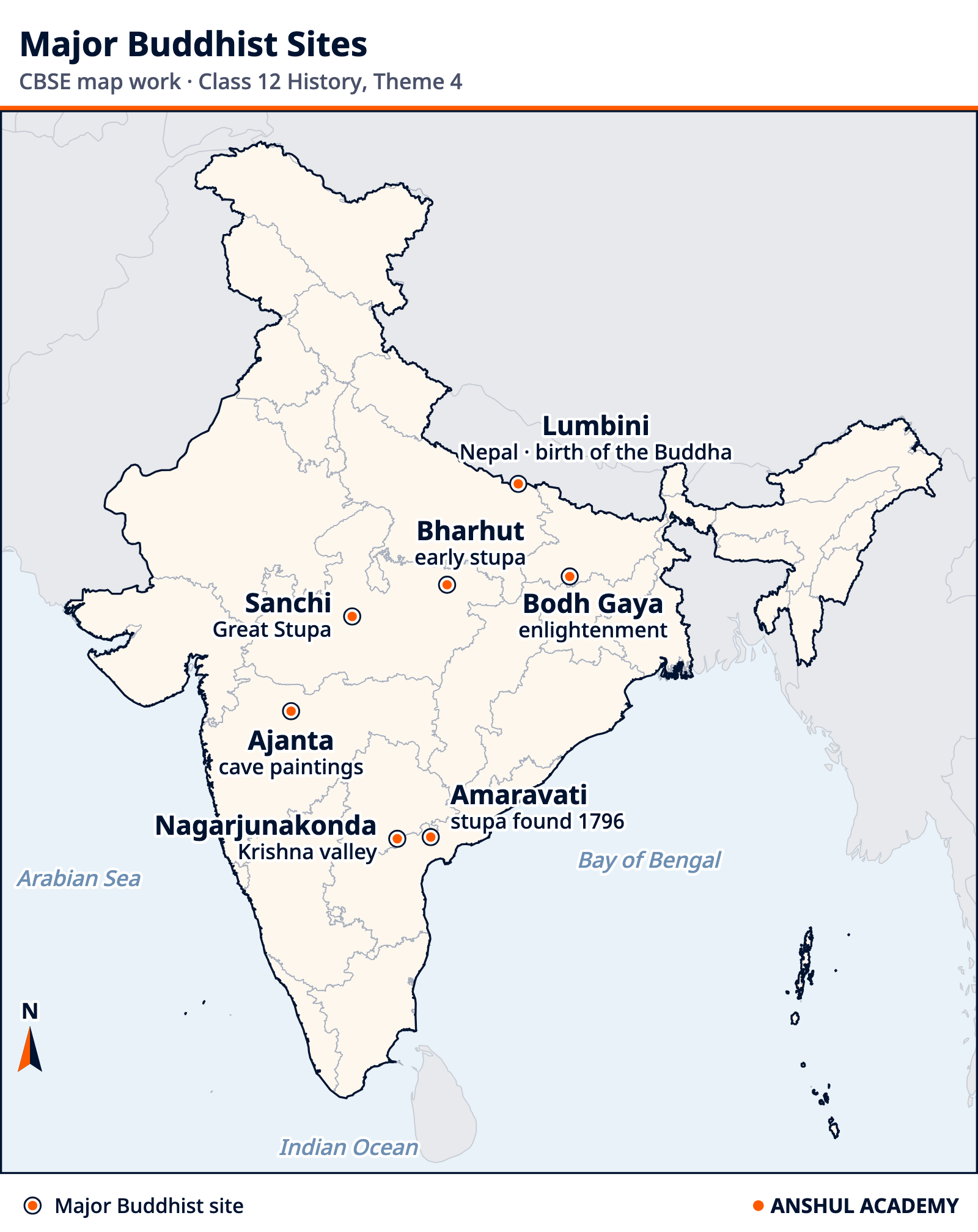
Map 1 (textbook): important Buddhist sites. The four places linked to the Buddha’s life lie close together in the Ganga valley; the stupa and cave sites spread much further south.
| Place | Significance |
|---|---|
| Lumbini | where the Buddha was born |
| Bodh Gaya | where he attained enlightenment |
| Sarnath | where he gave his first sermon |
| Kusinagara | where he attained nibbana |
| Other Buddhist sites | Sanchi, Bharhut, Amaravati, Nagarjunakonda, Ajanta, Nasik, Karle, Barabar |
CBSE map work (Part I, item 5): major Buddhist sites. The CBSE 2026-27 map list asks you to locate these seven sites on an outline map of India. The map below marks all seven.
| Site | Where it is today | What the chapter links it with |
|---|---|---|
| Lumbini | Nepal, just north of the border with Uttar Pradesh | Birthplace of the Buddha; Asoka’s pillar marks his visit |
| Bodh Gaya | Bihar | Where the Buddha attained enlightenment |
| Sanchi | Madhya Pradesh, near Bhopal | The Great Stupa, which survived when Amaravati did not |
| Bharhut | Madhya Pradesh | An early stupa, plain except for its stone railings and gateways; hundreds of donative inscriptions |
| Ajanta | Maharashtra | Cave paintings showing stories from the Jatakas |
| Amaravati | Andhra Pradesh, on the Krishna | The great stupa found by a local raja in 1796 and later dismantled |
| Nagarjunakonda | Andhra Pradesh, in the Krishna valley | A Buddhist site shown on the book’s Map 1 |
7.1 Why were stupas built?
Some places became sacred because they held relics, the Buddha’s bodily remains or objects he used, buried in mounds called stupas. The tradition likely predates Buddhism but became closely bound to it, so a stupa itself came to stand for the Buddha and for Buddhism.
The Mahaparinibbana Sutta: as the Buddha lay dying, Ananda asked what to do with his remains. The Buddha first replied, “Hinder not yourselves Ananda by honouring the remains of the Tathagata. Be zealous, be intent on your own good.” Pressed further, he said stupas should be built at the four crossroads, and “whosoever shall there place garlands or perfume… or make a salutation there, or become in its presence calm of heart, that shall long be to them for a profit and joy.”
The Ashokavadana says Asoka distributed the Buddha’s relics to every important town and ordered stupas built over them. By the second century BCE stupas stood at Bharhut, Sanchi and Sarnath.
7.2 How were stupas built?
Inscriptions on railings and pillars record donations: kings such as the Satavahanas, guilds such as the ivory workers who funded part of a Sanchi gateway, and hundreds of ordinary women and men who recorded their names, home town, occupation and relatives. Bhikkhus and bhikkhunis contributed too.
7.3 The structure of the stupa
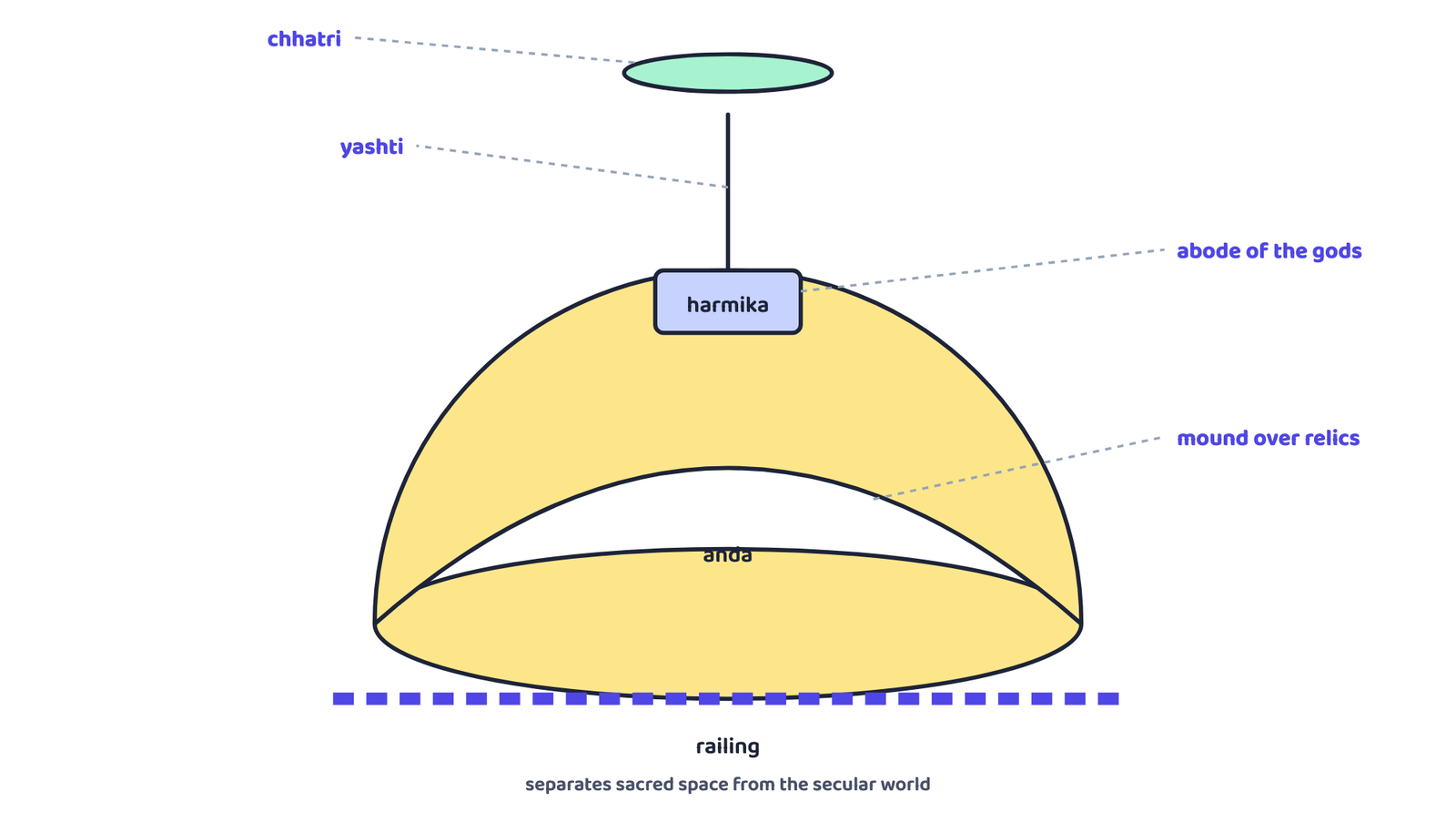
Early stupas at Sanchi and Bharhut were plain apart from railings resembling bamboo or wooden fencing, with richly carved gateways at the four cardinal points. Worshippers entered by the eastern gateway and walked clockwise, mound on the right, imitating the sun’s path. Later mounds, as at Amaravati and Shah-ji-ki-Dheri (Peshawar), became elaborately carved.
8 “Discovering” Stupas: the Fate of Amaravati and Sanchi
Amaravati: lost
- 1796: a local raja building a temple stumbled on the ruins, and mined it for stone hoping to find treasure
- Colin Mackenzie visited later and drew the sculpture, but his reports went unpublished
- 1854: Walter Elliot, commissioner of Guntur, collected panels and shipped them to Madras (“the Elliot marbles”), also finding the western gateway
- By the 1850s slabs had gone to the Asiatic Society at Calcutta, the India Office in Madras, even London, and into private British gardens; each new official removed more, citing the last one’s example
- H.H. Cole objected: “It seems to me a suicidal and indefensible policy to allow the country to be looted of original works of ancient art.” He argued museums should keep plaster casts, originals should stay in situ; he failed to persuade the authorities here
- Today the mahachaitya at Amaravati is “an insignificant little mound”, stripped of its former glory
Sanchi: saved
- Discovered 1818: three of four gateways still standing, the fourth fallen but on the spot, the mound in good condition
- Even here, moving the gateway to Paris or London was proposed
- By the time Sanchi was known, Cole’s argument for in situ preservation had gained ground and finally held
The one-sentence answer for “why did Sanchi survive and Amaravati not”: Amaravati was found before scholars understood the value of leaving finds where they were, Sanchi after, once in situ preservation was an established idea.
9 Sculpture
9.1 Stories in stone
Sanchi’s carvings work like a wandering storyteller’s cloth scroll, or charanachitra: a scene that looks rural at first glance is identified by art historians as the Vessantara Jataka, about a generous prince who gave everything away and lived in the forest with his family. Reading it needed matching image to text.
9.2 Symbols of worship
Many early sculptors avoided showing the Buddha in human form, using symbols instead: an empty seat for his meditation, a stupa for the mahaparinibbana, a wheel for his first sermon at Sarnath. A tree at the site of enlightenment does not mean “a tree”; it stands for an event in his life, and reading it needs familiarity with the tradition behind it.
9.3 Popular traditions
Not every carving is Buddhist doctrine. Women swinging from gateway edges, holding a tree, puzzled early scholars until literary comparison identified the motif as a shalabhanjika, a woman whose touch was popularly believed to make trees flower and fruit, an auspicious, pre-Buddhist symbol absorbed into the stupa’s decoration. Fine animal carvings, elephants, horses, monkeys, cattle, both illustrate Jataka stories and serve as symbols in their own right, an elephant standing for strength and wisdom.
A woman surrounded by lotuses and elephants, seemingly sprinkled with water (an abhisheka or consecration), is read by some historians as Maya, the Buddha’s mother, and by others as the popular goddess Gajalakshmi. Devotees who saw it may well have identified her as both at once. James Fergusson, one of the earliest modern art historians, studied the recurring serpent motif at Sanchi without access to Buddhist literature (mostly untranslated in his time) and concluded Sanchi was a centre of tree and serpent worship, a case of a real motif read through the wrong framework.
Paintings survive best on cave walls, most famously at Ajanta, depicting Jataka stories, courtly life, processions and festivals, using shading for a three-dimensional effect and, in places, striking naturalism.
10 New Religious Traditions
10.1 Mahayana Buddhism
By the first century CE, early Buddhism’s stress on self-effort began to shift towards the idea of a saviour, alongside the Bodhisatta: a deeply compassionate being who used accumulated merit to help others rather than to exit the world through nibbana. Worship of Buddha and Bodhisatta images became central to this new tendency, called Mahayana, “the great vehicle”. Its followers labelled the older tradition Hinayana, “the lesser vehicle”, though its own adherents called themselves theravadins, followers of the theras, the old, respected teachers.
10.2 The growth of Puranic Hinduism
The saviour idea was not unique to Buddhism. Vaishnavism (Vishnu as principal deity) and Shaivism (Shiva as chief god) grew alongside it, both centred on bhakti, devotion visualised as love between devotee and god. Vaishnavism developed cults around ten avatars, forms the deity took to save the world from disorder; recognising local deities as one of these avatars was a way of unifying scattered traditions. Shiva was mostly symbolised by the linga, occasionally shown in human form. Reading such sculpture means knowing the stories behind head-dresses, ornaments and ayudhas (weapons or auspicious objects held in the hands).
These stories mostly survive in the Puranas, compiled by Brahmanas by about the mid-first millennium CE, in simple Sanskrit verse meant to be read aloud to everyone, women and Shudras included, who had no access to Vedic learning. Much of their content took shape through ordinary interaction between priests, merchants and travellers; Vasudeva-Krishna, for instance, began as an important deity local to Mathura and spread from there.
10.3 Building temples
Around the time stupas reached their mature form, the first temples were being built to house divine images. The earliest was a small square garbhagriha with one doorway; a tall shikhara was later raised over the shrine, and temple walls carried sculpture. Later temples grew far more elaborate, with assembly halls, walls, gateways and water arrangements.
Some early temples were hollowed straight out of rock as artificial caves, a tradition running back to the caves built for Ajivika renouncers on Asoka’s orders in the third century BCE. It reached its peak in the eighth century with the Kailashnatha temple at Ellora, carved from a single rock. A copperplate inscription records the chief sculptor’s own amazement once it was done: “Oh how did I make it!”
11 Can We “See” Everything?
11.1 Grappling with the unfamiliar
Nineteenth-century European scholars, confronted with multi-armed or part-animal figures, sometimes found them grotesque and made sense of them by comparing them to Greek sculpture they already knew. Buddha and Bodhisatta images from the northwest, in cities such as Taxila and Peshawar where Indo-Greek rulers had reigned from the second century BCE, showed clear Greek influence, and were prized by these scholars precisely because they were closest to the familiar.
Do not present this as a neutral method. Judging unfamiliar art by how closely it resembles familiar Greek art is a yardstick problem, not an objective standard, and the chapter uses it as an example of a bias to notice, not a technique to copy.
11.2 If text and image do not match
A famous rock-cut panel at Mahabalipuram is read two different ways even by art historians who agree on using textual comparison: some see the descent of the river Ganga from heaven, the natural cleft in the rock reading as the river, a story told in the Puranas and epics; others see Arjuna performing penance on a riverbank to win divine weapons, pointing to the central ascetic figure. Matching text to image is a far better method than the Greek-comparison one, but it does not always resolve into one answer.
Finally, remember that most religious life, daily practice, festivals, oral belief, was never recorded as a monument, sculpture or painting at all. The spectacular survivals this chapter focuses on are, quite literally, the tip of the iceberg.
12 Timelines and Revision
| Timeline 1 · major religious developments | |
|---|---|
| c. 1500-1000 BCE | Early Vedic traditions |
| c. 1000-500 BCE | Later Vedic traditions |
| c. sixth century BCE | Early Upanishads; Jainism, Buddhism |
| c. third century BCE | First stupas |
| c. second century BCE onwards | Development of Mahayana Buddhism, Vaishnavism, Shaivism and goddess cults |
| c. third century CE | Earliest temples |
| Timeline 2 · discovery and preservation of early monuments | |
|---|---|
| 1814 | Founding of the Indian Museum, Calcutta |
| 1834 | Ram Raja publishes Essay on the Architecture of the Hindus; Cunningham explores the Sarnath stupa |
| 1835-1842 | James Fergusson surveys major archaeological sites |
| 1851 | Establishment of the Government Museum, Madras |
| 1854 | Alexander Cunningham publishes Bhilsa Topes, among the earliest works on Sanchi |
| 1878 | Rajendra Lala Mitra publishes Buddha Gaya: The Heritage of Sakya Muni |
| 1880 | H.H. Cole appointed Curator of Ancient Monuments |
| 1888 | Treasure Trove Act, giving government the right to acquire archaeological finds |
| 1914 | John Marshall and Alfred Foucher publish The Monuments of Sanchi |
| 1923 | John Marshall publishes the Conservation Manual |
| 1955 | Nehru lays the foundation stone of the National Museum, New Delhi |
| 1989 | Sanchi declared a World Heritage Site |
- Sanchi survived because in situ preservation was already an established idea by the time it was found; Amaravati was found too early for that and was stripped.
- The mid-first millennium BCE produced Mahavira, the Buddha and 64 rival schools, all challenging Vedic sacrificial authority with individual agency.
- Jainism centres on ahimsa and renunciation through the five vows; the Buddha’s path is the middle way between penance and indulgence.
- The Buddha’s teachings survive as the Tipitaka, compiled orally after his death and later written down in Pali, then Sanskrit.
- The sangha admitted every social group as equals, women included from Ananda’s intervention onward, and ran on consensus, then vote.
- A stupa holds relics inside an anda, topped by the harmika, yashti and chhatri, ringed by a railing; worshippers circle it clockwise.
- Sculpture must be read through the tradition that made it: symbols like the empty seat, wheel and stupa stand for episodes in the Buddha’s life, not literal objects.
- Popular, pre-Buddhist motifs like the shalabhanjika and the serpent sit inside Buddhist monuments alongside doctrinal ones.
- Mahayana added a saviour figure and image worship to Buddhism; Vaishnavism and Shaivism developed their own bhakti and avatar traditions in parallel.
- Reading unfamiliar art by comparing it to Greek sculpture is a documented bias, not a neutral method; even text-based reading, as at Mahabalipuram, can leave genuine disagreement.
- 1 markWho funded the preservation of Sanchi in the nineteenth century?
- 1 markName the three pitakas of the Tipitaka.
- 1 markWhat is ahimsa, and in which tradition is it central?
- 1 markWhat does nibbana mean?
- 1 markWhat is a stupa, and what does the word literally mean?
- 2 marksDistinguish between Mahayana and Hinayana/Theravada.
- 2 marksWhat are anicca, anatta and dukkha?
- 2 marksWhy did the French and English eventually accept plaster casts instead of the original Sanchi gateway?
- 2 marksWhat is a shalabhanjika, and why does its presence at Sanchi matter?
- 3 marksWere the ideas of the Upanishadic thinkers different from those of the fatalists and materialists? Give reasons.
- 3 marksSummarise the central teachings of Jainism.
- 3 marksDiscuss the role of the begums of Bhopal in preserving the stupa at Sanchi.
- 3 marksDescribe the parts of a mature stupa.
- 3 marksWhy do you think women and men joined the sangha?
- 3 marksWhat does the story of Punna’s conversation with the Brahmana reveal about Buddhist attitudes to ritual?
- 3 marksWhy did H.H. Cole’s argument succeed at Sanchi but fail at Amaravati?
- 5 marksTo what extent does knowledge of Buddhist literature help in understanding the sculpture at Sanchi?
- 5 marksDiscuss the developments in sculpture and architecture associated with the rise of Vaishnavism and Shaivism.
- 5 marksDiscuss how and why stupas were built.
- 5 marksCompare the fate of the stupas at Amaravati and Sanchi, and explain what this reveals about the history of archaeological preservation in colonial India.
- 5 marksDiscuss the different explanations offered for the rock-cut panel at Mahabalipuram, and what this disagreement tells us about reading sculpture through texts.
- 5 marksRead the inscription of Dhanavati (Kushana ruler Huvishka’s 33rd year) and answer: how did she date her inscription, why might she have installed the Bodhisatta image, who were her relatives, what text did she know, and from whom did she learn it?
- 5 marksOn an outline world map, mark the areas to which Buddhism spread, with the land and sea routes from the subcontinent to each.
- 1 markThe council that first compiled the Buddha’s teachings met at:
(a) Sarnath(b) Vesali(c) Bodh Gaya(d) Sanchi - 1 markMakkhali Gosala belonged to the tradition of the:
(a) Lokayatas(b) Ajivikas(c) Theravadins(d) Jainas - 1 markThe first woman ordained as a bhikkhuni was:
(a) Punna(b) Gandhari(c) Mahapajapati Gotami(d) Kamalavati - 1 markThe empty seat in early Buddhist sculpture is a symbol for:
(a) the first sermon(b) the Buddha’s meditation(c) the mahaparinibbana(d) the Bodhisatta - 1 markThe Kailashnatha temple at Ellora is an example of a temple that was:
(a) built brick by brick(b) carved out of a single rock(c) built with a garbhagriha only(d) constructed of wood - 1 markWalter Elliot’s collection of sculpture panels from Amaravati came to be known as the:
(a) Bhilsa Topes(b) Elliot marbles(c) Treasure Trove finds(d) Fergusson collection
Choose: (a) both A and R are true and R explains A; (b) both true but R does not explain A; (c) A true, R false; (d) A false, R true.
Reason (R): They represented his presence instead through symbols such as the empty seat, the wheel and the stupa.
Reason (R): He had studied the translated Buddhist texts describing the site in detail.