and Devotional Texts
c. eighth to eighteenth century
By the mid-first millennium CE, temples, stupas and monasteries already marked the landscape. This chapter follows what came after: poet-saints composing in regional languages, hagiographies written by devotees, and a widening cast of new gods, goddesses and religious leaders, all of it fluid, contested and reshaped generation after generation.
1 A Mosaic of Religious Beliefs and Practices
1.1 The integration of cults
Historians see two processes running at once: Brahmanical ideas were deliberately spread, through Puranic texts composed in simple Sanskrit verse explicitly meant for women and Shudras excluded from Vedic learning; and, at the same time, Brahmanas absorbed and reworked the beliefs of other social groups.
Terms coined by sociologist Robert Redfield: the great tradition is what dominant groups (priests, rulers) observe; the little tradition is local practice that need not match it. Both change through ongoing interaction. Scholars keep the terms in quotation marks because they are uneasy with the hierarchy the words imply.
At Puri, Orissa, by the twelfth century the principal deity, Jagannatha (“lord of the world”), was identified as a form of Vishnu, even though the image was and still is carved from wood by local tribal specialists, a visibly different Vishnu from anywhere else. Goddess worship, often no more than a stone smeared with ochre, was widely absorbed the same way, equated with Lakshmi (Vishnu’s wife) or Parvati (Shiva’s wife).
1.2 Difference and conflict
Tantric practices, often linked to the goddess, were open to women and men across caste, and shaped both Shaivism and Buddhism in the east, north and south. Set against Vedic tradition, the contrast is stark: Agni, Indra and Soma, central to the Vedas, become marginal in Puranic religion, while Vishnu, Shiva and the goddess barely register in Vedic mantras yet dominate Puranic mythology, and the Vedas were still revered as authoritative regardless. Conflict followed naturally: Vedic traditionalists condemned practices outside sacrifice and mantra, Tantric practitioners often ignored Vedic authority altogether, devotees pushed their own chosen deity as supreme, and relations with Buddhism and Jainism were frequently tense.
Bhakti, devotional worship, already had almost a thousand years of history by this point, ranging from routine temple worship to ecstatic, trance-like adoration, often set to singing and chanting, especially among Vaishnava and Shaiva sects.
2 Poems of Prayer: Early Traditions of Bhakti
Poet-saints drew communities of devotees around themselves. Brahmanas often remained intermediaries, yet these traditions also welcomed women and “lower castes”, groups the orthodox Brahmanical framework treated as ineligible for liberation. Historians classify bhakti into saguna (with attributes, worship of a specific deity in anthropomorphic form, such as Vishnu, Shiva or Devi) and nirguna (worship of an abstract, formless god).
2.1 The Alvars and Nayanars of Tamil Nadu
Among the earliest bhakti movements (c. sixth century): the Alvars (“immersed” in devotion to Vishnu) and Nayanars (devotees of Shiva), who travelled singing Tamil hymns, identifying sacred shrines that later grew into major pilgrimage temples where their compositions became part of temple ritual.
2.2 Attitudes towards caste
Some historians read the Alvars and Nayanars as protesting, or at least reforming, the caste system, supported by the fact that bhaktas came from Brahmanas, artisans, cultivators and even “untouchable” castes alike. Their compositions were sometimes claimed to equal the Vedas: the Nalayira Divyaprabandham, an anthology of Alvar verses, was called the “Tamil Veda”.
Tondaradippodi, a Brahmana Alvar: “You (Vishnu) manifestly like those ‘servants’ who express their love for your feet, though they may be born outcastes, more than the Chaturvedins who are strangers and without allegiance to your service.”
Source 2 · shastras or devotion? Appar, a Nayanar: “O rogues who quote the law books, / Of what use are your gotra and kula? / Just bow to Marperu’s lord as your sole refuge.”
2.3 Women devotees
Andal, a woman Alvar, saw herself as Vishnu’s beloved, and her verses expressing that love are still sung today. Karaikkal Ammaiyar, a Shiva devotee, took the path of extreme asceticism; both women renounced social obligations without joining a formal order, and their very existence challenged patriarchal norms.
Karaikkal Ammaiyar describing herself: “The female Pey (demoness) with… bulging veins, protruding eyes, white teeth and shrunken stomach, red haired and jutting teeth, lengthy shins extending till the ankles, shouts and wails while wandering in the forest… which is the home of our father (Shiva).”
By the tenth century the twelve Alvars’ compositions were compiled as the Nalayira Divyaprabandham. The verses of Appar, Sambandar and Sundarar were compiled and classified by their music into the Tevaram, also in the tenth century.
2.4 Relations with the state
From the second half of the first millennium, states such as the Pallavas and Pandyas (c. sixth to ninth centuries) ruled Tamil country, where Buddhism and Jainism had long drawn support from merchants and artisans. Nayanar hymns are notably hostile to Buddhism and Jainism, likely reflecting competition for royal patronage. The Chola rulers (ninth to thirteenth centuries) backed Brahmanical and bhakti traditions directly, funding temples such as Chidambaram, Thanjavur and Gangaikondacholapuram and the era’s spectacular bronze Shiva sculpture.
Both Nayanars and Alvars were revered by Vellala peasants, so kings courted their memory too: the Cholas built temples adorned with sculpture recreating the saints’ visions, introduced Tamil Shaiva hymns into temple ritual, and organised them as the Tevaram. An inscription of c. 945 records the Chola ruler Parantaka I consecrating metal images of Appar, Sambandar and Sundarar, carried in festival processions.
3 The Virashaiva Tradition in Karnataka
Twelfth-century Karnataka saw a new movement led by Basavanna (1106-68), a Brahmana minister at a Kalachuri court. His followers, Virashaivas (“heroes of Shiva”) or Lingayats (“wearers of the linga”), remain an important community today. They worship Shiva as a linga, worn in a silver case on a shoulder loop, and revere jangamas, wandering monks. Believing the devotee unites with Shiva at death and does not return to the world, they bury rather than cremate their dead, rejecting Dharmashastra-prescribed funerary rites.
Lingayats challenged caste and the idea of ritual “pollution”, questioned rebirth, and encouraged practices the Dharmashastras disapproved of, such as post-puberty marriage and widow remarriage, winning followers among those marginalised by Brahmanical order. Their tradition survives through vachanas (“sayings”) composed in Kannada.
Basavanna: “When they see a serpent carved in stone they pour milk on it. If a real serpent comes they say: ‘Kill. Kill.’ To the servant of the god who could eat if served they say: ‘Go away! Go away!’ But to the image of the god which cannot eat they offer dishes of food.”
4 Religious Ferment in North India
Vishnu and Shiva were worshipped in temples built with royal support, but historians find nothing like the Alvars and Nayanars in north India until the fourteenth century. One explanation: Rajput states gave Brahmanas important secular and ritual roles that went largely unchallenged. Meanwhile the Naths, Jogis and Siddhas, often from artisan groups such as weavers (increasingly significant as craft production and long-distance trade grew), questioned Vedic authority and spoke in the developing regional languages, but never won the ruling elite’s support the way the Chishtis eventually would.
The coming of the Turks, culminating in the thirteenth-century Delhi Sultanate, undercut the Rajput states and their allied Brahmanas, and brought major cultural and religious change, including the arrival of the sufis.
5 New Strands in the Fabric: Islamic Traditions
5.1 Faiths of rulers and subjects
Arab merchants had used the western coast for centuries before Islam; in 711 Muhammad Qasim conquered Sind, folding it into the Caliph’s domain. Turkish and Afghan rule (Delhi Sultanate, c. thirteenth century), Deccan sultanates, the Mughal Empire and many eighteenth-century regional states all made Islam a ruler’s religion in large parts of the subcontinent.
The ulama are Islamic scholars expected to guide rulers under the shari’a, law derived from the Qur’an, hadis (the Prophet’s remembered words and deeds), qiyas (reasoning by analogy) and ijma (community consensus). A zimmi (“protected”) was a non-Muslim following revealed scripture (Jews, Christians, later extended to Hindus in India) who paid jizya in exchange for protection under Muslim rule.
Rulers in practice were flexible: many, including Akbar and Aurangzeb, granted land and tax exemptions to Hindu, Jaina, Zoroastrian, Christian and Jewish institutions.
Akbar’s 1598 farman: “Whereas it reached our eminent and holy notice that the padris… wish to build a house of prayer (church) in the city of Kambayat… the dignitaries of the city… should in no case stand in their way but should allow them to build a church.”
Source 6 · reverence for the Jogi. Aurangzeb, writing to a Jogi in 1661-62: “The possessor of the sublime station, Shiv Murat, Guru Anand Nath Jio! May your Reverence remain in peace and happiness ever under the protection of Sri Shiv Jio!… A piece of cloth for the cloak and a sum of twenty five rupees which have been sent as an offering will reach (Your Reverence)…”
5.2 The popular practice of Islam
Every convert accepted the five pillars: shahada (one God, Muhammad his messenger), namaz/salat (prayer five times daily), zakat (alms), sawm (fasting in Ramzan), hajj (pilgrimage to Mecca). Beyond that, practice varied by sect (Sunni, Shi’a) and local custom. The Khojahs, an Ismaili (Shi’a) branch, spread ideas through the ginan (from Sanskrit jnana, “knowledge”), devotional poems in Punjabi, Multani, Sindhi, Kachchi, Hindi and Gujarati, sung in special ragas, later recorded in the Khojaki script. Arab traders settling on the Malabar coast adopted Malayalam and local customs including matriliny and matrilocal residence (wife’s family home, children with her, husband visiting).
Universal features: orientation towards Mecca, marked by the mihrab (prayer niche) and minbar (pulpit). Locally variable: roof style and building material, e.g. the brick Atiya mosque (Bangladesh, 1609) or the Kashmiri wooden Shah Hamadan mosque (Srinagar, 1395).
5.3 Names for communities
“Musalman” barely appears in Sanskrit texts and inscriptions between the eighth and fourteenth centuries. People were instead named by origin: Turushka (Turks), Tajika (Tajikistan), Parashika (Persia), or by older labels reused, Shaka or Yavana (originally for Central Asians and Greeks). Mlechchha, the broadest term, marked anyone outside caste norms speaking non-Sanskrit languages, often derogatory but rarely a marker of “Muslim” as a religious community set against “Hindu”. As Theme 5 showed, “Hindu” itself carried no fixed religious meaning for a very long time.
6 The Growth of Sufism
Sufis emerged in early Islam as ascetic, mystical dissenters against the Caliphate’s growing materialism and against rigid, scholastic Qur’anic interpretation, seeking salvation instead through intense devotion, love of God, and imitation of the Prophet as a perfect human being.
Sufism is an English coinage; the Islamic term is tasawwuf, possibly from suf (wool, their coarse clothing), safa (purity), or suffa (the platform outside the Prophet’s mosque where close followers gathered).
6.1 Khanqahs and silsilas
By the eleventh century, sufis organised around a khanqah (hospice), led by a shaikh (Arabic) or pir/murshid (Persian), who took disciples (murids) and named a successor (khalifa). From the twelfth century, silsilas (literally “chain”) formalised an unbroken spiritual lineage back to the Prophet, through which blessings passed. Initiation involved an oath of allegiance, a patched garment, and shaved hair.
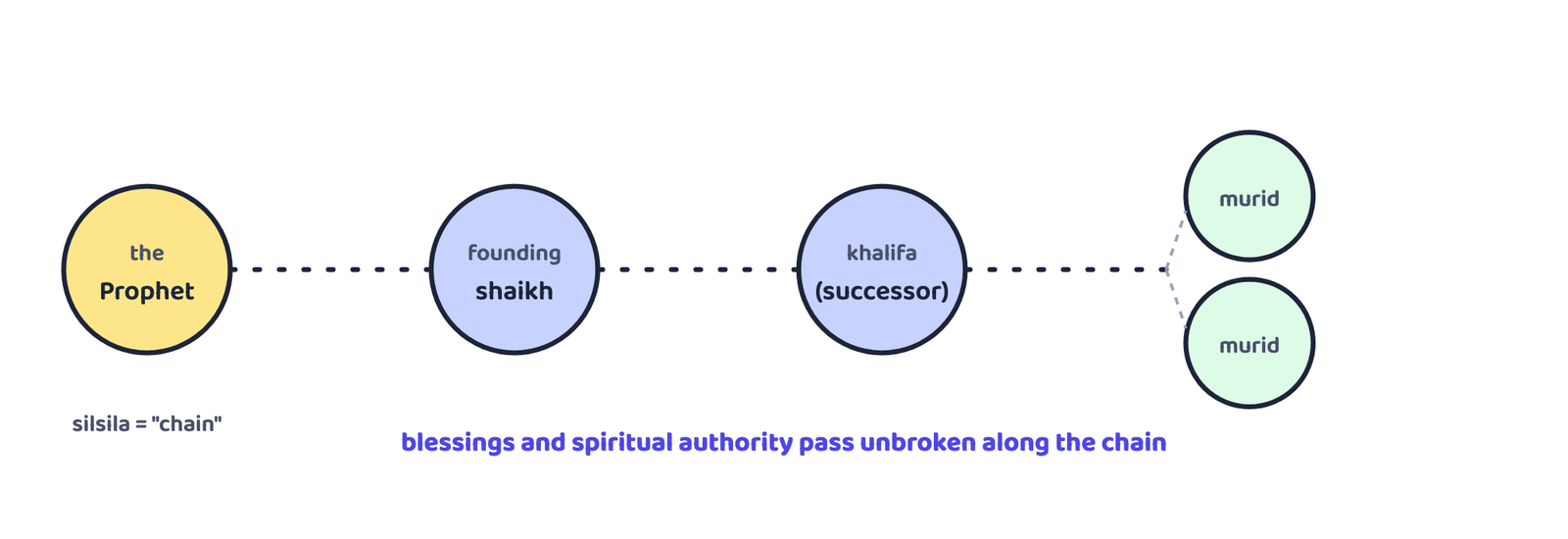
A shaikh’s tomb (dargah) became a devotional centre after death, drawing pilgrims (ziyarat), especially on the death anniversary (urs, signifying union with God), on the belief that saints grew closer to God in death. Such a shaikh, venerated as wali (plural auliya, “friend of God”), was believed to hold barakat (grace) enabling karamat (miracles).
6.2 Outside the khanqah
Some mystics rejected the khanqah for mendicancy and celibacy, ignoring ritual and practising extreme asceticism: Qalandars, Madaris, Malangs, Haidaris. Their open defiance of the shari’a earned them the label be-shari’a, against the ba-shari’a sufis who observed it.
7 The Chishtis in the Subcontinent
The most influential group to migrate to India in the late twelfth century, the Chishtis adapted successfully to the local environment, absorbing features of Indian devotional life.
7.1 Life in the khanqah
Shaikh Nizamuddin’s fourteenth-century hospice at Ghiyaspur, on the Yamuna outside Delhi, had small rooms, a large hall (jama’at khana) for prayer and living, a veranda, boundary wall, and the shaikh’s own rooftop room where he received visitors morning and evening. It once sheltered nearby residents fleeing a feared Mongol invasion.
| Major Chishti sufi | Year of death | Dargah location |
|---|---|---|
| Shaikh Muinuddin Sijzi | 1235 | Ajmer (Rajasthan) |
| Khwaja Qutbuddin Bakhtiyar Kaki | 1235 | Delhi |
| Shaikh Fariduddin Ganj-i Shakar | 1265 | Ajodhan (Pakistan) |
| Shaikh Nizamuddin Auliya | 1325 | Delhi |
| Shaikh Nasiruddin Chiragh-i Dehli | 1356 | Delhi |
An open kitchen, the langar, ran on unasked-for charity (futuh), feeding soldiers, slaves, singers, merchants, poets, travellers, Hindu jogis and qalandars alike, all seeking discipleship, healing amulets, or the shaikh’s intercession. Visitors included poets Amir Hasan Sijzi and Amir Khusrau and chronicler Ziyauddin Barani. Local practices absorbed included bowing before the shaikh, offering water to visitors, shaving initiates’ heads, and yogic exercises.
Forced across the Indus as a Turkish army captive in 1039, Abu’l Hasan al Hujwiri settled in Lahore and wrote the Kashf-ul-Mahjub (Unveiling of the Veiled) explaining tasawwuf. He died in 1073; his tomb became a major pilgrimage site, and he is still revered as Data Ganj Bakhsh (“Giver who bestows treasures”), his mausoleum called Data Darbar.
7.2 Ziyarat and qawwali
The most revered Chishti shrine is Khwaja Muinuddin’s at Ajmer, known as “Gharib Nawaz” (comforter of the poor). Textual references date from the fourteenth century; Muhammad bin Tughlaq was the first Sultan to visit, and Ghiyasuddin Khalji of Malwa funded its first tomb structure in the late fifteenth century. Sitting on the Delhi-Gujarat trade route helped its popularity. Akbar, drawn by the singing of pilgrims bound for Ajmer, visited fourteen times up to 1580, seeking blessings for conquests, vows and sons, giving lavish gifts, including a huge cooking cauldron (degh) in 1568, and building a mosque within the compound.
Shah Jahan’s daughter, in her biography of Muinuddin Chishti: “I did not sleep on a leopard skin at night, I did not extend my feet in the direction of the blessed sanctuary… I passed the days beneath the trees… I went to the holy sanctuary and rubbed my pale face with the dust of that threshold. From the doorway to the blessed tomb I went barefoot, kissing the ground… I went around the light-filled tomb of my master seven times… with my own hand I put the finest quality of itar on the perfumed tomb.”
Music and dance, especially qawwali, were central to ziyarat, evoking divine ecstasy through zikr (reciting the Divine Names) or sama’ (“audition”, mystical music), integral to Chishti practice as a clear point of contact with indigenous devotion.
Dargah Quli Khan, an eighteenth-century Deccan visitor, on Nasiruddin Chiragh-i Dehli’s shrine: “The Shaikh is not the lamp of Delhi but of the entire country. People turn up there in crowds… Muslims and Hindus pay visits in the same spirit.”
7.3 Languages and communication
Delhi’s Chishtis conversed in Hindavi, the people’s language. Baba Farid’s verses in the local language were later incorporated into the Guru Granth Sahib. Others composed masnavis (long poems) using human love as an allegory for divine love, such as Malik Muhammad Jayasi’s Padmavat, the romance of Padmini and Ratansen of Chittor read as the soul’s journey to the divine. Around Bijapur, Karnataka, Chishti sufis composed short Dakhani (Urdu variant) poems, likely sung by women at chores such as grinding grain, plus lurinama (lullabies) and shadinama (wedding songs), probably drawing on Lingayat vachanas and the Marathi abhangs of Pandharpur’s sants, a route through which Islam reached Deccan villages.
“As you take the cotton, you do zikr-i jali / As you separate the cotton you should do zikr-i qalbi / And as you spool the thread you should do zikr-i aini… Do this day and night, / And offer this to your pir as a gift.”
Amir Khusrau (1253-1325), poet, musician and Nizamuddin Auliya’s disciple, introduced the qaul (Arabic, “saying”), a hymn opening or closing qawwali, still recited first by qawwals at Nizamuddin’s shrine today.
7.4 Sufis and the state
Chishti austerity meant distance from worldly power, not total isolation: they accepted unsolicited grants from political elites, and Sultans set up auqaf (charitable trusts) and granted tax-free land (inam). Rather than accumulate wealth, Chishtis spent it immediately on food, clothing, housing and ritual needs, which built the shaikhs’ moral authority and drew mass support kings wanted access to. The Delhi Sultans, facing a non-Muslim majority, resisted ulama pressure to impose shari’a as state law and instead courted sufis, whose authority came directly from God, not from jurists. Kings also wanted their own tombs near sufi shrines, believing auliya could intercede with God on their behalf.
Conflict still occurred: both sides sometimes expected prostration and feet-kissing as rituals of authority, and disciples addressed Nizamuddin Auliya with the grand title sultan-ul-mashaikh.
At Nizamuddin Auliya’s hospice, 1313: a local ruler offered the deed to two gardens and land. The shaikh refused it, lamenting, “What have I to do with gardens and fields and lands?… None of… our spiritual masters had engaged in such activity”, and recalled how Shaikh Fariduddin once told a prince offering money and four villages: “Give me the money. I will dispense it to the dervishes. But as for those land deeds, keep them… Give them away to such persons.”
The Suhrawardi order under the Delhi Sultans and the Naqshbandi under the Mughals also engaged with the state, though not in the Chishti mould; some sufis in these orders even accepted courtly office. Shaikh Salim Chishti’s dargah, built inside Akbar’s capital Fatehpur Sikri, symbolises the Chishti-Mughal bond directly.
8 New Devotional Paths: Dialogue and Dissent in North India
8.1 Kabir
Kabir (c. fourteenth-fifteenth centuries) survives through three overlapping manuscript traditions: the Kabir Bijak (Kabirpanth, Varanasi and UP), the Kabir Granthavali (Dadupanth, Rajasthan), and verses within the Adi Granth Sahib, all compiled well after his death; by the nineteenth century, printed anthologies circulated as far apart as Bengal, Gujarat and Maharashtra.
His poems, in the nirguna poets’ sant bhasha, include ulatbansi (“upside-down sayings”) that invert everyday meaning (“the lotus which blooms without flower”) to gesture at a Reality words cannot capture. He drew on Islam (Allah, Khuda, Hazrat, Pir), Vedantic tradition (alakh, nirakar, Brahman, Atman) and yogic tradition (shabda, shunya) all at once, sometimes using Islamic monotheism to attack Hindu idol worship, sometimes using sufi zikr and ishq to express Hindu nam-simaran.
“Tell me, brother, how can there be / No one lord of the world but two?… God is called by many names: / Names like Allah, Ram, Karim, / Keshav, Hari, and Hazrat. / Gold may be shaped into rings and bangles. / Isn’t it gold all the same? / Distinctions are only words we invent… Neither can find the only Ram. One kills the goat, the other cows. / They waste their lives in disputation.”
Do not claim historians can confirm Kabir’s birth religion. Vaishnava hagiographies (from the seventeenth century, roughly 200 years after his life) say he was a Hindu, Kabirdas, raised by a poor Muslim weaver (julaha) family and initiated into bhakti by Ramananda. But Kabir’s own verses only use “guru” and “satguru”, naming no specific preceptor, and historians note Ramananda and Kabir cannot easily be made contemporaries without implausibly long lifespans for one or both. Treat the Ramananda link as evidence of Kabir’s later importance to different traditions, not as settled biography.
8.2 Baba Guru Nanak and the Sacred Word
Baba Guru Nanak (1469-1539), born to a Hindu merchant family in Nankana Sahib near the Ravi in Muslim-majority Punjab, trained as an accountant, studied Persian, married young, but spent his time among sufis and bhaktas, and travelled widely. His nirguna bhakti firmly rejected sacrifices, ritual baths, image worship, austerities and the scriptures of both Hindus and Muslims; the Absolute, rab, had no gender or form. His method was remembering and repeating the Divine Name, expressed in Punjabi hymns called shabad, sung to various ragas while his companion Mardana played the rabab.
He organised followers into a community with rules for congregational worship, sangat, and appointed his disciple Angad as the next preceptor (guru), a line continued for nearly 200 years. He likely never intended a new religion, but his followers gradually distinguished themselves from both Hindus and Muslims. The fifth guru, Arjan, compiled Nanak’s hymns with those of his four successors and other poets, Baba Farid, Ravidas and Kabir among them, into the Adi Granth Sahib (hymns called gurbani). The tenth guru, Gobind Singh, added the ninth guru Tegh Bahadur’s compositions, forming the Guru Granth Sahib, and founded the Khalsa Panth with its five symbols: uncut hair, a dagger, shorts, a comb, a steel bangle, consolidating the community as a socio-religious and military force.
8.3 Mirabai, the Devotee Princess
Mirabai (c. fifteenth-sixteenth centuries), reconstructed mainly from orally transmitted bhajans, was, by tradition, a Rajput princess of Merta in Marwar married against her will into the Sisodia clan of Mewar. She defied the roles of wife and mother, took Krishna, Vishnu’s avatar, as her chosen lover, and after her in-laws allegedly tried to poison her, escaped to live as a wandering saint.
“I will build a funeral pyre of sandalwood and aloe; / Light it by your own hand / When I am burned away to cinders; / Smear this ash upon your limbs… let flame be lost in flame.” And elsewhere: “What can Mewar’s ruler do to me? / If God is angry, all is lost, / But what can the Rana do?”
Some traditions name her preceptor as Raidas, a leather worker, itself a defiance of caste norms, and describe her taking widow’s white or a renouncer’s saffron robes. She founded no sect, yet remains a lasting inspiration, her songs still sung especially by poor and “low caste” women and men in Gujarat and Rajasthan.
In the late fifteenth century, Shankaradeva led Assamese Vaishnavism, his teachings called Bhagavati dharma (based on the Bhagavad Gita and Bhagavata Purana), stressing absolute surrender to Vishnu. He promoted naam kirtan in sat sanga congregations, founded satra (monasteries) and naam ghar (prayer halls), institutions that still function, and composed the Kirtana-ghosha.
9 Reconstructing Histories of Religious Traditions
Sculpture and architecture, as in Themes 1 and 4, need context to interpret. Textual sources here range enormously, from Basavanna’s plain vachanas to the ornate Persian of a Mughal farman, each genre demanding its own reading skills.
| Source type | What it is | Example |
|---|---|---|
| Treatises | Manuals on sufi thought and practice; show outside influence on Indian sufism | Kashf-ul-Mahjub of Ali bin Usman Hujwiri (d. c. 1071) |
| Malfuzat | “Uttered”: conversations of sufi saints, compiled with the shaikh’s permission for didactic purposes, over centuries and across regions | Fawa’id-al-Fu’ad, Nizamuddin Auliya’s conversations, compiled by Amir Hasan Sijzi (Source 9) |
| Maktubat | “Written”: letters from sufi masters to disciples, revealing both the shaikh’s beliefs and the recipients’ spiritual and worldly concerns | Maktubat-i Imam Rabbani, by Shaikh Ahmad Sirhindi (d. 1624), whose views are often contrasted with Akbar’s more liberal outlook |
| Tazkiras | Biographical accounts of saints, often glorifying their own order’s lineage, sometimes fantastical, still historically valuable | Siyar-ul-Auliya of Mir Khwurd Kirmani (14th c., first Indian sufi tazkira, on the Chishtis); Akhbar-ul-Akhyar of Abdul Haqq Muhaddis Dehlavi (d. 1642) |
These traditions continue to flourish today, which helps historians compare present practice with textual and painted evidence to trace change, but also creates resistance to the idea that a living tradition has itself changed over time. The task is to study these lived beliefs with sensitivity while still recognising them as dynamic, not frozen.
10 Timeline and Revision
| Some major religious teachers, by approximate period | |
|---|---|
| c. 500-800 | Appar, Sambandar, Sundaramurti (Tamil Nadu) |
| c. 800-900 | Nammalvar, Manikkavachakar, Andal, Tondaradippodi (Tamil Nadu) |
| c. 1000-1100 | Al Hujwiri/Data Ganj Bakhsh (Punjab); Ramanujacharya (Tamil Nadu) |
| c. 1100-1200 | Basavanna (Karnataka) |
| c. 1200-1300 | Jnanadeva, Muktabai (Maharashtra); Khwaja Muinuddin Chishti (Rajasthan); Bahauddin Zakariyya, Fariduddin Ganj-i Shakar (Punjab); Qutbuddin Bakhtiyar Kaki (Delhi) |
| c. 1300-1400 | Lal Ded (Kashmir); Lal Shahbaz Qalandar (Sind); Nizamuddin Auliya (Delhi); Ramananda (UP); Chokhamela (Maharashtra); Sharafuddin Yahya Maneri (Bihar) |
| c. 1400-1500 | Kabir, Raidas, Surdas (UP); Baba Guru Nanak (Punjab); Vallabhacharya (Gujarat); Abdullah Shattari (Gwalior); Muhammad Shah Alam (Gujarat); Gesu Daraz (Gulbarga); Shankaradeva (Assam); Tukaram (Maharashtra) |
| c. 1500-1600 | Sri Chaitanya (Bengal); Mirabai (Rajasthan); Shaikh Abdul Quddus Gangohi, Malik Muhammad Jaisi, Tulsidas (UP) |
| c. 1600-1700 | Shaikh Ahmad Sirhindi (Haryana); Miyan Mir (Punjab) |
- “Hindu” religion in this period formed through integration: Brahmanical ideas spread outward, local cults (Jagannatha, goddess stones) were absorbed inward, with real conflict alongside the merging.
- Alvars and Nayanars (c. sixth century) sang Tamil bhakti hymns, drew followers across caste, and were later patronised heavily by the Cholas.
- Basavanna’s Lingayats rejected caste, ritual pollution and rebirth, and buried rather than cremated their dead.
- North Indian bhakti lagged until the fourteenth century, partly because Rajput-era Brahmanas held secure positions; Naths, Jogis and Siddhas questioned the Vedas without royal backing.
- Islam arrived through both rulers (from 711 in Sind) and ordinary conversion; the zimmi/jizya system and terms like mlechchha show a flexible, evolving vocabulary, not a fixed Hindu-Muslim binary.
- Sufi organisation: khanqah led by a shaikh/pir, silsila as spiritual chain, dargah and urs after death. Chishtis were the most locally adapted order, using sama’, Hindavi, and regional poetic forms.
- Sufis and Sultans needed each other: sufis’ popular authority helped legitimise rulers who could not easily impose shari’a on a non-Muslim majority.
- Kabir, Guru Nanak and Mirabai all preached versions of nirguna or personal devotion cutting across Hindu-Muslim and caste lines; each survives mainly through orally transmitted, later-compiled texts.
- Reconstructing this history needs multiple source types, treatises, malfuzat, maktubat, tazkiras, each read with attention to genre, author and audience.
- 1 markWhat is meant by “great” and “little” traditions, and who coined the terms?
- 1 markDefine saguna and nirguna bhakti.
- 1 markWhat is a khanqah, and who leads it?
- 1 markWhat does the word silsila literally mean?
- 1 markName the five symbols of the Khalsa Panth.
- 2 marksDistinguish between be-shari’a and ba-shari’a sufis.
- 2 marksWhat is a zimmi, and what tax did this status involve?
- 2 marksWhat are malfuzat and maktubat?
- 2 marksWhat was the Tevaram, and how was it compiled?
- 3 marksExplain, with examples, what historians mean by the integration of cults.
- 3 marksDiscuss the ways in which the Alvars, Nayanars and Virashaivas critiqued the caste system.
- 3 marksWhy do you think kings tried to establish connections with the Nayanars and the sufis?
- 3 marksWhat were the five pillars of Islam accepted by all converts?
- 3 marksWhy is it difficult for historians to confirm whether Kabir was born a Hindu or a Muslim?
- 3 marksDescribe the layout and daily life of Shaikh Nizamuddin’s khanqah at Ghiyaspur.
- 3 marksWhat does Akbar’s farman on the Khambat church, and his letter to a Jogi, tell us about Mughal religious policy?
- 5 marksDiscuss the major beliefs and practices that characterised Sufism.
- 5 marksTo what extent does the architecture of mosques in the subcontinent reflect a combination of universal ideals and local traditions?
- 5 marksAnalyse, with illustrations, why bhakti and sufi thinkers adopted a variety of languages to express their ideas.
- 5 marksDescribe the major teachings of either Kabir or Baba Guru Nanak, and how these have been transmitted to us.
- 5 marksDiscuss the sources historians use to reconstruct the history of sufi traditions, and the strengths and limits of each.
- 5 marksWhy do you think the traditions of Kabir, Baba Guru Nanak and Mirabai remain significant in the twenty-first century?
- 5 marksOn an outline map of India, plot three major sufi shrines and three temples associated with a form of Vishnu, Shiva and the goddess respectively.
- 1 markJagannatha at Puri is worshipped as a form of:
(a) Shiva(b) Vishnu(c) Brahma(d) Devi - 1 markBasavanna’s followers are known as:
(a) Alvars(b) Nayanars(c) Lingayats(d) Naths - 1 markThe most revered Chishti dargah, known as “Gharib Nawaz”, is at:
(a) Delhi(b) Ajmer(c) Ajodhan(d) Fatehpur Sikri - 1 markThe qaul, sung at the opening of qawwali, was introduced by:
(a) Baba Farid(b) Amir Khusrau(c) Nizamuddin Auliya(d) Malik Muhammad Jayasi - 1 markThe Adi Granth Sahib was first compiled by:
(a) Guru Nanak(b) Guru Angad(c) Guru Arjan(d) Guru Gobind Singh - 1 markMirabai is associated with devotion to:
(a) Shiva(b) Krishna(c) the goddess(d) Surya
Choose: (a) both A and R are true and R explains A; (b) both true but R does not explain A; (c) A true, R false; (d) A false, R true.
Reason (R): The majority of their subjects were non-Muslims, and imposing shari’a risked provoking their opposition.
Reason (R): Kabir’s own verses never name a preceptor, and the later hagiographies disagree with each other about his birth.