
- why families need support services, and what the word ‘vulnerable’ means
- why children, youth and the elderly are vulnerable, and the Juvenile Justice (Care and Protection of Children) Act, 2000
- the initiatives for children: ICDS, SOS Children’s Villages, Children’s Homes run by the Government and adoption (CARA)
- the youth programmes: NSS, the National Service Volunteer Scheme, Promotion of Adventure, Scouts and Guides, the Commonwealth Youth Programme and Promotion of National Integration
- the programmes for the elderly and the National Old Age Pension Scheme (NOAPS)
- the people skills, administrative skills, education and career avenues for a career in this field
1 Significance: the family and support services
- The family is the basic unit of society. One of its chief functions is to look after the needs of its members
- A family may include parents, their children of various ages and the grandparents
- Its composition (who lives in it) varies from one household to another, and changes at different stages of its life cycle
- Members together try to meet each other’s needs, but a family cannot always provide all the specialised services needed for optimal growth and development (the best possible growth) of its members
- Example: young children need formal education, and all members need health care
- So each community creates other structures such as schools, hospitals, universities, recreation centres and training centres
The specialised services or support services provided by structures that a community creates (schools, hospitals, universities, recreation centres, training centres), which different members of the family can access to meet their needs.

1.1 Many families cannot use even these services
- A family, along with other structures of society like schools and hospitals, is expected to meet the needs of its members
- But many families in our country cannot meet even the basic needs of their members, or access and use the services of other structures
- One of the reasons is lack of resources, especially financial
- Many children, youth and elderly are separated from their families and left to cope on their own; by themselves they find it difficult to meet their own needs
- Poverty in India is widespread; the nation is estimated to have a third of the world’s poor
- According to the Planning Commission of India, in 2011-2012, 29.5 per cent of the population was living below the national poverty line
- Less than 30 per cent of the population has access to adequate sanitation facilities
- Less than half of all deliveries in a year are conducted by trained birth attendants; this causes high maternal and infant mortality (deaths) and morbidity (illness)
- Less than half the country’s households consume iodised salt; lack of iodine adversely affects the mental and physical growth of the child
- Pervasive discrimination against girls and women shows in poor nutritional and educational outcomes and in the declining ratio of girls to boys, particularly in the youngest age group
2 The role of the state, and basic concepts
- For families, or members, in challenging and difficult circumstances, the state/society has to step in and look after their needs
- This is because it is the responsibility of the government and society to ensure that all citizens have a decent life, and that children and youth have opportunities for holistic development in a healthy and stimulating environment
- One way the government responds is by setting up institutions and initiating programmes dedicated to children, youth and the elderly
- It also supports the efforts of the private sector and/or the NGO sector (non-governmental organisations)
- Some institutions and programmes focus on meeting specific needs
- Others adopt a holistic perspective and meet various needs of the individual together
- The holistic approach comes from the philosophy that all the needs of the individual must be met together to have optimal impact
2.1 The ‘vulnerable’ groups
The chapter focuses on children, youth and the elderly because these are the ‘vulnerable’ groups in our society.
‘Vulnerable’ refers to those persons/groups in a society who are more likely to be affected by adverse circumstances and on whom adverse circumstances are likely to have a more harmful impact.
If the needs of any individual are not met in the course of daily life, that person becomes vulnerable.
The book: this is answered by understanding the needs of these groups

3 Why are children vulnerable?
- Childhood is a period of rapid development in all domains (every area of growth)
- Development in one area influences development in all others
- For optimal growth, the child’s needs for food, shelter, health care, love, nurturance and stimulation must be met in a holistic manner
- Adverse experiences can have a lasting impact on the child’s development
- All children are vulnerable, but some are more vulnerable: those living in challenging conditions and difficult circumstances, whose basic needs of food, health, care and nurturance are not met, which stops them from developing their full potential
- Nearly two-thirds of children under five years suffer from moderate or severe malnutrition, which affects development in all areas
- About 3 million children live on the streets without any shelter
- Only one in three children of pre-school age has the opportunity to be in an early learning programme
- Less than half of India’s children between 6 and 14 years go to school
- A little over one-third of all children who enrol in Standard I reach Standard VIII; the others drop out
- 17 million children in India work, as per official estimates; the actual number may be more, and according to the World Bank it may be 44 million
3.1 The Juvenile Justice (Care and Protection of Children) Act, 2000
- All children in difficult circumstances need care and protection, but some may violate the law or be involved in anti-social activities
- The Act is the first legal framework for juvenile justice in India (juvenile = a person under 18)
- It concerns itself with two categories of children: (1) those “in conflict with law”, and (2) those “in need of care and protection”
Children who have been caught by the police for violating the Indian penal code; that is, they are arrested because they have committed, or are accused of, a crime.
- The Act provides a special approach to the prevention and treatment of juvenile delinquency
- It gives a framework for the protection, treatment and rehabilitation (helping a person return to normal life) of children
- It provides proper care, protection and treatment by catering to their development needs
- It adopts a child-friendly approach in the adjudication and disposition (deciding and settling) of matters in the best interest of children
- It aims at their ultimate rehabilitation through various institutions
- The Act is in compliance with the Child Rights Convention
3.2 Children in need of care and protection
Under the Act, the children identified as in need of care and protection are those:
| # | Children who … | Examples / meaning |
|---|---|---|
| 1 | are without any home, settled place or abode, or without any means of sustenance (living) | abandoned, street, runaway and missing children |
| 2 | live with a person (guardian or not) who is unfit to exercise control over the child | where the child may be killed, abused or neglected by that person |
| 3 | are mentally or physically challenged, ill, or suffering from terminal illness or incurable disease | and have no one to support or look after them |
| 4 | are abused, tortured or exploited for sexual abuse or illegal acts | victims of exploitation |
| 5 | are vulnerable to being inducted into drug abuse or trafficking | at risk of being drawn into drugs or trafficking |
| 6 | are victims of armed conflict, civil commotion or natural calamity | children hit by conflict or disaster |
| 7 | are likely to be abused for unconscionable (grossly unfair) gain | abandoned, orphaned, trafficked minors rescued from red-light areas, child labourers rescued from factories, lost, runaways, special needs children and children of prisoners |
For “Which two categories of children does the Juvenile Justice Act deal with?”, write the two categories separately, and give three or four examples of the ‘care and protection’ category from the table.
4 Institutions, programmes and initiatives for children
Many programmes and services, run by the government and by non-governmental organisations, operate in the country to meet the needs of vulnerable children. The book describes four significant initiatives:
4.1 Integrated Child Development Services (ICDS)
The Integrated Child Development Services (ICDS) of the Government of India is the world’s largest early childhood programme. It aims to meet the health, nutrition, stimulation and early learning/education needs of children below six years of age in an integrated manner, so as to foster their development.
For mothers
health, nutrition and hygiene education
For children aged 3-6
non-formal pre-school education
Supplementary feeding
for all children below six, and diet for pregnant and nursing mothers
Growth monitoring
regular checks on the child’s growth
Basic health care
services such as immunisation and vitamin A supplements
- The programme today covers over 41 million children
- The services are delivered in an integrated manner at the childcare centre named ‘anganwadi’
4.2 SOS Children’s Villages
An independent non-governmental social organisation which has pioneered a family approach to the long-term care of orphaned and abandoned children.
- Vision: family-based, long-term care for children who can no longer grow up with their biological families
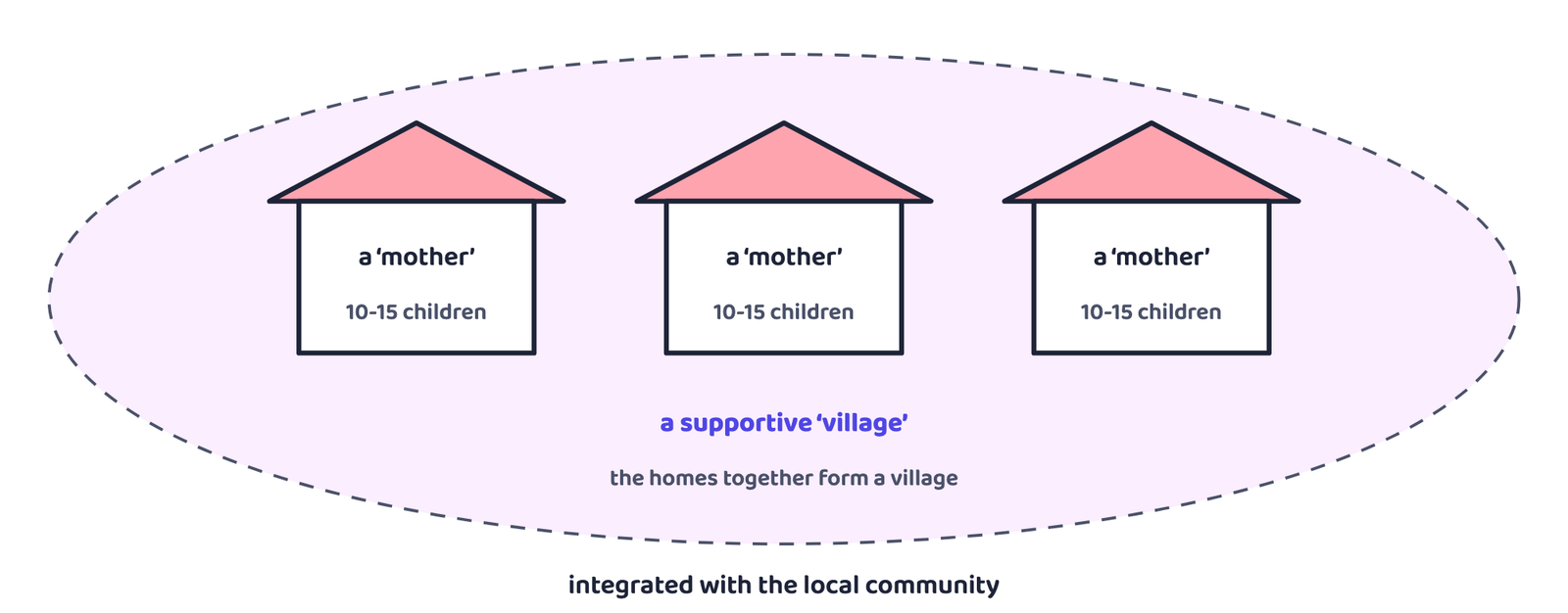
- In each SOS home there is a ‘mother’ who looks after 10-15 children
- This unit lives like a family; the children experience relationships and love once again, which helps them recover from traumatic experiences
- They grow up in a stable family environment and are supported individually until they become independent young adults
- The SOS families live together, forming a supportive ‘village’; they are integrated with the local community and contribute to its social life
- The first SOS village in India was set up in 1964; the organisation now cares for about 6000 needy/abandoned children in 40 villages across the country
- During unrest and disasters, such as the toxic gas accident of 1984 in Bhopal, cyclones, earthquakes and the Tsunami, SOS gave immediate help through emergency relief programmes, which were later converted into permanent facilities, mostly SOS Children’s Villages
4.3 Children’s Homes run by the Government
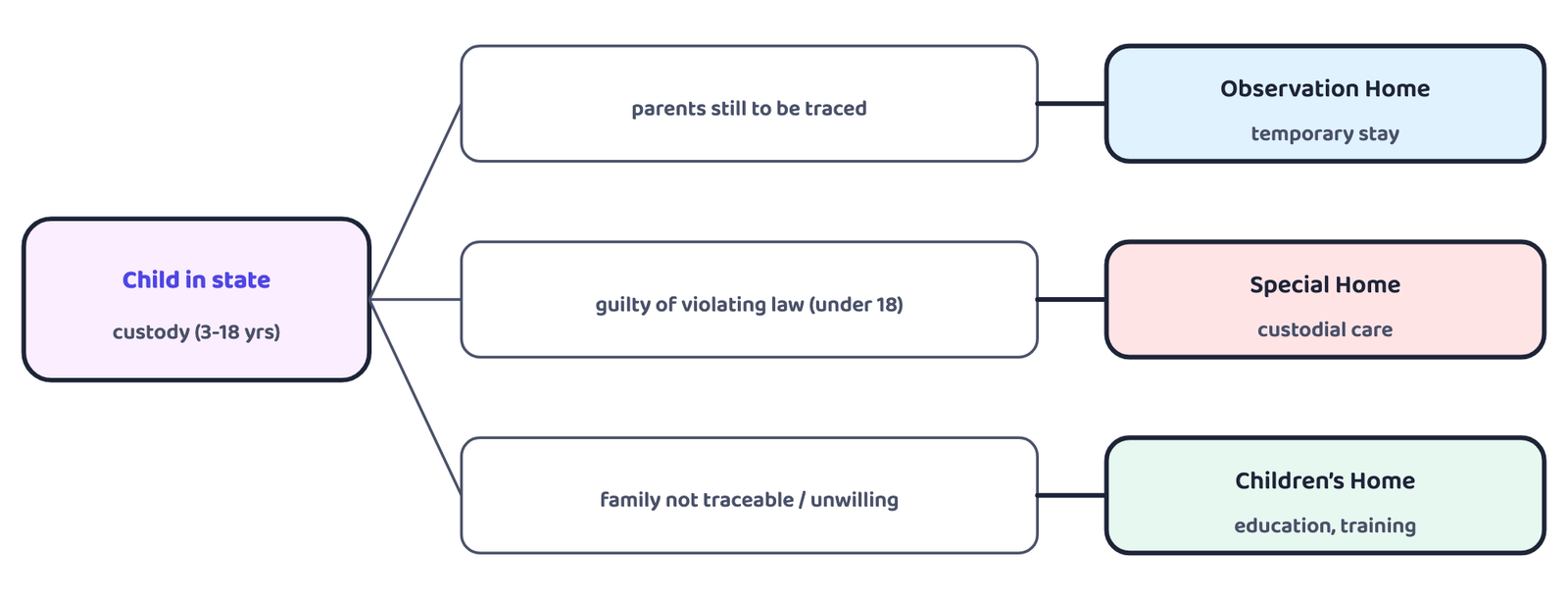
- These are for children from 3-18 years who are in state custody for various reasons
- There are three kinds of homes for children
Homes where children stay temporarily till the completion of an investigation to track down their parents and collect information on their family background.
Homes where juveniles (children under 18 years of age) found guilty of violation of law are placed in custodial care.
Homes where children stay whose families are not traceable, or are unfit/dead, or simply unwilling to take the child back.
- In these Homes the government is responsible for providing room, board, education and vocational training
- Most of these Homes are run by the government in partnership with NGOs
- Efforts are made to help the children develop skills which will enable them to become productive members of society
4.4 Adoption
- India has a long tradition of child adoption
- Earlier, adoption was limited within the family and was covered by social and religious practices
- With changing times, adoption beyond the family has been institutionalised and legalised
- The Government of India and State Governments provide support and guidance through policies and programmes
- NGOs provide the necessary delivery systems for the process of adoption
A Central Agency constituted by the Government of India under the advice of the Supreme Court, to strengthen adoption rules and facilitate adoption, which sets up guidelines for adoption to safeguard the welfare and rights of children.
| Initiative | Run by | For whom | Key point |
|---|---|---|---|
| ICDS | Government of India | children below six; pregnant and nursing mothers | world’s largest early childhood programme; anganwadi |
| SOS Children’s Villages | independent NGO | orphaned and abandoned children | family approach; a ‘mother’ with 10-15 children; in India since 1964 |
| Children’s Homes | Government (mostly with NGOs) | children of 3-18 years in state custody | Observation, Special and Juvenile/Children’s Homes |
| Adoption | Government (policy), NGOs (delivery systems) | children without families | CARA guidelines |
“Differentiate between Observation Homes, Special Homes and Children’s Homes” can be asked as a 3-mark question. For each Home, write which child is placed there and whether the stay is temporary.
5 Why are youth vulnerable?
The National Youth Policy, 2014 defined ‘youth’ as persons in the age group of 15-29 years. Those between 13 and 19 years are called adolescents.
- Our national progress depends, crucially, on how youth are encouraged and nurtured as a positive force for national growth and enabled to contribute to socio-economic development
5.1 Why youth is a vulnerable period
Biological changes
coming to terms with many changes in the body, which affect the sense of well-being and identity
Preparing for adult roles
earning a livelihood and marriage, followed by raising a family
Pressure and stress
peer pressure and pressure to excel in a competitive world cause stress and turmoil
Substance abuse
without positive support from family/environment, some adolescents consume alcohol and drugs; this maladjustive way of combating stress is on the rise
Health
risks related to sexual and reproductive health; many lack the knowledge and power to make informed choices
5.2 Especially vulnerable groups of youth
5.3 What youth need
To be socially useful and economically productive, youth need:
- appropriate education and training
- gainful employment
- adequate opportunities for personal development and advancement
- shelter, a clean environment and basic health services of quality
- social defence and protection from all manner of exploitation
- suitable participation in decision-making bodies on youth issues and on socio-economic and cultural matters
- access to sports, physical education, adventure and recreational opportunities
6 Youth programmes in India
The Ministry of Youth Affairs and Sports adopted the National Youth Policy in 2003. The programmes for youth are:
| # | Programme | For whom | Aim / work |
|---|---|---|---|
| 1 | National Service Scheme (NSS) | college level students | involve them in social service and national development |
| 2 | National Service Volunteer Scheme | students who have completed their first degree | whole-time for one or two years in national development, mainly through Nehru Yuva Kendras |
| 3 | Promotion of Adventure | youth clubs and voluntary organisations | adventure activities with government financial assistance; risk-taking, team-work, endurance |
| 4 | Scouts and Guides | boys and girls | character building through loyalty, patriotism and thoughtfulness for others |
| 5 | Commonwealth Youth Programme | youth of Commonwealth countries | participation in development; co-operation and understanding among Commonwealth countries |
| 6 | Promotion of National Integration | youth of one state (through voluntary agencies) | visits to other states; understanding of the country’s heritage and customs |
6.1 National Service Scheme (NSS)
- Aim: to involve college level students in programmes of social service and national development
- Construction: construction and repair of roads, school buildings, village ponds and tanks
- Environment and ecology: tree plantation, removal of weeds from lakes, digging pits
- Health and welfare: hygiene and sanitation, family welfare, child-care, mass immunisation
- Skills: vocational training in craft, tailoring and knitting, and organising co-operatives
- NSS students also assist local authorities in implementing relief and rehabilitation programmes for the economically and socially weaker sections
6.2 National Service Volunteer Scheme and Nehru Yuva Kendras
- The scheme gives students who have completed their first degree the chance to work whole-time for a short period of one or two years in programmes of national development
- This is done mainly through Nehru Yuva Kendras
- Volunteers work in adult education, setting up youth clubs, work camps, youth leadership training, vocational training and promotion of rural sports and games
- The Nehru Yuvak Kendras also aim to enable the non-student youth of rural areas to contribute to rural development
- The Kendras popularise nationally accepted objectives: self-reliance, secularism, socialism, democracy, national integration and scientific temper
- Their activities: non-formal education, social service camps, sports, cultural and recreational programmes, vocational training, youth leadership camps, youth clubs
- Goal: help non-student youth acquire literacy and numeracy skills for self-reliance and upgrade their abilities, making them functionally efficient, economically productive and socially useful
National Service Scheme (NSS)
- college level students
- social service and national development
- assists local authorities in relief and rehabilitation
National Service Volunteer Scheme
- students who have completed their first degree
- whole-time for one or two years
- mainly through Nehru Yuva Kendras
6.3 Promotion of Adventure
- Youth clubs and voluntary organisations organise adventure activities using the financial assistance provided by the government
- Activities: mountaineering, trekking, hiking, exploration for collecting data, study of flora and fauna in mountains, forests, deserts and sea, canoeing, coastal sailing, raft-exhibitions, swimming and cycling
- Aim: to encourage the spirit of adventure, risk-taking, co-operative team-work, a ready response to challenging situations, and endurance among the youth
- The government also helps set up and develop institutions for such activities
6.4 Scouts and Guides
- The government gives financial support for training scouts and guides and organising rallies and jamborees
- Aim: to develop the character of boys and girls and make them good citizens by inculcating loyalty, patriotism and thoughtfulness for others
- It promotes balanced physical and mental development and a desire for social service
6.5 Commonwealth Youth Programme
- India participates in the Commonwealth Youth Programme
- Aim: to make youth participate in the development processes of their countries, and to provide a forum for co-operation and understanding among Commonwealth countries
- Under it, three regional centres for advanced studies in youth work have been set up, in India, Zambia and Guyana
- The Asia Pacific Regional Centre has been set up at Chandigarh, India
6.6 Promotion of National Integration
- The government gives financial help to voluntary agencies to organise visits of youth from one state to another state with marked cultural differences
- This builds understanding of the country’s historical and cultural heritage, and of the problems, environment and social customs of people in other regions
- Camps and seminars are also organised to promote national integration
The CBSE sample paper asks “Give two features of NSS” for 2 marks. Write the first and the last points of section 6.1: the social service and national development work, and the help to local authorities in relief and rehabilitation.
7 Why are the elderly vulnerable?
In India, Senior Citizens are persons in the age group of 60 years and above. In a number of countries, a Senior Citizen is a person aged 65 years and above.
- The population of older persons in India has risen steadily because life expectancy (the average number of years a person is expected to live) has increased: it was about 29 years in 1947, and in 2009-13 it was 69.3 years for females and 65.8 years for males
- India has the second largest number of Senior Citizens in the world, after China
- The elderly will be nearly 9 per cent of the population in 2016 (source: Human Development Report)
The four special features of the elderly population in India:
- The majority (80%) live in rural areas, which makes service delivery a challenge
- Feminisation of the elderly population (women form a growing share of it)
- An increase in the number of the older-old (persons above 80 years)
- A large percentage (30%) of Senior Citizens is below the poverty line
7.1 Reasons the elderly are vulnerable
Health
more prone to disease because of decreased physiological reserves and defence mechanisms; ageing brings low vision and blindness from cataracts, deafness from nerve impairment, loss of mobility from arthritis and a general inability to care for oneself
Loneliness
children move away for marriage or to earn a living; feelings of loneliness, isolation and of being a burden on others
Financial dependence
many depend financially on the younger generation, which adds to their stress
Changing family and values
in metropolitan cities the traditional family network is fragmenting and the traditional value system is changing
- Features of city life that reduce support from the immediate and extended family: small family size, nuclear families, lack of free time to care for the aged, limited living space, high cost of living, long working hours
- Sometimes ideas like privacy, space, independence, materialism and focus on self also lead to the inability to care for the elderly
- So many elderly persons are left to fend for themselves at a time when family support is most necessary
Ageing has become a major social challenge.
The book adds: it is necessary to provide for the economic and health needs of the elderly and to create a social milieu which is conducive and sensitive to emotional needs of the elderly
7.2 The positive side of old age
- Old age is not only problems and difficulties; many old people continue to live fulfilling lives
- In many families the elderly are well respected and continue to find fulfilment
- A positive feature: most persons aged 60 or more are economically active, presumably because they work in sectors with no specific age of retirement
- The elderly should be recognised as a human resource, and their rich experience and residual capacities used for national development
- The government should ensure their ability to lead healthy and fruitful lives
- The government adopted the National Policy for Older Persons in 1999
8 Some programmes for the elderly
Programmes for the elderly in India are run by the Government, Non-Government Organisations, Panchayati Raj Institutions and local bodies. The book’s list, grouped here into four sets to make it easier to learn:
| Group | Programme / service (the book’s words) |
|---|---|
| Basic needs and shelter |
• programmes for the basic needs of Older Persons, particularly food, shelter and health care to the destitute elderly • Old Age homes to provide food, care and shelter • Respite Care Homes and Continuous Care Homes for Older Persons in old age homes who are seriously ill and need continuous nursing care and respite (rest) • programmes for Institutional as well as Non-Institutional Care/Services |
| Health and special care |
• Mobile Medicare Units for older persons in rural, isolated and backward areas • Day Care Centres for Alzheimer’s Disease/Dementia Patients (specialised day-care) • mental health care and specialised care (Mental Health Care Intervention Programmes) • disability care and hearing aids • physiotherapy clinics |
| Active life and company |
• Multi-Service Centres: daycare, educational and entertainment opportunities, healthcare, companionship • programmes encouraging Active and Productive Ageing • programmes to build and strengthen intergenerational relationships (between children/youth and Older Persons) • help-lines and counselling centres |
| Awareness and training |
• research, advocacy and awareness building programmes in the field of ageing • Awareness Generation Programmes for Older Persons and caregivers: self-care, preventive health care, disease management, preparation for old age, intergenerational bonding • training of caregivers for older persons • sensitising programmes for children, particularly in schools and colleges |
8.1 National Old Age Pension Scheme (NOAPS)
Old persons not having any regular means of subsistence on their own or through financial support from family members. NOAPS is meant for such persons.
Senior Citizens in India are counted from 60 years, but NOAPS beneficiaries must be above 65 years. Do not mix up the two ages.
The CBSE sample paper asks “Enumerate two features of NOAPS” for 2 marks. Write any two of the four points in the chain above, in full.
9 Preparing for a career
- Two routes in this career: work as in-charge or manager of activities in a programme/institution that is already running, or set up a new organisation/programme for youth, children or the elderly
- Either way you need a broad knowledge base and multiple skills
- You need the abilities and skills of a planner, a manager and an evaluator, maybe even an entrepreneur
- You also need strong knowledge of the needs, characteristics and modes of care giving for the target group
9.1 People skills
The skills needed for running or working in an organisation, which means interacting with people in different roles and from different backgrounds.

| Group | Why it matters |
|---|---|
| (i) The community | A programme succeeds if the community feels a sense of involvement and ownership; this happens when the people it is meant for are involved in planning right from the start. Participatory planning, management and implementation are the pillars of effective programmes, so building linkages with the community is a major part of the work. |
| (ii) The private sector | Private financial institutions, companies and organisations have come in a big way to support innovative programmes; it is an opportunity for them to discharge their social responsibilities. |
| (iii) Officials in the government | You may need to deal with government departments for funding and for fulfilling other legal requirements. |
| (iv) People within the organisation | For smooth functioning, everyone (both beneficiaries and personnel) should enjoy a harmonious relationship; cordial interpersonal relations are a major factor in success. |
9.2 Administrative skills
The skills for running or managing an organisation or programme, which involves handling finances, recruiting personnel, renting space, buying equipment, and maintaining records and stocks.
- Other people may deal with each of these, but it is necessary and helpful for you to have a basic understanding of the issues involved in each
9.3 Setting up a new organisation
An enterprising person who wishes to start a new organisation for a needy target group must consider:
- Last but not least, the person needs a vision of what he/she wants to achieve and how the organisation will meet the needs of the target group
- A person with a vision is usually deeply committed to the cause and has a strong passion for work in that area
- Programmes and institutions that give quality services to children, youth and the elderly will always remain a basic need of civil society
9.4 Education and training
- First step: develop a knowledge base and an understanding of children, youth and the elderly
- For this, an undergraduate degree in Home Science (also called Family and Community Sciences), Social Work or any other social science is appropriate; these degrees usually focus on the three vulnerable groups
- After the undergraduate degree you can enter the employment market or study further
- Open and Distance learning also offers programmes; the Indira Gandhi National Open University (IGNOU) offers programmes that can be done along with a regular degree, such as:
- Certificate Programme in NGO Management
- Diploma in Youth Development Work
- State Open Universities also offer programmes through the distance mode

10 Scope: career avenues
Depending on the type of programme you wish to work with and your own inclination, the field offers these career avenues:
Your own institution
set up your own institution for services to any target group
Manager
be a manager in an established institution or a programme
Functionary
be a functionary at any level/cadre
Researcher
consult with, assess or evaluate existing programmes and institutions
11 Practical work and activities
The book’s practicals and activities (the full method is in the NCERT Solutions post):
- Practical 1 (Care and Welfare of the Elderly): prepare a script and enact a play about the dynamics in a large joint family; a group of 5-6 students play children, parents and grandparents in a 15-minute role play, followed by a discussion of the role of the elderly in the family
- Practical 2: make a small booklet of four-line poems on environment, birds and animals, with illustrations, to promote young children’s language development; groups of six, cards of 4 × 6 inches, one poem and picture per card, 4-5 cards, a cover page, then holes punched and tied with an old string
- Activity 1: three groups list at least 5-8 special needs each of children, youth and the elderly
- Activity 3: two groups discuss the situation of the elderly in the neighbourhood and how the elderly can contribute to family and society
Syllabus practicals linked to this chapter:
- CBSE practical: modification of any one family meal for an elderly person, and preparing one modified dish (HBSE: change a normal diet into a soft diet for an elderly person). Keep in mind the health problems of old age and choose soft, easy-to-eat dishes
- CBSE project: profile two persons (child/adult) with special needs, covering their diet, clothing, activities, and physical and psychological needs; or interview two adolescents and two adults about their perception of persons with special needs
- HBSE: prepare and use teaching aids to communicate socially relevant messages to children, adolescents and adults in the community
- A family cannot provide every specialised service, so the community provides support services; one reason families cannot cope is lack of resources, especially financial
- Vulnerable = more likely to be affected by adverse circumstances; if needs are not met in daily life, a person becomes vulnerable
- Children: rapid development in all domains; Juvenile Justice Act 2000, two categories, child-friendly approach, in compliance with the Child Rights Convention
- ICDS: below six, world’s largest early childhood programme, anganwadi; SOS: family approach, a ‘mother’ with 10-15 children, 1964, 40 villages, about 6000 children
- Children’s Homes (3-18 years): Observation (temporary), Special (guilty of violating law, under 18), Juvenile/Children’s (no family); adoption: CARA, under the advice of the Supreme Court
- Youth 15-29 (National Youth Policy, 2014), adolescents 13-19; five especially vulnerable groups; National Youth Policy adopted 2003 by the Ministry of Youth Affairs and Sports
- NSS: college students, social service, relief and rehabilitation; Volunteer Scheme: after the first degree, 1-2 years, Nehru Yuva Kendras; Commonwealth centres in India, Zambia, Guyana; Asia Pacific centre at Chandigarh
- Senior Citizen: India 60+, many countries 65+; life expectancy about 29 years in 1947; second after China; 80% rural, 30% below the poverty line, older-old above 80
- Ageing is a major social challenge; the elderly are a human resource; National Policy for Older Persons 1999; NOAPS: destitute, above 65, proof of age and destitute status, states can add to the amount
- Career: planner, manager, evaluator; people skills (community, private sector, government officials, people within) and administrative skills; IGNOU certificate and diploma; four career avenues
- Can I define ‘vulnerable’ and give the reasons children, youth and the elderly are vulnerable?
- Can I list the five services of ICDS and four features of SOS Children’s Villages?
- Can I tell apart the three kinds of Children’s Homes?
- Can I name the six youth programmes and write two features of NSS?
- Can I write the four features of the elderly population, their programmes and the conditions of NOAPS?
- Can I name the four groups of people skills and the points of advice for someone setting up a new institution?