
- explain what Early Childhood Care and Education (ECCE) is, why it matters, and how it helps the child, the older sibling, the family and society
- define and tell apart early childhood, infancy, toddler, crèche, day care and preschool
- write the three basic objectives and the ten guiding principles of ECCE as per NCF (2005)
- list the skills of an early childhood professional and describe how to prepare for a career in ECCE
- describe the scope of the field, the services, the careers and the practicals (play material, puzzle, puppets and masks)
1 Unit III Introduction: Human Development and Family Studies
- Many changes take place in a person as he or she grows up
- Students who specialise in Human Development and Family Studies (HDFS) study these changes
- They also learn to provide effective and meaningful services for people at different ages, with different needs and in different circumstances
- Studying HEFS helps us know ourselves and the people around us better and lead a more meaningful life; the home and the workplace are treated with equal respect
- In accordance with the National Curriculum Framework (2005), all ethnic groups, languages, religions and communities are regarded as equal
| Point | What the book says |
|---|---|
| Names at college level | Child Development; Human Development and Childhood Studies; Human Ecology. The core stays the same; only the perspective differs slightly |
| When called Child Development | Greater focus on childhood and less emphasis on life span development; the difference is only a matter of degree |
| Who the career suits | Those drawn towards understanding interpersonal relationships and comfortable talking about these issues; honest self-reflection is part and parcel of the career |
| Whom you work with | Individuals and groups across the life span, from the very young to the old; but organisations focus on specific dimensions (all-round development of young children, counselling for specific age groups, interventions in education) |
- Early Childhood Care and Education (this chapter)
- Guidance and Counselling
- Special Education and Support Services
- Management of Support Services, Institutions and Programmes for Children, Youth and Elderly
2 Significance of ECCE
- Early childhood care and education is a very important area of study in Human Development
- The infant begins to learn from a very early age
- Along with learning about the world, the infant develops an attachment with family members, particularly the mother and father, as well as siblings and grandparents
- The young child begins to recognise other family members and people he or she meets regularly
- So the child learns to distinguish between people he or she recognises and those who look unfamiliar
2.1 Behaviour around the first year
- The child is growing very rapidly: learning to walk, pick up things with precision and manage his or her body in many ways
- The child is also developing control over bladder and bowel movements
2.2 Care arrangements for the young child
- In most cases, children are brought up only within the family for the first few years
- Where the mother works outside the home, there may be a need for substitute provisions for the care of the child
- Traditionally, this was the responsibility of another female of the household who lived with the family permanently (as in joint families) or stayed temporarily to support child care
- In recent times there has been an increasing need for institutional child care
The book says the crèche or family care is primarily seen as a substitute for the mother/primary caregiver. However, it may not be seen as an essential experience for the enrichment of a child’s learning and development. A crèche is mainly a place of care.
2.3 After about three years: the right learning environment
- Ideally, once the child is around three years of age, the activities and experiences begin to expand
- Experts differ on the exact age until which a child should be kept at home before entry to formal school
- The child can still enjoy only informal and small group activities, but chances to engage with people outside the family and close community become more valuable
- Once children learn to walk, run, manipulate things and speak, they actively engage with the environment; they gather information by interacting with people and materials
- Vocabulary in the mother tongue grows rapidly at this time
- So does the child’s understanding of nature, like sand, water, flowers, birds, machines and other materials
- Children are curious and often ask adults, “Why is this so?”
✓ Do at this age
- Satisfy the child’s curiosity with an optimal learning environment
- Never overburden the child to do more than he or she is capable of
- Teach through play, in a child centred way
✗ Do not
- Force a child to sit in one place and learn like in a formal school meant for older children
- Result: curiosity diminishes, and the child feels anxious and insecure
- Safe and secure
- Loving
- With a variety of people
- With play materials (toys or natural)
- With the presence of a caring adult: the mother, a grandparent, a preschool teacher or a sibling
2.4 Why preschool experiences are beneficial
- The learning and other experiences of a good preschool have been found to be extremely beneficial for young children
- The child centred approach and the play way method, which make learning enjoyable, are ideally suited for young children
Book: “The child centred approach and the play way method which makes learning enjoyable is ideally suited for young children.”
In simple words (not the book’s words): the child is at the centre of learning. The programme follows the child’s own pace and interests, is informal, does not overburden the child, and lets the child learn through play.
Learning among peers
Children enjoy the company of other children and very quickly learn to do things that often surprise even the parents
Independence
Parents wonder when the child eats by himself or herself, and also eats things not eaten at home
Children in difficult circumstances
For children who live in difficult circumstances or need additional support for learning, a good preschool is very beneficial
Preparation for formal schooling
Preschool enhances exposure to other adults, environments and materials and, more importantly, prepares the young child for formal schooling
“Children who do not go to nursery school are not learning.” This is wrong. The book says: “All children learn, naturally.” A preschool only enhances that learning.
Preschool education in a programme which is child-centred and informal provides the child with a good learning environment that complements the advantages of a good learning environment at home.
- Where the home environment is lacking in some way, the preschool experience can be an important factor in the child’s growth and development outside the home
2.5 Who benefits from ECCE
- In many communities, especially in remote areas or with fewer resources, parents go out for work
- So older children of school-going age are given the care of younger ones, and the older child is unable to attend school
- Institutional care for young children releases the older child from child care, so he or she can attend school
- These services also provide interventions in nutrition and health, besides learning, when required
- Thus there is a support to society in developing and building the next generation for the future
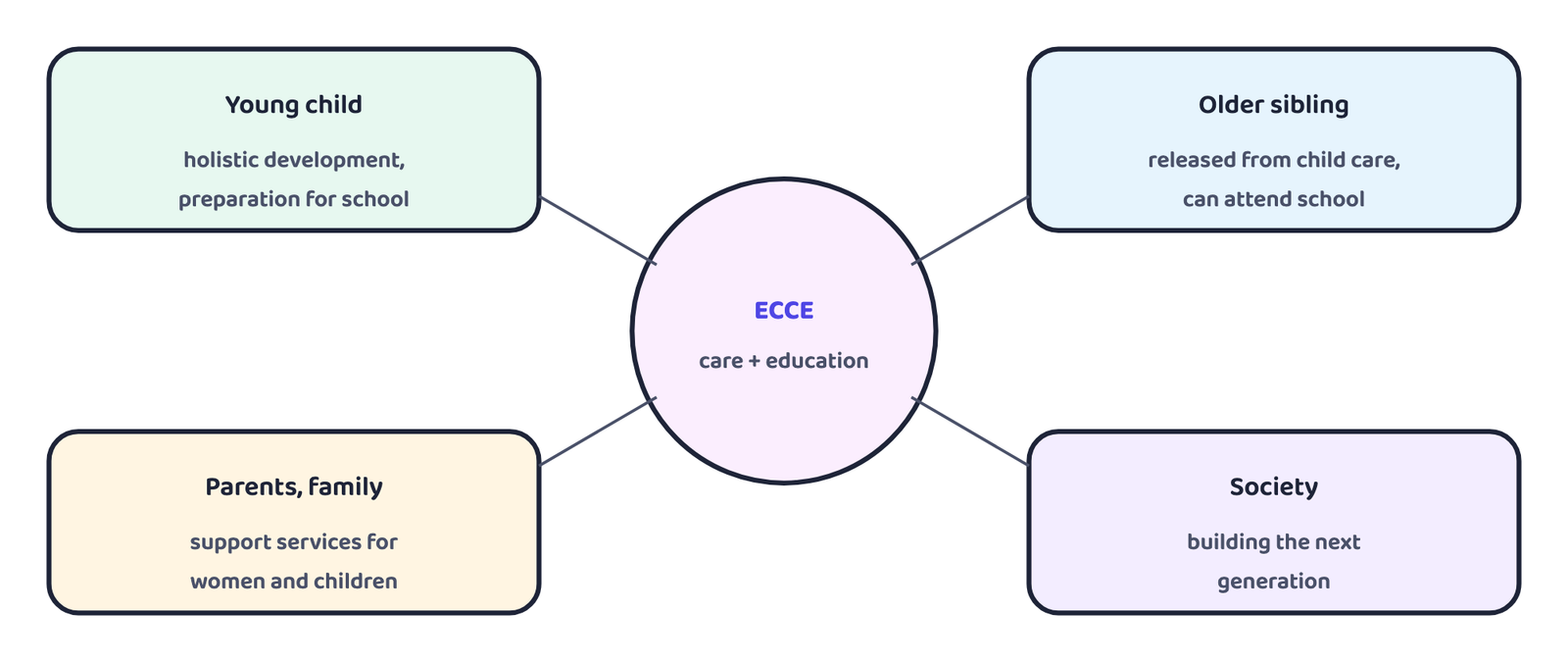
Book: “Early childhood care and education and care is an activity that benefits childhood in different circumstances, as well as families by providing the support to parents and the community in these basic tasks.” The basic tasks are those of the sentence before it: developing and building the next generation for the future.
2.6 The basic objectives of ECCE
As per the NCF (2005) Position Paper on Early Childhood Education published by NCERT, the basic objectives of ECCE are:
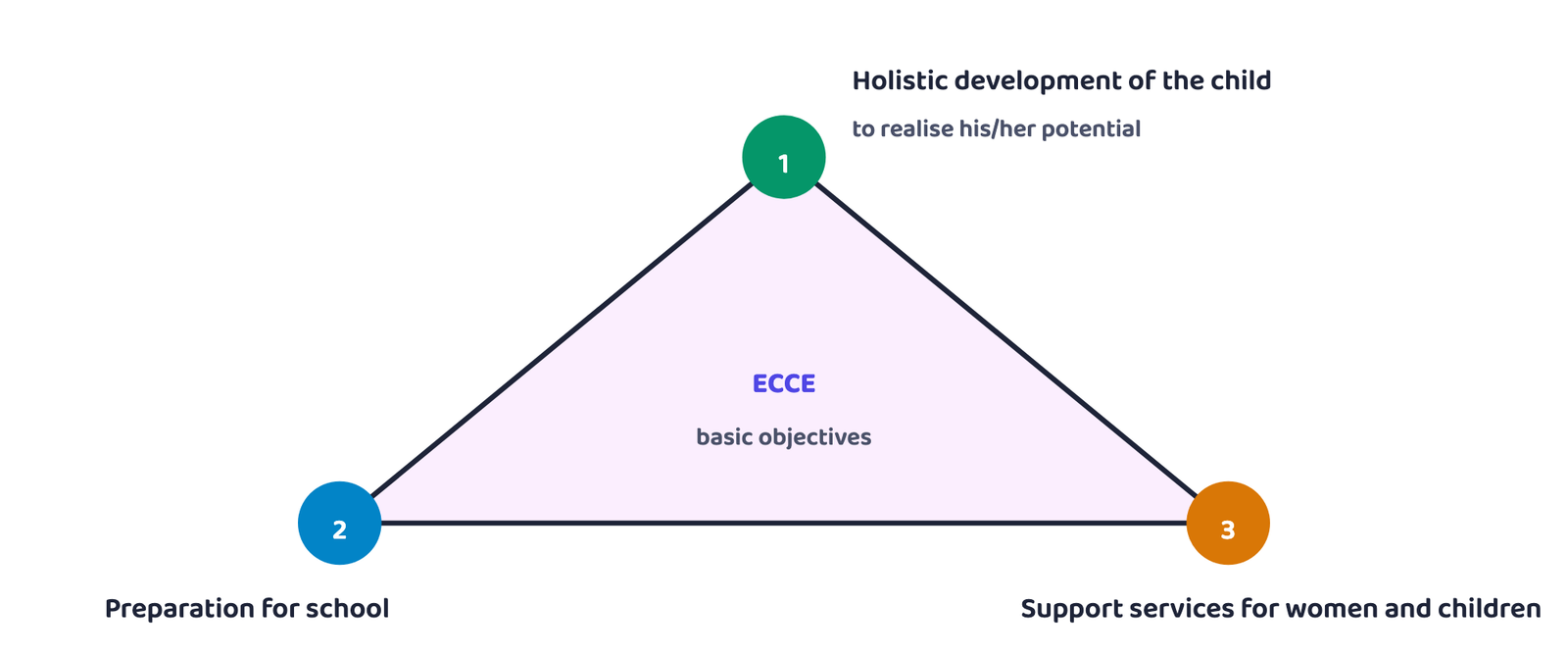
“H-P-S”: Holistic · Preparation · Support
H for holistic development, P for preparation for school, S for support services for women and children.
For “Explain the significance of ECCE”, write each beneficiary (child, older sibling, family, society) as a separate point, then add the preschool benefits (learning among peers, preparation for school, help for children in difficult circumstances) and the three objectives.
3 Basic Concepts
3.1 Stages by age
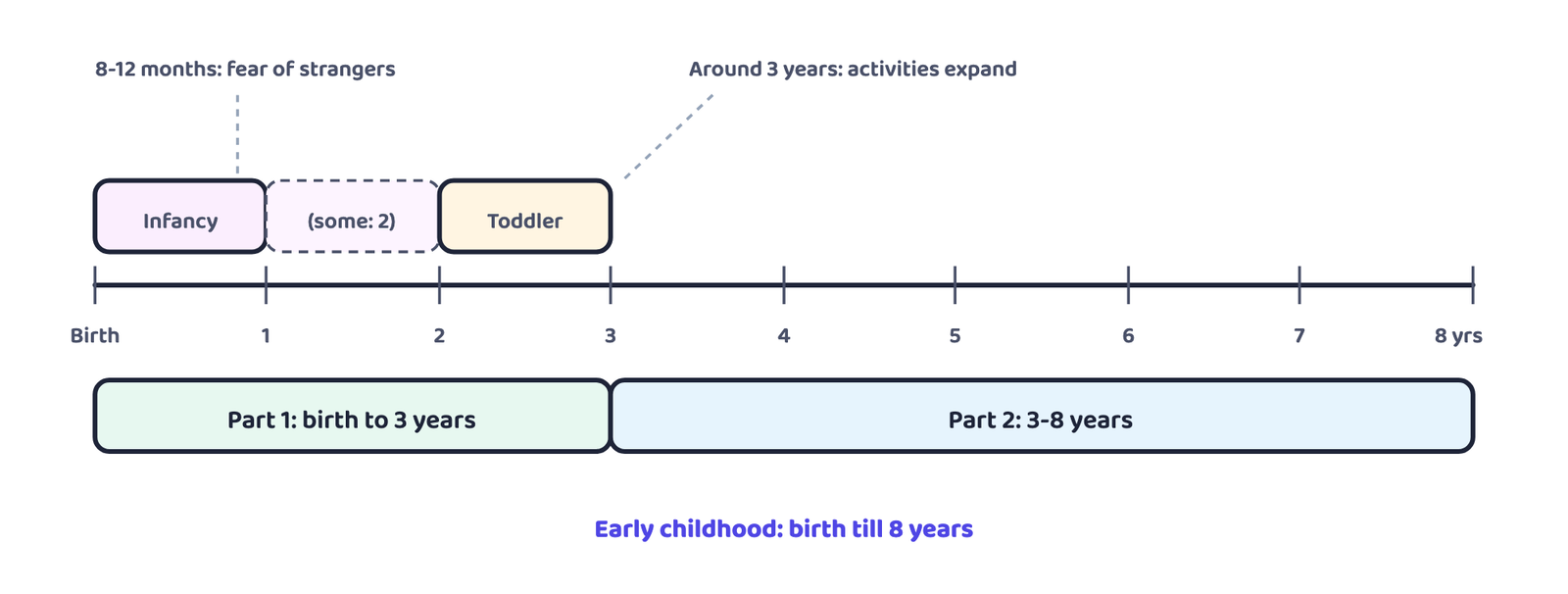
Early childhood is the phase of life from birth till 8 years of age. It is commonly divided into two, from birth to three years and 3-8 years, based on the developmental changes that characterise young children in these two stages.
Infancy is the period between birth and one year (some experts also denote infancy till two years), during which a child is largely dependent upon adults for everyday needs.
- It is a period of intense dependence on adults: usually the mother or father, or another primary caregiver such as the grandmother or a helper
- When the mother is employed outside the home, a substitute caregiver cares for the infant: a family member or a hired person
- The substitute care may be in the child’s own home, the caregiver’s home, an institution or a crèche
The child between two and three years is sometimes called a toddler, a term derived from the jumpy walk that a young child has at this age.
3.2 Crèche and day care
Crèche is the name given to an institutional setting that is particularly designed for the care of infants and young children in the absence of home care.
Day care is the care of children in the preschool years and may include infants and preschoolers, who are cared for in the absence of a primary caregiver at home.
| Point | Crèche | Day care | Preschool / nursery school |
|---|---|---|---|
| For whom | Infants and young children | Children in the preschool years; may include infants and preschoolers | The preschool child, ready for an environment beyond the family (extra-familial) |
| When | In the absence of home care | In the absence of a primary caregiver at home | Before formal schooling |
| Duration | Usually an all-day programme | Usually an all-day programme | Child-centred, informal programme |
| Main focus | Care; a substitute for the primary caregiver | Care, safety, feeding, habits | A good learning environment; preparation for school |
| Staff training | Teachers and helpers specially trained for the care of very young children, their safety, feeding, toilet habits, language development, social and emotional needs and learning | Specially trained as a pre-school or nursery school teacher | |
- Teachers who deal with children above three years of age require different skill sets
3.3 Preschool child, Montessori schools and anganwadis
- A preschool child is so called because he or she is now ready to experience an environment beyond the family (extra-familial)
- The teacher for this programme must be specially trained as a pre-school or nursery school teacher
- Some pre-schools are called Montessori schools; they are based on the principles of early childhood education outlined by the well-known educationist Maria Montessori
- The Government of India offers pre-school education through the anganwadis, which operate under its Integrated Child Development Services (ICDS)
- There are anganwadis in both urban and rural areas
3.4 Two more important principles
Jean Piaget: children understand the world differently
- The developmental psychologist Jean Piaget spent his life explaining that young children have different ways of understanding the world
- So they need a supportive environment to explore things in their own ways
- These features of development must be kept in mind to understand the principles of care and education of young children
Respect for the cultural context
- Every ECCE institution must realise the importance of the cultural context in which it operates
- It works along with, rather than in opposition to, the family
- This matters more for the young child, who cannot tell apart different perspectives and realities the way an older child or adult can
3.5 The ten guiding principles of ECCE (NCF 2005)
As per the NCF (2005) on ECCE, the guiding principles of ECCE are:
| No. | Guiding principle (book’s words) | In simple words |
|---|---|---|
| 1 | Play as the basis for learning | The child learns through play |
| 2 | Art as the basis of education | Drawing, songs, stories and other arts used to teach |
| 3 | Recognition of the special features of children’s thinking | Children think differently from adults |
| 4 | Primacy of experience rather than expertise | Experiential learning (learning by doing) is emphasised |
| 5 | Experience of familiarity and challenge in everyday routines | Daily routines carry both the known and something new to try |
| 6 | Mix of formal and informal interactions | Both planned and casual talk with children |
| 7 | Blend of textual and cultural sources | Learning from texts and from one’s own culture |
| 8 | Use of local materials, arts and knowledge | Things, arts and knowledge from the child’s surroundings |
| 9 | Developmentally appropriate practices, flexibility and plurality | Methods suited to the child’s age and development; flexible and varied |
| 10 | Health, well-being and healthy habits | Care of body and mind, good habits |
Do not mix up the objectives (3) with the guiding principles (10). “Preparation for school” is an objective; “Play as the basis for learning” is a guiding principle.
For a 5-mark question on “the guiding principles of ECCE as per NCF (2005)”, write at least five or six principles in the book’s words, each as a separate point with a one-line meaning.
4 Preparing for a Career
4.1 Why training is needed
- Children under 6 years have particular ways of understanding the world and social relationships, and specific developmental needs
- So any adult working with children must be carefully and well trained in early child development and care
- The question: parents are not trained in child care, so why should a teacher or caregiver need training?
Even parents benefit
Knowing how and why children behave helps parents expect differences between children of the same age and appreciate individual differences; there is often no point in competitive comparisons, even between siblings
ALL adults benefit
All adults in contact with children benefit from a scientific understanding of development and growth, which leads to realistic expectations and interactions
Even more critical for professionals
Early child care professionals are responsible for children other than their own; these activities are their work, and they receive formal recognition for it
- the children, who may not be their biological offspring
- the large group of adults who are family members of the children
- the institution they work for
- the larger society
So ECCE professionals have to be committed to the children, their well-being and learning, and aware of their needs and of the challenges in providing for their growth and development.
4.2 What is expected of a preschool teacher
- In the preschool years there is less need to supervise physical care (cleaning, feeding, toilet activity)
- Reason: the child can now speak, control bowel and bladder movements and eat independently
- The teacher focuses more on interesting and stimulating opportunities: learning new things, experiencing natural phenomena, and physical, language, social-emotional and other learning experiences
- The focus is on enhancing creative expression and exploration, although these aspects are equally important in the earlier years too
- Young children have a greater requirement for adult guidance: an adult can arrange the conditions to be creative or take the initiative to talk to someone, but a preschool child needs an adult’s support for such tasks
4.3 Lev Vygotsky: tasks neither too easy nor too difficult
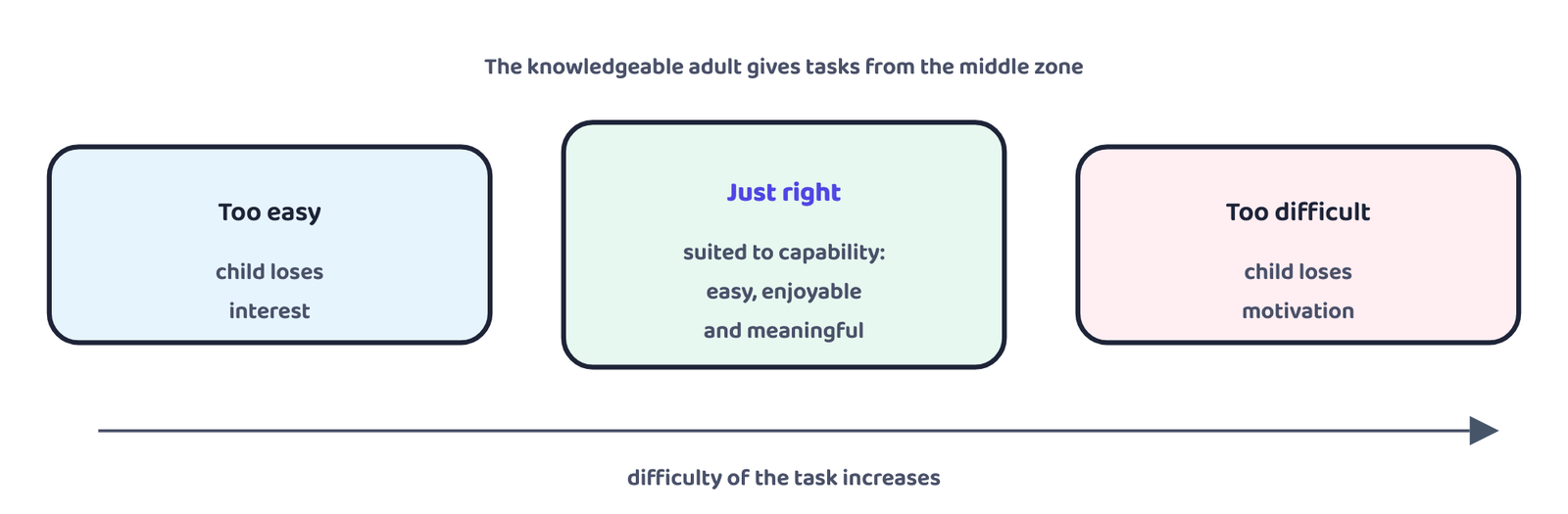
- Lev Vygotsky, a psychologist and educator, outlined the great need children have for a concerned, caring and knowledgeable adult
- The pre-school educator must know about the child’s capabilities more than information about the world
- By knowing how much a child knows and is capable of knowing, the adult can provide the optimal environment where learning is easy, enjoyable and meaningful
4.4 Skills of an early childhood professional
Some of the skills an early childhood professional needs to have are (8 in the book):
Interest
An interest in children and their development
Knowledge
Knowledge about the needs and capabilities of young children
Interaction
Capacity and motivation for interacting with children
Creative activities
Skills for creative and interesting activities with children in all areas of development
Enthusiasm
Enthusiasm for activities like story-telling, exploration, nature and social interaction
Answering queries
Willingness and interest in answering children’s queries
Individual differences
Capacity for understanding individual differences
Energy
Be energetic and prepared for physical activity for considerably long periods of time
4.5 Qualifications and personal qualities

- To prepare for a career in this field, one must study children’s development and the basic principles of care
- You need an undergraduate degree in a subject that has child/human development and/or child psychology as part of the course
- To enter the field soon after school, there is the option of a one year diploma or Open University educational courses
- Nursery Teacher Training is another course that offers training in this field
| Needed besides a degree | Why |
|---|---|
| A predisposition to be open and interactive with children | A fundamental requirement to become an effective early childhood specialist |
| Awareness of the community and culture | So that pre-school activities fit the culture and regional environment in which the child is growing up |
| Administrative and management skills | Record keeping, accounting and report-writing, so that the institution keeps proper records and contact with the parent community is effective and productive |
| A good repertoire of skills in the arts | Story-telling, dance, music, voice modulation and organising playful outdoor and indoor activities are mandatory when working with children |
| Being adaptive and flexible | Young children have a short attention span, so the teacher must adapt to the children rather than focus on completing her own plan of action |
- A pre-school teacher often has to quickly change her lesson plan, strategies and techniques to meet the needs of young children
- So a large repertoire of activities and skills must be prepared before entering the career
For “Describe how we can prepare for a career in ECCE” (Review question 7), write three parts: (a) the qualifications, (b) some of the eight skills, (c) the qualities needed besides a degree (openness, awareness of culture, administrative and arts skills, flexibility).
5 Scope
- The scope of early childhood care and education is very widespread
- A trained educator or caregiver can work as a teacher in a nursery school, a caregiver in a crèche, or a member of a team working on programmes for young children
- Several governmental and non-governmental organisations hire professionals to plan and promote campaigns or services for young children
- A person can set up his or her own child care and education programme as an entrepreneur, at home or in a separate space
- Such an enterprise needs expertise in the organisation and management of such institutions, over and beyond the training as a child care worker and educator
- Depending on qualification and interest, one can work as a coordinator of a programme run by someone else or as a trainer of teachers
- Higher studies: a post-graduate diploma or degree in early childhood education, then a doctoral degree for research and more senior roles
Commonly available services
- Crèches
- Day care centres
- Nursery schools
- NGOs
- ICDS
- Training institutes
Careers
- Teacher in nursery schools
- Caregiver in day care centres and crèches
- Team member for programmes for young children
- Professional to plan and promote campaigns or services for young children, organised by Governments or NGOs
- Entrepreneur in child related activities: camps, edu-picnics, activity clubs, preschool education centres
- Higher studies: a post-graduate diploma or degree in early childhood education, later doctoral degrees with research
“Services” and “careers” are two different lists in the book. Write the list the question asks for; for the entrepreneur career, always give the examples camps, edu-picnics, activity clubs and preschool education centres.
6 Practicals and Activities
The CBSE syllabus sets this practical for the unit: preparation of any one age-appropriate toy for children using locally available and indigenous material, OR preparation and use of any one teaching aid to communicate socially relevant messages for children/adolescents/adults in the community. The UP Board practical list names nothing separate for this chapter. The book’s three practicals prepare you for it:
- Practical 1 (Activities for preschool children): tasks: a visit to the playground or an open area, and collection of play material. Purpose: to plan and prepare materials for activities with young children, with emphasis on locally available low-cost or no-cost material. Steps: divide the class into groups of 5 students each; walk around the playground; collect clean, safe material (rocks, stones, pebbles, flowers, leaves, sticks); clean it properly; each group prepares one activity using colour, texture, number, shape, type of material or size. Book’s examples: (1) sort leaves into two sets by size and shape, paste them on two newspaper sheets and discuss the plant names; (2) make a scenery of a home, school or forest with drawn parts and stuck material, linking to any local craft or folk art; (3) children act like birds, animals and insects around the foliage and discuss which animals eat foliage. Story-telling and role play are particularly fascinating for children
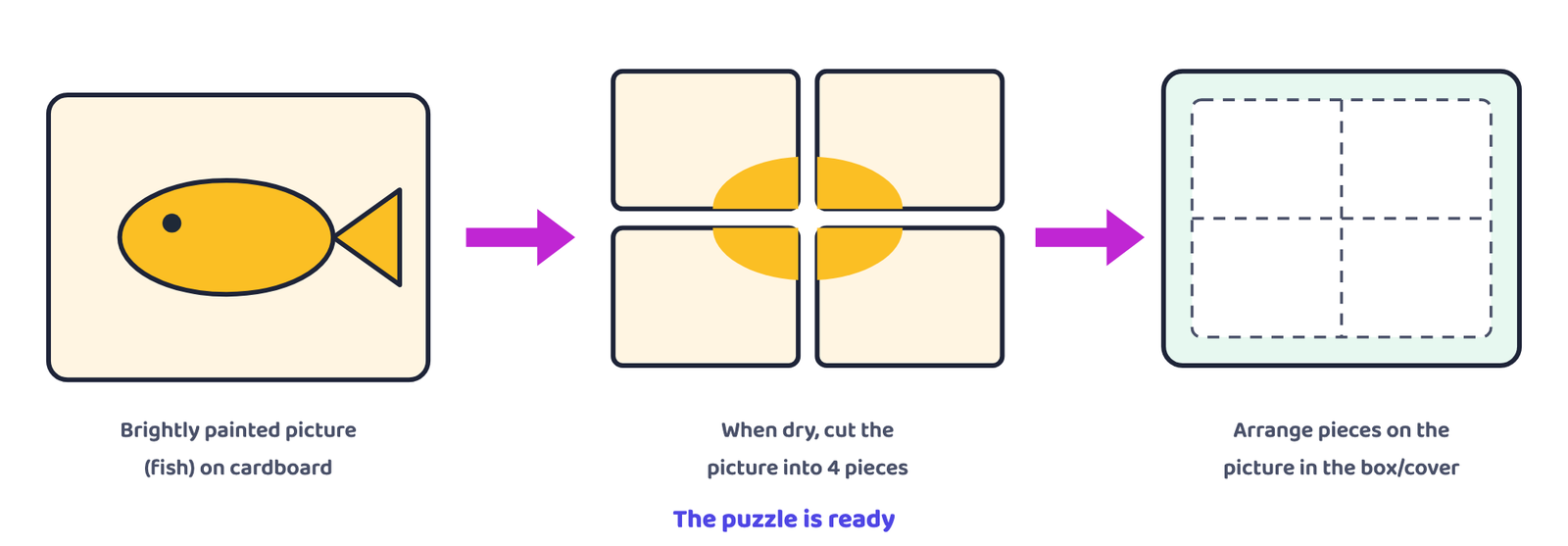
- Practical 2 (Theme: preparation and use of teaching aids, using indigenous and locally available material, to communicate socially relevant messages for children, adolescents and adults in the community): task: make a puzzle for young children with indigenous material; purpose: experience of developing and preparing play material that helps young children’s development
- Practical 3 (Theme: preparation of play materials): task: making puppets and masks; with 4-6 year old children, involve them in the making; use low cost material; masks and puppets promote language and socio emotional development. Steps: collect stiff paper, newspaper, pieces of cloth, thread, leaves and flowers (for colouring the paper); draw a face the size of a 10-year-old child’s face and outline a mask of a sun, flower or animal; draw a small face and join pieces of cloth as arms, legs and hair to make a puppet; tell a story or do a role-play; analyse what children learn from the activity
Note for the teacher in the book: the class may be divided into groups so that each group conducts one practical, and at the end the groups share their materials and experiences.
- Activity 1: list things a child should be able to do before entering Class 1 (walk, talk, read full sentences?)
- Activity 2: a favourite childhood story, who told it, what you liked, your favourite character and why
- Activity 3: the types of child care services in your neighbourhood
- HDFS has four areas of work; the first is ECCE (this chapter)
- 8-12 months: fear of unknown people = recognising familiar faces; around 1 year: clings to the caregiver; then a sense of security
- Care: another female of the household → informal family care (a neighbour’s home crèche) → institutional centre; a crèche substitutes for the primary caregiver but is not an essential learning experience
- Around 3 years: vocabulary, curiosity (“Why is this so?”); forcing formal learning kills curiosity and makes the child anxious and insecure
- Best environment: safe, secure, loving, variety of people and play materials, a caring adult
- Preschool = child-centred, informal, complements home; “All children learn, naturally”; older siblings can attend school
- Objectives (3): holistic development, preparation for school, support services for women and children
- Early childhood 0-8 (0-3, 3-8); infancy 0-1 (some: 2); toddler 2-3, jumpy walk
- Crèche = infants and young children, absence of home care; day care = preschool years; both usually all-day
- Montessori schools: Maria Montessori; anganwadis under ICDS, urban and rural; Piaget: children understand the world differently; work along with the family’s culture
- Ten guiding principles: play, art, children’s thinking, experience over expertise, familiarity and challenge, formal and informal, textual and cultural, local materials, developmentally appropriate practices, health
- Vygotsky: a knowledgeable adult; tasks neither too easy nor too difficult
- 8 skills; qualifications: undergraduate degree / one year diploma or Open University / Nursery Teacher Training; administrative and arts skills; flexibility for a short attention span
- 6 services and 6 careers; entrepreneur: camps, edu-picnics, activity clubs, preschool education centres
- Practicals: play material collection, puzzle, puppets and masks; CBSE Practical 6: a toy or a teaching aid from indigenous material
- Can I define crèche and day care and tell them apart?
- Can I write the three objectives and at least six guiding principles of ECCE without looking?
- Can I list the eight skills of an early childhood professional?
- Can I explain why young children need an informal programme before formal schooling?
- Can I list the six services and the six careers in this field?