
- why food safety and quality matter, and why they are a global concern
- the meaning of food safety, toxicity, hazard, contamination, adulteration and food quality
- physical, chemical and biological hazards; how food infection differs from food intoxication
- the four levels of food standards, the ISI mark and Agmark, FSSA 2006, the functions of FSSAI and PFA 1954
- Codex, ISO and WTO; the food control system; GMP, GHP and HACCP
- career avenues in this field and the practical tests for food adulteration
1 Introduction: why safe food matters
- Food is a major determinant of the health, nutritional status and productivity of a population
- So the food we eat must be wholesome and safe
- Unsafe food can lead to a large number of food-borne diseases; newspapers often report illness caused by contaminated or adulterated food
- Globally, food-borne illness is a major problem of public health concern
Food-borne illness does not only cause death. It sets off a whole chain of losses:
This is why food safety and quality have gained worldwide significance.
2 Significance of food safety and quality
- Food safety and quality are important at the home level
- They are critical in large scale food production and processing, and wherever food is freshly prepared and served
- In the past many foods were processed at home
- Now, better technology and processing, higher per capita incomes, better purchasing power and higher consumer demand have led to many processed foods and food for health / functional foods; the safety of such foods needs to be assessed
- The quality of food stuff, raw as well as processed, is of public health concern
2.1 Why the issue has grown in the past decade: seven factors
Eating outside the home
Lifestyles and eating habits are changing fast, so more people eat out. In commercial settings food is made in bulk and handled by many persons, so it is more likely to be contaminated. It is often made many hours in advance and may spoil if not stored properly.
Processed and packaged foods
There are many processed and packaged foods, and their safety is important.
Pre-packaged spices
Spices, condiments and oilseeds were once processed at home, so purity was not a concern. Today pre-packaged spices, spice powders and mixes are in demand, especially in cities and metros. Even raw food stuff must be checked.
Transport of bulk food
The logistics of moving bulk food are complex and there is a long gap between processing and consumption. So risk assessment and safety management during mass production and mass distribution are critical.
New pathogens
Microbial adaptations, antibiotic resistance, altered human susceptibility and international travel have increased food-borne microbial diseases. Nearly half of all known food-borne pathogens were discovered in the past 25-30 years, and many illnesses are still of unknown etiology (unknown cause). Active surveillance networks are needed, nationally and internationally.
World trade
India is a signatory to the World Trade Organisation (WTO) non-tariff agreement, which opened world markets to all countries. Every country must now protect the safety and quality of its foods and make sure imported foods are safe. Effective food standards and control systems are needed, and manufacturers must have their products regularly tested.
- Pollution of the atmosphere, soil and water, and the use of pesticides in agriculture, bring their own contaminants
- Additives such as preservatives, colourants, flavouring agents and stabilisers are also used
- So analysing food for its components, both nutrients and contaminants, becomes imperative (essential)
Because of these factors there is a growing concern for safe, wholesome and nutritious food, and this has widened the scope and careers in this field.
Review Question 1, “Explain why food safety and quality are of global concern”, is answered from Sections 1 and 2: first the NFHS figure and the economic effects of food-borne illness, then the seven factors, one point each.
3 Basic concepts: food safety, toxicity and hazard
3.1 Food safety, toxicity and hazard
Food safety means assurance that food is acceptable for human consumption according to its intended use.
Food safety is easier to understand once two other ideas are clear: toxicity and hazard.
Toxicity is the capacity of a substance to produce harm or injury of any kind under any conditions.
Hazard is the relative probability that harm or injury will result when a substance is not used in a prescribed manner and quantity.
Toxicity
- a capacity of the substance
- it can cause harm under any conditions
Hazard
- a relative probability that harm will result
- when the substance is not used in the prescribed manner and quantity
Swapping “capacity” and “probability”. Toxicity = the capacity to harm; hazard = the probability of harm. The CBSE sample paper 2026-27 gives the “relative probability” definition and asks for the term (hazard).
Hazards cause harmful or adverse effects on the health of consumers. They are of three kinds:
3.2 Physical hazards
A physical hazard is any physical material not normally found in food, which causes illness or injury, for example wood, stones, parts of pests and hair.

3.3 Chemical hazards
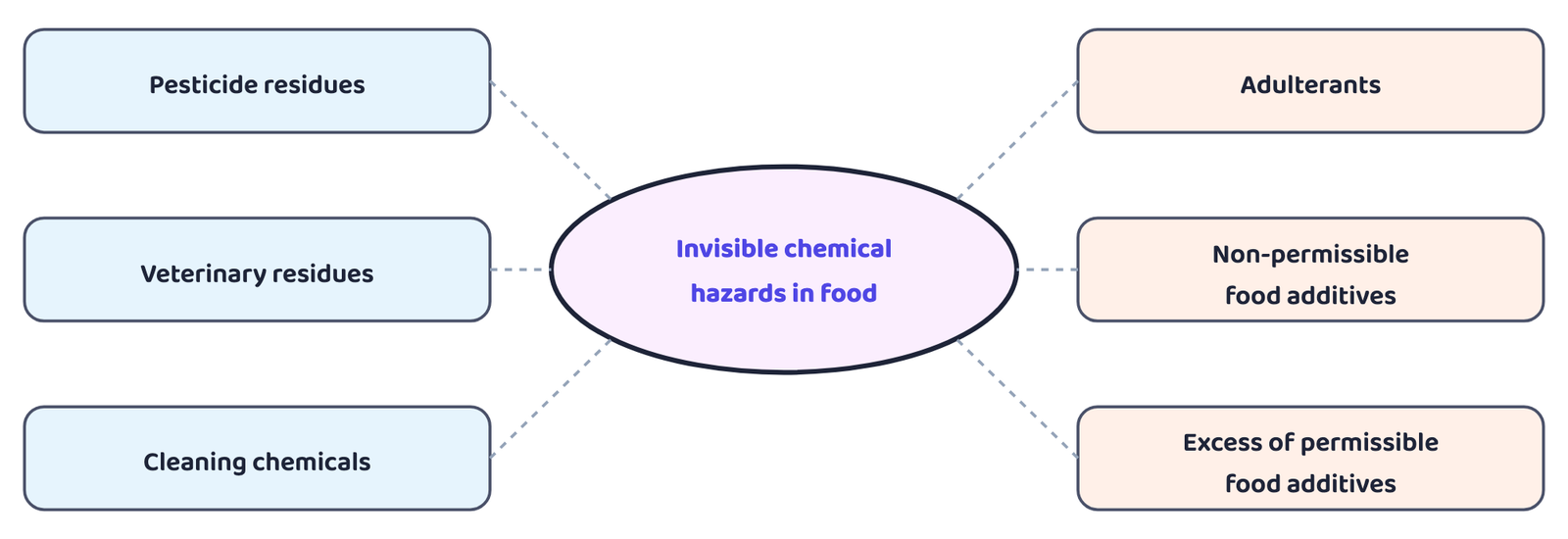
Chemical hazards are chemicals or deleterious (harmful) substances which may be intentionally or un-intentionally added to foods.
- This category includes pesticides, chemical residues, toxic metals, polychlorinated biphenyls, preservatives, food colours and other additives
- They cannot be seen in food, so the book calls them invisible chemical hazards
3.4 Biological hazards
Biological hazards are living organisms, including microbiological organisms. Micro-organisms that are associated with food and cause diseases are called food-borne pathogens.
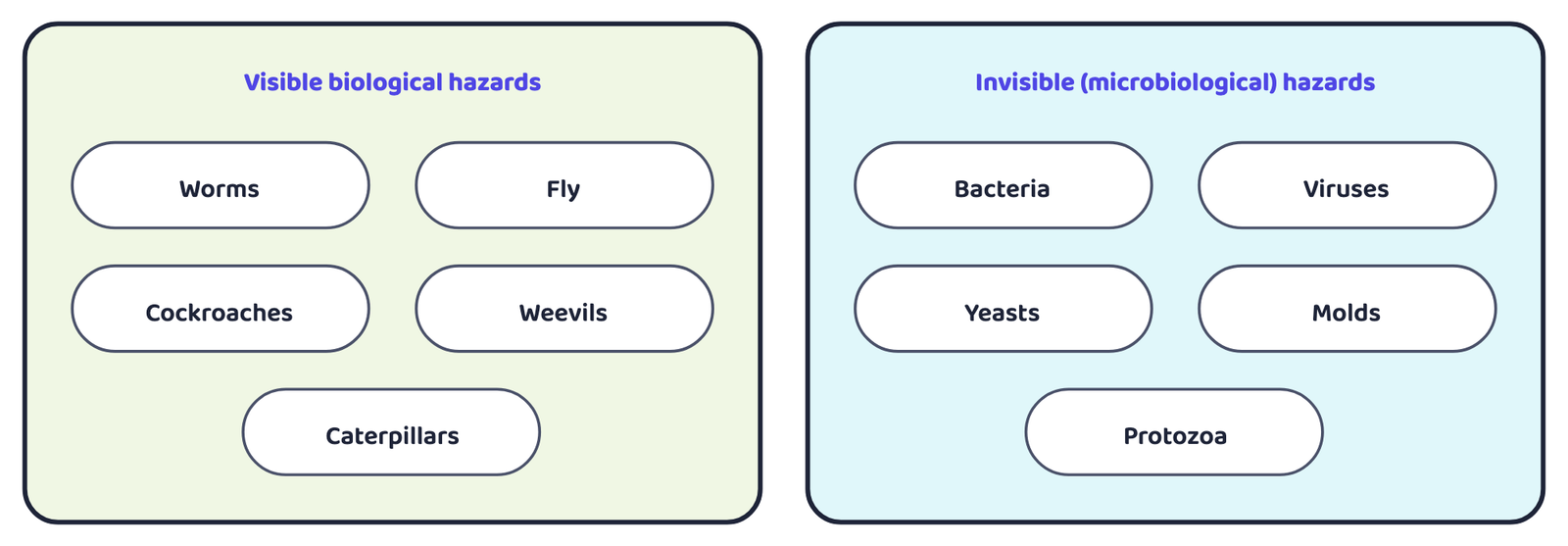
Microbial pathogens cause two types of food-borne disease: food infection (which the book and syllabus also call food poisoning) and food intoxication. The book’s sentence reads: “There are two types of food-borne diseases from microbial pathogens, infections and poisoning”; its headings then describe them as food infection / food poisoning (live pathogens) and food intoxication (toxins).
3.5 Food infection (food poisoning)
Food infection results from the ingestion of live pathogenic organisms which multiply in the body and cause disease.
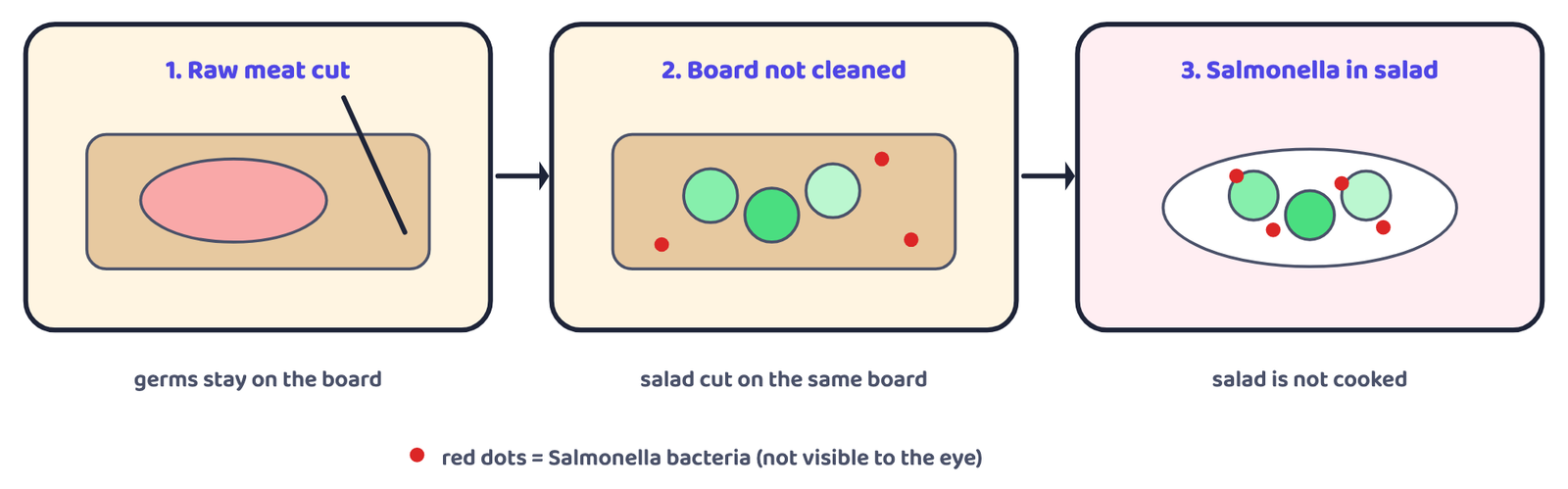
- Salmonella is a classic example
- It lives in the intestinal tract of animals; raw milk and eggs are also sources
- Heat destroys Salmonella, but inadequate cooking lets some organisms survive
- It is often spread by cross-contamination (see the figure)
- Food also gets infected if an infected food handler does not wash hands with soap after using the bathroom and before touching food
- It reproduces very fast: its number doubles every 20 minutes
- Symptoms: diarrhoea, fever and abdominal cramps
3.6 Food intoxication
In food intoxication, some bacteria produce harmful toxins in food, and these toxins are present in the food even if the pathogen has been killed.
- Organisms produce toxins when food has not been hot enough or cold enough
- Toxins cannot be detected by smell, appearance or taste
- So food that smells and looks good is not necessarily safe
- Example: Staphylococcus aureus
- Such organisms exist in air, dust and water
- They are present in the nasal passage, throat, skin and hair of 50 per cent of healthy individuals; carriers contaminate food if they touch these places while handling food
- Diarrhoea is one of the symptoms
- Parasites can also cause infestation, e.g. worm infestation by tape worm in pork; food can also be infested by pests and insects
| Basis | Food infection (food poisoning) | Food intoxication |
|---|---|---|
| Disease caused by | live pathogens that enter the body | toxins made by bacteria in the food |
| In the body | pathogens multiply in the body | the ready-made toxins do the harm |
| If the pathogen is killed | heat destroys it; inadequate cooking lets some survive | toxins stay in the food even after the pathogen is killed |
| Example | Salmonella | Staphylococcus aureus |
| Found in | intestinal tract of animals; raw milk, eggs | air, dust, water; nose, throat, skin, hair of healthy people |
| Symptoms named | diarrhoea, fever, abdominal cramps | diarrhoea |
3.7 Why new pathogens keep emerging
- Among all hazards, biological hazards are an important cause of food-borne illness
- In spite of all efforts, microbial pathogens are still a serious concern and new pathogens continue to emerge
Four factors
The human host; animal hosts and their interactions with humans; the pathogen itself; and the environment, including how food is produced, processed, handled and stored.
Host susceptibility
Changes in host susceptibility due to malnutrition, age and other conditions allow new infections in vulnerable populations.
New strains
Genetic exchange or mutations in the organisms create new strains that can cause disease.
New populations, new areas
Changes in eating habits, climate, mass production, food processing and globalisation of the food supply expose people to new pathogens.
- Examples: Norovirus, Rotavirus, hepatitis E, contributing to about 70 per cent of cases
- New pathogens will keep evolving, so we need methods to isolate them, control them and detect them in foods
4 Contamination, adulteration and food quality
4.1 Contamination and adulteration
Contamination is the presence of harmful or objectionable foreign substances in food, such as chemicals, micro-organisms or dilutants, before, during or after processing or storage.
Food adulteration is the process in which the quality of food is lowered either by the addition of inferior quality material or by extraction of a valuable ingredient.
- It includes the intentional addition or substitution of substances
- It also includes biological and chemical contamination during growth, storage, processing, transport and distribution of food products
- It lowers or degrades the quality of food products
Adulterants are those substances which are used for making food products unsafe for human consumption.
Contamination
- the presence of harmful or objectionable foreign substances
- before, during or after processing or storage
- e.g. chemicals, micro-organisms, dilutants
Adulteration
- a process that lowers the quality of food
- adding inferior material or extracting a valuable ingredient
- intentional addition or substitution, plus biological and chemical contamination
4.2 Food quality
Food quality refers to the attributes that influence a product’s value to consumers. It includes both negative and positive attributes.
Negative attributes
- spoilage
- contamination
- adulteration
- food safety hazards
Positive attributes
- colour
- flavour
- texture
- Food quality is a holistic concept that brings together: nutritional traits; sensorial properties (colour, texture, shape, appearance, taste, flavour, odour); social considerations; and safety
- Safety is a preliminary attribute and precursor of quality: food must first be safe before it can be called good quality
- To make sure foods are safe and of good quality, governments and international bodies have laid down food standards that manufacturers and suppliers are expected to follow
Food service providers are all those involved in pre-preparation, preparation/processing, packaging and service. They should follow good manufacturing practices and keep in mind:
- Quality of raw materials and water
- Cleanliness of the premises, personnel, equipment, food preparation, storage and serving areas
- Storage of food at appropriate temperature
- Food hygiene
- Good service practices
5 Food standards and their four levels
- Effective food standards and control systems are needed to integrate quality into every aspect of food production and service
- They ensure a supply of hygienic, wholesome food and facilitate trade within and between nations
- There are four levels of standards, which are well coordinated
5.1 The four levels of standards
Company standards
Prepared by a company for its own use; normally they are copies of national standards.
National standards
Issued by the national standards body, the Food Safety and Standards Authority of India (FSSAI).
Regional standards
Regional groups with similar geography, climate and so on have legislation standardisation bodies.
International standards
Published by the International Organisation for Standardisation (ISO) and the Codex Alimentarius Commission (CAC).
6 Food standards and regulations in India
6.1 Voluntary product certification
| Mark | Run by / meant for | Nature |
|---|---|---|
| ISI mark | Bureau of Indian Standards (BIS), which deals with standardisation of consumer goods including food products; the ISI scheme is for processed foods | voluntary |
| Agmark | certification of agricultural products (raw and processed) for safeguarding the health of consumers | voluntary |
6.2 Food Safety and Standards Act (FSSA), 2006
- The object of the Act is to consolidate the laws relating to food
- The Food Safety and Standards Authority of India (FSSAI) was established under this Act; it consolidates the acts and orders that earlier handled food issues in various Ministries and Departments
- FSSAI was set up to lay down science-based standards for food and to regulate its manufacture, storage, distribution, sale and import, so that safe and wholesome food is available
- The Act has two provisions that were not specified in the PFA: maintaining hygienic conditions in and around manufacturing premises; and assessment and management of risk factors to human health in a scientific manner
- FSSA reflects the international shift in food laws from compositional (vertical) standards to safety (horizontal) standards
- Framing regulations to lay down standards and guidelines for articles of food, and a system of enforcing them
- Laying down mechanisms and guidelines for accreditation of certification bodies (which certify food safety management systems of food businesses), accreditation of laboratories and notification of accredited laboratories
- Giving scientific advice and technical support to the Central and State Governments for policy and rules on food safety and nutrition
- Collecting and collating data on food consumption, biological risk, contaminants and residues in food, identifying emerging risks and introducing a rapid alert system
- Creating an information network across the country, so that the public, consumers, Panchayats etc. get rapid, reliable and objective information on food safety
- Providing training programmes for persons who are or will be in food businesses
- Contributing to international technical standards for food, and sanitary and phyto-sanitary standards
- Promoting general awareness about food safety and food standards
6.3 Prevention of Food Adulteration Act (PFA), 1954
- Enacted by the Government of India in 1954 to prevent adulteration of food
- It has been amended over 200 times as per need
- Besides PFA, there were other Orders for the quality of specific foods:
| Order | What it covers |
|---|---|
| Fruit and Vegetable Product Order | specifications for fruit and vegetable products |
| Meat Food Products Order | processing of meat products is licensed under it |
| Vegetable Oil Products Order | specifications for vanaspati, margarine and shortenings |
All such acts are now consolidated under the FSSA. All food products manufactured in India, or imported and sold in India, have to meet the requirements of the FSSA.
7 International organisations and agreements
- Since ancient times, governing authorities have tried to make and enforce food standards to protect consumers’ health and prevent dishonest practices in the sale of food
- The three major organisations in food standards, quality, research and trade: Codex Alimentarius Commission (CAC), International Organisation for Standardisation (ISO) and World Trade Organisation (WTO)
7.1 Codex Alimentarius Commission (CAC)
- CAC is an intergovernmental body formed to set international standards that protect the health of consumers and facilitate food and agricultural trade
- The book records its membership in 2017 as 187 member countries and one Member Organisation (European Community)
- India is a member through the Ministry of Health and Family Welfare
- CAC has become the single most important international reference point for food standards
The Codex Alimentarius is the document published by the CAC. It means “Food Code” and is a collection of internationally adopted food standards. It includes Standards, Codes of Practice, Guidelines and other recommendations to protect consumers and ensure fair practices in food trade.
- Different countries use Codex standards to develop their national standards
7.2 International Organisation for Standardisation (ISO)
- ISO is a worldwide, non-governmental federation of national standards bodies (ISO member bodies)
- Mission: to promote standardisation in the world, to facilitate the international exchange of goods and services, and to develop cooperation in intellectual, scientific, technological and economic activity
- Its work results in international agreements, published as International Standards
- ISO 9000 is an international reference for quality requirements; it is concerned with the “Quality Management” of an organisation; adopting it is voluntary
Codex
- used to develop national regulations
- slow to change
- describes the minimal acceptable practices
ISO
- voluntary
- standards are reviewed every five years
- describes current standard industrial practices
The CBSE sample paper also asks how ISO differs from FSSAI. Every point below comes from this chapter:
| Point | ISO | FSSAI |
|---|---|---|
| What it is | a worldwide, non-governmental federation of national standards bodies | India’s national standards body, set up by the Government under the FSSA, 2006 |
| Level of standards | international standards | national standards |
| Following them | adoption is voluntary | all food made in, or imported and sold in, India must meet FSSA requirements |
| Main concern | standardisation for the exchange of goods and services; ISO 9000 deals with quality management of an organisation | science-based food standards; regulating manufacture, storage, distribution, sale and import of food |
7.3 World Trade Organisation (WTO)
- The book gives its year of establishment as 1995
- Main objective: to help trade flow smoothly, freely, fairly and predictably
- It does this by administering trade agreements, settling trade disputes and assisting countries in trade policy issues
- The WTO Agreement covers goods, services and intellectual property
| Body | Nature | Main work | Key words |
|---|---|---|---|
| CAC | intergovernmental | international food standards for consumer health and food trade | “Food Code” |
| ISO | non-governmental federation | standardisation; International Standards | ISO 9000, Quality Management |
| WTO | trade organisation | trade agreements, trade disputes, trade policy help | goods, services, intellectual property |
7.4 The food control system
To enforce the adoption and implementation of standards, a strong Food Control System is needed. An effective system has two parts:
(i) Food inspection
- conformity of products to standards is verified through inspection
- ensures foods are produced, handled, processed, stored and distributed as per regulations and legislation
- Government / Municipal authorities appoint food inspectors to investigate the status of quality conformity to standards in their laboratories
(ii) Analytical capability
- well-equipped, state-of-the-art accredited laboratories
- well-trained personnel who know laboratory management and physical, chemical and microbiological analysis
- able to detect contaminants, environmental chemicals, biotoxins, pathogenic bacteria, viruses and parasites
8 Food safety management systems
- Food safety issues now go beyond just avoiding pathogens and chemical toxicants
- A food hazard can enter at any stage of the food chain, so adequate control throughout the food chain is essential
- Food safety and quality are ensured through GMP, GHP and HACCP
Good Manufacturing Practices are a part of quality assurance to ensure that manufacturers/processors take proactive steps to make their products safe.
- They minimise or eliminate contamination and false labelling
- This protects the consumer from being misled and helps them buy products that are not harmful
- GMP is a good business tool that refines compliance and performance by manufacturers
Good Handling Practices are a comprehensive approach from the farm to the store or consumer, to identify potential sources of risk and to show what steps and procedures are taken to minimise the risk of contamination.
- GHP ensures that all persons who handle food have good hygiene practices
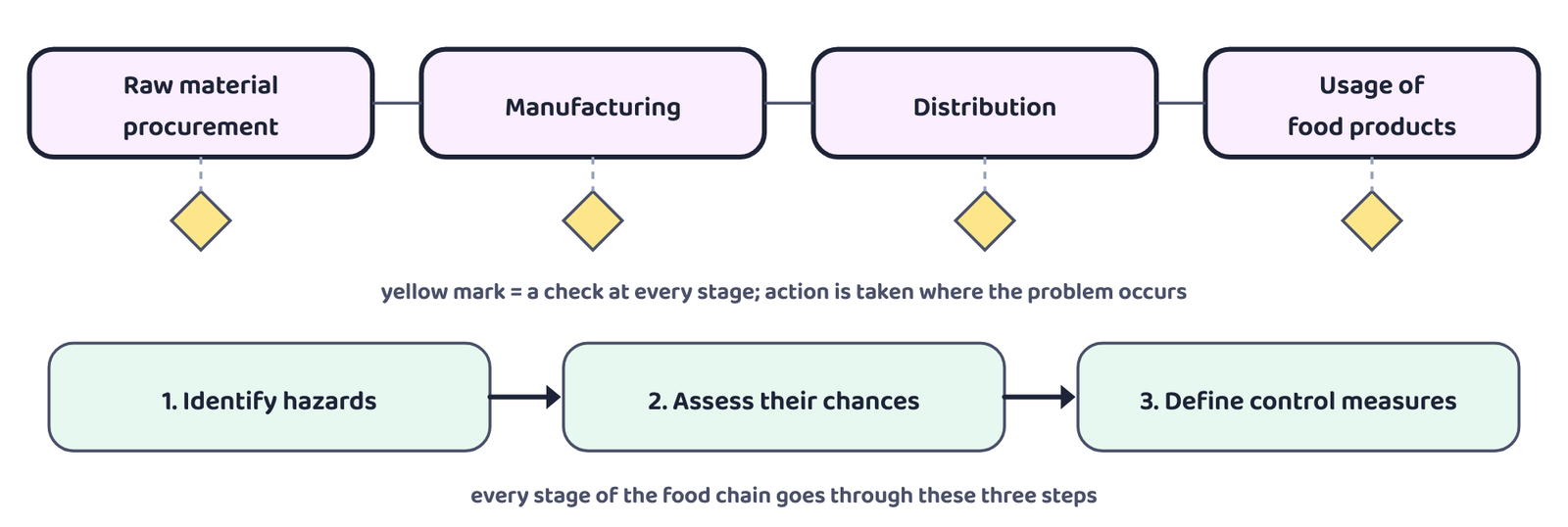
HACCP is a means of providing assurance about the safety of food. It is an approach to food manufacture and storage in which raw materials and each individual step of a process are considered in detail and evaluated for their potential to contribute to the development of pathogenic micro-organisms or other food hazards.
HACCP involves: identification of hazards; assessment of the chances of hazards at each stage of the food chain (raw material procurement, manufacturing, distribution, usage of food products); and defining measures to control the hazards.
8.1 Why implement HACCP (its significance)
- It is a preventive approach to ensure food safety
- End product inspection and testing, though important, is time consuming, expensive and finds problems only after they occur; HACCP detects hazards at any stage of processing or manufacture, so action is taken at the stage where the problem occurs and the end product is good
- It lets producers, processors, distributors and exporters use resources efficiently and cost effectively for food safety
- FSSA, 2006 places the primary responsibility for safe food on producers and suppliers through HACCP, GMP and GHP; this matters for consumer protection and international food trade
- It assures consistently good quality products
| System | Focus | Key idea |
|---|---|---|
| GMP | manufacturers / processors | proactive steps; minimises or eliminates contamination and false labelling |
| GHP | handling from farm to store or consumer | sources of risk; good hygiene of all food handlers |
| HACCP | raw materials and every step of the process | identify, assess and control hazards |
9 Scope and career avenues
- India is growing in food processing; the food industry accounts for about 26 per cent of the gross domestic product (GDP) and will be a major growth area
- This has boosted international trade but also raised the responsibility for safety in terms of sanitary and phyto-sanitary protection
- The FSSA of 2006 is a major shift in food laws; it seeks greater consumer protection by ensuring safe, wholesome food at all stages of the food chain, so careers in this area have grown
9.1 Knowledge needed, posts and opportunities
Adequate knowledge needed
- Food Chemistry
- Food Processing and Preservation
- Food Analysis and Quality Control
Also desirable
- Food Microbiology
- Food Laws
- Sensory Evaluation
- Posts in regulatory and public health agencies: food legislators, food safety officers (inspectors), food analysts / public analysts
- Voluntary agencies such as Agmark and BIS, and Quality Control Laboratories
- After the required training one can work as a food auditor
- Large food industries and flight kitchens have in-house quality control units that need trained professionals

- Self-employment and entrepreneurship: an analytical food laboratory, a food safety consultancy, and Food Safety and Sanitation Education
- Placement options are emerging at different levels in both regulatory and health agencies
- Home Science, especially Food Science and Nutrition, gives the knowledge to improve safety and quality and the skills to understand and manage food safety hazards
- Quality Control Laboratories in the food industry, as analysts or at managerial level
- Food testing laboratories in the public and private sector, in various positions including food inspectors and food testing
- Specialist in HACCP
- Food Auditors
- Quality Certification such as ISO
- Teaching and Academics
- Research
- Scientific writers
- Voluntary organisations, in various capacities
10 Practicals and activities
CBSE 2026-27 practical 5 comes from this chapter: a qualitative test for food adulteration in pure ghee, tea leaves, whole black pepper, turmeric powder, milk or asafoetida. Both practicals and both activities of the book are summarised below (each is solved in full in the NCERT Solutions post).
- Activity 1: keep 5 fresh fruits, 5 fresh vegetables and one food preparation (bread/chapati/roti) at room temperature for a week; list the signs of quality and chart the changes in appearance (bright/dull, shrivelled, mouldy), texture (firmness/softness/soggy), colour and odour when fresh, on day 2 or 3, and on day 7
- Activity 2: visit a restaurant / canteen / dhaba / street food outlet, comment on its cleanliness and hygiene, suggest improvements and prepare a pamphlet on food safety and hygiene for workers using ICT
- Practical 1: check raw and cooked foods from local shops for hazards (below)
- Practical 2: six qualitative tests for food adulteration (below)
10.1 Practical 1: Test of food adulteration
- Purpose: to learn simple ways of identifying adulteration in foods and understand the importance of quality and safety
- Tasks: collect raw and cooked foods from local shops; examine them for adulterants; record observations
| Group | Samples |
|---|---|
| Group A | raw foods: rice, wheat, pulses, spices (mustard seeds, coriander seeds, jeera), tea leaves; 100 g of each from two different shops, preferably loose unpacked |
| Group B | snacks: pakodas, idlis, samosas or any local snack, from two or three different roadside vendors |
| Group C | assorted mithais / Indian sweets from two different vendors |
- Each group uses the work sheet to mark each item as present in large amounts/numbers, moderate amounts, small amounts, or absent: hair, stones, stems and seeds, matchsticks, stapler pins, bidis/cigarettes, camphor balls, worms/insect parts, mercury balls, infested grains, any other
- Use a separate worksheet for each vendor and each food; finally compare and comment on the quality of the food items
10.2 Practical 2: Qualitative tests for food adulteration
The class works in groups of 3-4. Each group brings these samples to class:
| Sample | Sources | Quantity |
|---|---|---|
| Pepper | branded packed, unbranded packed and loose | 25 g each |
| Ice cream | branded and unbranded (made and sold by a local vendor) | 1 small cup |
| Milk | branded packaged, loose | 100 ml |
| Vegetable oil / ghee | sesame oil, groundnut oil, hydrogenated fat/vanaspati, branded and unbranded loose pure ghee | 25 g each |
| Tea leaves | branded, loose locally available leaf teas (3 in number) | 100 g of each |
| Turmeric powder | branded, unbranded packed and loose | |
| Asafoetida powder | branded and unbranded loose |
| Food | Tested for | Chemicals / method (short) | What the result means |
|---|---|---|---|
| Pure ghee | sesame oil (i.e. ghee adulterated with hydrogenated fat / vanaspati, which contains sesame oil) | 5 test tubes (A sesame oil, B groundnut oil, C melted vanaspati, D melted branded ghee, E melted loose ghee), about 2 ml each; add 1 ml of 1 per cent sucrose solution, then 1 ml concentrated hydrochloric acid; shake well | pink colour = sesame oil present |
| Tea leaves | excessive stalks | 5 g tea + 500 ml water, boil 15 minutes, filter; pick out stalks with forceps into a preweighed petridish, dry at 100 degrees, weigh, find the percentage | stalks should be less than 25 per cent |
| Black pepper | light berries | 10 g pepper in a 250 ml beaker + 150-200 ml alcohol water mixture (sp. gr. 0.8 to 0.82); pick out the berries that float, dry, weigh, find the percentage | higher percentage of light berries = the berries have been extracted |
| Turmeric | metanil yellow | 2 g turmeric + 5 ml distilled water, mix; slowly add 5-10 ml concentrated hydrochloric acid | pink to magenta = metanil yellow, a toxic adulterant |
| Milk / ice cream | starch | 10 ml milk or melted ice cream + iodine solution drop by drop, mix | blue colour = starch present |
| Asafoetida (hing) | colophenial resins | 1-2 g hing + 10 ml petroleum ether, shake, filter; to 5 ml filtrate add 5 ml of 0.5 per cent copper acetate solution, shake, let layers separate | blue or green ether layer = colophenial resins, which are not permitted |

Ghee-pink, turmeric-magenta, milk-blue, hing-blue/green
The tea and pepper tests are not colour tests: you weigh and find a percentage. Tea stalks must be under 25 per cent; the more light berries in pepper, the more the berries have been extracted.
- NFHS 2015-2016: more than 9 lakh children under five had acute diarrhoea; food-borne illness harms trade, tourism, earnings and growth
- Toxicity = capacity to harm; hazard = relative probability of harm; hazards are physical, chemical, biological
- Infection = live pathogens (Salmonella, doubles every 20 minutes, cross-contamination); intoxication = toxins (Staphylococcus aureus, in 50 per cent of healthy people)
- Norovirus, Rotavirus, hepatitis E: about 70 per cent of cases; half of known pathogens found in the past 25-30 years
- Safety is a preliminary attribute and precursor of quality
- Four levels of standards: company, national (FSSAI), regional, international (ISO, CAC)
- ISI (BIS, processed foods) and Agmark (agricultural products) are voluntary; FSSA 2006 set up FSSAI; PFA 1954 (amended over 200 times) and three Orders now consolidated under FSSA
- CAC: intergovernmental, “Food Code”; ISO: non-governmental, ISO 9000 quality management, reviewed every five years; WTO: goods, services, intellectual property
- Food control system = food inspection + analytical capability
- GMP (manufacturer, proactive), GHP (farm to consumer), HACCP (identify, assess, control at every step)
- Food industry about 26 per cent of GDP; food safety officers, public analysts, food auditors, HACCP specialists
- Ghee-pink (sesame oil), turmeric-magenta (metanil yellow), milk-blue (starch), hing-blue/green (colophenial resins); tea stalks under 25 per cent
- Can I write the definitions of toxicity and hazard without mixing them up?
- Can I give four differences between food infection and food intoxication, with examples?
- Can I list at least five functions of FSSAI and the three Orders under PFA?
- Can I differentiate Codex from ISO, and ISO from FSSAI on four points?
- Can I explain the significance of HACCP in five points?
- Can I name the chemicals and the result of all six adulteration tests?