
- The five functions of sports event management, and what each one does before a sports meet
- Which of the four committees does which job before, during and after an event
- How to draw a knock-out fixture for any number of teams: halves, byes, their order and seeding
- How to draw a league fixture by the cyclic, staircase and tabular methods, and how a winner is decided on points
- How combination tournaments work, how intramurals differ from extramurals, and what community sports events are for
In the CBSE Physical Education (048) curriculum, this is Unit 1: Management of Sporting Events, worth 5 marks + 4 “b” marks. The “b” marks are concept-based questions (a tactile diagram, data interpretation or a case study) set for visually impaired candidates in place of a picture item. The theory paper is 70 marks; the practical carries 30 marks (fitness tests, one sport or game, yogic practices, record file and viva). The prescribed book is CBSE’s own Physical Education Class XII textbook; there is no NCERT book for this subject.
1 Functions of Sports Event Management
Any sports meet, from a school Sports Day to a state championship, has to be managed. Management is done through five functions. The book calls planning the foremost function and organising the next step after it; the curriculum lists all five in this order: plan, organise, put people in place, direct them, and check that the work is going to plan.
1.1 Planning
Planning is the foremost function of management in sports: it gives a view of the future course of action, clearly defining the aims, goals and objectives of the event and the procedure to achieve them.
- A good plan is specific, logical, flexible and complete in all aspects, and helps in controlling future events.
- A plan must take in all the other functions (organising, staffing, directing, controlling) so that the predetermined goals are achieved.
- Good planning makes the event run smoothly, effectively and free from conflict.
- It explains the procedure or method in simple, easy-to-understand language.
- A sports plan is prepared professionally, with the elements of commitment, enjoyment and voluntary effort.
1.2 Organising
Organising is the step after planning: it is the process of execution of the plan, by distributing resources and organising personnel to achieve the goals set at the planning stage.
- It decides the type of jobs and the responsibility for each, to meet the planning objectives.
- An organisation chart, showing the various positions and who reports to whom, is prepared at this stage.
1.3 Staffing
Staffing means identifying the key staff positions and making sure the proper talent is serving in each job, so that the aims and objectives of the organisation are achieved.
- Recruitment and selection of qualified people takes place here.
- After hiring come orientation (new persons are introduced to the nature, goals and policies of the event), training and professional development.
- Example of posts for a sports event: Director at the top, then Deputy Director, then Assistant Director.
1.4 Directing
Directing is the function of guiding, inspiring and instructing people to accomplish the organisation’s goals. It is a leadership quality.
- It tells the staff what needs to be done, by whom and by when.
- It includes supervision of the staff while motivating them at the same time.
- Without directing, planning and organising have no meaning.
1.5 Controlling
Controlling refers to all the processes that leaders create to monitor success: establishing performance standards, measuring actual performance and comparing the two to find irregularities.
- It involves giving instructions to the staff and making sure those instructions are followed.
- For a sports event, every instruction given to organising committee members must be carried out sincerely for the event to succeed.
- Higher-level management controls lower-level staff so that resources are used efficiently and effectively.
Students mix up the two “people” functions. Staffing is getting the right people into posts (recruitment, selection, orientation, training). Directing is leading the people already in post (telling them what to do, supervising, motivating). The book’s own MCQ asks in which function the “recruitment process” takes place: the answer is staffing.
2 Committees and Their Responsibilities
A sports event is run by committees, formed for its systematic and smooth conduct. Committees are formed on the basis of three levels of management:
| Level | Who (intramural event) | Who (extramural event) | Job |
|---|---|---|---|
| Top | Governing body / Principal | Director / Deputy Director / Supervisor of the state or zone | Prepare policies, aims and objectives |
| Middle | Department heads, physical education teachers | Execute the policies, achieve the aims | |
| Lower | Teachers, administrators, finance officers | Implement the orders of the top level | |
2.1 Hierarchy of the organising committee
Intramural event (in school)
- Chairperson: Principal of the school
- Convener: Physical Education Teacher
- Members: Teachers of the school
- Head Boy/Girl: Sports Secretary/President
Extramural event (between schools)
- Chairperson: Director of Physical Education and Sports in the State Government
- Convener: Deputy Director / Assistant Director / Supervisor Sports
- Members: Physical Education Teachers of different schools
There is no fixed number of committees. It depends on the number of participants, the level of the event, the area of specialisation and the dedication of volunteers. By and large, four committees are formed under one organising committee.
2.2 Technical Committee
Handles the technical side: requisitions to procure sports equipment, and conducting matches on time through selected officials (referees, umpires, judges, timekeepers).
2.3 Logistics Committee
Has a wider scope of work: transportation, boarding and lodging, refreshment, decoration and the ceremonies. It may have sub-committees. It looks after the Opening Ceremony, hires the photographer/videographer, and arranges the Victory and Closing Ceremonies, including reception, entertainment, light and sound, and the medical side.
2.4 Finance Committee
Provides financial oversight: planning, accounting and decision-making about money. It finalises sponsorship, watches the inflow and outflow of money, buys equipment and other items, and settles officials’ payments. It pitches to companies to attract sponsors. The book calls it the backbone of the sports tournament.
2.5 Marketing Committee
Develops plans and strategies to place the event in the market, for publicity and sponsorship. Publicity runs through social media, print media, TV, e-mail and so on. Sponsorship can be in cash or kind, through media partners, food partners, drink partners. It also runs campaigns for the event.
Every committee has a job before (pre), during and after (post) the event. This table is the exact shape of a “role of the committee” answer:
| Committee | Pre-event | During the event | Post-event |
|---|---|---|---|
| Technical | Requisition to purchase equipment; invite and confirm officials; cleaning and layout of fields; arrange equipment and stationery; prepare fixtures, rules and regulations | Conduct matches; ensure presence of the jury; cleaning and layout of fields; collect score sheets from officials; prepare the merit list | Cleaning and layout of fields; maintenance of the field; put all equipment back in the store |
| Logistics | Stationery, chairs, tables, souvenirs, light and sound, bouquets; invitations to stakeholders, other schools and VIP guests; requisition for medals and certificates; refreshments; boarding and lodging; select volunteers; first aid kit and medical facilities | Conduct Opening and Closing Ceremonies; check registration; distribute refreshment; manage spectators; hand over medals and certificates; transport players between place of stay and field | Supervise cleaning of the venue; put items back in their places |
| Finance | Prepare the budget; purchase equipment, stationery, medals, certificates and items other committees need; prepare and finalise the MoU with sponsors | Check inflow and outflow of money, including payment and remuneration of officials | Examine records of settled bills and accounts; prepare the financial report |
| Marketing | Strategy for sponsorship and publicity; meet or call on sponsors; prepare MoUs for sponsorship | Issue press releases; work with the media; manage communication; meet sponsors’ requirements as per MoUs; arrange telecast | Issue a press release; may arrange a re-telecast |
“Purchase of sports equipment” and “requisition for equipment” are two different jobs. The Technical Committee only puts forward the requisition (asks for it). The Finance Committee actually purchases the equipment. “Rules and regulations” and “fixtures” belong to the Technical Committee, and they are prepared before the event.
T-F-M-L: “The Field Means Lots”
Technical runs the field, Finance holds the money, Marketing talks to the media, Logistics looks after people and things.
2.6 Checklist for organising a sports event
The book gives a 23-point checklist. Here its items are grouped for easy recall:
Set up
Formation of organising committees · objectives · theme · date · place of the event
Money
Budget · sponsorship · marketing campaign · checking on the sponsors
Teams and rules
Invitations to teams and guests · confirmation of teams · drawing fixtures and layout of field · rules and regulations
On the ground
Logistics (accommodation, refreshments, transport, medical staff, water, tables, chairs, flags, notice board) · equipment and score sheets · referees and prizes · sign posts to the stadium · practice and warm-up area
People and safety
Briefing of volunteers and staff · decorations · security · photographers · approvals, licence and NOCs
3 Tournaments and Fixtures: The Basics
A tournament is a series of games or matches played among players or teams to determine the winner.
A tournament gives a chance to demonstrate skills, evaluate one’s performance, motivate players to perform well, attract people to sports so that sports become popular, and provide healthy entertainment.
Tournaments are of three types, according to how teams move ahead or get eliminated:
3.1 Knock-Out tournament
In a Knock-Out Tournament, a player or team continues to play matches until it is defeated. A defeated team is eliminated.
3.2 League or Round Robin tournament
In a League or Round Robin Tournament, each player or team plays a fixed number of matches allotted before the start, so that every team gets an equal chance to play every other team.
| Knock-Out | League (Round Robin) | |
|---|---|---|
| A defeat means | Elimination from the tournament | The team stays; it just earns fewer points |
| Cost and time | Saves cost and time | Needs more money, time and facilities |
| Each match | Intensive, because of the fear of elimination; teams must give their best every time | Fixed number of matches for every team |
| Fairness | Draws are by lots, so two good teams may meet early; a good team can go out early by chance or accident | Equal chance to every team; the true winner emerges |
| Ranking | A ranking of all teams is not possible | A ranking of all teams can be prepared |
| Seeding | Possible | No provision of seeding for extraordinary teams |
| Matches for N teams | N − 1 | N(N − 1) ÷ 2 |
3.3 Combination tournament
A Combination Tournament combines the knock-out and league formats, for example Knockout-League, League-Knockout or Knockout-League-Knockout.
Combination tournaments are held when (a) the number of participants is large, (b) the participants are spread over different areas, or (c) the venues are in different zones or places. They remove some of the demerits of both knock-out and league tournaments.
3.4 Fixture
A fixture is the programme listing which team will play whom, where (venue) and when (time). In the book’s words, it is “a process of arrangement of the teams in systematic order in various groups for competitive fights for physical activity”.
- The book also quotes two short dictionary meanings: “a sports event or its date” and “a sports match that has been arranged for a particular time and place”.
- In athletics and swimming the word used is heats; in tennis, badminton and other games the words are ties or fixtures.
- An unbiased draw of fixtures is the road to a successful tournament.
3.5 Bye
A bye means a team is not required to play the first (primary) round because of the allotment of draws; it moves to the next round without playing. Byes are given through a random lottery system.
The organising committee gives byes for these reasons:
- Uneven number of teams: a knock-out works smoothly only when the number of teams is a power of two (8, 16, 32, 64 …); in a league, byes are needed when the number of teams is odd.
- Separate pooling of previous winners in the same group, to create even competition.
- To stop one team from playing more matches on a single day than the others, which would put some teams at a disadvantage.
Other definitions the book quotes: “a sportsman in a tournament who is without an opponent”, and “the right to proceed to the next round of a competition without contesting the present round, often through non-appearance of an opponent”.
3.6 Seeding
Seeding is the process of placing teams so that good teams (by ranking, previous year’s position and so on) do not meet each other at an early stage of the tournament. It reduces the chance of good teams being eliminated early.
The procedure for placing seeded teams is the same as for byes (Section 4.3). Other definitions the book quotes: “to arrange or schedule, as competitive teams or players, so that the most skilled are matched in the later rounds of play”, and “to rank a player according to the perceived likelihood of his or her winning a specific tournament”.
4 Drawing a Knock-Out Fixture
Every knock-out fixture is drawn with the same handful of formulas. Learn them as one set.
Number of rounds = the power to which 2 is raised to reach the next power of 2 (8 teams: 2³ = 8, so 3 rounds; 25 teams: 2⁵ = 32, so 5 rounds). Matches in the first round = (N − NB) ÷ 2. These two are not printed as formulas in the book, but the book’s own case study (25 teams) asks for both, and both follow directly from the steps below.
4.1 The six steps
4.2 Brackets with no byes
When N is a power of 2, every team plays in round 1. With 4 teams there are 3 matches: two in round 1 and the final. With 8 teams there are 7 matches in 3 rounds: four in round 1, two semi-finals and the final.

4.3 The order in which byes are given
The book prints two orders. Both start the same way: the 1st bye goes to the last team of the lower half and the 2nd bye to the first team of the upper half. They differ in the 3rd and 4th:
| Bye | Order given first | Order given second (“OR”) |
|---|---|---|
| 1st | Last team of lower half | Last team of lower half |
| 2nd | First team of upper half | First team of upper half |
| 3rd | Last team of upper half | First team of lower half |
| 4th | First team of lower half | Last team of upper half |
| 5th onwards | Repeat the same pattern, moving one team inward each time (second-last of lower half, second of upper half, and so on) | |
The book’s own worked fixture (Illustration 3) uses the second order, and the brackets below follow it too. With this order the byes always split as the Step 4 formula says: (NB − 1) ÷ 2 in the upper half and (NB + 1) ÷ 2 in the lower half.
Byes start at the ends of each half (top and bottom) and move inward one place at a time; the middle teams play the first round. The very first bye always goes to the bottom team (last team of the lower half). Label them B1, B2, B3 … in your fixture so the order is clear.
4.4 Worked bracket: 7 teams (1 bye), a practice example
Matches = 7 − 1 = 6 · Halves: upper = (7 + 1) ÷ 2 = 4, lower = (7 − 1) ÷ 2 = 3 · Byes = 8 − 7 = 1, which goes to the lower half: (1 + 1) ÷ 2 = 1 · B1 = team 7 (last team of lower half) · Rounds = 3

4.5 Worked bracket: 11 teams (5 byes), the book’s Illustration 3
Matches = 11 − 1 = 10
Halves: upper = (11 + 1) ÷ 2 = 6 (teams 1 to 6), lower = (11 − 1) ÷ 2 = 5 (teams 7 to 11)
Byes = 16 − 11 = 5 → upper = (5 − 1) ÷ 2 = 2, lower = (5 + 1) ÷ 2 = 3
Order: B1 = 11, B2 = 1, B3 = 7, B4 = 6, B5 = 10
Round 1: 2 vs 3, 4 vs 5, 8 vs 9 (3 matches) · then 4 matches in round 2, 2 semi-finals and the final

4.6 Worked bracket: 13 teams (3 byes), the book’s exercise III.1
Matches = 13 − 1 = 12
Halves: upper = (13 + 1) ÷ 2 = 7 (teams 1 to 7), lower = (13 − 1) ÷ 2 = 6 (teams 8 to 13)
Byes = 16 − 13 = 3 → upper = (3 − 1) ÷ 2 = 1, lower = (3 + 1) ÷ 2 = 2
Order: B1 = 13 (last of lower), B2 = 1 (first of upper), B3 = 8 (first of lower)
Round 1: 2 vs 3, 4 vs 5, 6 vs 7, 9 vs 10, 11 vs 12 (5 matches) · Rounds = 4

12 teams: 11 matches; 6 + 6 teams; 16 − 12 = 4 byes, 2 in each half.
15 teams: 14 matches; upper 8, lower 7; 16 − 15 = 1 bye, in the lower half.
19 teams: 18 matches; upper 10, lower 9; 32 − 19 = 13 byes, 6 upper and 7 lower; 5 rounds.
25 teams: 24 matches; upper 13, lower 12; 32 − 25 = 7 byes, 3 upper and 4 lower; (25 − 7) ÷ 2 = 9 first-round matches; 5 rounds.
58 teams: 57 matches; 64 − 58 = 6 byes, 3 in each half; 6 rounds.
4.7 Seeding in a knock-out fixture
Seeded teams are placed in the same positions, in the same order, as byes. This puts them at the two ends of each half, as far from each other as possible, so they can only meet in the later rounds.
Q. (Practice example applying the book’s rule.) 16 teams enter. The four strongest teams from last year are to be seeded. Where do they go?
Answer: 16 is a power of 2, so there are no byes, but the seeds still take the bye positions in the bye order: S1 = team 16 (last of lower half), S2 = team 1 (first of upper half), S3 = team 9 (first of lower half), S4 = team 8 (last of upper half). Now S1 and S2 are in different halves and can meet only in the final; no two seeded teams can meet before the semi-finals.

5 Drawing a League (Round Robin) Fixture
In a league, each team plays once with every other team. So the first step is always to count the matches.
5.1 Cyclic method
In the Cyclic Method, one team is fixed in position and the other teams are rotated round it, one place per round, until the cycle is complete.
Even number of teams (6): no bye is needed. Rounds = 6 − 1 = 5. Team 1 stays fixed at the top of the right-hand column; the others move one place clockwise each round.

| Round I | Round II | Round III | Round IV | Round V |
|---|---|---|---|---|
| 6 vs 1 | 5 vs 1 | 4 vs 1 | 3 vs 1 | 2 vs 1 |
| 5 vs 2 | 4 vs 6 | 3 vs 5 | 2 vs 4 | 6 vs 3 |
| 4 vs 3 | 3 vs 2 | 2 vs 6 | 6 vs 5 | 5 vs 4 |
Odd number of teams (7): one team gets a bye in each round, and a different team gets it in the next round. Rounds = number of teams = 7. Here “Bye” takes the fixed position, and the seven teams rotate.
| I | II | III | IV | V | VI | VII |
|---|---|---|---|---|---|---|
| 7 (Bye) | 6 (Bye) | 5 (Bye) | 4 (Bye) | 3 (Bye) | 2 (Bye) | 1 (Bye) |
| 6 vs 1 | 5 vs 7 | 4 vs 6 | 3 vs 5 | 2 vs 4 | 1 vs 3 | 7 vs 2 |
| 5 vs 2 | 4 vs 1 | 3 vs 7 | 2 vs 6 | 1 vs 5 | 7 vs 4 | 6 vs 3 |
| 4 vs 3 | 3 vs 2 | 2 vs 1 | 1 vs 7 | 7 vs 6 | 6 vs 5 | 5 vs 4 |
Count every “vs” in your table. It must equal n(n − 1) ÷ 2: 15 for 6 teams, 21 for 7 teams. Each team must appear exactly once in every round (or have the bye).
5.2 Staircase method
In the Staircase Method, one team is fixed on the highest step and plays all the other teams; on the next step down, the next team is fixed to play all the remaining teams, and so on.

The book draws the staircase for 7 teams (A to G): the last row reads A vs G, B vs G, C vs G, D vs G, E vs G, F vs G, and the staircase holds 21 matches. Under the staircase, the matches are then listed in a “details of matches” table with the columns: Match No · Team A vs Team B · Date · Time · Venue · Result.
5.3 Tabular method
The CBSE curriculum names a third league method, the tabular method. (The book’s unit text works out only the cyclic and staircase methods.) Write the teams along the top and down the side of a grid. Each box above the diagonal is one match; the diagonal boxes (a team against itself) are crossed out, and the boxes below the diagonal repeat the same pairs, so they are left blank.
| Teams | A | B | C | D | E | F |
|---|---|---|---|---|---|---|
| A | × | 1 | 2 | 3 | 4 | 5 |
| B | × | 6 | 7 | 8 | 9 | |
| C | × | 10 | 11 | 12 | ||
| D | × | 13 | 14 | |||
| E | × | 15 | ||||
| F | × |
Read it as: match 1 is A vs B, match 7 is B vs D, match 15 is E vs F. The numbered boxes come to 15, the same as 6 × 5 ÷ 2.
5.4 Deciding the winner: the points table
In a league, the winner and the ranking are decided on points. The book’s example scale is Winner = 5, Draw = 3, Loser = 0. Total points = (wins × 5) + (draws × 3).
| Team | Played | Won | Lost | Drawn | Points | Rank |
|---|---|---|---|---|---|---|
| A | 5 | 4 | 0 | 1 | 4×5 + 1×3 = 23 | I |
| B | 5 | 3 | 1 | 1 | 15 + 3 = 18 | II |
| F | 5 | 0 | 0 | 5 | 0 + 15 = 15 | III |
| C | 5 | 1 | 2 | 2 | 5 + 6 = 11 | IV |
| E | 5 | 1 | 2 | 2 | 5 + 6 = 11 | IV |
| D | 5 | 0 | 4 | 1 | 0 + 3 = 3 | V |
C and E are level on 11 points, so they share rank IV. The organisers frame the rules for a tie before the tournament starts.
A case study may use a different points scale, such as football’s 3 points for a win and 1 for a draw. Always find the scale first by testing one row: if a team with 13 wins and 4 draws has 43 points, then 13 × 3 + 4 × 1 = 43, so the scale is win = 3, draw = 1. Then rank every team by points.
When every pair of teams meets twice, it is a double league, and the matches double: n(n − 1). For 7 teams: 7 × 6 = 42 matches. This is not worked in the book’s unit, but the CBSE sample paper uses it (its example is the IPL).
6 Combination Tournaments
A combination fixture is drawn by the same steps as knock-out and league fixtures, one stage after the other. The book works a League-Knockout fixture for 8 teams.
6.1 League stage
Matches = 8 × 7 ÷ 2 = 28. 8 is even, so rounds = 8 − 1 = 7, with no bye. The book’s round table keeps team 8 fixed and rotates the others (cyclic method):
| Round 1 | Round 2 | Round 3 | Round 4 | Round 5 | Round 6 | Round 7 |
|---|---|---|---|---|---|---|
| 1-8 | 7-8 | 6-8 | 5-8 | 4-8 | 3-8 | 2-8 |
| 2-7 | 1-6 | 7-5 | 6-4 | 5-3 | 4-2 | 3-1 |
| 3-6 | 2-5 | 1-4 | 7-3 | 6-2 | 5-1 | 4-7 |
| 4-5 | 3-4 | 2-3 | 1-2 | 7-1 | 6-7 | 5-6 |
Points are given as Winner = 5, Draw = 3, Loser = 0, and a points table ranks the teams. In the book’s example, the top four teams, 1, 5, 6 and 8, qualify for the knock-out rounds.
6.2 Knock-out stage
The tournament committee decides before the tournament how qualified teams will be paired in the semi-finals. In its example the book places the teams as per their ranking: 1st (team 1) vs 2nd (team 5) and 3rd (team 6) vs 4th (team 8). It lists other patterns too: 1st vs 3rd and 2nd vs 4th; or 1st vs 4th and 2nd vs 3rd; or a draw of lots.
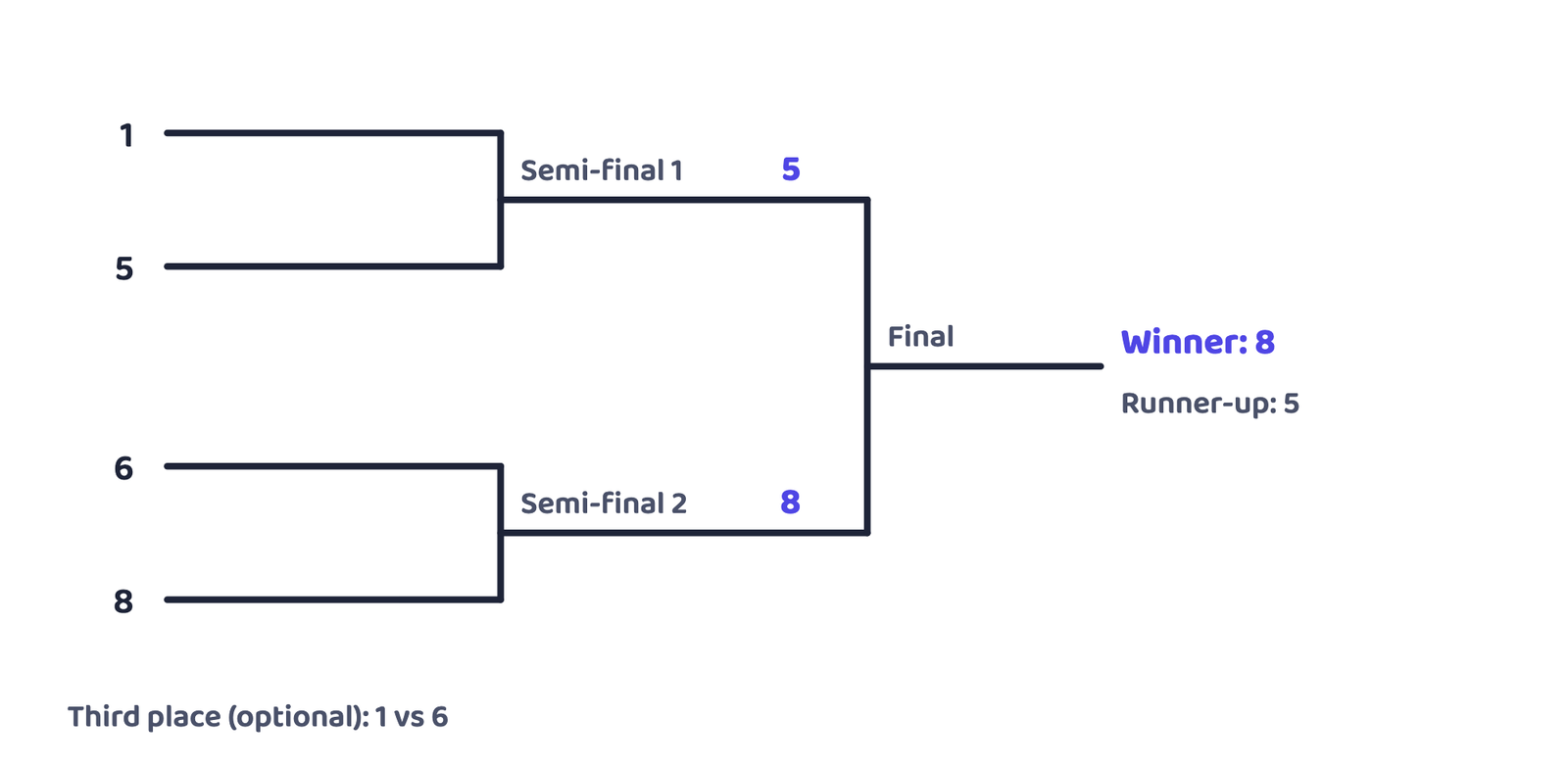
So team 8 is the winner of the League-Knockout tournament and team 5 is the runner-up.
Q. How many matches are played in all in this 8-team League-Knockout? (The book does not total them; work it out from the two stages.)
Answer: League 28 + semi-finals 2 + final 1 = 31 matches (32 if the third-place match is played).
The FIFA World Cup, the world’s largest event by viewership, uses a League-Knockout combination. In the format the book describes, there are eight groups (A to H) of four teams; every team plays the other three in its group, and the top two from each group go to the pre-quarterfinals, where the knock-out rounds begin.
7 Intramural and Extramural Tournaments
7.1 Intramural
Intramural means “within the walls”. An intramural tournament is conducted within the walls of a single institution, school or community, among its own players.
Examples: Sports Day, Sports Festival, Athletics Meet, Swimming Meet, a badminton tournament among Houses, Classes, Hostels or Residents of one school.
Objectives of intramurals
(i) Mass participation in sports in the institution · (ii) all-round development of children · (iii) values like fair play, respect, friendship · (iv) first opportunity to compete in a controlled environment · (v) fitness, wellness and health · (vi) curricular integration through sports · (vii) personality: first stage of leadership, control of emotions, cooperation
Significance of intramurals
(i) Selection for extramural: players show their skill and fitness here, which becomes the base for selecting players or teams · (ii) group cohesion: students of different classes, houses, backgrounds and communities cooperate, gain self-confidence, develop social relations and tolerance of other cultures · (iii) professional experience: helping to conduct the tournament gives experience of officiating and event management, useful later in professional and personal life · (iv) health: a healthy, active lifestyle; physical, mental, social and spiritual well-being · (v) recreation: joy, because the events are not so competitive · (vi) mass participation: meant for all students, not only players
7.2 Extramural
Extramural means “outside the boundary or walls”. An extramural tournament is conducted outside the walls of the organising unit, between players or teams of two or more schools, colleges or institutions.
Examples: Zonal, Inter-District, State, National or International tournaments.
Objectives of extramurals
(i) High performance at the highest level of the tournament · (ii) a feeling of integration with other institutions · (iii) opportunities to choose a career in sports · (iv) social, cultural and economic development through sports
Significance of extramurals
(i) Progression in performance: experience, tactics and strategies, fitness, psychological preparation · (ii) psychological factors: balance stress, confidence, self-esteem, emotions; build leadership and team building · (iii) level of fitness rises with the level of the tournament, making a person physically and mentally strong to compete at higher levels · (iv) socialisation: cross-cultural exchange and closer ties between communities, regions and countries
| Intramural | Extramural | |
|---|---|---|
| Meaning | Within the walls of one institution | Outside the walls; between institutions |
| Who takes part | Students of the same school (houses, classes, hostels) | Teams representing different schools, colleges, districts, states, countries |
| Main aim | Mass participation, all-round development | High performance at the highest level of the tournament |
| Environment | Controlled environment; activities are not so competitive | Higher levels of tournament, which raise performance and fitness |
| Examples | Sports Day, inter-house matches | Zonal, Inter-District, State, National meets |
8 Community Sports: Purpose and Benefits
Community sports is a society-based practice of connecting and engaging people with opportunities to participate in sports, exercise and fitness activities.
- It can be the backbone of health promotion for school children, adults, elders and socially vulnerable groups.
- Purposes: community awareness programmes, social campaigns, talent search, recreation and more.
- Community sports are called low-threshold sport activities: almost anyone can join, which makes them a powerful way to bring many people into sport and fitness.
- They are not always competitive, and even when organised they may not follow the rule book strictly: parents, experienced players or community volunteers may act as officials.
- They should be held in residential societies, villages, cities and schools, to create harmony among all age groups, including senior citizens, women and the differently-abled.
8.1 Benefits of community sports
Health
Improves cardiovascular and muscular health; lowers the risk of lifestyle diseases; good for physical and mental health.
Social
Make friends; people work together towards a common goal; a sense of belonging; group cohesion; good citizens.
Psychological
Better psycho-social health; higher self-esteem; personal development; stress management.
Economic
Less burden on the health budget; optimum use of resources; healthy people mean lower medical bills and more production; weaker sections can also take part.
Regular community activities (cricket, volleyball, football, basketball, yoga, aerobics, morning walk, jogging) let neighbours know each other and build camaraderie and trust in the society.
8.2 Community sports events
| Event | Purpose | Key points |
|---|---|---|
| Sports Day | Showcase the abilities of children and youth; a chance for community members to meet and interact | Shows the organisational strength of the society; focus on maximum engagement, not only talented athletes. National Sports Day: 29th August, birth anniversary of hockey legend Major Dhyan Chand |
| Health Run | Improve health standards and spread awareness of physical activity; or raise charity | Aim is to participate, not to win; many registrations needed; no age bar; not a professional race, no long distance; run by NGOs or health departments |
| Run for Fun | Spread the message of staying fit; sometimes to raise funds | Friendly races for any age; careful planning to avoid accidents (age, mobility, movements). Examples: lemon and spoon race, sack race, three-legged race, parent and child race, teacher and child race, banana race, road running |
| Run for Specific Cause | Awareness about a social issue, or charity | Causes such as cleanliness, a green environment, cancer, AIDS, gender inequality |
| Run for Unity | Promote integrity and brotherhood in a community, state, nation or among religions | Builds bonding and a sense of togetherness |
| Games and Sports | Wholesome development of the community | Indigenous games such as kho-kho, kabaddi, marbles and gilli danda keep people familiar with the nation’s cultural heritage |
The Fit India Movement was launched on 29th August 2019, Major Dhyan Chand’s birth anniversary, by Prime Minister Shri Narendra Modi, to make people physically active and keep them away from lifestyle diseases. His words: “Swasth vyakti, swasth parivar aur swasth samaj, yahi naye Bharat ko shresth Bharat banane ka raasta hai.”
Do not mix up the runs. Unity → brotherhood and integrity. Specific cause → one social issue (cleanliness, cancer, AIDS). Health Run → health awareness, no age bar. Run for Fun → fun races like the sack race.
- Five functions in order: Planning → Organising → Staffing → Directing → Controlling. Planning is the foremost; recruitment happens in staffing.
- Three levels of management (top, middle, lower); four committees: Technical, Finance, Marketing, Logistics, each with pre, during and post duties.
- Technical: fixtures, rules, officials, merit list. Finance: budget, MoU, financial report (the backbone). Marketing: publicity, press release, telecast. Logistics: ceremonies, stay, transport, first aid.
- Knock-out: N − 1 matches; halves (N + 1) ÷ 2 and (N − 1) ÷ 2; byes = next power of 2 − N; odd byes: (NB − 1) ÷ 2 upper, (NB + 1) ÷ 2 lower; first bye to the last team of the lower half.
- Seeding keeps good teams apart; seeds take the bye positions in the bye order.
- League: n(n − 1) ÷ 2 matches; cyclic (one team fixed, rounds n − 1 or n), staircase (top step plays all), tabular (boxes above the diagonal); winner by points.
- Combination: e.g. League-Knockout; used for many teams, spread-out participants or venues in different zones.
- Intramural = within the walls (mass participation); extramural = outside the walls (high performance).
- Community sports are low-threshold; benefits: health, social, psychological, economic; events: Sports Day (29 August), Health Run, Run for Fun, Run for Specific Cause, Run for Unity.
- Can I draw a knock-out fixture for 9, 13 or 19 teams with the byes labelled B1, B2 … in the right places?
- Can I draw a cyclic fixture for 5 teams and a staircase for 6 teams, and check the match count?
- Can I write the pre, during and post duties of any committee without mixing them up?