
- What talent identification and talent development mean, the five stages, and how a talent identification system works from age 10 to 16
- How a sports training plan is split into micro, meso and macro cycles, with their durations and purposes
- The types of strength, endurance and speed, and the methods used to develop each one
- The types of flexibility and the stretching methods that improve it, including PNF
- The seven coordinative abilities, and how circuit training works
In the CBSE Physical Education (048) curriculum, this is Unit 10: Training in Sports, worth 9 marks. The prescribed book is CBSE’s own Physical Education Class XII textbook; there is no NCERT book for this subject. The 2026-27 sample paper asks this unit as 1-mark MCQs (the two major components of load; the meaning of strength), a 2-mark question on isometric exercises for the shoulder region, and a 5-mark question on the sports training cycle (micro, meso and macro). The curriculum also lists circuit training, which the book does not cover; section 8 teaches it as general knowledge.
Born in 1929, he joined the army in 1951 and found his sprinting talent there. He set a national record of 45.73 seconds in the 400 m at the 1960 Olympics (fourth place), which stood for almost 40 years, and he is the only athlete to win 400 m gold at both the Commonwealth Games and the Asian Games. He ran 365 days a year, with a fixed weekly plan of sprints in the season. His story shows what this chapter is about: talent that is spotted, then developed through planned training.
1 Talent Identification and Talent Development
Talent identification and development have become increasingly important in sports performance, especially in the last 20 years. Research studies the qualities behind elite performance and how coaches can help talented athletes develop through the sports system.
Talent is adequate aptitude or ability in one direction, above the normal average. Someone with talent can do something without trying hard.
Talent identification is “the process by which children are encouraged to participate in the sport they are most likely to succeed, based on selected parameters. These parameters are designed to predict performance capacity, considering the child’s current level of fitness and maturity.”
Identification is the first step in the progression from beginner to successful international athlete. Talent development follows as the next critical phase in achieving sporting success.
1.1 The talent identification system (Table 10.1)

| Stage | Age | What happens |
|---|---|---|
| First stage | 10 to 12 years | Easy field tests, carried out in schools and given by the teachers. Those who seem talented are encouraged into general training in schools and clubs. |
| Second stage | 13 to 16 years | Easy tests again in schools. Those selected then take more sophisticated tests by specialists in area or state centres: field tests and laboratory tests, depending on the facilities. |
| Final step | 13 to 16 years | Those selected go to elite junior programmes on an event-group basis. Promising athletes not selected join club training programmes. All tested youths are encouraged into recreational sports. |
The test battery at the second stage should include: background information, training history, competition results, anthropometric (body) measurements, and psychological and physiological tests.
Work with schools
The best way to reach the maximum number of children
Keep the door open
Good competition performance should always give a chance to enter the selection
Local but standard
In developing countries, tests are adapted to local conditions but standardized across the whole country; promote a youth competition structure
1.2 Five stages of talent identification and development

| Stage | Meaning (as in the book) |
|---|---|
| 1. Talent detection | Discovery of potential performers who are not currently involved in the sport in question |
| 2. Talent identification | Recognizing participants with the potential, at an earlier age, to become elite performers in the future |
| 3. Talent development | Provides athletes with a suitable learning environment to accelerate or realize their potential |
| 4. Talent selection | The ongoing process of identifying individuals at various stages of development who demonstrate pre-requisite performance levels |
| 5. Talent transfer | Transfer from one sport to another sport where there are more significant opportunities to succeed |
These five steps are common across sports, and in everyday practice the selection for the next step of a programme is influenced by performance in the previous development environment.
1.3 Importance and components of talent identification
Importance
- Discovery of great talent
- Recognition of hidden talent
- Talent recognised at an early stage lets children show their skills at their extreme
- Finds a significant asset for the country
Components (six)
- Physiological attributes
- Physical attributes
- Psychological attributes
- Technical/Tactical attributes
- Results
- Intangibles
A short meaning of each component, to write in a long answer (our explanation; the book only names them): physiological means how the body works under load, such as heart, lungs and muscle fibre type; physical means body size, build and motor abilities like speed and strength; psychological means cognitive, emotional and personality traits such as motivation and concentration; technical/tactical means skill and game sense; results means competition performance; intangibles means qualities that are hard to measure, such as attitude and coachability.
“PPP-T-R-I”
Physiological, Physical, Psychological, Technical/Tactical, Results, Intangibles: the six components of talent identification.
1.4 Steps for talent and its promotion (Do you know box)
| Step | When and aim | Selection is based on |
|---|---|---|
| Step I | Screening of children for the basic training stage | Health and physique; general physical performance capacity; motives, interest and mental capabilities; interests of parents |
| Step II | After 3-4 years of basic training: selection for a group of sports (advanced training stage) | Physique and motor abilities; ability to tolerate load; performance; cognitive, emotional and personality traits |
| Step III | After 3-4 years of advanced training: selection for a sport (high-performance training stage) | Physique; performance and the potential for performance; talent indicators; cognitive, emotional and personality traits |
2 Sports Training Cycle: Micro, Meso and Macro
A sportsperson follows a planned system of training to reach high performance. The planning formats are the long-term plan, Olympic plan, annual plan, sectional plan and day’s plan. All of them form one unified training base. The shorter the plan, the more concrete and specific its training content, and every short plan is made to fit the needs of the longer plans.
The long-term plan is the largest unit in the system of planned training. It lasts about 8 to 15 years, beginning with the basic training of the sportsperson and continuing until optimum performance in a specific sport is reached.
2.1 An Olympic plan in smaller time units
An Olympic plan is divided into small time units. At each level the coach first makes an assessment, then a prediction, then a prescription (the actual plan).

2.2 Sectional plans and the three training cycles
The most common plans in sports training are sectional plans, the plans of phases, periods and weeks. The three periods of a training year (preparatory, competition and transitional periods) and the three training cycles (micro, meso and macro) are all sectional plans. They are made from the needs and recommendations of the annual plan, and because they are short, their training details are more specific.
A sports training cycle is a planned unit of training of fixed duration (a micro, meso or macro cycle) in which load and recovery are arranged so that the sportsperson improves step by step and reaches peak performance at the right time. (Our working definition, built from the book’s description of the three cycles.)

| Point | Micro cycle | Meso cycle | Macro cycle |
|---|---|---|---|
| Duration | 3 to 10 days (5 to 10 days for intermediate and high-performance sportspersons) | 3 to 6 weeks; 4 weeks is considered best | 3 to 12 months |
| Called | Shortest cycle | Cycle of medium duration | Longest (most extended) cycle |
| Purpose | An integral part of the whole training process, though too short for most training tasks | To tackle specific training tasks (six, listed below) | To improve performance capacity so the sportsperson gives an optimal performance at a specific time during the competition |
| Recovery | Last day: active recovery and relaxation | Last week: a transitional phase for recovery and relaxation | Last mesocycle: recovery, for a smooth move to the next macrocycle |
Load in a micro cycle
Three proportions of high load to medium (or low) load are used in a micro cycle:

- 1:1: every day of high load is followed by a day of medium load.
- 2:1: every two days of high load are followed by a day of medium load.
- 3:1: every three days of high load are followed by a medium or low load day.
The six specific training tasks of a meso cycle
Learning and acquiring mastery of skills
Maintenance and stabilization of performance
Development of physical and motor fitness components
Preparation for a specific competition
Attainment of optimal level of performance
Preparation for the next mesocycle by providing recovery and relaxation
A mesocycle of 4 weeks is considered the best because it is the minimum period in which a significant change takes place in physiological and psychological factors.
(Our explanation; the book uses the word only in an exercise.) Dividing the training year into periods and cycles is called periodization. Load is raised step by step and followed by recovery, so the body adapts without breaking down, each cycle has a clear task, and the athlete peaks exactly at the championship instead of too early or too late.
Psychologist Anders Ericsson writes that it takes 10,000 hours of practice to become an expert. An athlete training 5 hours a day, seven days a week, all 365 days of the year trains hours a year, so needs years to become an expert.
“Micro = Days, Meso = Weeks, Macro = Months”
3 to 10 days, 3 to 6 weeks, 3 to 12 months: every cycle starts at 3.
3 Strength
Strength is one of the most important motor components of fitness. It is a conditional ability that depends on the energy release process in the muscles, and it is a direct product of muscle contraction. Since every movement in sport comes from muscle contraction, strength is part and parcel of all motor abilities, technical skills and tactical actions. The amount of force muscles can produce to complete a task is strength.
Strength is the ability of a group of muscles to overcome resistance.
- H. Singh: “strength is the ability to overcome resistance or to act against resistance.”
- Barrow and McGee: “strength is the capacity of the whole body or any of its parts to exert force.”
- Mathews: “The force that a muscle or group of muscles can exert against a resistance in one maximum effort.”
3.1 Types of strength
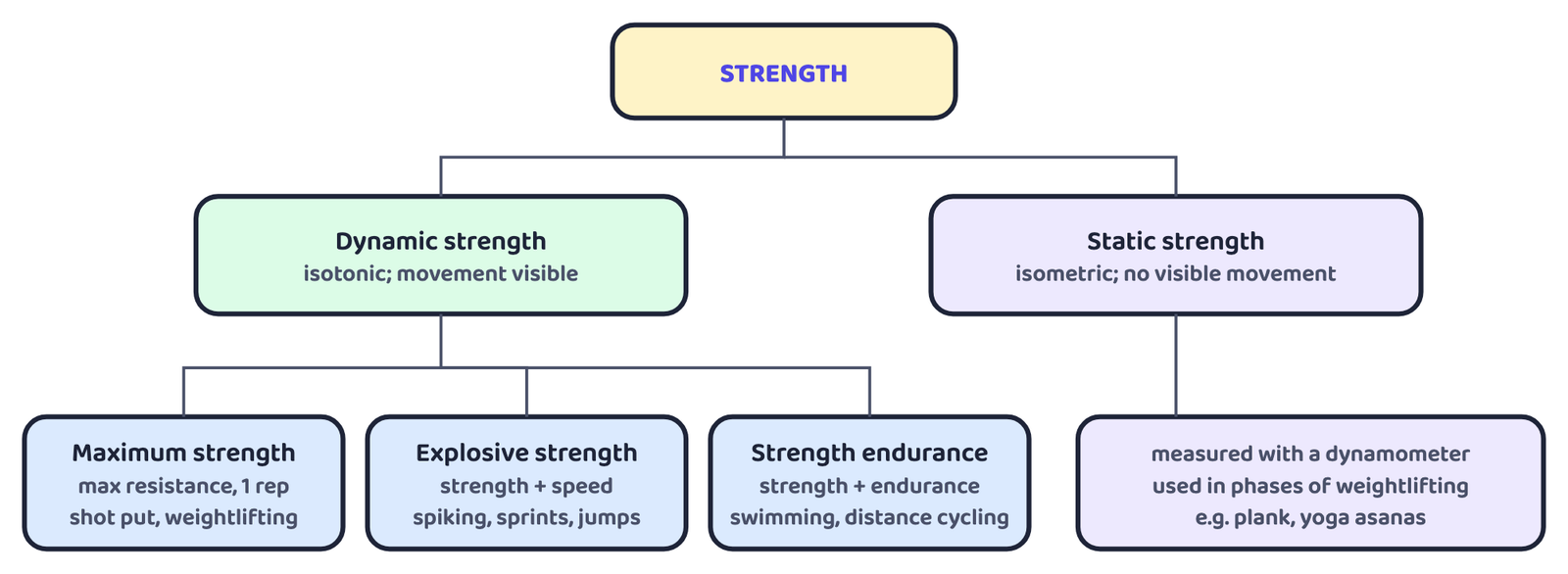
Static strength (isometric)
- Force is used against resistance but no movement is seen
- Measured with a dynamometer
- Not usually applied in sports, but used in phases of weightlifting
- Examples: plank, yoga asanas
Dynamic strength (isotonic)
- Movements are visible; rhythmic contractions with a change in muscle length, using a relatively small force
- Needed in pull-ups and push-ups; the muscles tire until not one more repetition is possible
- Examples: push-ups, full squats
- Three kinds: maximum, explosive, strength endurance
| Dynamic strength | Meaning | Made of | Sports |
|---|---|---|---|
| Maximum strength | The ability to overcome maximum resistance in a single repetition or muscular contraction (force in a maximal effort) | Strength | Long jump, shot put, javelin throw, weightlifting, discus throw |
| Explosive strength | The ability to overcome resistance as fast as possible; uses sub-maximum resistance; depends on inter and intramuscular coordination | Strength + speed | Volleyball spiking, jumps in basketball, sprint events |
| Strength endurance | The ability to overcome resistance under fatigue, for as long as possible; medium-intensity resistance; can be static or dynamic | Strength + endurance | Long-distance races, swimming, distance cycling |
3.2 How many sets and repetitions (Do you know box)
1RM means “one repetition maximum”: the heaviest load a person can lift once (general term; the book uses it without explaining).
| Goal | Sets × repetitions | Intensity | Rest between sets |
|---|---|---|---|
| Muscle strength | 2 to 5 sets × about 2 to 6 | At least 85% of 1RM | 2 to 5 minutes |
| Muscle power | 3 to 6 sets × 3 to 6 | 30 to 60% of 1RM (30 to 45% when the weight is released, as in bench press throws) | 2 to 5 minutes |
| Muscular endurance | 2 or 3 sets × 15 to 25 | Below 65% of 1RM | 1 to 2 minutes for higher repetitions; under 1 minute for moderate |
| Muscle mass (hypertrophy) | 3 to 6 sets × 6 to 12 | 67 to 85% of 1RM | 30 to 90 seconds |
3.3 Methods to develop strength
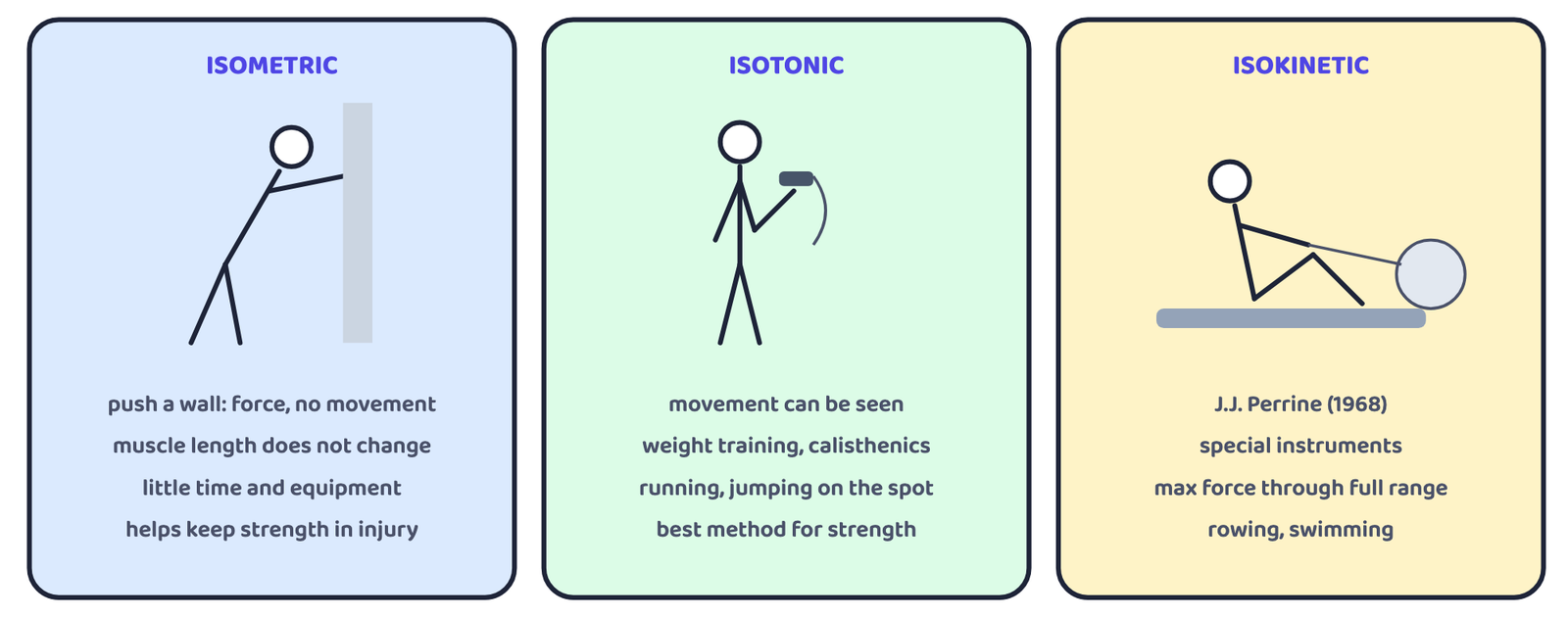
Strength is highly trainable. The book gives three methods:
| Method | Key features | Examples |
|---|---|---|
| 1. Isometric exercise | No visible movement; work is done but cannot be seen. Muscles create tension against another group of muscles. No change in muscle length (“iso” metric). Needs little time and equipment; can be done anywhere; useful for maintaining strength during an injury; done regularly, may change muscle size and shape. | Pushing a wall; plank |
| 2. Isotonic exercise | Movements can be seen directly; tone the muscles; very important in sports. Considered the best method to develop strength. | Running and jumping on the spot, weight training, calisthenics |
| 3. Isokinetic exercise | Introduced by J.J. Perrine in 1968. Done on specially designed instruments. The muscle applies maximal force throughout the range of motion around the joint (in isotonic work the pressure falls at a particular angle). Used in rowing and swimming. Its use is minimal, and its contribution to strength is yet to be scientifically proved. | Rowing, swimming |
The book’s own isometric example is pushing a wall. Shoulder exercises that work the same way (general knowledge, not from the book): wall press (push both palms hard into a wall and hold), palm press (press the palms together in front of the chest and hold), door-frame press (push the arms outwards against a door frame and hold), and the plank. Each is held for a few seconds with no visible movement.
3.4 Preventive measures in strength training
Strength training carries a high risk of injury, so it needs proper supervision. The book lists nine measures:
✓ Do
- Train only after a proper warm-up
- Build strong, stable joints first with general low-intensity strength training
- Use the correct technique with heavy weights
- Use a variety of exercises, working agonist and antagonist muscles one after the other
- Increase the load gradually, to the athlete’s ability and need
- Use the recovery period properly
- Breathe continuously; hold the breath only for the minimum time
- Use safety equipment: belts, boots, wrist bands
✗ Avoid
- Heavy loads for children: keep the load low until the age of 16, as injury chances are very high
- Training without proper supervision, as strength training carries a high risk of injury
4 Endurance
Endurance is the ability to maintain a certain level of energy production for a longer period; the ability to sustain an activity. Like strength, it is a conditional ability. It matters in health, training and competition, and is measured by the number of repetitions or the time an action is performed.
Endurance
- Harre: “the ability to resist fatigue.”
- Barrow and McGee: “the result of a physiologic capacity of an individual to sustain movement over a period of time.”
- H. Singh: “the ability to sustain an activity.”
4.1 Types of endurance by the nature of the activity
| Type | Meaning | Example |
|---|---|---|
| Basic endurance | The ability to resist fatigue in medium-intensity load using aerobic muscular metabolism; many muscles, slow pace, long time. Forms the base for all other types of endurance. | Jogging, cycling, swimming for more than 30 minutes |
| General endurance | The ability to do general sporting movements for a long time; not specific to any sport; built by general exercises. May include high-intensity work, but its duration is much shorter than basic endurance. | — |
| Specific endurance | The ability to perform the movements of a particular sport while resisting fatigue; varies from activity to activity with the nature of fatigue. | A hockey player’s endurance differs from a marathon runner’s or a cyclist’s |
4.2 Types of endurance by the duration of the activity
This classification (Harre, 1986) applies only to cyclic sports activities and is based on physiological factors.

| Type | Duration | Example | Depends on |
|---|---|---|---|
| Speed endurance | Up to 45 seconds | 400 m sprint | Power and capacity to produce energy |
| Short term endurance | 45 seconds to about 2 minutes | 800 m run | Speed endurance and strength endurance |
| Medium time endurance | 2 minutes to about 11 minutes | 1500 m and 3000 m runs | Speed and strength endurance, to a limited extent |
| Long time endurance | More than 11 minutes | Marathon, cross country | — |
4.3 Methods to develop endurance

1. Continuous method
Exercise is done for a long time without any rest. Because the activity is long and continuous, the intensity is low. It has four sub-types:
| Sub-type | How it is done | Heart rate | Duration |
|---|---|---|---|
| (a) Slow continuous | Same speed, no break, long time; speed set by heart rate. Walking, running, cycling. | 140 to 160 beats per minute | Not less than 30 minutes |
| (b) Fast continuous | Comparatively fast but uniform speed; more strenuous than slow continuous | 160 to 180 beats per minute | At least 20 minutes |
| (c) Variable pace | Pace changes, but the change is pre-planned; very strenuous, for trained athletes | 140 to 180 beats per minute | 15 minutes to 1 hour |
| (d) Fartlek | Swedish word meaning “speed play”; a variation of variable pace, but the change of speed is not planned: the athlete changes speed on his own with terrain, surroundings and feelings | Same as variable pace | Same as variable pace |
| Method | Effects given in the book |
|---|---|
| Slow continuous | Effect mainly on the muscles, with a few psychic and positive effects on metabolism: increased muscle glycogen and liver glycogen; increased capillarization; more and bigger mitochondria; improved thermal regulation; better oxidative enzymes; increased fat metabolism; positive effect on heart and lungs; improved willpower, self-discipline and self-conquest |
| Fast continuous | Improves VO2 max; improves the muscles’ capacity to consume oxygen; significant increase in size and number of mitochondria; improved anaerobic capacity |
| Variable pace | More glycogen in the muscles; more and bigger mitochondria; more efficient heart and lungs; better willpower and confidence; improved VO2 max |
| Fartlek | Promotes weight loss; an excellent test of strength and endurance; improves speed and race tactics and the “mind over matter” game; builds a racing mindset by copying the surges of speed in a race; teaches runners how hard they can push over short segments; increases physical and mental energy; improves flexibility; improves fast and slow twitch muscle response |
Fartlek is credited to the Swedish coach Gösta Holmér in the 1930s (general knowledge; the book only asks for the name in its case study).
2. Interval method
The most versatile method for endurance. The activity is done at comparatively high intensity with breaks of incomplete recovery. Its principle: work with enough speed and duration to raise the heart rate to 180 beats per minute; then take a short interval, and when the heart rate drops to 120-130 beats per minute, start work again. The book’s tree divides it into the slow or extensive and the fast or intensive interval method.
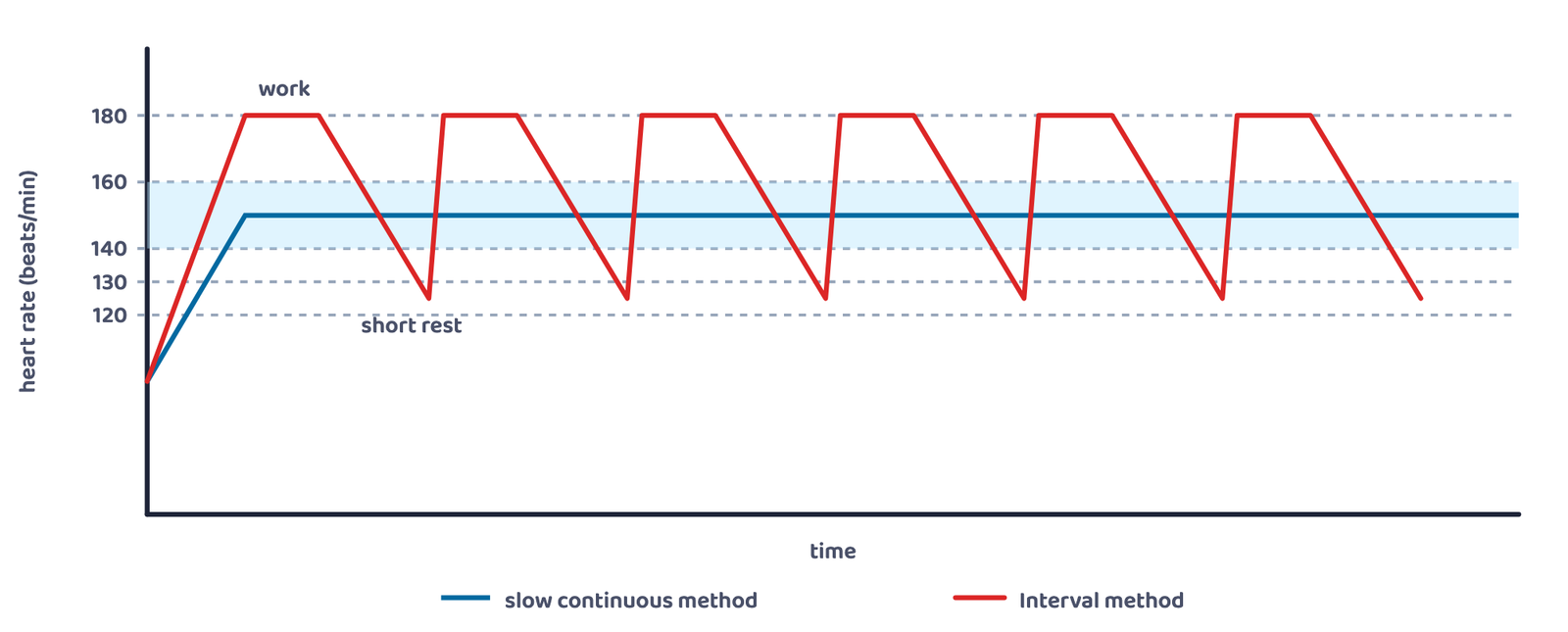
Effects: improved circulatory system, improved aerobic capacity, improved lactic acid tolerance, improved VO2 max.
3. Repetition method
Very high intensity, 90 to 100%, with an interval of complete recovery. It is the best method to develop speed endurance. Effects: improved anaerobic capacity, improved lactic acid tolerance, improved phosphagen stores.
4.4 Components of training load (Do you know box)
| Component | Meaning | Nature |
|---|---|---|
| Volume | The amount of training done: duration, distance covered, sets in weight training, number of repetitions, or work done in a given time | Quantitative |
| Intensity | The effort with which a session is completed: more work or effort per unit time. Speed is measured in metres per second, resistance in kilograms, and team games or distance races by heart rate. | Qualitative |
| Density | The volume of training completed within a given time frame | The less dense a session, the more intense it can be |
Volume and intensity have an inverse relationship, and so do density and intensity. The sample paper’s answer for “two major components of load” is intensity and volume.
5 Speed
Speed has a complex nature and depends heavily on the central nervous system. In sports it means the ability to carry out motor movements as quickly as possible. The movements can be cyclic or acyclic (our example: running is cyclic and a throw is acyclic).
Speed
- Theiss and Schnabel: “the prerequisite to do motor actions under given conditions (movement task, external force, individual prerequisite) in the minimum of time.”
- Johnson and Nelson: “the capacity of an individual to perform successive movement of the same pattern at a fast rate.”
Factors that decide speed: mobility of the nervous system; explosive strength; correct technique; bio-chemical reserves and metabolic power; flexibility; and psychic factors such as optimum arousal, attention, motivation, concentration and the ability to relax.
5.1 Types of speed
| Type | Meaning | Depends on / used in |
|---|---|---|
| 1. Reaction ability | The ability to react quickly to a stimulus or signal (visual, auditory, tactile); two kinds: simple and complex | Depends entirely on coordinative abilities |
| 2. Acceleration ability | The ability to reach a high speed of movement from a stationary position | Explosive strength, technique, movement frequency; vital in sprints |
| 3. Movement speed | The ability to perform a single movement in the minimum possible time | Technique and explosive strength; acyclic sports (in cyclic sports only the first phase) |
| 4. Locomotor ability | The ability to maintain maximum speed for the maximum possible time or distance | Mobility of the nervous system; 100 m and 200 m sprints, speed skating, short cycling sprints. Chances of improving it are relatively low. |
| 5. Speed endurance | The ability to move at high speed for a longer time, under fatigue | Anaerobic capacity, technique, psychic factors |
5.2 Methods to develop speed
Speed depends on genetic and environmental factors. Genetics cannot be changed: a person with more fast-twitch fibres has more speed, and one with more slow-twitch fibres has better endurance, and this ratio cannot be changed. So genetic make-up sets the upper limit of speed, but training (the environment) still matters. The two common methods:
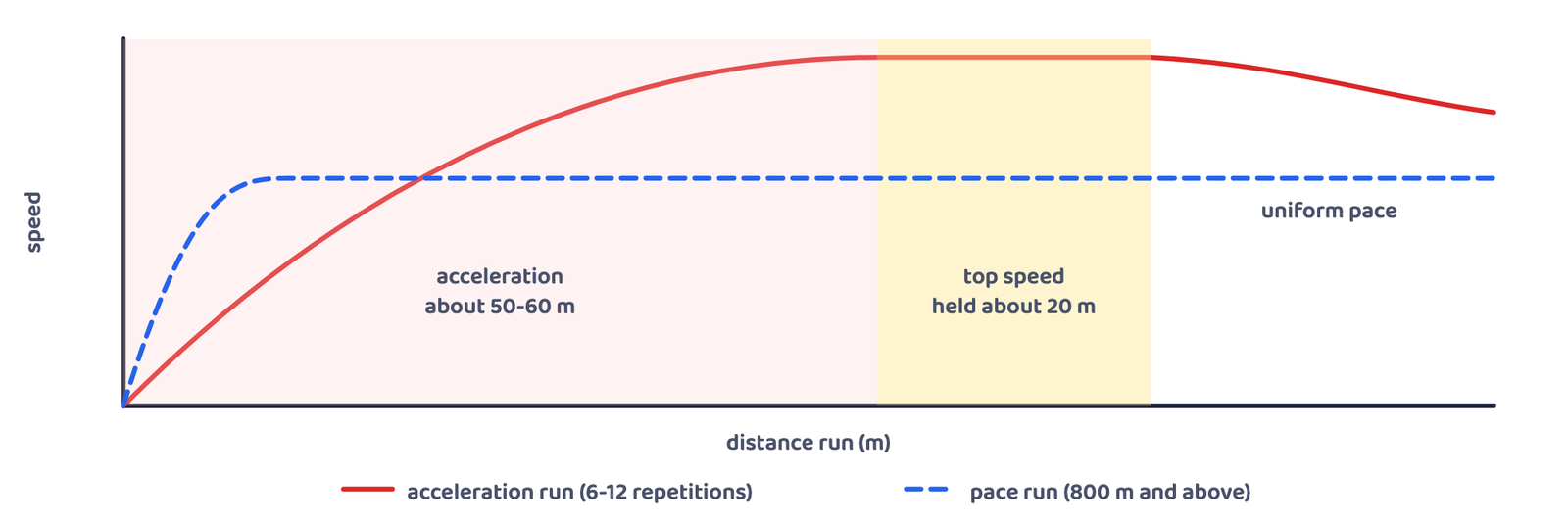
Acceleration runs
- Develop the ability to reach maximum speed from a static start
- Run a set distance, gaining full momentum as early as possible
- A sprinter needs about 50-60 m to reach top speed; even trained athletes hold top speed for about 20 m only
- 6-12 repetitions with complete recovery, set by age, capacity and fitness
- Always after a proper warm-up
Pace runs
- Run the set distance at a uniform speed
- For races of 800 m and above
- An athlete can run only about 300 m at full speed, so in longer races energy must be saved by pacing
- Run at maximum steady speed for a distance 10-20% more than the race distance
- Repetitions set by fitness, with complete recovery
Slow-twitch fibres (type I, red fibres) resist fatigue, suit sustained small movements and posture, have more mitochondria and myoglobin, and are aerobic: long-distance running, swimming, cycling. Fast-twitch fibres give fast movement over short distances and are anaerobic: short races, weightlifting, jumping.
6 Flexibility
Flexibility depends on genetic factors and on physical activity. It is neither a conditional nor a coordinative ability. It is affected by muscle strength, the structure of the joints, tendons, ligaments and other factors. A flexible person does daily tasks with more ease and efficiency, and has better posture.
Flexibility is the range of motion around a joint, that is, the ability to execute a movement with greater amplitude or range.
Flexibility helps by preventing injuries, improving posture, reducing back pain, keeping joints healthy, improving balance during movement, and helping skills to be learnt quickly (such as the backstroke in swimming).
6.1 Importance of flexibility (five points in the book)
A greater range of motion lets the muscles develop more force and speed
Movements need minimum muscular tension, so movement economy is higher
Reduces stiffness in joints
Reduces the risk of injuries, as muscles are more pliable
Helps keep the right posture while performing
6.2 Types of flexibility
| Type | Meaning | Key facts |
|---|---|---|
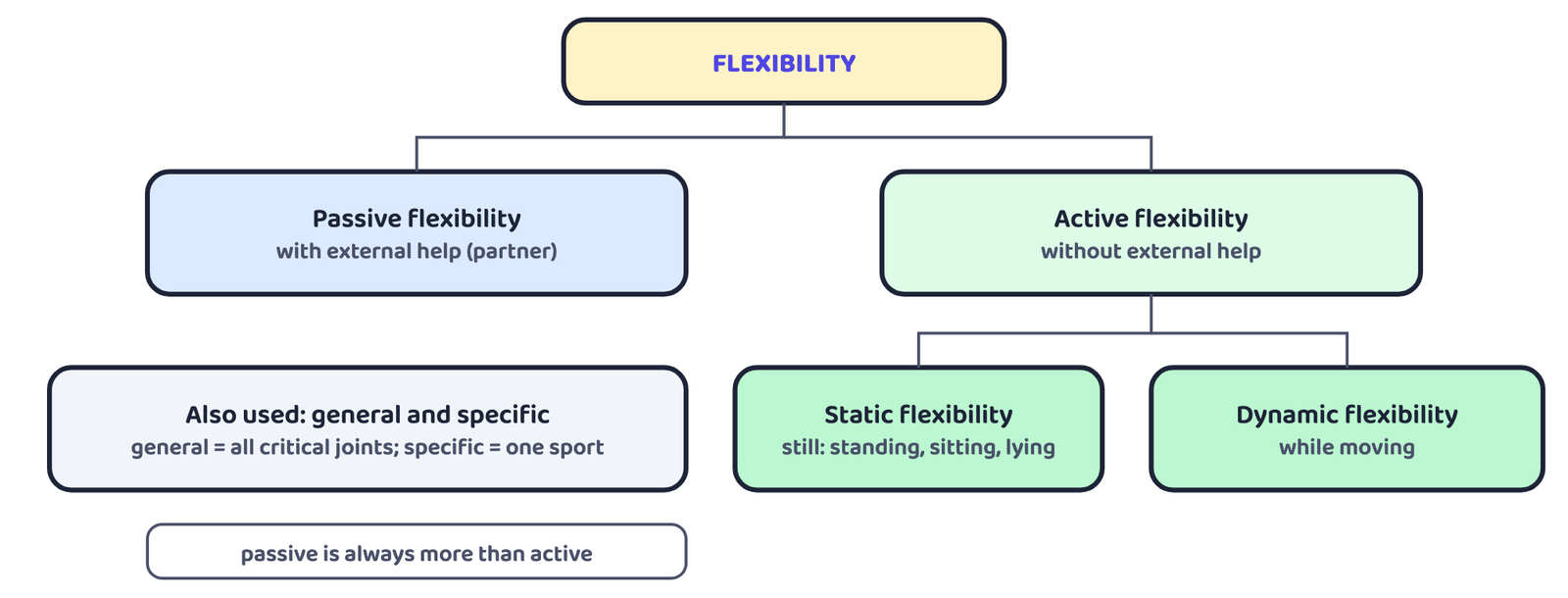
| Passive flexibility | Movement with greater amplitude with external help, e.g. stretching with a partner | Always more than active; decided by joint structure and stretchability of muscles and ligaments; the base of operational flexibility |
| Active flexibility | Movement with greater amplitude without external help, e.g. a sportsperson stretching on his own | Always less than passive; the gap shows a lack of muscular strength or coordination |
| (a) Static flexibility | Needed for movements done in a static position: standing, sitting or lying | Form of active flexibility |
| (b) Dynamic flexibility | Needed for movements while the person is moving | Form of active flexibility |
| General flexibility | Flexibility of all the critical joints of the body: shoulder, hip, trunk | Not for any one sport |
| Specific flexibility | The ability to perform movements related to a specific sport | Sport-specific |
6.3 Methods to improve flexibility
| Method | How it is done |
|---|---|
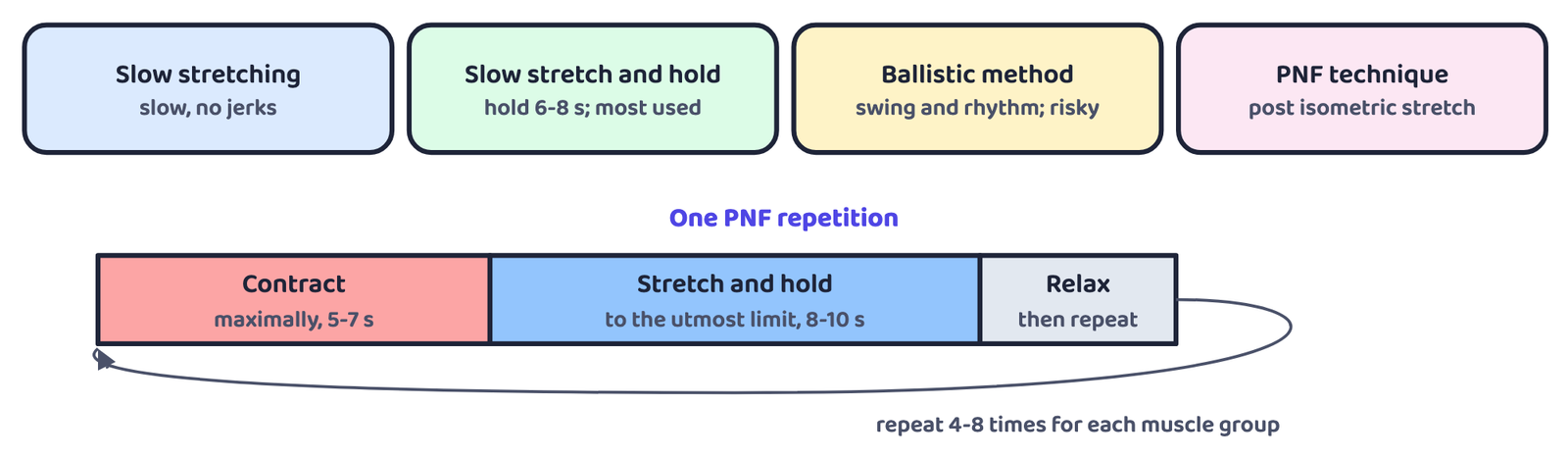
| 1. Slow stretching | Slowly stretch the muscles around the joint, without any jerky movements. The first and foremost method. |
| 2. Slow stretch and hold | After stretching, hold for about 6-8 seconds at the maximum stretching point. The most commonly used method in games and sports. |
| 3. Ballistic method | The movement is done with a swing and rhythm, using the body’s momentum to extend the range of motion. Once popular, but many experts believe it can lead to injury. |
| 4. PNF technique | Proprioceptive Neuro-Muscular Facilitation, also called the post isometric stretch. Principle: a muscle contracted maximally for a few seconds relaxes maximally afterwards. Contract the muscle for 5-7 seconds, then stretch it gradually to its utmost limit and hold for 8-10 seconds; repeat 4-8 times for each muscle group. |
Static stretching
- Ease slowly into the stretch and hold
- Hold about 10 seconds for a cool down
- Hold about 30 seconds to improve flexibility
Dynamic stretching
- Controlled movements, usually of the legs and arms
- Suits events that need dynamic movement
6.4 Tips for developing flexibility (Do you know box)
- The right age is before puberty; flexibility is hard to develop after it.
- Once improved, flexibility deteriorates if stretching is not continued.
- Stretching when tired affects flexibility negatively; stretch when fresh, ideally after warm-up.
- Without a proper warm-up, the muscles may be overstretched.
- Aim for optimum, not maximum flexibility: too much lowers joint stability and raises injury risk.
- Stretch each muscle group several times: usually 10-15 repetitions.
- Consciously relax the antagonist muscles while stretching.
- Avoid jerky movements.
- Age has an inverse relationship with flexibility, so do not compete with others.
- For faster gains, stretch daily or twice a day, with exercises for each joint.
7 Coordinative Abilities
Coordinative abilities depend mainly on the central nervous system’s motor control and regulation process. They enable a person to do various activities correctly and efficiently.
Zimmerman et al.: “Coordinative abilities are understood as relatively stabilized and generalized patterns of motor control and regulation processes. These enable the sportsman to do a group of movements with better quality and effect.”
7.1 The seven types of coordinative abilities
| Ability | Meaning | Sports example / depends on |
|---|---|---|
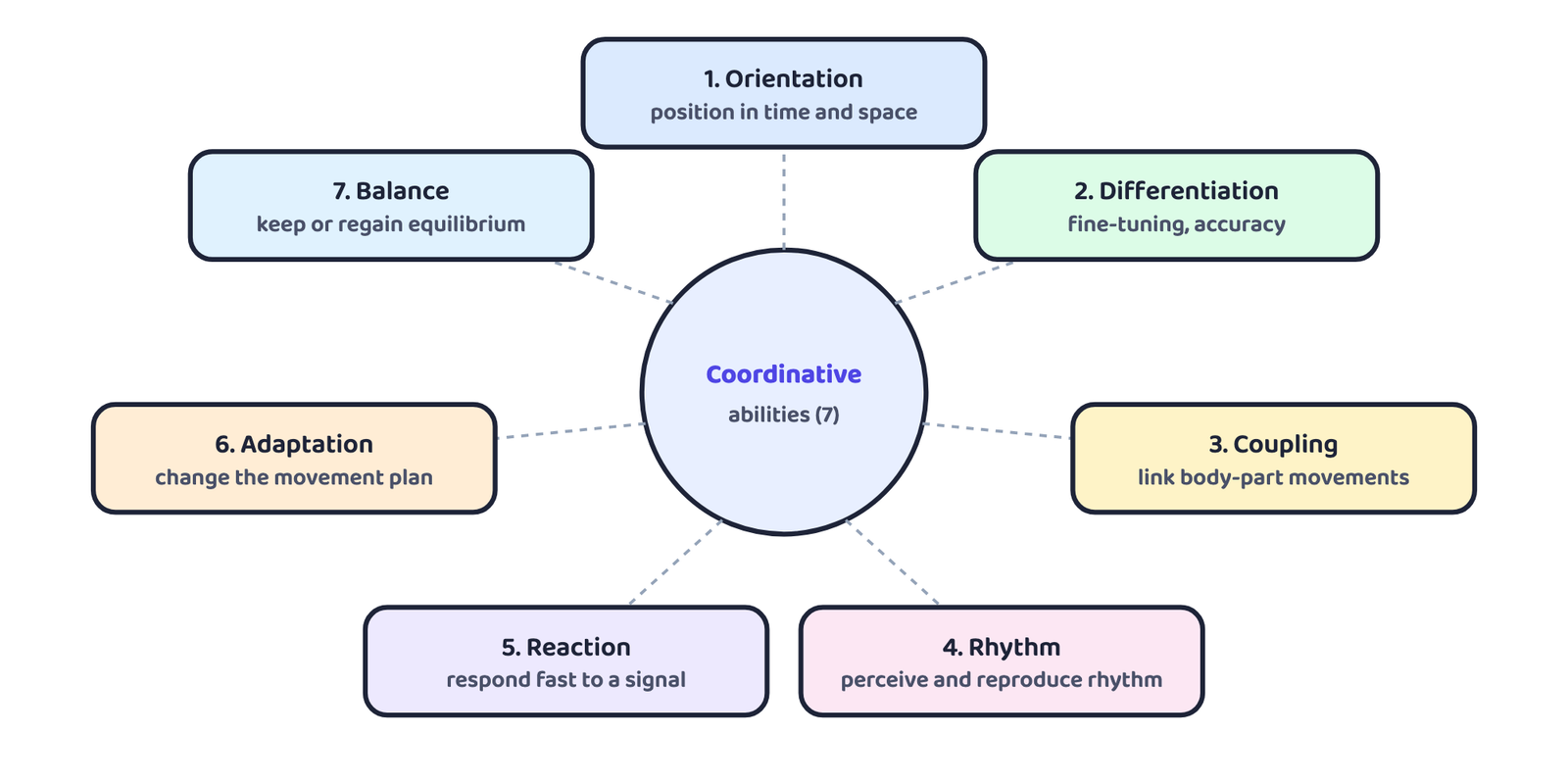
| 1. Orientation | The ability to determine and change the position and movements of the body in the required time and space, in a field of action (court, rink, ground) and with a moving object (ball, opponent, partner) | Gymnastics; in team games, vision, especially peripheral vision, is decisive |
| 2. Differentiation | The ability to attain high fine-tuning of movement phases; a high level of accuracy | Depends on movement experience and mastery over the action; movement sense |
| 3. Coupling | The ability to coordinate body part movements with one another, towards a definite goal-oriented movement | Gymnastics, team games: in football, ball control or dribbling is coupled with running and jumping; depends on kinaesthetic and visual senses |
| 4. Rhythm | The ability to perceive the rhythm of a movement and do it with the required rhythm, or to reproduce rhythm stored in motor memory | Gymnastics and figure skating (external rhythm and music) |
| 5. Reaction | The ability to react quickly and effectively to a stimulus (visual, auditory, tactile); simple and complex | Visual, auditory and tactile signals |
| 6. Adaptation | The ability to adjust or completely change the movement programme on the basis of changes or expected changes in the situation | Depends on the speed and accuracy of perceiving changes |
| 7. Balance | The ability to maintain equilibrium throughout the movement and regain it quickly after a disturbance | (a) in a still position or slow movement: kinaesthetic, tactile and partly vestibular senses; (b) in rapidly changing positions: mainly the vestibular sense organs |
“O D C R R A B”: “Only Don Can Run Round And Back”
Orientation, Differentiation, Coupling, Rhythm, Reaction, Adaptation, Balance.
7.2 Methods to develop coordinative abilities
The curriculum asks for methods, but the book lists only the types. The methods usually taught in sports training are:
- Variation in movement execution: do the same skill in different ways (left and right hand, different speeds).
- Variation in external conditions: change the ball, court size, surface or opponent.
- Combination of movement skills: join skills, such as dribbling then shooting.
- Practice under time pressure: do the skill as fast as possible.
- Variation in information intake: train with eyes closed or with changed signals, to sharpen the senses.
- Practice after pre-loading: do the skill when slightly tired, as in a match.
8 Circuit Training
The curriculum lists “Circuit Training: Introduction & its importance”, but the book has no section on it. This section is from general sports-training knowledge.
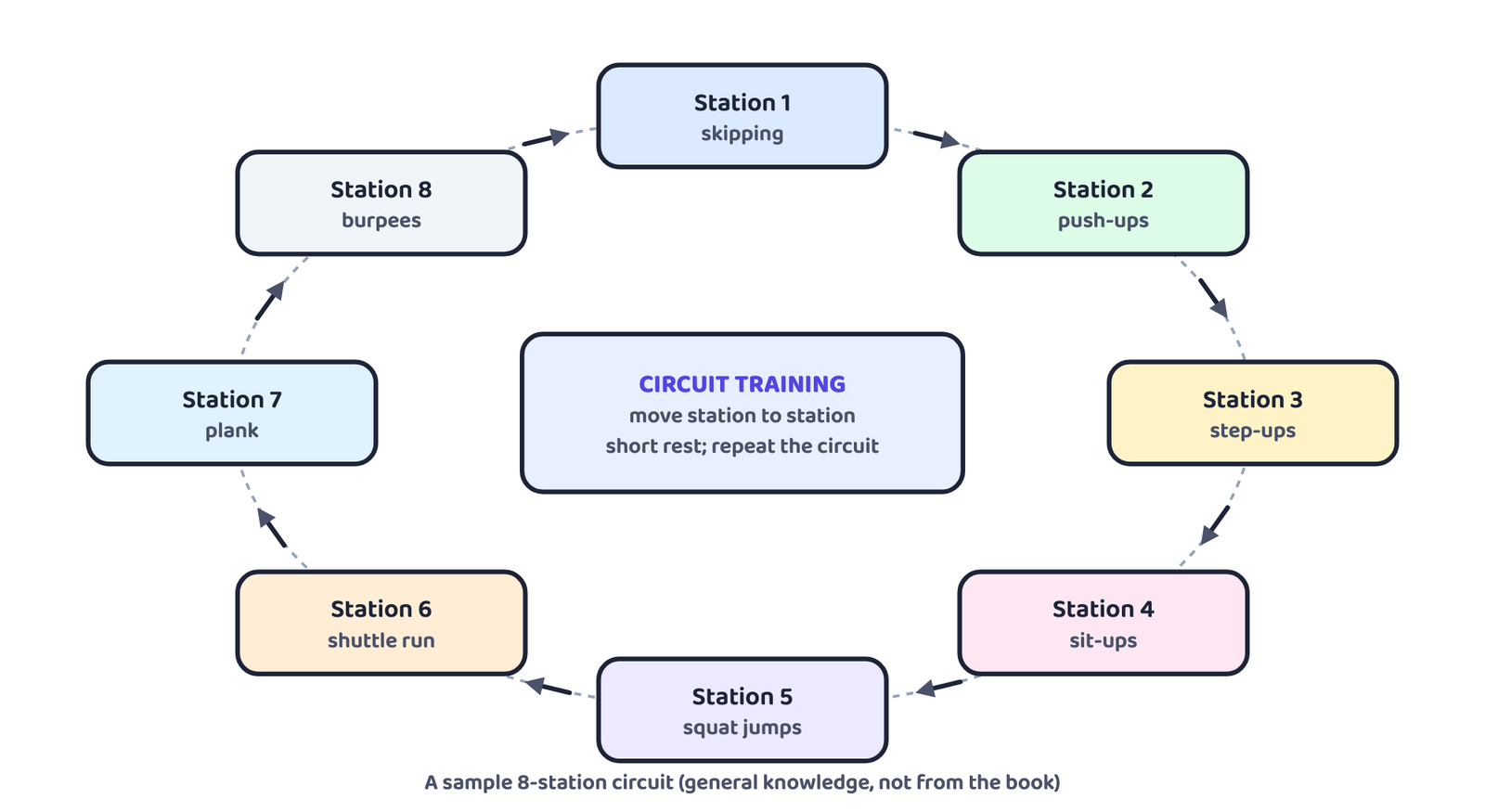
Circuit training is a method of training in which a person does a series of different exercises at fixed points called stations, arranged in a circuit, moving from one station to the next with little or no rest, and repeating the whole circuit.
It was developed by R.E. Morgan and G.T. Adamson at the University of Leeds, England, in 1953. A circuit usually has 6 to 10 stations; each exercise is done for a fixed time (about 30 to 60 seconds) or a fixed number of repetitions, and the circuit is repeated 1 to 3 times. Exercises are arranged so that the same muscle group is not worked at two stations in a row.
8.1 Importance of circuit training
All-round fitness
Develops strength, endurance, speed and flexibility together
Many at once
A large group can train at the same time, one or two per station
Saves time
A full workout in a short time
Little equipment
Body-weight exercises need almost none
Interesting
Variety keeps motivation high and boredom low
Easy to adjust
Load, time and stations can suit any age or fitness level; progress is easy to measure
9 Revision
- Talent identification stages: 10-12 years (school field tests), 13-16 years (field + lab tests), then elite, club or recreational programmes.
- Five stages: detection, identification, development, selection, transfer.
- Six components: physiological, physical, psychological, technical/tactical, results, intangibles.
- Long-term plan 8 to 15 years. Micro 3 to 10 days; meso 3 to 6 weeks (4 best); macro 3 to 12 months.
- Micro cycle load: 1:1, 2:1, 3:1 (high : medium or low).
- Strength: static (isometric) and dynamic (isotonic: maximum, explosive, strength endurance). Methods: isometric, isotonic (best), isokinetic (J.J. Perrine).
- Endurance by duration: speed (up to 45 s), short (45 s to 2 min), medium (2 to 11 min), long (over 11 min).
- Slow continuous 140-160 / 30 min; fast continuous 160-180 / 20 min; variable pace and fartlek 140-180 / 15 min-1 h.
- Interval: up to 180, restart at 120-130 (incomplete recovery). Repetition: 90-100%, complete recovery.
- Speed types: reaction, acceleration, movement speed, locomotor, speed endurance. Methods: acceleration runs, pace runs.
- Flexibility: passive (more) and active (static, dynamic). Methods: slow stretching, stretch and hold (6-8 s), ballistic, PNF (5-7 s contract, 8-10 s hold, 4-8 times).
- Coordinative abilities: orientation, differentiation, coupling, rhythm, reaction, adaptation, balance.
- Circuit training: stations in a circuit, little rest, all-round fitness.
- Can I name and explain the five stages of talent identification and development?
- Can I compare micro, meso and macro cycles on duration, purpose and recovery?
- Can I list the six training tasks of a meso cycle?
- Can I draw the strength tree and give one sport for each type?
- Can I give the heart rate and duration for each continuous method, and the principle of the interval method?
- Can I explain acceleration runs and pace runs with their numbers?
- Can I describe one PNF repetition with its timings?
- Can I name all seven coordinative abilities with a sports example each?
- Can I draw a circuit and give four points on its importance?