
- What personality is, its definitions, and how Jung’s types and the Big Five (OCEAN) theory describe it
- What motivation is, the difference between intrinsic and extrinsic motivation, and the techniques coaches use to motivate athletes
- Why people exercise, what exercise does for body and mind, and how to make people stick to it (exercise adherence)
- What aggression is, how hostile and instrumental aggression differ from assertive behaviour, and how aggression can be managed
- Four psychological attributes of athletes: self-esteem, mental imagery, self-talk and goal setting
In the CBSE Physical Education (048) curriculum, this is Unit 9: Psychology and Sports, worth 7 marks in the 70-mark theory paper. The curriculum lists five topics: personality (Jung’s classification and the Big Five theory), motivation and its techniques, exercise adherence, aggression in sports, and the psychological attributes self-esteem, mental imagery, self-talk and goal setting. The prescribed book is CBSE’s own Physical Education Class XII textbook; there is no NCERT book for this subject.
Psychology deals with behaviour (general knowledge; the book does not define it). Sports psychology uses it to understand why athletes behave the way they do: why one talented player keeps training through pain and failure while another drops out after one bad season. The book opens with a news report on exactly this problem: the Indian cricket board discussing the hiring of sports psychologists to help young players handle pressure and stop talented under-14 and under-16 players from leaving the game.
1 Personality: Meaning and Definitions
Personality is the relatively stable and unique set of characteristics of an individual (behaviours, thoughts and emotional patterns) that shows across different situations and over a varied period of time. These patterns evolve from biological and environmental factors.
- The word comes from the Latin word persona, the mask worn by actors in the Roman theatre to change their appearance for a role. The audience expected a certain behaviour from each mask, though the actor did not have those qualities himself.
- So “personality” came to mean an individual’s characteristic way of responding to other people and to situations: shy, happy, courageous, aggressive and so on.
- The concept is still evolving and covers so much that no single definition includes every aspect.
1.1 Definitions by psychologists
| Psychologist (year) | Definition or idea |
|---|---|
| Robert A Baron (2008) | “Personality is an individual’s unique and relatively stable pattern of behaviour, thoughts and feelings.” |
| Carl Jung (1933) | Personality as an attitude: a predisposition to behave in a certain manner. |
| William Herbert Sheldon (1942) | A typology based on three body types, Endomorph, Ectomorph, Mesomorph, each linked to a different temperament. |
| Cattell (1950) | Personality is “that which permits a prediction of what a person will do in a given situation.” |
| Guildford (1959) | Personality is an “individual’s unique pattern of traits.” |
| Allport (1961) | Personality is the dynamic organization within the individual of those psychological systems that determine his unique adjustment to his environment. |
| Eysenck (1953) | Personality is a more or less stable and enduring organization of a person’s character, temperament, intellect and physique which determines his unique adjustment to the environment. |
| Matt Jarvis (2006, in his book) | Presents a general definition offered by Pewin (1993): personality represents the structural and dynamic properties of an individual as they reflect themselves in characteristic responses to situations. |
For a 2-mark “Define personality”, write Baron’s definition in quotes with his name, then one line on persona. For “comment on Allport’s theory”, write Allport’s definition and explain its key words (see section 2.3).
1.2 Why personality matters in sports
- No two athletes behave in the same way; they may react differently to the same situation.
- A coach must know how each athlete responds to the demands of training and of competition. For example, some athletes do not like taking commands from a coach but respond well to cooperative learning.
- Sports psychologists also study which type of people choose a particular sport or exercise programme.
2 Personality Types and Approaches
A personality type is a psychological classification of different types of people. Types are different from traits, which come in different degrees.
2.1 Type approach and trait approach
Type approach
- Puts people into categories with similar behaviour
- Example: two types of people, introverts and extroverts
- Examples in the book: Myers and Briggs type indicator, Friedman and Rosenman Type A behaviour, body types (Kretschmar, Sheldon’s somatotype), fluid types (Hippocrates)
Trait approach
- Looks at specific psychological attributes in which people differ
- A trait is a characteristic that is unchanging and predictable, e.g. shyness
- Introversion-extroversion is a continuous dimension, with many people in the middle
2.2 The major theories
The book names these major theories of personality: dispositional (trait), psychodynamic, humanistic, biological, behaviourist, evolutionary and social learning. Many psychologists do not follow just one, and take a mixed (heterogeneous) approach.
2.3 Trait theory
- Some traits are innate: the infant has a basis for the trait at birth. Others are acquired through learning, such as tidiness or untidiness.
- Eysenck, Cattell and Allport support inherent traits as “cardinal” and proposed a theory based on biological factors: people inherit a type of nervous system that affects how they learn and adapt to the environment.
Allport is also known for dividing traits into three levels: cardinal traits (one trait that rules a person’s whole life), central traits (the 5 to 10 main traits that describe a person) and secondary traits (traits that appear only in some situations).
2.4 Psychodynamic theory
Sigmund Freud and Neo-Freudians such as Jung described the structure of personality in three parts, id, ego and super ego. The psychodynamic theory assumes an interaction between nature (innate instincts) and nurture (parental influences).
2.5 Interaction perspective: the approach used in modern sport
- A player with a high hostility trait may not behave aggressively when his team is winning by a large margin.
- A composed athlete may show anxiety when he has to score the winning run off the last ball of a knock-out match.
3 Jung’s Classification of Personality
Carl Gustav Jung, a Swiss psychiatrist, was a disciple of Sigmund Freud and worked with him for five years. He later disagreed with some of Freud’s main ideas and took a separate path, so he is often called a Neo-Freudian. In 1921 he published Psychology Types, classifying personality on two aspects.
3.1 The two aspects
Personality attitude
Extrovert or Introvert. Jung was the first to bring the ideas of introversion and extroversion into psychology.
Personality functions
Four functions: Thinking, Feeling, Sensing and Intuition.
Jung did not mean these as labels for people; he wanted to show how complex human types are.
3.2 Introvert and extrovert
An introvert is a person mainly interested in his or her own inner world of thoughts and feelings: reserved, reflective, and inclined to withdraw from outer reality.
An extrovert is a person who prefers the outer world of people and things: highly social, broad-minded, bold, outgoing and optimistic. In Jung’s theory the extrovert is the total opposite of the introvert.
| Introvert | Extrovert |
|---|---|
| Interested in their own self; reserved | Highly socialised; broad-minded |
| Self-aware and introspective | Expressive; enjoys being the centre of attention |
| Takes pleasure in solitary activities: reading, writing, meditating | Enjoys large social gatherings: parties, community activities, public demonstrations, business or political groups |
| Tends to shy away from public interaction; less vocal | Meets unknown people easily; enthusiastic, talkative, assertive, gregarious |
| Thinks before acting; analytical before speaking | Action oriented; bold, outgoing, optimistic; works well in groups |
| Lives in an inner world, creates their own imagery world | Prefers the outer world of things |
3.3 The four personality functions
Feeling
Making decisions based on values and the effect on people rather than logic; uses emotions to understand a situation.
Thinking
Deciding objectively on evidence and principles; information is judged with logic and reason.
Sensing
Perceiving the world through facts, evidence, data and details; uses the senses, looking and listening.
Intuitive
Perceiving the world through concepts, theories and abstractions; sometimes called the “sixth sense”.
On p.312 the book’s text and figure place thinking and sensation under rational (judging) and intuition and feeling under irrational (perceiving). Its eight-preferences table on the next page pairs the functions differently (sensing-intuition for taking in information, thinking-feeling for decisions), so learn the four functions themselves and the table below.
3.4 The eight preferences
The book also prints a table of four pairs of preferences:
| What it is about | One side | Other side |
|---|---|---|
| Where you focus your attention | Extraversion: the outer world of people and things | Introversion: the inner world of ideas and impressions |
| How you take in information | Sensing: through the five senses | Intuition: from patterns and the big picture, future possibilities |
| How you make decisions | Thinking: logic, objective analysis of cause and effect | Feeling: values, subjective, person-centred concern |
| How you deal with the outer world | Judging: planned, organised, things settled | Perceiving: flexible, spontaneous, options kept open |
3.5 The eight personality types
According to Jung, the two attitudes cannot be shown in isolation: each is joined to one of the four functions. 2 attitudes × 4 functions = 8 types (mental functions-in-attitude).

| Type | What it involves | Such people |
|---|---|---|
| Extroverted Thinking | Organising for efficiency, systematising, applying logic, setting standards, guidelines and boundaries, deciding if something works | See the world through complex, solid ideas often handed down by others; often work in maths and science |
| Introverted Thinking | Analysing, categorising, evaluating by principles, checking for inconsistencies, clarifying definitions | See how the world works in a subjective, creative way, from internal knowledge; often work in science |
| Extroverted Feeling | Connecting, considering others and the group, keeping group values, adjusting to others | Judge on social values and beliefs; often work in business and politics |
| Introverted Feeling | Valuing, judging worth, clarifying values, deciding what is worth standing up for | Base feelings on emotions and beliefs; often work in art |
| Extroverted Sensing | Experiencing the immediate context, acting in the physical world, noticing changes and opportunities | See what is happening and go with it, not influenced by others’ opinions; often taste-testers or proof-readers |
| Introverted Sensing | Reviewing past experiences, recalling stored impressions, “what is” evoking “what was” | Look for hidden meaning through inner reflection; often work in art |
| Extroverted Intuitive | Interpreting situations and relationships, seeing “what could possibly be”, noticing what is not said | Base meanings on facts rather than feelings; usually inventors |
| Introverted Intuitive | Foreseeing effects without external data, realising “what will be”, envisioning transformations | Decide by inner desires; usually artists or religious figures |
3.6 Ambivert
An ambivert is someone who falls in the middle of the introvert-extrovert continuum, showing a blend of the traits of both along with some specific strengths.
Ambivert is a relatively new term. Jung did not use it, but he explained that there is no such thing as a pure introvert or a pure extrovert; later psychologists supported this idea.
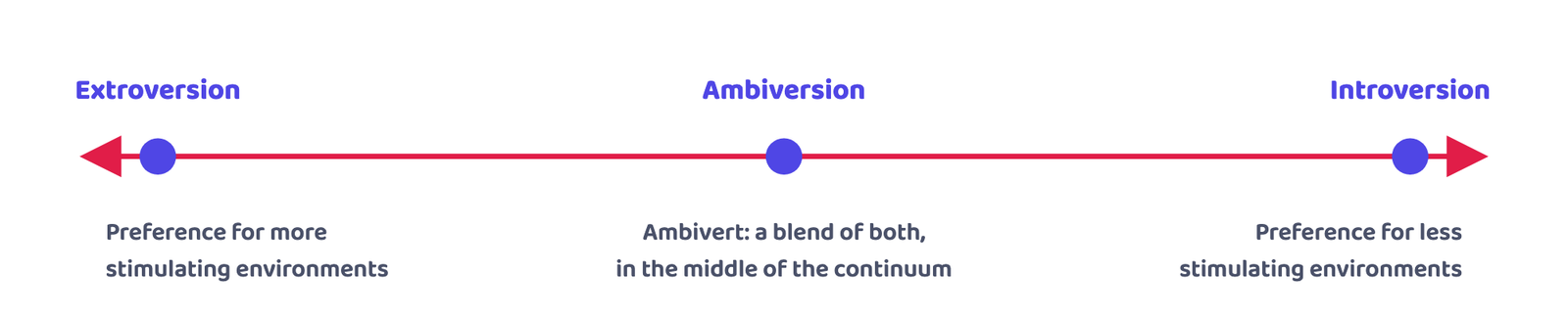
Introverts are not “actively involved in the world of people and things”; that describes extroverts. Introverts are comfortable alone and being by themselves.
4 Big Five Theory of Personality
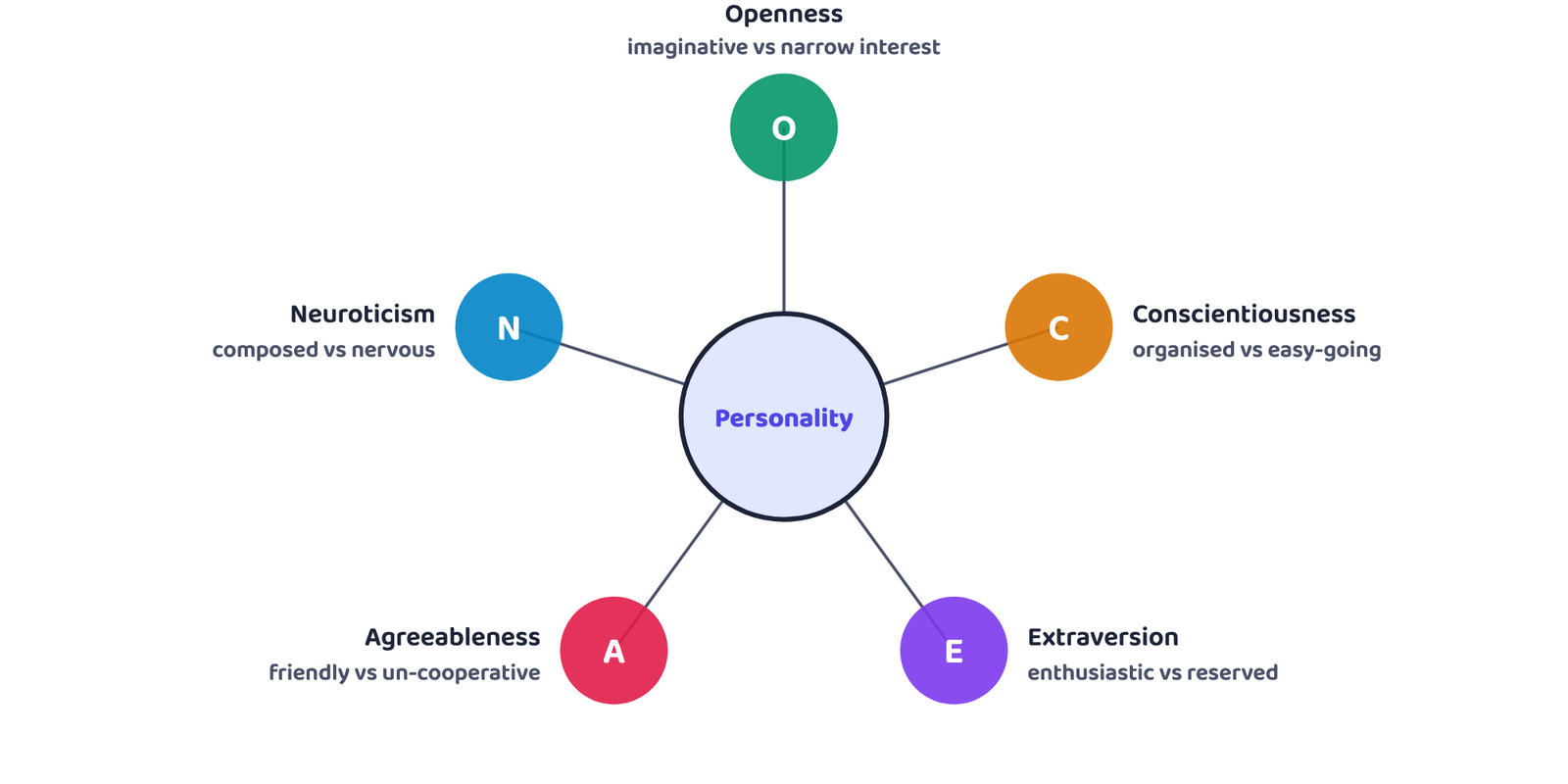
The Big Five Factor model was offered by Paul Costa and Robert McCrae. It is a trait approach, also called the Five Factor Model, and is remembered by the acronym OCEAN.
OCEAN: Openness, Conscientiousness, Extraversion, Agreeableness, Neuroticism
Each trait is a line with a high end and a low end; every person sits somewhere on each of the five lines.
4.1 The five traits
Openness to experience
Imaginative vs narrow interest. High: imaginative, humorous, intellectual, creative, curious, broad interests, open to ideas. Low: closed, suspicious, rigid. Sport: high scorers show new ideas, new skill execution and variety.
Conscientiousness
Organised vs easy-going. High: well-organised, careful, responsible, hardworking, dependable. Low: relaxed, spontaneous, disorganised, careless. Sport: linked with cognition; high scorers do better in academics and in sport wherever planning, organising and decision-making matter.
Extraversion
Enthusiastic vs reserved. High: enthusiastic, energetic, positive, talkative, assertive, sociable, seeks stimulation from others. Low: reserved, sober, cautious, prefers solitude or small groups. Sport: people high on both extraversion and openness are more likely to take up adventure and risky sports.
Agreeableness
Friendly vs un-cooperative. Measures compassionate, helpful, friendly behaviour. High: good-natured, cooperative, trusting. Low: suspicious, irritable, uncooperative, antagonistic, rude and unkind.
Neuroticism
Composed vs nervous: emotional stability. High: nervous, anxious, excitable, unpleasant emotions, impulsive and hostile behaviour. Low: calm, even-tempered. Sport: strongly affects performance; exercise is supported as an alternate therapy for neurotic behaviour.
4.2 High and low scores
| Big Five trait | Behaviour for a high score | Behaviour for a low score |
|---|---|---|
| Openness | Curious, imaginative, intellectual, creative, open to trying new things, focused on new challenges, thinks about abstract concepts | Dislikes change, does not enjoy new things, resists new ideas, not very imaginative, dislikes abstract or theoretical concepts |
| Conscientiousness | Well-organised, careful, responsible, self-disciplined | Disorganised, careless, relaxed, easy-going |
| Extraversion | Active, optimistic, sociable, interactive, affectionate | Sober, reserved, cautious |
| Agreeableness | Good-natured, friendly, helpful, trusting, cooperative | Irritable, suspicious, rude, uncooperative |
| Neuroticism | Insecure, nervous, anxious, excitable | Calm, composed, poised, hardy, secure |
For neuroticism the low score is the calm, composed end; do not write “high neuroticism” for a calm athlete.
5 Motivation
Motivation is the driving force that spurs a person to action. Robert Baron (2008) explains it as a process to initiate, guide and maintain behaviour over time. Simply put, motivation is the direction and intensity of effort.
- The word comes from the Latin movere, “to move”.
- The basic reason for any human activity is motivation: it inspires and guides a person to move in a particular direction.
5.1 The two factors of motivation
If either the objective or the direction is missing, the quality of the action suffers. When an activity reaches its goal, the drive reduces and the person stops being active.
5.2 Types: amotivation, intrinsic and extrinsic
Amotivation is a state of lacking any motivation to engage in an activity, marked by a lack of perceived competence and/or a failure to value the activity or its outcomes.
Intrinsic motivation is internal motivation that drives a person from within to pursue actions for fun, pleasure, fulfilment or challenge, i.e. for the pure enjoyment of the activity.
Extrinsic motivation is behaviour driven by external rewards or forces such as money, fame, grades, prize, praise, or even the wish to avoid punishment.

- Intrinsic comes from the French word intrinseque, “inward”. It satisfies needs felt from within and is linked to the person’s natural instincts or urges.
- Extrinsic comes from the Latin word entrinsecus (as printed in the book), meaning “outward”. The satisfaction does not come from within; the reasons for action are outside the person’s character.
| Point | Intrinsic motivation | Extrinsic motivation |
|---|---|---|
| Definition | Driving force to pursue an action for fun, joy or inner satisfaction | Driving force to pursue an action for reward, trophy, money, promotion or praise |
| Factors | Internal: joy, enjoyment | External: reward, promotion, praise |
| Method | Goal-setting strategies, family and community support | Linking success with future benefits, awards, promotions and avenues |
| Benefits | Long-term benefit of keeping up a behaviour | Helps to start a drive towards a behaviour when internal factors are missing |
Of seven reasons an athlete may give for playing: (1) “doesn’t know why he plays, sees no benefit” shows amotivation; (2) to learn a new skill, (3) to gain skill mastery and perfection, (4) to find joy and happiness show intrinsic motivation; (5) to win a reward or trophy, (6) to make the coach happy for a best-athlete award, (7) to avoid pressure from the family show extrinsic motivation.
Extrinsic rewards can sometimes weaken intrinsic motivation. When a player who already enjoys the game starts getting paid or rewarded for it, the reason for playing can shift from “I enjoy it” to “I am doing it for the reward”; when the reward stops, the interest may drop too. Psychologists call this the overjustification effect. The book makes a related point under “valance of reward”: a reward motivates only if the athlete values it.
6 Motivation Techniques
Motivation is the process in which a learner’s internal energies or needs are directed towards goals in the environment. As long as a person is satisfied with present behaviour and knowledge, he or she will not try to change. The book bases motivation techniques on four approaches:
6.1 Cognitive approach
Motivation comes from actively processing and interpreting information. Two theories are used:
- Expectancy theory: people are motivated for a task where the probability of success is higher than that of failure.
- Goal-setting theory: a stronger drive comes from good information on the time set for the task, its difficulty and how specific it is.
Time bound
The task should have a time limit.
Set complexity level
Neither too difficult nor too easy.
Make task specific
Instructions precise about what is to be done.
Define purpose
The outcome of the task clear and defined.
6.2 Pedagogical approach
The teaching and coaching methods used in training guide and maintain the athlete’s behaviour. Good communication, a positive relationship, enjoyable training, involving athletes in decisions and giving useful feedback all raise motivation.
- (a) Guided discovery method: athletes are more motivated when allowed to find solutions themselves than when just told what to do. Lack of independence in decision-making hurts motivation; cooperative learning helps.
- (b) Valuable feedback system: a strong support system with feedback that gives specific direction pushes athletes to work harder for longer.
- (c) Fun-based training: training should be challenging and task-oriented, but fun, creativity and innovation keep athletes going under heavy training loads.
- (d) Individualized Training Programme (ITP/IEP): each athlete is unique, so a programme within his or her attainable limits lets the athlete set personal targets; it avoids burnout and keeps the athlete motivated.
6.3 Social support strategy
Taking up sport and exercise is strongly influenced by the people around. Positive support from the peer group, family and friends builds healthy habits and the drive to keep exercising. Group activities and involving family and peers increase participation.
6.4 Facilitation approach
- (a) Incentives and rewards: awards and rewards help athletes keep up sport with consistency.
- (b) Valance (value) of reward: a reward works only if the athlete values it. The coach must know what the individual athlete wants. Example: an athlete may value being made captain more than a pay hike.
- (c) Performance appraisals: recognising and praising present and past efforts creates drive for future action and confidence; regular appraisal with suitable rewards.
- (d) Quality support and facilitation: the facilities given matter, but the impact is larger only when the support is of high quality; factors affecting athletes are studied and the right support provided.
6.5 Motivation and sports: why people play
Research summarised in the book gives four motives for sport and exercise:
All four are intrinsic, so people take part in sport largely for intrinsic reasons. External motives can be added whenever the intrinsic motive falls.
7 Exercise Adherence
“If exercise could be packed into a pill, it would be the single most widely prescribed and beneficial medicine in the nation.”
Dr Robert Butler, Former Director, National Institute of Ageing (quoted in the book)
Exercise adherence is the extent to which an individual keeps up active involvement in physical exercise as advised (interval, exercise dose and dosing regimen) despite opportunities and pressures to withdraw. It includes both starting and maintaining exercise behaviour.
- It is linked to the “stickability” factor: the quality of continuing with sport or exercise without losing the motivation to pursue it.
- It can also be called a self-regulated, voluntary behaviour aimed at keeping an exercise routine for a long time after the first phase of adoption.
7.1 Reasons to exercise (exercise determinants)
People differ: some have never thought of exercising, some plan to start but never do, some start and then drop out. The reasons why people exercise:
Overcoming social physique anxiety
People worry how others see their looks, body shape, weight and size; exercise with proper diet helps them become lean and fit.
Reduced risk of disease
Urban, sedentary lifestyles raise hypertension and obesity; exercise counters the sedentary lifestyle.
Recreation
Long desk hours and serious study leave little time for fun; exercise and recreational sport provide fun along with physical benefits.
Mental relaxation
Exercise is one of the most effective and economical ways to cope with stress and depression.
Socialization
Team sports and group exercise connect people with friends and the community, overcoming social isolation and loneliness.
7.2 Benefits of exercise
| Benefit | What the book says |
|---|---|
| 1. Health benefits | (a) reduces risk of cardiovascular disease (hypertension, coronary heart disease): strengthens the heart, improves circulation, raises oxygen levels, lowers the risk of high cholesterol and heart attack; (b) weight management: dieting alone is not effective without regular exercise; (c) strengthens bones and muscles, slows loss of bone density with age; (d) reduces risk of some cancers (colon, breast, uterus, lungs); (e) reduces risk of falls in older adults (balance and muscle-strengthening work plus moderate aerobic activity) |
| 2. Stress relief | Prolonged stress brings illness, low energy, sleep problems, headaches, poor judgment, weight gain, depression and anxiety; exercise relieves it |
| 3. Increases happiness | The body produces more endorphins during exercise, which create positive feelings, improve mood and relax the person |
| 4. Promotes self-efficacy | Self-efficacy is the belief that one can achieve a specific goal; sport builds belief in one’s ability to complete physical tasks |
| 5. Promotes social cohesion | Group exercise and sport prevent boredom and isolation; group cohesion among members is itself a reason to exercise |
| 6. Enhances value orientation | Values from physical activity: discipline, better learning, self-actualization, social responsibility, ecological integration |
| 7. Cognitive benefits | Regular aerobic activity improves attention control and information-processing speed; more blood and oxygen reach the brain, and hormones that can enhance the growth of brain cells are stimulated; (a) attention control and concentration improve at all ages; (b) memory improves and physical activity enhances intelligence, especially among children; memory loss in the elderly is delayed, and brain changes that can cause Alzheimer’s disease are reduced |
| 8. Mental health benefits | Mood and the feel-good factor rise; (a) exercise as therapy for emotional disorders such as depression and anxiety; (b) fitness as a moderator of life stress; (c) runner’s high: mental alertness, mood uplift, a feeling of liberation, suppressed discomfort and heightened well-being |
| 9. Psychological well-being | Changes in blood flow to the brain, more oxygen consumption, less muscular tension and better metabolism create a feeling of well-being |
| 10. Personality enhancement | Long-term activity, especially before maturity, shows greater extraversion and stability |
| 11. Develops leadership qualities | Persisting through adversity (lack of space, poor logistics, adverse conditions) builds leadership |
| 12. Special population | (a) Clinical population: people with intellectual disabilities gain in skills of daily living through psychomotor activities; (b) Elderly: regular activity, even low-intensity bouts, slows the ageing process |
“Psychological benefits of exercise” means points 2, 3, 4, 7, 8, 9 and 10 above: stress relief, happiness (endorphins), self-efficacy, cognitive benefits, mental health (including runner’s high), psychological well-being and personality enhancement.
8 Strategies for Enhancing Adherence to Exercise
Most people know exercise is good for them, yet many never start, and many who start drop out. The book gives ten strategies:
| Strategy | How it works |
|---|---|
| 1. Goal setting | A moderate bout of exercise of 20-30 minutes gives positive psychological effects; exercise above the lactate threshold (LT) feels unpleasant and makes people quit. Here the book expands SMART as Specific, Measurable, Attainable, Realistic, Time based; in its goal-setting section it uses Specific, Measurable, Action-oriented, Realistic, Timely (section 13). |
| 2. Adding variety | Boredom causes drop-out; new exercises for the same body part, new methods, new equipment, new logistics and new members bring fresh energy |
| 3. Social support enhancement | Friends, family, classmates engaged as motivators: a buddy partner, youth leader or mentor system |
| 4. Contract | Participants sign a written contract of intent to comply, with expectations, responsibilities and contingencies; regular (chronic) exercise keeps the benefits that one (acute) bout gives |
| 5. Reinforcement interventions | Positive and negative reinforcement; incentives, rewards and badges for attendance and participation |
| 6. Feedback | Individual feedback on progress gives direction and energy to continue |
| 7. Process orientation | Outcome or product goals (weight loss, physique, appearance) work at the start but are hard to keep up; goals that are more intrinsic in nature help people become lifelong exercisers |
| 8. Problem solving | Identify the obstacles between the person and the activity goals, generate and try solutions, evaluate and change them if needed |
| 9. Health risk appraisals | Information on current health, risk factors and fitness level motivates, helps track change and shows areas to improve for goal setting |
| 10. Health education | Learning from experts about the benefits, correct technique and expected results gives confidence, motivation and protection from injury or discouragement; health-care providers have strong influence |
Good Variety Supports Contracts; Rewards, Feedback, Process, Problems, Risk and Education
Goal setting, Variety, Social support, Contract, Reinforcement, Feedback, Process orientation, Problem solving, health Risk appraisal, health Education: the ten strategies in the book’s order.
9 Aggression in Sports
Players are sometimes in the news for hitting opponents or abusing officials, spectators or team-mates. The book gives two such reports: a footballer convicted in court for breaking an opponent’s cheekbone with his elbow in 1988, and a heavyweight boxer disqualified for biting his opponent.
According to the American Psychological Association (APA), aggression is a type of behaviour aimed at causing physical or psychological harm to another. Most psychologists describe it as any behaviour intended to harm or injure a living being who is trying to avoid it.
9.1 Three features of aggression
It is a behaviour that can be seen
Not an emotion inside a person, such as anger.
It is intentional
Never accidental: a deliberate act to harm, physical or psychological (hitting, pushing, abusing on purpose).
The victim wants to avoid it
The person being harmed is trying to avoid the harm.
9.2 Gill’s four criteria (2000)
Sport psychologist Gill (2000) gave four criteria to judge whether an act in sport is aggressive:
9.3 More definitions
- Bandura (1973): behaviour that results in personal injury or destruction of property.
- Baron and Richardson (1994): behaviour directed towards the goal of harming or injuring another living being who is motivated to avoid such treatment.
- Baron and Byrne (2000): the intentional infliction of some form of harm on others.
Aggression is behaviour that is hostile and violates other people’s rights. Reactive aggressive behaviour is unplanned and impulsive, usually a response to anger, fear or a need to retaliate. Proactive aggressive behaviour is calculated and planned, with some motive other than harming someone.
10 Types of Aggression
The two types accepted in sport psychology were cited by Husman and Silva in 1984: hostile and instrumental aggression.
Hostile aggression is violent and angry behaviour whose intent and primary goal is to harm the other person. It is committed in response to a perceived threat or insult, and is unplanned, reactionary, impulsive and fuelled by intense emotion. It is also called reactive aggression.
- “Hostile” means “opposed”.
- Examples: a boxer who punches below the belt to injure an opponent because he is losing; an athlete who uses abusive words to hurt a player who angered him with better skills.
- The aggressor feels a loss of control and physiological hyperarousal, and uses non-legitimate or illegal means.
Instrumental aggression is aggressive behaviour used as a means to attain a non-aggressive goal such as winning, money, prestige or some other advantage. There is an intent to harm, but without necessarily being angry.
- “Instrumental” means “serving as a means”: aggression is only a tool.
- It is harmful behaviour without provocation, used to obtain an outcome or to coerce others.
- Examples: elbowing and injuring a player to gain a competitive advantage; a late tackle to stop an opponent from scoring.
- Instrumental aggression is learned behaviour, while hostile aggression is impulsive. In the majority of situations, neither is an ideal response.
An APA science brief (2013) on young children and media exposure describes, besides physical aggression (kicking, pushing), relational aggression: harming others through relationships, by social exclusion, withdrawing friendship, or spreading rumours and false news.
World chess champion Viswanathan Anand said the prospect of losing made him aggressive, but he channelled that feeling into a willingness to play long games, which kept him motivated.
10.1 Assertive behaviour
Assertive behaviour is standing up for yourself and your values in a non-threatening manner, using legitimate means, with no intent to harm and with respect for the other person.
For a sports psychologist there is no “good” or “bad” aggression: any behaviour meant to harm another person physically or mentally is aggression and is not acceptable. Sports psychologists point to an important concept, assertive behaviour: assertive behaviour is a positive form of expression and leads to positive resolution; aggression is negative, puts others down and is often counter-productive.

| Point | Hostile | Instrumental | Assertive |
|---|---|---|---|
| Intent | Harm or suffering | Harm or suffering | No harm |
| Primary goal | Harm or injure | Win or advantage | Win or advantage |
| Process | Non-legitimate | Non-legitimate | Legitimate |
| Emotion | Anger | No anger | Unusual effort and energy expenditure |
| Explanation (afterwards) | Self-justification instead of apology | Offers apologies |
Instrumental aggression is still aggression, even though there is no anger: the intent to harm is there and the means are non-legitimate. Only assertive behaviour is legitimate.
10.2 Aggression management: a challenge in sports
Socially acceptable discharge
Drive theory: aggression is an inborn drive that builds up until discharged (catharsis). Give outlets such as aerobics, swimming, martial-arts kicking pads or punching bags.
Positive reinforcement
Aggression has a circular effect, one act leading to the next; break the circle, e.g. by giving players space to speak and express their opinion.
Negative reinforcement
Strict punishment rules for violence during competitions; fair-play points for players and teams who show restraint.
Modelling
Young players copy their heroes and seniors, so aggression should not be promoted or appreciated at the top level; this reduces the trickle effect.
Training and role playing
With experts, athletes learn to control hostile feelings and anger.
External cues
Putting winning above participation leads to aggression; coaches and parents should value participation over performance, fair play over winning, fun over results.
11 Psychological Attributes in Sports
Sports scientists study the attributes of successful athletes. Psychological attributes influence performance, behaviour and well-being. The book discusses four: self-esteem, mental imagery, self-talk and goal setting.
11.1 Self-esteem
Self-esteem is a person’s evaluation of, or attitude towards, himself or herself. According to the APA, it is the degree to which the qualities and characteristics in one’s self-concept are perceived to be positive.
- It centres on belief in the self, respect for the self and confidence in the self.
- An equally important part is esteem from others: the respect and admiration others give a performer is also motivating. Because pursuit of excellence is comparative, the coach should build in performers the desire for esteem from others.
- It reflects a person’s physical self-image, view of accomplishments and capabilities, values, and how others view and respond to the person.
- A reasonably high self-esteem is an important part of mental health; low self-esteem and feelings of worthlessness are common depressive symptoms.
- William Russell’s work links athletic participation to the physical dimension of self-esteem (how we judge our bodies against others’). Other dimensions: intellectual, competitive, congenial (whether others like you).
- The pursuit of self-esteem is a powerful motive behind marathon runners, cyclists and other exercisers. Studies show a positive link with exercise behaviour; low self-esteem is linked with eating disorders, obesity and several forms of dependence. Its closest neighbouring idea is physical self-worth.
- Regular exercise is related to increased self-esteem. The book quotes that “athletic participation is associated with increases in self-esteem and positive feelings about the body.”
11.2 Mental imagery
Mental imagery is using one’s senses to create or recreate an experience or visual image in the mind that at times may seem as real as seeing it with our physical eyes.
The definition, expanded:
- (a) an image can be created in the mind without any external stimulus;
- (b) an image may involve one or more of the physical senses;
- (c) an image is made from information stored in the sensory store, working memory or long-term memory.

Internal imagery
- The athlete sees himself or herself performing from inside his or her own body
- Good example: mental rehearsal of sporting techniques
External imagery
- The athlete pictures himself or herself performing from outside
- Like watching oneself on a screen
The use of the “mind’s eye” is important both in stress management and in focusing athletes on their task; imagery can aid relaxation and focusing.
Why imagery works:
- When we imagine a technique, the nervous system and muscles react much as they would in the real action, so imagery helps us learn and practise techniques.
- It de-sensitises us to the anxiety of competition: the more we face anxious situations, in real life or in imagination, the less anxiety they cause.
- It is the most popular mental training technique among athletes; coaches say they use it more than any other and find it the most useful. All athletes can improve their imagery ability through systematic practice.
How to practise imagery: the PETTLEP model. A popular framework, PETTLEP is a seven-point checklist for designing an imagery intervention:

Uses and benefits of imagery: athletes use it for skill learning and practice, strategy development and rehearsal, competition preparation (getting familiar with venues, mental warm-ups), mental skill development, and coping with injuries, heavy training and distractions. Benefits:
- Acquisition and improved performance of skills and strategies
- Modification of attention focus and other cognitions
- Regulation of arousal and anxiety
- Enhanced self-confidence, motivation and self-control
11.3 Self-talk
Self-talk is an overt (spoken aloud) or covert (silent) personal dialogue in which the athlete interprets feelings, perceptions and convictions, and gives himself or herself instructions and reinforcement.
- Every athlete has thoughts during performance, positive or negative; these are a form of self-talk. The athlete must learn to control and structure them to his or her advantage.
- It is an effective technique to control thoughts and influence feelings; thoughts and feelings in turn influence self-confidence and performance.
- The athlete should carefully pre-select the actual words and phrases; the coach or sport psychologist can help.
For self-talk to be effective, the statements should be: (a) brief and phonetically simple; (b) logically linked with the skill involved; (c) in line with the sequential timing of the task.
| Type of self-talk | What it does | Book’s example |
|---|---|---|
| 1. Task-specific statements (technique) | Words that reinforce technique | “Turn” while preparing to step into a tennis volley |
| 2. Encouragement and effort | Words that encourage the athlete to persevere or try harder | “You can do it” before a play at home plate in softball |
| 3. Mood words | Words that raise mood or arousal | “Hard” or “blast” in a play in football or soccer |
Benefits of self-talk:
Builds self-efficacy
Creates the belief that one is competent to do the task well.
Skill acquisition
Keeps the athlete working hard while learning a new skill, changing bad habits for good ones.
Creating and changing mood
Mood words create a desired mood or change a bad one, e.g. “go” or “explode” out of the sprint blocks.
Controlling effort
Keeps effort up in long practices and fights boredom: “pick it up”, “stay with it”, “pace”.
Focusing attention
Reminds a tired athlete to stay focused on the task at hand.
11.4 Goal setting
Goal setting is the process of establishing a level of performance proficiency which should be reached within a prescribed time period. It is a mental training technique that increases an individual’s commitment to reaching a specific standard on a task within a specified time.
- It works in sport, employee exercise programmes and industry, raises self-efficacy and gives a task intrinsic worth.
- A beginner sets goals intuitively (make a decent pass, sustain a rally, finish a race); later, a long-term goal is broken into short-term goals, a hierarchy reached one by one.
Why goal setting works: it focuses attention on specific task demands; increases effort and intensity; encourages persistence in adversity; and promotes strategies and problem solving to reach the goal. Specific goals improve performance more than “no goals” or “do your best” goals.
12 Types of Goals

| Goal | Focus | Book’s examples |
|---|---|---|
| Outcome goal | The final result of a sporting event. Uncontrollable, yet attractive and exciting; drives the hard preparation; keeps the bigger picture in view; achieved through process and performance goals | Winning a championship or medal; losing the desired weight; a top rank in school |
| Performance goal | The athlete’s own achievement, relatively independent of others; flexible and controllable, so difficulty can be raised or lowered to stay challenged; tracks progress and measures effort | Scoring 100 in an innings or making 50 passes in a match, rather than winning or losing |
| Process goal | Specific behaviour or technique during the task; key verbal cues that lock in good performance | Focus on the defender rather than the ball; arm position towards the target while shooting; toe position while jogging |
Mental skills are enhanced when athletes focus on the right goals at the right time.
A goal about technique (how the arm moves) is a process goal. A goal about your own number (100 runs) is a performance goal. A goal about the final result (win the trophy) is an outcome goal.
12.1 Principles of goal setting
- Make goals specific, measurable and observable.
- Clearly identify time constraints.
- Use moderately difficult goals; they are better than easy or very difficult goals.
- Write goals down and regularly monitor progress.
- Use a mix of process, performance and outcome goals.
- Use short-range goals to achieve long-range goals.
- Set team as well as individual performance goals.
- Set practice as well as competition goals.
- Make sure goals are internalised by the athlete.
- Consider personality and individual differences in goal setting.
13 SMART Goals and Benefits of Goal Setting
Sport psychologists use the acronym SMART for five characteristics of a well-stated goal. In its goal-setting section the book explains them as:
13.1 The five characteristics
Specific
Focuses exactly on what is to be achieved: “80 percent accuracy in free-throw shooting” is specific; “becoming a better basketball player” is not.
Measurable
Can be quantified, so you know how close you are; “to become a better server in tennis” is not measurable.
Action-oriented
Has action steps and plans: what, when and how. Keeps athletes focused and energised.
Realistic
Attainable, within the athlete’s capability; stretches but is not out of reach. Too high discourages, too low leaves the athlete dissatisfied.
Timely
Has a deadline and allows an appropriate amount of time.
13.2 Benefits of goal setting
The book lists: improved focus of attention; develops persistence; mobilisation of efforts; developing new learning techniques; increased motivation.
- Personality: from Latin persona (mask); Baron (2008): unique and relatively stable pattern of behaviour, thoughts and feelings. Also Jung 1933, Sheldon 1942, Cattell 1950, Guildford 1959, Allport 1961, Eysenck 1953.
- Types are categories; traits come in degrees. Modern sport uses the interaction view: behaviour = personality + situation.
- Jung (1921, Psychology Types): 2 attitudes (introvert, extrovert) × 4 functions (thinking, feeling, sensing, intuition) = 8 types; ambivert in the middle.
- Big Five (Costa and McCrae), OCEAN: Openness, Conscientiousness, Extraversion, Agreeableness, Neuroticism.
- Motivation: Latin movere; direction and intensity of effort; objective (why) + direction (what). Amotivation, intrinsic (inside), extrinsic (outside).
- Techniques: cognitive, pedagogical, social support, facilitation (valance of reward: captain vs pay hike).
- Exercise adherence = sticking to exercise (“stickability”). 5 reasons, 12 benefits, 10 strategies (goal setting, variety, social support, contract, reinforcement, feedback, process orientation, problem solving, health risk appraisal, health education).
- Aggression (APA): behaviour aimed at physical or psychological harm. Gill’s 4 criteria. Husman and Silva (1984): hostile (harm is the goal, anger) and instrumental (harm as a means to win, no anger). Assertive = legitimate, no harm.
- Self-esteem: evaluation of oneself; regular exercise is related to increased self-esteem. Imagery: internal and external, PETTLEP. Self-talk: task-specific, encouragement and effort, mood words. Goals: outcome, performance, process; SMART.
- Can I write five differences between an introvert and an extrovert, and name Jung’s eight types?
- Can I expand OCEAN and give the high and low ends of each trait?
- Can I explain two motivation techniques with their sub-points, and the valance of reward example?
- Can I tabulate hostile, instrumental and assertive behaviour on intent, goal, process and emotion?
- Can I give one example each of a process, a performance and an outcome goal, and the three types of self-talk?