
- What biomechanics is, and the three types of motion
- Newton’s three laws of motion, each with sports examples, and the F = m × a sum
- The three classes of levers, drawn with fulcrum, effort and load, with body and sports examples
- Static and dynamic equilibrium, the factors and principles of stability, and the centre of gravity
- Types of friction, how to reduce it, and its advantages and disadvantages in sport
- What a projectile is, and the six factors that decide its flight path
In the CBSE Physical Education (048) curriculum this is Unit 8: Biomechanics and Sports, worth 10 marks, the most of any unit in the theory paper. The curriculum lists five topics: Newton’s laws of motion, types of levers, equilibrium and centre of gravity, friction, and projectile. The 2026-27 sample paper has a 5-mark question on projectiles, a 3-mark question on the advantages of friction and two 1-mark MCQs from this unit. The prescribed book is CBSE’s own Physical Education Class XII textbook; there is no NCERT book for this subject.
1 What Is Biomechanics?
Biomechanics is the science of movement of a living body, including how muscles, bones, tendons and ligaments work together to produce movement.
- Biomechanics is part of the larger field of kinesiology; biomechanics focuses on the mechanics of movement.
- It is both a primary and an applied science: it does research and also puts the findings to practical use.
- It covers the structure of bones and muscles and the movements they produce, and also the mechanics of blood circulation, kidney (renal) function and other body functions.
- The American Society of Biomechanics says biomechanics represents the broad interplay between mechanics and biological systems.
- It studies humans, animals, plants and even the mechanical workings of cells. Example: the biomechanics of a squat looks at the position and movement of the feet, hips, knees, back, shoulders and arms.
1.1 Motion and its three types
Motion is a movement that results from a force. Often the force comes from our own muscles, but not always: if an opponent pushes you to the ground, the force came from them, not from your muscles.
Linear motion
Movement in a straight line. The book’s laws of motion and terms like velocity, speed, acceleration and momentum are applied to it.
Angular motion
Movement in a circle around a central point. Almost every movement of the body at a joint is angular.
General motion
A combination of linear and angular motion, for example running the 400 m sprint.
The book opens with Roberto Carlos’s famous 35-metre free kick for Brazil against France in 1997. He struck the lower right part of the ball so that it spun. The spin made the air pressure lower on one side, and the ball curved towards the low-pressure side into the goal. This bending of a spinning ball is called the Magnus effect; the kick is often called a “banana kick”. The goal was scored at the Stade de Gerland in Lyon, and the book says Newton first noticed the effect while playing tennis in 1670.
2 Newton’s Laws of Motion and their Application in Sports
Sir Isaac Newton (1642-1727) gave three general rules about how objects move. They are now known as Newton’s Three Laws of Motion. Every throw, kick, jump and sprint in sport follows them.

2.1 First law: Law of Inertia
Newton’s first law (Law of Inertia): a body will remain at rest or continue to move at a constant velocity unless acted upon by an external (resultant) force.
Inertia is the resistance of any object to any change in its motion, including a change in direction. An object tends to keep moving in a straight line at a constant speed.
Application in sports:
- Hockey puck on ice: it slides on, and stops only because of friction on the ice, or when it meets a player’s stick or the goalpost.
- Skater: a skater gliding on ice keeps gliding with the same speed and in the same direction unless an external force acts on the skater.
- Soccer: the ball stays at rest until the player’s muscles move the leg and kick it; it then moves until another player or the net stops or changes its motion. The unbalanced forces here are the foot, the head, friction, gravity and the net.
- Ball in the air: once a ball is thrown, the only force on it in mid-air is gravity. Without gravity it would keep travelling at a constant speed; thrown upwards, it would go on into space.
2.2 Second law: Law of Momentum
Newton’s second law (Law of Momentum): the rate of change of momentum is proportional to the resultant force and takes place in the direction of the resultant force. In other words, the acceleration produced is directly proportional to the net force, is in the same direction as the net force, and is inversely proportional to the mass of the object.
The more mass a thing has, the more force is needed to move it. Push a car and a truck with the same force and the car accelerates more, because it has less mass.
Q. A discus of mass 2 kg is accelerated at 20 m/s². Find the force acting on it.
Step 1: Given m = 2 kg, a = 20 m/s²
Step 2: F = m × a = 2 × 20
Answer: F = 40 newton
Application in sports:
- Shot-put: a player who applies more force and releases the shot at the correct angle gets a greater displacement (distance) than a player who applies less force.
- Throwing, kicking, striking: the ball travels in the direction of the line of action of the force; the greater the force, the greater the ball’s speed.
- Training: if a player improves leg strength while keeping the same body mass, the legs can accelerate the body more, giving better agility and speed.
- Soccer: more force is needed to kick the ball higher and faster, so a player can judge the force needed for a pass or a shot at goal.
2.3 Third law: Law of Reaction
Newton’s third law (Law of Reaction): for every action there is an equal and opposite reaction. Whenever one object exerts a force on a second object, the second object exerts an equal and opposite force on the first.
When you walk, your foot pushes the floor back and the floor pushes you forward. No force can act alone.
Application in sports:
- Diving: a diver pushes down on the springboard; the springboard pushes back up, projecting the diver into the air.
- Rowing boat: when you jump off a small rowing boat into the water, you move forward and the boat moves backward.
- Kicking a soccer ball: the leg feels the kickback force of the ball. We feel it less because the leg has much more mass than the ball.
- Jumping: the legs push down on the ground, and the ground pushes back with an equal and opposite force, the ground reaction force, which propels us into the air.
In a vertical jump the joints take loads of several times the body weight: the book gives mean peak loadings of about 5.5 to 8.4 times body weight at the hip and 8.9 to 10.0 times at the ankle.
| Law | Other name | Key idea | Sports examples |
|---|---|---|---|
| First | Law of Inertia | No change in motion without an external force | Puck on ice, gliding skater, ball at rest until kicked |
| Second | Law of Momentum | F = m × a; more force, more acceleration; more mass, less acceleration | Shot-put, discus, kicking harder, stronger legs |
| Third | Law of Reaction | Equal and opposite reaction | Springboard diving, jumping (ground reaction force), boat moving back |
I-M-R: Inertia, Momentum, Reaction
First, second, third in alphabetical order: I comes before M, M before R.
3 Levers and their Application in Sports
A lever is a type of machine. In the body, bones are the levers, the joints are the fulcrums and the muscles supply the force. The bony levers stay still until muscles move them, and muscles stay still until the nervous system stimulates them.
A lever is “a rigid bar used to overcome resistance when a force is applied.” It is also described as “a rigid piece that transmits and modifies force or motion when forces are applied at two points, and it turns about a third.”
3.1 The four parts of a lever
Load
The object that has to be moved (the resistance).
Fulcrum
The point about which the lever turns. In the body, it is the joint. Its position decides the class of lever.
Effort
The force applied to move the load. In the body, it is the muscular force.
Lever
The rigid bar itself. In the body, the bones of the skeleton.
- Force (effort) arm: the book describes it as “the point at which the force is applied”; it is measured from the fulcrum to that point.
- Load (resistance) arm: the book describes it as “the point where the load or resistance is located”; it is measured from the fulcrum to that point.
If you are asked to sketch a lever system, include all four parts: the bar (lever), the fulcrum (triangle), the effort (arrow) and the load (box or arrow), with labels. Leaving out the bar or the labels loses marks.
3.2 The three classes of levers
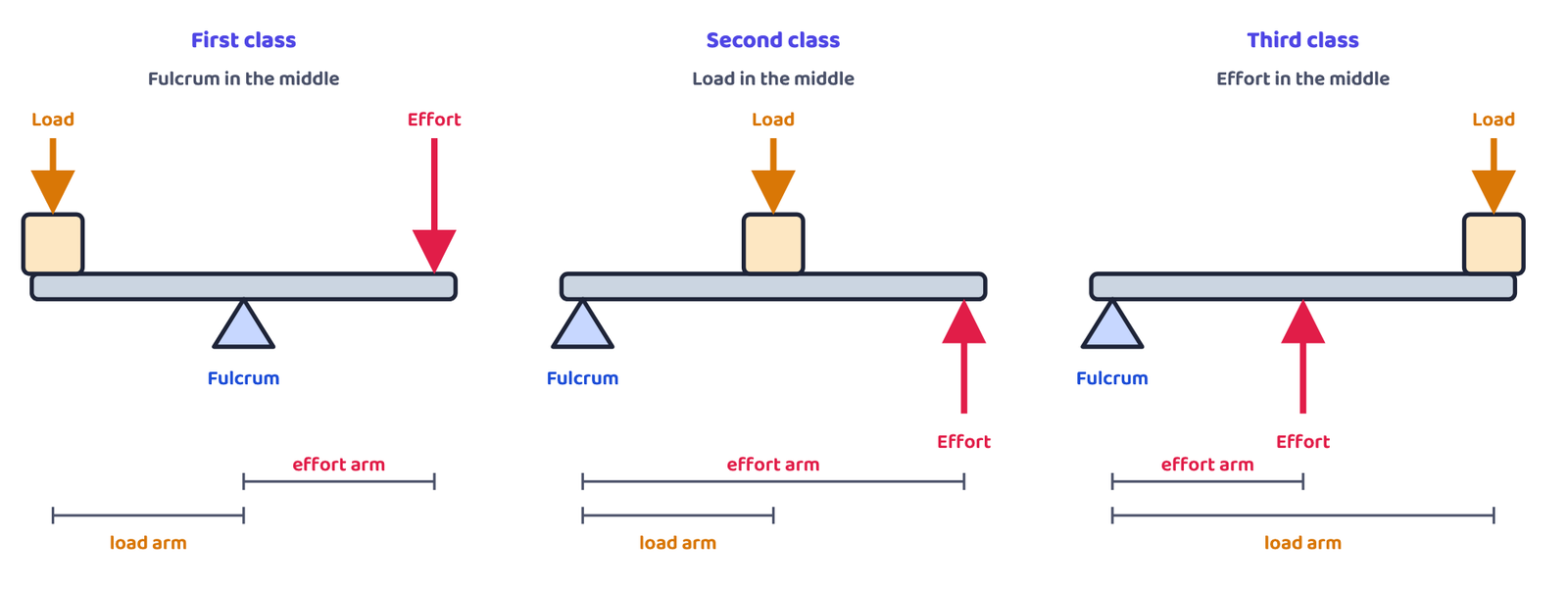
| Class | In the middle | Arms | What it gives |
|---|---|---|---|
| First class | Fulcrum (between force and resistance) | Depends on where the fulcrum is placed | Fulcrum near the load: long force arm, less force needed, but the force moves a long way. Short force arm: more force needed, but a gain in speed and range of motion at the load end |
| Second class | Load (between fulcrum and force) | Force arm always longer | Force needed is always less than the weight lifted |
| Third class | Effort (between fulcrum and resistance) | Force arm always shorter | Large force needed, but the load moves through a much longer range: speed and range of motion at the expense of force. The most common lever in the human body |
F-L-E = 1-2-3
Ask “what is in the middle?” Fulcrum → first class, Load → second class, Effort → third class.
3.3 Examples in the body and in sports

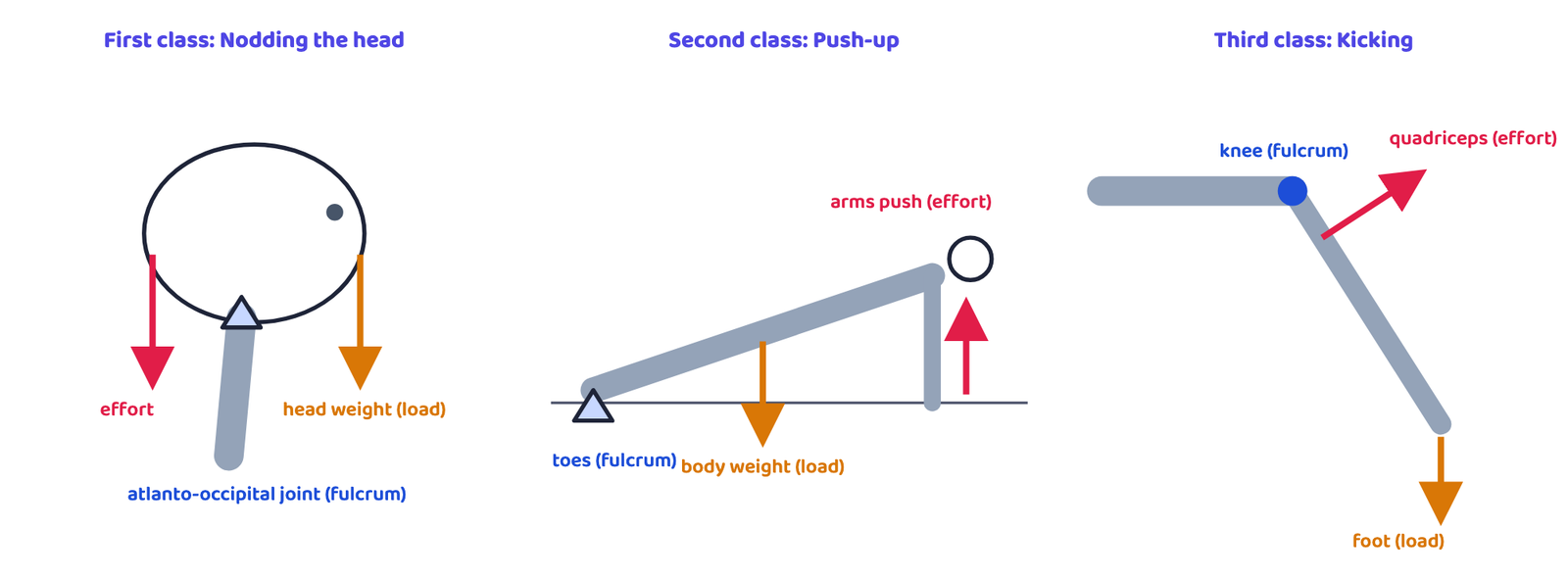
| Class | Example | Fulcrum | Effort | Load |
|---|---|---|---|---|
| First | Throwing a ball: triceps extending the elbow | Elbow | Triceps | Arm / ball |
| V-sit-up | Hip joint | Abdomen | Leg / lower body | |
| Looking up/down or side to side | Atlanto-occipital joint (the head balances like a see-saw) | Neck muscles | Weight of the head | |
| Second | Standing on the toes (foot as a whole) | Ball of the foot | Gastrocnemius (calf) pulling at the heel | Body weight |
| Straight push-ups | Ball of the foot | Arm muscle contraction | Body weight | |
| Third | Biceps causing flexion at the elbow | Elbow joint | Biceps | Arm / weight |
| Sit-ups | Hip joint | Abdomen | Upper body | |
| Kicking (lower limb) | Knee joint | Quadriceps, at the tibial tuberosity | Foot |
“Neck muscles” and “weight of the head” for head nodding are general knowledge; the book only says the head pivots on the atlanto-occipital joint like a see-saw.
3.4 Application of levers in sports
- The human lever system is built for speed and range of movement at the expense of force. Short force arms and long resistance arms need great muscular strength: the biceps force arm is only 1 to 2 inches, the triceps force arm less than 1 inch.
- A sports skill uses several levers together: throwing a ball uses levers at the shoulder, elbow and wrist.
- Longer lever = more velocity. A tennis player hits harder with a straight-arm drive than with a bent elbow, because the lever is longer and moves faster. Long levers give better performance in baseball, hockey, golf and field hockey.
- Shorter lever = quickness. A baseball catcher brings the hand back to the ear for a quick throw; a sprinter bends the knee so much that the spikes almost touch the gluteal (buttock) muscles, shortening the leg lever.
- Cricket bat: the book gives the fulcrum at the top of the handle, the force closer to the neck of the handle and the load as the bat’s body. With the force between the fulcrum and the load, this matches the definition of a third-class lever.
Levers can be internal (the bones of the limbs) or external (sports implements such as rackets, bats and hockey sticks). The “bar” in the definition can be of any shape.
4 Equilibrium: Static and Dynamic
When something is stable or balanced, it is not easily upset: it takes effort to topple it. An unstable object is easily upset. Equilibrium (stability, balance) is needed for performing every skill.
Equilibrium is a state of balance or a stable situation, where opposite forces cancel each other out and where no changes are occurring.
The centre of gravity (CG) shifts with every change in posture. In the standing posture it lies near the centre of the upper pelvic region (slightly different in males and females). A big part of any skill is adjusting the body segments all the time to control the CG.
4.1 Types of equilibrium
Static equilibrium
- Body is at rest, completely motionless: not moving or rotating
- All forces and torques acting on it add up to zero
- Balance during rest or a stationary position
- Examples: batsman’s stance in cricket, sprinter on the starting block, wrestler’s wide stance
Dynamic equilibrium
- Body is moving with constant velocity: no change in speed or direction
- All applied and inertial forces on the moving body are in balance
- Balance during movement
- Examples: sprinter running on the track, cyclist cycling, footballer dribbling
Static equilibrium is the state when a body is at rest or completely motionless.
Dynamic equilibrium is the state when all the applied and inertial forces acting on a moving body are in balance, resulting in movement with unchanging speed or direction.
1. The sum of all the vertical forces acting on the body must be zero.
2. The sum of all the horizontal forces acting on the body must be zero.
3. The sum of all the torques (turning forces) must be zero.
4.2 Factors that increase equilibrium
- CG falls within the base of support. Stability decreases as the CG gets near the edge of the base.
- Larger base of support.
- Greater weight.
- Lower centre of gravity.
- When expecting an oncoming force: place the CG near the side of the base that will receive the force, and extend the base in the direction of the expected force.
- Greater friction between the body and the surface it touches.
- Rotation about an axis: a moving cycle is easier to balance than a stationary one.
- Kinaesthetic physiological functions: the vestibular system, vision, touch and kinaesthetic awareness.

4.3 Guiding principles to determine the degree of stability
Broader the base, greater the stability
Spread the feet in the direction of movement. Where a stance is needed, using both hands and feet gives the widest base.
Body weight is directly proportional to stability
A heavier person is harder to move. That is why judo, wrestling, taekwondo and boxing are played in bodyweight categories.
Lower the CG, higher the stability
A player bends the knees to stop sooner; a wrestler half-sits; a shot-putter bends the knees at the end to avoid a foul.
CG nearer the centre of the base, more stability
If the CG goes beyond the base, balance is lost. A gymnast on a balance beam who starts to fall raises the arm or leg on the opposite side to bring the CG back over the base.
Direction of the acting force
If the direction of a force is known, move the line of gravity close to the edge of the base where the force will come. A judoka shifts the foot in the line of the opponent’s force and uses it as a counterforce to throw him.
4.4 Centre of gravity
The centre of gravity is the point at which all the weight or mass of a body may be considered to be concentrated.
- For a person standing in the anatomical position, the CG is where the three primary planes and axes of the body meet.
- The body is flexible, so the CG moves with every significant movement; in many sports skills it is constantly moving.
- For a rigid object of uniform density and regular shape, the CG is at its exact centre; hung from that point, the object stays in rotational equilibrium.
- An athlete’s stability depends on the CG. It is the point about which the body can rotate freely in any direction.
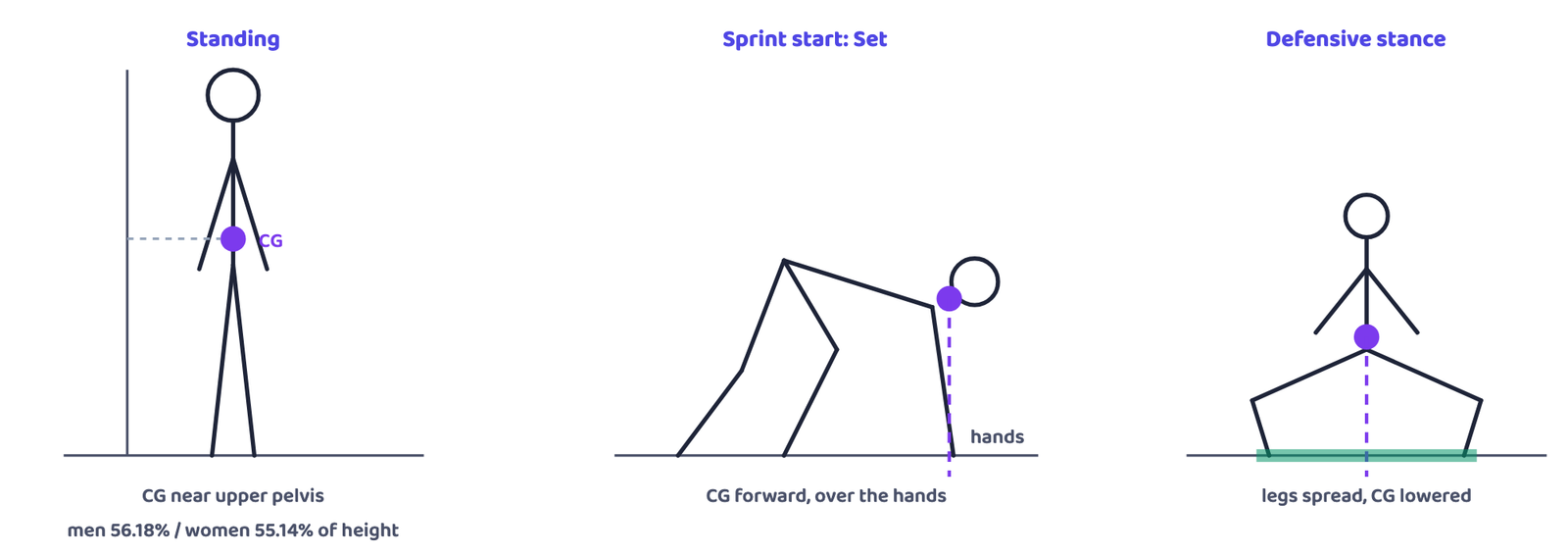
In an adult man standing upright, the CG is at about 56.18% of the height from the ground; in an adult woman it is at about 55.14%.
Importance and application of CG in sports. Knowing where the CG is:
Examples of CG in sports:
- Weightlifting (snatch and jerk): widening the legs and lowering the body brings the CG down for stability.
- Running: the runner’s CG is low in the pelvis and in front of the body because the upper body leans forward. A low CG in front helps acceleration.
- Basketball and volleyball defence: defenders spread their legs to lower the CG towards the base and take a better position against the attacker.
- Sprint start, “Set” position: body weight is taken on the hands so the CG falls on the edge of the base formed by the hands, for an instant start. If the CG falls behind that line, the start is delayed because more force is needed to go ahead.
- Wrestling: a wrestler who falls spreads the arms, knees and legs on the mat to get a balanced position that is hard for the opponent to move.
5 Friction and Sports
Friction is a force that opposes the motion between two surfaces that are in touch. It always acts in the direction opposite to the direction in which the object is moving or trying to move.
- Friction is a contact force.
- It produces heat: rub your hands together quickly and they get warmer.
- It can bring a moving object to rest: a ball rolled on a surface stops after a while.
5.1 Types of friction

| Type | Meaning | Sports examples |
|---|---|---|
| Static friction | Acts when a force is applied but the object does not move. You must push harder than the static friction to start motion; once the object moves, there is no static friction | Pushing a heavy object with too little force: it does not move |
| Sliding friction (kinetic) | One body slides or rubs over the surface of another | Skating on ice, planting the pole in pole vault, skiing, a sliding weight |
| Rolling friction (kinetic) | One body rolls over another, as between wheels and a surface | A hit hockey or cricket ball rolls and then stops; roller skates, skateboards |
| Fluid friction (kinetic) | Opposes objects moving through a fluid (gas, air, water) | Riding a bike against the air; cyclists wear streamlined helmets and special clothing to reduce it; paragliding and hang gliding |
Limiting friction is the force that comes into play when one body is just on the verge of moving over another. At that moment the moving force and the opposing force are equal; any more moving force causes slipping. It is proportional to the normal reaction between the surfaces and does not depend on the area of contact.
5.2 Things that affect friction
- A lubricant (motor oil, grease, wax) between two surfaces reduces it.
- Rolling an object instead of pushing it reduces it.
- Rougher surfaces increase it; smooth surfaces generally give less friction than uneven ones.
- Friction increases when the force pressing the two objects together increases.
5.3 Methods of reducing friction
Polishing
Rubbing a surface smooth reduces its unevenness. Shining a cricket ball increases its swing.
Lubricating
Applying motor oil, grease or wax, as in bearings and gears.
Wheels and ball bearings
They turn sliding friction into rolling friction, saving energy and time, as in roller skates.
Streamlining
Shaping a body to cut air friction: the javelin, boats, ships and vehicles have a sharp, pointed front.
5.4 Advantages and disadvantages of friction in sports
Without the right amount of friction we could not grip any sports equipment. Friction is also needed for every push and pull in sport.
| Sport | How friction helps |
|---|---|
| Athletics | Spiked shoes increase friction for speed. Sprint shoes have spikes in the front portion only; long-distance runners use very different shoes |
| Badminton | A good racket grip increases friction with the hand, so the racket does not slip and the shot counts |
| Basketball | Friction between shoes and court gives control of movement; players wipe their shoes often for more friction |
| Cricket | Fielders wear spiked shoes for grip in the run-up, running between the wickets and to avoid slipping |
| Cycling | Tyre friction prevents slipping and skidding; brake friction slows the bike |
| Football / soccer | Helps to run, change and hold position and tackle correctly; strikers and defenders use different numbers and sizes of studs |
| Gymnastics | Lime powder on the palms increases friction with the horizontal bar |
| Javelin | Hand friction gives the grip; shoe friction with the track gives the ground reaction force for the throw |
| Running | Shoe friction lets the athlete run fast, slow down, stop and change direction without slipping |
| Weightlifting | Specially designed shoes give friction with the floor so the lifter does not slip |
- Cycling: in a cycle race tyres heat up from friction and may burst, causing serious accidents.
- Weightlifting and gymnastics: palm skin gets damaged by friction, and the athlete may still slip; so they use powder on the palms and special shoes.
- Pole vault: with too little friction between palms and pole, the vaulter loses grip; adhesive is used on the palms.
- Makes movement difficult: friction makes moving any object harder.
- Wastes energy: more friction means more force, and more force means more energy, to overcome it.
- Injuries: sliding or falling across the ground can cause injuries, even critical ones.
- Wear and tear: sports equipment wears out over time because of friction.
Friction can be advantageous or disadvantageous depending on its use, time and place. Some friction is needed in every sport, but the amount differs from sport to sport.
This is why friction is called a “necessary evil”
6 Projectile in Sports
A projectile is an object upon which the only force acting is gravity. Once projected or dropped, it continues in motion by its own inertia and is influenced only by the downward force of gravity.
- Without gravity, a projectile would travel in a continuous straight line.
- Because of gravity, projectiles travel in a parabolic (curved) path, called the trajectory.
- In simple words, the motion of an object in flight after being thrown is projectile motion.
6.1 Kinds and examples of projectiles
Each of these is a projectile, provided air resistance is negligible:
Dropped from rest
An object simply let go from a height falls straight down.
Thrown vertically upward
Goes straight up, slows down, and comes back down.
Thrown at an angle
Thrown upward at an angle to the horizontal: the usual curved path of a throw or a jump.
Horizontal projectile
Projected horizontally from a height (as in the book’s figure); it curves down to the ground.
| Object as a projectile | Body as a projectile |
|---|---|
| Basketball, football, shot-put, hammer, discus, javelin, golf ball, volleyball, tennis ball | High jump, long jump, gymnastics, diving, figure skating, ski jumping |
The motion of a projectile has two separate components happening at the same time: one along the horizontal direction and the other along the vertical direction, which has a constant acceleration due to the force of gravity.

6.2 Factors affecting the projectile trajectory (flight path)
Gravity
The force by which the earth pulls every object towards its centre; it is directly proportional to the mass of the body. Without gravity the body would go in a straight line after being thrown.
Air resistance
Depends on surface area, speed, surface texture and mass (see the table below).
Speed of release
How fast the object is released (thrown or hit). It depends mainly on muscle force. Generally, the greater the speed of release, the greater the distance, as in the javelin and discus.
Angle of release
The angle at which the object is thrown or hit into the air. It varies with the activity: basketball shooting needs an angle above 45°; tennis needs a low angle of about 3° to 15°.
Height of release
How high above the ground the object is released. For a given speed and angle, the greater the height of release, the greater the horizontal distance, as in the javelin and hammer throw.
Spin
A ball moving through the air moves in the direction of least air pressure. A force applied below, above or to the side of the CG puts spin on the projectile. Spin helps it keep its course and can change its height or direction, as in basketball shooting.
| Air resistance factor | Effect | Book’s example |
|---|---|---|
| Surface area | Larger surface area, more air resistance | Basketball compared with a golf ball |
| Speed | More speed, more air resistance | The space shuttle |
| Surface of the object | Rough surface, more air resistance | Swinging ball in cricket |
| Mass | Smaller (lighter) mass, more affected by air resistance | Shuttlecock in badminton |
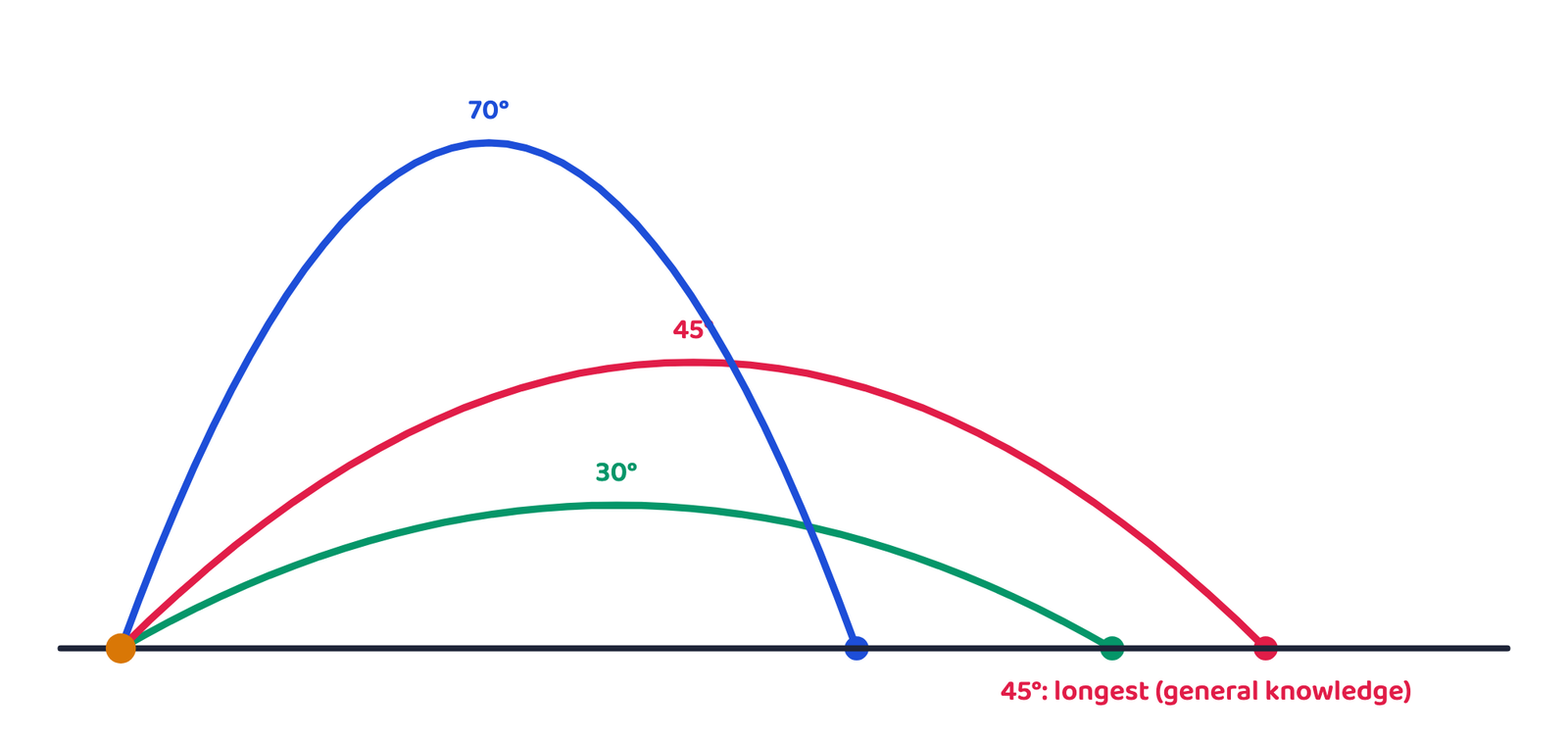
Gravity does not stop acting at the top of the flight. It acts throughout, from release to landing, and only the vertical part of the motion is changed by it.
6.3 Application of projectile in sports
Most sports involve a projectile, usually a ball. Physics helps to find the best angle of flight for maximum speed or distance.
- Baseball, pitching: a thrown ball is a projectile in mid-air; its path depends on the pitcher’s height, arm angle and the spin on the ball.
- Baseball, hitting: the launch angle is the angle at which the ball leaves the bat. The best launch angles for line drives and home runs are about 10-30 degrees, usually needed to hit the ball 325 to 400 feet over the fence.
- Basketball: the ball must be shot at a certain angle with a certain force. The best angle depends on the height of the shot and the distance from the hoop. According to Professor John Fontanella, the ideal angles from the free-throw line vary from 48.7 to 52.2 degrees, with shorter players.
6.4 Types of spin
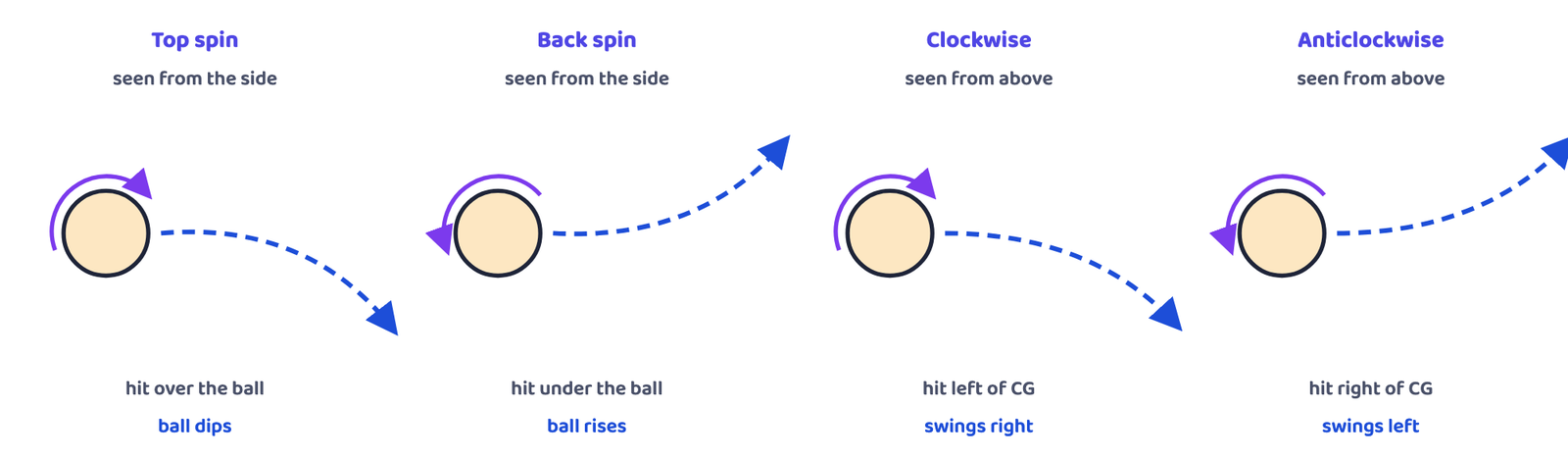
| Spin | How it is put on the ball | Effect |
|---|---|---|
| Top spin | Hit over the ball | Downward force; the ball drops |
| Back spin | Hit under the ball | Upward force; the ball rises |
| Clockwise spin | Hit on the left side of the CG | Ball swings to the right |
| Anticlockwise spin | Hit on the right side of the CG | Ball swings to the left |
- Biomechanics = science of movement of a living body; part of kinesiology. Motion: linear, angular, general.
- Newton: 1st = Inertia (no change without force), 2nd = Momentum (F = m × a; 2 kg × 20 m/s² = 40 N), 3rd = Reaction (equal and opposite; ground reaction force).
- Lever parts: load, fulcrum, effort, lever (bone). Middle part names the class: F-L-E = 1-2-3.
- 1st: triceps extension, V-sit-up, head nodding. 2nd: rising on toes, push-up (force always less than load). 3rd: biceps curl, sit-up, kicking (most common in the body; speed and range at the cost of force).
- Equilibrium: static (at rest; vertical forces, horizontal forces and torques all zero) and dynamic (constant velocity).
- Stability rises with a broader base, more weight, lower CG, CG near the centre of the base, and the line of gravity moved towards the edge of the base where a force is expected.
- CG = point where all the weight is concentrated; near the upper pelvis; 56.18% (men) and 55.14% (women) of height.
- Friction opposes motion; static and kinetic (sliding, rolling, fluid); limiting friction at the verge of motion. Reduce by polishing, lubricating, ball bearings, streamlining. A necessary evil.
- Projectile: only gravity acts; parabolic path; horizontal + vertical components. Six factors: gravity, air resistance, speed, angle, height of release, spin.
- Can I draw all three lever classes with the bar, fulcrum, effort and load labelled, and give a body and a sports example of each?
- Can I state each of Newton’s laws, name it, and give two sports examples?
- Can I list the six factors affecting a projectile and the four air-resistance factors?
- Can I write four advantages and four disadvantages of friction with sports examples?