
- Which three physiological factors decide a person’s strength, endurance, speed and flexibility
- How slow twitch and fast twitch muscle fibres differ, and which energy system runs which event
- What exercise does to the muscles, heart and lungs, straight away and after months of training
- What changes in the body as we grow old
- How sports injuries are classified, and the cause, prevention and treatment of each soft tissue, joint and bone injury
In the CBSE Physical Education (048) curriculum, this is Unit 7: Physiology and Injuries in Sports, worth 4 marks + 4 “b” marks. The “b” marks are concept questions (a tactile diagram, data interpretation or a case study) set for visually impaired candidates. The prescribed book is CBSE’s own Physical Education Class XII textbook; there is no NCERT book for this subject. The sample paper asks this unit as 1-mark MCQs (hypertrophy, sprain), a 2-mark question on PRICE, and a 4-mark case study on a sprain and its first aid.
1 Physiological Factors Determining Components of Physical Fitness
Exercise physiology is the study of the body’s response to exercise.
When we exercise, many body systems respond: skeletal, muscular, nervous, endocrine, cardiovascular, metabolic, respiratory, digestive, urinary and reproductive. All systems work jointly, but the response of each system is independent. Each fitness component is trained with a different exercise, intensity and volume, so the systems respond differently.
| System | Its job during exercise |
|---|---|
| Metabolic system | Produces energy; looks after intake and output of energy |
| Cardiovascular system | Controls circulation; carries oxygen and energy to muscles, and waste products from muscles to the kidney |
| Respiratory system | Takes in air, diffuses oxygen to the lungs and muscle tissue, removes carbon dioxide |
| Neuromuscular and skeletal system | Allows body movement through muscle contraction |
| Neuroendocrine and immune system | Help maintain homeostasis (a steady internal state) of the body |
The book studies three major physiological factors that decide the components of fitness:
Skeletal muscles factor
Type of muscle fibres and properties of muscles
Energy production factor
How food becomes ATP; the three energy systems
Cardiorespiratory factor
Heart and lungs supplying oxygen: VO2 max, stroke volume
1.1 Skeletal Muscles Factor
Skeletal muscles are made of muscle fibres of two kinds: slow twitch (Type I) and fast twitch (Type II). Most muscles contain a mix of both. The proportion depends on genetics, hormones and habits of exercise, and the mix plays a dominant role in strength, endurance and speed. Regular training can change the proportion of slow and fast twitch fibres.

| Point | Slow twitch (Type I, slow oxidative) | Fast twitch (Type II, fast glycolytic) |
|---|---|---|
| Enzymes | Many oxidative enzymes | Many glycolytic enzymes |
| Capillaries, myoglobin, mitochondria | More capillaries, more myoglobin and mitochondrial enzymes | Fewer mitochondria, limited aerobic capacity |
| Colour | Red (more capillaries, greater blood supply) | Lighter (do not need blood supply to produce energy) |
| Type of activity | Aerobic | Anaerobic |
| Contraction | Slow rate, keeps contracting for long without fatigue | Fast rate, tires rapidly |
| Energy | Large amount of energy, slowly | Small amount of energy, quickly; consumes lots of energy |
| Fatigue resistance | High | Low |
| Sports | Long distance running, swimming, cycling | Jumps, throws, sprint |
The rest of the fibres are fast twitch: 20 to 30% in long distance runners, 70 to 75% in sprinters and 48 to 52% in non-athletes. Even among athletes in the same sport, the fibre types vary.
Four properties of skeletal muscles decide different components of fitness. The book names the four; the one-line meanings below are our general explanation:
Contractility
The ability of a muscle to contract (shorten) and produce force
Excitability
The ability to respond to a stimulus, such as a message from a nerve
Extensibility
The ability to be stretched beyond resting length
Elasticity
The ability to return to its original length after stretching
The force a muscle produces depends on the number and types of motor units, the length of the muscle, the nature of neural stimulation of the motor units, and the contractile history of the muscle.
“Slow is Red, Long is Ahead”
Slow twitch fibres are red and win the long races; fast twitch fibres are pale and win the short, explosive ones.
1.2 Energy Production Factor
Cellular respiration is the process in which ATP (Adenosine triphosphate) is formed from food. The main sources of energy in food are carbohydrates, fats and proteins. During exercise, the load on the metabolic system increases manifold.
Carbohydrates
- Give instant energy
- Fuel for short duration exercise
- Glucose and glycogen fuel high intensity activity
Fats and proteins
- Fats give a larger amount of energy; used in long duration exercise
- Proteins give a small but important share
Metabolism is the process of overall energy transformations occurring in the body.
Anabolism is the process in which simple molecules combine to generate complex molecules.
Catabolism is the process of breakdown of food and stores to produce energy for work.
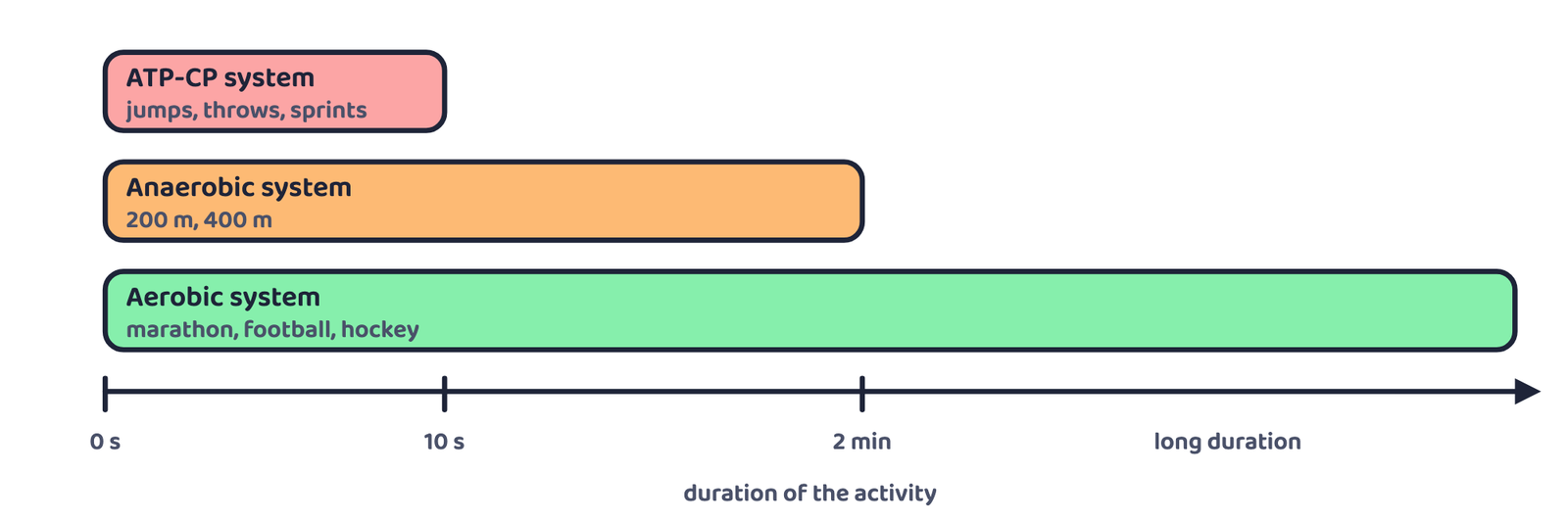
Three energy systems work in our body:
| Energy system | Supplies energy for | Examples from the book |
|---|---|---|
| ATP-CP (creatine phosphate) system | Less than 10 seconds; very short, very intense, dynamic | Jumps, throws, sprints, weightlifting, powerlifting |
| Anaerobic system | Less than two minutes | 200 m and 400 m races |
| Aerobic system | Long duration activities | Marathon, football, hockey |
The ATP-PCr system is also called the immediate energy system, phosphagen system and alactic anaerobic system; it is the main energy provider for high intensity exercise up to 10 seconds, such as lifting a weight, swinging a golf club, doing a push-up or throwing a hammer. The aerobic and anaerobic systems work simultaneously; which one is predominant depends on the type, duration and intensity of exercise, long and short-term nutritional status and the proportion of fibre types.
1.3 Cardiorespiratory Factor
The cardiorespiratory system is the combination of the respiratory and cardiovascular systems. They work together to transport oxygen to the cells and support metabolism by delivering nutrients. During exercise the demand for energy, and so for oxygen, rises with the intensity, duration and type of activity. To meet it, pulmonary ventilation, external respiration and internal respiration work together. The cardiovascular response to exercise is directly proportional to the oxygen demand of the skeletal muscles. Maximal oxygen consumption (VO2 max), blood pressure, blood volume, oxygen diffusion and extraction, and muscle and arterial blood flow all increase with activity.
Stroke volume is the volume of blood pumped out of the left ventricle of the heart during each systolic (contraction) cycle.
1.4 Physical Fitness Components Determined by the Physiological Factors
| Component | Meaning | Physiological factors that decide it | Examples |
|---|---|---|---|
| Strength | Ability of the body to work against resistance. Sub-types: maximum strength, explosive strength, strength endurance | High percentage of fast twitch fibres where a sudden burst of energy is needed; force production high, fatigue quick | Weightlifting, jumps, sprint |
| Endurance | Ability of the body to work for a longer period without getting fatigued | Higher slow twitch fibres; aerobic system gives energy; VO2 max and ventilation capacity dominate | Brisk walk, running, marathon, cycling, swimming |
| Speed | Ability to cover maximum distance in the shortest period | Very high fast twitch fibres; motor neuron stimulation (brain tells muscles to act fast); ATP-CP system | 100 m race, roller skating |
| Flexibility | Ability of muscles and tendons to lengthen without getting damaged | Elasticity and extensibility of muscles, type of joint, homothermic (body) temperature; muscles, tendons and ligaments | Stretching, yoga |
For flexibility training, the muscle groups must be understood:
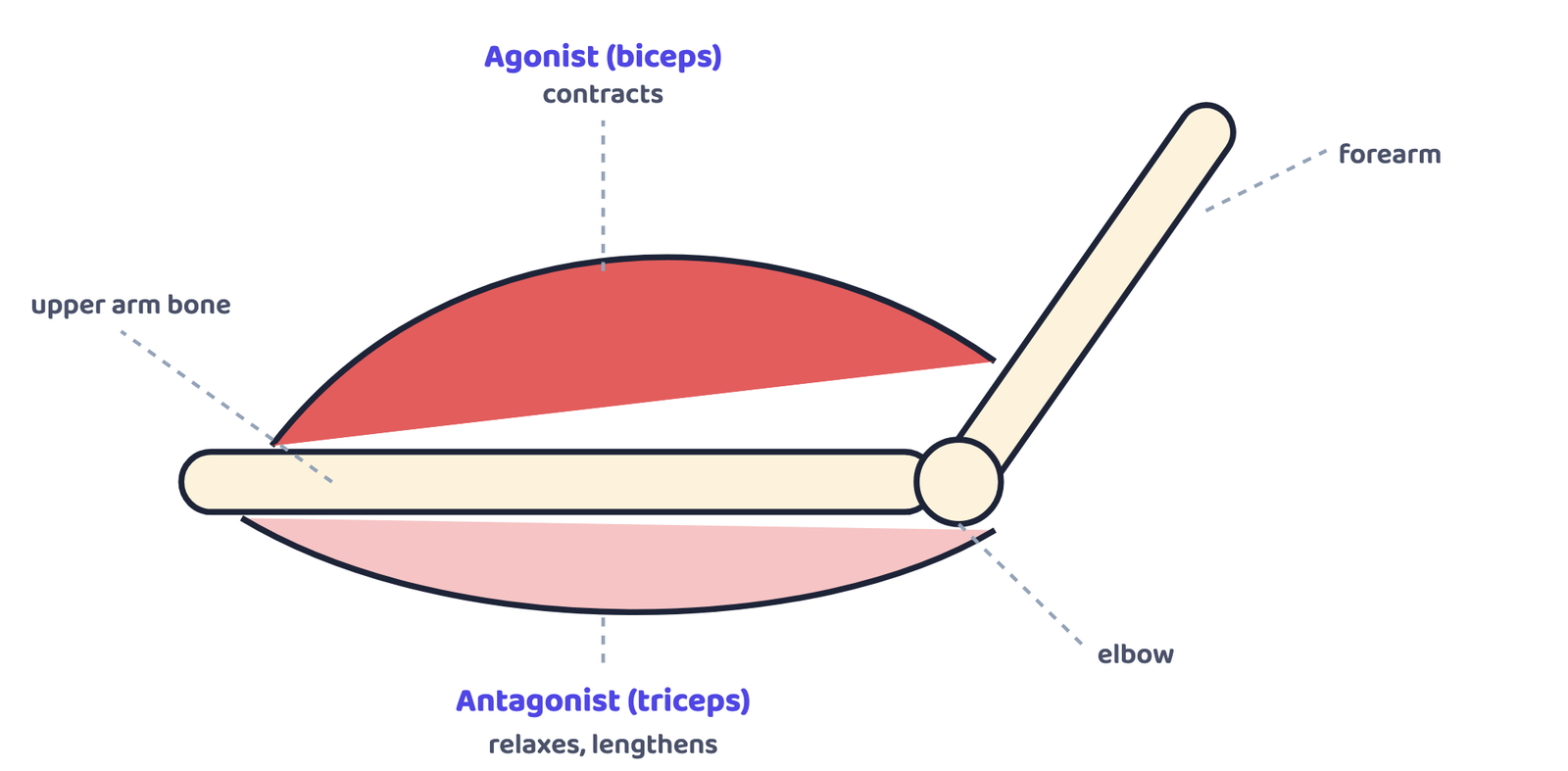
Agonists
Muscles which contract to perform a certain action (prime movers)
Antagonists
Muscles which oppose the prime movers; they relax and lengthen progressively to allow the agonists to move
Synergists
Muscles that work together in close cooperation, contracting or relaxing to modify the agonist’s action. Include conjoint, neutralizer and stabilizer muscles
The biceps and triceps example in Figure 3 is our own illustration of the book’s definitions.
Aerobic exercise
- Any type of cardiovascular conditioning (“cardio”)
- Means “with oxygen”
- Brisk walking, swimming, running, cycling
- Breathing and heart rate increase
Anaerobic exercise
- Breaks down glucose for energy without oxygen
- Short length, high intensity
- Much energy released in a small time
- Oxygen demand exceeds oxygen supply
ATP (Adenosine Triphosphate) is a complex organic chemical that provides energy to drive many processes in living cells, e.g. nerve impulse propagation, muscle contraction and chemical synthesis. Myoglobin is a red, iron-containing protein pigment in muscles, similar to haemoglobin. Mitochondria are cell organelles outside the nucleus that produce energy for the cell through cellular respiration.
2 Effect of Exercise on the Muscular System
Exercise is a series of sustained muscle contractions, long or short depending on the activity. Its effects are short term (during and shortly after exercise) and long term (lasting effects of regular training).
2.1 Short Term Effects
- Increased blood supply: to match the fuel demand, blood supply rises in the whole body or in the muscle group doing most of the work.
- Increased muscle temperature: contracting muscles produce a lot of heat energy, raising the temperature of the muscles and the body.
- Increased muscle flexibility: more blood flow and higher temperature increase the elasticity of muscles; stretching and mobility exercises add to it.
- Accumulation of lactate: if blood does not bring enough oxygen, lactic acid collects in the muscles, causing pain and soreness.
- Micro-tears in muscle fibres: stress during exercise causes tiny tears; the body repairs the fibres and makes them larger.
2.2 Long Term Effects
- Hypertrophy of muscle: scientific and systematic exercise increases the thickness of muscle fibres, so the muscle grows bigger.
- Increase in strength of ligaments and tendons: regular exercise strengthens bones, ligaments and tendons; this prevents injury and improves performance.
- Increase in size and number of mitochondria: aerobic exercise does this, so muscles take in more oxygen and produce more ATP.
- Increase in myoglobin storage: myoglobin carries oxygen to the mitochondria; more myoglobin means more oxygen and more energy.
- Increase in glycogen storage: glycogen is stored in muscles and liver; a larger store can give continuous energy for 90 to 120 minutes.
- Increase in oxidation/metabolism: endurance training increases mitochondrial density, so muscles can oxidise (burn) more fat; metabolism rises.
- Increase in lactate acid tolerance: regular exercise helps the body tolerate the pain and soreness of lactic acid.
Hypertrophy is the increase in muscle size that results from an increase in the thickness of muscle fibres.
“Increased blood supply” is a short term effect, while “increase in lactate acid tolerance” is a long term effect. Accumulation of lactate (short term) and tolerance of lactate (long term) are easy to swap.
3 Effect of Exercise on the Cardiorespiratory System
Cardiovascular system
- Parts: heart, blood vessels, blood
- Delivers oxygen and nutrients; removes CO2 and other wastes
- Transports hormones; supports thermoregulation and body fluid balance; regulates immune function
Respiratory system
- Parts: nose, nasal cavity, pharynx, larynx, trachea, bronchi, lungs (air can also enter through the oral cavity)
- Transports air to the lungs; exchanges O2 and CO2 between air and blood; regulates blood pH
3.1 Effect of Exercise on the Cardiovascular System
| Short term effects | Long term effects |
|---|---|
| Heart rate increases | Size and strength of heart increase (cardiac hypertrophy) |
| Blood circulation and blood flow increase | Blood volume increases |
| Blood pressure (systolic) increases | Low level of accumulation of lactic acid |
| Stroke volume increases | Resting heart rate decreases (bradycardia) |
| Cardiac output increases | Normal blood pressure; increase in stroke volume and cardiac output; increase in capillary network |
Short term effects explained:
- Increased heart rate: working muscles need more oxygen; the heart meets this by pumping faster.
- Increased blood circulation: as heart rate rises, more blood flows to tissues and organs to deliver oxygen.
- Increased blood pressure: endurance exercise raises systolic blood pressure in direct proportion to exercise intensity, because cardiac output rises; diastolic pressure changes minimally with most types of training.
- Increased stroke volume: more blood is pumped per beat to deliver oxygen. After an endurance training programme, the heart’s capacity to pump blood in one contraction rises by 20 to 50 percent.
- Increased cardiac output: rises because both heart rate and stroke volume rise.
Cardiac output is the amount of blood pumped out by each ventricle of the heart in one minute.
Q. At rest, a student’s heart beats 70 times a minute and pumps 70 mL per beat. Find the cardiac output.
Step 1: HR = 70 beats/min, SV = 70 mL/beat
Step 2: Q = 70 × 70 = 4,900 mL/min
Answer: about 4.9 L/min, close to the book’s resting value of about 5.0 L/min. (The numbers in this example are our own.)
Long term effects explained:
- Increased size and strength of heart: continuous aerobic exercise enlarges and strengthens the heart; this is called cardiac hypertrophy.
- Low level of accumulation of lactic acid: anaerobic respiration turns glucose into energy without oxygen and leaves lactic acid, which makes muscles tired and painful. Training prepares muscles to work with less oxygen and the circulatory system to carry oxygen better, so less lactic acid builds up.
- Decrease in resting heart rate: a more efficient heart needs fewer beats to meet the body’s needs at rest; this is called bradycardia.
- Normal blood pressure: endurance training can substantially reduce both systolic and diastolic pressure; regular exercise keeps blood pressure normal.
- Increase in stroke volume and cardiac output: a bigger, stronger heart pumps blood more efficiently.
- Increase in capillary network: capillary density at muscle sites improves, so more oxygen reaches the muscles; exercise also prevents the decline in capillary function that comes with age.
Cardiac hypertrophy is the enlargement of the heart (increase in its size and strength) due to continuous endurance (aerobic) training.
Bradycardia is the decrease in resting heart rate that results from the improved efficiency of a trained heart.
3.2 Effect of Exercise on the Respiratory System
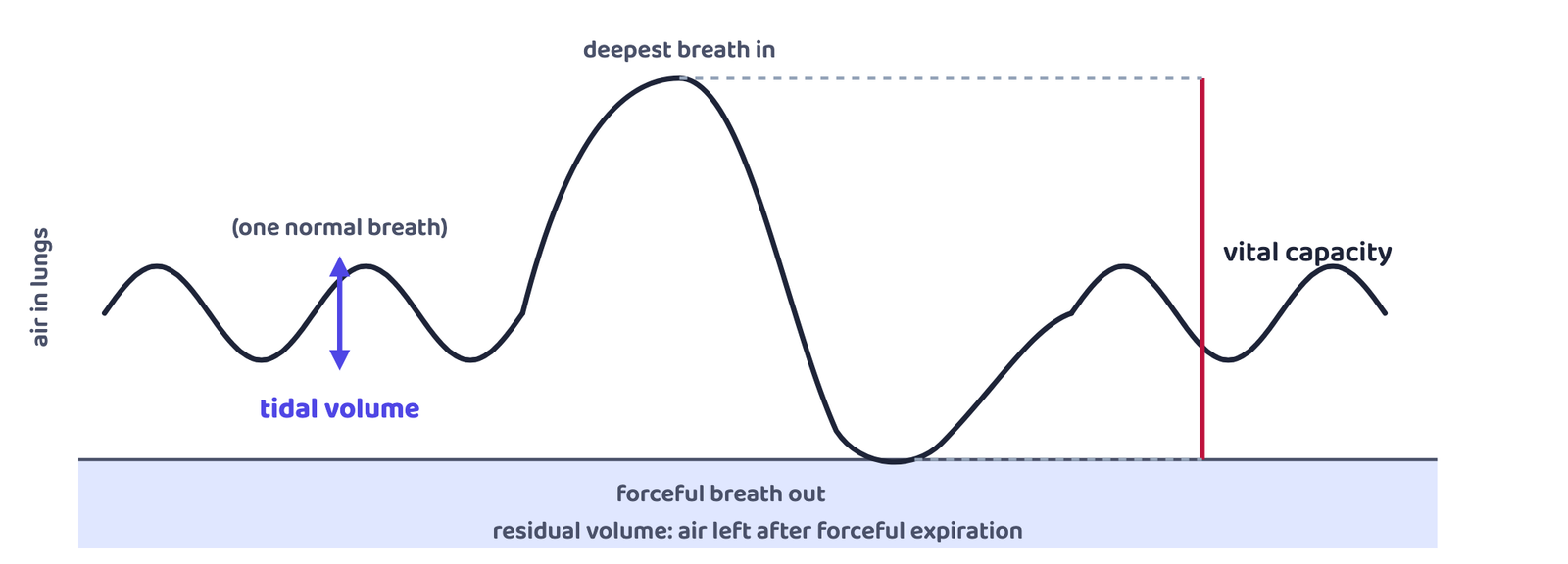
Tidal volume is the amount of air inhaled and exhaled in one breath.
Residual volume is the volume of air that remains in the lungs after forceful expiration.
Pulmonary diffusion is the capacity of the lungs to allow oxygen and carbon dioxide to pass in and out of the blood.
Short term effects:
- Respiratory rate increases: the body needs more oxygen, so breathing rate rises from 12 to 20 breaths per minute at rest (adult) to about 40 breaths per minute during exercise.
- Tidal volume increases: to take in more oxygen and remove more carbon dioxide.
- Rate of exchange of gas increases in the lungs.
Long term effects:
- Increased efficiency of respiratory muscles: inhalation and exhalation become fluent, meeting the oxygen demand.
- Increased lung volume: long-duration exercise increases the capacity and volume of the lungs; the book states that vital capacity increases by almost 100% compared with a normal individual.
- Increased pulmonary diffusion: regular sub-maximal training increases gas exchange, and the size of the alveoli also increases.
- Increased residual volume: the book states that regular exercise increases residual volume, which helps keep gas exchange within normal limits.
For “effect of exercise on the heart / cardiovascular system”, write the answer in two labelled parts, short term and long term, each point with a one-line reason. A 5-mark answer needs at least four points from each side.
4 Physiological Changes Due to Ageing
Ageing is an inevitable and extremely complex multifactorial process, characterised by the progressive degeneration of organ systems and tissues. It is largely determined by genetics and influenced by environmental factors such as diet, exercise, exposure to micro-organisms and pollutants.
| Area | What changes with age (book’s figures) |
|---|---|
| Muscular strength (maximal force a muscle or muscle group can generate) | Peak between ages 20 and 40, when muscle cross-sectional area is largest. Concentric strength declines slowly, then faster after middle age; eccentric strength declines later and more slowly. Women lose strength later than men. A 40% to 50% reduction in muscle mass (fibre atrophy and loss of motor units) between ages 25 and 80 is the main cause. |
| Neural function | Nearly 40% fewer spinal cord axons and a 10% fall in nerve conduction velocity; simple and complex reaction time and movement time get slower; detecting a stimulus and processing it takes longer. |
| Endocrine changes | About 40% of people aged 65 to 75 and 50% of those over 80 have impaired glucose tolerance, leading to Type 2 diabetes. Thyroid dysfunction (less thyrotropin from the pituitary, less thyroxine) lowers glucose metabolism and protein synthesis. Growth hormone output falls: somatopause. |
| Pulmonary function | Static and dynamic lung function deteriorate; ventilation and gas exchange become much slower in moving from rest to sub-maximal exercise. |
| Cardiovascular function | Lower maximum heart rate, so lower maximum cardiac output; reduced peripheral blood flow with loss of muscle mass. Sedentary living causes losses at least as great as ageing. |
| Body composition (percentages of fat, bone, water and muscle) | After age 60, total body mass decreases although body fat increases. |
| Bone mass (amount of minerals, mostly calcium and phosphorus, in a certain volume of bone) | Osteoporosis is a major problem, especially in postmenopausal women; bone mass can fall by 30% to 50% after age 60. |
Osteoporosis is a condition in which the ageing skeleton demineralises and becomes porous, so bone mass is lost and the risk of a broken bone increases.
Atrophy is the decrease in size of a body part, cell, organ or other tissue.
The endocrine system consists of a host organ (gland), minute quantities of chemical messengers (hormones) carried in the blood, and a target or receptor organ.
5 Sports Injuries
Injuries may be caused by incorrect movement, hitting or colliding with equipment, aggressive sporting actions like diving and sliding, overtraining or lack of conditioning. Different injuries need different remedies, so each must be understood.
Athletic injury (Morris, 1984): “some physical damage or insult to the body that occurs during athletic practice or competition causing a resultant loss of capacity or impairing performance.”
Sports injury (IOC Manual of Sports Injuries, 2012): damage to the tissues of the body that occurs as a result of sport or exercise.
The book also says a sports injury is any stress or overstretch put on soft tissues or bone, on or off the field, causing pain and hindering performance. Cuts, tears, overstretching of tissues, broken bones and dislocated joints are common.
5.1 Classification of Sports Injuries (by cause)
5.2 Types of Sports Injuries
| Group | Injuries (book’s table) |
|---|---|
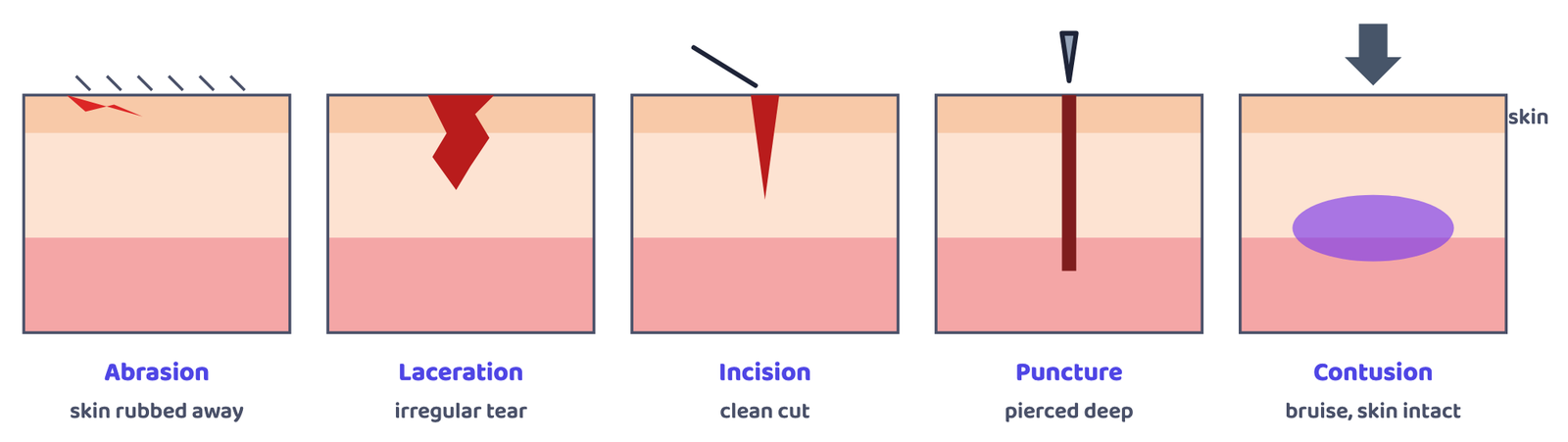
| Skin injuries | Abrasion (falling on a rough or firm surface) · Laceration (tears in the skin) · Incision (cut by a sharp edge) · Puncture wound (piercing by a sharp, pointed object) · Avulsion (tearing away of a part of the skin) · Contusion (bruise from a direct blow, e.g. a player’s knee hitting another’s thigh) |
| Soft tissue injuries (muscles, ligaments) | Sprain (ligament of a joint overstretched or the joint moved in an abnormal direction; pain, tenderness, swelling at the joint) · Strain (muscle or tendon; mild, moderate, severe) |
| Joint injuries | Dislocation: displacement of contiguous surfaces of bones in a joint; complete or partial |
| Bone injuries | Fracture: break in the continuity of the bone; open (compound) or closed (simple); from a mild crack to shattering into many pieces |
5.3 Soft Tissue Injuries
A soft tissue injury is damage to the muscles, ligaments and tendons of the body.
The six soft tissue injuries in the curriculum: abrasion, contusion, laceration, incision, sprain and strain.
| Injury | What it is | Cause | Prevention | Treatment (as in the book) |
|---|---|---|---|---|
| Abrasion | Grinding or rubbing away of the upper superficial layers of the epidermis | Exposed skin in moving contact with a rough surface | Protective clothing and pads (general caution; the book gives none) | Clean the affected part; stop bleeding early with compression bandages; anti-tetanus injection |
| Contusion | A type of haematoma: blood collected outside a vessel (a bruise) | A blow crushes muscle fibres and connective tissue without breaking the skin: collision with a player or equipment, or a heavy fall | Wear all safety gear while playing, such as helmets and guards | Non-steroidal anti-inflammatory drugs such as Ibuprofen, or pain relief medicines as prescribed by the doctor |
| Laceration | Irregular, tear-like wound from blunt trauma | Skin hits an object, or an object hits the skin with force | Proper personal equipment, including eye protection | Clean the affected part; stop bleeding early with compression bandages |
| Incision | A cut into body tissue, exposing tissue, bone or organ beneath | A clean, sharp-edged object: knife, razor, glass splinter | Keep the area free from sharp edges | Gently wash with soap and water; dry with a clean towel; then apply the dressing |
| Strain | Injury to a muscle or tendon: overstretch, partial or complete tear; acute or chronic | Overuse, force or stretching: lifting heavy objects, running, jumping, throwing | Regular stretching and strengthening exercise | Ice packs; keep the muscle in a stretched position; RICE |
| Sprain | Stretching or tearing of ligaments (fibrous tissue joining bones at a joint); most common in the ankle | Overextending or tearing a ligament while severely straining a joint | Regular stretching and strengthening exercise | RICE |

Sprain
- Injury to a ligament (bone to bone)
- At a joint, most often the ankle
- Joint forced beyond its range
Strain
- Injury to a muscle or tendon (muscle to bone)
- Mild, moderate or severe; acute or chronic
- Overuse, force, overstretching
Sprain: ligament at a joint. sTrain: muscle or Tendon.
The “t” in strain points to tendon; a sprain is always at a joint.
5.4 Hard Tissue Injuries
A hard tissue injury is an injury to the skeletal system of the body, in which the bone cracks or breaks.
Dislocation
Dislocation is “the displacement of contiguous surfaces of two or more bones which are in a joint.” A joint dislocation is also called luxation; a partial dislocation is referred to as a subluxation.
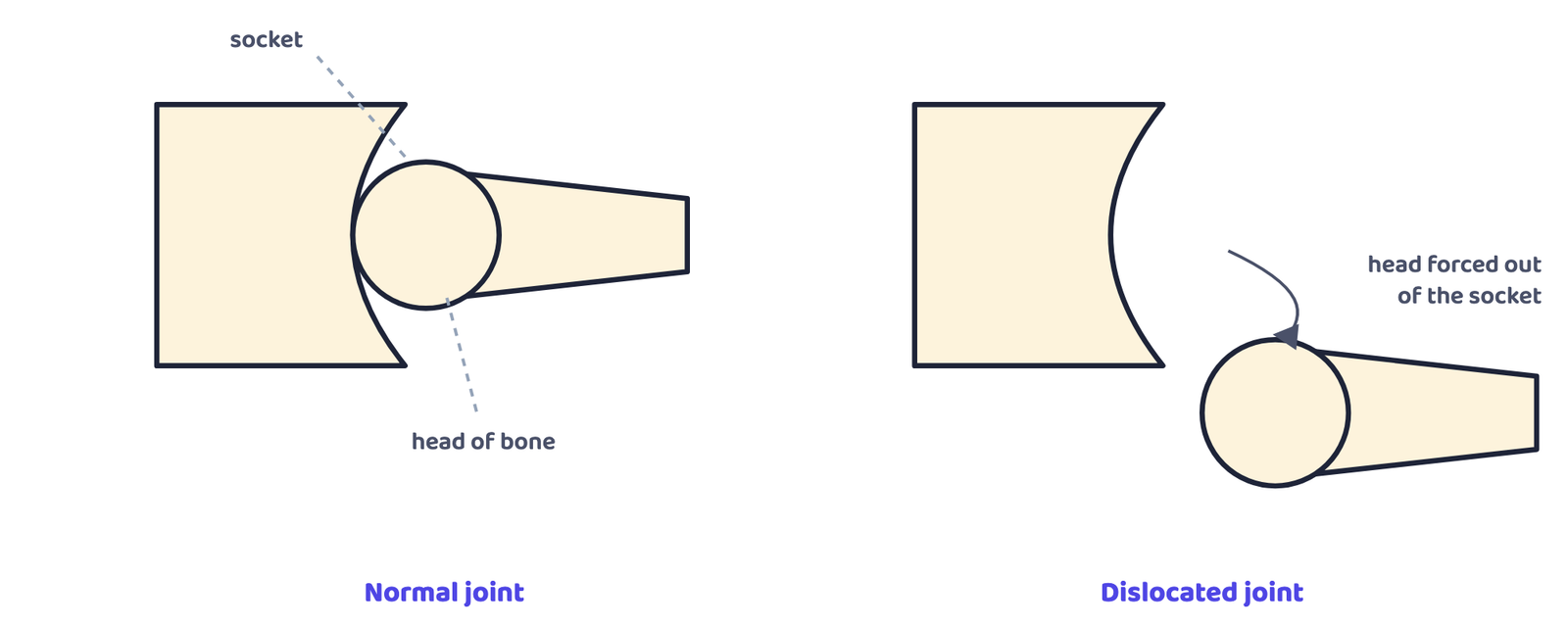
- Causes: trauma that forces a joint out of place: accidents, falls, contact sports such as football; also weak muscles and tendons around the joint, more common in older people with weaker muscles and balance problems.
- Symptoms (6): pain; swelling; bruising; instability of the joint; loss of ability to move the joint; visibly deformed joint (bone looks out of place).
- Treatment: apply ice and keep the joint elevated while waiting for a doctor. Then:
- Medication to reduce pain;
- Manipulation: a doctor returns the bones to their places;
- Rest: keep the joint immobile with a sling or splint;
- Rehabilitation: physical therapy exercises strengthen muscles and ligaments around the joint;
- Surgery if manipulation fails, if blood vessels or nerves are damaged, or if bones, muscles or ligaments need repair.
Never try to push a dislocated joint back yourself. Putting the bones back is the doctor’s job (manipulation, as the book says); untrained attempts can damage nerves and blood vessels.
Fractures
A fracture is a break in the continuity of the bone. Fractures are caused by a direct impact, such as a fall or a severe tackle; stress fractures develop over time from overuse.
The book names the two kinds; the meanings below are the general explanation of the terms.
Closed (simple) fracture
- Bone breaks, skin stays unbroken
Open (compound) fracture
- Broken bone comes through the skin, making a wound

| Fracture | What it is | Cause | Prevention | Treatment (as in the book) |
|---|---|---|---|---|
| Stress | Small crack from repeated stress | Increasing the amount or intensity of an activity too quickly; overuse; inadequate protective equipment | Add low impact activities so one part is not stressed repeatedly | Rest, cold therapy (ice packs, cold compresses), anti-inflammatory medicines such as Ibuprofen; 6 to 8 weeks to heal |
| Greenstick | Fracture in a young, soft bone, in which the bone bends | Most commonly a fall | Regular exercise, proper safety equipment, enough calcium in the child’s diet | Removable splints give better results than casting in children with torus fractures of the distal radius |
| Comminuted | Bone broken, splintered or crushed into a number of pieces | Direct and indirect trauma or violence | Strong bones: calcium-rich food and regular exercise | X-ray for diagnosis; open reduction, with fragments held together by surgical nails, wires, plates |
| Transverse | Straight break right across a bone | A large force acting perpendicular to the bone | Physical activity and weight bearing exercise; calcium-rich food | Can be treated at home along with rest and medicine; a back brace (TSL) or abdominal binder may be prescribed to limit motion at the fracture site |
| Oblique | Bone breaks diagonally | A fall, accident or other trauma | Calcium-rich food and regular exercise | Depends on severity: anti-inflammatory medicines, reduction (resetting the bone) |
| Impacted | Broken ends jammed together by the force of the injury | Mainly a fall from a height with great impact | Physical activity, weight bearing exercise, good calcium intake | A sling or splint keeps the broken bones in place so the sharp ends do not move and cause further damage |
Any suspected fracture should be seen by a doctor and confirmed by an X-ray. Until then, keep the part still with a splint or sling and do not try to straighten it.
“Green bends, Common breaks many, Trans goes across, Oblique goes slant, Impact jams”
5.5 Managing a Soft Tissue Injury: RICE and PRICE
For strain and sprain the book prescribes RICE: Rest, Ice, Compression, Elevation. The sample paper also asks about PRICE, which adds Protection in front. The details below the R-I-C-E headings, and the P, are general first-aid guidance, not taken from the book.
- Ice is usually applied for about 15 to 20 minutes at a time, never directly on bare skin.
- Elevation above heart level helps reduce swelling, because fluid drains away from the injured part.
- Aims of first aid, the 3 P’s: Preserve life, Prevent deterioration (stop the injury getting worse), Promote recovery.
- A compression bandage that causes numbness, tingling or blue fingers or toes is too tight and must be loosened.
✓ Prevention (from the book)
- Regular stretching and strengthening exercise
- Wear safety gear and proper personal equipment
- Increase training load gradually; add low impact activities
- Keep the playing area free from sharp edges
- Calcium-rich diet and weight bearing exercise for strong bones
✗ Avoid
- Overtraining and lack of conditioning
- Incorrect technique or equipment
- Ignoring pain while playing (general caution)
- Skipping the warm-up (general caution)
6 Revision
- Three physiological factors: skeletal muscles, energy production, cardiorespiratory.
- Slow twitch (Type I) = red, aerobic, endurance; fast twitch (Type II) = pale, anaerobic, strength and speed.
- Muscle properties: contractility, excitability, extensibility, elasticity.
- ATP-CP under 10 s; anaerobic under 2 min; aerobic for long duration.
- Muscular short term: blood supply, temperature, flexibility, lactate, micro-tears. Long term: hypertrophy, ligaments/tendons, mitochondria, myoglobin, glycogen (90 to 120 min), metabolism, lactate tolerance.
- Cardiac output = HR × SV; resting about 5.0 L/min. Long term: cardiac hypertrophy, bradycardia.
- Breathing rate 12 to 20 at rest, up to 40 per minute in exercise.
- Ageing: strength peaks 20 to 40; bone mass falls 30 to 50% after 60 (osteoporosis); somatopause.
- Sprain = ligament; strain = muscle or tendon; both RICE.
- Fractures: greenstick (bends), comminuted (many pieces), transverse (across), oblique (diagonal), impacted (jammed), stress (overuse).
- Can I compare slow and fast twitch fibres on five points?
- Can I name the energy system for a 100 m sprint, a 400 m race and a marathon?
- Can I list five short term and seven long term effects of exercise on muscles?
- Can I define stroke volume, cardiac output, tidal volume and residual volume?
- Can I draw and name six types of fracture?
- Can I write the cause, prevention and treatment of a sprain and a strain?