
- How the Paralympics, Special Olympics and Deaflympics began, who runs them, and the key dates, logos, oaths and programmes of each
- The ten impairment types that make an athlete eligible for the Paralympics
- The difference between classification (Paralympics) and divisioning (Special Olympics), and the Maximum Effort Rule
- What inclusion means, why inclusive education is needed and how India can implement it
- The eight advantages of physical activity for CWSN and the six strategies that make physical activity accessible to them
In the CBSE Physical Education (048) curriculum, this is Unit 4: Physical Education & Sports for CWSN (Children with Special Needs, Divyang), worth 4 marks + 4 “b” marks. The “b” marks are concept-based questions (a tactile diagram, data interpretation or a case study) for visually impaired candidates. The prescribed book is CBSE’s own Physical Education Class XII textbook; there is no NCERT book for this subject. CWSN stands for Children with Special Needs.
At the Commonwealth Games in Manchester, England, in 2002, medals won by disabled competitors were counted towards their countries’ final totals for the first time. They marched with their national teams, lived in the athletes’ village and competed in the same stadiums at peak times.
1 Disability and How Disability Sport Began
Disability refers to limitations in individual functioning, including physical impairment, intellectual impairment, cognitive impairment, sensory impairment, mental illness and various types of chronic diseases.
A person with a disability is kept away from sports and physical education by three kinds of barriers: the impairment itself, attitudinal barriers (how people think) and environmental barriers (places and facilities that do not suit them).
- Sports events for athletes with an impairment have existed for more than 100 years. The first sport clubs for the deaf existed in Berlin in 1888.
- Competitive games for people with special needs were widely introduced only after World War II, to help the large number of war veterans and civilians injured during the war.
- Today there is sport for athletes with visual impairment, cerebral palsy and various other needs. The three big organisations in this chapter are the Paralympics, Special Olympics and Deaflympics. The Paralympics and Special Olympics are recognised by the International Olympic Committee (IOC).
2 Paralympics
Paralympics is a mega sports event involving athletes with a range of disabilities, organised by the International Paralympic Committee (IPC). The word means “a series of international contests for athletes with disabilities that are associated with and held following the summer and winter Olympic Games.”
PARA (Greek: beside, alongside) + OLYMPIC
Put together, Paralympics means games held parallel to the Olympics. It does not come from “paraplegia”.
2.1 History of the Paralympic movement
In the CBSE sample paper, Dr Ludwig Guttmann is named as the father of the Paralympic Games.
2.2 Bringing every impairment under one umbrella: the IPC
Different organisations worked for different disabilities, so there was a need to bring all impairments under one umbrella. The major effort came in 1982.

| Organisation | Full name | Year |
|---|---|---|
| ISMGF | International Stoke Mandeville Games Federation | 1952 |
| ISOD | International Sport Organisation for the Disabled (for those who could not take part in the Stoke Mandeville Games) | 1964 |
| CPISRA | Cerebral Palsy International Sports and Recreation Association | 1978 |
| IBSA | International Blind Sports Federation | 1980 |
| ICC | International Co-ordinating Committee Sports for the Disabled in the World | 1982 |
| INAS-FID | International Sports Federations for Persons with an Intellectual Disability (joined the ICC) | 1986 |
| IPC | International Paralympic Committee: global governing body of the Paralympic movement | 1989 |
2.3 The International Paralympic Committee (IPC) at a glance
- Work: organises the Summer and Winter Paralympic Games and coordinates world championships and other competitions. All Paralympic Games are governed by the IPC.
- Vision: “To enable Para athletes to achieve sporting excellence and inspire and excite the world.” (The book also prints it as “To enable Paralympic athletes to achieve sporting excellence and to inspire and excite the world.”)
- Anthem: “Hymne de l’Avenir” (“Anthem of the Future”), composed by Thierry Darnis, adopted as the IPC’s official anthem in March 1996.
- Same cities and venues as the Olympics: till 1988 the Paralympics ran on a separate schedule. Since the Summer Games of Seoul, Korea (1988) and the Winter Games of Albertville, France (1992), they are held in the same cities and venues as the Olympics, almost immediately after them, by an agreement between the IPC and the IOC.
2.4 Summer Paralympic sports (Tokyo 2020)
The book lists 22 summer Paralympic sports for Tokyo 2020, with the year each one entered the Games:
| Sport | Since | Sport | Since |
|---|---|---|---|
| Archery | 1960 | Paratriathlon | 2016 |
| Athletics | 1960 | Para-Taekwondo | 2020 |
| Boccia | 1984 | Powerlifting | 1984 |
| Cycling: track and road | 1984 | Rowing | 2008 |
| Equestrian | 1996 | Shooting | 1976 |
| Football 5-a-side (vision impaired) | 2004 | Sitting Volleyball | 1976 |
| Goalball | 1980 | Swimming | 1960 |
| Judo | 1988 | Table tennis | 1960 |
| Para-Badminton | 2020 | Wheelchair Basketball | 1960 |
| Paracanoe | 2016 | Wheelchair Fencing | 1960 |
| Wheelchair Rugby | 2000 | ||
| Wheelchair Tennis | 1992 |
2.5 Categories: why athletes are put in sport classes
Without grouping, a para-sport competition may become one-sided and predictable: the least impaired athlete would always win.
To prevent this, para-athletes are placed in categories for competition based on their impairment. These categories are called sport classes. The criteria make sure that winning is decided by skill, fitness, power, endurance, tactical ability and mental focus, not by who is least impaired. An athlete is given a class when he or she starts competing, and the class may be reviewed throughout the career.
Purpose of the criteria:
- Defining the impairment group in which an athlete can compete in the various sports.
- Grouping athletes in classes defined by the degree of activity limitation related to the impairment and/or specific to the task in the sport.
2.6 The ten eligible impairment types
The IPC has set ten disability categories: eight physical, one visual and one intellectual. Not every sport allows every category. They apply to both Summer and Winter Paralympics.
| Physical impairment | What it means | Examples (book) |
|---|---|---|
| 1. Impaired muscle power | Force produced by muscles (of one limb, one side of the body or the lower half) is reduced | Paraplegia and quadriplegia, muscular dystrophy, spinal cord injury, spina bifida, post-polio syndrome |
| 2. Impaired passive range of movement | Range of movement in one or more joints is reduced in a systematic way; acute conditions such as arthritis are not included | (none named) |
| 3. Loss of limb or limb deficiency | Total or partial absence of bones or joints, due to illness, trauma or a congenital limb deficiency | Amputation, dysmelia |
| 4. Leg-length difference | Significant bone shortening in one leg, due to congenital deficiency or trauma | (none named) |
| 5. Short stature | Standing height reduced because of shortened legs, arms and trunk, from a musculoskeletal deficit of bone or cartilage | Achondroplasia, growth hormone deficiency, osteogenesis imperfecta |
| 6. Hypertonia | See Definition 3 below | Cerebral palsy |
| 7. Ataxia | See Definition 4 below | Cerebral palsy, Friedreich’s ataxia, multiple sclerosis |
| 8. Athetosis | See Definition 5 below | Cerebral palsy, choreoathetosis |
Hypertonia is marked by an abnormal increase in muscle tension and a reduced ability of a muscle to stretch. It may result from injury, disease or conditions which damage the central nervous system, e.g. cerebral palsy.
Ataxia is an impairment that consists of a lack of coordination of muscle movements, e.g. cerebral palsy, Friedreich’s ataxia, multiple sclerosis.
Athetosis is generally characterised by unbalanced, involuntary movements and a difficulty in maintaining a symmetrical posture, e.g. cerebral palsy, choreoathetosis.
Visual impairment
- From partial vision, enough to be judged legally blind, to total blindness
- Impairment of one or more parts of the visual system: eye structure, receptors, optic nerve pathway, visual cortex
- The athlete and the sighted guide are considered a team
- From 2012, guides and sighted goalkeepers in 5-a-side football became eligible for medals of their own
Intellectual disability
- Significant impairment in intellectual functioning with limitations in adaptive behaviour
- The IPC mainly serves athletes with physical disabilities; this group has been added to some Paralympic Games
- Only athletes with exceptional athletic ability, diagnosed before the age of 18
- Special Olympics World Games, by contrast, are open to all people with intellectual disabilities
3 Special Olympics
Special Olympics is the world’s largest sports organisation for children and adults with intellectual and physical disabilities, providing year-round training and competitions to 5 million athletes and Unified Sports partners in 172 countries.
3.1 How it began
- The concept was the brainchild of Eunice Kennedy Shriver, the founder of Special Olympics.
- In June 1962 she started a day camp called Camp Shriver for children with intellectual (and physical) disabilities at her home in Potomac, Maryland. It addressed the concern that children with special needs had very little opportunity to take part in organised athletic events.
- She was head of the Joseph P. Kennedy Jr. Foundation and a member of President John F. Kennedy’s Panel on Mental Retardation. Camp Shriver became an annual event, and the Foundation gave grants to universities, recreation departments and community centres to hold similar camps.
3.2 World Games and recognition
| Event | Year and place |
|---|---|
| First Special Olympics (World) Games | 20 July 1968, Soldier Field, Chicago, Illinois: about 1000 athletes from the US and Canada |
| First World Winter Games | 1977, Steamboat Springs, Colorado (US) |
| Recognised by the IOC | 1988 |
| First Winter Games outside the US | 1993, Austria |
| First Summer Games outside the US | 2003, Dublin, Ireland: 7000 athletes from 150 countries |
- The World Games alternate between Summer and Winter Games in two-year cycles, each recurring every fourth year.
- Like the IPC, Special Olympics is recognised by the IOC. Unlike the Paralympics, its World Games are not held in the same year or along with the Olympic Games.
- Special Olympics competitions are held every day around the world (local, national and regional), adding up to more than 100,000 events a year.
3.3 Mission, logo and oath
The mission of Special Olympics is to provide year-round sports training and athletic competition in a variety of Olympic-type sports for children and adults with intellectual disabilities, giving them continuing opportunities to develop physical fitness, demonstrate courage, experience joy and participate.
- Logo: based on the sculpture “Joy and Happiness to All the Children of the World” by Zurab Tsereteli, adopted in 1979. It is a symbol of growth, confidence and joy among children and adults with disabilities who are learning coordination, mastering skills, participating in competitions and preparing for richer, more productive lives.
- Athlete’s oath (first introduced by Eunice Kennedy Shriver at the first international games in Chicago, 1968):
Let me win. But if I cannot win, let me be brave in the attempt.
Special Olympics athlete’s oath
Sports offered include athletics, badminton, basketball, bocce, bowling, cricket, cycling, equestrian, figure skating, floorball, floor hockey, football, golf, gymnastics, handball, judo, kayaking, netball, powerlifting, roller skating, sailing, snowboarding, snowshoe running, skiing, softball, speed skating, swimming, table tennis, tennis, triathlon and volleyball.
Benefits for athletes: physical and health benefits, and psychological benefits such as higher self-confidence, self-esteem and social competence.
3.4 Programmes run by Special Olympics around the world
Young Athletes Programme
For children aged 2-7, with and without intellectual disabilities. An inclusive sport and play programme; games develop motor skills and hand-eye coordination.
Unified Sports Programme
Athletes with and without intellectual disabilities play as teammates. Training and playing together build friendship and understanding and break stereotypes. More than 1.4 million people take part worldwide.
Healthy Athletes Programme
Started in 1997. Offers health screenings to athletes in need to athletes in seven areas, educates them on health and identifies problems needing follow-up.
| Healthy Athletes screening | Area |
|---|---|
| Fit Feet | Podiatry (feet) |
| FUNfitness | Physical therapy: flexibility, strength, balance, aerobic fitness |
| Health Promotion | Better health and well-being |
| Healthy Hearing | Audiology |
| MedFest | Sports physical exam |
| Opening Eyes | Vision |
| Special Smiles | Dentistry |
3.5 Rules and eligibility
- Athletes are divided into competition divisions by ability, age and sex, so that each competes against athletes of similar ability.
- There are more than 30 Olympic-type individual and team sports.
- Medals go to the 1st, 2nd and 3rd place winners in each event; ribbons go to athletes finishing 4th to 8th.
- Eligibility: at least 8 years old, and identified by an agency or professional as having intellectual disabilities, cognitive delays (measured by formal assessment), or significant learning or vocational problems due to cognitive delay that require specially designed instruction.
4 Deaflympics
The Deaflympics are the international games for deaf and hard-of-hearing athletes, organised by the International Committee of Sports for the Deaf (ICSD). They are held every four years, starting from Paris in 1924.
- What makes them different: the Deaflympics are the only IOC-sanctioned games organised and run exclusively by members of the community they serve. Only people with hearing impairment can serve on the ICSD board and executive bodies.
- ICSD invites deaf and hard-of-hearing elite athletes from all over the world to compete and to build comradeship between their countries.
- Held every four years from 1924, except the 1943 and 1947 games, which were cancelled because of World War II.
4.1 The Deaflympics logo (designed 2003)
| Part of the logo | What it stands for |
|---|---|
| Hand shapes “ok”, “good” and “great”, overlapping in a circle | The original sign for “deaflympics”; together the hand shapes make the sign for “united” |
| Centre of the logo | The iris of the eye: deaf people are visual people who must use their eyes to communicate |
| Four colours: red, blue, yellow, green | The colours of the national flags of the world; they stand for the four regional confederations: Asia Pacific Deaf Sports Confederation, European Deaf Sports Organization, Pan American Deaf Sports Organization, Confederation of African Deaf Sports |
The logo ties together sign language, deaf and international cultures, unity and continuity.
4.2 Paralympics, Special Olympics and Deaflympics compared
| Point | Paralympics | Special Olympics | Deaflympics |
|---|---|---|---|
| For | Athletes with physical, visual and some intellectual impairments (10 types) | Children and adults with intellectual disabilities (age 8+) | Deaf and hard-of-hearing athletes |
| Governing body | IPC (1989) | Special Olympics (founder Eunice Kennedy Shriver) | ICSD (earlier CISS, 1924) |
| First games | Rome 1960 (roots: Stoke Mandeville 1948) | Chicago 1968 | Paris 1924 (International Silent Games) |
| Special feature | Classification into sport classes by type of impairment | Divisioning by ability, age and gender; every athlete recognised | Organised and run only by deaf people |
| Timing | Same cities and venues as the Olympics, just after them | Not held with the Olympics; Summer and Winter alternate | Every four years |
5 Classification and Divisioning in Sports
Classification and divisioning are processes used in disability sports for providing even and fair competition for athletes with disability by grouping them, much like mainstream sports group players by age-group, gender or weight.
The goal is to reduce the effect of variables such as age, gender, weight or ability on the result, so that the contest is decided by performance.
Classification
- Grouping process of the Paralympics and para-athletes
- Assigns categories based on the type of disability
- Done by IPC classifiers: medical, then functional assessment
Divisioning
- Grouping process of the Special Olympics
- Performance-based: groups athletes by skill level (ability), after age and gender
- Uses entry scores or a seeding round
5.1 Classification in the Paralympics
Classification is undertaken “to ensure that an Athlete’s impairment is relevant to sport performance, and to ensure that the Athlete competes equitably with other Athletes” (IPC).
According to the IPC, classification has two roles:
- Eligibility: to decide who is eligible. The minimum is an impairment that limits the sportsperson’s ability to take part, and the disability must be permanent.
- Grouping: to group sportspeople for the purpose of competition.
Classification process (generally three or four steps):
People involved: individual classifiers, medical classifiers, technical classifiers, a chief classifier, a head of classification, a classification panel and a classification committee.
5.2 Divisioning in the Special Olympics
Divisioning is the competitive-level matching or grouping used by Special Olympics, in which athletes are matched with others of the same gender, about the same age and, most importantly, about the same competitive ability.
It is a fundamental rule of Special Olympics. Unlike other sports organisations, Special Olympics encourages athletes of all ability levels and recognises every athlete for his or her performance.
Implementation: an athlete’s ability is the primary factor. It is found from an entry score from a prior competition or from a seeding round or preliminary event at the competition itself. Age and sex are the other factors. In the process, athletes are grouped in this order:
| Team sports: age groups | Individual sports: age groups |
|---|---|
| 15 and under | 8-11 years |
| 16-21 years | 12-15 years |
| 22 and above | 16-21 years |
| 22-29 years | |
| 30 and above |
- Before each competition, a time, score or skill assessment is submitted for each athlete or team.
- For events that are not timed or measured, such as football and badminton, there is a series of short games or an assessment by a committee.
- Divisions are then set up so that each set of competitors is closely matched. Athletes and coaches must follow the Special Olympics Official Sport Rules and the Athlete’s Code of Conduct.
The Maximum Effort Rule of Special Olympics requires athletes to give their maximum effort during the divisioning process, and coaches to motivate all athletes to give their best. Athletes who do not participate honestly in preliminary trials or final rounds violate the true spirit of competition and may even be disqualified.
Divisions are made from the preliminary scores, so those scores must show each athlete’s true ability. That is why the book links the rule to “the intentions of fairness”.
6 Inclusion in Sports: Concept, Need and Implementation
The Right to Education makes education a fundamental right of every child between the ages of 6 and 14. All children, including those who are physically or mentally challenged or have disabilities and disorders, have the right to come to school and develop their abilities. So it is the duty of every school to give them such opportunities.
6.1 Disability according to the WHO
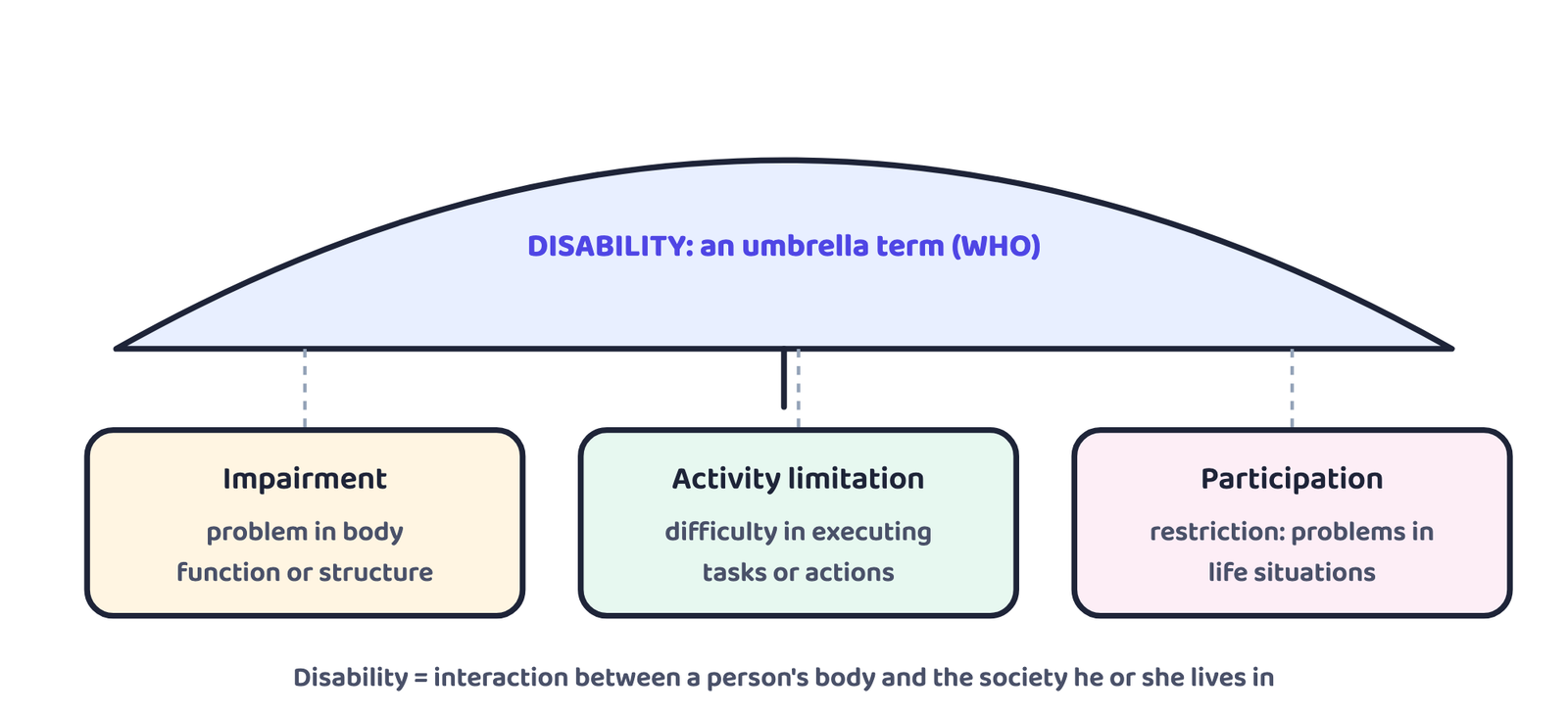
| Term (WHO) | Meaning |
|---|---|
| Impairment | A problem in body function or structure |
| Activity limitation | A difficulty met by a person in executing tasks or actions |
| Participation restriction | Problems a person experiences in life situations |
- Disability is not just one health problem: it reflects the interaction between features of a person’s body and features of the society in which he or she lives.
- Disability is more common among women, older people, and children and adults who are poor. People with disabilities often have less education and poorer living conditions, so they have the highest risks of infectious and non-infectious diseases.
- Many do not get needed health care; about half cannot afford it. Data from four countries in the Region: only 26% to 55% received the medical rehabilitation they needed, and only 17% to 37% received assistive devices such as wheelchairs, prostheses and hearing aids.
6.2 Encouraging inclusion through physical education and sports
Role of family
Accept the reality and do not give up on the child; promote awareness; treat the CWSN as an equal; give a structured routine with recreational games and sports; observe the child’s abilities and take professional help so he or she can excel.
Role of school
A structured programme with sports in the routine; trained APE (adapted physical education) teachers; adapted equipment and movements; help to move towards competitive sport (Special Olympics, Paralympics); infrastructure such as a ramp along with stairs; sensitisation programmes; intramural and extramural competitions or carnivals.
Role of organisations
Work at the grassroots to promote adapted sports; train teachers and coaches; organise events at Zonal, District, State, National and International levels.
6.3 What inclusion means
Inclusion is a vast concept that implies including everyone in education without being judgmental about their abilities, appearance, economic condition etc.
Inclusion in education refers to a model in which CWSN spend most or all of their time with students without special needs.
- Every individual differs in physical, social, emotional and cognitive characteristics; this diversity is a reality and must be respected.
- Inclusive education is more effective for students with special needs because they get a mixed experience; this social interaction leads to success in later life.
- Inclusion creates a safe, comfortable and emotionally secure environment. It is not a law to be forced on anyone: it is a process that helps a child smoothly understand, accept and live the culture of inclusion.
- Physical education and sports play a very important role in promoting inclusion in an educational institute.
6.4 Need for inclusive education
Inclusive education trains students for real-life situations, because students with and without disabilities learn to interact and work together.
| Need | How inclusion helps |
|---|---|
| 1. Builds self-esteem | CWSN see diverse learners and find they have much in common with others; stigma falls; self-confidence improves; friendships form and last |
| 2. Improves social and communication skills | Social skills are learnt by observation and imitation, so being in a regular class gives CWSN (for example autistic students) a better understanding of the world |
| 3. Enhances sensitivity | Students without disabilities become more sensitive, caring, patient and empathetic; helping peers brings satisfaction and lifelong friendships |
| 4. Better understanding and appreciation of others | All students understand and appreciate each other’s strengths and weaknesses and the differences between them |
| 5. Creates a sense of belonging | Every child is part of a community; CWSN feel accepted and belong to the group |
| 6. Enhances academic performance | Inclusive education gives better academic results than exclusive education; children with varying abilities are better motivated among other children |
| 7. Improves performance | Expectations are higher in a mixed-ability class, so each child is stretched to optimal performance |
6.5 Implementation of inclusive education in India
India has a very large number of children and persons with disabilities, and many face problems in getting inclusive education. Implementing it also ensures the best use of resources. The book lists these measures:
- Right to Education implemented effectively in all states, so that no child is left out.
- Teacher training, especially in rural areas, through training and in-service workshops to teach CWSN in an inclusive class.
- A support team that regularly analyses schools, curriculum and amenities, so children with learning difficulties get access to regular methods.
- A flexible approach to curriculum transaction, so teachers and students can diagnose and solve problems in teaching-learning.
- Parents as partners and as a resource in decisions about their child’s learning.
- Looking at what children can do rather than what they cannot do; recognising talent, not showing sympathy.
- Designing schools and classes for full potential: changes in classrooms, transport, educational materials and assistive devices such as audio textbooks or Braille textbooks.
- Education goals according to each child’s ability: a parallel curriculum, a suitable examination system and periodic evaluation of CWSN.
- Good relations between families of students with and without disabilities.
- Providing materials from the school: uniforms, books, stationery, transport allowance, stipend for girls, boarding and lodging, therapeutic services, teaching-learning materials and assistive devices.
- One-on-one help is allowed: a child may leave the class for specific reasons such as one-on-one assistance, but children with disabilities are not grouped together in separate classrooms.
The CBSE sample paper asks: “What do you understand by the term inclusion? Explain its need and implementation” for 1 + 2 = 3 marks. Write the definition for 1 mark, then two needs and two implementation measures, each as a separate point.
7 Advantages of Physical Activities for CWSN
Children with special needs have fewer chances to be physically active, so they are at higher risk of the problems that come with inactivity. Regular physical activity gives them physical, emotional and social advantages: strength gains, more flexibility, better bone health, better endurance and cardiovascular fitness, and, for children with movement disabilities, maintenance of mobility as they age.
7.1 The eight advantages
Physical benefits
Children with intellectual disabilities may have additional physical disabilities that lead to below age-level performance in typical motor skills; regular PE develops their gross and fine motor skills; improves hand-eye coordination, flexibility, muscle strength, endurance and cardiovascular efficiency; helps fight obesity and its complications.
Mode of recreation and fun
CWSN often miss social activities; sport lets them interact, make friends and build social skills.
Improved emotional health
Physical activity is proven to lower depression; it improves mood, mental health and well-being.
Channelising surplus energy
Hyperactivity in children with disabilities like ADHD, if directed well, gives cognitive benefits and constructive behaviour.
Psychological benefits
Better self-esteem, social awareness and self-confidence; less anxiety, stress and depression; a sense of accomplishment. Self-esteem matters especially because CWSN may often feel isolated from the group.
Healthy lifestyle
CWSN are about twice as likely as other children to be overweight or obese often because of the greater likelihood of being sedentary due to their disability, so they must learn healthy-lifestyle steps suited to their condition.
Behavioural benefits
Rule-based games teach self-regulation and decision-making; CWSN learn to focus on specific goals and work on verbal communication with peers; teamwork, problem solving, longer attention span and task-based behaviour carry over into the classroom.
Increased independence
More strength and energy improve daily life skills, so persons with disability can do more daily tasks without help.
8 Strategies to Make Physical Activities Accessible for CWSN
Participation of children with disabilities in sports and recreation promotes inclusion, minimises deconditioning (loss of fitness from not being active), optimises physical functioning and improves well-being. Yet they take part less, have lower fitness and more obesity than their peers. So each child’s participation needs well-planned strategies.
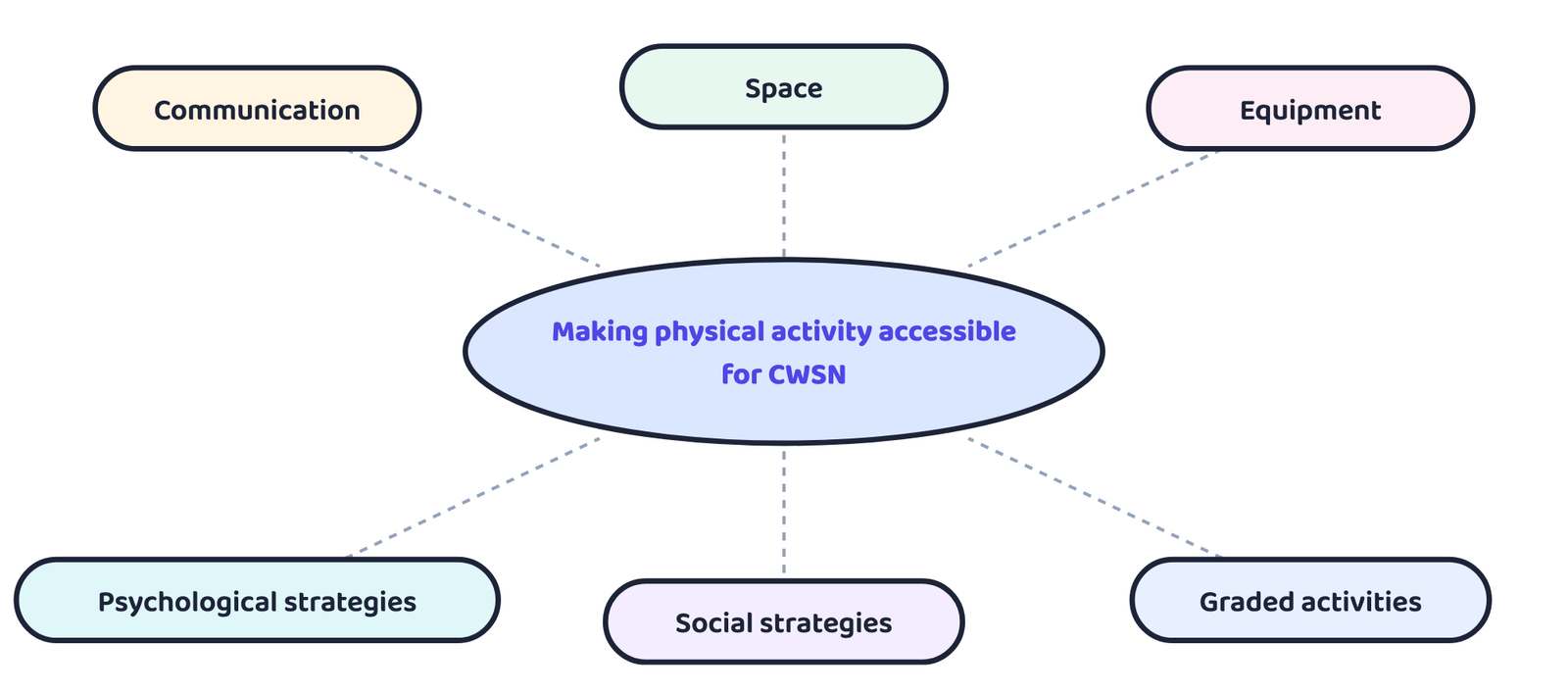
8.1 Communication
- Give advance information about the activity, space, resource person or any change, clearly.
- Use a variety of instruction: verbal, visual and peer teaching; visuals or a social story about the activity.
- Give positive, corrective or specific feedback.
- Give specific instructions in simple words and sentences, in a low tone, one instruction at a time.
- If necessary, use a communication board or communication book.
8.2 Space
- The space should be approachable for people with physical disability, and the activity area should be limited.
- It should be disturbance-free: no noise, heat, cold, difficult floor texture or audience.
- Start with indoor space; mark boundaries clearly: starting point, finishing point, sitting area.
- Children with autism must have a specific area, as they may need time to relax.
- Once behaviour, discipline and understanding of instructions are clear, move to outdoor space too.
8.3 Equipment
A lack of suitable equipment, together with a lack of trained professionals, discourages participation. Many modified devices are now available for adapted sports, from simple items to computerised devices like wheelchairs. Sport competitions involve four groups of disabled sportspersons:
The deaf
Hearing-impaired sportspersons.
Physical disability
People with physical disability.
Intellectual disability
People with intellectual (mental) disability.
Engineering support
People supported by specially designed high-level engineering equipment.
Equipment can be adapted along each of the following characteristics. Each one is a range: the teacher picks the point on the range that suits the child.

8.4 Graded activities

- At first, activities should be simple, each based on a single action (simple to complex).
- Move gradually from non-locomotor → locomotor → manipulative activities.
- The level of assistance moves from physical → verbal → independent.
- Show a fundamental motor skill through the teacher’s own body action; videos can also be used, with key words or phrases that highlight what the demonstration focuses on.
- Ask the child to demonstrate the skill to check understanding, and start practice immediately after the demonstration.
- Practise with a progressive count, or dramatically with rhymes or songs and voice modulation, so the children enjoy it.
| Skill type | Examples (book) |
|---|---|
| Locomotor skills | Running, jumping, hopping, galloping, rolling, leaping, dodging, horizontal jump, slide |
| Manipulative skills | Throwing, catching, kicking, striking, trapping, dribble, overhand throw, underhand roll |
| Stability skills | Balance, twisting, turning, bending |
8.5 Social strategies
8.6 Psychological strategies
Because of past exclusion or limited access, children with disabilities need a lot of motivation to take part.

Psychological barriers are the most influential. Changing attitudes is the key to increasing participation…
quoted in the book
- Barriers are attitudes, opinions and perceptions that prevent participation: (i) personal attitudes of persons with disability; (ii) attitudes of non-disabled people.
- Once children see gains in strength, coordination, flexibility, balance, motor skills and body awareness, their attitude to sport becomes positive.
- Children with a disability choose to play sport to improve and learn new skills, to have fun, to stay fit and to be physically challenged.
- Level of challenge: easy tasks chosen only for rewards lower enjoyment and intrinsic motivation; a challenging activity attracts children, but too great a challenge lowers motivation. The challenge often rises faster for the disabled, so it is better to let the child first take part within his or her own disability group.
- Coaches are often afraid to “push” individuals with a disability too far and cause “harm”.
- Children with strong peer relationships are more self-motivated and enjoy sport more; greater competence in sport goes with stronger peer relationships.
- A PE teacher in the UK reported that her pupils “actively encourage and support the pupils with disabilities” and that those pupils “grow in confidence as a result of their involvement”. Disability in sport is becoming more accepted than ever.
Intrinsic motivation
- Comes from within: enjoyment of the activity itself
- Raised by a suitably challenging activity
- Falls when the challenge is too great or tasks are chosen only for rewards
Extrinsic motivation
- Comes from the environment
- Friends, parents and coaches
- Making friends is a big reason children play sport
- Disability sport: deaf clubs Berlin 1888; widespread after World War II
- Guttmann: Stoke Mandeville Hospital 1944; Stoke Mandeville Games 29 July 1948 (16 servicemen and women, archery); first Paralympics Rome 1960, 23 nations
- Para = beside/alongside: games parallel to the Olympics; IPC 22 Sept 1989, Dusseldorf; anthem “Hymne de l’Avenir” (Thierry Darnis, 1996)
- IPC formed from ISMGF, ISOD, CPISRA, IBSA (ICC 1982) + INAS-FID (1986)
- 10 eligible impairments: 8 physical + visual + intellectual; sport classes stop the least impaired always winning
- Special Olympics: Eunice Kennedy Shriver, Camp Shriver 1962; Chicago 1968; IOC recognition 1988; oath “Let me win. But if I cannot win, let me be brave in the attempt.”; logo by Zurab Tsereteli, 1979
- Programmes: Young Athletes (2-7), Unified Sports, Healthy Athletes (1997, 7 areas); medals 1-3, ribbons 4-8; minimum age 8
- Deaflympics: International Silent Games Paris 1924; CISS then ICSD; Winter 1949; name 2001; logo 2003; run only by deaf people
- Classification (Paralympics, type of impairment; medical then functional assessment) vs divisioning (Special Olympics; age, gender, ability); Maximum Effort Rule
- Inclusion: everyone in education without judging ability, appearance or economic condition; 7 needs; 11 implementation measures; RTE 6-14
- 8 advantages of physical activity; 6 strategies: communication, space, equipment, graded activities, social, psychological
- Can I write the history of the Paralympics from 1888 to 1992 as a flowchart?
- Can I name the ten eligible impairments and define hypertonia, ataxia and athetosis?
- Can I explain the difference between classification and divisioning in three points?
- Can I list the three Special Olympics programmes and the seven Healthy Athletes areas?
- Can I describe the Deaflympics logo?
- Can I write five measures for implementing inclusive education in India?
- Can I explain the six strategies with one example each?