
- How Indians began to think of India as a country “of the people”, and the first political associations
- The laws of 1878 and 1883 that angered Indians, and the founding of the Indian National Congress in 1885
- Who the Moderates and the Radicals were, and how their methods differed
- The Partition of Bengal, the Swadeshi movement, the Muslim League and the Lucknow Pact
- How the First World War and Mahatma Gandhi turned the struggle into a mass movement
- Rowlatt Satyagraha, Jallianwala Bagh, Khilafat and Non-Cooperation, and how ordinary people understood Gandhiji
- The 1920s, Bhagat Singh and the HSRA, Purna Swaraj, the Dandi March and women in the struggle
- The 1935 Act, Quit India, Subhas Chandra Bose and the INA, and the events that led to Partition in 1947
These notes follow Chapter 8 of the old NCERT Class 8 History book “Our Pasts III” (rationalised edition). This book is still taught in many schools and state boards. Every date, name and quotation below is taken from that book, except a few extra facts that are clearly marked as not printed in the NCERT chapter.
1 The Emergence of Nationalism
By the late nineteenth century, many groups in India were unhappy with British rule: kingdoms had been taken over, new laws had been imposed, peasants, tribals and craftspeople had suffered. These experiences made people ask a big question: what is this country of India, and for whom is it meant?
India was the people of India: all the people, irrespective of class, colour, caste, creed, language or gender. The country, its resources and its systems were meant for all of them.
The answer that slowly emerged, in the book’s words
- Along with this answer came an awareness: the British controlled India’s resources and the lives of its people
- Until this control ended, India could not be for Indians. This feeling is the root of nationalism
1.1 The first political associations
- This consciousness was clearly stated by political associations formed after 1850, especially those formed in the 1870s and 1880s
- Most of them were led by English-educated professionals such as lawyers
Poona Sarvajanik Sabha
“Sarvajanik” means “of or for all the people”.
Indian Association
One of the important associations of this period.
Madras Mahajan Sabha
One of the important associations of this period.
Bombay Presidency Association
One of the important associations of this period.
Indian National Congress
The most important of all, founded in 1885.
Sarvajanik = sarva (all) + janik (of the people). Even though many of these associations worked in one part of the country, they described their goals as the goals of all the people of India, not of one region, community or class.
Sovereign: having the capacity to act independently, without outside interference.
- These associations worked with the idea that the people should be sovereign
- The book calls this a modern consciousness and a key feature of nationalism
- In simple words: Indians should have the power to take decisions about their own affairs
1.2 Why anger grew in the 1870s and 1880s
| Year | Law or event | What it did | What it showed |
|---|---|---|---|
| 1878 | Arms Act | Disallowed Indians from possessing arms | Indians lost the right to keep arms |
| 1878 | Vernacular Press Act | Allowed the government to confiscate the assets of newspapers, including their printing presses, if they published anything “objectionable” | It was meant to silence those who criticised the government |
| 1883 | Ilbert Bill | Provided for the trial of British or European persons by Indians, and sought equality between British and Indian judges | White opposition forced the government to withdraw it. This showed the racial attitudes of the British in India |
The Ilbert Bill was withdrawn, not passed. Indians were angry precisely because the government gave in to white opposition.
1.3 The Indian National Congress, 1885
- The need for an all-India organisation of educated Indians had been felt since 1880; the Ilbert Bill controversy made this desire stronger
- The Congress was established when 72 delegates from all over the country met at Bombay in December 1885
- The early leaders were largely from Bombay and Calcutta: Dadabhai Naoroji, Pherozeshah Mehta, Badruddin Tyabji, W.C. Bonnerji, Surendranath Banerji, Romesh Chandra Dutt and S. Subramania Iyer, among others
- Dadabhai Naoroji: a businessman and publicist settled in London, for a time a member of the British Parliament; he guided the younger nationalists
- A.O. Hume, a retired British official, also helped bring Indians from various regions together
Publicist: someone who publicises an idea by circulating information, writing reports and speaking at meetings.
Naoroji’s book Poverty and Un-British Rule in India offered a scathing criticism of the economic impact of British rule.
1.4 Who did the Congress speak for? (Source 1)
- A newspaper, The Indian Mirror, wrote in January 1886 that the first National Congress at Bombay was the “nucleus of a future Parliament” for the country
- Badruddin Tyabji, as Congress President in 1887, said the Congress was made up of representatives not of any one class or community, but of all the different communities of India
- From the very beginning the Congress tried to speak for, and in the name of, all the Indian people. This was its way of showing that India was one nation, not a set of separate groups
2 A Nation in the Making: The Moderates
The Congress in its first twenty years is often called “moderate” in its objectives and methods. Its leaders are called the Moderates.
2.1 Political demands
Bigger voice
A greater voice for Indians in the government and in administration.
Better councils
Legislative Councils made more representative, given more power, and introduced in provinces where none existed.
High posts
Indians placed in high positions; so civil service examinations to be held in India as well, not just in London.
Other demands
Separation of the judiciary from the executive, repeal of the Arms Act, and freedom of speech and expression.
Repeal: to undo a law; to officially end the validity of something such as a law.
2.2 Why Indianisation mattered
2.3 Economic issues raised by the early Congress
| What the Congress said was wrong | What it demanded |
|---|---|
| British rule had led to poverty and famines | Reduction of land revenue |
| Higher land revenue had impoverished peasants and zamindars | Cut in military expenditure |
| Exports of grain to Europe had created food shortages | More funds for irrigation |
- It also passed many resolutions on the salt tax, the treatment of Indian labourers abroad, and the sufferings of forest dwellers caused by an interfering forest administration
- So, although it was a body of the educated elite, the Congress did not speak only for professional groups, zamindars or industrialists
2.4 The Moderates’ method
- They wanted to make the public aware of the unjust nature of British rule
- They published newspapers, wrote articles and showed how British rule was leading to the economic ruin of the country
- They criticised British rule in speeches and sent representatives to different parts of the country to mobilise public opinion
- They believed the British respected the ideals of freedom and justice and would accept the just demands of Indians. So the task was to express these demands and make the government aware of Indian feelings
In 1887 the Moderate leader Dinshaw Wacha wrote to Naoroji that Pherozeshah was too busy with his personal work, that Telang too remained busy, and wondered how the country could progress if everyone was busy chasing gold. It shows a weakness of the early Congress: many of its leaders were busy professionals who gave politics only part of their time.
3 “Freedom is our Birthright”: The Radicals
- By the 1890s, many Indians began to question the political style of the Congress
- In Bengal, Maharashtra and Punjab, leaders such as Bepin Chandra Pal, Bal Gangadhar Tilak and Lala Lajpat Rai explored more radical objectives and methods
- They criticised the Moderates for their “politics of prayers”
- They stressed self-reliance and constructive work: people must rely on their own strength, not on the “good” intentions of the government
- People must fight for swaraj (self-rule)
“Freedom is my birthright and I shall have it!”
Slogan raised by Bal Gangadhar Tilak
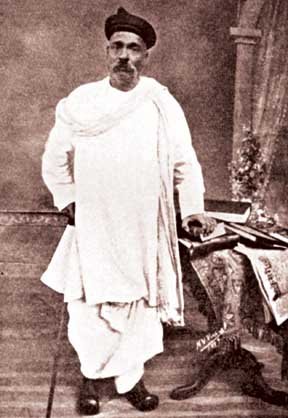
- Kesari, a Marathi newspaper edited by Tilak, became one of the strongest critics of British rule
- Lala Lajpat Rai, a nationalist from Punjab, was a leading member of the Radical group which was critical of the politics of petitions. He was also an active member of the Arya Samaj
Moderates
- Dominated the Congress in its first twenty years
- Petitions, speeches, newspapers, articles
- Believed the British respected freedom and justice
- Wanted to make the government aware of Indian feelings
- Opposed boycott, felt it involved the use of force
Radicals
- Rose in the 1890s: Pal, Tilak, Lajpat Rai
- Called it “politics of prayers”
- Self-reliance and constructive work
- Rely on the people’s own strength; fight for swaraj
- Mass mobilisation and boycott of British institutions and goods
3.1 The Partition of Bengal, 1905
- In 1905, Viceroy Curzon partitioned Bengal
- Bengal was then the biggest province of British India and included Bihar and parts of Orissa
- The British said it was for “administrative convenience”. But this “convenience” was closely tied to the interests of British officials and businessmen
- Instead of removing the non-Bengali areas, the government separated East Bengal and merged it with Assam
- According to the book, the main British motives were perhaps to curtail the influence of Bengali politicians and to split the Bengali people
3.2 The Swadeshi movement
- The partition angered people all over India. All sections of the Congress, the Moderates and the Radicals, opposed it
- Large public meetings and demonstrations were held, and new methods of mass protest developed
- This struggle came to be known as the Swadeshi movement. It was strongest in Bengal, with echoes elsewhere; in deltaic Andhra it was called the Vandemataram Movement
Oppose British rule
The basic aim of the movement.
Self-help
Encouraging Indians to depend on themselves.
Swadeshi enterprise
Supporting Indian-made goods and Indian businesses.
National education
Education run by Indians, for Indians.
Indian languages
Encouraging the use of Indian languages.
- To fight for swaraj, the Radicals called for mass mobilisation and boycott of British institutions and goods
- Some individuals began to suggest that “revolutionary violence” would be necessary to overthrow British rule
Revolutionary violence: the use of violence to make a radical change within society.
3.3 The Muslim League and separate electorates
- A group of Muslim landlords and nawabs formed the All India Muslim League at Dacca in 1906
- The League supported the partition of Bengal
- It wanted separate electorates for Muslims; the government conceded this in 1909
- Result: some seats in the councils were reserved for Muslims, who would be elected by Muslim voters. This tempted politicians to gather a following by giving favours to their own religious groups
Council: an appointed or elected body of people with an administrative, advisory or representative function.
3.4 Split, reunion and the Lucknow Pact
3.5 Quick timeline: 1878 to 1916
4 The Growth of Mass Nationalism
After 1919, the struggle became a mass movement. Peasants, tribals, students and women joined in large numbers, and occasionally factory workers too. In the 1920s some business groups also began to actively support the Congress. The reasons lie in the First World War.
4.1 The impact of the First World War

- The war led to a huge rise in defence expenditure of the Government of India, so the government increased taxes on individual incomes and business profits
- Military expenditure and the demand for war supplies caused a sharp rise in prices, causing great difficulties for common people
- Business groups reaped fabulous profits. The war created a demand for industrial goods (jute bags, cloth, rails) and reduced imports from other countries into India, so Indian industries expanded, and Indian business groups began to demand greater opportunities for development
- The British expanded their army; villages were pressurised to supply soldiers for an alien cause. Many soldiers served abroad and returned wanting to oppose colonial rule in India
- In 1917 there was a revolution in Russia. News of peasants’ and workers’ struggles and ideas of socialism spread widely and inspired Indian nationalists
5 The Advent of Mahatma Gandhi
- Gandhiji, aged 46, arrived in India in 1915 from South Africa
- In South Africa he had led Indians in non-violent marches against racist restrictions, so he was already a respected leader, known internationally
- His South African campaigns had brought him in contact with many kinds of Indians: Hindus, Muslims, Parsis and Christians; Gujaratis, Tamils and north Indians; upper-class merchants, lawyers and workers
- In 1895, with other Indians, he had established the Natal Congress (Durban, South Africa) to fight racial discrimination
- He spent his first year in India travelling throughout the country, understanding the people and their needs
- His earliest interventions were in local movements in Champaran, Kheda and Ahmedabad, where he came into contact with Rajendra Prasad and Vallabhbhai Patel
- In Ahmedabad he led a successful millworkers’ strike in 1918
The book names Champaran, Kheda and Ahmedabad but gives a year only for the Ahmedabad strike (1918). The years 1917 and 1918 for Champaran and Kheda, and the details “Bihar”, “indigo-growing” and “cotton”, are extra facts not printed in the NCERT chapter, added for revision.
6 The Rowlatt Satyagraha, 1919
- In 1919, Gandhiji called for a satyagraha against the Rowlatt Act, just passed by the British
- The Act curbed fundamental rights such as the freedom of expression and strengthened police powers
- Mahatma Gandhi, Mohammad Ali Jinnah and others felt the government had no right to restrict people’s basic freedoms. They called the Act “devilish” and tyrannical
- Gandhiji asked people to observe 6 April 1919 as a day of non-violent opposition, a day of “humiliation and prayer” and hartal (strike). Satyagraha Sabhas were set up to launch the movement
- It was the first all-India struggle against the British government, though it was largely restricted to cities
In April 1919 the government used brutal measures to crush demonstrations and hartals. The Jallianwala Bagh atrocities were inflicted by General Dyer in Amritsar on Baisakhi day (13 April): he opened fire on a gathering of people in a walled compound, and bullet marks remain on its wall. On learning of the massacre, Rabindranath Tagore renounced his knighthood to express the country’s pain and anger.
Satyagraha literally means “insistence on truth” (satya = truth, agraha = insistence). Jallianwala Bagh is a small enclosed garden near the Golden Temple in Amritsar; the troops fired on an unarmed, peaceful gathering that included old people, women and children, and hundreds were killed.
Knighthood: an honour granted by the British Crown for exceptional personal achievement or public service.
- During the Rowlatt Satyagraha, participants tried to keep Hindus and Muslims united against British rule
- Gandhiji always saw India as a land of all the people who lived in it, and wanted Hindus and Muslims to support each other in any just cause
7 Khilafat Agitation and the Non-Cooperation Movement
7.1 The Khilafat issue
- In 1920, the British imposed a harsh treaty on the Turkish Sultan or Khalifa; people were as furious about this as about Jallianwala
- Indian Muslims wanted the Khalifa to keep control over Muslim sacred places in the erstwhile Ottoman Empire
- The leaders of the Khilafat agitation, Mohammad Ali and Shaukat Ali, wanted to start a full-fledged Non-Cooperation Movement
- Gandhiji supported them and urged the Congress to campaign against the “Punjab wrongs” (Jallianwala massacre), the Khilafat wrong, and to demand swaraj
7.2 What Non-Cooperation looked like, 1921-22
Students
Thousands left government-controlled schools and colleges.
Lawyers
Motilal Nehru, C.R. Das, C. Rajagopalachari and Asaf Ali gave up their practices.
Titles and legislatures
British titles were surrendered and legislatures boycotted.
Foreign cloth
Public bonfires of foreign cloth; imports of foreign cloth fell drastically between 1920 and 1922.
The book calls all this only “the tip of the iceberg”: large parts of the country were on the brink of a formidable revolt.
8 People’s Initiatives
In many places people resisted British rule non-violently. In others, different groups understood Gandhiji’s call in their own way and protested in ways that did not match his ideas. In both cases, people linked their movements to local grievances.
| Region | Who | What they did |
|---|---|---|
| Kheda, Gujarat | Patidar peasants | Non-violent campaigns against the high land revenue demand of the British |
| Coastal Andhra and interior Tamil Nadu | Local people | Liquor shops were picketed |
| Guntur district, Andhra Pradesh | Tribals and poor peasants | “Forest satyagrahas”: sent cattle into forests without paying grazing fee, because the colonial state had restricted their use of forest resources. They believed Gandhiji would get taxes reduced and forest rules abolished; in many forest villages they proclaimed swaraj and believed “Gandhi Raj” was about to be established |
| Sind (now in Pakistan) | Muslim traders and peasants | Very enthusiastic about the Khilafat call |
| Bengal | Khilafat-Non-Cooperation alliance | Gave enormous communal unity and strength to the national movement |
| Punjab | Sikhs (Akali agitation) | Tried to remove corrupt mahants, supported by the British, from their gurdwaras; closely linked with Non-Cooperation |
| Assam | Tea garden labourers | Shouting “Gandhi Maharaj ki Jai”, demanded a big wage increase and left British-owned plantations, saying it was Gandhiji’s wish. In Assamese Vaishnava songs, “Gandhi Raja” replaced Krishna |
Picket: people protesting outside a building or shop to prevent others from entering.
Mahants: religious functionaries of Sikh gurdwaras.
Gandhiji (12 March 1938) explained ahimsa (non-violence): it comes from doing good continually without expecting anything in return. In South Africa he learnt the “eternal law of suffering” as the only remedy for undoing wrong and injustice. A satyagrahi must be ready to suffer cheerfully and must wish ill to no one, not even to those who have done him wrong. This is how non-violence could become the basis of a struggle.
9 The People’s Mahatma
- Sometimes people thought of Gandhiji as a kind of messiah, someone who could help them overcome misery and poverty
- Gandhiji wanted class unity, not class conflict. Yet peasants imagined he would help them fight zamindars, and agricultural labourers believed he would give them land
- At times people credited Gandhiji with their own achievements: peasants of Pratapgarh in the United Provinces (now Uttar Pradesh) managed to stop illegal eviction of tenants, but felt it was Gandhiji who had won this for them
- At other times, using Gandhiji’s name, tribals and peasants did things that did not conform to Gandhian ideals
- Popular images too showed Gandhiji as a divine being. In one picture in the book he is driving Krishna’s chariot, guiding other nationalist leaders in the battle against the British
Illegal eviction: forcible and unlawful throwing out of tenants from the land they rent.
The report on the kisan movement was astonished at how far Gandhiji’s name had reached, even in remote villages. Nobody knew quite who he was: a Mahatma, sadhu, Pundit, a Brahmin of Allahabad, even a deota (god). Whatever he said was accepted as true. His real power came from the belief that he had got bedakhli (illegal eviction) stopped in Pratapgarh. People thought he was against the zamindars, not the government: “We are for Gandhiji and the Sarkar.”
10 The Happenings of 1922-1929
10.1 Chauri Chaura and after
- Gandhiji was against violent movements
- In February 1922, a crowd of peasants set fire to a police station in Chauri Chaura (in Gorakhpur district of present-day Uttar Pradesh (extra fact, not in NCERT)); twenty-two policemen were killed. The peasants were provoked because the police had fired on their peaceful demonstration
- Gandhiji abruptly called off the Non-Cooperation Movement
Gandhiji’s followers
- Constructive work in the rural areas
- Sincere social work in villages in the mid-1920s
- Extended their support base, which helped launch the Civil Disobedience movement in 1930
Chitta Ranjan Das and Motilal Nehru
- The party should fight elections to the councils
- Enter the councils to influence government policies
- C.R. Das, a lawyer from East Bengal, was especially active in the Non-Cooperation Movement
- Two important developments of the mid-1920s: the formation of the Rashtriya Swayamsevak Sangh (RSS), a Hindu organisation, and the Communist Party of India (the RSS was founded in 1925 (extra fact, not in NCERT)). These parties held very different ideas about the kind of country India should be
- The revolutionary nationalist Bhagat Singh was also active in this period
10.2 Simon Commission and Purna Swaraj
- In 1927, the British government in England decided to send a commission headed by Lord Simon to decide India’s political future
- It had no Indian representative, so all political groups decided to boycott it; when it reached India (in 1928 (extra fact, not in NCERT)) it was met with demonstrations and banners saying “Simon Go Back”
- In 1929, under the presidentship of Jawaharlal Nehru, the Congress resolved to fight for Purna Swaraj (complete independence)
- So “Independence Day” was observed on 26 January 1930 all over the country
Purna Swaraj: complete independence, the goal the Congress resolved to fight for in 1929.
10.3 Bhagat Singh and the HSRA
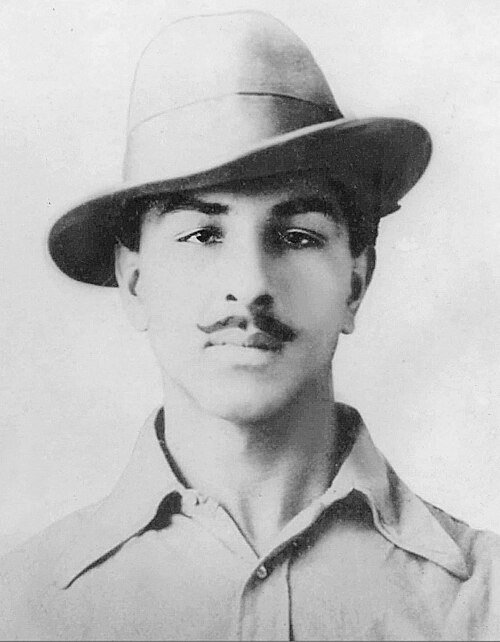
“It takes a loud voice to make the deaf hear. Inquilab Zindabad!”
Heading of the book’s box on the revolutionary nationalists
- Bhagat Singh, Chandra Shekhar Azad, Sukhdev and others wanted to fight colonial rule and the rich exploiting classes through a revolution of workers and peasants
- They founded the Hindustan Socialist Republican Association (HSRA) in 1928 at Ferozeshah Kotla in Delhi
11 The March to Dandi, 1930
Purna Swaraj would not come on its own; it had to be fought for. In 1930 Gandhiji declared he would lead a march to break the salt law.
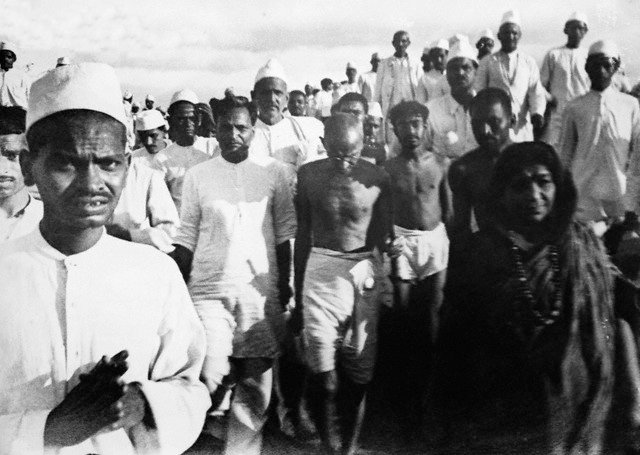
The Salt March linked the general desire for freedom to a specific grievance shared by everybody. Since rich and poor alike eat salt, the issue did not divide the rich and the poor.
- Peasants, tribals and women took part in large numbers
- A business federation published a pamphlet on the salt issue
- The government tried to crush the movement through brutal action against peaceful satyagrahis; thousands were jailed
Between 1930 and 1932 the British held three Round Table Conferences in London to discuss India’s future. The Congress took part only in the second one, in 1931, where Gandhiji represented it; the talks broke down and he returned disappointed. The Congress boycotted the third conference (1932).
11.1 Women in the freedom struggle: Ambabai from Karnataka
- Women from diverse backgrounds took part: young and old, single and married, rural and urban, from conservative and liberal homes
- Both British officials and Indian nationalists felt women’s participation gave the struggle an immense force
- It brought women out of their homes, gave them a place in the professions and in governance, and could pave the way for equality with men
- Ambabai was married at twelve and widowed at sixteen. She picketed foreign cloth and liquor shops in Udipi, was arrested, served a sentence and was rearrested. Between prison terms she made speeches, taught spinning and organised prabhat pheris. She called these the happiest days of her life
- Women had to fight even for the right to take part: during the Salt Satyagraha, Gandhiji was at first opposed to women’s participation; Sarojini Naidu persuaded him to allow it
- Sarojini Naidu, active since the early 1920s, was a significant leader of the Dandi March and the first Indian woman to become President of the Indian National Congress (1925)
12 The 1935 Act and the Second World War
- The combined struggles bore fruit: the Government of India Act of 1935 prescribed provincial autonomy
- Elections to the provincial legislatures were held in 1937; the Congress formed governments in 7 out of 11 provinces
- In September 1939, after two years of Congress rule in the provinces, the Second World War broke out
- Critical of Hitler, Congress leaders were ready to support the British war effort, but wanted India to be granted independence after the war in return
- The British refused, and the Congress ministries resigned in protest
Provincial autonomy: the capacity of the provinces to make relatively independent decisions while remaining within a federation.
Baji Mohammed, President of the Nabrangpur Congress, Orissa, in the 1930s, reported that on 25 August 1942, nineteen people died on the spot in police firing at Paparandi in Nabarangpur; over 300 were injured and more than a thousand were jailed in Koraput district. Veer Lakhan Nayak, a legendary tribal leader who defied the British, was hanged; he was not worried about dying, only sad he would not live to see freedom’s dawn. Baji Mohammad mobilised 20,000 people, offered satyagraha many times, joined protests against the Second World War and the Quit India movement, and served long jail terms.
13 Quit India and Later
- In the middle of the Second World War, Mahatma Gandhi started a new phase of the movement: the British must quit India immediately (Quit India movement, August 1942)
- To the people he said “do or die” in the fight against the British, but they must fight non-violently
- Gandhiji and other leaders were jailed at once, but the movement spread. It especially attracted peasants and the youth, who gave up their studies to join it
- Communications and symbols of state authority were attacked all over the country; in many areas people set up their own governments
- The British first responded with severe repression: by the end of 1943, over 90,000 people were arrested and around 1,000 killed in police firing; in many areas, orders were given to machine-gun crowds from airplanes
- The book’s verdict: the rebellion ultimately brought the Raj to its knees
13.1 Subhas Chandra Bose and the INA
- Bose was a radical nationalist with socialist leanings. He did not share Gandhiji’s ideal of ahimsa, though he respected him as the “Father of the Nation”
- In January 1941 he secretly left his Calcutta home, went to Singapore via Germany, and raised the Azad Hind Fauj or Indian National Army (INA)
- In 1944, the INA tried to enter India through Imphal and Kohima to free India from British control, but the campaign failed
- INA members were imprisoned and tried; people from all walks of life joined the movement against the INA trials
14 Towards Independence and Partition
14.1 The 1940 resolution and the “two nations” idea
- In 1940 the Muslim League moved a resolution demanding “Independent States” for Muslims in the north-western and eastern areas of the country
- The resolution did not mention partition or Pakistan
- From the late 1930s, the League began viewing the Muslims as a separate “nation” from the Hindus
Past tensions
History of tension between some Hindu and Muslim groups in the 1920s and 1930s.
1937 elections
Seemed to convince the League that Muslims were a minority who would always “play second fiddle” in a democracy, and might even go unrepresented.
United Provinces, 1937
The Congress rejected the League’s wish to form a joint Congress-League government there, which annoyed the League.
Congress weakness
The Congress failed to mobilise the Muslim masses in the 1930s, so the League widened its social support.
Early 1940s
The League enlarged its support while most Congress leaders were in jail.
14.2 The road to Partition, 1945-1947
“General” constituencies: election districts with no reservations for any religious or other community.
14.3 The human cost of Partition
- Many hundred thousand people were killed, and numerous women faced untold brutalities
- Millions were forced to flee their homes and became refugees in alien lands; refugees from riot-torn Punjab gathered in New Delhi in search of shelter and food
- India changed, many of its cities changed, and a new country, Pakistan, was born
- So the joy of independence came mixed with the pain and violence of Partition
India became independent on 15 August 1947, and Pakistan on 14 August 1947. The “north-western and eastern areas” of the 1940 resolution correspond roughly to present-day Pakistan and Bangladesh (later East Pakistan).
15 Leaders in the Book’s Pictures
The figure captions of this chapter carry facts that are often asked. Here they are in one table.
| Leader | What the book says |
|---|---|
| Jawaharlal Nehru | Gandhiji’s disciple, a Congress Socialist and an internationalist; a leading architect of the national movement and of free India’s economy and polity. Pictured listening to Gandhiji before the Bombay session of the Congress, July 1946 |
| Maulana Azad | Born in Mecca to a Bengali father and an Arab mother; a scholar of Islam; believed in wahadat-i-deen, the essential oneness of all religions; a staunch supporter of Hindu-Muslim unity; opposed Jinnah’s two-nation theory. Pictured with other members at the Congress Working Committee, Sevagram, 1942 |
| C. Rajagopalachari (Rajaji) | Leader of the Salt Satyagraha in the south; member of the Interim Government of 1946; free India’s first Indian Governor-General. Pictured speaking to Gandhiji before the Gandhi-Jinnah talks, 1944 |
| Sardar Vallabhbhai Patel | From an impoverished peasant-proprietor family of Nadiad, Gujarat; a foremost organiser of the movement from 1918; Congress President in 1931; important role in the negotiations of 1945-47 |
| Mohammad Ali Jinnah | An ambassador of Hindu-Muslim unity until 1920; important role in the Lucknow Pact; reorganised the Muslim League after 1934; became the major spokesperson for Pakistan. Pictured with Gandhiji in Bombay, September 1944 |
| Khan Abdul Ghaffar Khan (Badshah Khan) | Pashtun leader from the North West Frontier Province; founder of the Khudai Khidmatgars, a powerful non-violent movement among the Pathans; strongly opposed Partition and criticised his Congress colleagues for agreeing to it. Pictured with his colleagues at a peace march through Bihar, March 1947 |
| Sarojini Naidu | First Indian woman President of the Congress (1925); a leader of the Dandi March. Pictured with Gandhiji in Paris, 1931 |
| Subhas Chandra Bose | Radical nationalist with socialist leanings; raised the INA |
16 Master Timeline, 1915 to 1947
R-K-N-C-D-Q
The Gandhian mass movements in order: Rowlatt (1919), Khilafat (1920), Non-Cooperation (1921-22), Chauri Chaura stops it (1922), Dandi (1930), Quit India (1942).
- Nationalism: India belongs to all its people; the people should be sovereign
- Associations of the 1870s-80s: Poona Sarvajanik Sabha, Indian Association, Madras Mahajan Sabha, Bombay Presidency Association, INC
- Anger: Arms Act and Vernacular Press Act (1878), Ilbert Bill withdrawn (1883)
- INC: December 1885, Bombay, 72 delegates; Naoroji, Tyabji, Bonnerji and others; A.O. Hume helped
- Moderates: petitions, councils, civil service exams in India, economic critique; Radicals (Pal, Tilak, Lajpat Rai): self-reliance, swaraj, boycott
- 1905 Partition of Bengal by Curzon, Swadeshi; 1906 Muslim League at Dacca; 1907 split; 1909 separate electorates; 1916 Lucknow Pact
- WWI: taxes and prices up, business profits, industries grew, soldiers aware; Russia 1917
- Gandhi: back in 1915 aged 46; Champaran, Kheda, Ahmedabad (1918)
- 1919 Rowlatt Satyagraha, Jallianwala (13 April); 1920 Khilafat; 1921-22 Non-Cooperation; February 1922 Chauri Chaura (22 policemen)
- 1927 Simon Commission; 1929 Purna Swaraj (Nehru); 26 January 1930 Independence Day; 1928 HSRA; 1931 executions
- 1930 Dandi: 240 miles, salt united rich and poor; Ambabai; Sarojini Naidu
- 1935 Act (provincial autonomy); 1937 Congress in 7 of 11; 1939 ministries resign
- 1942 Quit India, “do or die”; 90,000 arrested by end of 1943; Bose and INA (Imphal, Kohima, 1944)
- 1940 resolution; 1946 elections and Cabinet Mission; 16 August 1946 Direct Action Day; 1947 Partition
- Can I name the five associations and explain “sarvajanik”?
- Can I list the three things that angered Indians in 1878-1883?
- Can I write four demands of the Moderates and three differences between Moderates and Radicals?
- Can I explain why Bengal was partitioned and what the Swadeshi movement aimed at?
- Can I write the economic effects of the First World War?
- Can I describe Non-Cooperation in four regions and how people saw Gandhiji?
- Can I explain why Gandhiji chose salt?
- Can I list the developments of 1937-47 that led to Pakistan?