The difference between an equation and an identity
All the standard square and cube identities, and how to visualise them geometrically
How to factor a quadratic by splitting the middle term
How to simplify a rational expression by factoring and cancelling common factors
identityexpansionfactorisationsplitting the middle termperfect squarerational expression
1What Is an Identity?
Learn by heartDefinition 1
An identity is an equation that is true for every value of the variables in it. An equation that is only true for particular values is not an identity. E.g. x2−1=24 is true only for x=±5 (an equation), but (x+y)2=x2+2xy+y2 is true for all x,y (an identity).
Take any three consecutive square numbers, say 1,4,9. Add the smallest and largest, subtract twice the middle: (1+9)−2(4)=2. Try 25,36,49: (25+49)−2(36)=2 again. This always gives 2, and algebra explains why: writing the numbers as (n−1)2,n2,(n+1)2, we get (n−1)2+(n+1)2−2n2=2n2+2−2n2=2 for every n.
2Square Identities
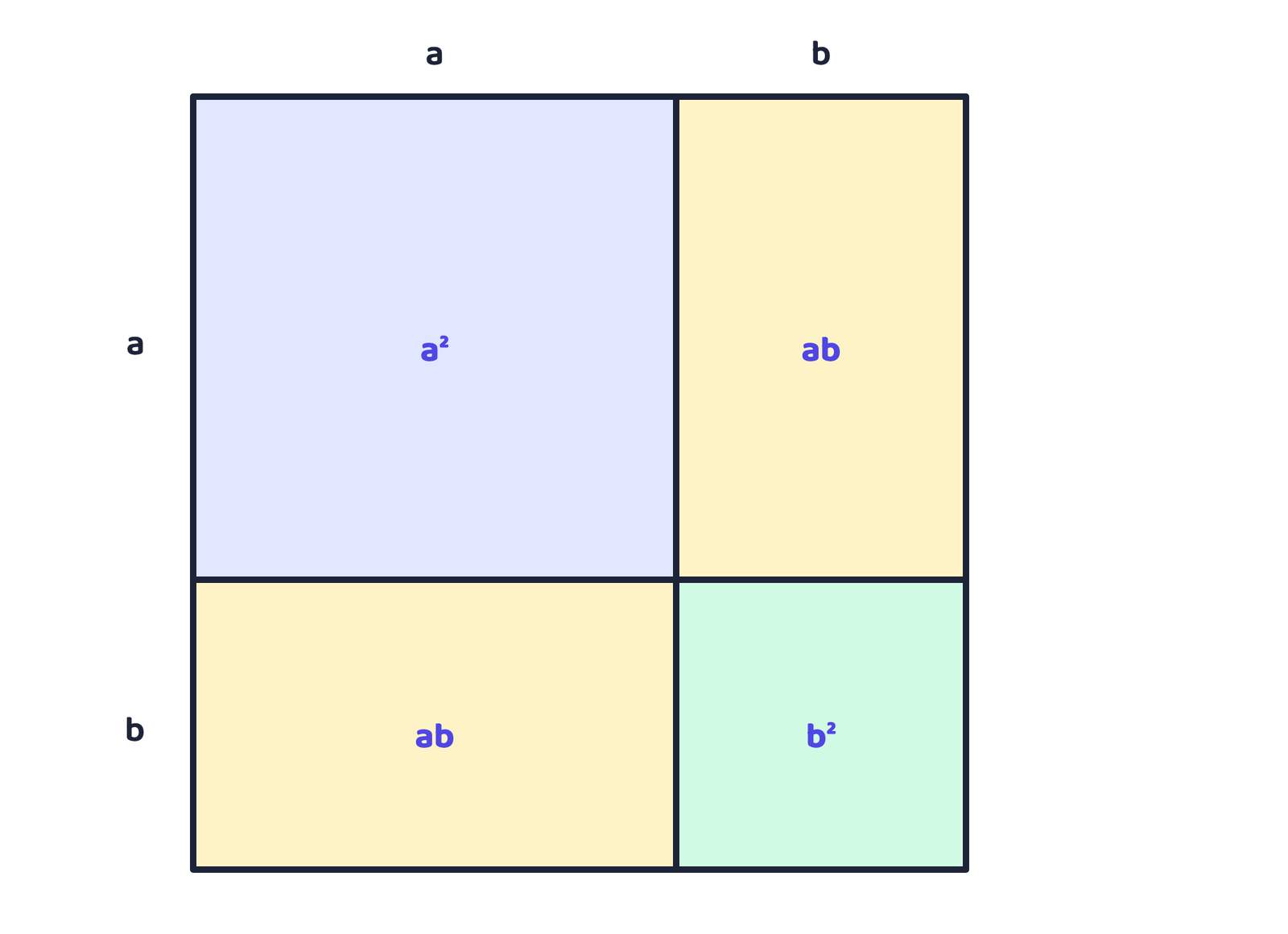
Figure 1: A square of side (a+b) splits into an a×a square, a b×b square, and two ab rectangles, giving (a+b)² = a² + 2ab + b².
Formula
(x+y)2=x2+2xy+y2
Also true for negative and rational x,y, proved generally using the distributive property: (x+y)(x+y)=x(x+y)+y(x+y)
Formula: difference of squares, and Śhrīdharāchārya’s form
x2−y2=(x+y)(x−y), equivalently x2=(x+y)(x−y)+y2
Proposed 750 CE as a quick way to square numbers
Solved Example
Q. Use Śhrīdharāchārya’s method to find 552.
552=(55+5)(55−5)+52=60×50+25=3000+25=3025
3Factoring Quadratics
The identities above run in reverse too: they factor expressions, not just expand them.
Solved Example
Q. Factor 9x2+30x+25.
9x2=(3x)2, 25=52, 30x=2(3x)(5), matching a2+2ab+b2 with a=3x,b=5. So 9x2+30x+25=(3x+5)2
Splitting the middle term
To factor x2+(a+b)x+ab as (x+a)(x+b): find two numbers a,b whose sum is the coefficient of x and whose product is the constant term.
Solved Example
Q. Factor x2−5x−24.
Need two numbers with sum −5 and product −24: these are −8 and 3.
x2−5x−24=x2−8x+3x−24=x(x−8)+3(x−8)=(x−8)(x+3)
Formula (general quadratic)
(ax+b)(cx+d)=acx2+(ad+bc)x+bd
Algebra tiles: seeing a factorisation
The book also factors quadratics with algebra tiles: an x2-tile (an x by x square), x-tiles (x by 1 strips) and unit tiles (1 by 1 squares). To factor x2+7x+12, take one x2-tile, seven x-tiles and twelve unit tiles and arrange them into a rectangle: three x-tiles on one side of the x2-tile, four below it, and the twelve unit tiles in a 3×4 array in the corner. The sides of the rectangle are x+3 and x+4, so x2+7x+12=(x+3)(x+4).
A rectangle forms only when the x-term is split correctly: 7x=3x+4x works because 3×4=12, while 7x=2x+5x does not (2×5=10). This is exactly the “splitting the middle term” rule above. The same tiles show products such as (2x+3)(3x+1)=6x2+11x+3, and in general (px+a)(qx+b)=pqx2+(pb+aq)x+ab.
Common Mistake
When the constant term is negative, the two numbers a and b must have opposite signs; when it is positive, they must have the same sign as the middle-term coefficient’s sign. Getting this backwards is the single most common factoring error.
4Cube Identities
Identity
Expression
Sum cubed
(x+y)3=x3+3x2y+3xy2+y3
Difference cubed
(x−y)3=x3−3x2y+3xy2−y3
Difference of cubes
x3−y3=(x−y)(x2+xy+y2)
Sum of cubes
x3+y3=(x+y)(x2−xy+y2)
Three-variable cube identity
x3+y3+z3−3xyz=(x+y+z)(x2+y2+z2−xy−yz−zx)
Where the cube identities come from
(x+y)3=(x+y)(x+y)2=(x+y)(x2+2xy+y2), expanded by distributivity, gives x3+3x2y+3xy2+y3. Replacing y with −y gives the difference-cubed identity, with signs alternating +,−,+,−.
Rewrite as (2n)3−3(2n)2(5m)+3(2n)(5m)2−(5m)3, matching x3−3x2y+3xy2−y3 with x=2n,y=5m. So it equals (2n−5m)3
Special case worth remembering
If x+y+z=0, then x3+y3+z3=3xyz
Because the first factor (x+y+z) in the identity becomes zero, leaving x3+y3+z3−3xyz=0.
Given
x+y+z=10, xyz=25, x2+y2+z2=38
Find
x3+y3+z3
Solution
From (x+y+z)2=x2+y2+z2+2(xy+yz+zx): 100=38+2(xy+yz+zx)⇒xy+yz+zx=31
From the cube identity: x3+y3+z3−3(25)=10(38−31)⇒x3+y3+z3=70+75=145
5Simplifying Rational Expressions
Factor the numerator and denominator fully, then cancel any factor common to both (assuming the denominator is never zero).
Given
5x2+5x−100x2−7x+12, denominator =0
Simplify
Solution
Numerator: need sum −7, product 12: these are −3,−4. So x2−7x+12=(x−3)(x−4)
Denominator: 5x2+5x−100=5(x2+x−20); need sum 1, product −20: these are 5,−4. So =5(x−4)(x+5)
5(x−4)(x+5)(x−3)(x−4)=5(x+5)x−3 (cancelling x−4, valid since x=4)
Solved Example: area word problem
Q. A rectangular pool’s breadth is 4 m less than its length, and its area is 96 sq. m. Find its dimensions.
Let length =x m, breadth =x−4 m. Then x(x−4)=96⇒x2−4x−96=0
Need sum −4, product −96: these are −12,8. So (x−12)(x+8)=0⇒x=12 (rejecting x=−8, a length can’t be negative)
Length =12 m, breadth =8 m
Every identity in this chapter comes from expanding a product with the distributive property, just applied to squares, cubes, and sums of several variables.
the single idea to carry out of this chapter
All identities in one place
(x+y)2x2+2xy+y2
(x−y)2x2−2xy+y2
(x+y+z)2x2+y2+z2+2xy+2yz+2zx
x2−y2(x+y)(x−y)
x2+(a+b)x+ab(x+a)(x+b)
(ax+b)(cx+d)acx2+(ad+bc)x+bd
x3−y3(x−y)(x2+xy+y2)
x3+y3(x+y)(x2−xy+y2)
(x+y)3x3+3x2y+3xy2+y3
(x−y)3x3−3x2y+3xy2−y3
x3+y3+z3−3xyz(x+y+z)(x2+y2+z2−xy−yz−zx)
Check yourself before the exam
Can I state and apply all 11 identities without looking them up?
Can I factor a quadratic by splitting the middle term, choosing the correct signs?
Can I use Śhrīdharāchārya’s method or the (x+y+z)² identity to square a number mentally?
Can I simplify a rational expression and state the value that must be excluded?
Quick Revision: read this the night before the exam
Identity = true for all values; equation = true only for specific values
(x±y)2=x2±2xy+y2; (x+y+z)2 adds all three squares plus three cross terms
x2−y2=(x+y)(x−y); use it for fast squaring: a2=(a+b)(a−b)+b2
Splitting the middle term: find two numbers with the given sum and product
(x±y)3=x3±3x2y+3xy2±y3 (signs alternate for the minus case)
x3+y3+z3−3xyz=(x+y+z)(x2+y2+z2−xy−yz−zx); equals 0 when x+y+z=0
Simplify rational expressions by factoring both parts and cancelling, noting what can’t equal zero
Practice Questions
1 markExpand (3x−5)2 using an identity.
1 markEvaluate 9982 using a suitable identity.
2 marksFactor 25x2+70xy+49y2.
2 marksFactor x2+2x−63 by splitting the middle term.
2 marksEvaluate 52×48 using x2−y2=(x+y)(x−y).
3 marksExpand (2p−3q+r)2 using the three-term identity.
3 marksFind a if x3+12x2q+48xq2+64q3=(x+a)3.
2 marksSimplify 3s2+2st−5t29s2−25t2, assuming the denominator is never 0.
3 marksIf x+y+z=0, show that x3+y3+z3=3xyz, and use it to find 23+(−5)3+33.
4 marksA square garden of side 30 m has a path of uniform width s m built around it. Find an expression for the area of the path in terms of s.
3 marksA number plus its reciprocal equals 613. Find the number(s).
1 markWhich is an identity, not just an equation? (a) x2=16(b) 2x+3=11(c) (x+1)2=x2+2x+1(d) x2−x=6
1 markTo factor x2−9x+20, the two numbers needed are: (a) 4 and 5(b) −4 and −5(c) 2 and 10(d) −2 and −10
Assertion (A):(a+b)2 is always greater than or equal to a2+b2 when a,b>0. Reason (R):(a+b)2−(a2+b2)=2ab, which is non-negative when a,b>0.
Case Study
Saira arranges one square tile of side x units, 8 rectangular strips of size x by 1 units, and 15 unit squares to build one large rectangle, with total area x² + 8x + 15 square units.
1 markWhich two numbers have sum 8 and product 15?
1 markFactor x² + 8x + 15 into two linear factors.
2 marksState the length and breadth of Saira’s rectangle in terms of x.
Answer Key
Q19x2−30x+25
Q29982=(1000−2)2=1000000−4000+4=996004
Q3(5x+7y)2
Q4Sum 2, product −63: numbers 9, −7. (x+9)(x−7)
Q552×48=(50+2)(50−2)=2500−4=2496
Q64p2+9q2+r2−12pq+4pr−6qr
Q7a=4q (since 64q3=(4q)3 and the pattern matches x3+3x2(4q)+3x(4q)2+(4q)3)
Q8(3s+5t)(s−t)(3s−5t)(3s+5t)=s−t3s−5t
Q9Proof follows from the factored identity; 2+(−5)+3=0, so sum of cubes =3(2)(−5)(3)=−90
Q10Outer square (30+2s)2 minus garden 302: path area =120s+4s2 sq. m
Q11x+x1=613⇒6x2−13x+6=0⇒(3x−2)(2x−3)=0⇒x=32 or 23
MCQ 1–3(a) · (c) · (b)
A/RBoth A and R are true, and R is the correct explanation of A
Case Study3 and 5 · (x+3)(x+5) · length =x+5, breadth =x+3