
- How to identify the terms, variables, coefficients and degree of a polynomial
- What makes a pattern “linear”, and the difference between linear growth and linear decay
- How to find the relationship y = ax + b between two variables from real data
- How to plot a line and read off its slope and y-intercept, and what makes two lines parallel
1Algebraic Expressions and Polynomials
A shop sells sealed boxes: red boxes have 4 pens each, blue boxes have 5 pencils each. If Meera buys x red boxes and y blue boxes, and gets 3 extra pens free, the total number of pens and pencils is . This is an algebraic expression: a combination of numbers, variables and operation symbols.
In an algebraic expression, the parts separated by + or − signs are its terms. The letters standing for unknown numbers are variables. The number multiplying a variable is its coefficient, and a term with no variable is the constant term.
In : the terms are , and ; the variables are and ; the coefficients of and are and ; and is the constant term.
This chapter deals only with expressions in one variable, such as or . An expression like , with two variables, is not the kind of polynomial studied here.
An algebraic expression in one variable and its powers is called a polynomial (or univariate polynomial). The highest power of the variable in a polynomial is its degree.
| Degree | Name | Example |
|---|---|---|
| 0 | Constant polynomial | (written ) |
| 1 | Linear polynomial | |
| 2 | Quadratic polynomial | |
| 3 | Cubic polynomial |
Q. Find the degree and coefficient of in .
A. Highest power of is 3, so degree (a cubic polynomial). Coefficient of is
2Linear Polynomials and Linear Patterns
A polynomial of degree 1, such as or , is called a linear polynomial. When a linear polynomial is equated to a constant, we get a linear equation.
A chess club charges a joining fee of ₹200 plus ₹50 for every match played. If is the number of matches, the total cost is , a linear polynomial in .
| Matches played | 1 | 2 | 3 | 4 | |
|---|---|---|---|---|---|
| Amount paid (₹) | 250 | 300 | 350 | 400 |
A linear pattern is a sequence of numbers in which the difference between any two consecutive terms is constant. When that constant difference is added each time, we call it linear growth; when it is subtracted, linear decay.
Linear growth
- Quantity increases by a fixed amount
- Chess fee: +₹50 per match
- Represented by a line with positive slope
Linear decay
- Quantity decreases by a fixed amount
- Pocket money: −₹5 per day
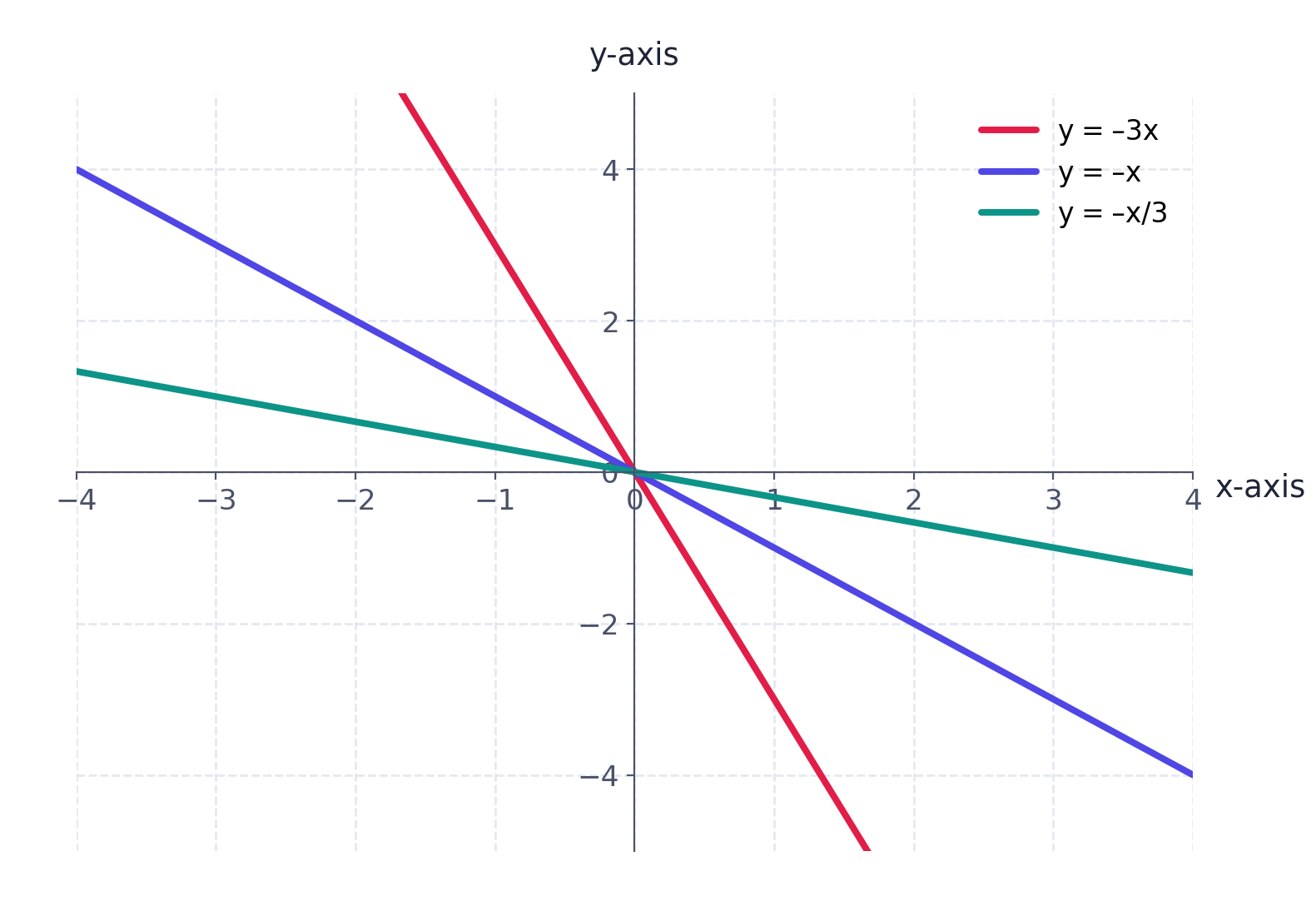
- Represented by a line with negative slope
Q. A growing pattern of square tiles has 1, 3, 5, 7, 9 … tiles at Stages 1, 2, 3, 4, 5. Find the rule for the number of tiles at Stage , and the number of tiles at Stage 20.
The difference between consecutive terms is constantly 2, so this is a linear pattern. Each stage has one less than twice the stage number: tiles .
At Stage 20: tiles
Not every increasing pattern is linear. A pattern is linear only if the difference between consecutive terms stays exactly the same every time, not just “getting bigger”.
3Finding the Relationship y = ax + b
A linear relationship between two variables and is written . If we know two pairs of values, we can find and by solving two equations together.
Given
A data plan bill is , where = GB used. 10 GB costs ₹350; 20 GB costs ₹550
Find
The values of and
Substituting the two data points: and
From the first equation, . Substituting into the second:
Then . So the relationship is
Here means each extra GB costs ₹20, and means there is a fixed monthly charge of ₹150 even with 0 GB used. Reading meaning into and is a common follow-up question.
4Graphing Lines: Slope and y-intercept
To plot , we only need two points. When , , giving point A. When , , giving point B. Plotting A and B and joining them with a ruler, extended in both directions, gives the line.
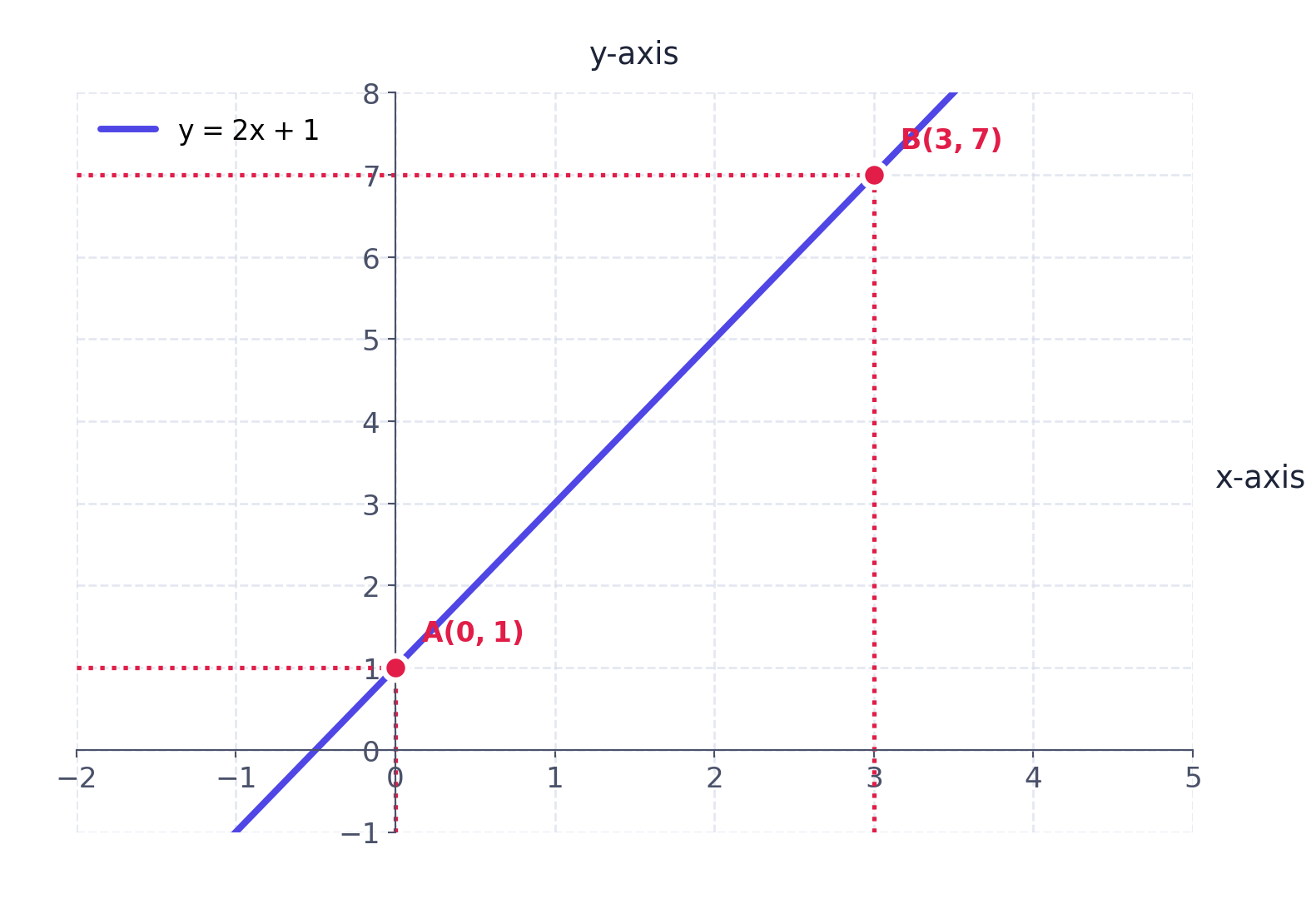
A point lies on a line exactly when its coordinates satisfy the line’s equation. For : does lie on it? Substitute : , which matches, so yes.
Plotting families of lines through the origin shows what the number in controls:
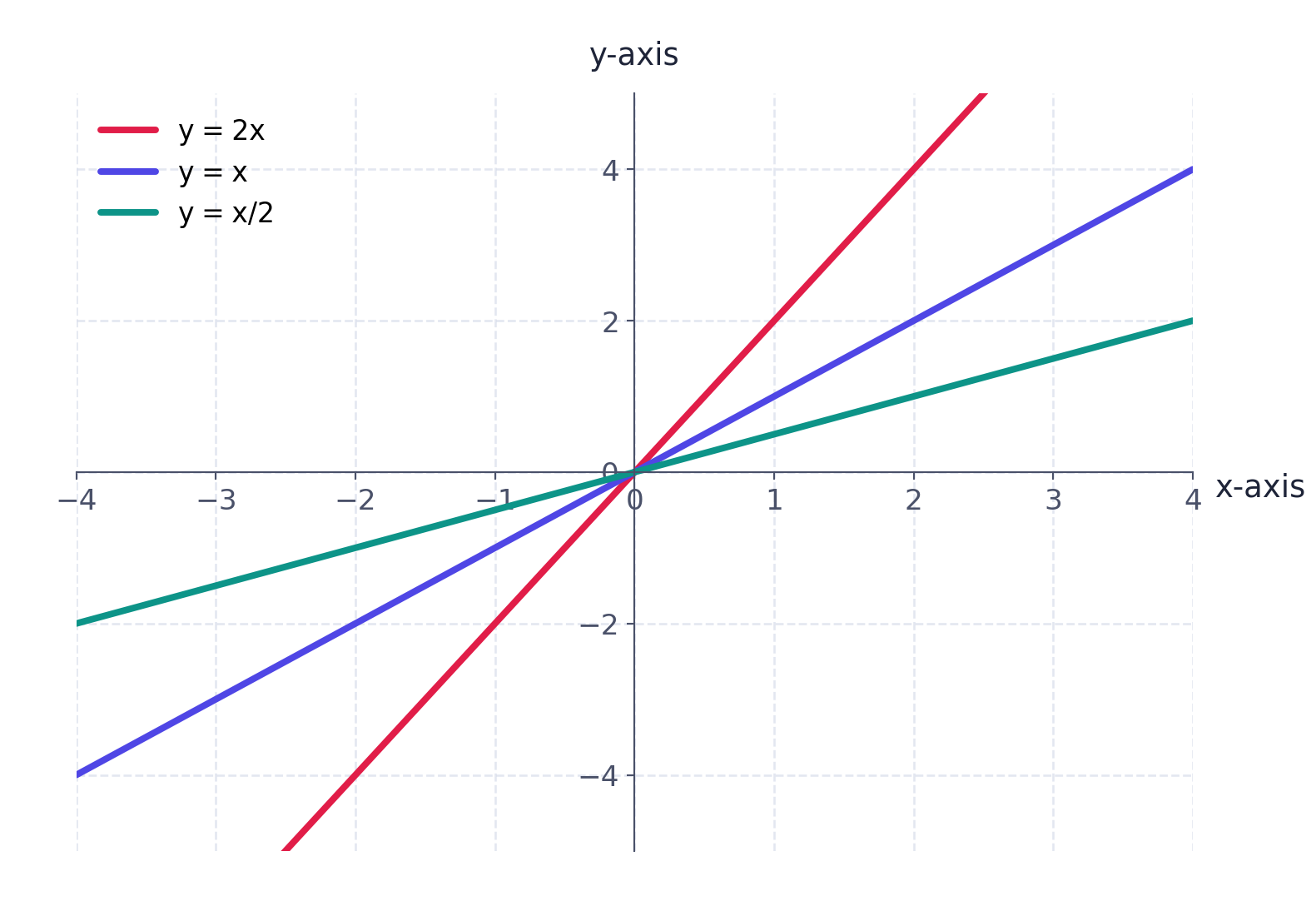
In , is called the slope of the line. It measures both direction (positive slope rises, negative slope falls) and steepness (larger is steeper).
Now compare lines with the same slope but a different constant term:
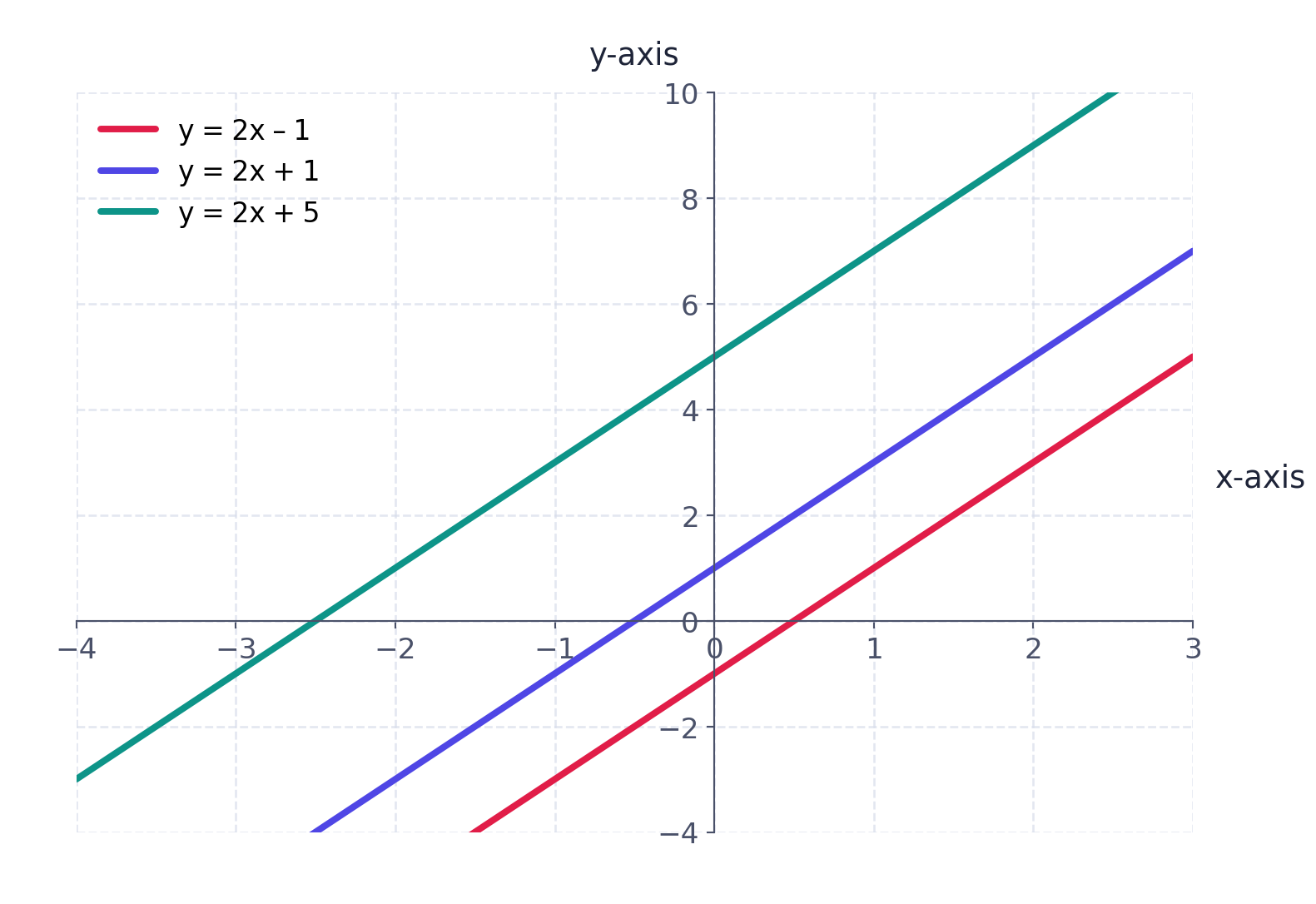
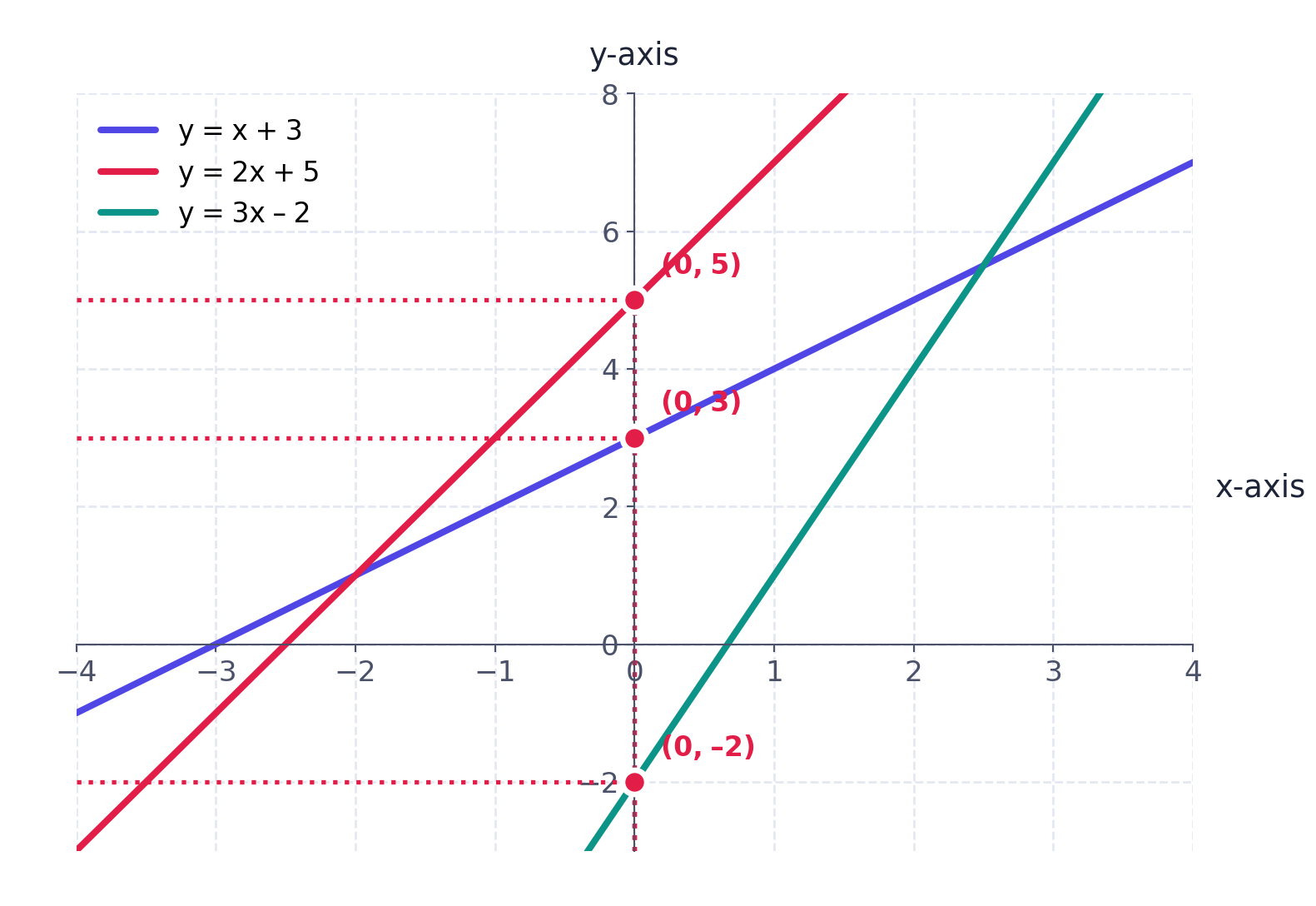
In , the constant is the y-intercept: the line always crosses the y-axis at the point .
✓ True
- Keeping fixed and changing changes the slope, not the y-intercept
- Keeping fixed and changing shifts the line up or down, keeping it parallel to the original
- Lines with the same but different are parallel
✗ False
- Changing makes the line steeper or flatter
- Two lines with different slopes are parallel if their y-intercepts are close enough
- In there is no constant term, so must be 0
An auto-rickshaw fare that starts at ₹25 and adds ₹15 per km beyond the first 2 km is a real linear relationship: fare for km. The slope, ₹15, is exactly the per-km rate; you will meet the same idea again when you study speed as the slope of a distance-time graph.
Every straight line is completely described by just two numbers: its slope and its y-intercept.
the single idea to carry out of this chapter
- Can I find the degree, coefficients and constant term of a polynomial on sight?
- Can I tell linear growth from linear decay just from the sign of the slope?
- Can I find a and b in y = ax + b from two given data points?
- Can I plot a line from two points, and explain what its slope and y-intercept mean?
- Degree of a polynomial = highest power of the variable; degree 1 is linear
- Linear pattern: constant difference between consecutive terms (growth = added, decay = subtracted)
- y = ax + b: find a, b by substituting two known (x, y) pairs and solving
- Any two points fix a line; a point lies on a line iff it satisfies the equation
- a = slope (steepness and direction); b = y-intercept, the point (0, b)
- Same a, different b: parallel lines. Same b, different a: lines crossing the y-axis at the same point
- 1 markWrite a polynomial of degree 3 in x, where the coefficient of is .
- 1 markFind the value of when .
- 2 marksIf a number is multiplied by 3 and 5 is added, the result is . Find the number.
- 2 marksA positive number is 4 times another number. If 20 is added to both, one new number becomes twice the other. Find the numbers.
- 2 marksRavi has ₹600 and saves ₹200 every month. Write a linear expression for the amount after months, and find the amount after 8 months.
- 3 marksThe digits of a two-digit number differ by 2. Reversing the digits and adding to the original number gives 132. Find the number.
- 4 marksDraw the graphs of and (rewrite in form first). Find their slopes and y-intercepts. Are they parallel?
- 3 marksThe graph of a linear polynomial passes through and . Find .
- 4 marksLet and . Given , cuts the x-axis at , and for all . Find and .
- 3 marksWhat do all lines of the form , , have in common? Explain using the y-intercept.
- 1 markThe degree of the polynomial is:
(a) 5(b) 4(c) 3(d) 2 - 1 markThe y-intercept of the line is:
(a) 6(b) 2(c) –3(d) –9 - 1 markWhich pair of lines is parallel?
(a) y = 3x+1, y = 3x-4(b) y = 2x, y = -2x(c) y = x+2, y = 2x+2(d) y = 5, x = 5
Reason (R): Lines with the same slope and different y-intercepts are parallel.
- 1 markWrite the linear relationship between and .
- 1 markIs this linear growth or linear decay? What is the slope?
- 2 marksHow many litres are in the tank after 12 minutes?