
- Find the perimeter of polygons, the circumference of a circle, the length of an arc and the perimeter of a sector
- Explain what π is, trace how its value was found from Mesopotamia to Mādhava, and why π is irrational
- Work out the stagger on a 400 m track and solve perimeter puzzles made of arcs
- Find areas of rectangles, parallelograms and triangles, and use the median theorem
- Use Heron’s formula, the circumcircle and incircle formulas, and Brahmagupta’s formula for a cyclic 4-gon
- Square a rectangle by Baudhāyana’s construction, and find the area of a circle, a sector and a segment
The chapter opens at a 4 × 100 m relay race. The athletes are not on one starting line: those in the outer lanes start ahead of those in the inner lanes, yet the finish line is the same for everyone. To see why this is fair, we need to know how to find the length around a circle.
The stagger is the distance between the starting points of adjacent lanes on a running track.
1 Perimeter of a Shape
The perimeter of a shape is the total length around its border. Picture a tiny insect walking around the border, never turning back, until it returns to its starting point: the distance it travels is the perimeter.
| Shape | Perimeter | Ratio perimeter : side |
|---|---|---|
| Square, side | 4 : 1 for every square | |
| Equilateral triangle, side | 3 : 1 for every equilateral triangle | |
| Rectangle, length , width | depends on the shape of the rectangle | |
| Circle, diameter | circumference | is the same for every circle |
- Double the side of a square (2 units → 4 units) and the perimeter also doubles (8 units → 16 units). As the square grows or shrinks, the ratio stays fixed at 4 : 1.
- The formula for the perimeter of a square is a special case of the rectangle formula: put in to get .
- The perimeter of a circle is usually called its circumference.
2 Perimeter of a Circle: the C/D Ratio
In ancient days people realised that the ratio of the circumference to the diameter of a circle does not change when the size of the circle changes. The book calls it the C/D ratio. Today this constant is written π (said “pie”, as in pie, not as in pizza).
The answer comes out between 3 and 4, and with care between 3.1 and 3.2. The ratio can also be estimated by pure geometry, with no measurement at all, as the next section shows.
2.1 Why π is more than 3 and less than 2√3
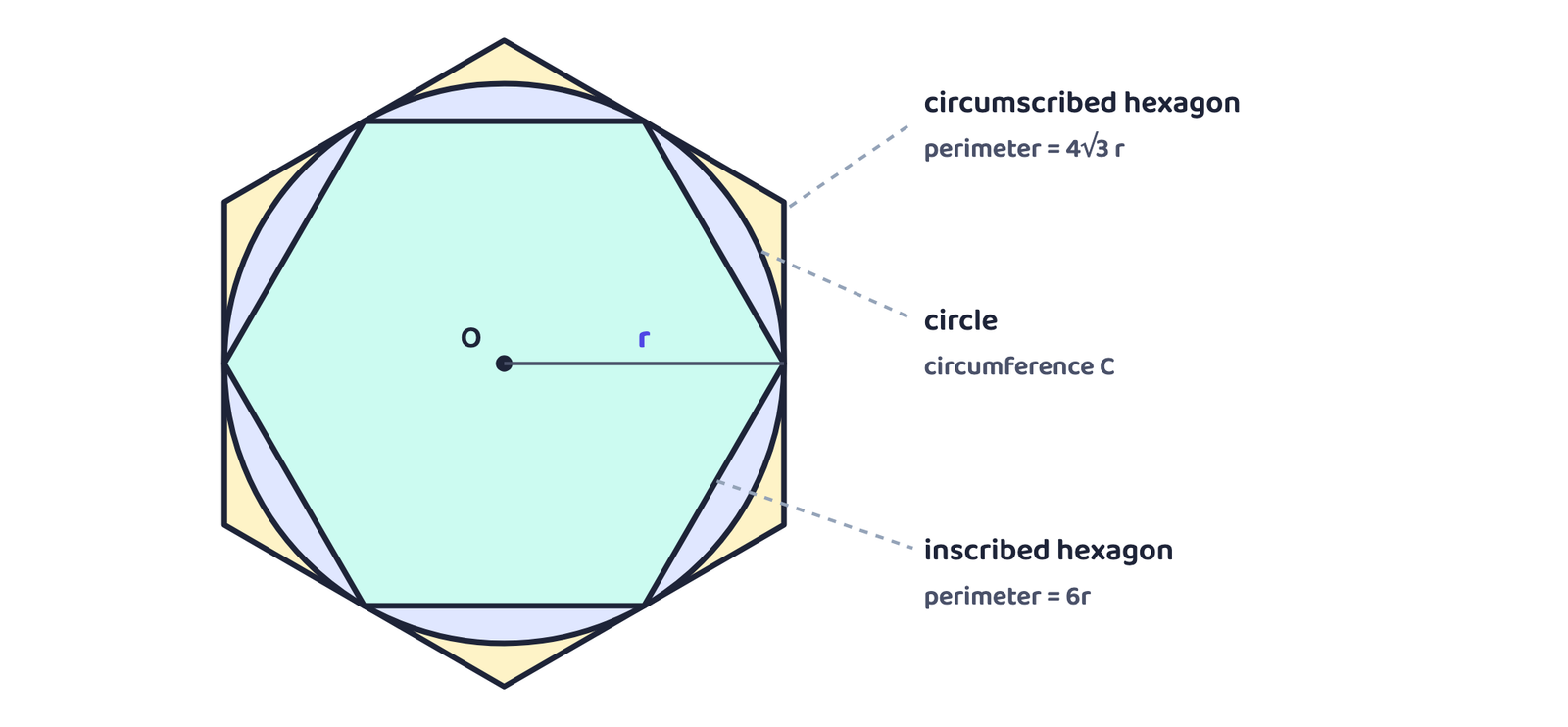
2.2 C/D’s adventurous journey: from ancient approximations to Mādhava’s exact formula
Mathematicians in every region have been fascinated by π. It is a bridge between many areas of mathematics, linking the straight-edged world of polygons with the curves of nature. Early civilisations used “good-enough” values for building and trade; later, finding π more and more exactly became a benchmark of how advanced a mathematical theory was.
| When | Who / where | What they found |
|---|---|---|
| c. 1900 BCE | Mesopotamia | Circle slightly longer than its inscribed hexagon, so π > 3; took |
| by 250 BCE | Archimedes of Syracuse | “Trapped” π between inscribed and circumscribed polygons: hexagons gave 3 and ; with 96-sided polygons, |
| about 150 CE | Ptolemy of Alexandria | Refined Archimedes’ work for his astronomical tables: |
| 263 CE | Liu Hui (China) | “Circle-cutting method”, the groundwork for Zu Chongzhi |
| 480 CE | Zu Chongzhi (China) | Polygons up to 24,576 sides; Yuelü (Approximate Ratio) and Miü (Close Ratio) |
| 499 CE | Āryabhaṭa | , called asanna (“approaching”, “approximate”) |
| 628 CE | Brahmagupta | , less accurate but chosen for elegance and ease in equations |
| (after them) | Mādhava of Sangamagrāma | First exact formula for π, an infinite series; π to 11 decimal places, 3.14159265358 |
| c. 1500, 1706, 1914, 1988 | Nīlakaṇṭha, Machin, Ramanujan, the Chudnovsky brothers | Faster and faster series; π is now known to neels (hundreds of trillions) of digits |
| 1706 | William Jones (Welsh) | First used the Greek letter π for the C/D ratio |
| 1761 | Lambert | Proved that π is irrational |
- Zu Chongzhi’s 355/113 stayed the most accurate value of π in the world for over 800 years. No fraction with a denominator less than 15,000 is as close to π.
- Āryabhaṭa’s word asanna hinted that the ratio cannot be written exactly as one simple fraction.
- Brahmagupta’s √10 became the main approximation in the Arab world and medieval Europe for centuries.
- Until Mādhava, no value was as accurate as 355/113, or as simple as 22/7, 3.1416 and √10.
- Jones chose π because it is the first letter of the Greek word perimetros (perimeter). The Swiss German mathematician Leonhard Euler (said “oiler”) made the symbol popular.
3 π Is Irrational
A rational number is a number that can be written as a fraction , where and are integers and . Examples: , , .
A number that cannot be written as a ratio of two integers is called irrational. π and are irrational.
3.1 Fractions versus π
Fractions (rational)
- Decimal digits repeat in a rhythm
π (irrational)
- Digits go on forever
- No visible pattern at all
- Āryabhaṭa and Zu Chongzhi seem to have regarded π as irrational
- Lambert proved it in 1761 (needs advanced mathematics)
- Because π is irrational there is no “best fraction” for it: for any fraction close to π, we can find another that is closer.
- is good enough for most practical uses, and is much better.
π and are “close but not equal”. Write and , never . In the same way, and .
Count the letters in each word of “How I wish I could recollect pi”: 3, 1, 4, 1, 5, 9, 2, so π ≈ 3.141592… Because π ≈ 3.14, 14 March (written “3-14” in North America) is Pi Day; because π ≈ 22/7, 22 July (written “22-7” in India) is Pi Approximation Day.
4 Length of an Arc of a Circle
4.1 Semicircle, quarter circle and any arc
Semicircle
Reflect the circle in a diameter AB (or rotate it through 180°, a half-turn): the two halves swap places, so they are equal. Length .
Quarter circle
Rotate the circle through 90°: each quarter covers the next, so all four are equal. Length .
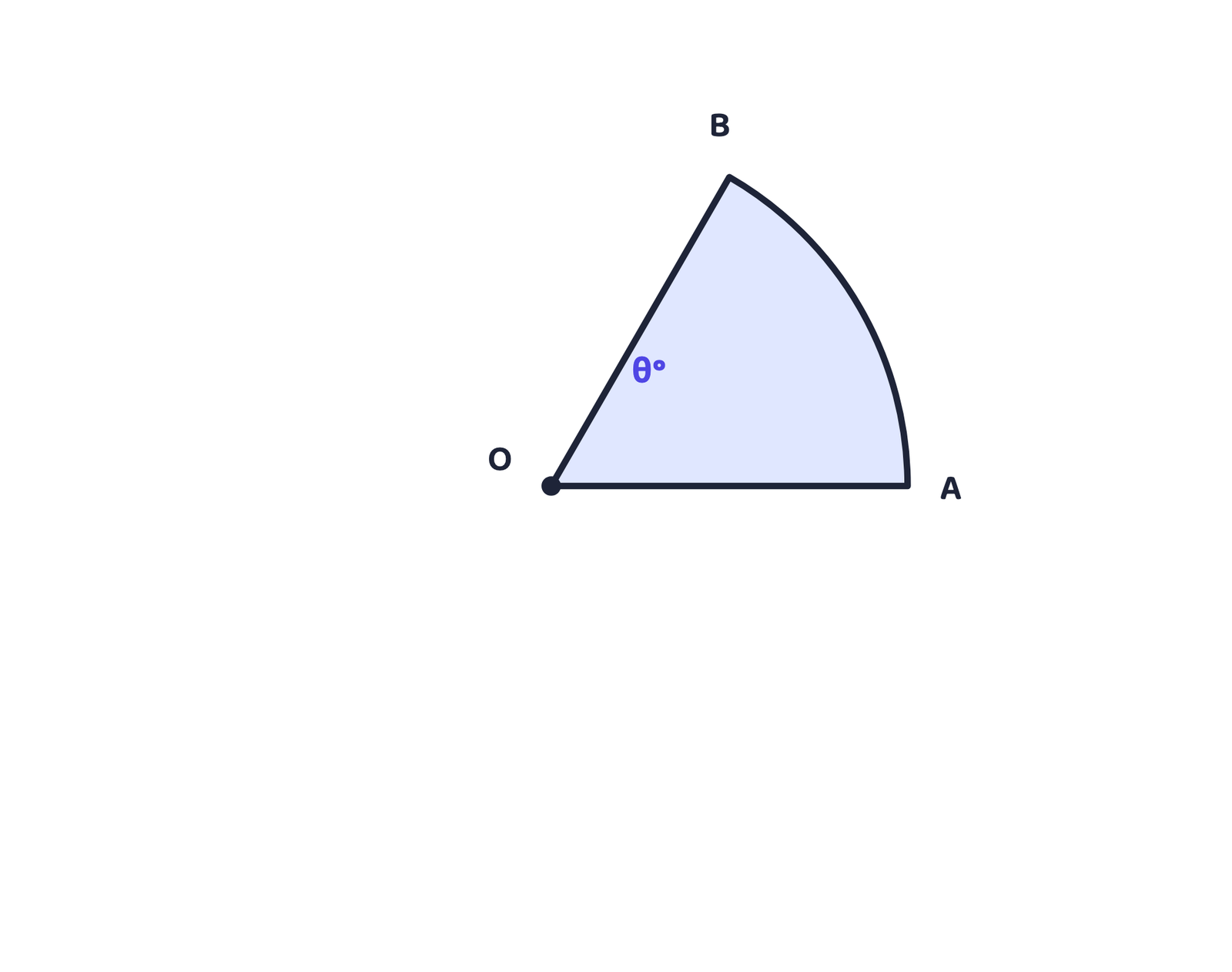
Given
Radius m, angle at the centre
Find
Arc length (use )
Arc m
A sector’s boundary is the curved arc plus the two radii. Perimeter . Forgetting the is the most common slip.
4.2 A closer look at a 400 m athletics track
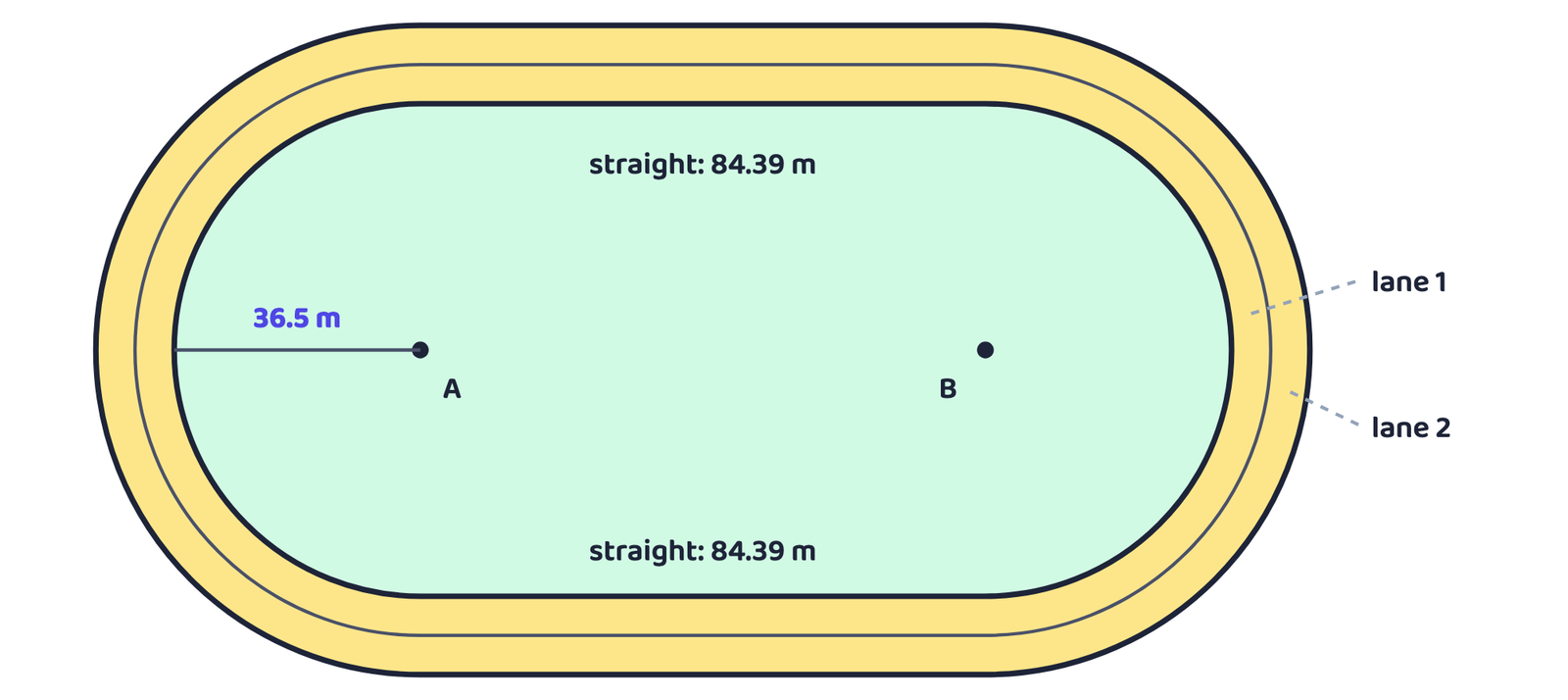
Given
Straights 84.39 m each; inner radius 36.5 m; runner keeps 0.3 m from the inner border;
Find
Distance she runs in one full lap of lane 1
Two straights m. Her bends have radius m, and the two semicircles together make one full circle: m.
Total m
- On the straights, runners in every lane run the same distance.
- On the bends, the runner in lane 2 runs further, because her semicircles have a larger radius. The stagger exists to make up exactly this difference, so it gives no one an unfair advantage.
Lane 1 vs lane 2: if each runner keeps the same distance from her own lane’s inner border, the radii differ by one lane width, 1.22 m. Over the two bends (one full circle) the extra distance is m, so the lane-2 runner starts about 7.67 m ahead for one full lap.
Lane 3 vs lane 2: the radius grows by the same 1.22 m again, so the same stagger is needed between every pair of adjacent lanes.
The 200 m school track: each semicircular bend adds m per lane, whatever the radius of the bend. So the stagger depends on how many bends are run in lanes, not on how big the track is; a smaller track does not by itself mean a smaller stagger.
4.3 Problems, puzzles and paradoxes on perimeter
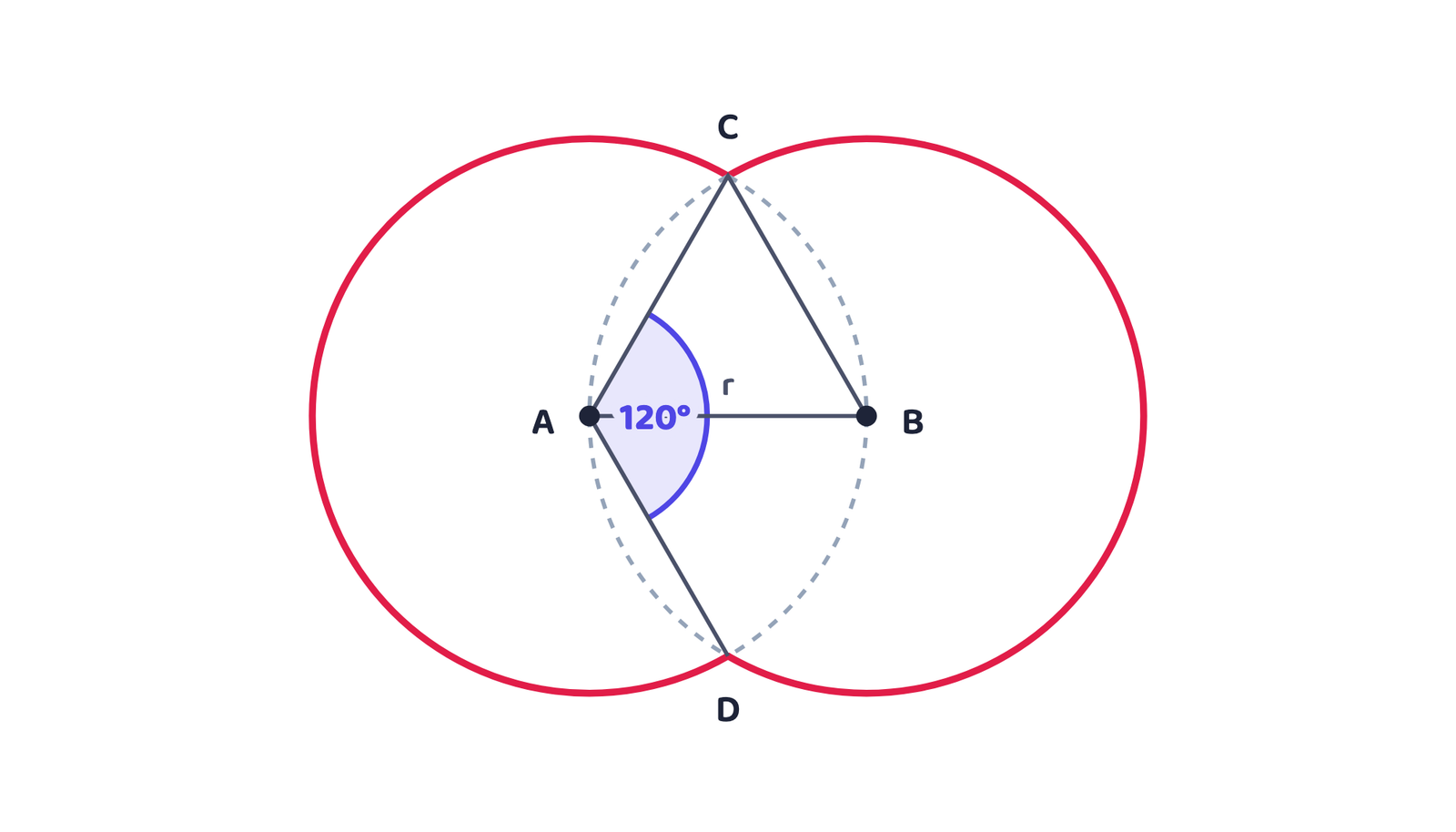
Q. Two circles of radius each pass through the other’s centre. Find the perimeter of the shape they form (ignore the parts inside).
Step 1: , so △ABC is equilateral and ∠CAB = 60°. Similarly ∠BAD = 60°, so ∠CAD = 120° (and ∠CBD = 120°).
Step 2: each dashed arc is of its circle, so each red arc is of its circle.
Answer: perimeter
Q. Points P and Q are joined by one big semicircle , and also by three smaller semicircles , , placed along PQ. Which path is longer?
Let the radii be . Path 1 ; path 2 . Since and also , we get .
Answer: the two paths have equal length, however the smaller semicircles are sized.
5 Area of a Rectangle and a Parallelogram
Area is the amount of space occupied by a two-dimensional region in a plane. It is measured against a unit: a square, whose area is 1 unit² (also written 1 sq. unit).
| Shape | Area | Why |
|---|---|---|
| Rectangle, sides , | sq. units | rows of unit squares (Grade 8) |
| Square, side | sq. units | special case of the rectangle, |
| Parallelogram, base , height | cut and move into a rectangle with the same base and height | |
| Triangle, base , height | half of a parallelogram (Section 6) | |
| Trapezium, parallel sides , , height | two copies make a parallelogram of base (end-of-chapter exercises) | |
| Rhombus or kite, diagonals , | two triangles on one diagonal (end-of-chapter exercises) |
- Parallelogram: in the book’s Fig. 6.17, a copy A′B′C′D′ of parallelogram ABCD is turned into rectangle EB′C′F with the same base and the same height . The shapes differ, but the area is the same: base × height .
- The “thin” parallelogram gap: if the parallelogram is so slanted that the foot of the perpendicular from C to AD does not land on side AD, the cut does not work directly. Fix: choose D′ on DA close to D and A′ on DA extended with A′A = D′D. Then A′BCD′ is a parallelogram, and since △CDD′ ≅ △BAA′ it has the same area as ABCD. Repeat this step as many times as needed.
- Can the sides alone give a parallelogram’s area? No. Keep the side lengths fixed and change the angle between adjacent sides: the height changes, so the area changes. (The rectangle, with a 90° angle, has the largest area.)
6 Area of a Triangle
6.1 Three ways to the formula
Enclose it in a rectangle
A right-angled triangle is half of a rectangle. For any other triangle, the height splits the base into , giving two halves of rectangles: .
Obtuse-angled triangle
If the angle at F is obtuse, the height from E falls outside, at M on GF produced (FM = ). Then △EFG = △EMG − △EMF .
Two congruent copies
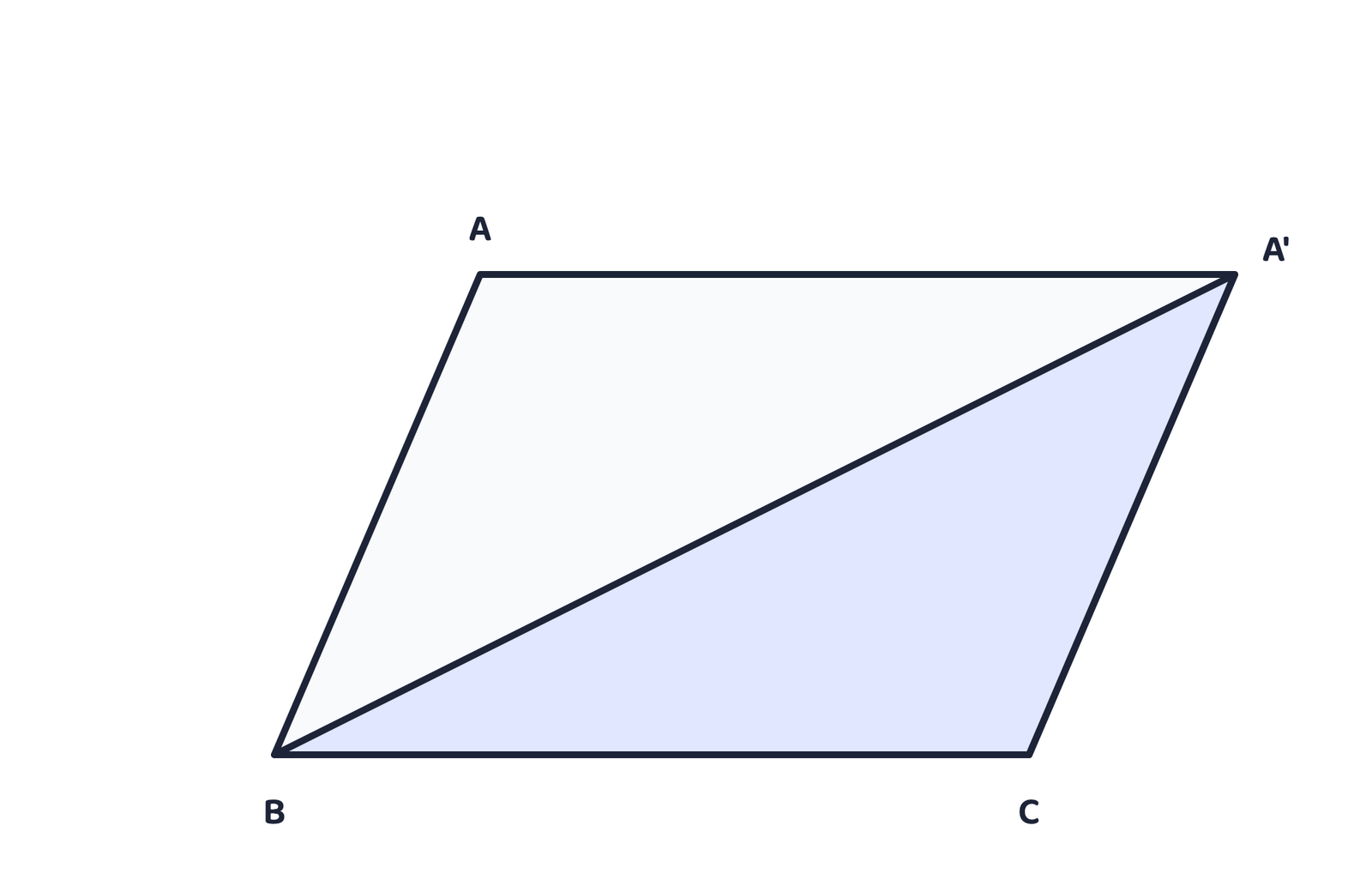
Two congruent copies of a triangle fit together into a parallelogram (∠B′C′A′ = ∠BCA are alternate angles, so the sides are parallel). The triangle is half: .
6.2 A property of the median
A median of a triangle is the line segment joining a vertex to the midpoint of the opposite side.
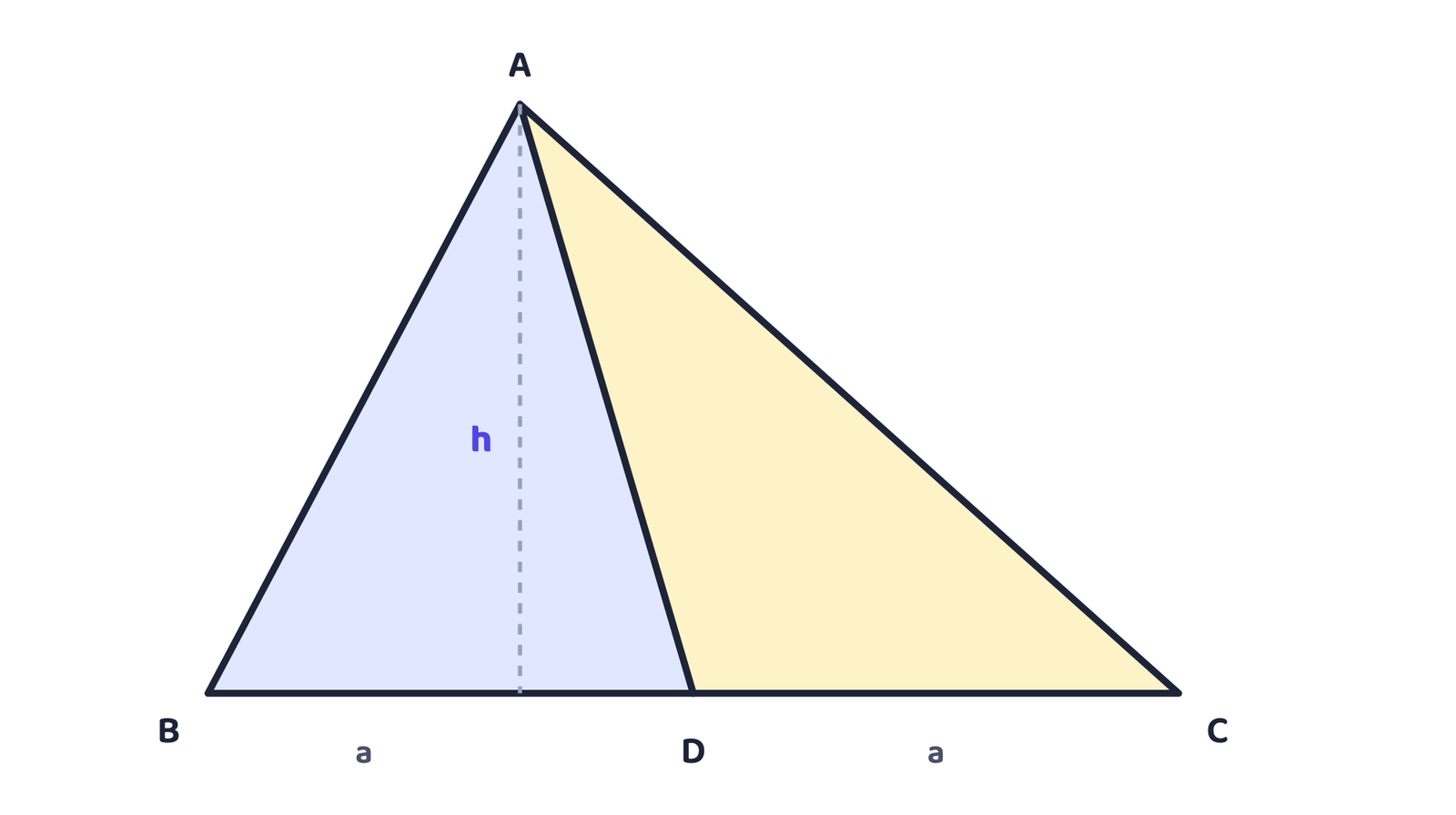
A median of a triangle divides it into two triangles with equal area.
Proof: △ABD and △ACD have equal bases (BD = DC = ) and the same height from A, so each has area sq. units. This is surprising, because the two triangles are, in general, different shapes (not congruent).
- Think and Reflect: △ABD can be cut with straight cuts into pieces that rearrange to cover △ACD exactly. The book says this is possible but leaves the least number of pieces for you to find.
- Think and Reflect: given any two polygons of equal area, can one always be cut into pieces that rearrange into the other? Try a square and a non-square rectangle, two different triangles, a triangle and a square, then form your own conjecture.
- Rectangles with perimeter 40 units: , so there are infinitely many (sides need not be integers). The largest area is the square sq. units. There is no smallest: a rectangle has area only 1.99, and the area can be made as small as we like without ever reaching 0.
7 Heron’s Formula
Heron was a Greek mathematician and inventor who taught at the Museum in Alexandria, a city in ancient Egypt on the banks of the Nile. His formula finds a triangle’s area from its three sides alone, with no height needed.
The semi-perimeter of a triangle is half its perimeter: .
| Book example | Heron’s formula gives | Check with ½ × base × height |
|---|---|---|
| Example 3: equilateral, side | ; area | , so ; area |
| Example 4: isosceles, equal sides , base | ; area | ; area |
| Example 5: sides 3, 4, 5 | ; area | , so right-angled at B (converse of the Baudhāyana-Pythagoras theorem); area |
The symbol ∴ means and is read as “therefore”. Heron’s formula has many proofs; one uses the Baudhāyana-Pythagoras theorem and repeated use of . You will study proofs in Grade 10.
Given
A triangle with sides 13 cm, 14 cm, 15 cm
Find
Its area by Heron’s formula
. Area cm²
7.1 Two more formulas: the circumcircle and the incircle
The circumcircle of △ABC is the one circle that passes through all three vertices of the triangle. Its radius is .
The incircle of △ABC is the one circle that fits tightly inside the triangle, touching all three sides. Its radius is .
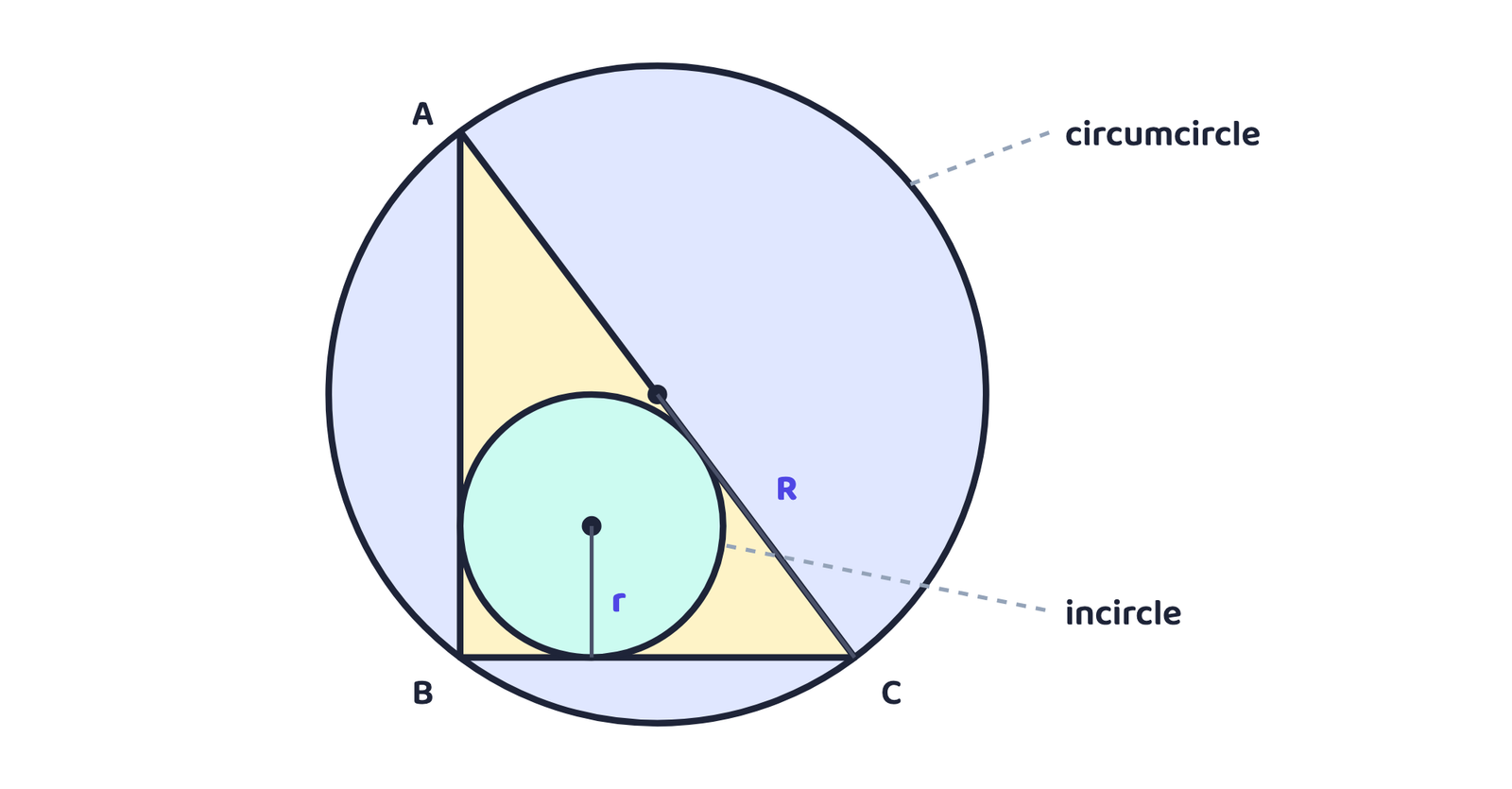
It is right-angled, so its circumcircle has the hypotenuse as diameter: . Then . Its inradius is , and . Both agree with Heron’s answer, 6 sq. units.
8 Brahmagupta’s Formula for the Area of a Cyclic 4-gon
Heron finds a triangle’s area from its three sides. Can we find a 4-gon’s area from its four sides? No.
| 4-gon with sides 3, 3, 3, 3 (a rhombus) | Area |
|---|---|
| Square shape | 9 |
| Slightly pushed over | 8.01 |
| Pushed over further | 5.41 |
The book drew these in GeoGebra and measured them with its “Area” tool (you can also join four rods at their ends). Same sides, different areas. So we need one more piece of information: one angle, or the length of one diagonal, or the angle at which the diagonals cut each other, or a key geometric property of the figure, such as being cyclic.
A cyclic 4-gon (cyclic quadrilateral) is a 4-gon whose four vertices all lie on one circle.
8.1 Checking the formula on special 4-gons
Example 6: rectangle
All rectangles are cyclic. Sides : , so area . Correct.
Example 7: isosceles trapezium
All isosceles trapezia are cyclic. Parallel sides , , equal legs : , and the formula simplifies to . The height is , so this is , exactly half the sum of the parallel sides × the distance between them.
Given
A cyclic 4-gon with sides 5, 5, 12, 12 units
Find
Its area
. Area sq. units
8.2 Special cases and generalisation in mathematics
A special case is what a general result becomes when we apply some extra condition. The general result is then called a generalisation of the special case. Generalisation is an extremely important part of mathematics.
| General result | Extra condition | Special case |
|---|---|---|
| Rectangle: , perimeter | Square: , perimeter | |
| Right-angled △ with ∠C = 90°: | (isosceles) | , so |
| Brahmagupta: | Heron: |
8.3 Brahmagupta’s formula generalises Heron’s formula
If the vertices were planets, A and D coinciding would be two planets colliding to form one large planet. The book notes that this actually happened in the early history of the solar system.
9 Squaring a Rectangle
In ancient times, to square a shape meant to construct a square equal in area to that shape. The shape could be a rectangle, a triangle or a circle.
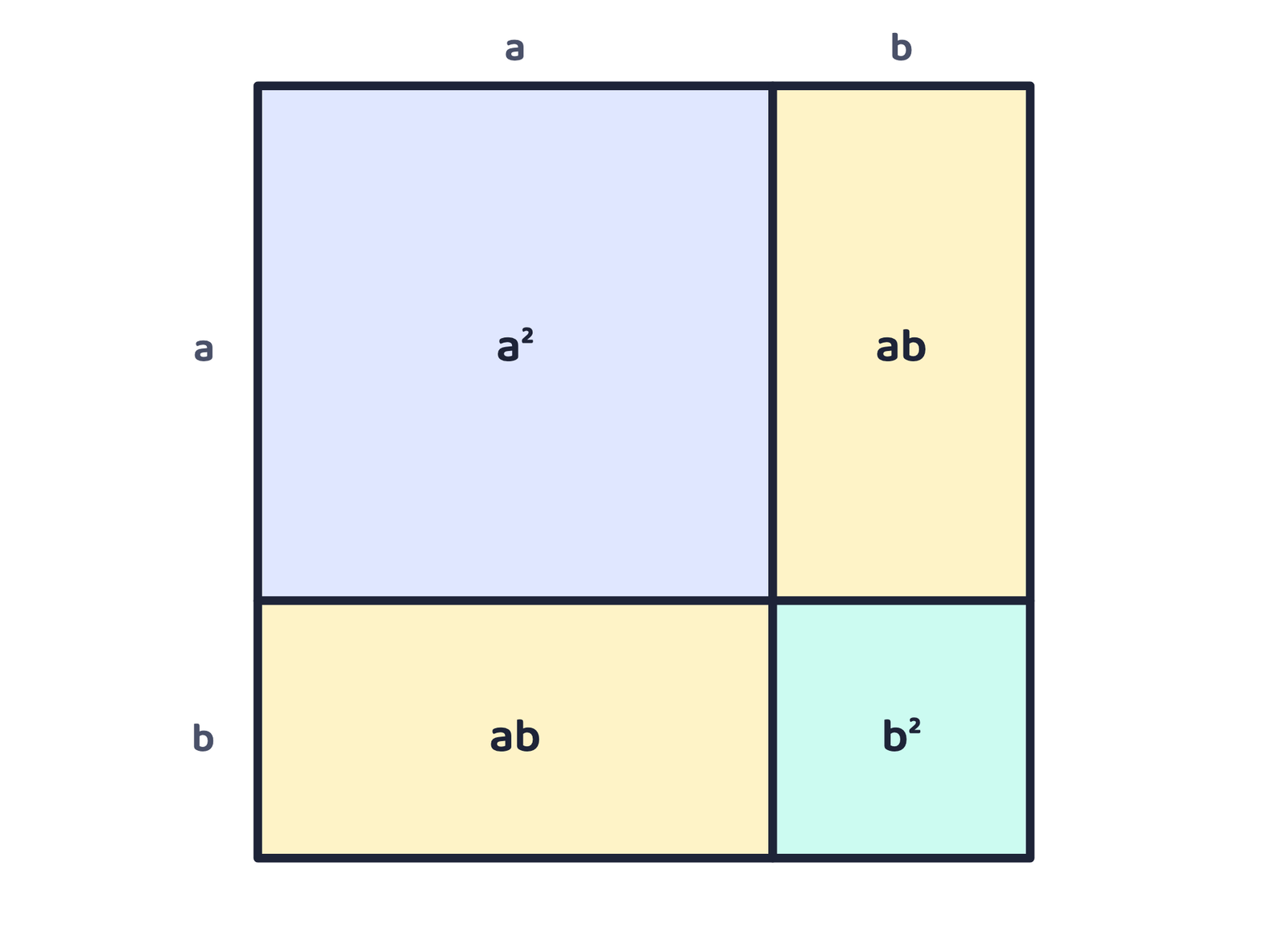
The ancient Indian mathematician Baudhāyana squared a rectangle in his Śhulbasūtra (800 BCE). Given a rectangle with sides and (), we must construct a square of area . Here is a slightly simplified form of his construction.
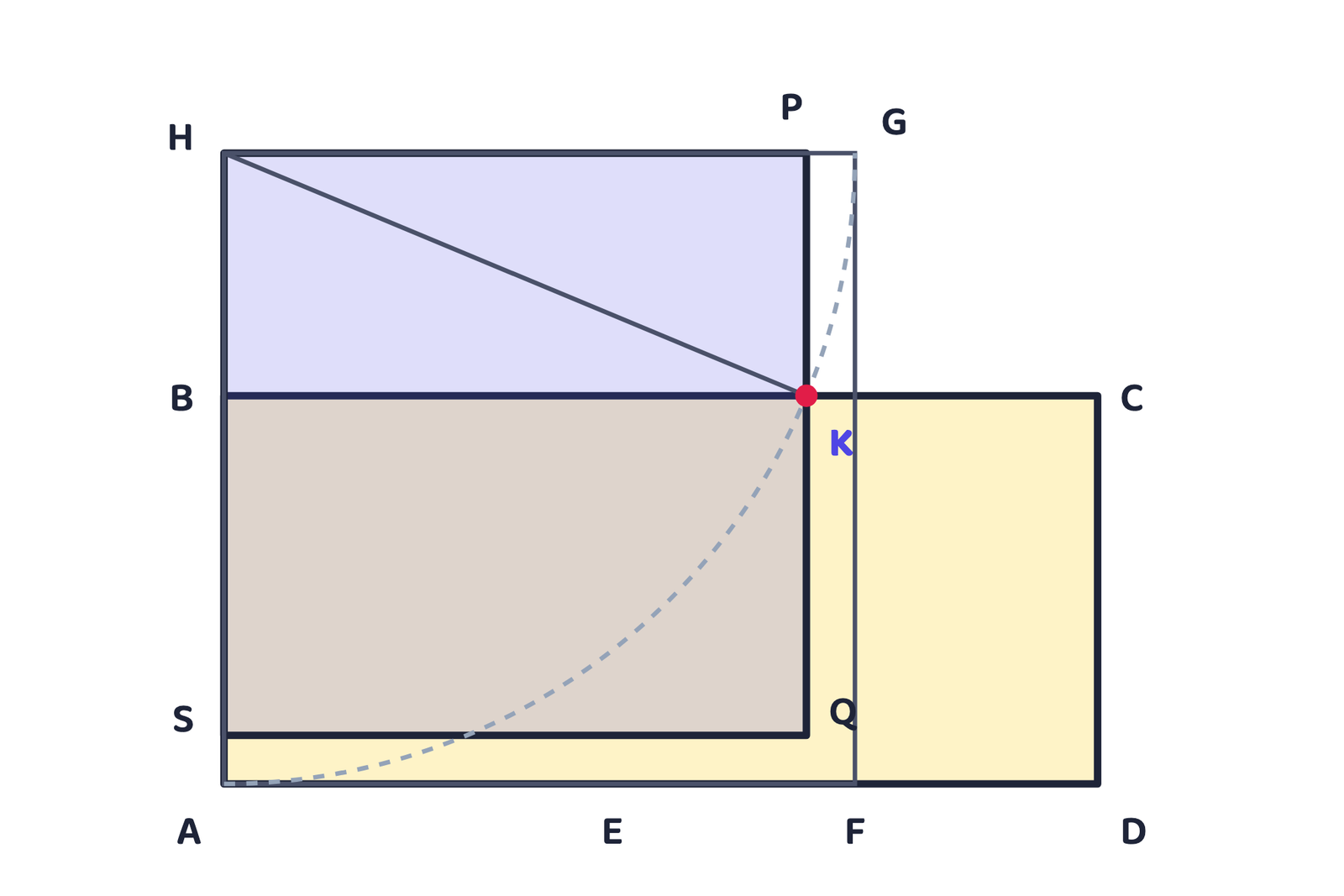
Why it works: the construction is a geometrical translation of the identity .
First turn the triangle into a rectangle of the same area (base and height , since ), then square that rectangle with Baudhāyana’s construction.
10 Area of a Circle
A circle is easy to draw with a rope and a peg, and people have used circular shapes in settlements, buildings and tools for thousands of years. Early on they needed its area: how much grain a cylindrical tower (circular cross-section) can hold, how much land a circular garden or building takes up, for planning cities and for taxes.
10.1 Why area must be proportional to the square of the circumference
| Shape | Perimeter P | Area A | P² : A |
|---|---|---|---|
| Square, side | |||
| Equilateral triangle, side |
For any shape, the ratio P² : A depends only on the shape, not on its scale. So for a circle too, C² : A must be a fixed constant. The question was: which constant?
With and , . Taking this as 12 is the same as taking π ≈ 3.
10.2 Archimedes: the circle as a triangle
“The area of a circle is equal to the area of a right angle triangle with sides equal to the radius and the circumference of the circle.”
Archimedes, as quoted in the book
- His proof uses a property of every regular polygon: its area perimeter radius of the circle that fits tightly inside it. (This extends the triangle formula area with the incircle.)
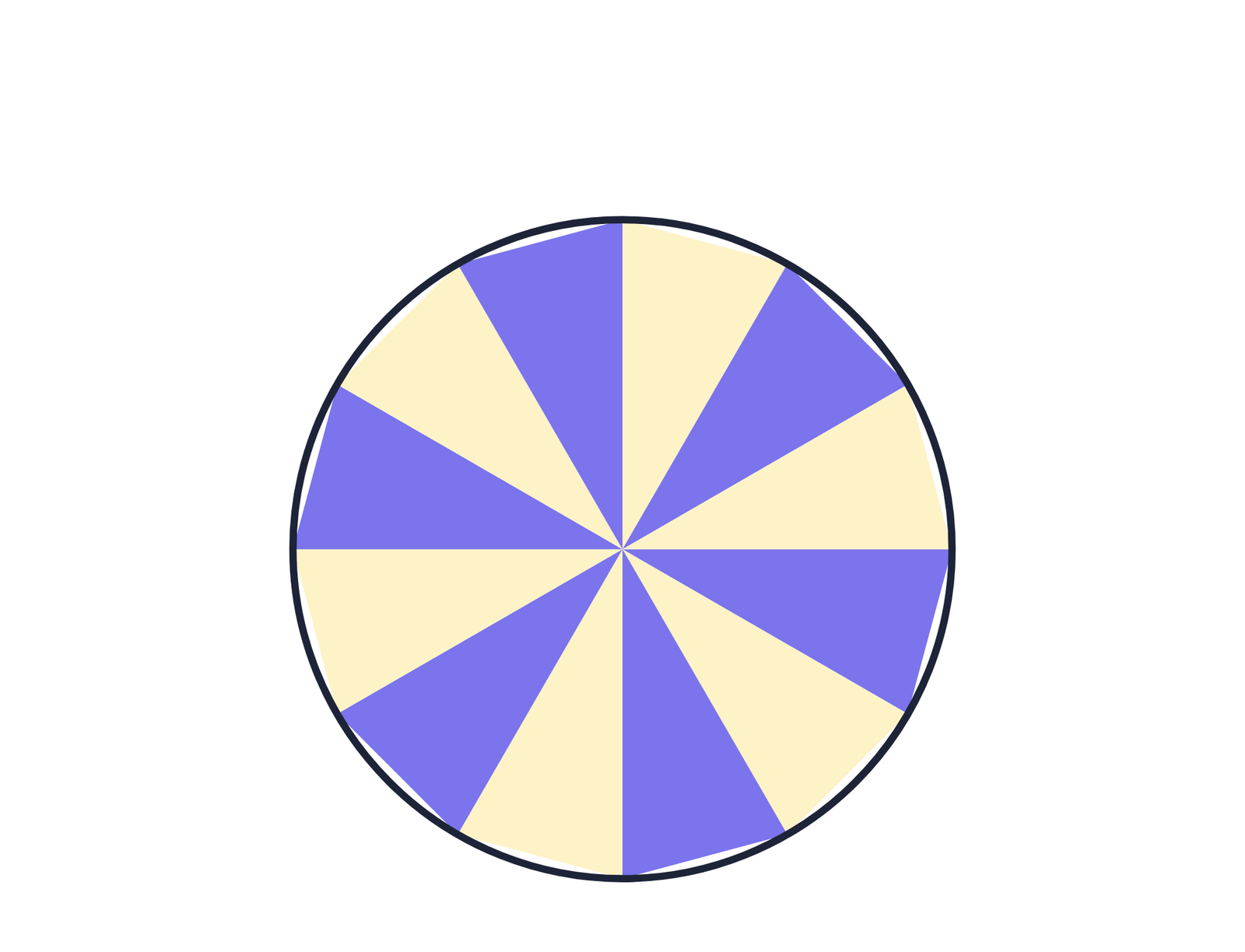
- He then did a thought experiment: let the number of sides grow larger and larger. The polygon approaches the circle, its perimeter approaches , and the area becomes .
10.3 Nīlakaṇṭha’s visual explanation
11 Area of a Sector and a Segment
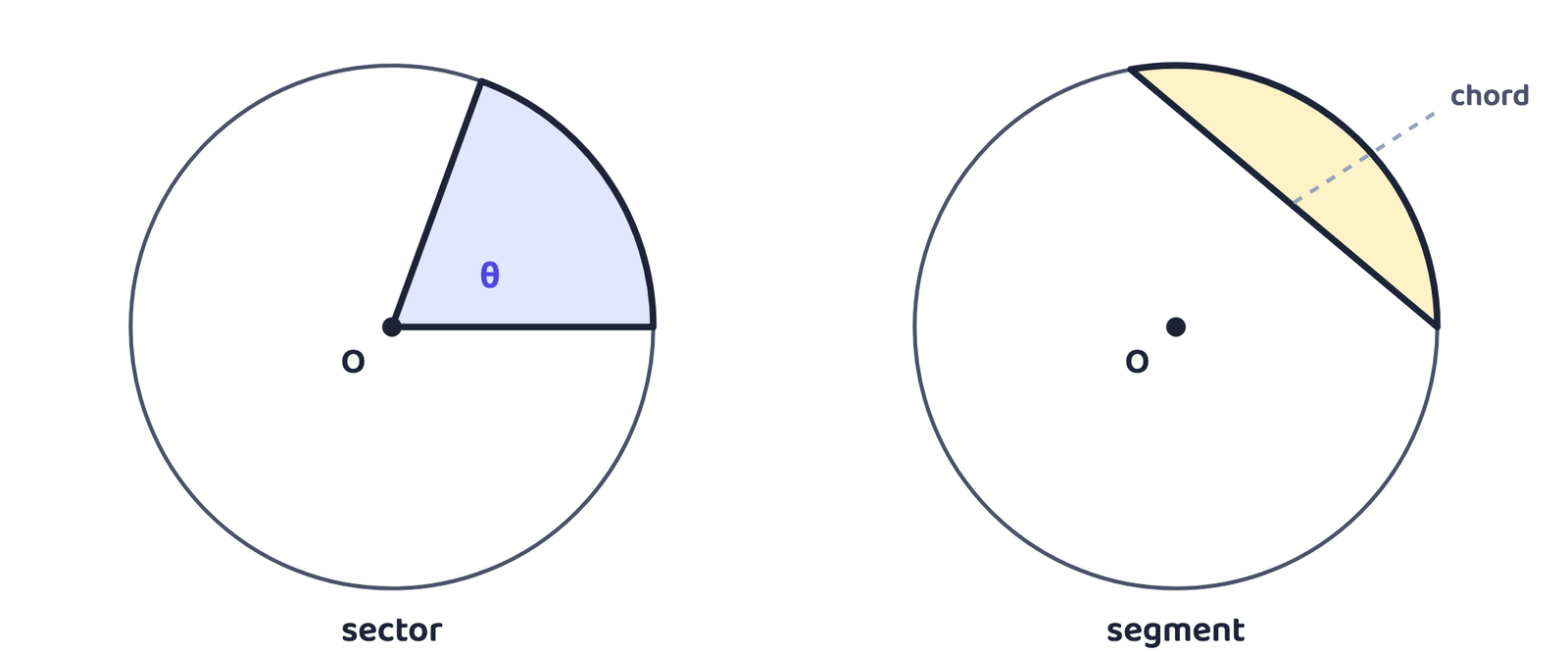
A sector of a circle is the region bounded by an arc and the two radii containing the endpoints of the arc.
A segment of a circle is the region bounded by an arc of the circle and the chord joining the endpoints of the arc.
| Region | Fraction of the circle | Area | Symmetry used |
|---|---|---|---|
| Semicircular disc | reflection symmetry | ||
| Quarter circular disc (quadrant) | quarter-turn symmetry | ||
| Sector of angle | rotational symmetry |
- A chord cuts the circle into a minor part (the smaller angle ) and a major part (angle ); this is true for both sectors and segments.
- Minor segment = sector − the triangle formed by the two radii and the chord. Major segment = whole circle − minor segment.
Given
Radius cm, sector angle
Find
Area of the sector (use )
Area cm² (approx.)
Given
Radius cm; a chord subtends at the centre (, )
Find
Area of the minor segment
Sector cm² (approx.). The two radii and the chord form an equilateral triangle (two sides 10 and a 60° angle between them), area cm².
Minor segment cm² (approx.)
Double every length of a shape and its area becomes times; triple every length and it becomes times. That is why circumferences in the ratio 3 : 2 give areas in the ratio 9 : 4.
- Can I explain why π is more than 3 using an inscribed hexagon, and give Archimedes’ bounds?
- Can I match each name (Zu Chongzhi, Āryabhaṭa, Brahmagupta, Mādhava, Jones, Lambert) to what they did with π?
- Can I find arc length, the perimeter of a sector and the stagger between two lanes?
- Can I prove that a median divides a triangle into two equal areas?
- Can I use Heron’s formula and Brahmagupta’s formula, and show Heron’s is the special case ?
- Can I write the steps of Baudhāyana’s construction and prove ?
- Can I find the area of a circle, a sector, and a minor or major segment?
- π = C/D, the same for all circles; or ; π is irrational (Lambert, 1761)
- Circumference ; arc length
- Estimates of π: Archimedes ; Zu Chongzhi ; Āryabhaṭa 3.1416; Mādhava
- Stagger makes up for the longer bends of outer lanes
- Parallelogram = ; triangle = ; a median splits a triangle into two equal areas
- Heron: , ; also and
- Brahmagupta (cyclic 4-gon): , ; gives Heron
- Baudhāyana squared a rectangle using
- Area of a circle ; area of a sector
- 1 markFind the circumference of a circle of radius 21 cm (use ).
- 2 marksFind the length of an arc of radius 10.5 cm subtending 60° at the centre.
- 3 marksFind the area of a triangle with sides 8 cm, 15 cm, 17 cm using Heron’s formula, and verify using base × height.
- 2 marksFind the area of a cyclic 4-gon with sides 9, 9, 16, 16 units.
- 2 marksFind the area of a sector of radius 21 cm with a central angle of 60°.
- 2 marksThe diameter of a wheel is 63 cm. How far does it travel in 500 revolutions?
- 1 markAD is a median of △ABC, whose area is 48 sq. cm. Find the area of △ABD.
- 2 marksFind the perimeter of a sector of radius 7 cm with a central angle of 90°.
- 3 marksA park is a rhombus with all sides 13 m and one diagonal 24 m. Find its area using Heron’s formula (split it into two triangles).
- 2 marksThe ratio of the circumferences of two circles is 3 : 2. Find the ratio of their areas.
- 1 markπ is:
(a) exactly 22/7(b) a rational number(c) an irrational number(d) an integer - 1 markThe area of a sector with θ = 180° is:
(a) πr²(b) πr²/2(c) πr²/4(d) 2πr² - 1 markBrahmagupta’s formula applies to:
(a) any 4-gon(b) any parallelogram(c) only a cyclic 4-gon(d) only a square
Reason (R): The two triangles formed have equal bases and share the same height from the opposite vertex.
- 1 markWhat is the arc length of the sector (use )?
- 1 markWhat is the perimeter of the sector (including the two straight edges)?
- 2 marksWhat area is planted with flowers?