
- The five interacting spheres that make up the Earth system
- Why the Sun heats the Earth unevenly, and how albedo and the atmosphere’s layers control this
- How uneven heating drives local and planetary winds, and ocean currents
- The water, carbon, nitrogen and oxygen cycles, and why keeping them balanced matters
- How human activities disrupt these cycles, and what can be done to restore balance
1The Earth as a System
Life on Earth is powered by a constant flow of energy and matter, mainly from the Sun, but also from the Earth’s hot interior and chemical reactions in the air, water and rocks. The Earth system is made up of five interacting spheres.
A disturbance in one sphere changes the others: less snowfall (cryosphere) means less water in lakes (hydrosphere), which affects grass growth (biosphere). This “spheres are connected” idea is a favourite board question.
2Uneven Heating of the Earth
Solar radiation reaches the Earth as electromagnetic (EM) waves travelling through vacuum at the speed of light, . Unlike sound waves, EM waves need no medium. About 99% of the Sun’s energy reaching Earth falls in the ultraviolet (UV), visible and infrared (IR) range.
Short wavelength UV is mostly absorbed by the ozone layer, protecting life. Visible light powers photosynthesis and warms land and water. Infrared radiation warms the Earth’s surface, which re-radiates heat that greenhouse gases like carbon dioxide, methane and water vapour partly trap, keeping the Earth warm enough for life.
Insolation is the amount of the Sun’s radiation that reaches the Earth’s surface. The solar constant, about , is the average solar energy received per unit time per unit area perpendicular to the Sun’s rays at the top of the atmosphere.
Q. How much solar energy is received by a 1 m² area in one hour, if insolation at the Earth’s surface is ?
Step 1 –
Step 2 –
Answer –
Anna Mani, India’s pioneering atmospheric scientist, mapped solar insolation across India in the 1950s. With S. Rangarajan, she published Solar Radiation Over India (1982), India’s first insolation atlas.
2.1 Albedo
The fraction of solar radiation reflected by a surface is called its albedo. High albedo surfaces (like snow) stay cool because they reflect more light; low albedo surfaces (like black soil) heat up faster because they absorb more light.
| Material | Albedo |
|---|---|
| Snow | 0.80-0.90 |
| Ice | 0.50-0.70 |
| Crushed rock | 0.25-0.30 |
| Ocean water | Low (absorbs most incoming radiation) |
Cities are warmer than surrounding rural areas, especially at night, because concrete, steel and asphalt absorb and re-radiate more heat than vegetation. This is called the urban heat island effect.
2.2 Latitude and the atmosphere’s role
Because the Earth is spherical, sunlight falling on the equator is concentrated over a smaller area than sunlight spread over the polar regions, making the equator warmer and the poles colder. This uneven heating, together with the atmosphere’s composition (78% nitrogen, 21% oxygen, plus other gases), drives global winds and ocean currents.
| Layer | Approximate altitude | Key feature |
|---|---|---|
| Troposphere | 0-12 km | Weather formation; temperature decreases with height |
| Stratosphere | 12-50 km | Ozone layer absorbs UV; temperature increases with height |
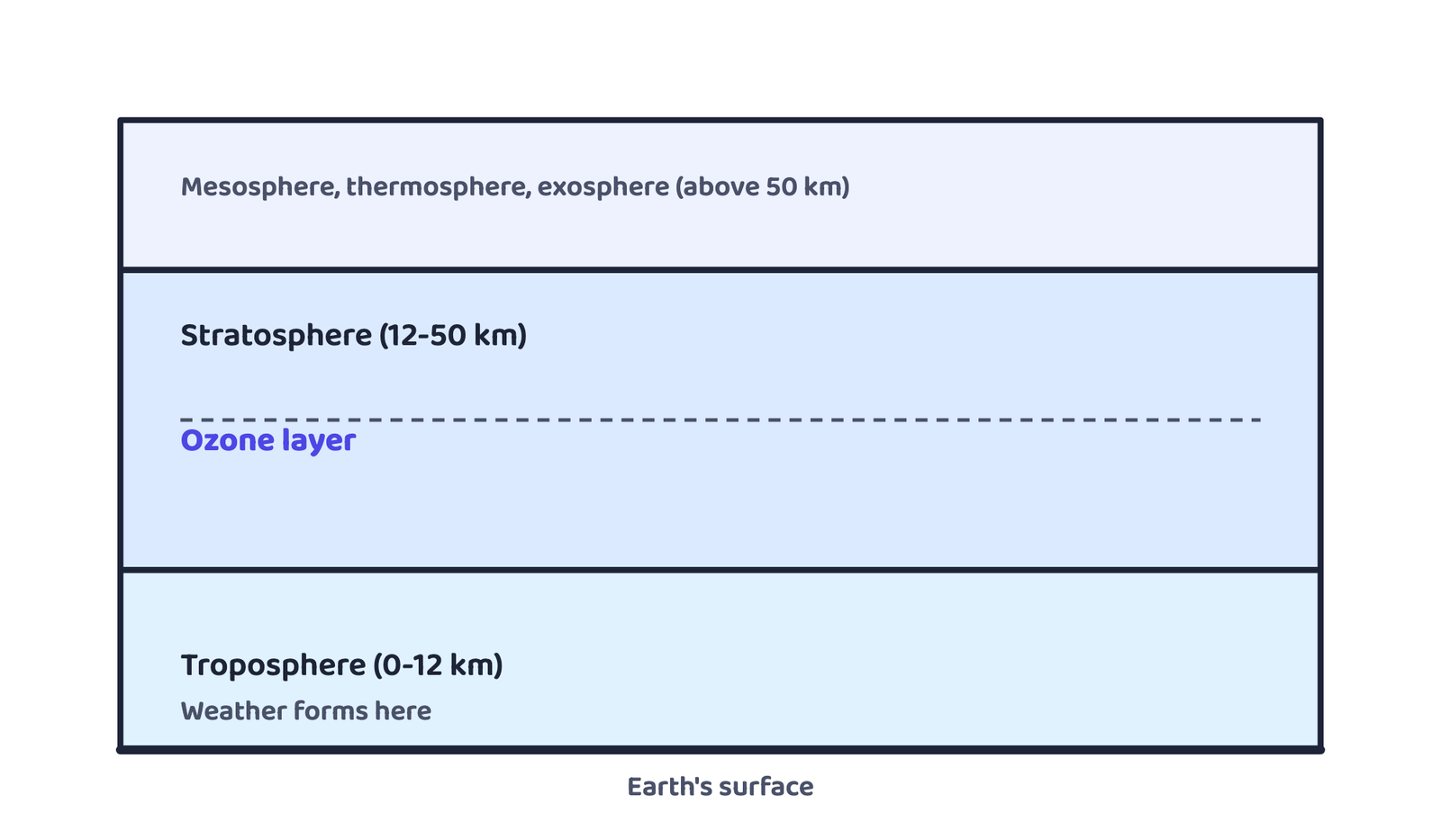
Students often confuse the protective ozone layer (in the stratosphere, blocks harmful UV) with ground-level ozone (formed by vehicle emissions reacting with sunlight, harmful to breathe). Same gas, opposite effect, depending on where it is.
CFCs used in refrigerators and aerosols caused severe ozone loss over Antarctica, the “ozone hole.” The Montreal Protocol, a global agreement, reduced CFC use, and the ozone layer is now slowly recovering.
3Uneven Heating Causes Wind and Ocean Currents
Wind is the movement of air from high pressure to low pressure, mainly caused by uneven heating of the Earth’s surface.
3.1 Local winds
Valley breeze (day)
- Sun-facing mountain slopes heat faster than the valley floor
- Warm air over slopes rises, creating low pressure
- Cooler air from the valley flows up to replace it
Mountain breeze (night)
- Slopes lose heat faster and cool down
- Air over slopes becomes cool and dense
- It flows down into the warmer valley
3.2 Planetary winds
Uneven heating between the equator and poles creates pressure belts: an equatorial low pressure belt (warm air rises), sub-tropical high pressure belts around 30° N/S (air sinks), sub-polar low pressure belts around 60° N/S, and polar high pressure belts around 90° N/S. The Earth’s rotation deflects these winds, to the right in the Northern Hemisphere and to the left in the Southern Hemisphere.
3.3 Ocean currents
Planetary winds drag surface ocean water by friction, setting up currents. Temperature and salinity differences, the Earth’s rotation, and land distribution further shape them into large circular patterns called gyres, clockwise in the Northern Hemisphere and counter-clockwise in the Southern Hemisphere. The Gulf Stream and its extension, the North Atlantic Drift, carry warm water toward north-west Europe, keeping many ports ice-free even in winter.
Ocean currents transport heat from the equator to the poles, reducing global temperature differences. Always connect this to why the same latitude can have very different climates on either side of an ocean.
4Biogeochemical Cycles
Living organisms constantly exchange matter and energy with air, water, soil and rocks. This cyclic movement of matter and energy between the abiotic and biotic components is called a biogeochemical cycle. It keeps essential nutrients like carbon, nitrogen and oxygen available to support life.
4.1 Water cycle
Climate change intensifies the water cycle: a warmer atmosphere holds more moisture, causing heavier monsoons in some areas and droughts elsewhere, while melting glaciers add water to rivers and threaten coastal cities like Mumbai and Chennai.
4.2 Carbon cycle
The fast cycle (photosynthesis, respiration, decomposition) happens over days to years. The slow cycle (dead organisms buried and converted to coal, oil and gas over millions of years, then burnt) releases carbon much faster than it was stored.
The Keeling curve shows atmospheric CO₂ has risen about 35% since 1960, from 315 ppm to 420 ppm, mainly due to burning fossil fuels and deforestation, an unprecedented rise in human history.
4.3 Nitrogen cycle
The nitrogen cycle is the overall movement of nitrogen between air, soil, water and organisms, through nitrogen fixation, assimilation, ammonification, nitrification and denitrification.
The Haber-Bosch process makes ammonia from atmospheric nitrogen artificially, producing most fertilisers used today. This “Bread from Air” revolution powered India’s Green Revolution; more than half the nitrogen atoms in the human body come from this process.
4.4 Oxygen cycle
About 21% of the atmosphere is free oxygen gas. Respiration and combustion consume oxygen and release CO₂, while photosynthesis restores oxygen using sunlight, water and CO₂ to form glucose. This balance keeps oxygen circulating between the atmosphere, land, oceans and living organisms.
5Human Impact on Earth’s Processes
Excess atmospheric CO₂ increases ocean absorption, making sea water more acidic and threatening plankton and coral reefs. Warmer ocean water, in turn, reduces the ocean’s capacity to absorb CO₂ as a carbon sink.
- 1 markWhat causes an algal bloom in a lake near farmland?
- 1 markName the process described in the passage.
- 3 marksExplain why eutrophication leads to fish deaths.
✓ Restoring balance
- Switch to renewable energy like solar and wind
- Plant trees and practise sustainable farming
- Reduce, reuse and recycle to save water, food and energy
✗ What worsens the imbalance
- Burning fossil fuels without limit
- Deforestation, which reduces photosynthesis and increases soil erosion
- Overusing fertilisers, which causes eutrophication
The Montreal Protocol successfully reduced CFCs and is helping the ozone layer recover, showing what global cooperation can achieve. The Kyoto Protocol and Paris Agreement, aimed at reducing CO₂ emissions, have been less successful so far.
The Earth works as one connected system, energy and matter constantly flow between its spheres, and a disturbance in one sphere changes the others.
the single idea to carry out of this chapter
- Five spheres: geosphere, hydrosphere, cryosphere, atmosphere, biosphere
- Insolation and solar constant (~1.4 kW/m²) drive Earth’s energy balance; albedo decides how much a surface reflects
- Troposphere (0-12 km): weather; Stratosphere (12-50 km): ozone layer absorbs UV
- Local winds: valley breeze (day, up-slope), mountain breeze (night, down-slope)
- Planetary winds: equatorial low, sub-tropical high (30° N/S), sub-polar low (60° N/S), polar high (90° N/S)
- Ocean currents form gyres, clockwise in North, counter-clockwise in South; Gulf Stream warms Europe
- Biogeochemical cycles: water, carbon (fast and slow cycle), nitrogen (fixation, nitrification, ammonification, denitrification), oxygen
- Human impact: ocean acidification, eutrophication, deforestation; solutions include renewables and Montreal Protocol-style cooperation
- 1 markDefine albedo.
- 1 markName the two atmospheric layers where nearly all weather occurs and where the ozone layer is located.
- 1 markWhat is a biogeochemical cycle?
- 1 markName the bacteria responsible for nitrogen fixation in the root nodules of legumes.
- 1 markWhat is the approximate value of the solar constant?
- 1 markName the process that converts nitrates back into nitrogen gas.
- 1 markWhich two gases make up about 99% of the Earth’s atmosphere by volume?
- 3 marksExplain how a valley breeze forms during the day.
- 3 marksDifferentiate between the fast carbon cycle and the slow carbon cycle.
- 3 marksExplain how deforestation disrupts the carbon and water cycles.
- 3 marksWhat is eutrophication, and what causes it?
- 3 marksExplain why the equator stays warm throughout the year while the poles remain cold.
- 3 marksDistinguish between insolation and the solar constant.
- 3 marksWhy does the urban heat island effect make cities warmer than surrounding rural areas?
- 3 marksExplain how the Montreal Protocol helped the ozone layer recover.
- 5 marksDescribe the steps of the nitrogen cycle with the bacteria involved at each step.
- 5 marksExplain how uneven heating of the Earth gives rise to planetary wind belts.
- 5 marksDescribe the water cycle and explain how climate change is intensifying it.
- 5 marksExplain how ocean currents form and how they influence the Earth’s climate.
- 1 markThe primary reason the Earth’s surface warms is that
(a) solar radiation is absorbed directly by carbon dioxide(b) tiny atmospheric particles absorb and directly heat the Earth
(c) the surface absorbs solar radiation, which is re-radiated and trapped by greenhouse gases(d) clouds reflect radiation that heats the Earth - 1 markSnow has a high albedo, which means it
(a) absorbs most incoming sunlight(b) reflects most incoming sunlight
(c) has no effect on sunlight(d) melts faster than ice - 1 markA mountain breeze blows at night because
(a) the valley floor cools faster than the slopes(b) the slopes cool faster and send dense air down into the valley
(c) warm air always sinks(d) there is no pressure difference at night - 1 markWhich bacteria convert ammonia into nitrite during nitrification?
(a) Rhizobium(b) Pseudomonas
(c) Nitrosomonas(d) Azotobacter - 1 markThe ozone layer is located in the
(a) troposphere(b) stratosphere
(c) mesosphere(d) thermosphere - 1 markOcean currents form large circular patterns called
(a) gyres(b) monsoons
(c) fronts(d) cyclones - 1 markEutrophication is mainly caused by excess
(a) carbon dioxide in the atmosphere(b) nitrogen from fertiliser runoff entering water bodies
(c) oxygen in rivers and lakes(d) ozone at ground level
Reason (R): Ocean currents transport heat from the equator toward the poles, reducing temperature differences between regions.
Reason (R): Ozone in the stratosphere absorbs incoming UV radiation, which heats that layer.