
- What biodiversity and endemic species mean, and why some regions are called biodiversity hotspots
- The criteria scientists use to classify organisms, and how classification systems changed over time
- The five kingdom classification, and the defining features of each kingdom
- How Kingdom Plantae and Kingdom Animalia are further divided into classes and phyla
- The classification hierarchy from kingdom to species, and the rules of binomial nomenclature
- How fossils provide evidence for changing biodiversity, and why biodiversity is under threat today
1India as a Biodiversity Hotspot
The Earth is home to an enormous variety of life, from microscopic organisms to giant trees. This immense variety of living organisms is called biodiversity. Every organism plays a role in keeping nature stable: algae release oxygen, fungi and bacteria decompose waste into manure, and bees and bats pollinate flowers.
Endemic species are species that are restricted to a particular region of the world and are not found naturally anywhere else, for example the Nilgiri tahr, Lion-tailed macaque, Nepenthes khasiana and Neelakurinji, all found only in India.
Biodiversity hotspots are regions that support a large number of endemic species and have undergone significant habitat loss, making them a priority for conservation.
India has four global biodiversity hotspots: the Western Ghats, Indo-Burma (including North East India), the Himalayas, and Sundaland (including the Nicobar Islands).
2How has Biodiversity Evolved?
The biodiversity seen today was not always the same. Small differences among individuals affected their chances of survival and reproduction, helping them adapt to changed conditions. These differences accumulated over many generations and gave rise to new forms of life. The systematic study of this diversity is made possible by classification.
3Criteria to Classify Organisms
The same organism can fit into different groups depending on the criterion chosen, for example the eagle, tiger and leopard can all be grouped as carnivores based on eating habits. Scientists look at broad, easily visible features first, then more detailed ones.
External features
Visible characteristics such as shape, size and body organisation
Mode of nutrition
Autotrophic (makes own food) or heterotrophic (depends on others)
Internal structures
Skeletal patterns, presence or absence of organs and tissue types
Cell structure
Unicellular or multicellular, eukaryote or prokaryote, cell wall present or not
Ecological role
Producer, consumer, or decomposer
Reproduction
Asexual and/or sexual methods
Genetic similarity
Similarities in inherited features, studied in detail using DNA
4The Need for Classification
Imagine walking into a library where thousands of books are scattered on the floor, with no arrangement by subject or author. Finding one book would be nearly impossible. In the same way, classifying the Earth’s millions of organisms systematically helps us understand them better.
- Make the study of living organisms more organised and systematic
- Understand the similarities and differences among living beings
- Understand how organisms are related and how they interact
- Identify and name newly discovered organisms
- Support biodiversity conservation by flagging organisms under threat
- Give scientists worldwide a common system to discuss organisms
5Classification Systems Over Time
Scientists developed different classification systems as their knowledge and tools improved.
Remember the two kingdom system created confusion for organisms like Amoeba (unicellular, moves like an animal) and fungi (does not move, but heterotrophic). Each new kingdom was added to resolve one such confusion.
6Five Kingdom Classification
Whittaker’s five kingdom system groups all life based on cell type, cell structure, level of organisation, mode of nutrition and ecological role.
6.1 Kingdom Monera – unicellular prokaryotes
Bacteria and cyanobacteria are single-celled prokaryotes grouped under Monera. They are found everywhere, including soil, water, hot springs and inside the human body. Some bacteria are pathogens, but many are useful, like Lactobacillus and Rhizobium. Cyanobacteria are autotrophic and were among the first organisms to release oxygen through photosynthesis.
6.2 Kingdom Protista – unicellular eukaryotes
All single-celled eukaryotes, with or without a cellulose cell wall, are grouped under Protista, for example Amoeba, Euglena and Paramecium. Some are autotrophic, others heterotrophic. Protists are an important link in aquatic food chains: some produce oxygen, some serve as food for small animals, and some act as decomposers.
6.3 Kingdom Fungi – multicellular heterotrophs with a cell wall
Fungi are mostly multicellular eukaryotes with a cell wall made of chitin. They cannot make their own food, so they absorb nutrients from dead or decaying matter through thread-like filaments called mycelium, acting as important decomposers. Yeast is an exception, a unicellular fungus. Mushrooms are macroscopic fungi that reproduce by spores, while Aspergillus and Penicillium are used to make enzymes and antibiotics.
Students often think fungi are plants because they do not move. Fungi are heterotrophic, absorb food, and have chitin cell walls, not cellulose, so they are placed in a separate kingdom.
7Kingdom Plantae
Plants are multicellular, autotrophic organisms with a cellulose cell wall, that perform photosynthesis and release oxygen. Kingdom Plantae is divided into five classes.
| Class | Key features | Reproduction | Example |
|---|---|---|---|
| Thallophyta | Simplest plant body (thallus), mostly aquatic, direct exchange with surroundings | Do not produce seeds | Spirogyra (algae) |
| Bryophyta | Root-like, stem-like and leaf-like structures (rhizoids); called plant “amphibians” | Needs water for reproduction | Moss, Marchantia |
| Pteridophyta | True roots, stems and leaves; vascular tissue (xylem and phloem) | Needs water; does not produce seeds | Ferns |
| Gymnosperm | Needle-like leaves reduce water loss; adapted to cold, dry regions | Water not needed; seeds exposed on cones | Pine, cycad |
| Angiosperm | Most complex body organisation; produce flowers | Seeds enclosed within fruits | Gulmohar, rose |
Lichens, seen as white-green patches on tree trunks and damp walls, are a symbiotic partnership between an autotrophic alga and a heterotrophic fungus. Since their colour changes with air pollutants, they are used as natural bioindicators of air quality.
8Kingdom Animalia
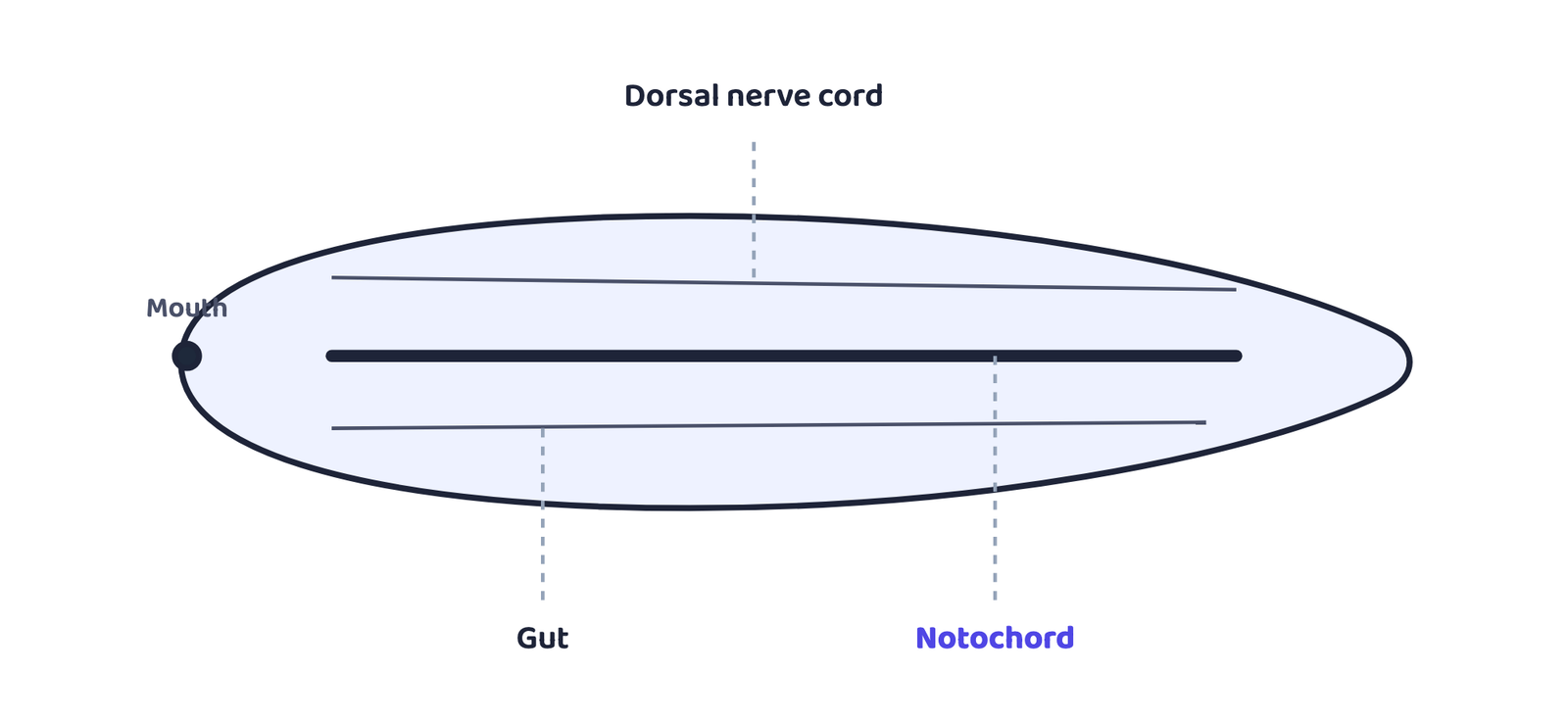
Animals are multicellular, heterotrophic organisms that show locomotion, rapid response to stimuli and coordinated behaviour. One of the major criteria for classifying animals is the presence or absence of a notochord, a flexible rod-shaped structure that acts as a precursor to the vertebral column in some chordates.
Chordata is further divided into Protochordata (like Amphioxus, notochord present but no true vertebral column) and Vertebrata (true backbone, divided into fish, amphibians, reptiles, birds and mammals).
8.1 Invertebrate phyla, in order of increasing complexity
| Phylum | Body plan / level of organisation | Skeleton | Example |
|---|---|---|---|
| Porifera | Cellular level; pores allow water flow, no true tissues | Absent | Sponge |
| Cnidaria | Tissue level; tentacles capture prey; single opening for food and waste | Absent | Hydra, jellyfish |
| Platyhelminthes | Organ level; bilateral symmetry; flattened body, single opening | Absent | Flatworm (tapeworm) |
| Nematoda | Organ system level; cylindrical body, two openings (mouth and anus) | Absent | Roundworm |
| Annelida | Organ system level; segmented, cylindrical body with body cavity | Absent | Earthworm |
| Arthropoda | Organ system level; segmented body, jointed legs | Exoskeleton | Insects, crabs, spiders |
| Mollusca | Organ system level; soft body, distinct head and muscular foot | Shell (in many) | Snail, octopus |
| Echinodermata | Organ system level; spiny skin, made of calcium carbonate | Endoskeleton | Starfish, sea urchin |
Arthropoda is the largest animal phylum, and its jointed exoskeleton is the single most common identification clue in board questions, since it protects the body, reduces water loss and supports strong muscles.
8.2 Vertebrates – animals with a backbone
Vertebrates possess a vertebral column, an internal skeleton that supports the body, protects vital organs like the brain and spinal cord, and allows larger body size and complex organ systems. Vertebrates are classified into five groups: fish, amphibians, reptiles, birds and mammals, based on their habitat, body covering and mode of reproduction.
9Adaptations as Outcomes of Structural Change
Animal diversity today reflects structural changes over long periods of time: fins and gills let fish move and breathe in water, feathers and hollow bones make flight possible in birds, fat storage in camels and thick fur in polar bears support survival in extreme conditions, and mammary glands in mammals improve the survival of the young.
9.1 The hierarchical nature of classification
Classification follows a step-by-step order, from very broad groups down to smaller, more specific ones. Every lower group is a part of the group above it, and organisms at a lower level share more features in common. This arrangement works like an address: it helps scientists identify, compare and study organisms accurately.
10Scientific Naming – The Binomial System
A tiger is called bagh in Hindi and tiger in English, which can cause confusion between regions. To avoid this, Carolus Linnaeus introduced binomial nomenclature, a universal naming system in which every organism gets a two-part scientific name written in Latin or a Latinised form.
Binomial nomenclature is a system of naming organisms with two parts: the genus name (shared by closely related species) followed by the species name, for example Panthera tigris for the tiger.
✓ Rules for writing scientific names
- Two parts: genus name first, species name second
- Genus name starts with a capital letter; species name is all lower case
- Written in italics when printed, underlined when handwritten
✗ Common mistakes to avoid
- Do not capitalise the species name
- Do not write the scientific name in plain upright text without italics or underline
- Do not reverse the order (species before genus)
Based on genetic data, Carl Woese (1977) proposed a three domain system: Bacteria, Archaea and Eukarya, showing that microscopic life is far more diverse than the five kingdom system suggested.
11Fossils as Evidence
Fossils are the preserved remains of plants and animals found in layers of rocks, sand and mud. Older rock layers generally contain simpler organisms, while newer layers show more complex forms. Fossils act as natural records that help us understand how life has changed over millions of years.
12Biodiversity Under Threat
Every species plays a role in nature: plants produce food and oxygen, animals pollinate flowers and disperse seeds, and microorganisms recycle nutrients. Human activities such as pollution, deforestation, overuse of resources and climate change are reducing biodiversity. When one species disappears, others that depend on it may also decline.
- 1 markWhich region’s biodiversity conservation did the Purple Frog’s discovery highlight?
- 1 markWhat does the species name “sahyadrensis” refer to?
- 3 marksExplain how the Purple Frog’s ancient family helps scientists understand evolution.
Classification is not just about naming organisms, it helps us understand relationships, trace the history of life, and conserve biodiversity.
the single idea to carry out of this chapter
- Biodiversity hotspots: Western Ghats, Indo-Burma, the Himalayas, Sundaland
- Classification history: Aristotle (habitat) to Linnaeus (2 kingdom) to Haeckel (3 kingdom) to Copeland (4 kingdom) to Whittaker (5 kingdom, 1969)
- Five kingdoms: Monera (unicellular prokaryote), Protista (unicellular eukaryote), Fungi (multicellular, chitin wall, heterotrophic), Plantae (multicellular, cellulose wall, autotrophic), Animalia (multicellular, no cell wall, heterotrophic)
- Kingdom Plantae: Thallophyta, Bryophyta, Pteridophyta, Gymnosperm, Angiosperm
- Kingdom Animalia: split by notochord into non-chordata (8 invertebrate phyla) and chordata (protochordata + vertebrata)
- Hierarchy: Kingdom > Phylum > Class > Order > Family > Genus > Species
- Binomial nomenclature: genus + species, genus capitalised, species lower case, italics/underline
- 1 markDefine an endemic species.
- 1 markName the scientist who proposed the five kingdom classification.
- 1 markWhat is a notochord?
- 1 markGive one example each of Thallophyta and Gymnosperm.
- 1 markName any one biodiversity hotspot found in India.
- 1 markWhich scientist introduced binomial nomenclature?
- 1 markName the three domains proposed by Carl Woese.
- 1 markWhich kingdom do mushrooms and yeast belong to?
- 3 marksList three criteria scientists use to classify organisms, with one example each.
- 3 marksWhy were fungi placed in a separate kingdom from plants, even though neither group moves?
- 3 marksDifferentiate between Porifera and Cnidaria on the basis of body organisation.
- 3 marksState the rules for writing the scientific name of an organism, with one example.
- 3 marksWhy are lichens used as bioindicators of air quality?
- 3 marksDistinguish between protochordates and vertebrates, with one example of each.
- 3 marksWhy is Arthropoda considered the most successful animal phylum?
- 3 marksExplain why the discovery of the Purple Frog was scientifically significant.
- 5 marksExplain the five kingdom classification system, listing one defining feature of each kingdom.
- 5 marksDescribe the classification hierarchy from kingdom to species, using the tiger as an example at each level.
- 5 marksDescribe the five classes of Kingdom Plantae, with one key feature and one example of each.
- 5 marksTrace how classification systems changed from Aristotle to Whittaker, explaining why each change was needed.
- 1 markWhich feature of sponge cells supports its classification under the animal kingdom?
(a) Absence of mitochondria(b) Ability to photosynthesise
(c) Presence of a cell membrane(d) Presence of a cell wall - 1 markBryophytes are called the “amphibians of the plant kingdom” because
(a) they live only in water(b) they need water for reproduction but grow on land
(c) they have no roots(d) they produce seeds - 1 markAn animal has jointed legs and a hard external skeleton. It belongs to phylum
(a) Annelida(b) Mollusca
(c) Arthropoda(d) Echinodermata - 1 markIn the scientific name Panthera tigris, “tigris” represents the
(a) genus(b) family
(c) species(d) kingdom - 1 markFungi obtain their nutrition mainly by
(a) photosynthesis(b) absorption from dead or decaying matter
(c) ingesting whole prey(d) chemosynthesis - 1 markA protochordate is an organism that
(a) never develops a notochord(b) has a notochord at least once in its life
(c) always has a true vertebral column(d) belongs to Kingdom Monera - 1 markWhich of these is NOT one of the criteria used to classify organisms?
(a) Mode of nutrition(b) Cell structure
(c) Colour of the organism(d) Ecological role
Reason (R): Classification into Fungi is based on cell wall composition (chitin) and heterotrophic nutrition, not on whether the organism is unicellular or multicellular.
Reason (R): The five kingdom classification is based on cellular organisation, and viruses lack cellular organisation, being acellular.