
1 Asexual Reproduction
Asexual reproduction involves a single parent, producing offspring that are genetically identical to it. It is seen in bacteria, amoeba, yeast, hydra, sponges, and many plants.
Many plants can grow entirely new plants from their own parts, without seeds at all. Potato and ginger sprout from their fleshy underground stems; money plant and sugarcane grow from stem cuttings; a Bryophyllum leaf can even sprout tiny plantlets along its edge. This is called vegetative propagation, since it uses the plant’s growing (vegetative) parts.
1.1 Vegetative propagation in agriculture
| Method | How it works |
|---|---|
| Cutting | A shoot cutting, with several nodes, is planted at a 45–60° angle in the soil |
| Grafting | A stem piece from one plant (scion) is fixed into a slit cut in a rooted plant of another variety (rootstock); the wound is protected until it heals |
| Layering | A flexible twig is bent and buried in soil while still attached to the parent; once roots form (10–15 days), it is cut free as a new plant |
| Tissue culture | Plantlets are mass-produced in the lab from a tiny piece of shoot tip (apical meristem) |
Tissue culture has transformed banana farming: healthy plantlets grown from the shoot tip eliminate virus-infected stock and boost yields. India’s Krishi Vigyan Kendras (KVKs), under the ICAR, also train farmers in modern grafting to grow higher-yield fruit varieties.
1.2 Budding, spores and the origin of microbes
In yeast, a small round outgrowth called a bud appears on the parent cell and eventually separates to live independently. Hydra reproduces the same way: repeated cell division at one spot on its body produces a bud, which enlarges and detaches. This process is called budding.
Rotten food and damp walls develop microbial growth seemingly out of nowhere. For centuries people believed living things could arise spontaneously from non-living matter, until Louis Pasteur’s experiments proved that new life always comes from pre-existing life. His work founded the germ theory of disease, strengthened the cell theory, and led directly to modern sterilisation practices.
Spores are lightweight, usually single-celled reproductive units, produced in huge numbers in a sac (as in Rhizopus) or on a swollen tip of a fungal thread called a hypha (as in Aspergillus). They float easily in air and germinate quickly once they land somewhere moist.
The mould on bread did not appear from nothing: airborne spores, already present, landed on the moist bread and multiplied rapidly. Refrigeration works precisely because cold slows spore germination, which is why it revolutionised how long fresh food can be safely kept.
Fungi are not just a nuisance: they break down organic waste and pollutants, help remove heavy metals from industrial waste, and are the source of life-saving antibiotics like penicillin and amoxicillin.
Every asexual process in this chapter, whether budding, spore formation or vegetative propagation, relies on mitosis: cell division that keeps the chromosome number identical to the parent. That is exactly why the offspring, called clones, are genetically identical to their one parent.
2 Sexual Reproduction
Sexual reproduction needs two parents, and both contribute genetic material. If a full set of chromosomes came from each parent, the chromosome count would double every generation. Meiosis, a special type of cell division, prevents that.
Meiosis halves the chromosome number, turning a diploid parent cell into haploid gametes (sperm and eggs in animals; pollen and ovules in plants). Each gamete gets exactly one chromosome from every pair.
Humans have 23 pairs of chromosomes (46 in total), one of each pair inherited from each parent. Because each pair can separate into a gamete in either of two ways, and there are 23 such pairs, the number of possible gamete combinations is enormous. This is why children resemble their parents without being identical to them, or to their siblings.
With just 3 pairs of contrasting traits, there are already possible combinations. With 23 human chromosome pairs, the number of possible combinations is astronomically larger. This random mixing is exactly what makes variation, and ultimately evolution, possible.
3 Sexual Reproduction in Flowering Plants
Flowering plants (angiosperms) are Earth’s most diverse plant group, and the flower is their reproductive organ.
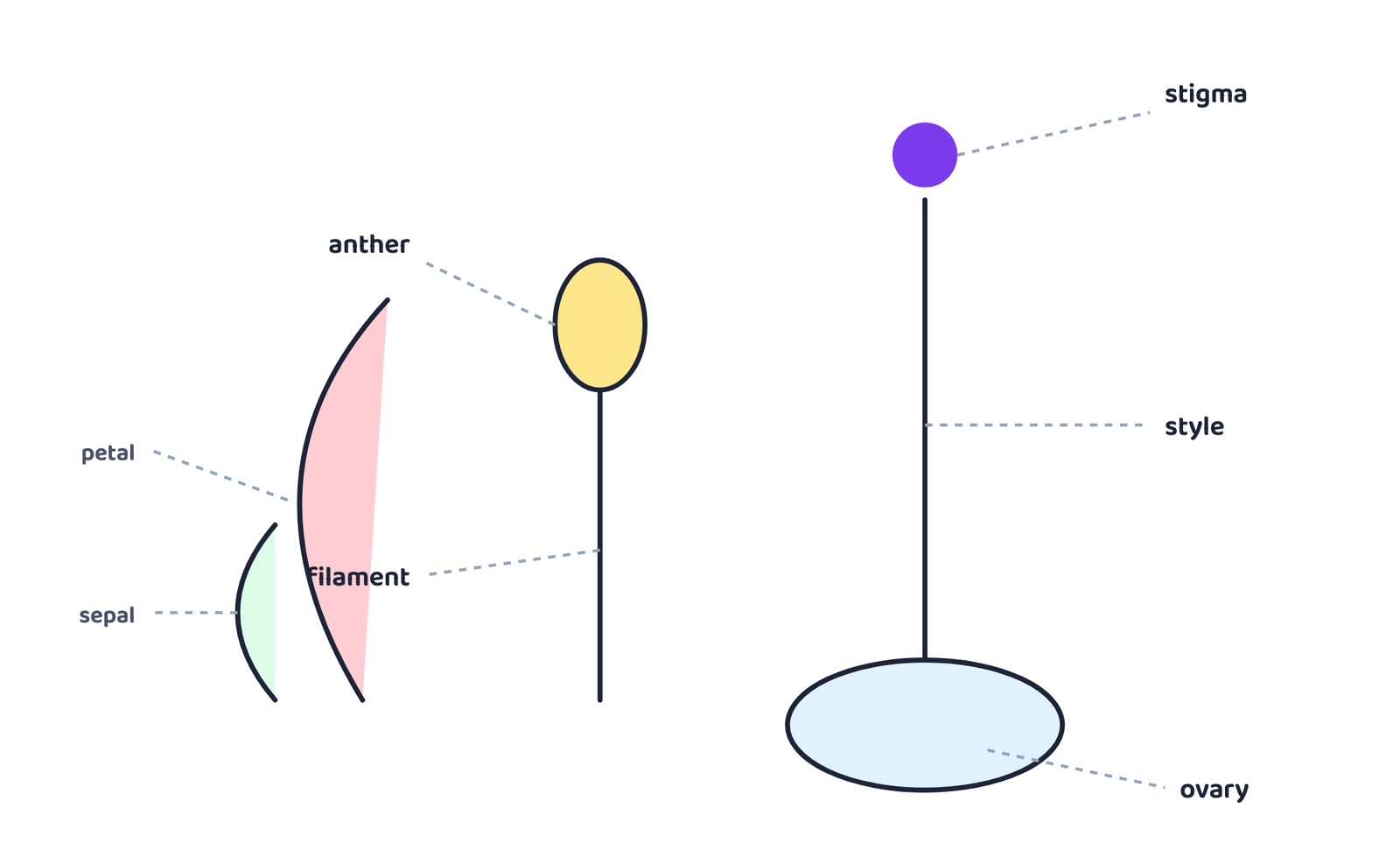
| Part | Role |
|---|---|
| Sepal | Green outer whorl, protects the flower in the bud stage |
| Petal | Coloured, often fragrant, attracts pollinators |
| Stamen (male) | Filament holds up the anther, which produces pollen grains carrying male gametes |
| Pistil (female) | Stigma receives pollen; style connects it to the ovary; the ovary holds ovules, each with an egg cell |
An experiment on pea flowers proves why pollen matters: remove the stamens from a flower bud before it opens, and no fruit forms. Leave the stamens in place, and fruit develops normally. This shows that the transfer of pollen from anther to stigma, pollination, is essential for fruit formation.
Self-pollination
- Pollen moves to the stigma of the same flower, or another flower on the same plant
Cross-pollination
- Pollen moves from one plant’s anther to a different plant’s stigma, of the same species
| Pollinating agent | Flower adaptations | Examples |
|---|---|---|
| Wind | Light, small pollen in huge numbers; long, feathery stigma | Wheat, maize, rice |
| Water | Pollen carried by water currents | Vallisneria, Hydrilla |
| Insects | Bright colours, nectar, fragrance; large, sticky or spiny pollen; sticky stigma | Sunflower, hibiscus, marigold |
| Birds | Bright, tubular, nectar-rich flowers | Coral tree, hibiscus (visited by sunbirds) |
3.1 Fertilisation and seed formation
Once pollen lands on a compatible stigma, it grows a pollen tube down through the style to the ovule. The male gamete travels through this tube and fuses with the egg cell: this fusion is fertilisation, and it produces a zygote.
The zygote develops into an embryo. Meanwhile, the ovary swells into a fruit, and the ovules inside it become seeds. Seeds disperse by wind, water or animals, and germinate into new plants once water, air and temperature are favourable.
Wind-pollinated grasses release 5–10 lakh pollen grains per flower but form only 50–200 seeds; insect-pollinated flowers like sunflower release just 20,000–40,000 grains but form 800–1000 seeds. Producing huge amounts of pollen is still an effective strategy for wind pollination, because so much of it is wasted before ever reaching a stigma.
P. Maheshwari, called the Father of Indian Embryology, pioneered in-vitro fertilisation in flowering plants by fusing egg and male gametes in a test tube, and was among the first to grow plant embryos on artificial nutrient media.
4 Sexual Reproduction in Animals
External fertilisation
- Eggs and sperm released into water, as in frogs and most fish
- Many eggs lost to currents or predators
- Large numbers of eggs laid to compensate
Internal fertilisation
- Fertilisation happens inside the female’s body
- Reptiles, birds, mammals
- Fewer eggs, but higher survival chances
| Animal | Fertilisation | Eggs at a time | Survival of young |
|---|---|---|---|
| Fish | External | 100s–1000s | Low |
| Frog | External | 5,000–50,000 | Low |
| Lizard | Internal | 2–20 | Moderate |
| Bird | Internal | 1–15 | Moderate to High |
Fish, amphibians and insects lay eggs with just enough yolk to hatch a larva, an independent feeding stage that grows on its own before transforming into an adult (as in a butterfly’s egg → larva → pupa → adult life cycle). Reptile and bird eggs instead carry enough yolk to sustain the embryo all the way to hatching. In mammals, the developing zygote grows entirely inside the mother’s body.
5 Reproduction in Human Beings
5.1 The male reproductive system
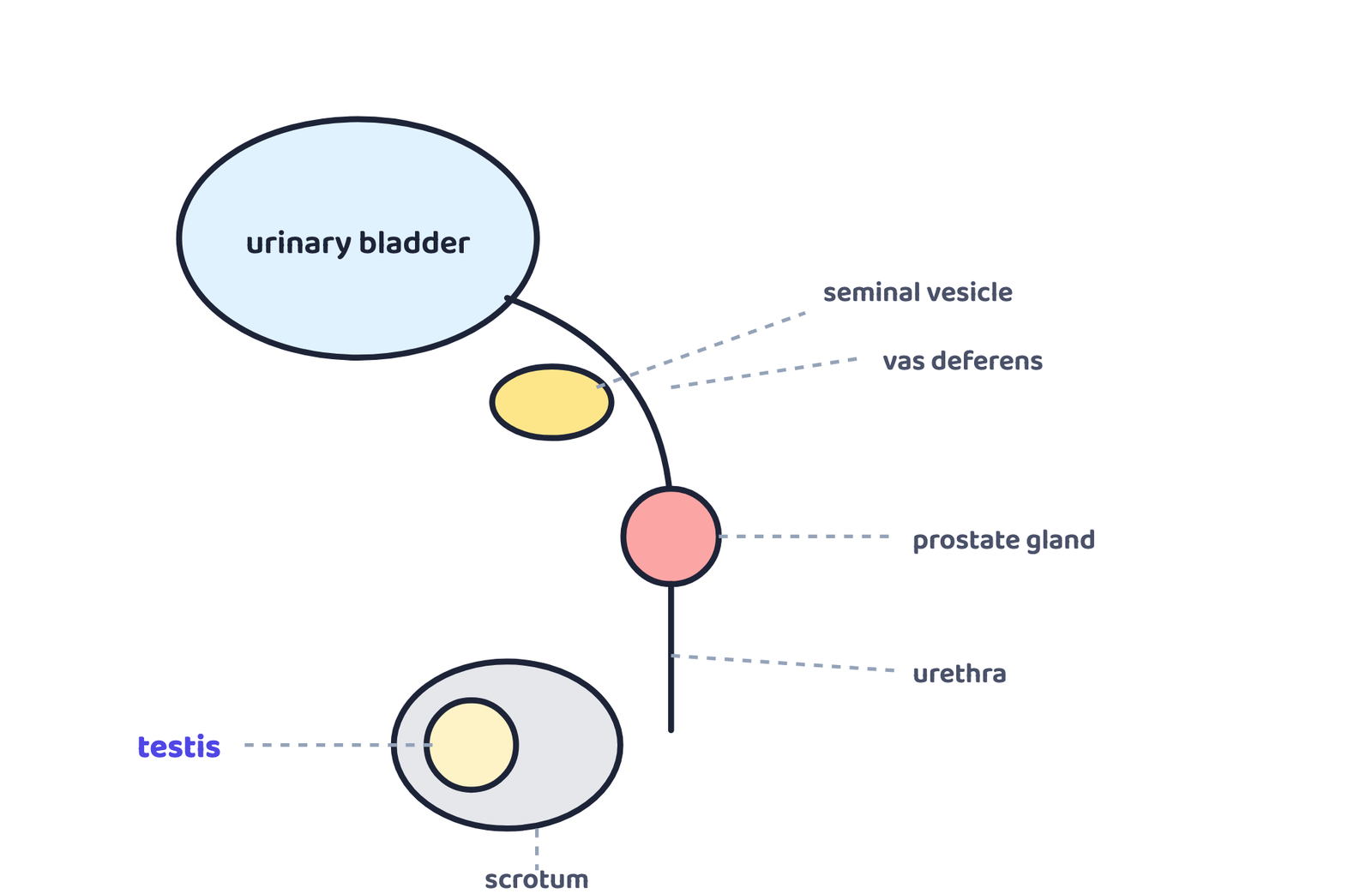
Sperm form in the testes, held in the scrotum outside the body so they stay slightly cooler than body temperature, which sperm formation requires. The testes also produce a hormone that drives puberty changes in boys. Sperm travel through the vas deferens to the urethra, gaining nourishing fluid from the seminal vesicles and prostate gland along the way.
5.2 The female reproductive system
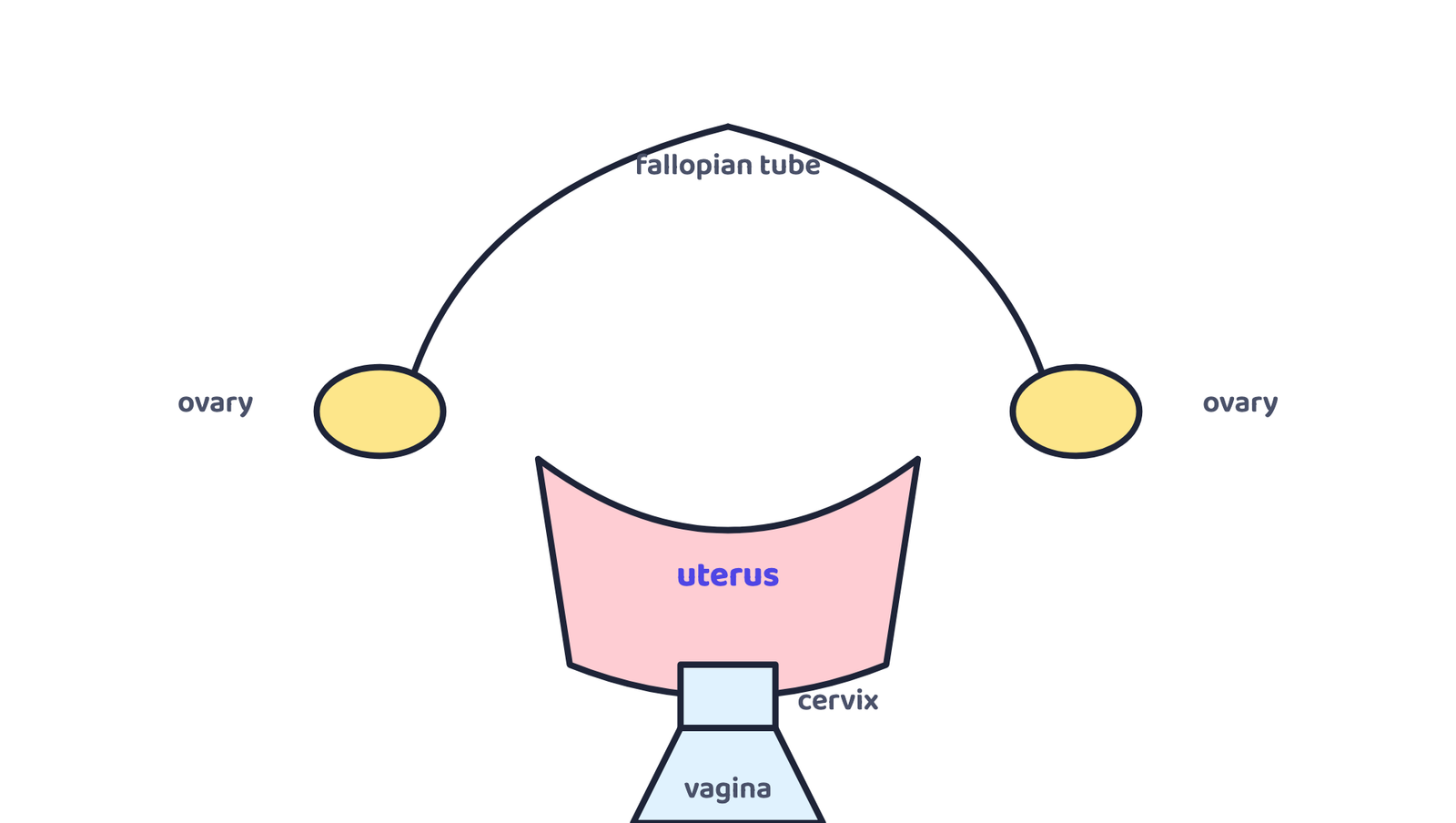
The ovaries produce eggs and hormones. Each oviduct (fallopian tube) connects an ovary to the uterus, the bag-like structure where a foetus develops. The uterus opens into the vagina through a narrow passage, the cervix.
| Feature | Sperm | Egg |
|---|---|---|
| Size | Very small | Large |
| Number produced | Millions | Few (one per month, roughly) |
| Stored nutrients | Absent | Present |
| Motility | Actively motile | Non-motile |
5.3 Fertilisation and the menstrual cycle
From puberty, roughly once a month, one mature egg is released from an ovary: this is ovulation. Before it happens, the uterus lining thickens in preparation. If sperm reach and fuse with the egg in the oviduct, a zygote forms; it divides repeatedly while travelling to the uterus and implants in the thickened lining, marking the start of pregnancy.
In-vitro fertilisation (IVF) combines egg and sperm outside the body, usually in a lab dish, before implanting the fertilised egg in the uterus. India’s first IVF baby, Kanupriya Agarwal (nicknamed Durga), was born in Kolkata in 1978, through the pioneering work of Subhash Mukhopadhyay.
If the egg is not fertilised, it survives about a day and then degenerates. The thickened, blood-rich uterine lining is no longer needed and sheds through the vagina along with some blood: this is menstruation, usually lasting 3–7 days. The full cycle repeats roughly every 21–35 days (often close to 28), starting at puberty (typically age 10–14) and continuing until menopause around age 50.
A baby’s biological sex is decided by the father, not the mother. The mother always contributes an X chromosome; the father contributes either an X (giving XX, a girl) or a Y (giving XY, a boy).
Good menstrual hygiene means: using clean products (pads, tampons or menstrual cups), washing with water rather than soap on the genital area, always washing hands before and after changing a product, wrapping and disposing of used pads properly (never flushing them), and changing products every 4–6 hours or more often during heavy flow.
5.4 Pregnancy and childbirth
Human pregnancy lasts about nine months, in three trimesters. The embryo’s major organs form in the first two months; from about the ninth week it is called a foetus. It grows steadily through the second trimester, and prepares for life outside the womb in the third. Birth happens through strong uterine contractions pushing the baby through the birth canal; when a normal delivery is not safe, doctors use medical or surgical methods instead.
A newborn needs breastfeeding (which gives complete nutrition and disease protection), warmth, timely vaccination and gentle handling. The mother needs good nutrition, rest, and to avoid smoking, alcohol or unsupervised medicines, since her health and the baby’s are closely linked.
Over 10 lakh ASHA (Accredited Social Health Activist) workers across India are trained to promote hygiene, immunisation, maternal care and family planning in their communities. Post-partum depression, a recognised and treatable condition some mothers experience after childbirth, is one of the things they can help connect a mother to support for.
6 Responsible Choices: Preventing Infections and Unwanted Pregnancy
Sexual maturity (the ability to reproduce) develops gradually through adolescence, but emotional maturity, the ability to handle feelings and make thoughtful decisions, takes longer. Being ready for sexual activity means both.
Sexually Transmitted Infections (STIs) spread through close physical contact and include gonorrhoea, herpes, syphilis, genital warts and HIV (which can progress to AIDS); some have no cure yet. Condoms reduce the risk of both STI transmission and pregnancy.
| Contraceptive method | How it works |
|---|---|
| Barrier (condoms, vaginal covers) | Physically stops sperm reaching the egg |
| Oral pills | Hormonally alters egg release; can have side effects |
| IUDs (e.g. Copper-T) | Placed in the uterus to prevent pregnancy; may sometimes irritate the uterus |
| Surgical methods | Block the vas deferens (in males) or fallopian tubes (in females) |
Abortion is a surgical option to end an unwanted pregnancy, generally only safe within the first trimester when the embryo is still very small. Sex-selective abortion, driven by preference for one gender, is a serious social problem, and prenatal sex determination is strictly prohibited by law in India, precisely because this practice distorts the natural sex ratio.
Scientists at the Central Drug Research Institute, Lucknow, developed the world’s first non-steroidal, non-hormonal oral contraceptive pill, taken just once a week. It is provided free through India’s National Family Planning Programme.
- Asexual reproduction (budding, spores, vegetative propagation) uses one parent and mitosis, giving genetically identical clones.
- Sexual reproduction uses two parents and meiosis, which halves the chromosome number and creates genetic variation.
- A flower’s stamen (anther + filament) is male; its pistil (stigma + style + ovary) is female.
- Pollination (anther to stigma) can be self or cross, carried by wind, water, insects or birds.
- Fertilisation fuses the male gamete with the egg cell to form a zygote; the ovary becomes the fruit, ovules become seeds.
- External fertilisation (fish, frogs) needs many eggs; internal fertilisation (reptiles, birds, mammals) protects fewer eggs better.
- In humans, testes make sperm; ovaries make eggs and release one roughly every 28 days (ovulation, around day 14).
- An unfertilised egg leads to menstruation; a fertilised one implants in the uterus and pregnancy begins.
- The father’s sperm (X or Y) determines a baby’s biological sex, not the mother.
- Condoms, pills, IUDs and surgical methods are contraceptive options; STIs spread through physical contact and some have no cure.
- 1 markDefine asexual reproduction.
- 1 markWhat is the male part of a flower called?
- 1 markDefine pollination.
- 1 markWhat is a zygote?
- 1 markWhere are sperm produced in the human male?
- 1 markWhat is ovulation?
- 1 markName the cell division that halves the chromosome number.
- 1 markWhich parent determines a baby’s biological sex?
- 3 marksDescribe the process of grafting with the help of a labelled diagram.
- 3 marksDistinguish between self-pollination and cross-pollination.
- 2 marksWhy does asexual reproduction produce offspring genetically identical to the parent?
- 3 marksExplain the difference between external and internal fertilisation, with one example each.
- 2 marksList the parts of the male reproductive system and their functions.
- 3 marksDescribe what happens in the human body when an egg is not fertilised.
- 2 marksWhy are wind-pollinated flowers usually small and dull-coloured, while insect-pollinated flowers are bright and fragrant?
- 3 marksExplain the role of the pollen tube in fertilisation.
- 2 marksState two hygienic practices to follow during menstruation.
- 3 marksDistinguish between a barrier method and a hormonal method of contraception.
- 5 marksDescribe the structure of a flower with a labelled diagram, and explain the function of each part.
- 5 marksExplain fertilisation and seed formation in a flowering plant, from pollination to fruit development.
- 5 marksDescribe the human menstrual cycle stage by stage over 28 days.
- 5 marksCompare vegetative propagation and sexual reproduction in plants in terms of genetic variation and speed.
- 5 marksExplain three methods of contraception and how each prevents pregnancy.
- 1 markWhich flower is expected to form fruit?
- 2 marksExplain why the other flower does not form fruit.
- 2 marksWhat does this experiment demonstrate about the role of pollen?
- 1 markBudding is an example of:
(a) sexual reproduction(b) asexual reproduction(c) pollination(d) fertilisation - 1 markThe female part of a flower is called the:
(a) stamen(b) sepal(c) pistil(d) petal - 1 markHuman cells have how many chromosomes?
(a) 23(b) 46(c) 92(d) 21 - 1 markWhich of these shows internal fertilisation?
(a) fish(b) frog(c) bird(d) none of these - 1 markOvulation typically occurs around day:
(a) 1(b) 7(c) 14(d) 28 - 1 markA baby’s biological sex is determined by the:
(a) mother’s chromosome(b) father’s chromosome(c) both equally decide together(d) it cannot be predicted - 1 markCopper-T is an example of a:
(a) barrier method(b) surgical method(c) IUD(d) oral pill
Choose: (a) both A and R true, R explains A; (b) both true, R does not explain A; (c) A true, R false; (d) A false, R true.
Reason (R): The uterus wall thickens during each cycle in preparation for a possible pregnancy.
Reason (R): Most pollen released into the wind never reaches a stigma.
Reason (R): Internally fertilised eggs or embryos are better protected inside the parent’s body.