
1 Production of Sound
Sound is produced by vibration: the periodic to-and-fro motion of an object. The vibrating object is called the source of the sound.
Pluck a stretched rubber band across an open box and it vibrates and sounds; stop the vibration, and the sound stops too. The same idea explains a plucked string, a struck metal plate, or air vibrating inside a flute.
In humans and many animals, sound comes from the vocal cords: tightly stretched muscular flaps in the larynx (voice box). The tongue, lips, mouth and nasal cavity then shape that sound into speech or song. Grasshoppers and crickets, by contrast, make sound by rubbing their wings or legs together.
In Kongthong, a village in Meghalaya called the Whistling Village, every person is given a unique whistled or sung “tune name” at birth, a tradition called Jingrwai Iawbei.
1.1 The tuning fork
A tuning fork is a U-shaped metal bar with a stem; its two arms are called prongs. Striking a prong on a rubber pad sets it vibrating: touch the vibrating prong to a water surface and you see ripples form, direct proof that it is genuinely vibrating even though the motion is too fast to see clearly.
2 Propagation of Sound
The material through which sound travels is its medium. A space with no matter in it at all is a vacuum.
Knock gently on a desk and listen with your ear in the air, then listen again with your ear pressed to the desk: the sound through the solid wood is clearly audible, proving sound travels through solids. Tap two spoons together underwater, and the sound still reaches you, proving it travels through liquids too.
The classic vacuum bell jar experiment proves sound needs a medium: a ringing electric bell inside a jar gets fainter and fainter as air is pumped out, and is almost inaudible near a vacuum, even though the bell can still be seen ringing. Letting air back in restores the sound. This is exactly why astronauts on a spacewalk cannot hear each other directly and must use radio devices instead.
3 Sound Waves
Stretch a slinky along the floor and give one end a sharp push-and-pull: a region where the coils bunch together (moving away from you) and a region where they spread out both travel down its length, even though the marked point on the slinky only moves back and forth in place. That is exactly the picture for sound.
A compression is a region where the medium’s density is higher than average; a rarefaction is a region where it is lower. A sound wave is a disturbance of alternating compressions and rarefactions travelling through a medium, without the medium’s particles actually travelling with it.
The particles of the medium do not travel along with a sound wave. Each particle only oscillates about its own fixed average position; it is the disturbance, and the energy it carries, that moves forward.
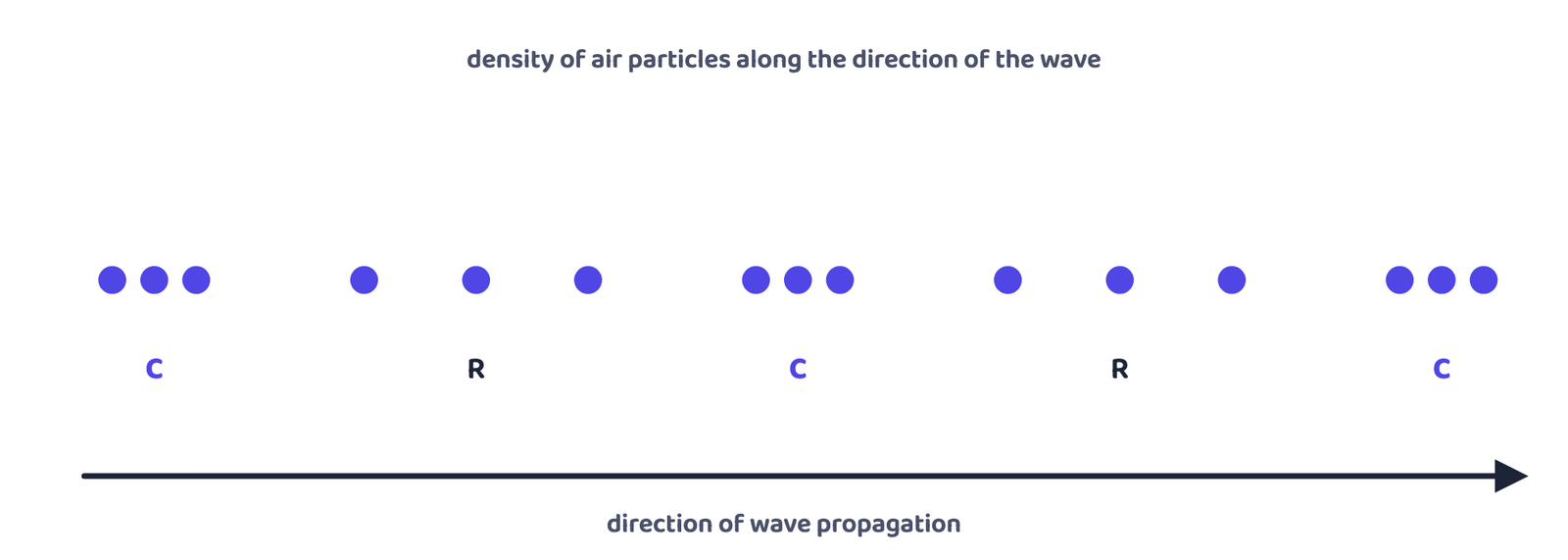
In a longitudinal wave, particles vibrate parallel to the direction the wave travels. Sound is a longitudinal wave, and because it needs a material medium, it is also called a mechanical wave.
Longitudinal wave
- Particles vibrate parallel to propagation
- Sound is the standard example
- Shows as compressions and rarefactions
Transverse wave
- Particles vibrate perpendicular to propagation
- Light is the standard example
- Light needs no medium, so it crosses a vacuum
A point source of sound sends out compressions and rarefactions equally in every direction, so its wavefronts are spherical. This is also why sudden gas expansion, as in a firecracker or a clap of thunder, produces a loud pulse of sound, and why a supersonic aircraft creates a sonic boom.
4 Energy of Sound Waves
Stretch a thin sheet tightly over a wide container and sprinkle grains on it. Make a loud sound nearby, without touching the sheet at all, and the grains visibly jump. The sound wave makes the sheet vibrate, and the sheet’s vibration moves the grains: sound is clearly carrying energy from its source.
A microphone converts sound energy into an electrical signal, by making a diaphragm vibrate; a speaker does the reverse, using an electrical signal to vibrate a cone and produce sound.
5 Wavelength, Frequency, Time Period and Speed
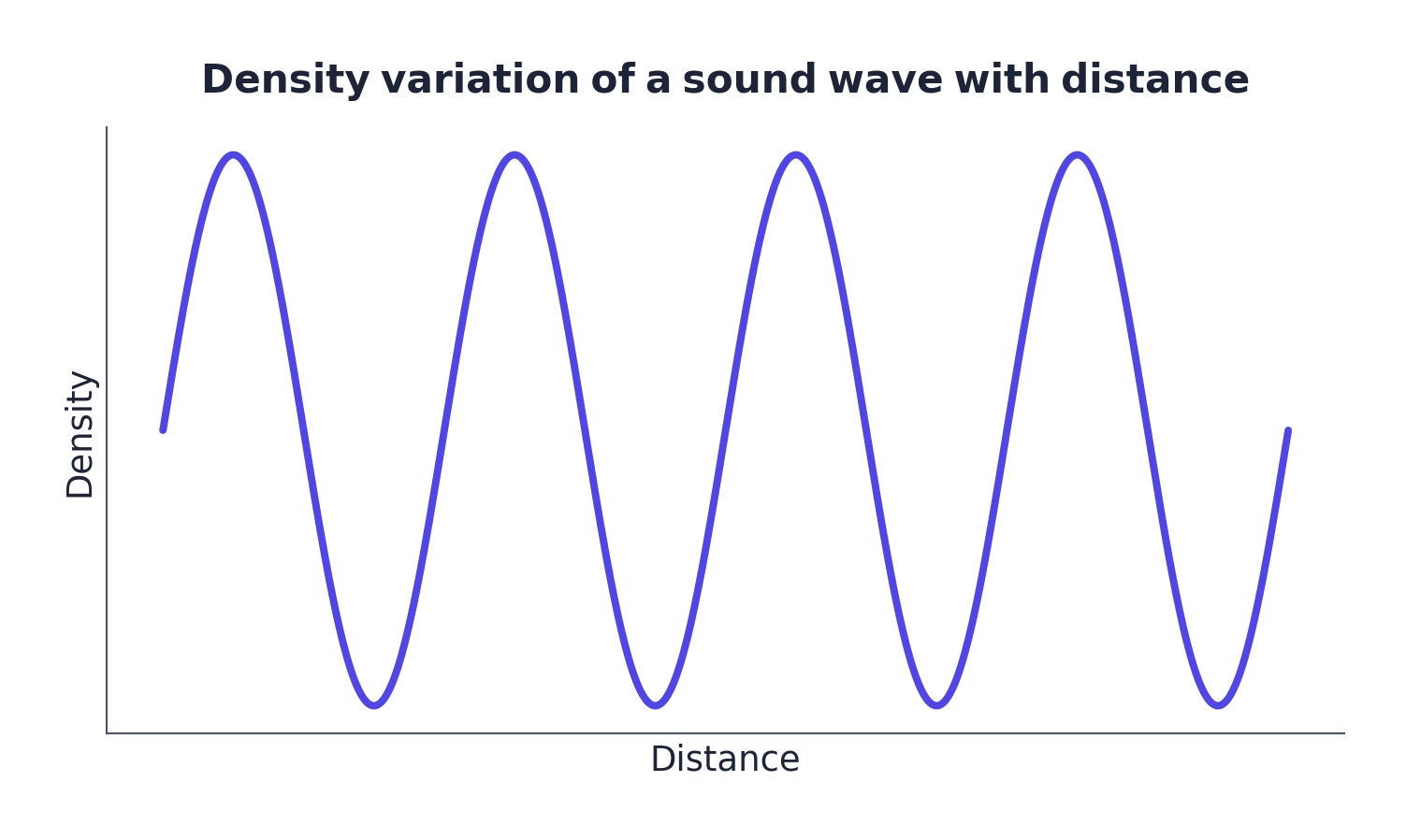
Q. A fixed point in a medium undergoes 10 density oscillations in 2 seconds. Find its frequency and time period.
5 Hz 0.2 s
Q. Human hearing spans 20 Hz to 20,000 Hz. Find both wavelengths in air (speed = 344 m/s).
17.2 m (at 20 Hz) 1.72 cm (at 20,000 Hz)
Q. Thunder is heard 5 s after lightning is seen (light arrives almost instantly). Estimate the distance, taking the speed of sound as 340 m/s.
Distance 1700 m (1.7 km)
| Medium | Approximate speed of sound at 15°C |
|---|---|
| Steel (solid) | 5000 m/s |
| Water (liquid) | 1500 m/s |
| Air (gas) | 340 m/s |
Sound travels fastest through solids, slower through liquids, and slowest through gases, because particles are packed most tightly in a solid and can pass a disturbance on fastest. In air specifically, speed rises with temperature and humidity: about 331 m/s at 0°C, 344 m/s at 22°C. In any single medium, speed depends only on the medium, not on the source or frequency: change the frequency, and the wavelength changes, while the speed stays fixed.
6 Amplitude, Intensity and Human Perception
Amplitude is the maximum change in density (in a compression or rarefaction) compared to the average density. Intensity is the amount of sound energy crossing a unit area, perpendicular to the wave, per unit time.
A larger amplitude carries more energy. Because that energy spreads over an ever-larger sphere as the wave moves outward, intensity always falls with distance from the source, even though the total energy is conserved.
| Physical quantity | How it is perceived |
|---|---|
| Frequency | Pitch: higher frequency sounds shrill (high pitch); lower frequency sounds deep (low pitch) |
| Amplitude | Loudness: larger amplitude sounds louder, measured practically in decibels (dB) |
Loudness and intensity are not the same thing. Intensity is an objective, measurable quantity; loudness is the listener’s own, subjective experience of it.
The human audible range is roughly 20 Hz to 20,000 Hz (20 kHz). Sound below 20 Hz is infrasonic; sound above 20 kHz is ultrasonic. Dogs, cats, bats and dolphins can detect ultrasound; elephants can detect infrasound.
A tone is a single-frequency sound, like a tuning fork or a whistle. A musical note combines a lowest fundamental frequency with higher overtones, and the exact mix gives an instrument its distinctive timbre, which is why a flute and a sitar playing the same note still sound completely different. An octave is the interval between a frequency and exactly double it.
Sir C. V. Raman, who won India’s first science Nobel Prize for the Raman Effect in light, also studied how Indian drums like the tabla and mridangam produce their rich sound. Both instruments carry a black paste patch at the centre of the drumhead, called the syaahi, which alters the membrane’s vibration to give unusually fine tonal control.
7 Reflection of Sound
Sound reflects off hard surfaces following the same law as light: the angle of incidence equals the angle of reflection, both measured from the normal, with the incident ray, reflected ray and normal all in one plane.
7.1 Echo
An echo is a reflected sound heard as a distinct repeat of the original. The brain needs at least 0.1 s between the direct and reflected sound to hear them as two separate sounds.
Taking the speed of sound as 340 m/s, sound covers m in 0.1 s. That is the round trip to the reflecting surface and back, so the minimum distance for a clear echo is half of that: 17 m.
Q. An echo is heard 0.5 s after a clap, with sound at 340 m/s. Find the distance to the wall.
Distance 85 m
Hard, smooth surfaces reflect sound well and give clear echoes; soft surfaces like curtains absorb sound; rough surfaces scatter it in many directions, so it never returns as a clean echo.
7.2 Reverberation
Reverberation is the persistence of sound caused by multiple reflections off the walls of a large enclosed space, happening when the reflections arrive less than 0.05 s apart.
Auditoriums are deliberately designed with absorbent panels, upholstered seats and curtains to control reverberation, so speech and music stay clear rather than blurring together.
The Whispering Gallery of the Gol Gumbaz in Bijapur, Karnataka, was designed with such acoustic precision that even a faint whisper can be heard clearly at multiple points around its huge dome.
8 Ultrasonic and Infrasonic Waves: Applications
| Wave type | Applications |
|---|---|
| Infrasonic (below 20 Hz) | Detecting earthquakes, volcanic eruptions and severe storms, since they travel very long distances through air and the Earth |
| Ultrasonic (above 20 kHz) | Ultrasonography (imaging organs), breaking kidney stones, ultrasonic welding and cleaning, detecting flaws in metal, locating underwater objects |
Echolocation is locating objects using reflected sound waves. Bats emit short ultrasonic bursts and sense the echoes to find prey and avoid obstacles in the dark; dolphins, whales and some birds do the same.
SONAR (Sound Navigation And Ranging) applies the same idea underwater: ultrasonic waves are sent out, and their reflections reveal the distance, direction and speed of submerged objects like submarines or shipwrecks.
Q. A naval sonar signal returns after 0.90 s. Speed of sound in seawater is 1530 m/s. Find the distance to the object.
Time to reach the object s
Distance 688.5 m
Drones and aircraft can be tracked even when out of sight, using audio surveillance: sensitive sound sensors pick up the characteristic low-frequency hum of their motors and engines.
- Sound is produced by vibration, and needs a medium (solid, liquid or gas) to travel; it cannot cross a vacuum.
- Sound is a longitudinal mechanical wave: alternating compressions and rarefactions travel, while medium particles only oscillate in place.
- Wavelength (λ, m), frequency (ν, Hz) and time period (T, s) are linked by and .
- Speed of sound is fastest in solids, then liquids, then gases, and rises with temperature in air.
- Amplitude decides loudness and the energy carried; intensity is energy per unit area per unit time, and falls with distance.
- Frequency is perceived as pitch; amplitude is perceived as loudness (measured in decibels).
- Human hearing spans roughly 20 Hz to 20 kHz; below is infrasonic, above is ultrasonic.
- Echo needs at least 0.1 s and 17 m minimum distance; reverberation happens when reflections arrive under 0.05 s apart.
- Echolocation (bats) and SONAR (underwater) both use reflected ultrasonic waves to find distance and position.
- 1 markWhat causes sound to be produced?
- 1 markDefine wavelength.
- 1 markWhat is the SI unit of frequency?
- 1 markState the human audible range of frequencies.
- 1 markWhat is an echo?
- 1 markName the type of wave that sound is.
- 1 markWhat does SONAR stand for?
- 1 markDefine amplitude of a sound wave.
- 3 marksDescribe the vacuum bell jar experiment and explain what it proves.
- 2 marksDistinguish between an echo and reverberation.
- 3 marksA source produces 10 oscillations in 2 seconds. Find its frequency and time period.
- 2 marksWhy can astronauts not hear each other directly during a spacewalk?
- 3 marksExplain why the speed of sound is greatest in solids and least in gases.
- 2 marksDistinguish between loudness and intensity of sound.
- 3 marksAn echo is heard 0.4 s after a sound is produced. Find the distance of the reflecting surface, taking the speed of sound as 340 m/s.
- 2 marksWhat are infrasonic and ultrasonic waves? Give one example of an animal that can detect each.
- 3 marksExplain how a bat uses echolocation to hunt in the dark.
- 2 marksWhy do the particles of a medium not travel along with a sound wave?
- 5 marksExplain, with a labelled diagram, how compressions and rarefactions are produced by an oscillating piston in a tube of air.
- 5 marksDerive the relation and use it to find the wavelength of a 20 Hz and a 20,000 Hz sound in air (speed 344 m/s).
- 5 marksExplain the working of SONAR, and calculate the distance to an object if a signal returns in 0.90 s through seawater (speed 1530 m/s).
- 5 marksDescribe three applications each of ultrasonic and infrasonic waves.
- 5 marksExplain reverberation and how auditoriums are designed to control it.
- 1 markWhat type of wave does the sonar use?
- 2 marksFind the time taken for the signal to reach the wreck.
- 2 marksCalculate the depth of the wreck.
- 1 markSound waves are:
(a) transverse waves(b) longitudinal waves(c) electromagnetic waves(d) not waves at all - 1 markThe minimum distance for a clear echo is about:
(a) 5 m(b) 17 m(c) 34 m(d) 50 m - 1 markFrequency is perceived by humans as:
(a) loudness(b) pitch(c) timbre(d) intensity - 1 markSound travels fastest in:
(a) air(b) water(c) steel(d) vacuum - 1 markWaves above 20 kHz are called:
(a) infrasonic(b) ultrasonic(c) audible(d) transverse - 1 markReverberation occurs when reflections arrive within:
(a) 0.1 s(b) 0.05 s(c) 1 s(d) 10 s - 1 markThe relation between speed, wavelength and frequency is:
(a) (b) (c) (d)
Choose: (a) both A and R true, R explains A; (b) both true, R does not explain A; (c) A true, R false; (d) A false, R true.
Reason (R): Sound requires a medium to travel.
Reason (R): Individual particles of the medium continuously move forward with the wave.
Reason (R): Light is a mechanical wave that needs no medium.