1 Classifying Mixtures
Stir sugar into water and taste it from the top of the glass and from the bottom. It tastes exactly the same. Now stir sand into water: the sand is still visible, and if you leave the glass alone for a minute it starts settling at the bottom. These two glasses represent the two families every mixture belongs to.
A homogeneous mixture (also called a solution) has the same composition throughout. Sugar solution, vinegar and soda water are all homogeneous.
A heterogeneous mixture does not have uniform composition. Its particles are usually visible and may settle with time, like sand in water.
Homogeneous
- Same composition throughout
- Particles not visible
- Never settles
- e.g. sugar solution, vinegar, soda
Heterogeneous
- Composition varies from place to place
- Particles often visible
- May settle with time
- e.g. sand in water, oil in water
A homogeneous mixture always remains homogeneous, whether you look at the first sip or the last. That single sentence answers most “is it homogeneous?” questions in this chapter.
2 Solutions and Concentration
Every solution has two parts. The substance that dissolves is the solute; the substance that does the dissolving is the solvent. In sugared water, sugar is the solute and water is the solvent.
You cannot mix a solute and solvent in just any proportion and expect the same result. Add the wrong amount of salt and sugar to water and you get a solution, but not ORS. Spray too little pesticide and the crop is unprotected; too much, and it damages the crop and the soil. The exact proportion matters, and that proportion is called concentration.
The concentration of a solution is the amount of solute dissolved in a given amount of solvent or solution.
ORS (Oral Rehydration Solution) was formulated by the Indian paediatrician Dilip Mahalanabis to treat dehydration from diseases like diarrhoea and cholera. After the World Health Organization popularised it, it saved millions of lives. Not every sugary drink sold as a rehydration mix is genuine ORS; the proportions have to be exact.
There are three common ways to state concentration as a percentage. All three answer the same question: how much solute for how much solution. What differs is how the solute and the solution are measured.
| Method | Formula | Best suited for | Typical example |
|---|---|---|---|
| Mass by mass % (% m/m) | Solids in solids or liquids, weighed easily | Milk powder, spice mixes, packaged food labels | |
| Mass by volume % (% m/v) | A solid dissolved in a liquid, where volume is easier to measure than weight | 5% glucose drip, 0.9% saline | |
| Volume by volume % (% v/v) | Two liquids that mix completely | Vinegar, perfumes, cosmetics |
\%\ m/v=\frac{\text{mass of solute}}{\text{volume of solution (mL)}}\times 100 \qquad
\%\ v/v=\frac{\text{volume of solute}}{\text{volume of solution}}\times 100$
Given
10 g salt dissolved in 90 g water
To find
Mass by mass percentage
Mass of solution
10% m/m
Q. 5 g of glucose is dissolved in water to make 100 mL of solution. Find the % m/v.
5% m/v
Q. 1 mL of liquid pesticide is made up to 100 mL of spray with water. Find the % v/v.
1% v/v
% m/m and % w/w are the same number, since mass and weight are used interchangeably in this context. Don’t treat them as two different formulas.
A saline drip used in hospitals is 0.9% m/v sodium chloride, meaning 0.9 g of salt in every 100 mL of solution. That exact strength matches the salt concentration of blood, which is why it is safe to put directly into the bloodstream.
3 Solubility
The solubility of a substance is the maximum amount of it that dissolves in a fixed quantity of solvent (usually 100 g or 100 mL) at a given temperature. A solution that cannot dissolve any more solute at that temperature is a saturated solution.
Temperature always has to be stated with a solubility value, because solubility changes with it. For a solid dissolving in a liquid, solubility generally increases as temperature rises. For a gas dissolving in a liquid, it is the opposite: solubility generally decreases as temperature rises, which is why a cold fizzy drink holds its bubbles better than a warm one.
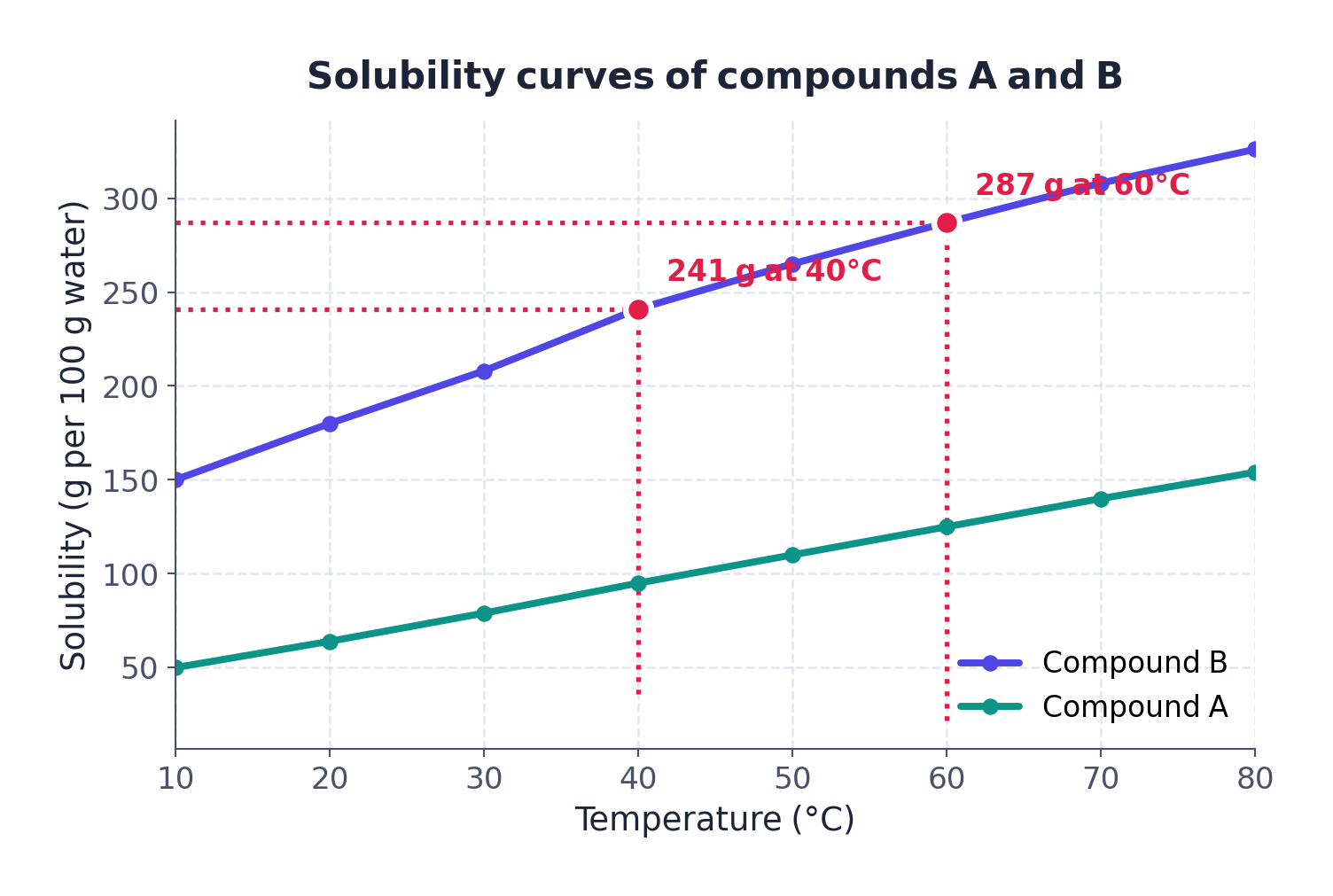
A solubility curve like this lets you read off, at a glance, exactly how much of a compound will dissolve at any temperature, and which of two compounds is more soluble at a given temperature.
4 Separating Homogeneous Mixtures
4.1 Crystallization
Crystallization is the process of forming crystals from a saturated solution, used to separate a pure solid or to purify one, based on the fact that solubility changes with temperature.
Take a saturated solution of compound B at 60°C, made by dissolving 287 g of B in 100 g of water. Cool it to 40°C, and the graph above shows that only 241 g of B can now stay dissolved. The remaining 46 g has nowhere to go, so it separates out as pure solid crystals.
Solid B deposited on cooling from 60°C to 40°C 46 g
Crystallization is used when a compound needs to be separated from a small amount of impurity, provided both are soluble in the same solvent. Rock salt, mishri (candy sugar) and even snowflakes and window frost are all naturally occurring crystals: a solid whose particles are arranged in a regular geometric pattern.
Slow cooling gives larger, better-formed crystals; rapid cooling (for example in ice-cold water) gives smaller, poorly formed ones. This comparison is a favourite “design an experiment” question.
Salt crystallization is an ancient Indian technique. Coastal communities made panga salt by boiling concentrated sea brine, and karkatch salt by simply letting seawater evaporate in the sun, giving crystals of different sizes.
4.2 Distillation
Distillation separates two miscible liquids by heating the mixture until the liquid with the lower boiling point vaporises, then cooling that vapour back into a liquid. It works when the boiling points differ by at least about 25°C, and can also recover a liquid from a solution of a dissolved solid.
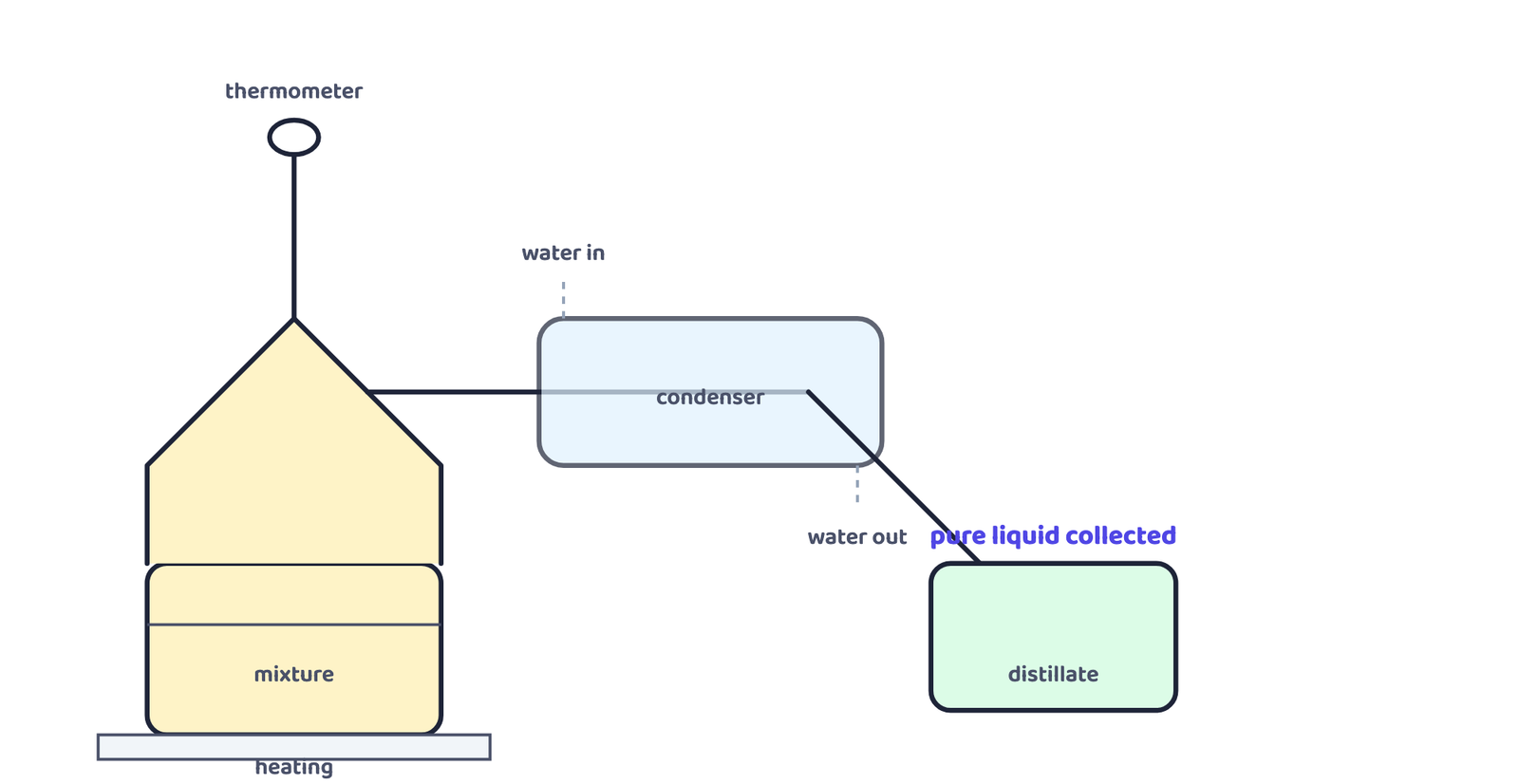
Acetone boils at about 56°C and water at 100°C, a difference far greater than 25°C, so a mixture of the two separates cleanly by distillation: the acetone vaporises first and is collected separately.
In Kannauj, Uttar Pradesh, known as India’s perfume capital, the earthy smell of the first rain is captured using a traditional distillation method called Deg-Bhapka and turned into a natural perfume called Mitti ka Ittar.
Fractional distillation separates liquids whose boiling points differ by less than 25°C, using repeated vaporisation and condensation. A petroleum refinery uses it to split crude oil into petroleum gas, petrol, kerosene, diesel and bitumen.
4.3 Paper Chromatography
Paper chromatography separates the components of a mixture by their different rates of movement through paper, carried by a solvent. It works because each component interacts differently with the paper and the solvent.
Chroma (colour) + graphein (to write) = “writing with colour”
Chromatography was first used to separate coloured dyes, which is exactly where its Greek name comes from.
The same technique separates the green pigments in a spinach leaf extract or the pigments in a flower petal. Water is not always the right solvent; sometimes alcohol or a mixture of solvents is needed instead.
5 Separating Heterogeneous Mixtures
5.1 Immiscible liquids
Pour water into a container that already has oil, and the two never mix; they form separate layers. Liquids that behave like this are called immiscible. A separating funnel uses the difference in density to split them.
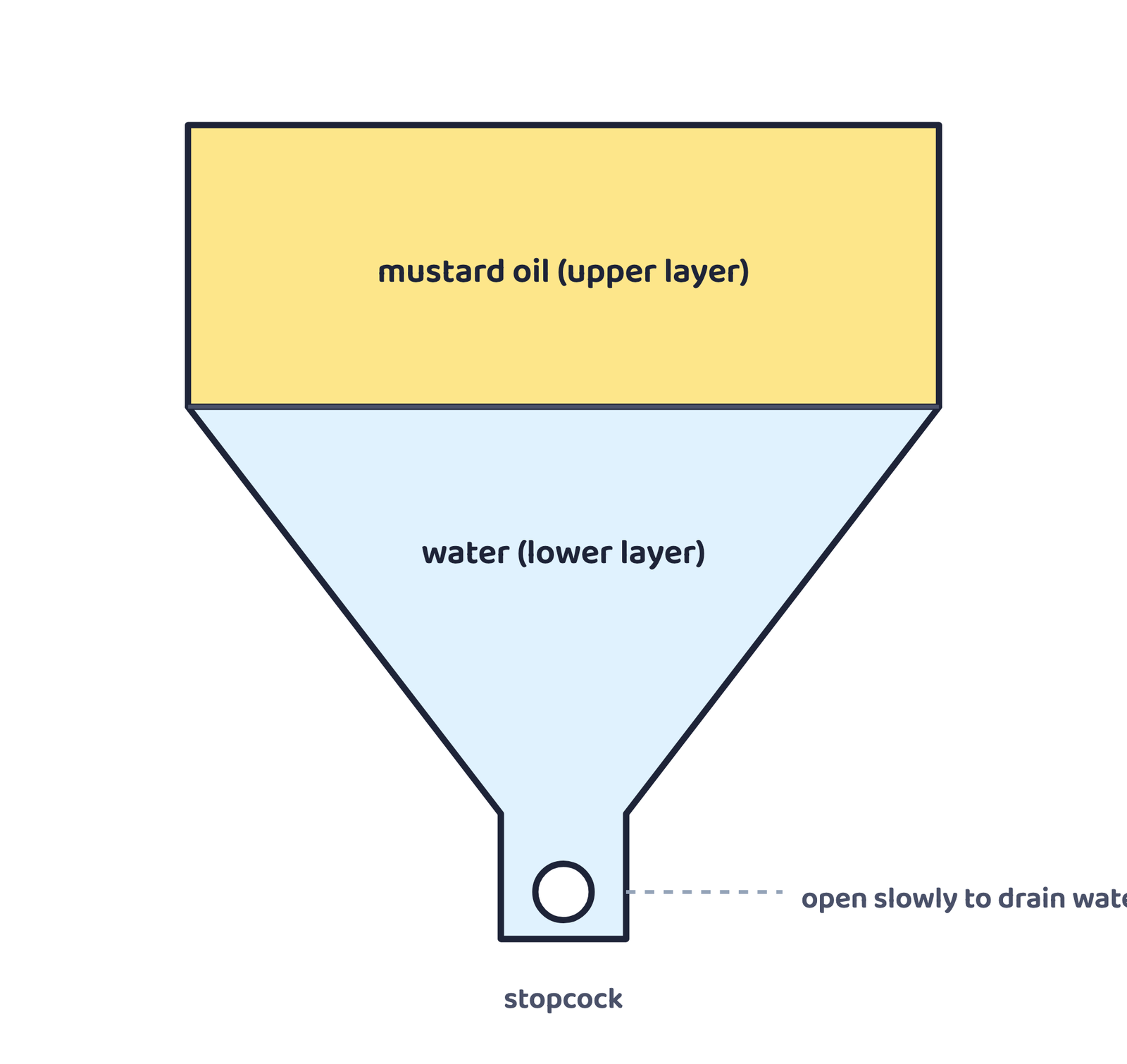
Water is drained off first through the stopcock, the small mixed portion in between is discarded, and the oil is collected last on its own.
Gas mixtures are almost always homogeneous, because gas particles move freely and mix completely (like hydrogen and oxygen used as rocket fuel). Smoke, fog and dust are the exceptions: solid or liquid particles suspended in a gas, which makes them heterogeneous.
5.2 Sublimation
Sublimation is a solid changing directly into vapour, without becoming liquid, on heating below its melting point. Deposition is the reverse: vapour turning directly back into solid on cooling.
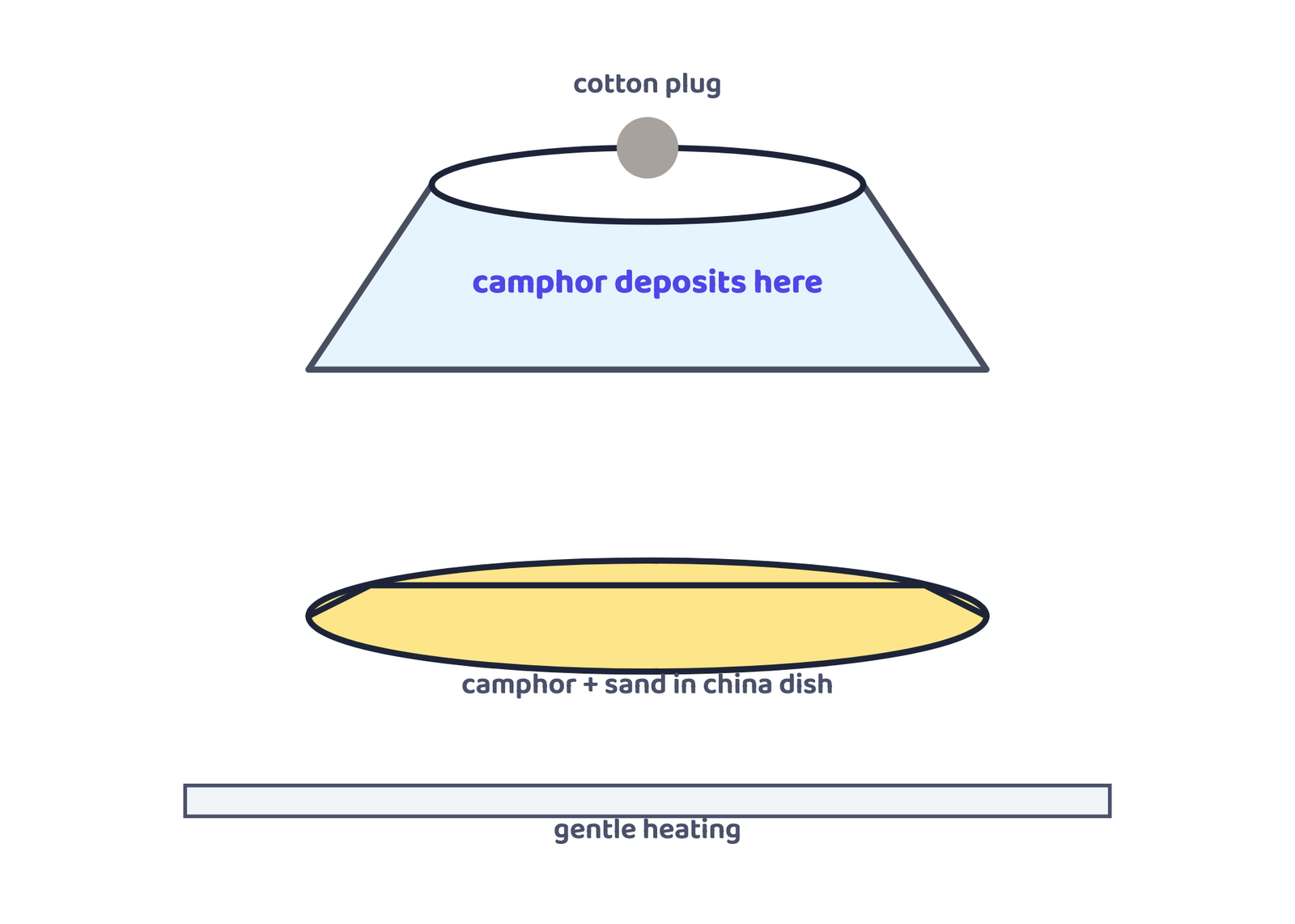
Naphthalene and solid carbon dioxide (dry ice) are two other common substances that sublime.
An alloy is a homogeneous mixture of two or more metals, or a metal and a non-metal, made by melting them together. Physical methods cannot separate the components of an alloy.
| Alloy | Approximate composition |
|---|---|
| Brass | 80% copper, 20% zinc |
| Bronze | 80% copper, 20% tin |
| Stainless steel | Iron with carbon, chromium, nickel and molybdenum |
5.3 Suspensions
A suspension is a heterogeneous mixture in which solid particles do not dissolve but stay spread through the liquid, visible to the naked eye, and settle if left undisturbed. Sand in water and tea leaves in water are suspensions.
Muddy water often stays cloudy even after ordinary filtration, because some particles are too fine for filter paper to catch. Two techniques handle that:
Centrifugation
Spinning the mixture at high speed throws heavier particles outward, where they settle at the bottom of the tube, leaving the lighter liquid on top. Used to separate blood into red blood cells and plasma.
Coagulation
A substance called a coagulant, such as powdered alum (fitkari), is added so the fine suspended particles clump together into larger lumps, which then settle and can be filtered or decanted off.
A paperfuge is a hand-powered centrifuge built from cardboard and string, spun by hand instead of electricity. It can separate blood components well enough to help detect diseases like malaria and anaemia in places with no reliable power supply.
Making paneer from milk is coagulation too: an acid like lemon juice or vinegar coagulates milk proteins, so they clump and separate from the liquid whey.
6 Colloids
Blood can be separated by centrifugation, like a suspension. But its cells cannot be seen with the naked eye, like a solution. Blood is neither: it is a colloid, a mixture between the two.
A colloid is a mixture whose particles are too small to settle on their own or be seen with the naked eye, but large enough to scatter light. Milk, tomato sauce, ice cream and blood are all colloids.
| Property | Solution | Colloid | Suspension |
|---|---|---|---|
| Nature | Homogeneous | Looks homogeneous | Heterogeneous |
| Particle size | Less than 1 nm | 1 to 1000 nm | More than 1000 nm |
| Visible to the eye | No | No | Yes |
| Separated by filtration | No | No | Yes |
| Settles on standing | Never | Never | Yes |
| Tyndall effect | No | Yes | Yes |
7 The Tyndall Effect
The Tyndall effect is the scattering of light by the particles of a colloid or a suspension, which makes the path of a light beam visible. It does not happen in a true solution. It is named after the scientist John Tyndall.
You have seen this effect without naming it: a beam of light through a dusty or smoky room, sunlight through gaps in leaves, or the visible cones of light from stadium floodlights on a foggy night.
In a colloid, the solute-like part is the dispersed phase; the substance it is spread through is the dispersion medium.
When both the dispersed phase and the dispersion medium are liquids, the colloid is called an emulsion. Milk and vanishing cream are oil-in-water emulsions; butter and cold cream are water-in-oil emulsions. An emulsifying agent, such as the protein in milk, keeps the emulsion from separating back out.
- Homogeneous mixtures (solutions) are uniform throughout; heterogeneous mixtures are not.
- Concentration is stated as % m/m, % m/v or % v/v, depending on what is convenient to measure.
- Solid solubility rises with temperature; gas solubility falls with temperature.
- Crystallization separates a pure solid from a saturated solution by cooling.
- Distillation separates miscible liquids differing by at least 25°C in boiling point; fractional distillation handles smaller differences.
- Paper chromatography separates components by how fast they travel through paper with a solvent.
- A separating funnel splits immiscible liquids using their density difference.
- Sublimation takes a solid straight to vapour; deposition takes vapour straight back to solid.
- Centrifugation and coagulation both help settle out very fine suspended particles.
- Solutions, colloids and suspensions differ mainly in particle size, and only colloids and suspensions show the Tyndall effect.
- 1 markDefine concentration of a solution.
- 1 markWhat is a saturated solution?
- 1 markName the process used to separate camphor from sand.
- 1 markWhat is the SI-friendly range of particle size for a colloid?
- 1 markWho is the Tyndall effect named after?
- 1 markName the substance added to muddy water to coagulate suspended particles.
- 1 markGive one example of an alloy and its two components.
- 1 markWhat is deposition?
- 3 marks10 g of salt is dissolved in 90 g of water. Find the mass by mass percentage of the solution.
- 2 marksA talcum powder contains 4% m/m zinc oxide. How much zinc oxide is present in 300 g of the powder?
- 3 marksVinegar contains 5% v/v acetic acid. Glacial acetic acid is 100% acetic acid. How would you prepare vinegar from it?
- 2 marksWhy does a solution never show the Tyndall effect?
- 3 marksExplain why immiscible liquids form two separate layers in a separating funnel.
- 2 marksIs sublimation different from evaporation? Justify your answer.
- 3 marksState whether each is true or false, and correct the false ones: (i) salt can be separated from a salt solution by evaporation or distillation, (ii) distillation can separate two liquids with the same boiling point, (iii) in paper chromatography, the solvent level should be above the spot at the start.
- 3 marksDistinguish between a solution, a suspension and a colloid on the basis of particle size and the Tyndall effect.
- 2 marksA brass alloy contains 70% copper by mass. Find the mass of copper and zinc in 120 g of brass.
- 3 marksWhy do cities with a lot of smoke and dust in the air often look hazy?
- 5 marksDescribe the process of crystallization of copper sulfate, from preparing the saturated solution to collecting dry crystals. Draw a labelled diagram of the apparatus.
- 5 marksTwo miscible liquids A (boiling point 60°C) and B (boiling point 90°C) need to be separated. Suggest and describe a suitable method, with a labelled diagram.
- 5 marksCompare evaporation, crystallization and distillation. State one situation where each would be preferred over the other two.
- 5 marksYou are given a mixture of sand, common salt and naphthalene. Describe, in the correct order, the separation techniques you would use to obtain all three separately.
- 5 marksExplain the process of centrifugation with the help of the spinning game analogy, and describe one real use of a centrifuge.
- 1 markWhat mass of potassium nitrate is needed to make a saturated solution in 50 g of water at 40°C?
- 2 marksIf a saturated solution made at 60°C in 100 g of water is cooled to 10°C, how much potassium nitrate crystallises out?
- 2 marksName the process this represents, and explain why it works.
- 1 markWhich of the following is a homogeneous mixture?
(a) Milk(b) Vinegar(c) Muddy water(d) Smoke - 1 markFractional distillation is used when boiling points differ by:
(a) more than 25°C(b) less than 25°C(c) exactly 100°C(d) it never depends on boiling point - 1 markThe particle size range of a colloid is:
(a) less than 1 nm(b) 1 to 1000 nm(c) more than 1000 nm(d) exactly 1000 nm - 1 markCamphor and sand are separated by:
(a) distillation(b) crystallization(c) sublimation(d) centrifugation - 1 markA saline drip is:
(a) 5% m/v glucose(b) 0.9% m/v sodium chloride(c) 5% v/v acetic acid(d) 4% m/m zinc oxide - 1 markWhich technique separates immiscible liquids?
(a) filtration(b) separating funnel(c) chromatography(d) sublimation - 1 markAn alloy is best described as a:
(a) heterogeneous mixture of metals(b) homogeneous mixture of metals(c) compound of metals(d) suspension of metals
Choose: (a) both A and R true, R explains A; (b) both true, R does not explain A; (c) A true, R false; (d) A false, R true.
Reason (R): The particles in a solution are smaller than 1 nm, so they cannot scatter light.
Reason (R): Blood is a true solution.
Reason (R): Acetone and water have boiling points that differ by more than 25°C.