1 Rediscovering the Roots of Atomic Theory
More than 2000 years ago, thinkers in India and Greece asked the same question, without a single experiment to test it: what is everything made of?
Acharya Kanada (India)
- Called the smallest, indivisible particle a parmanu
- Recorded in the Vaisesika Sutras
- Parmanus combine into dyads, triads and so on to build all matter
Leucippus and Democritus (Greece)
- Called it atomos, Greek for “indivisible”
- Same core idea, reached independently
Both ideas were pure reasoning, not experiments. The first genuinely scientific atomic theory came from John Dalton in 1808, based on real experimental evidence: matter is made of indivisible atoms, the basic building blocks that cannot be broken down further.
2 A Short History of Atomic Models
Every model in this story was later shown to be incomplete, and that is exactly the point: science advances by testing an idea, finding where it breaks, and building something better on top of it.
2.1 Thomson’s model
In 1897, J. J. Thomson passed a high voltage through gas in a low-pressure tube and observed rays travelling from the negative electrode to the positive one. These cathode rays turned out to be a stream of negatively charged particles, far lighter than any atom: the electron. Since every material gave the same result, electrons had to be present in every atom.
The electron is a negatively charged subatomic particle, with charge taken as by convention (actual charge C).
If atoms are neutral, where was the positive charge? Thomson proposed the atom as a sphere of positive charge with electrons scattered through it, like seeds in a watermelon, or plums in a pudding.
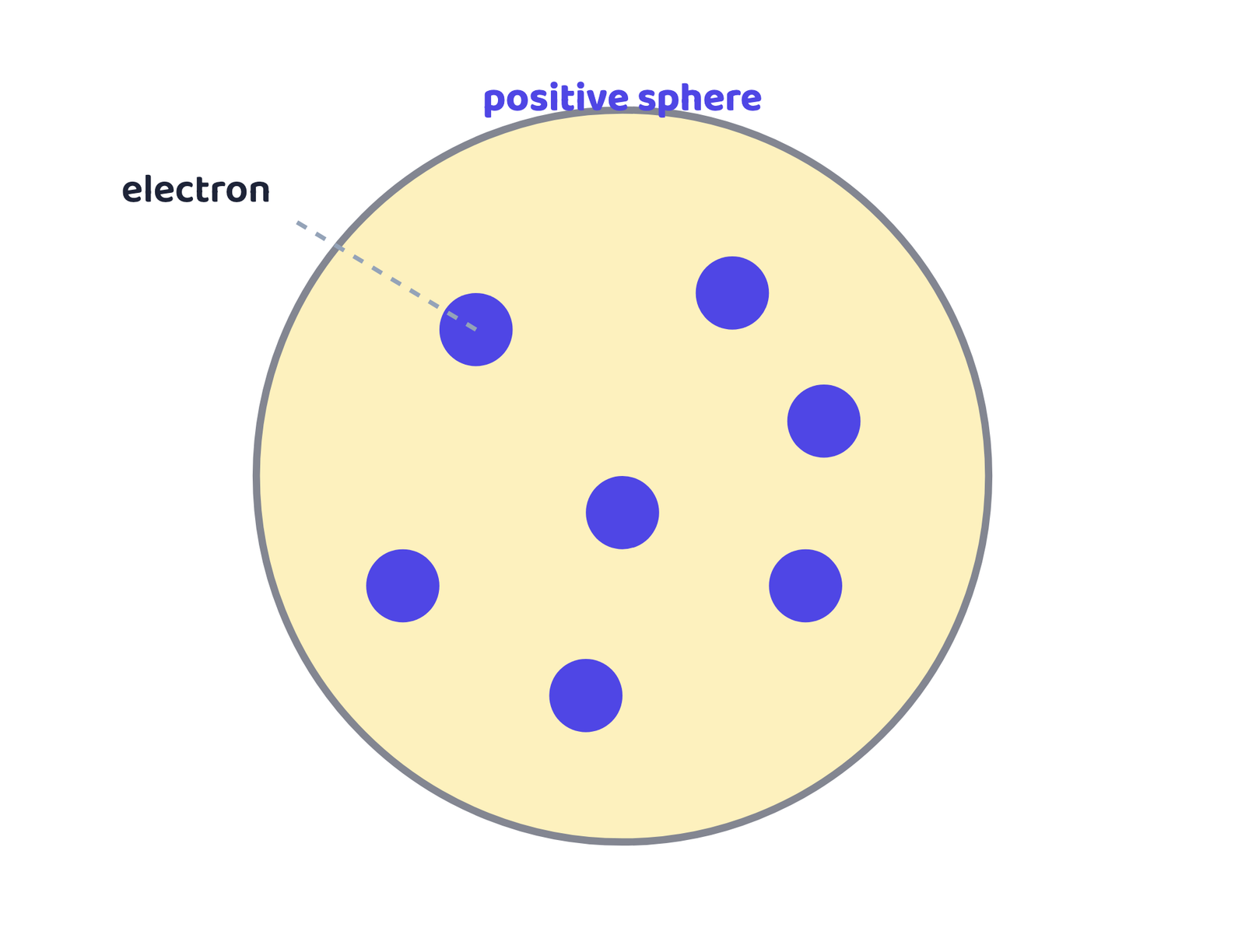
J. J. Thomson won the 1906 Nobel Prize in Physics for discovering the electron. As head of the Cavendish Laboratory at Cambridge, he mentored many scientists, including the one who would prove his own model wrong: Ernest Rutherford.
2.2 The gold foil experiment and Rutherford’s model
In 1911, Geiger and Marsden, working with Rutherford, fired alpha particles (tiny, positively charged particles) at extremely thin gold foil. If Thomson’s model was right, the spread-out positive charge should barely deflect them.
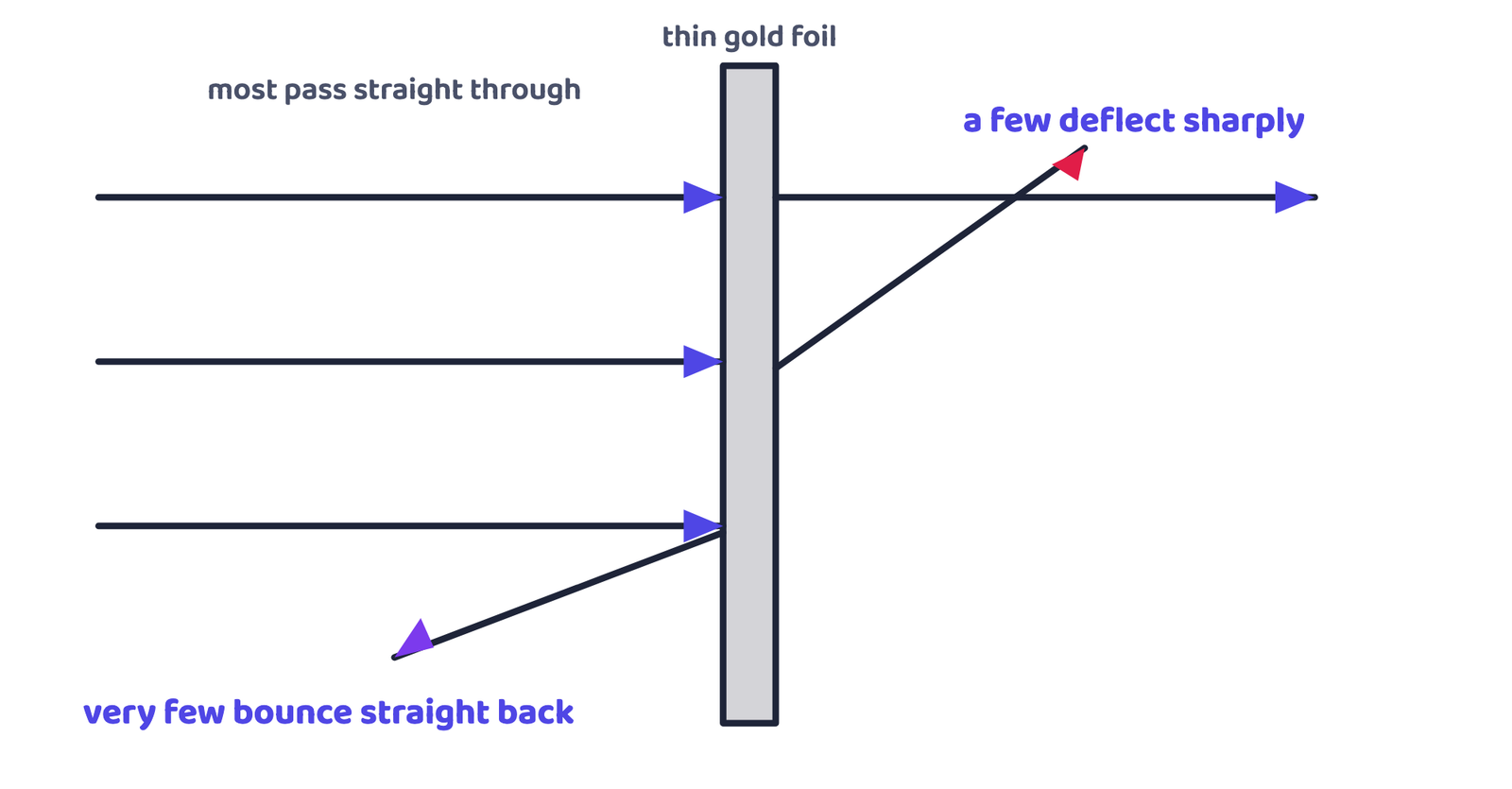
Most particles passed straight through, but a few deflected sharply and some bounced almost straight back. That was impossible under Thomson’s model, and it forced a new one.
Rutherford’s conclusions: an atom is mostly empty space; nearly all its mass and positive charge sit in an extremely small, dense nucleus at the centre; electrons orbit it like planets around the Sun.
A nucleus is about 100,000 times smaller than the whole atom.
If an atom were the size of a cricket ground (about 100 m across), the nucleus would be a single grain of black pepper at its very centre.
2.3 The proton, and the limits of Rutherford’s model
Rutherford also discovered the proton: much heavier than the electron, and carrying an equal but opposite charge. Since atoms are neutral, the number of protons always equals the number of electrons.
But Rutherford’s model had a serious flaw: an electron circling the nucleus is constantly changing direction, so it is constantly accelerating (as you learned in Chapter 4). An accelerating charge should lose energy continuously and spiral into the nucleus, collapsing the atom entirely. Real atoms clearly do not collapse, so something in the model had to be missing.
2.4 Bohr’s model
Niels Bohr solved this in 1913 by proposing that electrons do not lose energy in certain special orbits.
Electrons move only in fixed circular paths called shells, orbits or stationary states, each with a definite energy, called an energy level. An electron loses no energy while it stays in one shell.
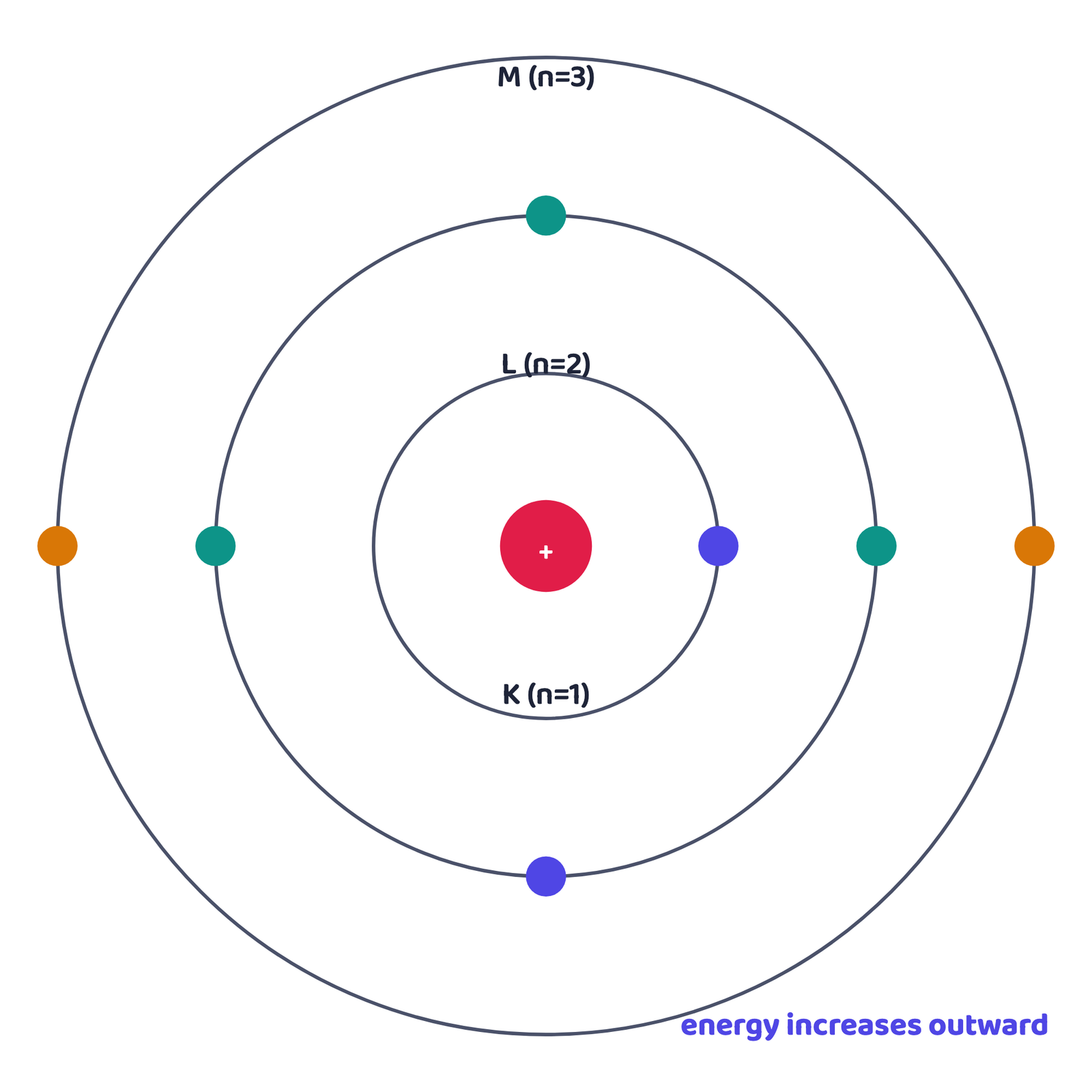
✓ Bohr’s model says
- Electrons move only in the allowed shells, never in between
- K shell (n=1) is closest and lowest energy
- Energy rises as shells go outward
- Moving shells needs a fixed jump of energy, absorbed or released
✗ Bohr’s model does not say
- Electrons drift anywhere around the nucleus
- Electrons lose energy while orbiting normally
- All shells hold the same number of electrons
The shells are named K, L, M, N… not A, B, C, D, because physicist Charles Barkla had already named an X-ray line “K”, leaving room in the alphabet in case an earlier series was ever found. Bohr borrowed the same letters for his shells. Bohr won the 1922 Nobel Prize for this atomic model.
3 What Makes Up an Atom’s Mass?
A puzzle remained: helium has 2 protons, but its mass is about 4 times that of hydrogen, not 2 times. Something else in the nucleus had to be adding mass without adding charge.
James Chadwick discovered the neutron in 1932: a particle with almost the same mass as a proton, but no electric charge. Neutrons are present in the nucleus of every atom except ordinary hydrogen (protium).
| Particle | Symbol | Relative charge | Location |
|---|---|---|---|
| Electron | e⁻ | −1 | Around the nucleus |
| Proton | p⁺ | +1 | In the nucleus |
| Neutron | n⁰ | 0 | In the nucleus |
Light atoms tend to have roughly equal protons and neutrons (carbon has 6 of each). Heavier atoms need proportionally more neutrons: iron has 26 protons but 30 neutrons, and uranium has 92 protons but 146 neutrons.
Every proton in the nucleus repels every other proton, since they all carry the same charge. Neutrons help hold the nucleus together, both by physically spacing the protons apart and by adding to the strong nuclear force that binds all the nucleons. That is exactly why heavier nuclei need extra neutrons to stay intact.
4 Symbols of Elements
By 1869, scientists knew 69 elements; today we know 118. Dalton gave the first pictorial symbols in 1803; Berzelius suggested Latin-based letter symbols in 1813, which IUPAC now standardises.
The first letter of a symbol is always capital, the second (if any) always lowercase: Al, not AL; Co, not CO. Some symbols come from Latin, Greek or German names rather than English: iron is Fe (Latin ferrum), mercury is Hg (Greek hydrargyros), tungsten is W (German wolfram).
5 Atomic Number and Mass Number
The atomic number () is the number of protons in an atom’s nucleus. Since atoms are neutral, it also equals the number of electrons.
The mass number () is the total number of protons and neutrons (together called nucleons) in the nucleus: . The electron’s mass is negligible in this count.
| Element | Protons | Neutrons | Mass number |
|---|---|---|---|
| Hydrogen | 1 | 0 | 1 |
| Helium | 2 | 2 | 4 |
| Lithium | 3 | 4 | 7 |
6 Electron Distribution in Shells
Bohr-Bury rules: a shell can hold a maximum of electrons ( = shell number); the outermost shell can hold at most 8 (or 2, if it is the only shell); shells fill in order, K then L then M then N, with the inner shell always completing first.
The way electrons fill these shells is called an atom’s electronic configuration, usually written as the count in each shell, K first: sodium is 2, 8, 1.
| Element | Symbol | Atomic number | Configuration (K, L, M) |
|---|---|---|---|
| Hydrogen | H | 1 | 1 |
| Helium | He | 2 | 2 |
| Carbon | C | 6 | 2, 4 |
| Oxygen | O | 8 | 2, 6 |
| Neon | Ne | 10 | 2, 8 |
| Sodium | Na | 11 | 2, 8, 1 |
| Chlorine | Cl | 17 | 2, 8, 7 |
| Argon | Ar | 18 | 2, 8, 8 |
7 Valency: An Atom’s Combining Capacity
The outermost shell that holds electrons is the valence shell; its electrons are valence electrons. Eight valence electrons form a stable octet (two, for an atom with only one shell), and atoms with a full octet are largely unreactive.
Valency is the number of electrons an atom gains, loses or shares to complete its octet. Fewer than 4 valence electrons → the atom tends to lose them; more than 4 → it tends to gain electrons instead.
Sodium: 2, 8, 1
One valence electron. Losing it reaches a stable octet, so sodium’s valency is 1.
Oxygen: 2, 6
Six valence electrons. Gaining two completes the octet, so oxygen’s valency is 2.
Carbon: 2, 4
Four valence electrons, exactly at the midpoint. It shares electrons instead of losing or gaining, giving it a valency of 4.
Valency is usually defined against hydrogen or chlorine, because both have valency 1. In water, , oxygen combines with two hydrogens, confirming oxygen’s valency of 2.
8 Isotopes and Isobars
Isotopes are atoms of the same element (same atomic number) with different mass numbers, because they carry different numbers of neutrons.
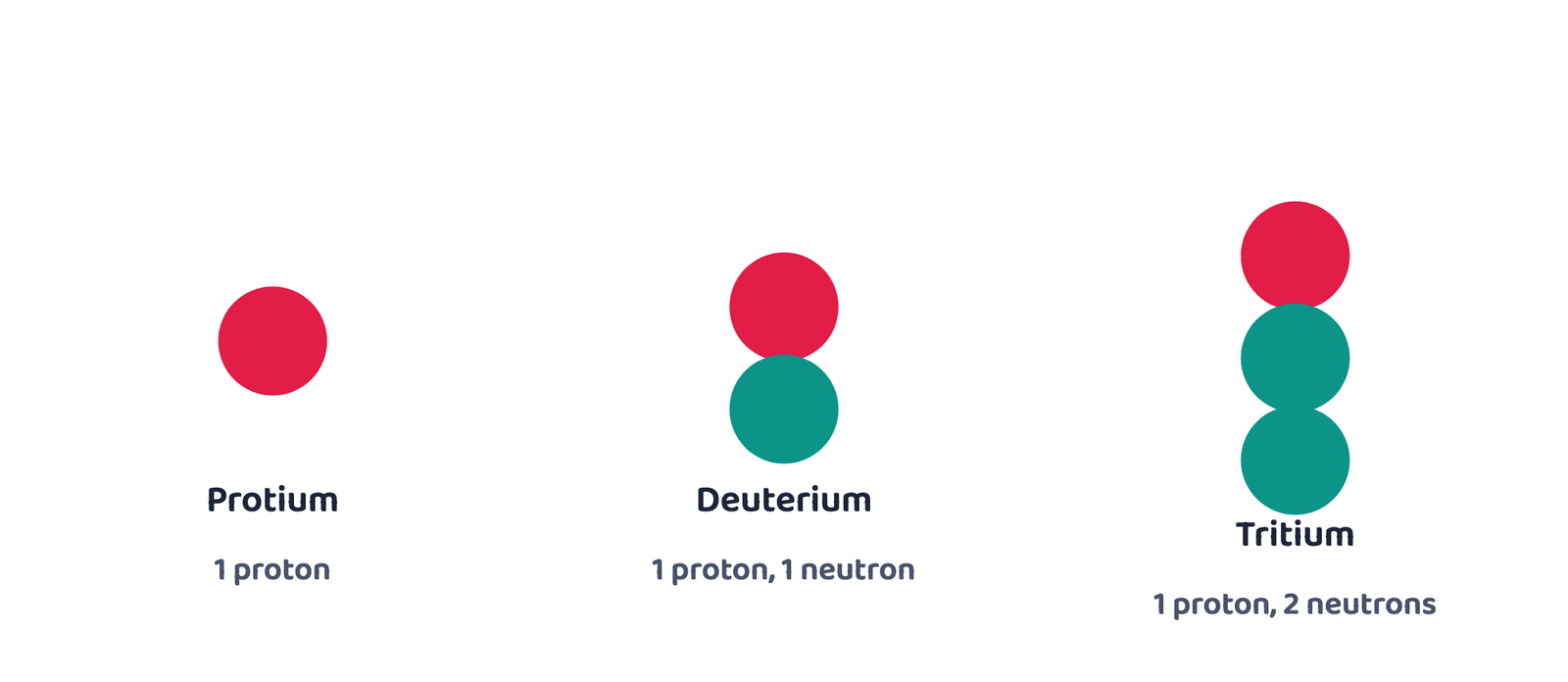
Isotopes have identical chemical properties, because chemistry depends on valence electrons, and isotopes have exactly the same electron count. Only their physical properties, like boiling and melting points, differ.
Isotopes have real everyday uses: Uranium-235 fuels nuclear power plants; Cobalt-60 treats cancer with radiation; Iodine-131 treats goitre and thyroid cancer; Carbon-14 dates ancient fossils and artefacts in archaeology.
An element’s atomic mass is a weighted average of its isotopes, not a simple average. Chlorine is 75% and 25% :
No single chlorine atom actually weighs 35.5 u; it is the average across a huge natural sample.
Isobars are atoms of different elements with the same mass number but different atomic numbers, such as calcium-40, potassium-40 and argon-40.
Isotopes and isobars are opposites of each other. Isotopes: same protons, different mass. Isobars: same mass, different protons. Mixing the two up is the single most common slip in this topic.
The story does not end with Bohr. Scientists later found that electrons do not really follow neat, fixed circular paths at all; today they are described as existing in “electron clouds”, regions where an electron is likely to be found, not an exact path. That quantum mechanical picture is one you will meet in higher classes.
Homi Jehangir Bhabha is called the father of the Indian nuclear programme. He founded the Tata Institute of Fundamental Research (TIFR) and the Bhabha Atomic Research Centre (BARC), which today uses its Dhruva reactor for neutron-scattering research into materials like superconductors and battery electrodes.
- Acharya Kanada’s parmanu and the Greek atomos were reasoned ideas; Dalton (1808) gave the first scientific atomic theory.
- Thomson discovered the electron and proposed the plum-pudding model: electrons in a positive sphere.
- The gold foil experiment showed a tiny, dense, positively charged nucleus, mostly surrounded by empty space.
- Rutherford’s model could not explain why electrons don’t spiral into the nucleus; Bohr fixed this with fixed energy shells.
- Shells fill in the order K, L, M, N, holding a maximum of electrons, with 8 as the outer-shell limit.
- Protons (+1), neutrons (0) and electrons (−1) are the three subatomic particles; Chadwick discovered the neutron in 1932.
- Atomic number = number of protons; mass number = protons + neutrons.
- Valency depends on valence electrons: fewer than 4 loses electrons, more than 4 gains them, exactly 4 shares them.
- Isotopes: same atomic number, different mass number. Isobars: same mass number, different atomic number.
- An element’s atomic mass is the weighted average of all its naturally occurring isotopes.
- 1 markWho discovered the electron, and by what experiment?
- 1 markDefine atomic number.
- 1 markWhat is the maximum number of electrons the L shell can hold?
- 1 markName the scientist who discovered the neutron, and the year.
- 1 markWhat is an octet?
- 1 markWrite the standard notation for an atom with atomic number 6 and mass number 12.
- 1 markWhat is the relative charge of a neutron?
- 1 markName one isotope of carbon.
- 3 marksDescribe the gold foil experiment and the three key observations it produced.
- 3 marksExplain why Rutherford’s model could not account for the stability of atoms.
- 2 marksAn atom has 12 protons and 12 neutrons. Find its atomic number and mass number.
- 3 marksWrite the electronic configuration of atomic numbers 12, 16 and 18, and state each element’s valency.
- 2 marksDistinguish between isotopes and isobars with one example each.
- 3 marksChlorine has isotopes of mass 35 u (75%) and 37 u (25%). Calculate its average atomic mass.
- 2 marksWhy do the isotopes of an element show identical chemical properties?
- 3 marksState three rules that govern how electrons are distributed among shells (Bohr-Bury rules).
- 2 marksWhy does sodium have a valency of 1, while oxygen has a valency of 2?
- 3 marksAn atom X has 11 electrons and a mass number of 23. Identify the element and find the number of neutrons.
- 5 marksDescribe, in chronological order, how the atomic model evolved from Dalton to Bohr, stating one key idea and one key limitation of each.
- 5 marksFor a magnesium atom (mass number 24, atomic number 12), find the number of protons, neutrons and electrons, and draw its shell diagram.
- 5 marksExplain valency using electronic configuration, with worked examples of an element that loses, one that gains, and one that shares electrons.
- 5 marksExplain the discovery of the neutron and why it was necessary to explain atomic mass.
- 5 marksComplete a table for five atoms giving atomic number, mass number, protons, neutrons and electrons, given partial data for each.
- 1 markWhat is the mass number of X?
- 2 marksWhat is the relationship between Y and Z? Explain.
- 2 marksAre X and Y isotopes, isobars, or neither? Explain your reasoning.
- 1 markThe gold foil experiment was conducted under the guidance of:
(a) J. J. Thomson(b) Ernest Rutherford(c) Niels Bohr(d) John Dalton - 1 markThe maximum number of electrons in the M shell is:
(a) 2(b) 8(c) 18(d) 32 - 1 markIsotopes of an element differ in their number of:
(a) protons(b) electrons(c) neutrons(d) valence electrons - 1 markThe valency of carbon (electronic configuration 2, 4) is:
(a) 2(b) 4(c) 6(d) 8 - 1 markCalcium-40, potassium-40 and argon-40 are examples of:
(a) isotopes(b) isobars(c) isomers(d) allotropes - 1 markThe symbol for iron, Fe, comes from its:
(a) English name(b) Latin name(c) Greek name(d) German name - 1 markAn atom is electrically neutral because:
(a) it has no protons(b) protons equal electrons(c) it has no neutrons(d) neutrons equal electrons
Choose: (a) both A and R true, R explains A; (b) both true, R does not explain A; (c) A true, R false; (d) A false, R true.
Reason (R): A few alpha particles bounced back sharply from the gold foil.
Reason (R): Isotopes have the same number of valence electrons.
Reason (R): Sodium’s electronic configuration is 2, 8, 1.