
1 Work Done by a Constant Force
Lift a 5 kg wheat bag 1 m off the floor, and you would say you “did work”. Lift three such bags to the same height, and you have done three times as much work. Lift one bag three times as high instead, and you have again done three times as much work. Both observations point to the same rule.
Work done by a constant force on an object that is displaced a distance in the direction of the force is .
Always name both the agency doing the work and the object it is done on. “Work done by the boy on the wheelchair” is a complete answer; “work was done” is not.
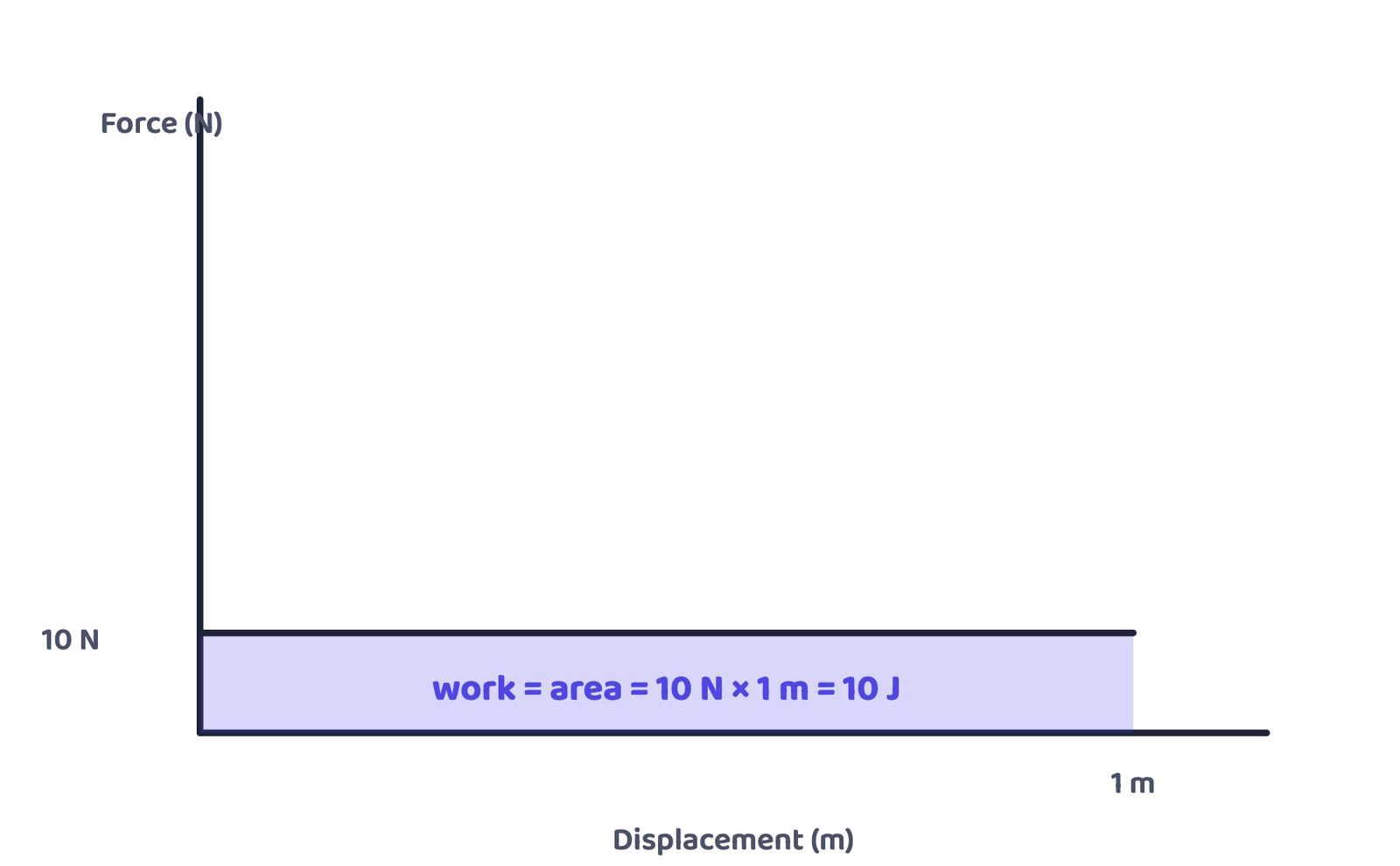
1.1 When is work zero?
✓ Work is done when
- A force acts on the object
- The object is displaced
- That displacement has a component in the direction of the force
✗ Work is zero when
- No force acts ()
- No displacement occurs (), like pushing a rigid wall
- The force is perpendicular to the displacement, like a girl carrying a box she also walks with
Pushing a wall makes your muscles tired, but if the wall does not move, you have done zero work on it in the scientific sense. Feeling tired and doing work are not the same thing.
1.2 Positive and negative work
Positive work
- Force and displacement point the same way
- e.g. pushing a wheelchair forward
- The object gains energy
Negative work
- Force and displacement point opposite ways
- e.g. a goalkeeper stopping a ball
- The object loses energy
Q. While exercising, a girl lifts a dumbbell and lowers it back down. When does she do positive work, and when negative?
Lifting: force and displacement both point up, so this is positive work.
Lowering: her hand still pushes up to hold the weight, but the displacement is downward, so this is negative work.
Q. A goalkeeper’s hand moves back 15 cm while stopping a ball with a force of 200 N. Find the work done on the ball.
The displacement is opposite to the applied force, so it is taken as negative:
J
2 The Work-Energy Theorem
A thrown cricket ball can knock over a wicket; a flowerpot dropped from a height can damage whatever it lands on. Both have gained the capacity to do work, which is what it means to possess energy.
The work-energy theorem: the work done on an object equals the change in its energy.
This holds for a system of objects too, and even when the force is not constant. Energy shares work’s SI unit, the joule (J).
The joule is named after James Prescott Joule, who studied how mechanical and thermal energy convert into each other. Mechanical work is only one way to transfer energy; it also moves as heat, as radiation (like sunlight reaching Earth), as sound, through electric circuits, and in nuclear reactions.
Q. In carrom, a striker hits a white coin, which then hits the black coin. Who does work, and what happens to the energy?
The striker does positive work on the white coin (force along its displacement), gaining it energy. By Newton’s third law, the white coin does negative work back on the striker. The white coin then does positive work on the black coin, and receives negative work in return, in the same pattern.
3 Forms of Energy
Energy shows up as mechanical, thermal, light, sound, chemical, electrical and nuclear energy, and constantly converts between forms: electrical energy becomes light in a bulb and heat in a water heater; chemical energy in food becomes the mechanical energy of your muscles; a ringing bell turns mechanical energy into sound.
4 Mechanical Energy
Mechanical energy is the energy an object has because of its motion or its position. That splits it into two parts.
4.1 Kinetic energy
Kinetic energy is the energy an object possesses because it is moving. An object at rest has zero kinetic energy.
Starting from rest, the work-energy theorem says the work a force does on an object equals the kinetic energy it gains. Combining with and the kinematic equation gives:
Q. If a vehicle’s velocity doubles, what happens to its kinetic energy?
4 times the original
Q. A 0.2 kg cricket ball is bowled at 154.8 km/h (= 43 m/s). Find its kinetic energy.
184.9 J
Given
15,000 kg jet, arrestor wire force 367,500 N, stopping distance 100 m
To find
Landing velocity
Work done by the wire (force opposite to motion) J
By the work-energy theorem, this equals the change in kinetic energy:
Solving, 70 m/s (252 km/h)
4.2 Potential energy
A stretched slingshot, a drawn bow, a compressed spring: release any of them and they set something else moving, giving it kinetic energy it did not have before. That energy had to come from somewhere, and it came from the work done earlier to deform the band, bow or spring.
Potential energy is energy stored by an object due to its deformation, or by a system of objects due to their relative positions.
Separated magnets, separated charges and a ball lifted away from the Earth all store energy this way too: work done against an internal force (gravitational, electric or magnetic) is stored, and released as kinetic energy when the objects are allowed to come back together.
Not every internal force stores energy this way. Work done against friction does not become potential energy; it is lost, mostly as heat.
Since the Earth is far more massive than any object near it, the Earth barely moves, so the stored energy of an Earth-object system is simply called the object’s gravitational potential energy.
Q. A fielder throws a 200 g ball 10 m straight up in celebration. Find its potential energy at the top ().
20 J
4.3 Conservation of mechanical energy
Mechanical energy is the sum of kinetic and potential energy: . When only gravity acts, mechanical energy stays constant: this is the conservation of mechanical energy.
Drop an object from height : at the top, . Partway down, some height is lost and some speed is gained, but the two changes exactly cancel, so stays throughout the fall. A swinging pendulum shows the same thing: released from height on one side, it has only potential energy; at the bottom it has only kinetic energy; on the far side it climbs back to almost the same height, converting that kinetic energy back to potential. In real life it slowly loses height because friction and air resistance drain away a little mechanical energy on every swing.
Conservation of mechanical energy is often a shortcut. It can hand you a final speed or position directly, without working through every intermediate step of the motion the way Newton’s laws would require.
Q. Find the speed of a child at the bottom of a slide of height , ignoring friction.
All the potential energy converts to kinetic energy:
The mass cancels out, so the speed depends only on the height, not on the child’s mass or the slide’s shape.
Given
10,000 kg truck at 72 km/h (=20 m/s), 30° escape ramp, sand resists with 50,000 N
To find
Minimum ramp length to stop the truck (rises 1 m for every 2 m travelled)
Initial KE J. Height gained , so PE gained .
Work-energy theorem: loss in KE = work done against sand + gain in PE
20 m
5 Power
Carrying a bag up the stairs in one minute feels very different from carrying it up slowly in five, even though the work done is identical. That difference is power.
Power is the rate at which work is done: . Its SI unit is the watt (W), where .
The watt is named after James Watt, who built an efficient steam engine. Horsepower (hp), still used for car engines and pumps, equals 746 W; it comes from early engineers comparing their new engines to the real horses they were replacing.
Q. A weightlifter raises 75 kg by 2 m in 5 s. Find the power required ().
J 300 W
Q. A 1000 kg car accelerates from rest to 20 m/s in 10 s. Find the engine’s power.
J 20,000 W
6 Simple Machines
A machine cannot reduce the total work a task needs, but it can make that work easier by changing the magnitude or direction of the force you apply.
The force you apply is the effort; the force you are working against is the load. Mechanical advantage .
6.1 Pulley
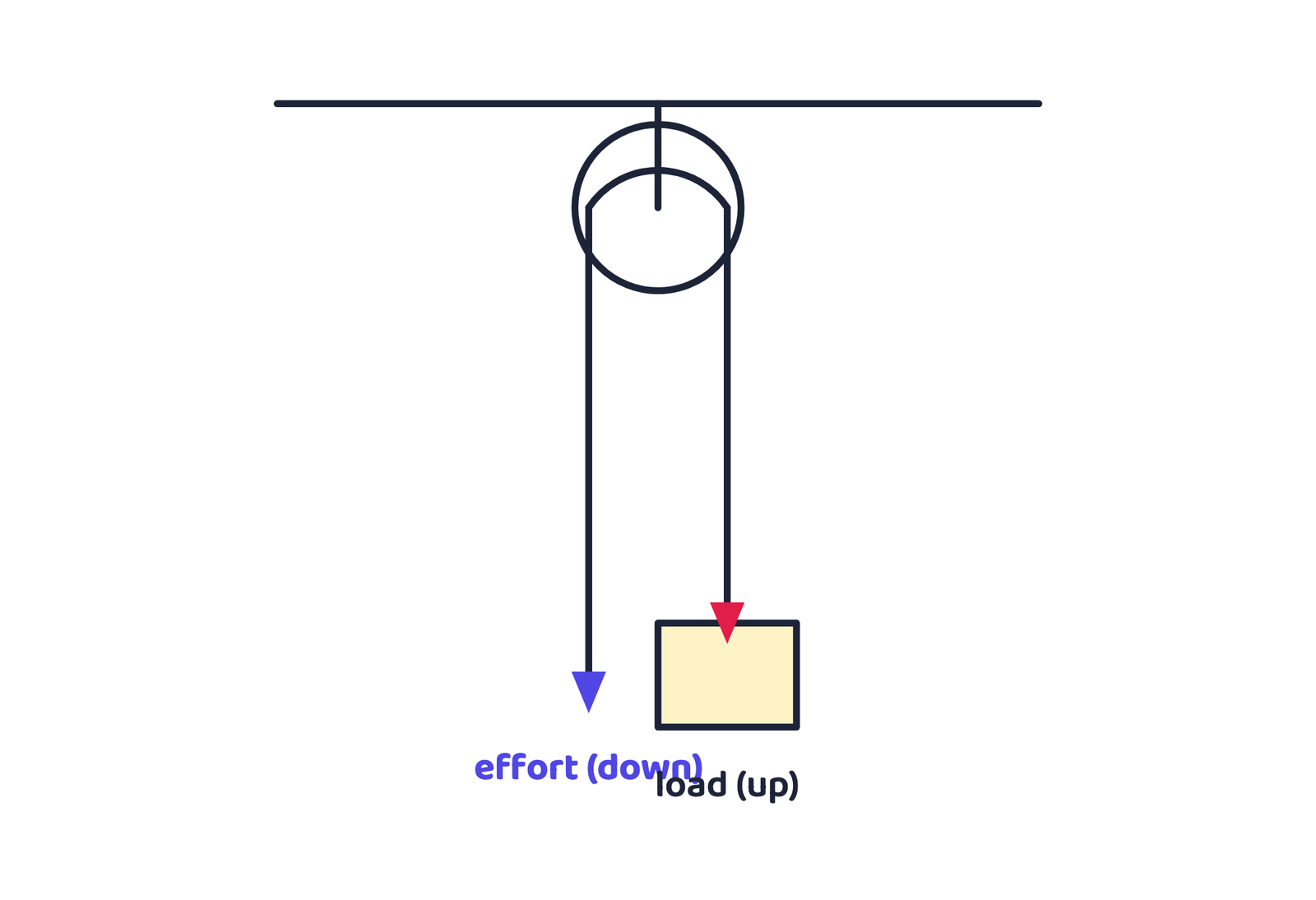
A fixed pulley lets you pull down instead of lifting straight up, which is often more convenient, but the effort still equals the load: mechanical advantage . A movable pulley or a system of pulleys can give mechanical advantage greater than 1, lifting a heavy load with a much smaller effort. This is why elevators and cranes rely on pulley systems.
6.2 Inclined plane
Pushing a box up a shallow ramp needs less force than lifting it straight up, but you push it a longer distance to reach the same height. Work stays the same either way.
Since on any real ramp, , and mechanical advantage is always greater than 1. A longer, shallower ramp needs even less force. This is exactly why hill roads wind gradually instead of climbing straight up, and why an inclined ladder is easier to climb than a vertical one.
Q. A ramp raises an object over a 30 cm step; the ramp’s horizontal width is 40 cm. Find its mechanical advantage.
The ramp length (hypotenuse) cm.
1.67
6.3 Lever
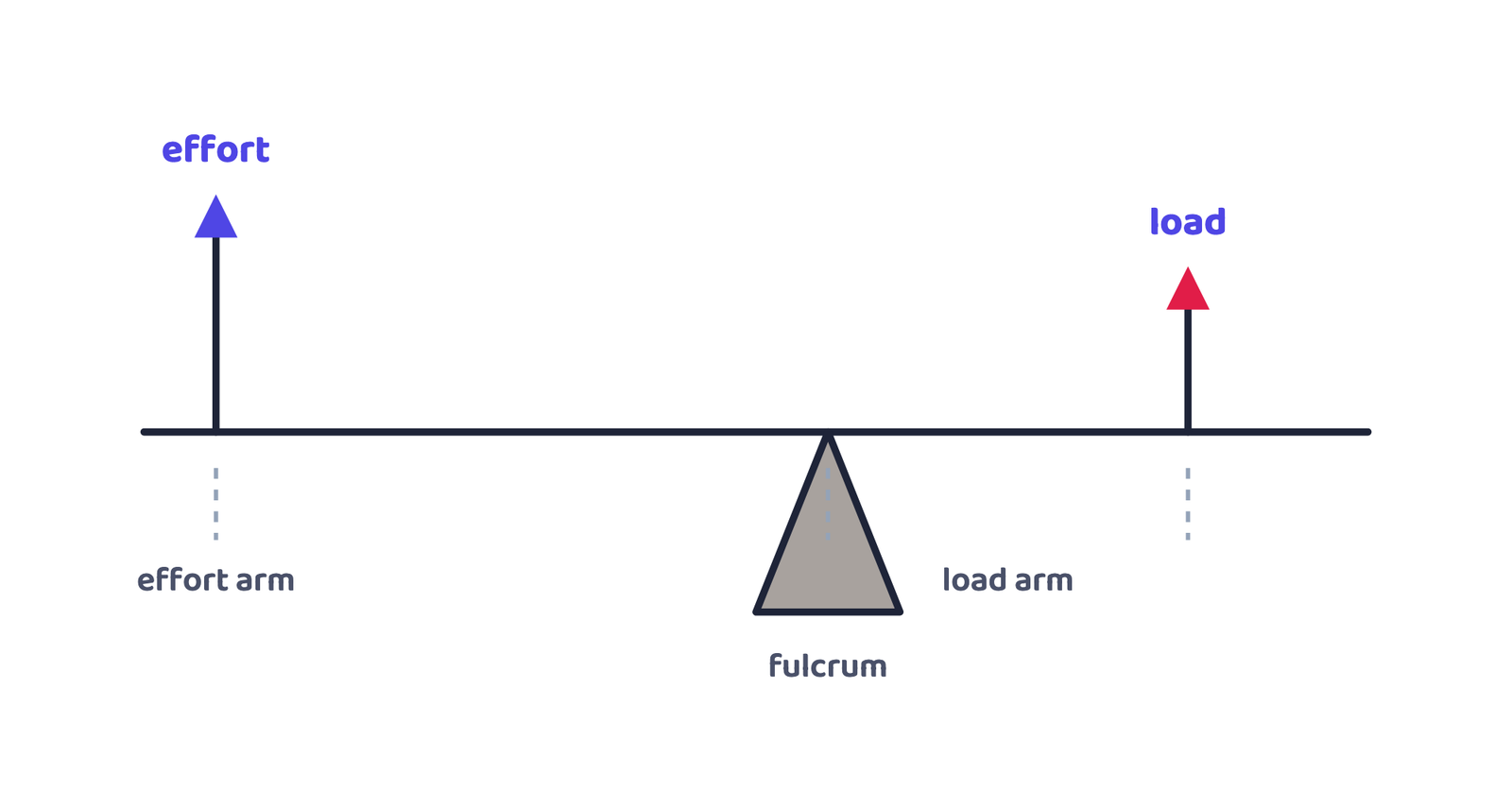
Q. On a seesaw, a 15 kg child sits 2 m from the fulcrum. Where must a 30 kg child sit to balance it?
1 m from the fulcrum
| Class | Arrangement | Examples |
|---|---|---|
| Class I | Fulcrum in between load and effort | Scissors, seesaw, pliers, crowbar |
| Class II | Load in between fulcrum and effort | Wheelbarrow, bottle opener, lemon squeezer |
| Class III | Effort in between fulcrum and load | Tweezers, broom, oar, fishing rod |
A lever, ramp or pulley reduces the effort needed, never the total work done. Machines redirect and rescale force; they never create energy.
A traditional Himalayan watermill, the gharat or panchakki, converts a stream’s potential energy into kinetic energy as it drops down a pipe, spinning a wheel that drives a grinding stone. Modern hydroelectric dams work on exactly the same principle, at a much larger scale.
- Work , only counting displacement along the force’s own direction.
- Work is zero if there is no force, no displacement, or the force is perpendicular to the displacement.
- The work-energy theorem: work done on an object equals the change in its energy.
- Kinetic energy ; potential energy (gravitational) .
- Mechanical energy stays constant when only gravity does work.
- Power , measured in watts; .
- Mechanical advantage = load ÷ effort; simple machines change force, never total work.
- A fixed pulley only changes direction (MA = 1); a longer incline or effort arm reduces the effort needed.
- Levers fall into three classes, based on where the fulcrum, load and effort sit relative to each other.
- 1 markDefine work done by a constant force.
- 1 markWrite the formula for kinetic energy.
- 1 markWhat is the SI unit of power?
- 1 markState the work-energy theorem.
- 1 markWhat is mechanical advantage?
- 1 markGive one example each of a Class I and a Class II lever.
- 1 markWhat is the mechanical advantage of a fixed pulley?
- 1 markIs work done when a coolie carries a box horizontally on his head? Why?
- 2 marksA weightlifter holds a barbell steady above her head. Is she doing any work on it? Explain.
- 3 marksA 0.2 kg ball is thrown 10 m straight up. Find its potential energy at the top ().
- 3 marksIf a vehicle’s speed is tripled, by what factor does its kinetic energy increase? Show your working.
- 2 marksWhy do hill roads wind around in gentle slopes instead of climbing straight up?
- 3 marksA weightlifter raises 75 kg by 2 m in 5 s. Find the work done and the power required.
- 2 marksState two examples each of positive and negative work done in daily life.
- 3 marksExplain, with an example, why work done against friction is not stored as potential energy.
- 3 marksA ramp raises an object over a 30 cm step and has a horizontal width of 40 cm. Find its mechanical advantage.
- 2 marksWhat is the difference between a fixed pulley and a movable pulley in terms of mechanical advantage?
- 3 marksOn a seesaw, a 15 kg child sits 2 m from the fulcrum. Where should a 30 kg child sit to balance it?
- 5 marksDerive the expression for kinetic energy using the work-energy theorem and the kinematic equations.
- 5 marksDerive the expression for gravitational potential energy, and state the conservation of mechanical energy with an example.
- 5 marksA 15,000 kg jet lands and is stopped in 100 m by an arrestor wire exerting 367,500 N. Find its landing speed.
- 5 marksExplain the three classes of levers with one labelled diagram and one real-life example for each class.
- 5 marksA 1000 kg car accelerates from rest to 72 km/h in 10 s. Find the work done by the engine and the power required.
- 1 markWhat is the truck’s initial kinetic energy?
- 2 marksIf the truck travels a distance along the ramp, write an expression for the height gained.
- 2 marksUsing the work-energy theorem, find the minimum ramp length needed to stop the truck.
- 1 markThe SI unit of work and energy is:
(a) newton(b) watt(c) joule(d) pascal - 1 markWork done is zero when:
(a) force and displacement are parallel(b) force is perpendicular to displacement(c) force and displacement are both large(d) never - 1 markIf the height of a falling object doubles, its potential energy at that height:
(a) stays the same(b) doubles(c) quadruples(d) halves - 1 markA fixed pulley has a mechanical advantage of:
(a) 0(b) 1(c) greater than 1(d) less than 1 - 1 markScissors are an example of a lever of:
(a) Class I(b) Class II(c) Class III(d) none of these - 1 mark1 horsepower equals:
(a) 100 W(b) 746 W(c) 1000 W(d) 550 W - 1 markA pendulum bob at its lowest point has:
(a) only potential energy(b) only kinetic energy(c) zero mechanical energy(d) neither kinetic nor potential energy
Choose: (a) both A and R true, R explains A; (b) both true, R does not explain A; (c) A true, R false; (d) A false, R true.
Reason (R): The wall does not undergo any displacement.
Reason (R): Its kinetic energy and potential energy both stay constant during the fall.
Reason (R): The length of the incline is greater than the height raised.