
1 The Atmosphere: Composition and Structure
Look up at the sky and you see clouds, sunshine, and feel the breeze on your face. All of this happens because the Earth is wrapped in a thick blanket of gases held in place by gravity, the force that pulls everything down towards the Earth. This blanket is called the atmosphere. It shields us from the Sun’s harmful ultraviolet rays, keeps the planet warm by trapping some of the Sun’s heat, and is the reason we have weather and climate at all.
The atmosphere is the layer of gases surrounding the Earth, held in place by gravity. It is essential for the survival of all living beings and regulates the Earth’s temperature and weather.
1.1 What is the air made of?
The atmosphere is a mixture of gases. Nitrogen and oxygen make up almost all of it; the rest is a small mix of other gases, plus water vapour and dust that vary from place to place.
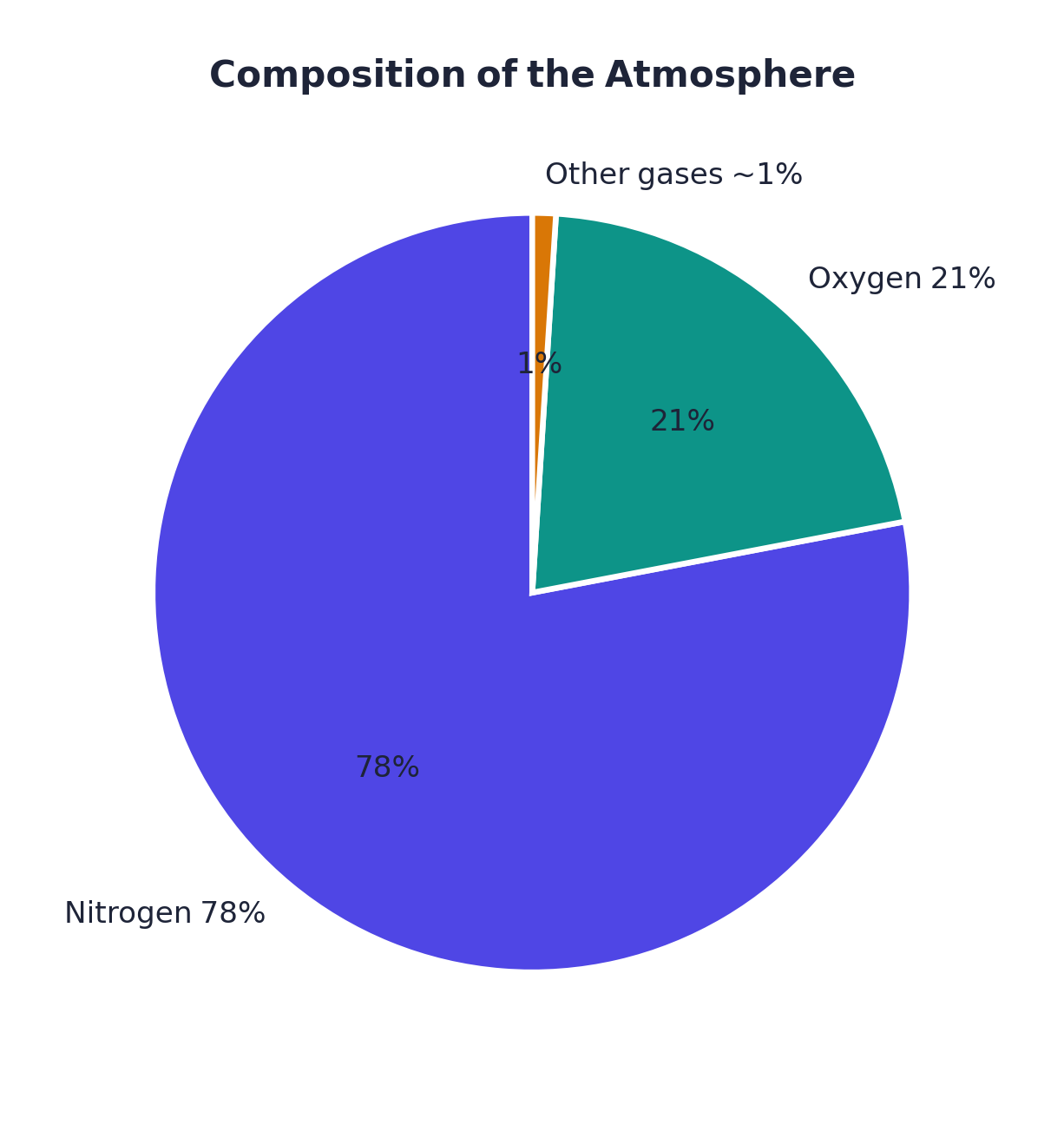
| The “other gases” slice, in full | Share |
|---|---|
| Argon | 0.93% |
| Carbon dioxide | 0.04% |
| Helium, neon, krypton, xenon, ozone, hydrogen | 0.03% |
Water vapour is not shown in the pie chart because it varies (about 0.1% to 0.4% of the air) rather than staying fixed like the other gases. It is the gas responsible for cloud formation and precipitation. The atmosphere also carries tiny dust particles, and its exact composition changes with altitude.
1.2 The five layers of the atmosphere
The atmosphere is not the same all the way up. It is divided into five layers based on how temperature and density change with increasing altitude (height above sea level). Density is highest close to the Earth’s surface and falls as you go higher.
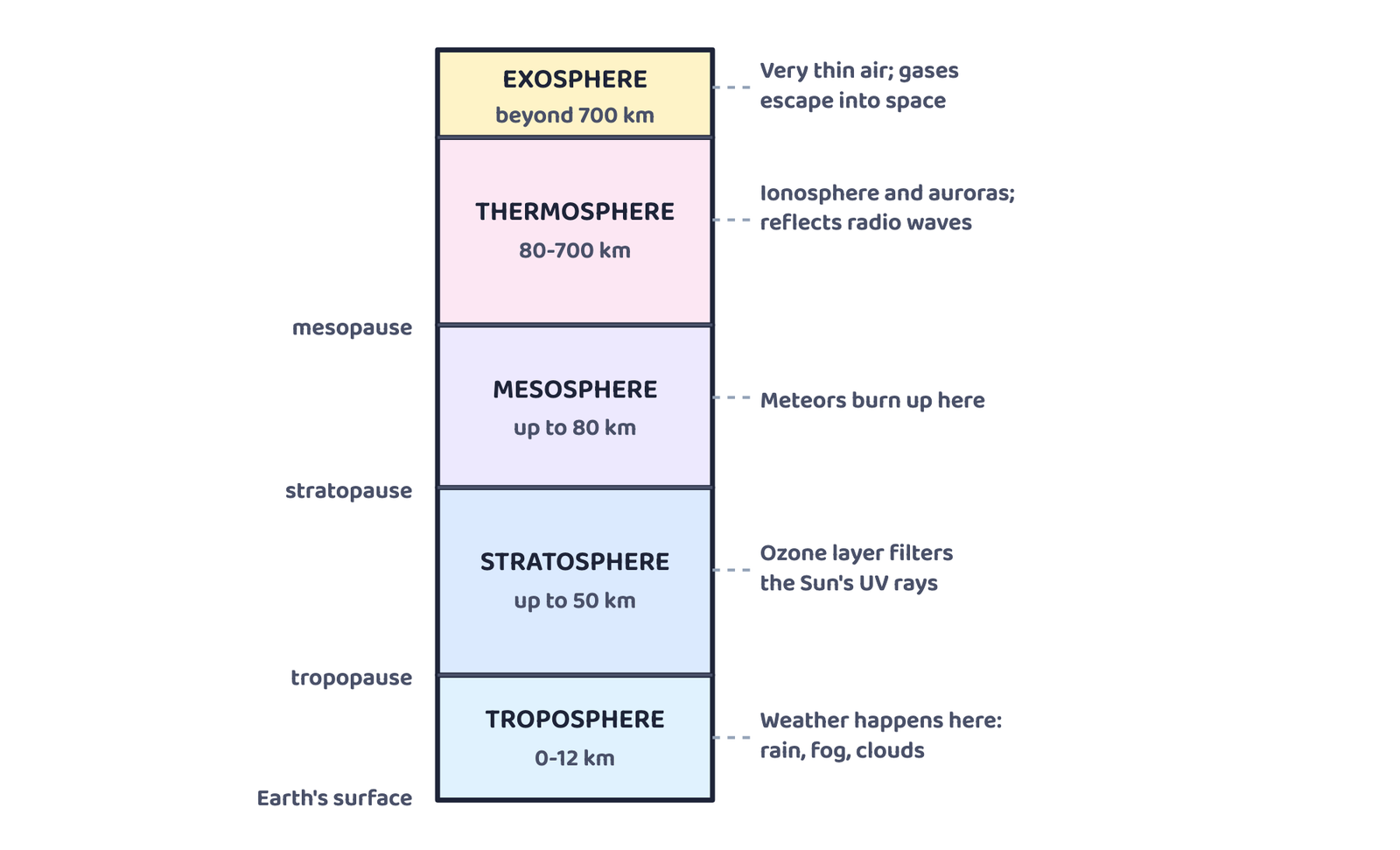
| Layer | Height | Temperature trend | Key facts |
|---|---|---|---|
| Troposphere | 0-12 km (average) | Decreases with altitude | Air we breathe, most water vapour and clouds; almost all weather occurs here |
| Stratosphere | up to 50 km | Rises with altitude | Free of clouds, so ideal for aircraft; contains the ozone layer |
| Mesosphere | up to 80 km | Decreases with altitude | Coldest layer; most meteorites entering from space burn up here |
| Thermosphere | 80-700 km | Rises very rapidly | Absorbs X-rays and UV rays; contains the ionosphere; auroras occur here |
| Exosphere | beyond 700 km | Merges into space | Uppermost, extremely thin air; light gases like helium and hydrogen escape |
Do not assume temperature always falls as you go up. It decreases with altitude only in the troposphere and mesosphere. In the stratosphere and thermosphere, temperature actually rises with altitude.
The ozone layer is a layer of ozone gas found in the stratosphere. It protects living beings by filtering out most of the Sun’s harmful ultraviolet radiation.
Auroras, the glowing lights seen near the poles, happen in the thermosphere. Charged particles from the Sun (the “solar wind”) are pulled towards the Earth’s magnetic poles, where they make atmospheric gases glow in colour. This is called the Aurora Borealis in the Northern Hemisphere and the Aurora Australis in the Southern Hemisphere.
2 Weather and Climate
You have probably asked “is it going to rain today?” and also “which months are the hottest here?” These are two different kinds of questions, and geography gives them two different names.
Weather is the hour-to-hour and day-to-day condition of the atmosphere at a place. It can change quickly and often.
Climate is the average weather condition of a place over a long period, usually thirty years or more, taken over a large area.
Weather
- Changes hour to hour, day to day
- Describes short-term conditions at one place
- “It rained this afternoon”
Climate
- Averaged over 30+ years
- Describes the general pattern over a large area
- “This region has hot, wet summers”
3 Elements of Weather and Climate
Five elements together decide what the weather and climate of a place will be: temperature, humidity, precipitation, atmospheric pressure and wind.
3.1 Temperature and insolation
Temperature varies between day and night, and between seasons. The biggest reason for this is insolation, the incoming energy from the Sun. Insolation is highest at the equator and decreases towards the poles, so temperature falls as you move from the equator towards the poles.
Insolation is the incoming solar energy from the Sun that is intercepted by the Earth. It decreases from the equator towards the poles.
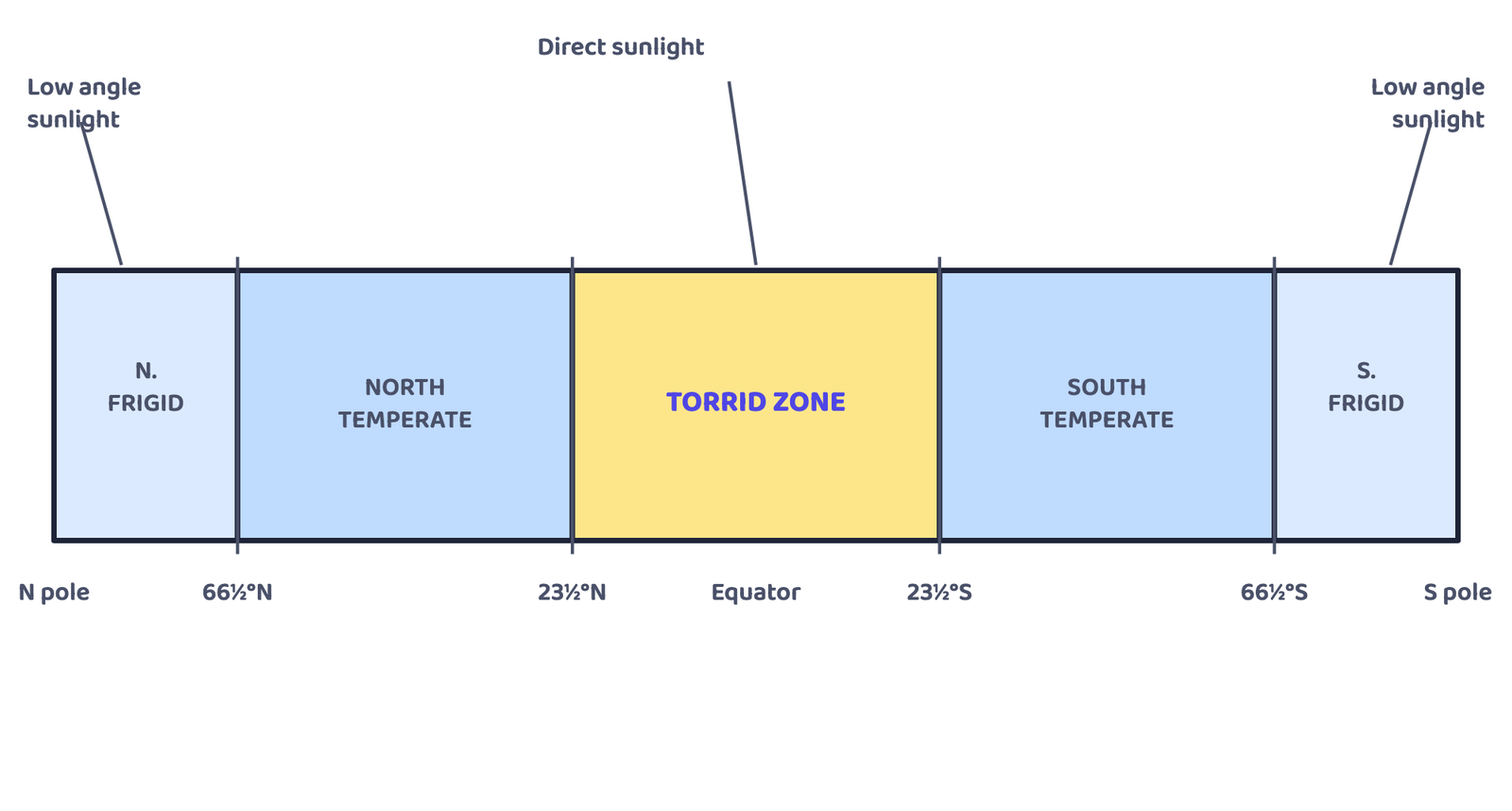
| Zone | Location |
|---|---|
| Torrid Zone | Between the Tropic of Cancer (23½°N) and the Tropic of Capricorn (23½°S) |
| North / South Temperate Zone | Between the Tropic and the Arctic / Antarctic Circle (23½° to 66½°) |
| North / South Frigid Zone | Beyond the Arctic Circle (66½°N) / Antarctic Circle (66½°S) |
3.2 Humidity
When water evaporates from land and water bodies, it becomes water vapour in the air. The presence of this water vapour is called humidity. Warmer air can hold more water vapour, so humidity is usually higher on hot days. On a very humid day, clothes take longer to dry and sweat evaporates more slowly, which is why the air feels uncomfortable.
3.3 Precipitation
Precipitation occurs when the atmosphere becomes saturated with water vapour, which condenses and falls to the Earth due to gravity. It includes drizzle, rain, snow, sleet and hail.
Rain, water falling in liquid form, is the most common kind of precipitation and it lowers the temperature of a place. Prevailing winds, mountains and the season all affect how much precipitation a place gets. A long spell without rain leads to a dry climate, and most groundwater is recharged by rainwater.
3.4 Atmospheric pressure and wind
Atmospheric pressure (air pressure) is the pressure exerted by the weight of air on the Earth’s surface. It is highest at sea level and falls rapidly as altitude increases.
Air presses on your body from every side, all the time, yet you never feel it. That is because your body pushes back with an equal counter-pressure, so the two cancel out.
Where a place is hot, air heats up and rises, creating a low-pressure area, usually linked to cloudy skies and wet weather. Where a place is cold, air is heavy and sinks, creating a high-pressure area, linked to clear, sunny skies. Air always moves from high pressure to low pressure, and this moving air is wind.
Wind is the movement of air from a high-pressure area to a low-pressure area. Winds are named after the direction they blow from, so a wind blowing from the west is called a westerly.
| Wind | Speed (km/hr) | Common effects |
|---|---|---|
| Calm | 0-1 | Calm air; smoke rises straight up |
| Light breeze | 6-11 | Felt on the face; leaves rustle; an ordinary vane starts to move |
| Strong breeze | 39-49 | Large branches sway; umbrellas become hard to use |
| Storm | 103-117 | Rare; usually causes widespread damage |
Local winds: sea breeze and land breeze
Along the coast, the land and the sea heat up and cool down at different rates, and this creates two small daily winds that moderate the local climate.
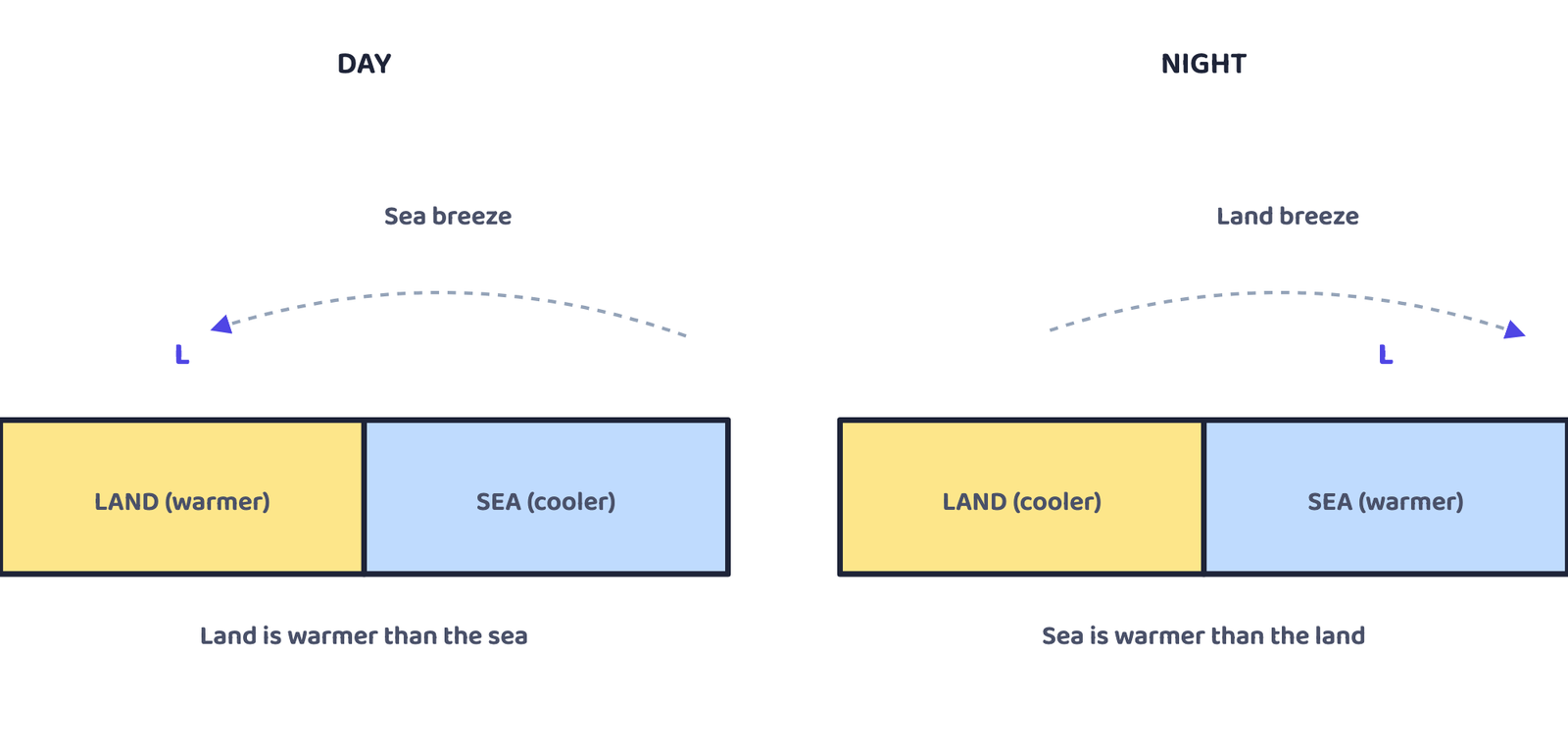
Sea breeze
- Blows during the day, especially afternoon
- From sea to land
- Land is warmer, so a low-pressure area forms over land
Land breeze
- Blows at night
- From land to sea
- Land cools faster than the sea; a smaller temperature difference means lower wind speed
4 Seasons in India
India’s climate is broadly a tropical monsoon type. The Indian Meteorological Department (IMD) recognises four main seasons through the year.
The Himalayan states are more temperate and experience two extra seasons, autumn and spring, in addition to these four.
4.1 Traditional Indian seasons (Ṛtu)
India has traditionally recognised six seasons of about two months each, based on the astronomical division of the year into six parts. The traditional Indian calendar reflects this arrangement of months too.
| Season (Ṛtu) | Indian calendar months | Gregorian months |
|---|---|---|
| Vasanta (spring) | Chaitra-Vaiśhākha | March-April |
| Grīṣhma (summer) | Jyeṣhṭha-Āṣhāḍha | May-June |
| Varṣhā (monsoon) | Śhrāvaṇa-Bhādrapada | July-August |
| Śharad (early autumn) | Āśhvina-Kārtika | September-October |
| Hemanta (late autumn) | Mārgaśhīrṣha-Pauṣha | November-December |
| Śhiśhira (winter) | Māgha-Phālguna | January-February |
Kauṭilya’s Arthaśhāstra records scientific measurements of rainfall and describes how this data was used in managing the country’s revenue and relief efforts.
5 The Monsoon
The monsoon is the seasonal reversal of wind direction during the year. The word comes from the Arabic mausim, meaning “season”, a name given by Arab traders who noticed the pattern while sailing to India.
Ancient Indians tracked the monsoon closely because farming depended on it. Kṛiṣhiparāśhara and Varāhamihira’s Bṛihatsaṁhitā describe rainfall-prediction methods based on the positions of the Sun and Moon. Kālidāsa’s Meghadūtam, written around the 5th century CE, even traces the path of the monsoon clouds across central India.
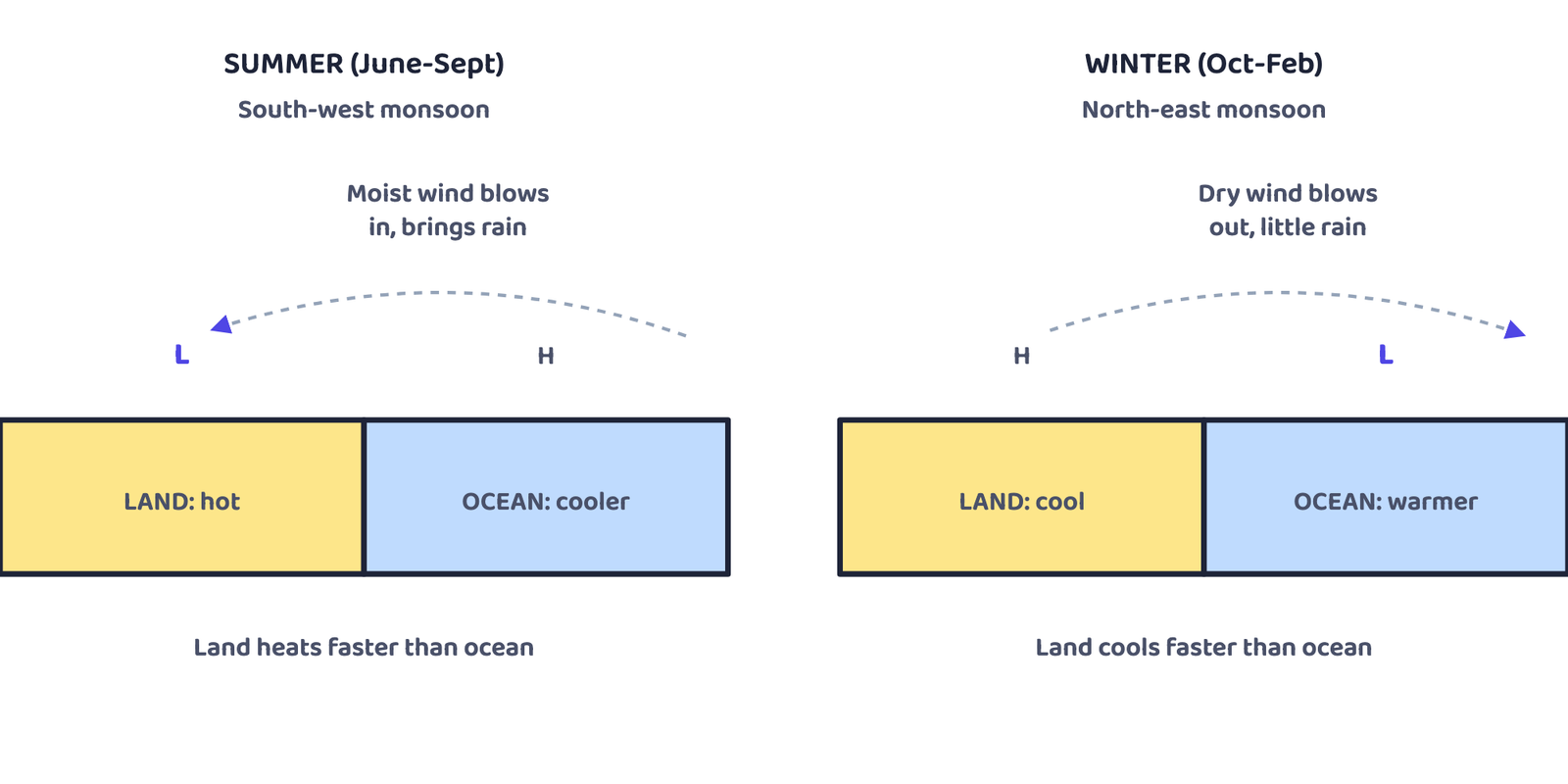
| South-west (summer) monsoon | North-east (winter) monsoon | |
|---|---|---|
| Months | June to September | October to February |
| Direction | Sea to land | Land to sea |
| Cause | Land heats faster than the ocean, creating low pressure over land | Land cools faster than the ocean, creating high pressure over land |
| Rainfall | Brings most of India’s annual rainfall | Mostly dry, except it picks up moisture over the Bay of Bengal and brings rain to Tamil Nadu, Andhra Pradesh and parts of Karnataka |
Monsoon rainfall shapes life across India. Most farmers depend on it for sowing and growing crops, and a good monsoon means enough food, and enough water in rivers, reservoirs and wells. It also affects transport, festivals and rural employment. But the same monsoon can turn destructive: too much rain causes floods, and a weak monsoon causes drought.
The Ministry of Earth Sciences runs the National Monsoon Mission to build better monsoon-prediction models. Its wider programme, Mission Mausam, aims to make India “Weather Ready” and “Climate Smart” by improving forecasting for agriculture, disaster management and rural development.
6 Climate Change and Carbon Footprint
Climate change is a long-term change in weather patterns, temperature, rainfall and wind, caused mainly by human activities such as burning fossil fuels, deforestation and industrial pollution.
These activities release greenhouse gases into the atmosphere, which trap heat and raise global temperatures.
Carbon dioxide
Released by burning fossil fuels (coal, petrol, diesel) and by deforestation
Methane
Released from agriculture, livestock and landfill waste
Nitrous oxide
Released from fertilisers and industrial processes
Water vapour
The most abundant greenhouse gas; its levels rise as the air warms
The effects are already visible: more frequent floods and droughts, melting glaciers, rising sea levels, and loss of biodiversity. Climate change threatens ecosystems, and also harms human health, agriculture and livelihoods, with women and children among the worst affected.
A carbon footprint is the total amount of greenhouse gases released into the atmosphere because of a person’s activities, such as travel, electricity use, and the goods and services they consume.
✓ Lowers your carbon footprint
- Walking, cycling or using public transport/carpool
- Switching off lights and fans when not in use
- Using water carefully, for example one bucket for a bath
- Reusing and recycling, avoiding single-use plastics
✗ Raises your carbon footprint
- Taking private cars for short trips, or frequent flights
- Leaving lights and fans on when no one needs them
- Long showers or running taps unnecessarily
- Using and throwing away single-use plastics
Tackling climate change needs collective effort: reducing carbon footprints, switching to renewable energy, protecting forests, and living more sustainably. Every small step adds up.
7 Case Study: Punjab Floods 2025
Natural causes
- Very heavy monsoon rain, intensified by western disturbances bringing extra moisture
- Heavy rain also fell in Himachal Pradesh and Jammu & Kashmir, upstream
- Rivers were already flowing high before the heaviest rain arrived
Human-made causes
- Weak, old river embankments (dhūsī bāndh) could not hold back the rising water
- Homes and farms built too close to rivers left less space for floodwater to spread
- Silt and mud had built up in rivers and dams, reducing their capacity
- Flood warnings arrived late or were unclear in some areas
Many people lost their lives, and thousands were moved to relief camps. Farmland and crops like paddy were destroyed, and poultry and dairy farms lost animals. Roads, bridges, border fences and public buildings were damaged, and standing water led to waterborne diseases and sanitation problems.
Disasters like this show why flood management and preparedness, of the kind coordinated by the National Disaster Management Authority (NDMA), matters so much in a monsoon-dependent country.
- The atmosphere is a blanket of gases (mainly nitrogen and oxygen) held by gravity, and it has five layers: troposphere, stratosphere, mesosphere, thermosphere and exosphere.
- Temperature falls with altitude only in the troposphere and mesosphere; it rises in the stratosphere and thermosphere.
- Weather is short-term and day-to-day; climate is the long-term average over 30+ years.
- Insolation is highest at the equator and lowest at the poles, which is why temperature falls from the equator towards the poles.
- Wind blows from high pressure to low pressure; hot air rises and creates low pressure, cold air sinks and creates high pressure.
- Sea breeze blows sea to land by day; land breeze blows land to sea by night.
- India’s climate is tropical monsoon, with four IMD seasons: winter, summer, monsoon and post-monsoon.
- The south-west (summer) monsoon brings most of India’s rain; the north-east (winter) monsoon is mostly dry except along the south-east coast.
- Climate change is a long-term, mostly human-caused change in weather patterns, driven by greenhouse gases like carbon dioxide and methane.
- The Punjab Floods of 2025 show how natural causes (heavy rain) and human-made causes (weak embankments, encroachment) combine to worsen a disaster.
- 1 markWhat is the atmosphere held in place by?
- 1 markName the two most abundant gases in the atmosphere.
- 1 markWhich layer of the atmosphere contains the ozone layer?
- 1 markDefine insolation.
- 1 markWhat are the four main seasons recognised by the IMD?
- 1 markWhere does the word “monsoon” come from?
- 3 marksDistinguish between the troposphere and the stratosphere.
- 2 marksWhy do we not feel the pressure of the atmosphere pressing on our bodies?
- 3 marksDistinguish between the south-west monsoon and the north-east monsoon.
- 2 marksDifferentiate between sea breeze and land breeze.
- 3 marksWhat is climate change, and what are its main causes?
- 2 marksWhat is a carbon footprint? Name two ways to reduce it.
- 3 marksExplain why temperature decreases from the equator towards the poles.
- 5 marksWhat is the atmosphere? Explain its composition with the help of a pie diagram.
- 5 marksDraw a labelled diagram of the structure of the atmosphere and describe each layer briefly.
- 5 marksExplain the mechanism of the south-west monsoon. Why is it so important for India?
- 5 marksDiscuss the natural and human-made causes of the Punjab Floods of 2025, and their effects.
- 1 markWhich layer of the atmosphere is closest to the Earth’s surface?
(a) Stratosphere(b) Troposphere(c) Mesosphere(d) Thermosphere - 1 markAeroplanes prefer to fly in the stratosphere mainly because:
(a) It has the most oxygen(b) It is free of clouds and weather disturbances(c) It is the coldest layer(d) It contains the ionosphere - 1 markAuroras occur in the:
(a) Troposphere(b) Stratosphere(c) Mesosphere(d) Thermosphere - 1 markA low-pressure area is usually associated with:
(a) Clear, sunny skies(b) Cloudy skies and wet weather(c) No wind at all(d) Very cold temperatures - 1 markThe south-west monsoon in India blows mainly from:
(a) Land to sea(b) Sea to land(c) North to south(d) Pole to equator - 1 markWhich of these is NOT a greenhouse gas?
(a) Carbon dioxide(b) Methane(c) Nitrogen(d) Nitrous oxide - 1 markThe traditional Indian season “Varṣhā” corresponds to which Gregorian months?
(a) March-April(b) May-June(c) July-August(d) November-December - 1 markThe north-east monsoon brings notable rainfall to:
(a) Rajasthan(b) Tamil Nadu(c) Punjab(d) Kashmir
Reason (R): Gas molecules in the thermosphere absorb X-rays and short-wave ultraviolet radiation from the Sun.
Reason (R): The daily reversal of sea breeze and land breeze keeps coastal temperatures from swinging as widely.
Reason (R): Most of India’s agriculture and water supply in rivers and reservoirs depend on monsoon rainfall.
- ActivityBeyond calm, light breeze, strong breeze and storm, find out the other wind-speed categories and their common effects.
- ActivityUsing the average monthly temperature and rainfall of any Indian city, plot a temperature-and-rainfall graph for the year.
- ActivityFill in the “My Carbon Footprint” self-check for transport, electricity, water and waste, score yourself, and note two changes you can make.
- ActivityDiscuss in class: how could better planning have reduced the damage from the Punjab floods, and what role can students play in disaster preparedness?
- ActivityCollect pictures of houses and clothing from different regions of India, and examine how climate has shaped them.