
1Before Writing Began
Humans have lived on Earth for millions of years, but writing, that is, putting words down so someone else can read them later, is only about 5000 years old. For everything before that, there are no books, letters or records to read. Historians and archaeologists (people who study old objects and sites) have to read clues instead: broken tools, old bones, cave paintings and buried buildings.
Writing began at roughly the same time in three places, and only two of the three scripts can be read today.
| Script | Who used it | Can we read it? |
|---|---|---|
| Harappan script (Sindhu lipi) | Sindhu-Sarasvati civilisation, on seals and pottery; picture-based | No. Still undeciphered |
| Cuneiform | Sumerians of Mesopotamia | Yes |
| Hieroglyphics | Ancient Egyptians | Yes |
| Brahmi | From about 400 BCE in southern India and the Ganga valley; standardised by Ashoka in the 3rd century BCE | Yes |
The scripts that can be read mark the start of the historical period, about 5000 years ago.
The Old World is the name for Africa, Asia and Europe taken together, because this is the geographical area where the oldest human settlements of the Palaeolithic period have been found.
| Before writing | After writing | |
|---|---|---|
| Share of human history | More than 99% (from about 3 million years ago to 5000 years ago) | Less than 1% (the last 5000 years, including today) |
| Main source used | Tools and other objects made by humans (artefacts) | Both artefacts and written documents |
| Lives of the people | Hard to know what people actually thought and believed | Literature gives names, events, and social and political life |
| Measuring time | Only approximate dating of cultures and events | Fairly accurate, since documents mention exact dates (coronations, wars, etc.) |
So why study a past this hard to reconstruct? Because it explains two things happening together: how humans changed physically, and how they changed the way they lived.
Biological evolution means the slow physical and genetic change through which our early ancestors, called australopithecines (australis = southern, pithecus = ape), gradually evolved into modern humans, or Homo sapiens.
Cultural evolution means how humans adapted to their surroundings during the Quaternary Period (the last 26 lakh years, including today) by inventing tools, techniques and new ways of using natural resources as the climate kept changing.
Human ways of life eventually changed from hunting and gathering food to growing it. Being able to produce more food than a family needed, a surplus, is exactly what made civilisation possible: it freed some people to become potters, traders, priests or rulers instead of only food-gatherers.
2Human Ancestors and Their Journey Out of Africa
Archaeologists dig up early human sites looking for tools, bones and other objects. To understand these clues better, they even make and use copies of the same tools themselves, this is called experimental archaeology, and it shows exactly how early humans might have used these objects every day.
A hominin is a member of the group that includes modern humans and our early human-like ancestors. It was around 3.3 million years ago that one of these ancestors made the earliest stone tools, the first sign of “human behaviour” as opposed to animal behaviour, which is why hominins are also called tool makers. Tools worked as “extra-corporal limbs”, extensions of the body that let people do things their hands alone could not.
A fossil is the preserved remains, traces or impressions of plants, animals or humans from the distant past. Fossils form when these remains get buried under layers of earth and, over thousands or even millions of years, slowly turn to stone.
| Ancestor | Lived where | Lived when | Known for |
|---|---|---|---|
| Homo habilis (“handy man”) | Olduvai Gorge, Tanzania and Kenya (Africa) | About 2.4-1.4 million years ago | Made the earliest chopper stone tools |
| Homo erectus | Eastern African Rift Valley, then Asia and Europe | About 2 million years ago | First hominin to migrate out of Africa; made handaxes and cleavers |
| Homo neanderthalensis | Europe and southwest Asia | Until about 40,000 years ago | Made Middle Palaeolithic flake tools |
| Homo sapiens (us) | Evolved in Africa, now everywhere | From about 300,000 years ago | The only human species living today; developed the most complex technology |
A very common one-mark question is to name the ancestor in the correct order: Homo habilis, then Homo erectus, then Homo neanderthalensis, then Homo sapiens. Learn the order along with one fact each (place, tools) rather than the names alone.
3Stone Age Tool Cultures
Early human history is divided into stages based on how tools and lifestyle changed over time. The word palaeo means “old” and lithic means “stone”, so the Palaeolithic period is also called the Old Stone Age.
3.1 Palaeolithic hunter-gatherers
In the Indian subcontinent, the oldest human settlement dates back to about 2 million years ago. Attirampakkam in Tamil Nadu is dated to about 1.5-1.7 million years ago, and Isampur in Karnataka to about 1.2 million years ago. Both sites have yielded animal fossils along with large cutting tools such as handaxes and cleavers, plus stone scrapers and choppers made of quartzite and limestone. These tools chopped animal meat, dug out tubers (root vegetables), scraped animal skin and cleaved bones to get at the protein-rich marrow inside.
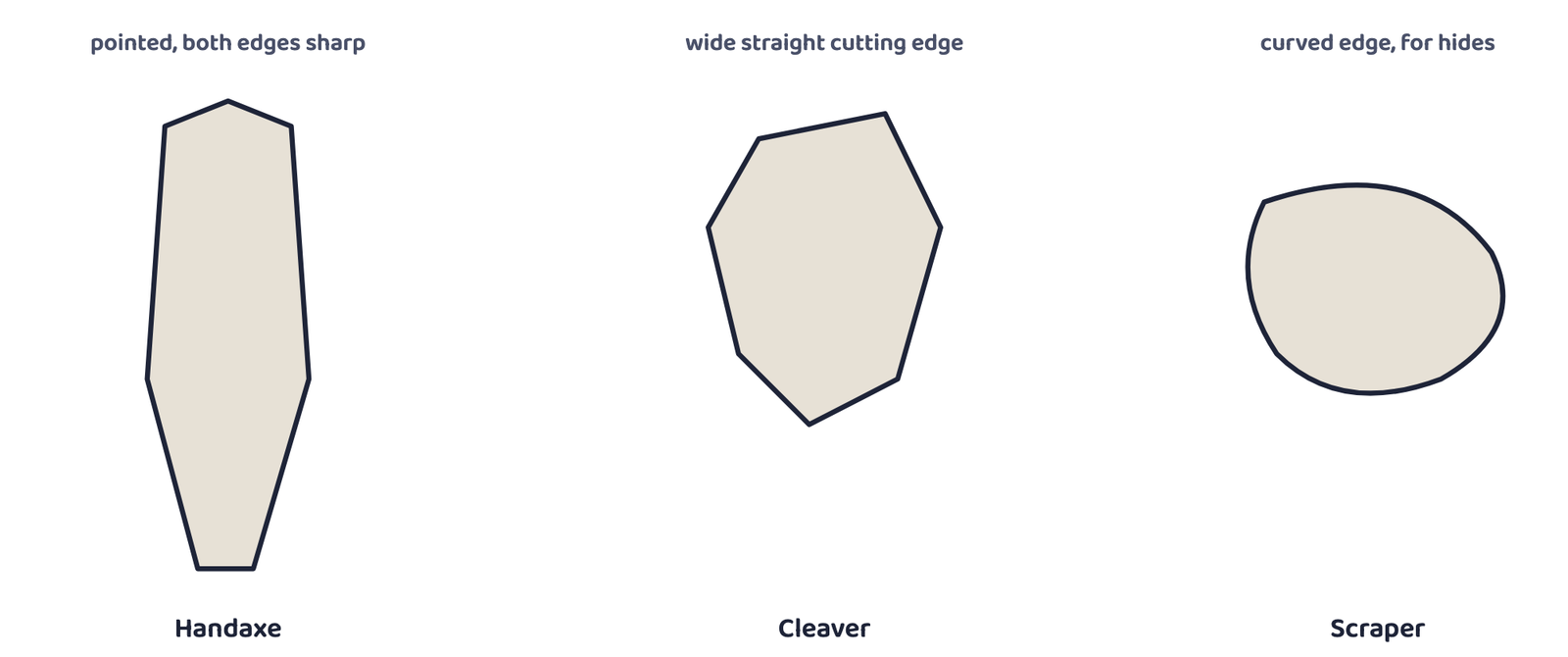
Later in the Palaeolithic, two things changed together: the tools and the first signs of symbolic thinking.
- Smaller, sharper tools: scrapers, borers and points, used to tip spears and darts
- The bow and arrow, plus parallel-sided blades and microblades of glassy rock, for hunting small game
- Cave and rock-shelter paintings, and bodies coloured with pigments
- The first beads, made of stone, bone and shell
- The burin (engraver), used to carve symbolic patterns on bone, shell and ostrich eggs
All of this belongs to our own species, Homo sapiens, who spread across the world, reaching Australia and the Americas between about 50,000 and 12,000 years ago.
3.2 Mesolithic hunter-gatherers
Around 12,000 years ago, Earth’s climate grew warmer. Forests and grasslands spread into areas that ice sheets had covered earlier, bringing a much wider range of resources such as small game, fish and edible wild grains. This triggered the first-ever population explosion in human history. Tiny microlithic tools let people gather both marine and freshwater food, and fishing became a mainstay of survival. Art also flourished, and people occupied caves and rock shelters more often.
Bhimbetka in Madhya Pradesh is a UNESCO World Heritage Site with hundreds of painted rock shelters, showing occupation from the Mesolithic period and even earlier.
| Palaeolithic | Mesolithic | Neolithic | |
|---|---|---|---|
| Tools | Large stone tools: handaxes, cleavers, scrapers, choppers | Tiny microlithic tools, bow and arrow | Polished stone tools for farming and food processing |
| Subsistence | Hunting large animals and gathering wild plants | Hunting small game, fishing, gathering wild grains | Farming and animal domestication (food production) |
| Settlement | Caves and open camps; no fixed home | Caves and rock shelters, occupied more often | First permanent village settlements |
| Art and other traits | Cave paintings begin; first beads of stone, bone, shell | Cave art flourishes (e.g. Bhimbetka) | Pottery-making, weaving, domestication of plants and animals |
4The Neolithic Revolution
The Neolithic Revolution is the gradual shift from a food-gathering (hunting-gathering) way of life to a food-producing (farming) way of life. Its hallmark was domestication, bringing selected wild plants and animals under human control and breeding them through cultivation and husbandry.
What changed with Neolithic farmers:
- Tools now produced and processed food instead of only procuring it
- Pottery was made in many shapes and sizes
- The first permanent village settlements appeared, the foundation of later cities
The shift did not happen everywhere at once. Each region reached farming, pottery and settled life (sedentism) on its own timeline, starting with different crops:
| Region | Domesticated first |
|---|---|
| West Asia | Wheat and barley |
| India and the Ganga plains | Millets and rice |
| North China | Millets |
| South China | Rice |
4.1 The Neolithic period in the Indian subcontinent
Mehrgarh, on the Bolan river in present-day Pakistan, is the oldest Neolithic site and the earliest known agricultural village in the subcontinent, dating to about 7000 BCE.
- Housing: sun-dried mud-brick houses and granaries
- Burial: the dead were buried in graves
- Ornaments: made from shells and semi-precious stones such as lapis lazuli and carnelian
- Crops: wheat and barley
- Animals: sheep, goats and the humped zebu cattle
- Metal: the first in the region to make copper objects, so Chalcolithic by about 4000 BCE
This laid the foundation for the Bronze Age Sindhu-Sarasvati civilisation around 3500 BCE. By 2500 BCE most of the subcontinent held Neolithic farming communities herding cattle, sheep and goats and growing cereals, millets and pulses, sometimes beside Chalcolithic neighbours.
Mehrgarh, its date (about 7000 BCE) and its location (Bolan river, present-day Pakistan) come up repeatedly. Learn them as one fact, not three separate ones.
5Sindhu-Sarasvati: The Early Stages
The Neolithic farming way of life that began at Mehrgarh spread into the middle and upper Indus valley and further east. Some of these settlements learned to extract copper from ore around 4000 BCE, becoming the earliest Chalcolithic sites in the subcontinent and marking the start of the Bronze Age here.
Large-scale pottery production, in many regional styles, is visible from 4000 BCE in Baluchistan and the Indus and Ghaggar-Sarasvati basins. Radiocarbon dates from Bhirrana and Kunal, in the dried-up Sarasvati belt, push a Pre-Harappan phase back to 7000-5500 BCE.
By about 2500 BCE those regional styles had become shared features of one civilisation. This stage is called Early Harappan, and the continuity shows in:
- Shared pottery traditions
- Semi-precious stone beads and shell bangles
- Terracotta objects and copper working
- Perimeter walls around settlements
- The use of seals, and probably the beginnings of the Harappan script
The Harappans were not farmers alone. Their crafts were already developing steadily:
- Pottery: the major craft, with distinct shapes and painted designs in each region
- Copper work and shell work: gradual, steady development
- Semi-precious stone beads: bead-making evidence at Harappa (Pakistan), Kunal (Haryana) and Datrana (Gujarat)
- Graffiti and early seals: simple geometric and animal motifs at Harappa, Rehman Dheri and Kunal, thought to be forerunners of the Harappan script
It was this combination of technological progress and economic integration in the Early Harappan period that gave rise to the great Harappan cities.
| Site | Where | Why it matters |
|---|---|---|
| Mehrgarh | Bolan river, Pakistan | Oldest Neolithic and earliest agricultural village in the subcontinent |
| Bhirrana, Kunal | Dried Sarasvati river belt (Haryana) | Pre-Harappan phase (7000-5500 BCE); early bead-making |
| Kalibangan | Rajasthan | Ploughed field with double-crop (Rabi and Kharif) furrows, still practised today |
| Dholavira | Kachchh, Gujarat | Elaborate water harvesting system: dams, canals and deep tanks, some cut into bedrock |
| Lothal | Gujarat | A dockyard built entirely of burnt bricks |
| Harappa, Rehman Dheri | Pakistan | Early graffiti and simple seals, forerunners of the script |
The Harappans used a standard system of weights and measures: a binary system (1, 2, 4, 8, 16…) for smaller units, and multiples of ten for larger ones. Cubical stone weights following this system have been found at many sites, showing planned settlements and organised, long-distance trade.
While the Sumerians were digging canals for irrigation, the Early Harappans in the Baluchistan foothills were building small check dams called “gabarbands” across streams for the same purpose. Dholavira’s tanks and Lothal’s dockyard are much more advanced descendants of this same water-management skill.
6Mesopotamia: Cities and Cuneiform Writing
Mesopotamia is a Greek word meaning “the land in between”, the land drained by the Euphrates and Tigris rivers in West Asia. Today, this region covers mainly Iraq and Kuwait, with parts of Turkey and southwestern Iran. The crescent-shaped foothills of the Zagros and Taurus mountains, stretching from the Mediterranean to the Persian Gulf, are called the “Fertile Crescent” because of how good the land was for farming.
Farming began here about 12,000 years before the present, and copper tools arrived around 4500 BCE, boosting agriculture, craft production and trade. Over the next 2000 years, some large settlements grew into “city-states”. Four major ones flourished from 3500 BCE onwards: the Sumerian, Akkadian, Assyrian and Babylonian city-states.
A city-state is a sovereign (self-ruling) state centred around one city, which rules the territory surrounding it.
6.1 The Sumerians
The Sumerian civilisation was the earliest to become city-based, at Ur and other cities of Sumer, in what is southern Iraq today. Sumerians were the first to build dams and canals for irrigation, and the first to build with mud bricks and burnt bricks, for houses, defensive walls and other structures. They worshipped many gods and built a grand temple called a ziggurat for each city’s chief god, around which the whole city grew.
A ziggurat was a tower-like, stepped, pyramid-shaped temple with several floors, with the main shrine at the very top, a sacred place. Palaces and royal storehouses stood around it, and its surrounding wall had only one gate, since the ziggurat also served as the city’s treasury.
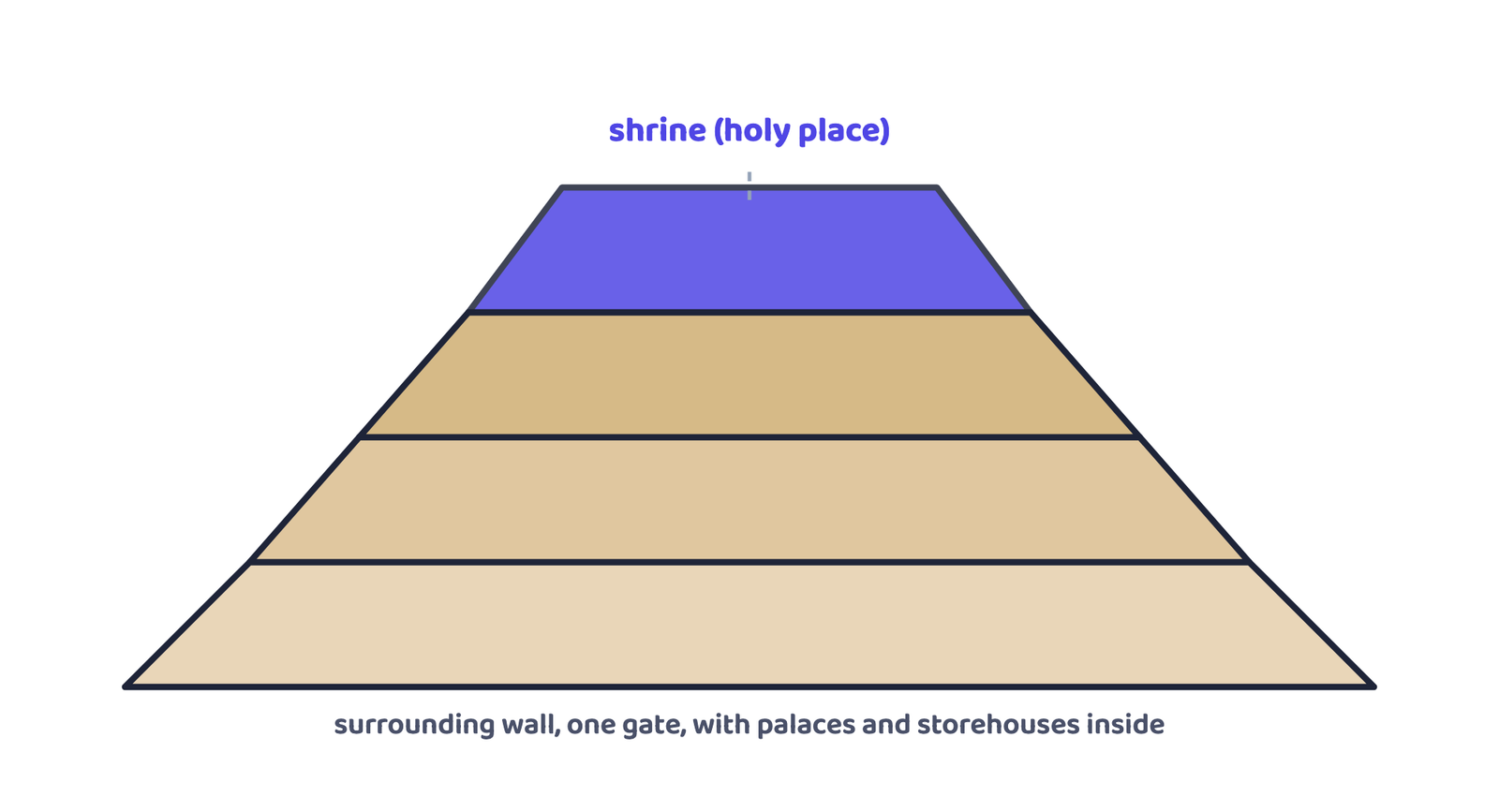
Sumerian cities were large: kings lived in grand palaces, ordinary people lived in small brick houses. Most people farmed, but crafts such as metalworking, pottery and textiles were common too, and merchants and traders existed as a separate profession. All major economic activity, farming, trade and the transport of goods, was tied to the temple authority, and entry to the sacred temple was limited to high priests and priestesses, reflecting a clear social hierarchy.
Cuneiform is one of the earliest writing systems, developed by the Sumerians, written by pressing a wedge-shaped reed stylus into soft clay tablets. The word comes from the Latin cuneus, meaning “wedge”.
The Sumerians started writing around 3200 BCE, and by 3000 BCE cuneiform was used all across Mesopotamia’s different city-states, even though they spoke different languages. Scribes had high social status, similar to priests. Cuneiform tablets tell us about Mesopotamian myths, epics, hymns, law codes, and records of farming and craft activity, especially of potters, seal-cutters, shipbuilders, carpenters and farm workers.
The Sumerians invented the wheeled cart and the sailboat. Their number system was based on 60, which is exactly why we still use a 60-minute hour, a 60-second minute and a 360-degree circle today.
6.2 The Akkadians, Assyrians and Babylonians
In 2334 BCE, the Sumerians’ power was overtaken by a new city-state centred on Akkad, further north in Sumer. The Akkadians spoke a different language, Akkadian, but used the same cuneiform script. Their records describe the world’s first dynastic empire, and this period also saw creative literature grow, including the Epic of Gilgamesh, one of the earliest written stories. Tablets of the Akkadian king Sargon mention trade with Dilmun (today’s Bahrain), Magan (Oman) and Meluhha, generally identified with the Sindhu-Sarasvati civilisation, trading semi-precious stone beads, ivory, timber, gold dust, and probably copper.
Around 2154 BCE, a new city-state, Assur in northern Mesopotamia, overtook the Akkadians. Assyrian dominance spread quickly across Mesopotamia and beyond, lasting until early 1700 BCE. From 1900 BCE, the city-state of Babylonia rose in central Mesopotamia, reaching its height under Hammurabi from 1792 BCE, who expanded it into a large empire. His most important contribution was the Code of Hammurabi, a compiled set of rules for civil and social conduct that became a model for many later legal systems. By 1400 BCE, repeated attacks by the Hittites and other rising powers, along with environmental strain, pressure on farmland and internal problems, had weakened Babylonian control for good.
The Hittites were Indo-European people who built a powerful empire in Anatolia (modern-day Turkey) around the second millennium BCE.
7Egypt and China: Rivers, Rulers and Records
7.1 Egyptian civilisation
Egypt is one of the world’s earliest civilisations, and it was already known to the Greeks and Romans, the Greek writer Herodotus visited and wrote about it as early as the 5th century BCE. Much of what we know comes from papyrus records.
Papyrus was an early paper made from the inner trunk of the papyrus plant, cut into strips, criss-crossed, pressed, dried and polished into sheets.
Egypt’s city-states emerged around 3000 BCE as population grew and resources increased. The river Nile watered the land, and every summer it flooded, leaving behind rich mud that Egyptians called “kemet” (“the black”), excellent for growing crops, so they called their own land Kemet too. About 5000 years ago, farmers learned to dig ditches to divert Nile water into their fields and store it in reservoirs, and by counting the days between floods, they developed a calendar. Organising such large digging and dam-building projects needed cooperation, which is thought to have led to the growth of local government and an administrative class, probably Egypt’s earliest form of local government.
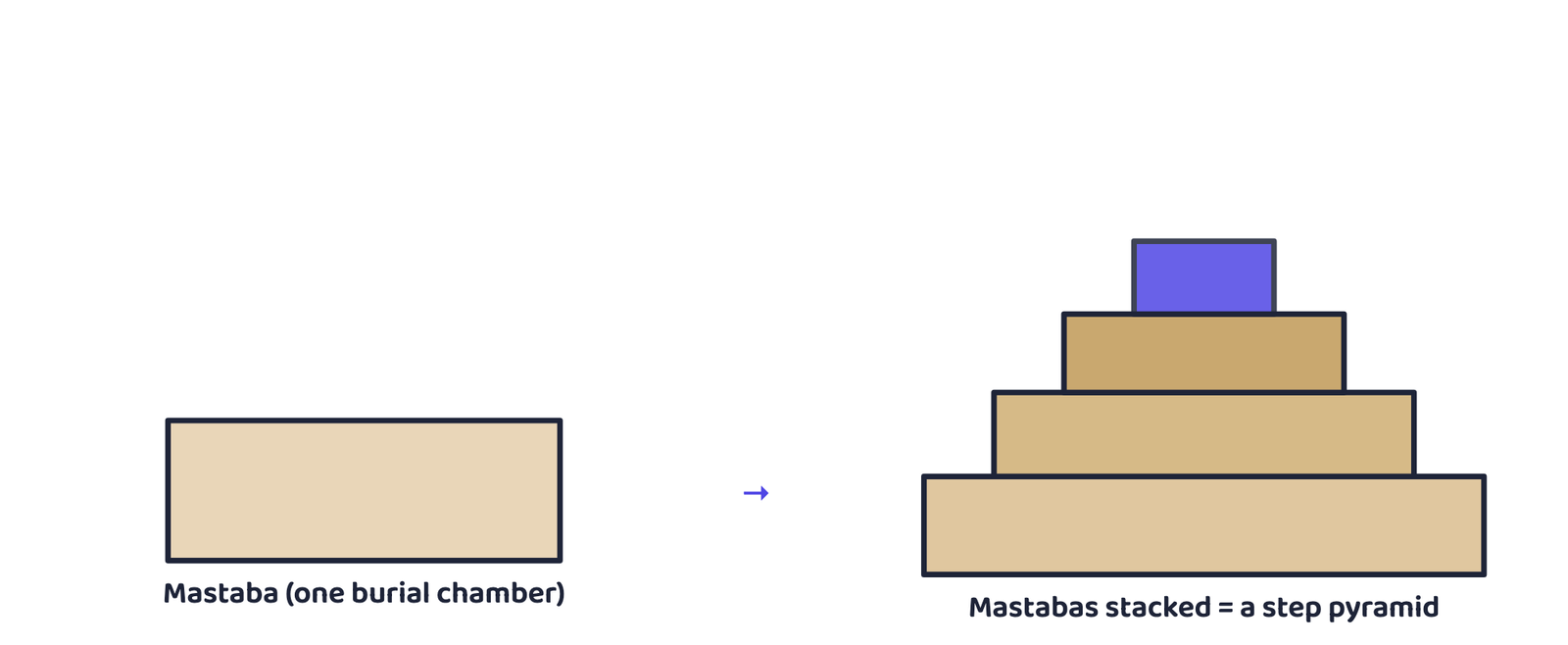
Over time, powerful rulers called Pharaohs emerged. After a Pharaoh’s death, the body was buried deep underground under a rectangular structure called a mastaba. Later, mastabas were stacked one on top of another to form a pyramid, such as the Step Pyramid at Saqqara. Egyptians believed each person had a “ka” (a spiritual double) that lived on after death if the body was preserved through mummification.
Mummification was the process of removing a body’s internal organs (except the heart), drying it with a salt called natron, oiling it, wrapping it in linen strips, placing it in a coffin, and burying it with rituals.
The social hierarchy of ancient Egypt, from the ruler at the top to the largest and least powerful group at the base.
In 1799, French army engineer Pierre Bouchard found a stone with the same message written in three scripts, including Greek. This Rosetta Stone let French linguist Jean-François Champollion finally decipher Egyptian hieroglyphics in 1822.
Egyptian women had more rights than their Greek or Roman counterparts: they could own property and run businesses. Cleopatra (69-30 BCE) was trained to rule from childhood and became queen at just eighteen.
The Egyptian calendar had three seasons of four months each: Inundation (the Nile’s flood season), Peret (growing season) and Shemu (harvest season), based on the rising of the star Sirius. A year was counted as 365 days, twelve months of thirty days plus five extra days, close to accurate but slightly short of the real year, which is about a quarter-day longer.
7.2 Chinese civilisation
The Chinese civilisation grew along two rivers, the Huang He (Yellow River) and the Yangtze, both centres of Neolithic culture from around 7000 BCE. Around 2000 BCE, copper and bronze metallurgy brought many Yellow River settlements to the edge of the Bronze Age, but it was only around 1600 BCE that true urban centres appeared, along with growing farm output and better metalworking, giving rise to China’s first Bronze Age territorial empire.
China’s Iron Age generally dates from around 600 BCE, when iron use spread widely. Zhou rulers were considered both kings and priests, “appointees of heaven”, but could be removed if their people did not prosper. Public officials were chosen carefully, tested in archery, horsemanship, calculation, writing and music.
China’s earliest historical source is the oracle bones: symbols carved onto animal bones and tortoise shells, then heated until they cracked, with the crack patterns interpreted to foretell the future. These now tell us about the hopes, fears and beliefs of early China. Unlike alphabets, the Chinese script is logographic: each character stands for a whole word or meaningful unit, not just a sound.
- Jade: ritual and status objects, prized because jade had to be brought in from outside China
- Marble: carved into birds, animals and pillar bases
- Bronze: mastered for weapons, tools and ritual vessels
- The Great Wall: began as separate walls built from 680 BCE by the Zhou and later dynasties against nomadic raids, joined up over time, with work continuing to the 17th century CE
- Silk: known since the Neolithic (4000-3000 BCE); so important a trade item by the 2nd century BCE under the Han that the route itself became the “Silk Route”
- Social hierarchy: by 1500 BCE society was stratified, rulers, nobles and aristocrats above, farmers and labourers below
- Two firsts: China was the first country to introduce paper currency, and the first to select civil servants by public examination
8Four River-Valley Civilisations Compared
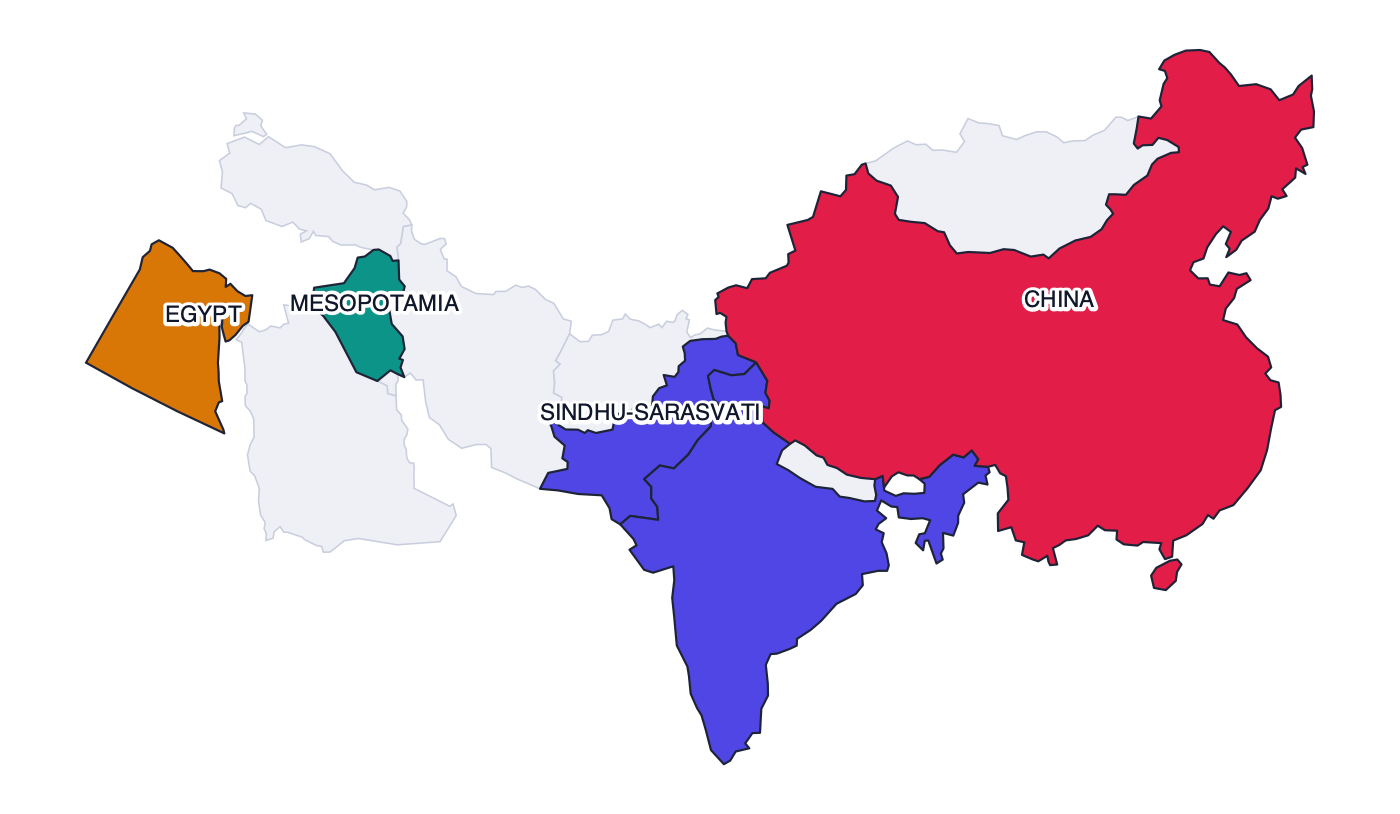
Four early world civilisations grew up independently in fertile river plains: the Harappan along the Sindhu (Indus) and Sarasvati, the Mesopotamian around the Euphrates and Tigris, the Egyptian along the Nile, and the Chinese in the Huang He basin. Mesopotamia and the Indus-Ghaggar-Sarasvati valleys are geographically close, which is why strong trade contact grew between the Harappans and Mesopotamians. Egypt and China, on the other hand, show little direct, tangible contact with the Sindhu-Sarasvati civilisation.
| Sindhu-Sarasvati | Mesopotamian | Egyptian | Chinese | |
|---|---|---|---|---|
| River(s) | Indus and Sarasvati | Euphrates and Tigris | Nile | Huang He and Yangtze |
| Script | Harappan script (undeciphered) | Cuneiform (deciphered) | Hieroglyphic (deciphered) | Logographic characters |
| City life | Planned cities, standard weights | City-states around temples/ziggurats | City-states, Pharaoh’s rule | Territorial dynastic empire |
| Best-known achievement | Town planning and water management (Dholavira, Lothal) | World’s earliest writing (cuneiform); the Code of Hammurabi | Pyramids; a 365-day calendar | The Great Wall; the Silk Route; paper currency |
Every one of these civilisations grew up on its own, in a different river valley, yet each needed the same three things: a river to farm beside, enough surplus food to free some people for other work, and eventually, a way to write things down.
the one idea to carry out of this chapter
The development of writing let early societies keep records of trade and social life, and over time this grew into literature. Many of the customs and ideas we live with today have roots that trace all the way back to these Bronze Age civilisations.
- Before writing (about 5000 years ago), we learn about people only from archaeology: tools, fossils and cave art
- Early humans evolved in Africa and migrated out in two big waves: Homo erectus (~2 million years ago) and Homo sapiens (~125,000 years ago)
- Palaeolithic hunter-gatherers used handaxes, cleavers and scrapers, and lived in caves or open camps
- Mesolithic people used microlithic tools and lived near rivers and lakes, hunting small game and fishing
- The Neolithic Revolution brought farming, animal domestication, pottery and permanent villages
- Chalcolithic communities used copper along with stone tools as early farming grew
- Bronze Age civilisations added urban centres, trade, writing and organised administration
- Sindhu-Sarasvati, Mesopotamia, Egypt and China each grew independently in a fertile river valley
- 1 markWhat is the Harappan script also called, and has it been deciphered?
- 1 markName the ancestor known as the “handy man” and the site where it lived.
- 1 markWhat do the words “palaeo” and “lithic” mean?
- 1 markName the oldest Neolithic site in the Indian subcontinent and its approximate date.
- 1 markWhich script did the Sumerians use for writing?
- 1 markName the ruler famous for compiling the Code of Hammurabi.
- 1 markWhat was mummification meant to preserve, and why?
- 1 markName the two rivers along which the Chinese civilisation grew.
- 3 marksDo you think life became easier or more challenging after humans started farming? Give two reasons for your answer.
- 3 marksExplain, with an example, how the environment offered both opportunities and challenges to early farming communities and river-valley civilisations.
- 2 marksWhy do historians divide early human history into ages such as the Stone Age, Bronze Age and Iron Age? What does this classification tell us about human progress?
- 3 marksWhat benefits and problems did rivers create for the people settled near them?
- 2 marksWhat was a ziggurat, and what two roles did it play in a Sumerian city?
- 2 marksWhat is a fossil, and how does one form?
- 3 marksDescribe the standard system of weights used by the Harappans, and what it tells us about their trade.
- 2 marksWhat was the Rosetta Stone, and why was it important for understanding Egypt?
- 5 marksImagine you are a Neolithic farmer. Describe a day in your life, and explain what challenges you might face that a hunter-gatherer would not.
- 5 marksIf the Harappan script were deciphered tomorrow, what new kinds of information do you think historians might learn?
- 5 marksPrepare a table with three columns, Palaeolithic, Mesolithic and Neolithic, and fill in their tools, settlements, art and subsistence. (Use the comparison table in Section 3 as your model.)
- 5 marks“Bronze Age civilisations developed independently but shared common features.” Examine this statement using the civilisations given in this chapter.
- 5 marksFind out more about the Code of Hammurabi with your teacher’s help. Why was it important, and do you think it was fair to every section of society? Give reasons.
- 5 marksIf you had to choose one invention from the early civilisations that changed the world permanently, what would it be, and why?
- 5 marksCompare the social hierarchy and daily life of Egypt with either Mesopotamia or China. What similarities and differences do you notice?
- ActivityOn an outline map, locate the major rivers and civilisations of Mesopotamia, Egypt, China and the Sindhu-Sarasvati valley, and mark the trade links between them.
- ActivityChoose one early civilisation (Mesopotamia, Egypt or China) and prepare a short scrapbook or presentation on its innovations in tools, writing, art and architecture.
- 1 markWhich of these ancient scripts has NOT yet been deciphered?
(a) Cuneiform(b) Hieroglyphic(c) Harappan script(d) Brahmi - 1 markHomo erectus was the first hominin to migrate out of Africa, carrying which tools?
(a) Microliths(b) Handaxes and cleavers(c) Iron ploughs(d) Bronze swords - 1 markThe hallmark of the Neolithic Revolution was:
(a) The invention of the wheel(b) Domestication of plants and animals(c) The use of iron(d) The building of pyramids - 1 markMehrgarh, the oldest Neolithic site in the subcontinent, lies on which river?
(a) Indus(b) Sarasvati(c) Bolan(d) Ganga - 1 markA ziggurat was mainly built as a:
(a) Fort(b) Stepped temple(c) Granary(d) Dockyard - 1 markMeluhha, mentioned in Akkadian trade records, is generally identified with:
(a) Egypt(b) The Sindhu-Sarasvati civilisation(c) China(d) Anatolia - 1 markThe Chinese script is best described as:
(a) Alphabetic(b) Logographic(c) Cuneiform(d) Pictographic only - 1 markThe Egyptian calendar’s year was based mainly on:
(a) The Moon’s phases(b) The rising of Sirius(c) The Nile’s temperature(d) The Zhou dynasty’s records
Reason (R): Writing was invented only about 5000 years ago, so nearly all of human history happened before written records began.
Reason (R): The Harappan script has not yet been deciphered, while cuneiform and hieroglyphic writing have been successfully read.
Reason (R): Only Mesopotamia and the Sindhu-Sarasvati civilisation, which lay geographically close, show strong evidence of trade contact; Egypt and China show little direct contact with the Sindhu-Sarasvati civilisation.