
1Society and State: The Basic Ideas
Whenever a large number of people live together, rules and shared habits slowly grow up between them to keep order and cooperation possible. In earlier grades you studied Governance and Democracy as ideas of today; this chapter looks at how the very same ideas, a “society” and a “state”, first took shape in India, from the age of the Rigveda down to about 1000 CE.
A society is a system of social relationships among people who share a common territory, culture and sense of belonging. It is built out of families, institutions like marriage, and customs, and it is held together mainly by custom and practice, not by written law.
A state is an organised political system based on formal rules and laws. It has clearly defined rights and duties for rulers and subjects, a working mechanism of governance, and institutions to enforce law and order.
A society can exist without a formal state, held together only by custom. A state needs organised government. This chapter traces how Indian society and Indian states each grew more complex over roughly two thousand years, from small kin-based clans to some of the largest empires of the ancient world.
2The Vedic Period: Literature and Early Polity
2.1 The Four Vedas
The Vedas are the earliest known body of Indian literature, since the script of the Harappans has never been deciphered. Vedic hymns lived on for centuries as spoken, memorised text before they were ever written down. Historians still debate exactly when the Rigveda, the earliest Veda, was composed, with estimates ranging from the fifth to the second millennium BCE. It was composed in the Sapta-Sindhu region, the land around the Indus and its five tributaries plus the Sarasvati, and interestingly both the Rigveda and the Sindhu-Sarasvati civilisation already knew the use of copper.
| Veda | What it contains |
|---|---|
| Rigveda | The earliest Veda, 1,028 hymns (suktas); some praise deities, others reflect on universal questions like creation and death |
| Yajurveda | Explains the performative side of yajnas (sacrifices), with prose explanations of hymns used in the Rigveda |
| Samaveda | Hymns drawn from the Rigveda, arranged for musical chanting; its chanting tradition underlies the seven svaras (notes) of Indian music |
| Atharvaveda | A wide range of hymns, some meant to ward off evil, others concerned with treating physical and mental illness |
Each Veda is itself made up of four layers: the samhita (hymns for invoking deities and making offerings), the brahmana (prose explanations of ritual, composed in prose), the aranyaka (forest philosophy of sages, from aranya = forest), and the upanishad (deep questions about the Self, or Atman, and the Ultimate Being, or Brahman).
Three similar-sounding words mean three completely different things. Brahman is a philosophical concept, the Ultimate Universal Being. A Brahmana is a type of Vedic text, the prose portion explaining rituals. And Brahmana/Brahmin is a varna, a social category. Mixing these up is one of the most common exam slips in this chapter.
2.2 Janas, the Rajā and the First Assemblies
Early Vedic society was organised into janas, or clans, groups of people bound together by kinship rather than by territory. The Rigveda alone names about thirty janas. Five of the most important, the Yadu, Turvasha, Puru, Anu and Druhyu, were together called the pañchajana, “the five peoples”. The name “Bharata” first appears in the Rigveda in exactly this way, referring not to a place but to the “Bharata jana”, the people ruled by the Bharata family.
The rājā of this period was not a king in the later sense. He functioned mainly as a clan chief, leading the jana in war and protecting its members. His power was checked, in principle, by three kinds of assembly named in the Rigveda and Atharvaveda.
| Assembly | What it was |
|---|---|
| Sabha | A smaller body, mainly judicial in function, made up of select elites |
| Samiti | A larger assembly that decided policy and political affairs, representing the wider population |
| Vidhata | A popular gathering of the whole jana, a forum for discussing warfare and other political matters |
A frequent question asks how these three assemblies checked the raja’s power, and which modern institution does a similar job. The honest answer is a partial parallel: an elected parliament today checks an elected government by law, while Vedic assemblies worked through custom and the consent of clan elders, not through a written constitution. Make that distinction explicit rather than just saying “like Parliament”.
3From Janapadas to Empires
Archaeology backs up this shift. Sites from the first millennium BCE, especially in the Ganga region, show a jump in iron tools, a wider variety of grain, and a new type of pottery called Painted Grey Ware (PGW). Later, in the middle Ganga region (from present-day Prayagraj to eastern Bihar), a “deluxe ware” called NBPW (Northern Black Polished Ware), known for its smooth glossy black surface, marks a richer, more advanced material culture, alongside more paddy cultivation and more use of iron.
A janapada literally means “where a people (jana) first set its feet.” It marks the shift from a kinship-based identity to a territory-based one, roughly between 1000 and 600 BCE, as control over land, farming and trade routes became more important than descent from a common ancestor.
A mahajanapada is a bigger political unit than a janapada. Roughly between 600 BCE and 300 CE, sixteen such mahajanapadas are recorded in contemporary texts.
Of these sixteen, Magadha (in present-day Bihar) grew the most powerful, thanks to its strategic location, fertile plains and strong rulers, and its expansion eventually gave rise to the Mauryan Empire, one of the largest empires of early Indian history. Alongside this, the political landscape of northern India came to include two different kinds of state.
Monarchical states (rajyas)
- Ruled by a single king
- Kingship generally hereditary
- The more common form by the Mauryan period
Republican states (ganas or samghas)
- Governed collectively, not by one ruler
- Power shared among clan leaders or assemblies
- Existed alongside the monarchies of the same period
In the Deccan, the Mauryan Empire was succeeded by the Satavahana Empire, which lasted nearly five hundred years, from the 2nd century BCE to the 3rd century CE. Further south, in peninsular India, lay four polities named in the Ashokan inscriptions.
| Kingdom | Region | Emblem |
|---|---|---|
| Chola | Lower Kaveri river valley | Tiger |
| Pandya | Tamraparni and Vaigai river valleys | Fish |
| Chera (Keralaputra) | Kerala | Bow |
| Satiyaputra | Northern Tamil Nadu | Not recorded |
The Chola, Chera and Pandya rulers together were known as the “three crowned kings”, or Vendar of Tamilakam, and their kingdoms flourished in fertile rice-growing regions. Much of what we know about them comes from Sangam literature (300 BCE-300 CE), the earliest Tamil literary tradition, which describes ambitious kings such as a Chera ruler who took the title adhiraja after defeating rival crowned kings, and mentions Vedic yajnas and links to epic traditions.
Do not confuse these early Sangam-age Chola, Chera and Pandya kingdoms with the much later “imperial” Cholas, Cheras and Pandyas who rose centuries afterwards. The names repeat, but they are different rulers, centuries apart. This is a favourite examiner trap.
4The King, His Council and the Chakravarti Ideal
4.1 Duties of the King
From the 6th century BCE, rulers were known by different titles in different regions: raja, maharaja or samrat. Early Indian texts give a clear picture of what a good king was supposed to do. Kautilya’s Arthashastra says plainly, “Only if a king is himself energetically active, do his officers follow him energetically.” The Yajurveda’s coronation oath tells the king to judge the strong and the weak fairly, protect the country from calamities, and do good to the people. The Shanti Parva of the Mahabharata goes further, describing the king’s duty to protect subjects from outside threats and internal disorder, and to administer justice in cases like abduction, robbery, theft and adultery. Punishments for serious offences, including killing a cow, treachery and drinking intoxicating liquor, could be severe, even capital.
Kingship was usually hereditary, passed from father to son. But some early texts also mention kings being elected, or even expelled by their people. Royal authority in early India, in other words, was not always absolute.
4.2 The Pan-Indian Ideal
Early Indian rulers thought of political authority in terms bigger than their own kingdom’s borders. This pan-Indian awareness shows up in a cluster of terms: Jambudvipa (a name for the whole subcontinent), Bharatavarsha, the Ashvamedha and Rajasuya yajnas (rituals asserting supreme kingship), Prithivi, and the ideal of the chakravarti, the “universal monarch”. Ashoka’s edicts describe his “energetic exertions” (parakrama) as bringing about change “in the spiritual life in Jambudvipa”. The Arthashastra defines Prithivi as “the area lying between the Himavat (Himalayas) and the sea,” and equates it with the chakravarti kshetra, literally the “domain of a universal paramount ruler.”
This ideal kept resurfacing over the centuries. During the Sangam period, the Chera king Nedunjeral Adan was said to have extended his conquests up to the Himalayas. Centuries later, in the 11th century CE, the Chola ruler Rajendra I adopted the title Gangaikonda (“bringer of the Ganga”) to commemorate his own campaign along the Ganga. The aspiration to rule over the whole Indian subcontinent, in other words, was expressed again and again across very different periods and regions.
4.3 The Council of Ministers and Kautilya’s Seven Limbs
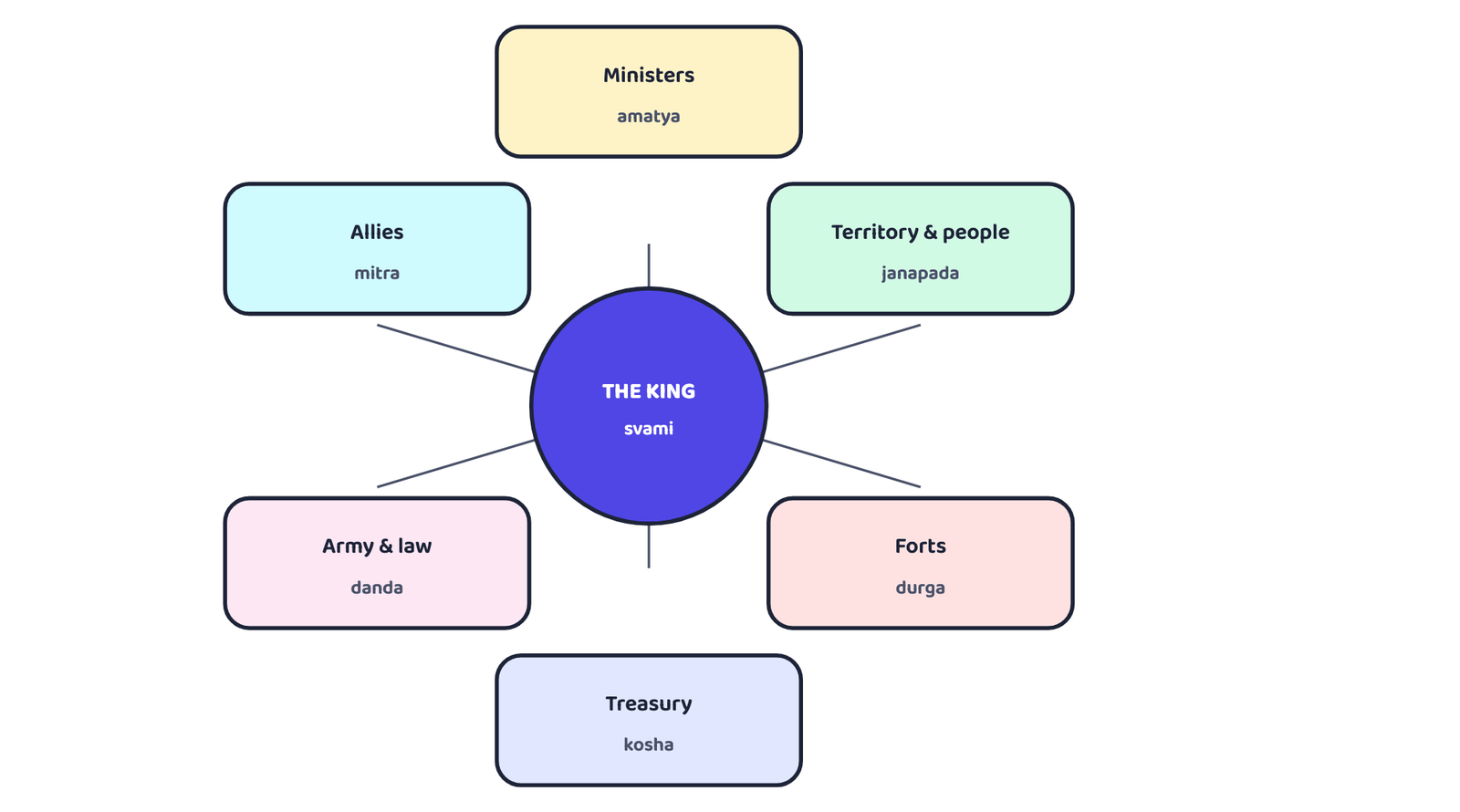
Texts from this period agree that a king never ruled alone. Central to the machinery of government was the mantri-parishad, the council of ministers, a small body of senior statesmen who advised and supported the king. It typically included the treasurer, the chief tax collector, the chief legal advisor and the commander-in-chief. An Ashokan inscription even records the council taking decisions in the emperor’s absence, showing that in exceptional circumstances the ministers could act independently, in the public interest. The Arthashastra sums up the idea memorably: “one wheel does not move the carriage.” Kautilya went on to describe the state itself as a whole made up of seven constituents, together called the Saptanga.
4.4 One Rock, Three Rulers: the Junagadh Inscription
- 2 marksWhy might later rulers have chosen to inscribe on a stone that already carried an earlier king’s words, rather than choosing a fresh rock?
5How Empires Were Administered
Early Indian kingdoms and empires were generally organised into provinces, further divided into smaller units down to the village. In the Satavahana Empire, for instance, the kingdom was divided into aharas (administrative divisions), each with its own ministers (amatyas), and below that lay villages headed by a gramika (village headman). District governors, or pradeshikas, handled judicial and administrative work, often after consulting important residents such as bankers, caravan leaders, artisans and scribes.
Between roughly 300 and 800 CE, power became more decentralised: the kingdom (rajya) was divided into provinces, which were further subdivided down to the village, the smallest unit everywhere. The names for each level differed between the north and the south, though the structure was the same.
| Level | North India | South India |
|---|---|---|
| Province | bhukti | mandala / mandalam |
| Division | vishaya / bhoga | kottam / valanadu |
| District | adhishthana / pattana | nadu |
| Group of villages (tahsil) | vithi | pattala / kurram |
| Village | Lowest unit everywhere | |
The Guptas largely kept the older Arthashastra-style pattern: the mantri headed civil administration, alongside a commander-in-chief, a general, and a chief of the palace guards. One new post appeared for the first time in this period: the sandhivigrahika, a “minister of peace and war”. The old category of amatyas broadened into kumaramatyas, officials at the local and provincial level. The Damodarpur copper plates, from the time of Kumaragupta I, record that a Gupta district office had five members: the head district officer, the chief banker, the chief caravan trader, the chief artisan, and the chief of revenue collection.
In the south, the Pallavas (c. 275-897 CE) combined a centralised monarchy with decentralised local government, dividing the kingdom into provinces, districts, taluks and villages. Their most distinctive feature was the tax-free land grant to villages, called Brahmadeya villages, whose assemblies had small committees called variyams managing irrigation, gardens and temple affairs. The Chalukyas of Badami (c. 543-753 CE) followed a similar pattern, but their land grants to Brahmin settlements were called agraharams; some of these, at Aihole and Badami, grew into important centres of learning in their own right.
Further north, the Gurjara-Pratiharas (8th-10th centuries CE) ruled large parts of northern and western India from their capital at Kannauj, which became so valuable that it triggered the “tri-partite struggle”, a long contest for control between the Gurjara-Pratiharas, the Palas and the Rashtrakutas. All three followed the same basic pattern: a monarchy resting on decentralised provinces, districts and villages, with the village as the smallest, most self-reliant unit, handling its own infrastructure, welfare and education.
The Imperial Cholas (9th-11th centuries CE) were especially noted for efficient administration and revenue collection. Their kingdom was divided into mandalams (provinces), then valanadus (districts), then nadus (groups of villages), and finally urs (individual villages). Chola village councils and assemblies handled disputes and local affairs directly, including revenue collection, land management, irrigation, road construction and record keeping, entirely on their own, without depending on the crown for patronage.
- 3 marksWhat does the Kudavolai system tell us about how seriously fairness was taken in choosing village representatives, thirteen centuries ago?
6Ethics: Dharma, Rita and Samatva
Some of the earliest Indian texts, the Vedas and the great epics, ask questions about right conduct, the origin of things, and the nature of the universe. The Bhagavad Gita, for example, emphasises knowledge, faith, action, virtue and an ethical way of life. Three ideas from this tradition are worth knowing well.
Samatva (“sameness”) is the principle that all bodies are made of the same matter and all forms of consciousness are manifestations of one supreme consciousness. The Mahabharata’s characters, drawn from every varna, repeatedly uphold samatva, and the epics praise the ruler or person who “works for the welfare of all beings,” criticising discrimination wherever they find it.
Rita, described in the Rigveda, is the all-pervading cosmic order representing harmony and balance, both in nature and in human society. It is the principle that regulates natural forces, upholds moral values, and maintains balance in the universe.
Dharma does not mean “religion.” It means duty, obligation, righteousness and moral conduct, tied to one’s role and responsibilities in society. Its Pali equivalent in Buddhism is dhamma.
The word “dharma” comes from the Sanskrit root dhri, the same root behind dharati, “the earth.” In the Mahabharata, Bhishma explains dharma as “that which upholds beings; whatever upholds all beings is dharma,” adding that “the dharma of iron is to sink and of wood is to float,” meaning every single thing, from a person to a piece of metal, has its own dharma, its own natural way of behaving.
This connection between ethics and politics runs right through Indian history. Ashoka’s edicts promoted dhamma by stressing moral conduct, respect within the family, non-violence and compassion. As noted above, the Uttaramerur inscription required candidates for the village assembly to have honest earnings and a pure mind. Literary works such as Kamandaka’s Nitisara and Banabhatta’s Kadambari, celebrated as one of the world’s first novels, both reflect on the ethics of kingship and governance.
7Varna, Jati and Social Mobility
7.1 The Varna System
Varna refers to a fourfold division of society into brahmana, kshatriya, vaishya and shudra. Its earliest reference is the Purushasukta, a hymn in Book 10 of the Rigveda.
“I am a poet; my father is a physician, my mother is a grinder of corn; having various occupations, desiring riches, we remain (in the world) like cattle (in the stalls).”
Rigveda 9.112.3
This single verse is one of the most quoted sources in this chapter, because a poet, a physician and a corn-grinder are described as members of one family. Read it as evidence, not as a rule: it does not prove all families worked like this, but it does show that occupation within a family was not always fixed by birth in early Vedic society. Historians describe early Vedic social identity as shaped by many overlapping factors: ethnicity, subgroup, region, village, gotra, language, and especially occupation, rather than birth alone.
| Varna | Main expected role |
|---|---|
| Brahmana | Study and teach the Vedas, perform yajnas, give and receive dana (gifts) |
| Kshatriya (rajanya) | Warfare, protecting people, administering justice; also studied scriptures and sponsored yajnas |
| Vaishya | Agriculture, pastoralism and trade, alongside scriptural study and charity |
| Shudra | Expected to assist the other varnas, but in practice also worked in agriculture, animal husbandry, trade, and arts and crafts |
Knowledge was valued above political power and wealth in this system, which was originally meant to be functional, based on what work a person did, not fixed at birth. The Buddhist text Sutta Nipata makes this explicit: “No brahmana is such by birth. No outcaste is such by birth but only by his deeds. A brahmana is such by his deeds.” Over time, however, this flexibility gradually reduced.
7.2 From Varna to Jati
Jati is a more specific social group that emerged gradually within the four broad varnas, driven by intermarriage among varnas, migrating communities becoming endogamous (marrying only within their own group), and territorial differences. Unlike varna, which stayed fixed at four categories, there was no limit on the number of jatis, and their number kept growing as new social groups and occupations developed.
7.3 Evidence of Social Mobility
Varna and jati were never as rigid as they sound on paper. Several ruling families themselves came from very different social backgrounds, including the Nandas, Mauryas, Shungas, Satavahanas, Vakatakas, Guptas and Pushyabhutis. Occupational mobility shows up in inscriptions too: the Mandsaur Stone Inscription (473 CE) records a guild of silk weavers who migrated from Lata in Gujarat to Dashapura in Madhya Pradesh during the Gupta period, and who were also skilled in archery and astrology, not weaving alone. The Karitalai copper-plate inscription of Maharaja Jayanatha (late 5th century CE) records brahmanas working as land managers, a role well outside the “expected” priestly duties.
In the south, the Sangam text Tolkappiyam describes a fourfold society organised around occupation rather than birth: Arasar (kings), Vanigar (traders and merchants), Velar (farmers) and Antanar (brahmanas, often patronised by kings). The poem Pattinappalai paints a lively, trade-oriented society of merchants, salt-makers, fishermen, artisans, farmers and warriors all interacting, evidence that society here was organised more around occupation and economic role than a rigid varna classification.
8Family, Women and Religious Life
8.1 Family and the Idea of Ashrama
In Vedic society the kula, or family, was the smallest social unit. Several kulas made up a grama (village); a group of gramas formed a visha, headed by a vishapati; and above the visha was the jana, with the raja as its chief protector.
Gotra refers to a patrilineal lineage or clan traced back to a common ancestor, traditionally a Vedic sage (rishi). Gotra affiliation often regulated marriage practices, since people were usually expected to marry outside their own gotra.
Everyone was expected to perform duties suited to their varna and to their stage of life, or ashrama. Life was divided into four such stages, and each one carried its own dharma.
All four stages were accompanied by numerous rituals, most importantly the shodasha samskaras, the “sixteen rites of passage”. Alongside the ashramas sat the four purusharthas, the goals of a fulfilled human life.
Dharma
Righteousness, acting according to one’s duty
Artha
Material well-being, legitimate only when guided by dharma
Kama
The fulfilment of desires
Moksha
Liberation from all worldly ties
8.2 The Role of Women
The Vedic period is often described as one in which women held a high and respectful position: women took part in scholarly learning, performed rituals alongside men in some contexts, and attended gatherings including the sabha. Several Rigvedic hymns are traditionally attributed to women sages, most notably Apala, Vishvavara, Ghosha and Lopamudra, and goddesses such as Usha (dawn) and Aditi (mother of the gods) held revered positions.
“Where women, verily, are honoured, there gods rejoice; where, however, they are not honoured, there all sacred rites prove fruitless.”
Manu-smriti 3.56
Over time, the position of women fluctuated and, in many respects, declined, even as they continued to contribute to household management, agriculture, crafts and religious practice. Gupta-Vakataka period literature (4th-6th centuries CE) features female characters shown as highly educated and skilled in the arts, and history offers a striking real example: Prabhavati Gupta, daughter of the Gupta ruler Chandragupta II, ruled as regent in the Vakataka kingdom and issued land grants in her own name. Women also appear as donors on several post-Maurya votive inscriptions (records dedicating a gift or structure to a deity).
Sangam literature similarly shows women as active participants in the economy, doing agrarian work such as planting, weeding, husking and winnowing paddy, alongside cattle rearing, spinning, fishing, salt production and garland selling. It names influential women too, such as the poetesses Avvaiyar and Vennikuyattiyar (a woman potter), alongside women bards and dancers. Later, in the Chola period, inscriptions record royal women such as Sembiyan Mahadevi, who supported temple building and religious institutions.
8.3 Religion and the Rise of Bhakti
The Vedic pantheon was not built around a strict hierarchy; different hymns praise different deities as supreme, and each deity was linked to an element of nature: the sun, rain, fire, earth, dawn. Worship happened mainly through yajnas, offerings made chiefly to the sacred fire. This early reverence for nature survives today in festivals like Chhath and Makar Sankranti, both built around sun worship.
Around the middle of the first millennium BCE, a movement of renunciants emerged, people who gave up material comforts and social ties to live as wanderers, called by terms such as parivrajaka (wanderer), bhikshu (one who lives by begging alms) and shramana (one who strives). Gautama Buddha and Mahavira are the most famous thinkers of this movement, though the idea of renunciation was already present in the Vedic tradition itself, in the vanaprastha and sannyasa ashramas described above.
Bhakti is a path of direct, personal devotion to a god (commonly Vishnu, Shiva or Shakti) that needs no elaborate Vedic ritual, and is open to everyone regardless of class or gender. Early references appear in texts like the Mahabharata, but Bhakti became an organised, widespread tradition from the 6th century CE in the Tamil region, through the twelve Vaishnava saint-poets called the Alvars and the sixty-three Shaiva saint-poets called the Nayanmars, who together created a large body of Tamil devotional literature.
9The Quest for Knowledge
Education in early India was treated as a holistic preparation for life, not just a path to a career. It aimed to cultivate values such as truth, patience, regularity, humility, control of the senses, purity of self (sattvashuddhi), and reverence for all beings, all guided by dharma. Alongside the Vedas, students studied grammar, logic, philosophy, ethics, mathematics, science, medicine and astronomy, plus arts and crafts such as music, dance, painting, physical education and archery, together with yoga, meditation and service to the guru.
The guru-shishya parampara, the teacher-student relationship, was treated as sacred. The teacher’s own home formed the centre of the gurukula, where the student lived as a member of the teacher’s family, following a disciplined life of self-control, obedience and devotion.
Several centres of higher learning grew up across the subcontinent well before the second millennium CE, attracting students from India and beyond: Takshashila, Nalanda, Vikramshila, Vallabhi, Odantapuri, Jagaddala, Mithila, Ujjayini, Varanasi and Kanchipuram among the most prominent. Excavations at Takshashila reveal a large, well-organised campus with planned housing, drainage and waste management, evidence of a genuinely urban system of education, not a scattering of huts.
Over several millennia, India produced a vast body of literature covering philosophy, grammar, medicine, astronomy, mathematics, agriculture, architecture and daily life, and much of this survived and grew even as kingdoms rose and fell.
| Field | Key works |
|---|---|
| Sanskrit grammar | Panini’s Ashtadhyayi, Pingala’s Chhandashastra, Patanjali’s Mahabhashya |
| Smriti: law and ethics | Manu-smriti, Yajnavalkya Smriti, Narada Smriti, Vishnu Smriti |
| Medicine | Charakasamhita, Sushrutasamhita |
| Sanskrit poetry (Kavya) | Kalidasa’s Raghuvamsha and Kumarasambhava |
| Tamil literature | Tiruvalluvar’s Tirukkural; the epics Silappadikaram and Manimekalai; the wide body of Sangam poetry on love (akam) and public life (puram) |
10Economy: Land, Trade and Guilds
10.1 Agriculture and Irrigation
The Mauryan state ran a detailed system to manage the economy. Village land was split into individual holdings, with common pastures kept for grazing and groves on the outskirts. The state encouraged clearing forests for farming, though it also protected certain categories of forest by law. The basic land tax was a fixed share of the produce, generally one-sixth, and Kautilya classified village land carefully: cultivated land, wasteland or fallow land, high and dry land, sown fields, and groves. Crops grown across regions included several varieties of rice, pulses, wheat, linseed, mustard, saffron and sugarcane.
The Buddhist text Milindapanho describes eight distinct stages of agricultural work, from preparing and weeding the fields to harvesting and winnowing, showing just how detailed contemporary understanding of farming was. In the Deccan, black soil suited cotton particularly well, and the Amarakosha, a standard Sanskrit lexicon, even devotes a chapter to forests, crops, plants and manure. Sangam literature describes the Chera region as rich in jackfruit, pepper and turmeric, alongside ragi and sugarcane.
Irrigation mattered just as much as land itself: reservoirs, canals and dams were built and carefully maintained. The Junagadh inscription (see Section 4.4) records that Pushyagupta, a governor appointed by Chandragupta Maurya, built a dam on the Sudarshana Lake near Girnar in Saurashtra, evidence of direct Mauryan state investment in irrigation infrastructure, motivated largely by the revenue that depended on it.
The Cholas were prolific builders of canals, lakes and tanks. The Grand Anicut (Kallanai), built across the Kaveri by the early Chola king Karikala, was repaired and used by ruler after ruler for centuries, and remarkably, it is still in use today, one of the oldest working water-regulation structures anywhere in the world.
10.2 Trade Routes, Ports and Guilds
The Arthashastra treats trade as a major economic activity in its own right, noting that Magadha traded textiles, gems, coral, pearls, metals and minerals across northern, central and southern India. Salt production was strictly regulated by the state, which also worked to keep trade routes safe and to stop the adulteration of goods. By around the 6th century BCE, two major overland routes had taken shape: the Uttarapatha in the north and the Dakshinapatha in the south, later maintained and extended by successive dynasties, linking inland cities to the coast and tying overland trade to maritime trade.
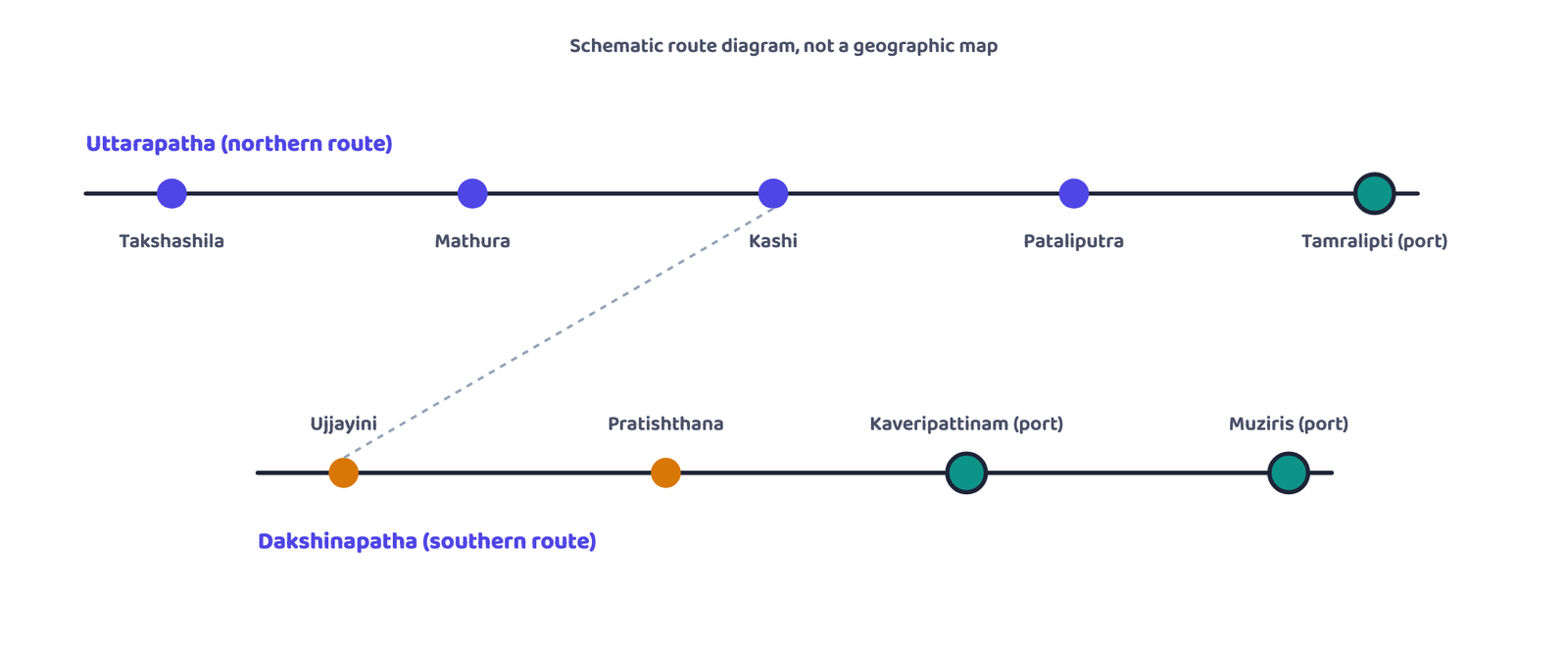
Trade contacts between the Harappans and Mesopotamia already existed via western-coast and Persian Gulf ports, and this network only grew, with ports such as Muziris, Kaveripattinam, Arikamedu and Masulipatnam developing into major hubs. Maritime trade used both coastal routes and long-distance routes across the Indian Ocean, and by the early centuries of the Common Era, India’s trade with Rome had expanded significantly, by sea and overland through Central Asia. The Tamil epic Silappadikaram mentions two important local routes: one linking Kanchipuram to the port of Poompuhar (Kaveripattinam), and another connecting Kanchipuram to Kanyakumari.
A shreni, or guild, was a collective organisation of traders, artisans or merchants engaged in the same profession, craft or occupation. Guilds grew significantly in importance after the rise of the mahajanapadas in the 6th century BCE, alongside the first metallic coins, silver punch-marked coins.
Guilds did far more than represent a trade. The Jataka literature records eighteen distinct types of guilds, showing how established and influential these institutions had become. Guilds regulated the quality of goods and often fixed prices, protecting both artisans and consumers, and supervised their own members’ conduct through guild courts. Remarkably, guilds also worked as banks: they took deposits, paid interest, and acted as financiers and trustees.
- 1 markWhat does this source tell us about the economic role of guilds?
- 1 markWhy were guilds trusted with money deposits?
- 1 markIdentify the donor and the donees named in this source.
An inscription on the southern gateway of the Great Stupa at Sanchi credits the guild of ivory workers from Vidisha with carving the stone sculptures on the gateways and railings around the stupa. Craft guilds, in other words, did not just fund religious buildings, they physically built them.
By the late pre-Gupta period, industries were flourishing on the back of this guild system: literary and archaeological sources mention silk, cotton, wool and linen textiles, made using diverse weaving techniques, with cities such as Mathura, Kashi and Kamarupa emerging as major textile hubs.
- Indian civilisation shows remarkable continuity in its social, cultural and political traditions across this whole period
- Political organisation evolved step by step: kin-based janas → territorial janapadas → sixteen mahajanapadas → empires (Mauryas, Guptas, Cholas), alongside republics (ganas/samghas)
- Kingship rested on both duty (Arthashastra, Shanti Parva) and structure (mantri-parishad, Kautilya’s Saptanga); administration ran through provinces, districts and self-governing villages, with local names differing north and south
- The economy rested on agriculture and irrigation, with trade, ports and guilds (shrenis) driving commerce and craft
- Society was organised by varna, which was originally functional, not fixed by birth; jati multiplied over time; women’s status was high in Vedic times but later fluctuated
- Despite constant political change, knowledge traditions, trade networks and devotional practices such as Bhakti kept flourishing across regions
- 5 marksHow did political organisation change from the Vedic period to the age of large empires such as the Mauryas and the Guptas? Explain the administrative system of the early Indian states.
- 5 marksDescribe the role of the king, important officers, and the methods used to govern large territories in early India.
- 3 marksIn your view, what were the most important features of the state and society in India before 1000 CE? Give reasons for your answer.
- 3 marksWhat do early texts such as the Rigveda, the Arthashastra and the Mahabharata reveal about political and social life?
- 3 marksWhat can we learn from early Indian society about varna and the role of women?
- 3 marksExplain how assemblies like the sabha and the samiti limited the power of the raja. Which modern institutions perform similar functions today?
- 3 marksWhat do the terms varna and jati refer to in early Indian society? How were they different, and what factors contributed to the formation of various jatis?
- 3 marksWhy do you think education in early India emphasised both knowledge and moral values? How might this have benefited society?
- 3 marksHow do you think the major trade routes of early India helped people exchange goods, skills, beliefs and cultural practices?
- 3 marksWhat might have been the advantages and challenges of ruling a large empire in the absence of modern communication systems?
- 3 marksMany ideas about governance come from texts composed by scholars and advisors of the king. What might be some limitations of relying only on such sources?
- 2 marksOn an outline map of India, mark and locate: Pataliputra, Nashik, Ujjayini, Vikramshila, Kanchipuram, Mathura and Rajagriha.
- ActivityPrepare a short presentation or poster on one of: life in Vedic society, the gurukula education system, trade and guilds in early India, or the role of women in early Indian society.
- 1 markThe pañchajana named in the Rigveda refers to:
(a) the five great yajnas(b) five janas: Yadu, Turvasha, Puru, Anu and Druhyu
(c) the five members of the mantri-parishad(d) the five rivers of the Sapta-Sindhu region - 1 markWhich mahajanapada rose to become the most powerful, leading eventually to the Mauryan Empire?
(a) Kosala(b) Avanti(c) Magadha(d) Vatsa - 1 markIn Kautilya’s Saptanga, “kosha” refers to:
(a) the army(b) the treasury(c) the forts(d) the allies - 1 markThe Uttaramerur inscription’s Kudavolai system was used to:
(a) collect land revenue(b) select members of the village assembly
(c) settle trade disputes(d) record temple donations - 1 markWhich title did the Chola king Rajendra I adopt to commemorate his campaign along the Ganga?
(a) Adhiraja(b) Chakravarti(c) Gangaikonda(d) Samrat - 1 markA shreni in early India was:
(a) a type of land grant(b) a guild of traders or artisans
(c) a village council(d) a Vedic assembly - 1 markThe “tri-partite struggle” for Kannauj was fought among:
(a) Guptas, Mauryas and Cholas(b) Pallavas, Chalukyas and Cholas
(c) Gurjara-Pratiharas, Palas and Rashtrakutas(d) Satavahanas, Kushanas and Guptas - 1 markThe new post of “sandhivigrahika” (minister of peace and war) first appeared under the:
(a) Mauryas(b) Guptas(c) Pallavas(d) Cholas
Reason (R): The Sutta Nipata states that a brahmana is such by his deeds, not by birth.
Reason (R): Village assemblies managed local functions such as irrigation, revenue collection and dispute settlement largely without depending on the crown.
Reason (R): The later imperial Chola, Chera and Pandya kingdoms emerged many centuries after the early Sangam-age kingdoms.
Reason (R): Early texts contain references to kings being elected or even expelled by their people.