
- Who wrote “Mother’s Day”, and what kind of play it is
- The full story of the Pearson family, scene by scene, in the order the play tells it
- Who Mrs Pearson, George, Doris, Cyril and Mrs Fitzgerald are, and how the personality swap changes each of them
- What the play is really about: the undervalued status of a mother, and what happens when she stops accepting it
- How Priestley uses comedy, contrast and stage directions to make a serious point
- The key words, idioms and stage-direction terms the play uses, explained in place
- How to answer an extract-based question from this play, with a worked example, and practice questions including the book’s own exercises
1Meet the Playwright and the Play
1.1 About J.B. Priestley

J.B. Priestley (John Boynton Priestley) was an English novelist, playwright, essayist and broadcaster, known for a large body of work across fiction, drama and journalism. “Mother’s Day” is a one-act play. As the chapter’s own introduction tells us, “the following play is a humorous portrayal of the status of the mother in a family,” and NCERT’s own exercise on this chapter describes it as “written in the 1950s.”
Know that the play is by J.B. Priestley and was “written in the 1950s” (exercise Q1). The chapter gives no exact year of writing or first performance, so do not write a specific date such as 1953.
1.2 The World of the Play
The whole play happens in one place and in one sitting: “the living-room of the Pearsons’ house in a London suburb,” on “an afternoon in early autumn,” with the play’s own stage direction simply reading “Time: The Present.” Because it never leaves this one room and never jumps in time, “Mother’s Day” is a compact one-act play: everything the audience needs to know about the Pearson family is shown to them inside this single scene.
A one-act play is a complete drama written in a single act, with one continuous setting and action, unlike a full-length play divided into several acts and scenes.
2Characters at a Glance
NCERT’s own character list, in the order it is printed, is Mrs Annie Pearson, George Pearson, Doris Pearson, Cyril Pearson and Mrs Fitzgerald. The play’s opening stage direction stresses that Mrs Pearson and Mrs Fitzgerald must have “sharply contrasting voices”, Mrs Pearson speaking with “a touch of suburban Cockney,” Mrs Fitzgerald “rather Irish”. The stage direction says only that this is “very important”; it gives no reason. One reading is that the contrast helps the audience tell, by voice and manner, which personality is in which body.
| Character | Role and key trait (as the play describes them) |
|---|---|
| Mrs Annie Pearson | The mother; “a pleasant but worried-looking woman in her forties,” taken for granted by her whole family |
| George Pearson | The husband; “about fifty, fundamentally decent but solemn, self-important, pompous,” a “heavy, slow-moving type” |
| Doris Pearson | The daughter; “a pretty girl in her early twenties, who would be pleasant enough if she had not been spoilt” |
| Cyril Pearson | The son; described simply as “the masculine counterpart of Doris”, equally spoilt, equally self-absorbed |
| Mrs Fitzgerald | The next-door neighbour; “older, heavier and a strong and sinister personality,” a fortune-teller who “learnt it out East” |
A foil is a character whose traits highlight another character’s traits by contrast. The nervous, apologetic Mrs Pearson and the bold, “sinister” Mrs Fitzgerald are foils to each other, which is why the swap is so easy to see on stage. Doris and Cyril are the opposite case: Cyril is “the masculine counterpart of Doris”, a parallel character who repeats the same spoilt behaviour.
3The Play, Scene by Scene
The play falls into three clear movements: the opening conversation that sets up the swap, the family confronted one by one, and the reversal that ends the play. Each is shown below as its own short chain so the whole shape of the plot can be seen at a glance before the detail.
3.1 Setting up the swap
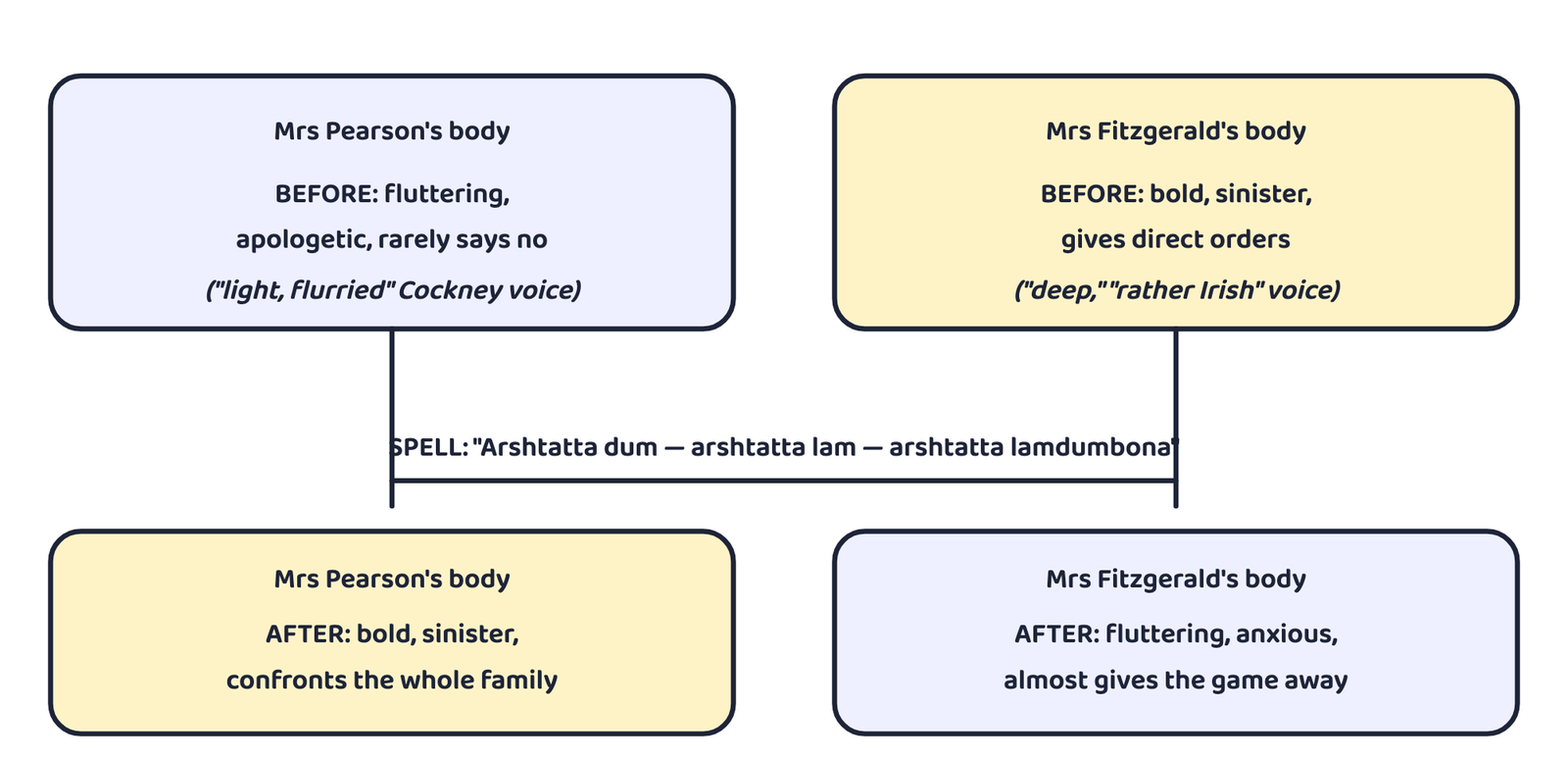
Once the chant is spoken, both women go limp “as if the life were out of them,” then revive with swapped personalities: Mrs Pearson’s body now carries Mrs Fitzgerald’s bold, dominating manner, and Mrs Fitzgerald’s body carries Mrs Pearson’s nervous, fluttering manner. The stage direction is exact about this: “Each must try to adopt the voice and mannerisms of the other.”
3.2 The family confronted, one by one
Do not write that Mrs Pearson “pretends” to be tough with her family. Inside the play’s own logic, her personality has genuinely swapped with Mrs Fitzgerald’s for this stretch of the scene, it is not an act she is putting on as herself.
3.3 The reversal and the ending
The play ends on this note of change: George says “Suits me,” Cyril “hastily” agrees, Doris hesitates and then agrees too. Mrs Fitzgerald leaves, and “the family cluster round Mother as — the curtain falls.” One reading is that the swap has done its work, even though the family never learns what really happened.
4The Personality Swap: Before and After
The swap is the play’s central technical device: the same body, but a completely different manner, voice and set of decisions. The diagram below lines up how each woman behaves before the swap against how “the same body” behaves once the personality inside it has changed.
Mrs Pearson, before the swap
- Finds it hard to stand up to her family
- Apologises even while agreeing she is right
- “It’s so hard to know where to start”
Mrs Pearson’s body, during the swap
- Smokes, drinks stout, says no without apologising
- Exposes George’s club nickname without flinching
- “Very neat. Didn’t know I had it in me.”
5Themes
The undervalued status of the mother
The chapter’s own introduction calls it “a humorous portrayal of the status of the mother in a family”. Mrs Fitzgerald puts it bluntly: “Husbands, sons, daughters should be taking notice of wives an’ mothers, not giving ’em orders an’ treating ’em like dirt.” In the play, Mrs Pearson’s unpaid, unthanked work is taken for granted by husband and children alike until she (through Mrs Fitzgerald) refuses to keep providing it.
Self-respect and assertiveness
Mrs Pearson cannot confront her family as herself until the personality swap forces the issue, but one reading is that the firmness can be hers: once her own personality returns, Mrs Fitzgerald warns her not to “go soft on ’em again,” and she keeps the family in line herself when she proposes the rummy evening (“What? Speak up!” to the hesitating Doris).
Comeuppance / poetic justice
Each family member’s own excuse is turned back on them: Doris’s talk of “working hard” and Cyril’s of “working all day” become Mrs Pearson’s own eight-hour day and weekend off; George’s pompous club pride is punctured by his own nickname.
Role reversal as social comment
Swapping who holds authority in the house, even briefly and through fantasy, exposes how the family behaves once someone stops silently accepting their treatment of her.
Comedy used for a serious message
The play is built as farce, but its subject, a mother’s unrecognised place in her own home, is genuine. Whether the play caricatures these issues, and whether its resolution convinces, are questions the exercises ask you to discuss (exercise Q1(ii)), not settled facts.
6Dramatic Devices and Technique
The terms below are standard terms from literary study. Apart from “satirical” (exercise Q1), the book itself does not use them.
Dramatic irony occurs when the audience (or some characters) know something that other characters on stage do not. Here, the audience and the two women know about the swap throughout; the Pearson family never does, which is what drives much of the comedy in the middle of the play.
Satire is the use of humour, irony or exaggeration to criticise or expose a social fault. The play satirises how a family can take a mother’s care completely for granted without ever noticing they are doing it.
Farce is a comic style built on exaggerated, improbable situations played for broad laughter. The personality-swap device itself, and the rapid pattern of refusals it produces, is the play’s central farcical element.
Stage directions are a playwright’s bracketed instructions on how a line should be delivered or how a character should move, e.g. “[coolly],” “[aggressively],” “[dubiously].” Priestley uses them constantly to do the character work a novel would normally do through narration.
One-act structure
A single set and continuous action let the play build its comedy through pattern and repetition rather than through change of scene.
Contrast
Before/after personality in the same body is the technical engine of the play; the two women’s contrasting voices (Cockney/Irish) make the contrast audible as well as behavioural.
Fantasy as metaphor
The magical swap can be read as a metaphor. It stages, in a compact and comic way, what happens when Mrs Pearson stops being submissive.
Colloquial dialogue
Contractions, interruptions and slang (“clot,” “piecan,” “barmy,” “tiddly”) mark the family’s everyday speech and give the comedy its rhythm and social setting.
If asked “how does Priestley make this play funny,” do not answer with plot alone. Name at least one technique: dramatic irony, contrast, or the stage directions, and quote the exact bracketed direction or line that shows it.
7Words to Know
| Word / phrase | Meaning in this play |
|---|---|
| sinister | giving an impression of evil or menace, used of Mrs Fitzgerald’s personality, though she turns out to be helpful |
| flurried | confused and agitated, hurried in a nervous way |
| laconic | using very few words |
| incisive | direct, sharp and decisive in speech or manner |
| pompous | self-important, taking oneself far too seriously |
| barmy / tiddly | informal British slang for “mad/foolish” and “slightly drunk” |
| clot / piecan | informal British insults, roughly “a foolish person” |
| aghast | filled with horror or shock |
| apprehensively | anxiously, fearing what might happen next |
| at sixes and sevens | in a state of confusion and disorder (“we’re at sixes and sevens here just now”, George) |
| guffaw | to laugh loudly and noisily (Cyril, “beginning to guffaw”) |
| dress circle | the first raised tier of seats in a theatre; Cyril’s “two front dress circles for the first house” jokes that Dad’s homecoming will be a show worth the best seats |
| blubbering | crying noisily (“Stop blubbering. You’re not a baby.”) |
| Lieutenant Quartermaster | an army officer’s rank; Mrs Fitzgerald’s husband rose to it during their twelve years “out East” |
8Lines to Remember
“Make up your mind — and there it is.”
Mrs Fitzgerald, in the play’s opening lines
“Husbands, sons, daughters should be taking notice of wives an’ mothers, not giving ’em orders an’ treating ’em like dirt.”
Mrs Fitzgerald, the play’s clearest statement of the mother’s position
“Arshtatta dum — arshtatta lam — arshtatta lamdumbona.”
the chant that swaps the two personalities, spoken twice in the play
“Very neat. Didn’t know I had it in me.”
Mrs Fitzgerald’s personality, now in Mrs Pearson’s body, pleased that her swap trick still works
“Don’t go soft on ’em again, else it’ll all have been wasted.”
Mrs Fitzgerald’s parting warning
The play never explains how or why the personality swap works. It tells us only that Mrs Fitzgerald “learnt it out East.” One reading is that the play is not really about magic but about what changes when somebody’s manner changes.
- Can I name all five characters exactly as the play prints them?
- Can I narrate the swap, the three confrontations, and the reversal in order without looking?
- Can I quote the chant and George’s club nickname exactly?
- Can I explain dramatic irony using this play’s own swap as the example?
- Can I argue both sides of whether the play caricatures these issues or the problems it raises are genuine (exercise Q1(ii))?
- “Mother’s Day” by J.B. Priestley, a one-act comic play, “written in the 1950s,” about the status of the mother in a family
- Setting: the Pearsons’ living room, a London suburb, one autumn afternoon, present day
- Five characters: Mrs Annie Pearson, George Pearson, Doris Pearson, Cyril Pearson, Mrs Fitzgerald (the neighbour)
- Mrs Fitzgerald reads Mrs Pearson’s fortune and urges her to “put your foot down”; Mrs Pearson admits she agrees but cannot do it herself
- They swap personalities with a chant, “Arshtatta dum — arshtatta lam — arshtatta lamdumbona”
- In Mrs Pearson’s body, Mrs Fitzgerald’s bold personality confronts Doris (the yellow silk), Cyril (tea, the “movement”), and George (the stout, “Pompy-ompy Pearson”)
- Doris and Cyril suspect “Mum” may have concussion; the real Mrs Pearson, now nervous in Mrs Fitzgerald’s body, nearly gives the game away
- The family is sent out; the two women swap back to their true personalities
- Mrs Fitzgerald warns Mrs Pearson not to go “soft” on them again; Mrs Pearson tests it at once, the family agrees to “a nice family game of rummy”, and “the family cluster round Mother” as the curtain falls
- Themes: the mother’s undervalued status, self-respect, comeuppance, comedy as a vehicle for a genuine social message
Extract: “But will you make up your mind now, Mrs Pearson dear? Put your foot down, once an’ for all, an’ be the mistress of your own house an’ the boss of your own family.”
Q (a) Who says this, to whom, and when? Answer: Mrs Fitzgerald says it to Mrs Pearson at the start of the play, just after reading her fortune with cards.
Q (b) What does “put your foot down” mean here? Answer: To be firm and stop accepting her family’s orders, instead of running after them “as if you were the servant in the house”.
Q (c) How does Mrs Pearson reply? Answer: “[smiling apologetically] That’s easier said than done.” She is “so fond of them”, though they are “so thoughtless and selfish”.
Method: name the speaker and the moment, explain the phrase in your own words, and support each answer with a short exact quotation from the play.
- 1 markWho is the author of “Mother’s Day”?
- 1 markWhere and when is the play set?
- 2 marksWhat advice does Mrs Fitzgerald give Mrs Pearson at the start of the play?
- 2 marksQuote the exact words of the chant used to swap personalities.
- 3 marksHow does “Mrs Pearson” treat Doris once the swap has happened?
- 3 marksWhat does George learn about himself, and from whom?
- 4 marksExplain, with an example from the play, what is meant by dramatic irony.
- 4 marksHow does the play end, and what does Mrs Fitzgerald warn Mrs Pearson about?
- 6 marks“Mother’s Day” is a humorous and satirical depiction of the status of the mother in the family. Discuss, with examples from the play.
- If you were to write about these issues today what are some of the incidents, examples and problems that you would think of as relevant? (exercise Q2, an open discussion question)
- Is drama a good medium for conveying a social message? Discuss. (exercise Q3, an open discussion question)