
- Write any composite number as a product of primes, and explain why there is only one way to do it
- Find the HCF and LCM of two or three numbers by the prime factorisation method
- Use HCF × LCM = product for two numbers, and know that it need not hold for three
- Prove that , , are irrational by the method of contradiction
- Prove that numbers like and are irrational
The chapter in the current NCERT reprint has two parts: the Fundamental Theorem of Arithmetic (Section 1.2, Exercise 1.1) and Revisiting Irrational Numbers (Section 1.3, Exercise 1.2). The CBSE 2026-27 curriculum lists the same two topics for Real Numbers. Euclid’s Division Algorithm and decimal expansions of rational numbers, found in older guides, are not in the CBSE 2026-27 syllabus, and this reprint has no section on them.
1 The Fundamental Theorem of Arithmetic
Every natural number greater than 1 is one of two kinds, and this whole section is about the difference:
Prime number
- Has exactly two factors: 1 and itself
- Cannot be broken into smaller factors
- 2, 3, 5, 7, 11, 13, 23 …
Composite number
- Has more than two factors
- Can be broken into smaller factors
- 4, 6, 12, 253 = 11 × 23 …
Powers: means (2 multiplied 3 times); 3 is the power of 2. A prime that appears once has power 1, e.g. .
If we multiply primes together, repeating them as often as we like, we build up composite numbers: , , and infinitely many more. The real question is the reverse: can every composite number be broken back down into primes? To find out, we break a large number down with a factor tree, splitting each composite number into two factors until only primes are left.
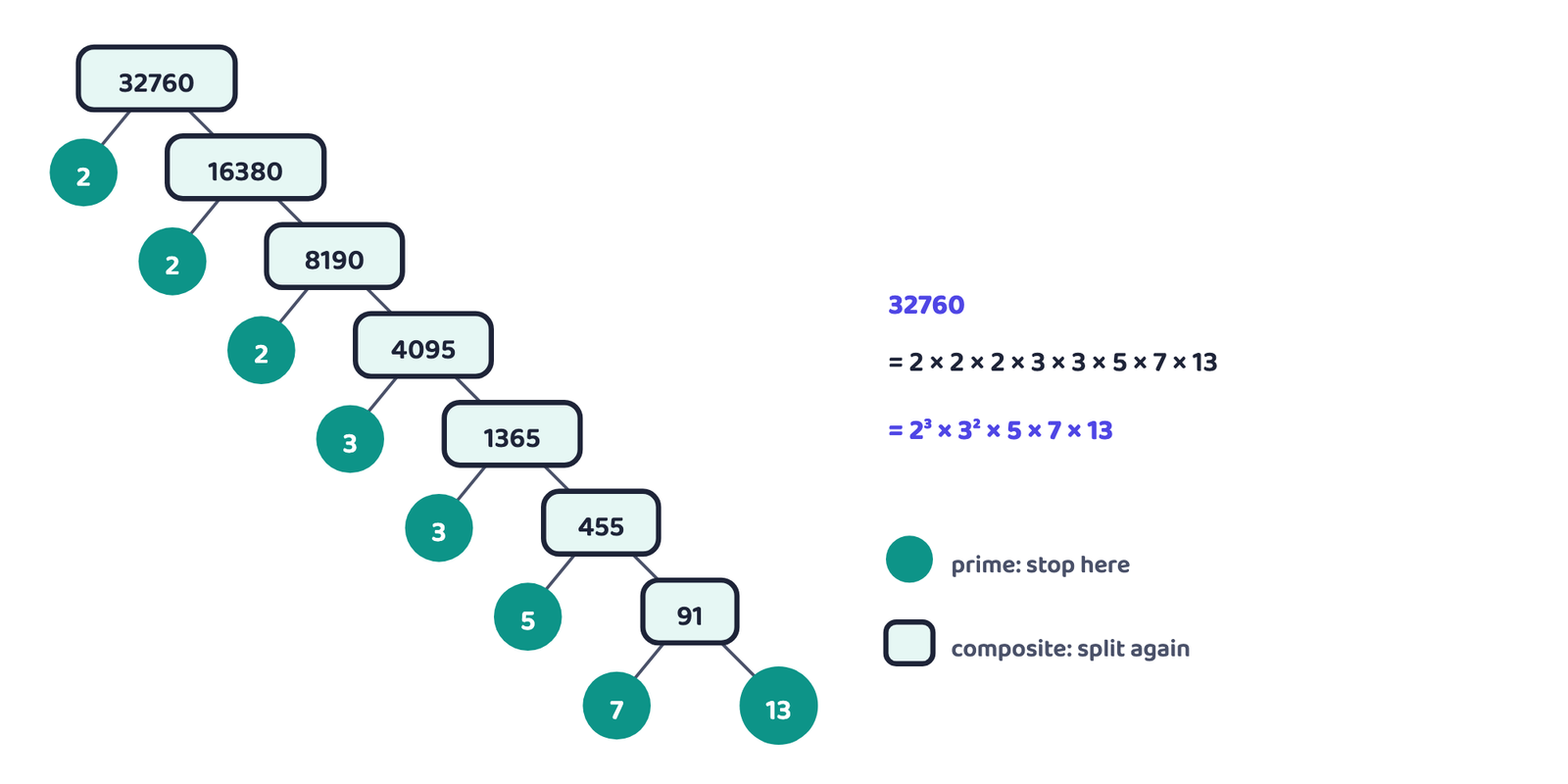
Try another: (3803 and 3607 are both prime numbers). Every number we try breaks down into primes in this way. This always happens, and it has been proved, so it is stated as a theorem (a result that has been proved true).
“Every composite number can be expressed (factorised) as a product of primes, and this factorisation is unique, apart from the order in which the prime factors occur.”
The theorem says two things. First, a factorisation into primes always exists. Second, it is unique (there is only one): and count as the same factorisation, since only the order differs. So if we always write the primes from smallest to largest (ascending order), there is exactly one way to write any composite number, such as . NCERT also states it as: “The prime factorisation of a natural number is unique, except for the order of its factors.”
An equivalent version of this theorem was probably first recorded as Proposition 14 of Book IX in Euclid’s Elements. The first correct proof was given by Carl Friedrich Gauss (1777-1855) in his Disquisitiones Arithmeticae. Gauss is often called the “Prince of Mathematicians” and is counted among the three greatest mathematicians of all time, along with Archimedes and Newton.

In problems, the uniqueness part is used to show which primes cannot appear in a number’s factorisation, as in Example 1:
Q. Consider the numbers , where is a natural number. Check whether there is any value of for which ends with the digit zero.
Solution: A number ending in 0 is divisible by 10, so it is divisible by 5, and its prime factorisation must contain the prime 5.
But , so the only prime in the factorisation of is 2.
By the uniqueness in the Fundamental Theorem of Arithmetic, no other prime (in particular, not 5) can appear.
So there is no natural number for which ends with the digit zero.
The same argument settles every “can end in 0?” question: a number ends in 0 only if its prime factorisation contains both 2 and 5. Look at the number being raised to the power: has no 5, so it never ends in 0; always does.
Q. Show that and are not prime.
Solution: Take out the common prime factor from both terms.
.
.
Each number has a factor other than 1 and itself (13 and 5), so both are composite.
2 HCF and LCM by Prime Factorisation
HCF is the Highest Common Factor and LCM the Lowest Common Multiple. The way you found them in earlier classes, by first breaking each number into primes, is called the prime factorisation method. It works because of the Fundamental Theorem of Arithmetic.
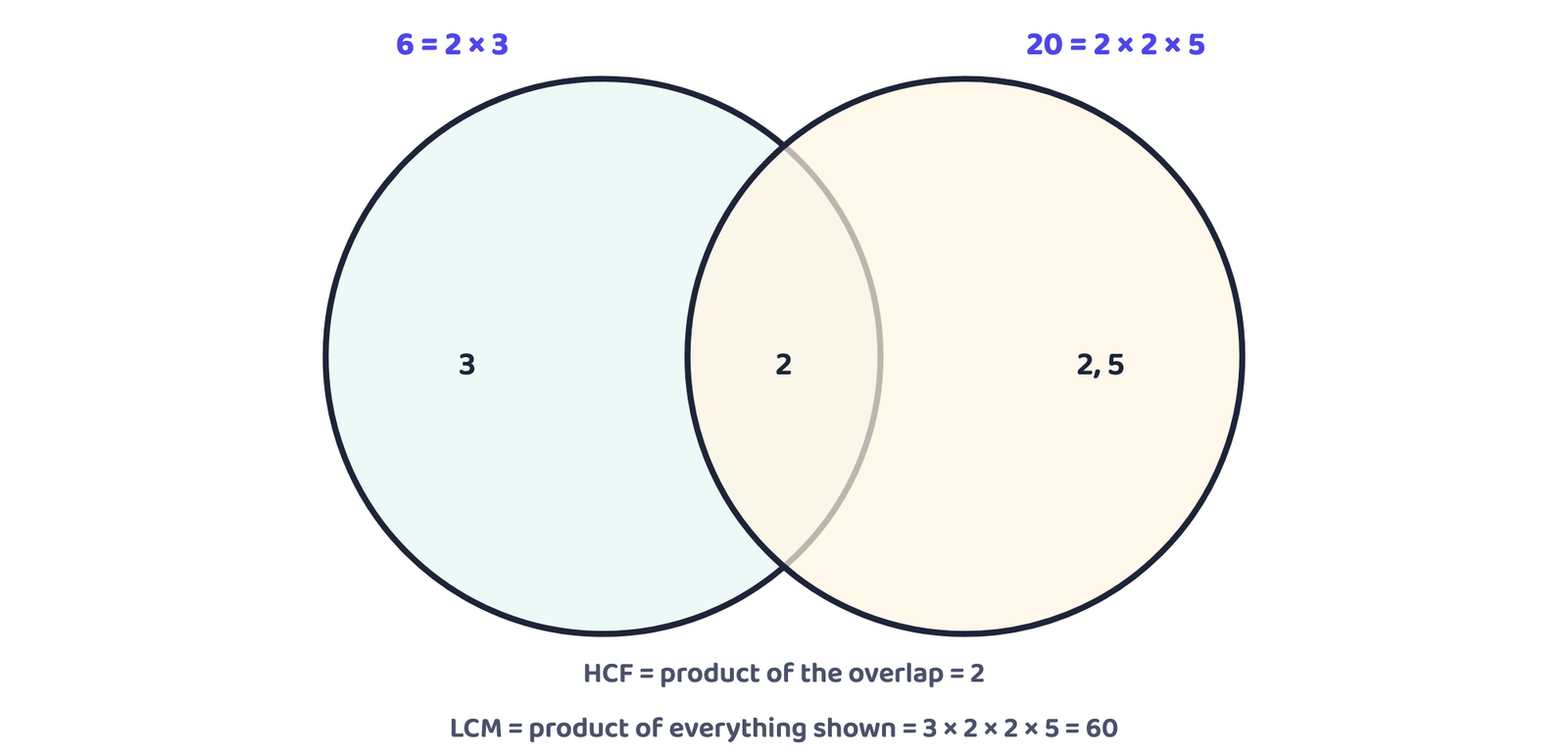
Q. Find the LCM and HCF of 6 and 20 by the prime factorisation method.
Solution: and .
Common prime: only 2, smallest power . So .
All primes involved: 2, 3, 5, greatest powers . So .
Notice that . This is true for every pair of positive integers:
Q. Find the HCF of 96 and 404 by the prime factorisation method. Hence, find their LCM.
Solution: and .
Common prime: 2, smallest power . So .
.
Q. Find the HCF and LCM of 6, 72 and 120, using the prime factorisation method.
Solution: , , .
Common primes: 2 and 3, smallest powers and . So .
Greatest powers: , , . So .
The product rule is stated for two numbers. Do not use it for three. In Example 4, , but . So for 6, 72 and 120, the product of the three numbers is not equal to the product of their HCF and LCM. For three numbers this equality does not hold in general, so find the HCF and LCM by prime factorisation.
Q. Sonia takes 18 minutes and Ravi 12 minutes to go once round a circular path. They start together from the same point, in the same direction. When are they next together at the starting point?
Solution: Sonia is back at the start after every multiple of 18 minutes and Ravi after every multiple of 12 minutes, so they are there together first after LCM(18, 12) minutes.
and , so .
They meet again at the starting point after 36 minutes.
3 Theorem 1.2: The Tool for the Irrationality Proofs
Before proving any number irrational, we need one fact about primes, which also comes from the Fundamental Theorem of Arithmetic.
Let be a prime number. If divides , then divides , where is a positive integer.
“ divides ” means is a multiple of (for example, 3 divides 12). It is written . The arrow means “so” or “implies”.
Why it is true is shown below. NCERT marks this proof with an asterisk: “Not from the examination point of view.”
4 Revisiting Irrational Numbers
A number is rational if it can be written as a fraction of two integers with (for example , , ). Here and are any integers, not the prime of Theorem 1.2. Rational and irrational numbers together make up the real numbers.
A number is called irrational if it cannot be written in the form , where and are integers and .
You already know several: , , , , , . In Class 9 you were told they are irrational; now we prove it. The proofs use two ideas:
Two integers are coprime if they have no common factor other than 1. Any fraction can be reduced to lowest terms with and coprime.
To prove a statement, assume the opposite and show that this assumption leads to something impossible. The assumption must then be false, so the statement is true.
4.1 Theorem 1.3: is irrational
4.2 The same method for , and any
Theorem 1.2 works for every prime, so the proof above works for whenever is prime. Only the number changes:
Q. Prove that is irrational.
Solution: Assume, to the contrary, that is rational, so with coprime integers, .
Then , and squaring, . So 3 divides , and by Theorem 1.2, 3 divides .
Write . Then , that is, . So 3 divides , and hence 3 divides (Theorem 1.2).
Now 3 is a common factor of and , which contradicts that they are coprime.
So is irrational.
Steps for proving , or irrational. Write every step, in this order: assume rational → coprime → square → Theorem 1.2 → substitute → Theorem 1.2 again → contradiction → conclusion.
5 Rational and Irrational Numbers Together
In Class 9 you were told two facts. NCERT proves them for particular numbers:
| Fact | NCERT example |
|---|---|
| Rational ± irrational is irrational | (Example 6) |
| Non-zero rational × or ÷ irrational is irrational | (Example 7) |
Q. Show that is irrational.
Solution: Assume, to the contrary, that is rational, so with coprime, .
Rearranging, .
Since and are integers, is rational, so would be rational.
This contradicts the fact that is irrational. So is irrational.
Q. Show that is irrational.
Solution: Assume, to the contrary, that is rational, so with coprime, .
Rearranging, . Since 3, and are integers, is rational, so would be rational.
This contradicts the fact that is irrational. So is irrational.
These rules need one rational and one irrational number. Two irrationals can give a rational answer: and . Also, the rational number must be non-zero when multiplying: is rational.
6 Extra: HCF and LCM of Three Numbers
From NCERT’s “Note to the Reader”: for three positive integers (here need not be prime), HCF × LCM need not equal the product , but these formulas hold:
Check with 6, 72, 120: HCF(6, 72) , HCF(72, 120) , HCF(6, 120) , so , matching Example 4.
- FTA: every composite number is a product of primes, uniquely apart from order
- A number ends in 0 only if its prime factors include both 2 and 5; so , never end in 0
- HCF = smallest powers of common primes; LCM = greatest powers of all primes
- for two numbers; for three numbers it does not hold in general (6, 72, 120)
- Theorem 1.2: prime and
- is irrational for every prime : assume with coprime, square, Theorem 1.2 twice, contradiction
- rational ± irrational = irrational; non-zero rational × or ÷ irrational = irrational
- 1 markExpress 84 as a product of its prime factors.
- 2 marksFind HCF(96, 120) by prime factorisation, and hence their LCM.
- 2 marksCan end with the digit 0 for any natural number ? Give a reason.
- 3 marksProve that is irrational.
- 3 marksProve that is irrational.