
- Tell whether a list of numbers is an arithmetic progression (AP), and give the reason
- Write the first term , the common difference and the general form of any AP
- Find any term with , and find which term a given number is
- Add the first terms in one step with or
- Turn word problems on salary, savings, prizes, production and rows of objects into an AP and solve them
general formfinite APinfinite APnth term / general term
last term lsum of first n termsarithmetic mean
1 Patterns in Everyday Life
Many lists of numbers around us follow a pattern. The book begins with patterns in nature: the petals of a sunflower, the holes of a honeycomb, the grains on a maize cob, and the spirals on a pineapple and on a pine cone. It then gives six patterns from day-to-day life. Look at
how each next number is made, because that decides everything in this chapter.
| Situation (from the book) | The list | How the next number is made | Adds a fixed number? |
|---|---|---|---|
| Reena’s monthly salary: starts at ₹8000, annual increment (yearly rise) ₹500 | 8000, 8500, 9000, . . . | add 500 | Yes |
| Rungs of a ladder: bottom rung 45 cm, each rung 2 cm shorter going up (8 rungs) | 45, 43, 41, . . ., 31 | add −2 | Yes |
| Savings scheme: ₹8000 invested becomes times itself every 3 years (amounts after 3, 6, 9, 12 years) | 10000, 12500, 15625, 19531.25 | multiply by | No |
| Unit squares in squares of side 1, 2, 3, . . . units | squares of consecutive (one-after-another) numbers | No | |
| Shakila’s money box for her daughter: ₹100 at age one, ₹50 more every year | 100, 150, 200, 250, . . . | add 50 | Yes |
| Pairs of rabbits at the start of months 1 to 6 | 1, 1, 2, 3, 5, 8 | add the two previous numbers | No |
This chapter studies only the lists marked “Yes”: lists where every next term comes from
adding the same fixed number.
2 What Is an Arithmetic Progression?
Each number in a list is called a term. Look at these five lists from the book:
| List | Rule | Fixed number added |
|---|---|---|
| 1, 2, 3, 4, . . . | each term is 1 more than the one before | 1 |
| 100, 70, 40, 10, . . . | each term is 30 less than the one before | −30 |
| −3, −2, −1, 0, . . . | add 1 to the term before | 1 |
| 3, 3, 3, 3, . . . | add (or subtract) 0 | 0 |
| −1.0, −1.5, −2.0, −2.5, . . . | add −0.5 (that is, subtract 0.5) | −0.5 |
An arithmetic progression (AP) is a list of numbers in which each term is obtained by adding a
fixed number to the preceding term, except the first term.
(Preceding term = the term just before it. The first term has nothing before it, so it is simply given.)
The fixed number added each time is called the common difference of the AP, written .
It can be positive, negative or zero.
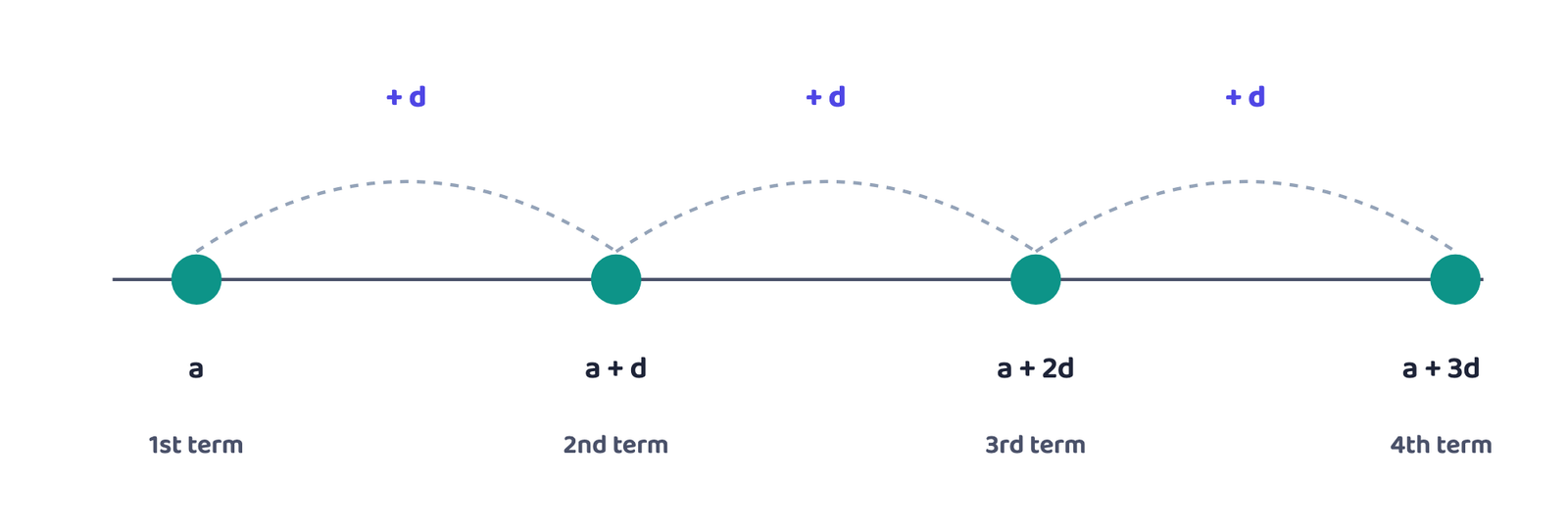
We write the terms as (first term), (second term), . . ., (th term). Since the same
is added every time, the gap between any two neighbouring terms is always (here is the term just before ):
The general form of an AP is
2.1 Finite and infinite APs
Finite AP
- Stops after a certain number of terms, so it has an end
- Has a last term
- e.g. cash prizes for Classes I to XII: 200, 250, 300, . . ., 750
Infinite AP
- The terms never end (the list ends with “. . .”)
- Has no last term
- e.g. 1, 2, 3, 4, . . .
The book’s finite APs, with their common differences:
| Finite AP | List | |
|---|---|---|
| Heights of students in a queue (cm) | 147, 148, 149, . . ., 157 | 1 |
| Minimum temperatures of a week in January, lowest to highest (°C) | −3.1, −3.0, −2.9, . . ., −2.5 | 0.1 |
| Balance after paying 5% of a ₹1000 loan every month (₹) | 950, 900, 850, . . ., 50 | −50 |
| Cash prizes to toppers of Classes I to XII (₹) | 200, 250, 300, . . ., 750 | 50 |
| Total savings after each month, saving ₹50 a month for 10 months (₹) | 50, 100, 150, . . ., 500 | 50 |
2.2 Writing an AP from a and d
To write down an AP you need both the first term and the common difference . Knowing only one
of them is not enough. Start at and keep adding :
| The AP | ||
|---|---|---|
| 6 | 3 | 6, 9, 12, 15, . . . |
| 6 | −3 | 6, 3, 0, −3, . . . |
| −7 | −2 | −7, −9, −11, −13, . . . |
| 1.0 | 0.1 | 1.0, 1.1, 1.2, 1.3, . . . |
| 0 | ||
| 2 | 0 | 2, 2, 2, 2, . . . |
2.3 Test for an AP: checking whether a list is an AP
Now the other way round: you are given a list and must decide whether it is an AP. The first term is
simply the first number. For , use the fact that in an AP each term minus the term just before it is always
the same:
Here is any term (the th term) and is the term just after it.
Tip: once you already know a list is an AP, one difference is enough to find . A list that fails the test:
1, 1, 2, 3, 5, . . . (its differences 0, 1, 1, 2 are not all the same, so it is not an AP).
Always subtract the earlier term from the later term (), even when the later
term is smaller. For 6, 3, 0, −3, . . . write , not .
Q. For the AP write the first term and the common difference .
Solution: and .
Q. Which of these lists form an AP? If they do, write the next two terms.
(i) 4, 10, 16, 22, . . . (ii) 1, −1, −3, −5, . . . (iii) −2, 2, −2, 2, −2, . . . (iv) 1, 1, 1, 2, 2, 2, 3, 3, 3, . . .
Solution:
(i) , , . Same every time, so it is an AP with . Next two terms: and .
(ii) , , . It is an AP with . Next two terms: and .
(iii) but . The differences are not equal, so it is not an AP.
(iv) , , but . Not equal, so it is not an AP.
3 The nth Term of an AP
What is Reena’s monthly salary in her 5th year? Adding ₹500 year by year works, but what about the
25th year? Watch the pattern as we go:
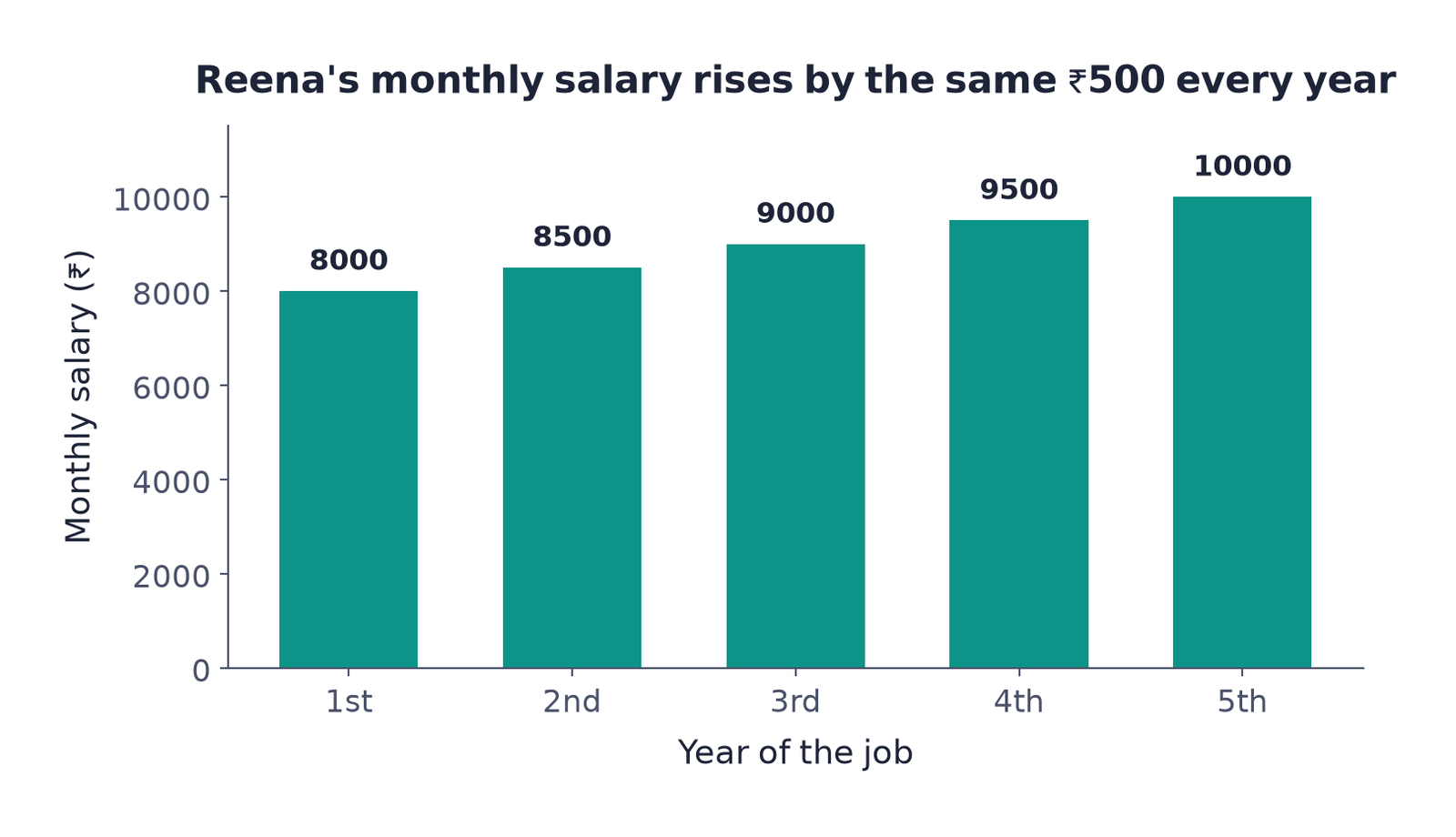
So each year’s salary = first salary + (year number − 1) × annual increment. The same thing happens in
every AP with first term and common difference :
last term, which is sometimes written .
3.1 Finding a term
Given
AP: 2, 7, 12, . . .
To find
the 10th term
, , . So 47.
3.2 Which term is a given number?
Put the given number in place of and solve for .
Q. Which term of the AP 21, 18, 15, . . . is −81? Is any term 0? Give a reason.
Solution: , .
. So the 35th term is −81.
For 0: . So yes, the 8th term is 0.
counts positions (1st, 2nd, 3rd, . . .), so it can only be a positive integer. If solving gives
a fraction, a negative number or zero, the given number is not a term of the AP. Write this reason in the
answer, because it explains why the given number is not a term of the AP.
Q. Check whether 301 is a term of the list 5, 11, 17, 23, . . .
Solution: The differences , , are all 6, so it is an AP with , .
If 301 is the th term: , so and .
This is not a positive integer, so 301 is not a term of the list.
Q. How many two-digit numbers are divisible by 3?
Solution: They are 12, 15, 18, . . ., 99, an AP with , , .
.
There are 30 such numbers.
3.3 Finding the AP from two conditions
If two terms are given, write each one using . You get two equations in and ; subtract one from the other to find , then find .
Q. Determine the AP whose 3rd term is 5 and 7th term is 9.
Solution: . . . (1) and . . . (2).
Subtracting (1) from (2): , so . Then from (1), .
The AP is 3, 4, 5, 6, 7, . . .
3.4 The kth term from the end
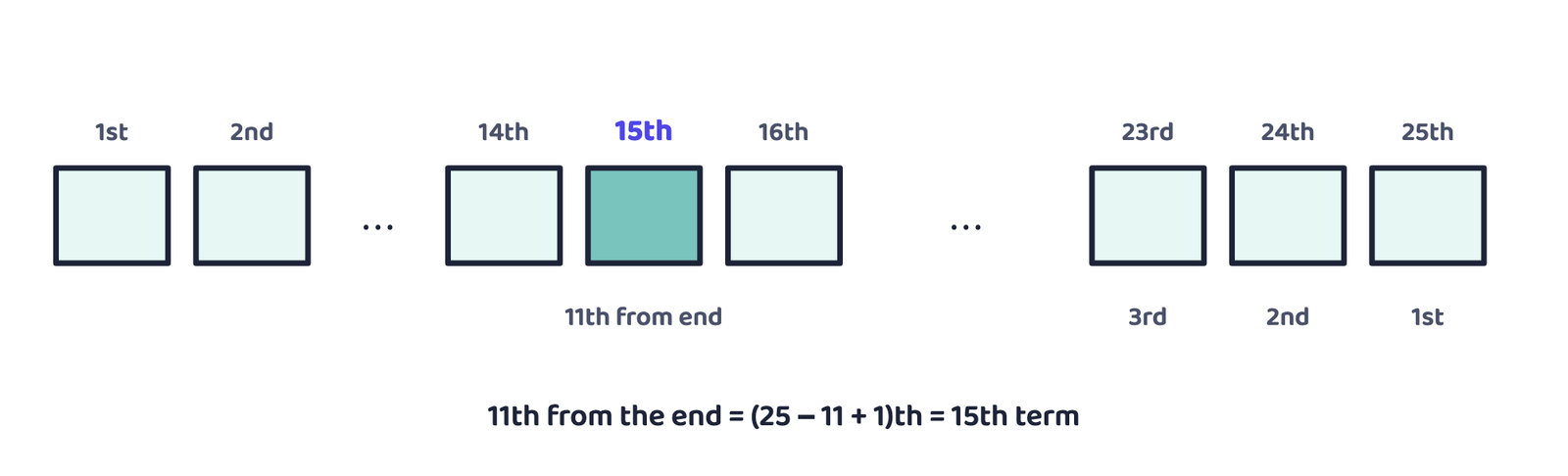
In a finite AP with terms, the th term from the end is the
th term from the start. The “+1” is there because the last term itself is the 1st term from the end (so the 11th term from the end of 25 terms is the 15th, not the 14th).
Another way: start at the last term and step back times, so the th term from the end .
Q. Find the 11th term from the last term (towards the first term) of the AP 10, 7, 4, . . ., −62.
Method 1 (count the terms): , , .
.
The 11th term from the end is the 15th term (a common slip is to write the 14th):
−32.
Method 2 (reverse the AP): Written backwards the AP is −62, −59, −56, . . ., so now and
. The required term is the 11th term of this new AP: −32.
3.5 Word problems on the nth term
Q. ₹1000 is invested at 8% simple interest per year. Do the interests at the end of each year form an
AP? If so, find the interest at the end of 30 years.
Solution: Simple interest ( = money invested, = rate per cent per year, = time in years). After 1, 2, 3 years:
, then 160, then 240, . . . Each is 80 more than the last, so it is an AP with
, . Then . Interest after 30 years = ₹2400.
Q. A flower bed has 23 rose plants in the first row, 21 in the second, 19 in the third, and so on,
with 5 plants in the last row. How many rows are there?
Solution: 23, 21, 19, . . ., 5 is an AP (each row has 2 fewer plants) with , , .
. There are 10 rows.
4 Sum of the First n Terms of an AP
Shakila puts ₹100 in her daughter’s money box on her first birthday, ₹150 on the second, ₹200 on the third,
and so on. How much is collected by the 21st birthday? Adding 21 numbers one by one is slow. A formula does it in
one line, and the idea behind it comes from the famous mathematician Gauss.
When Gauss was just 10 years old, he was asked to add the whole numbers from 1 to 100. He wrote the sum forwards and
backwards and added the two lines. Every pair adds to 101, and there are 100 pairs:

The same trick works for any AP whose th term is :
Since , this is also .
are given but is not.
Given
Shakila’s money box: , ,
To find
total money on the 21st birthday,
₹12600.
The formula for the sum of the first n terms involves four quantities S, a, d and n. If we know any three of them, we can find the fourth.
NCERT textbook, Section 5.4
Useful when the question gives as a formula in , such as . Also .
4.1 Solved examples on the sum
Q. Find the sum of the first 22 terms of the AP 8, 3, −2, . . .
Solution: , , .
−979.
Q. The sum of the first 14 terms of an AP is 1050 and its first term is 10. Find the 20th term.
Solution: .
So 200.
Q. How many terms of the AP 24, 21, 18, . . . must be taken so that their sum is 78?
Solution: , , .
(dividing by 3) , so
or . Both answers are correct.
Why two answers? Here is positive and is negative, so the terms turn negative after a while.
The 5th to 13th terms (12, 9, . . ., −9, −12) add up to zero, so the sum of the first 4 terms and the sum of the
first 13 terms are both 78.
When the sum formula gives a quadratic equation in (one with an term), it can have up to two solutions (roots). Do not throw one away out of habit.
Reject a solution only if it is not a positive integer, or if it is impossible in the story (for example, an answer that would give some row a negative number of plants). Both can be correct.
Q. Find the sum of (i) the first 1000 positive integers (ii) the first positive integers.
Solution: (i) has , , :
500500.
(ii) Here and the last term is : , that is,
Q. Find the sum of the first 24 terms of the list whose th term is .
Solution: , , , . . . The list 5, 7, 9, 11, . . .
has a constant difference 2, so it is an AP with , .
672.
Q. A manufacturer produced 600 TV sets in the third year and 700 in the seventh year. Production rises
by the same fixed number every year. Find (i) the production in the 1st year (ii) the production in the 10th
year (iii) the total production in the first 7 years.
Solution: Production increases by a fixed number, so the yearly figures form an AP.
and . Subtracting, , so and .
(i) 1st year: 550 sets.
(ii) 775 sets.
(iii) 4375 sets.
5 Arithmetic Mean
If three numbers are in AP (here , , are simply three numbers in a row), the middle one is
exactly halfway between the other two, because gives .
Q. For what value of are , and three consecutive terms of an AP?
Solution: The middle term is the mean of the other two:
. The terms are 5, 6, 7, and , so the answer
checks out.
6 Solving Word Problems: One Method for All
Many questions in this chapter are word problems, such as the salary, savings, flower-bed and TV-production examples. The method stays the same: say why the numbers form
an AP, write and (or equations for them), pick the right formula, and answer in the words of the question.
| What the problem gives | What it asks | Formula to use |
|---|---|---|
| A starting value and a fixed yearly/weekly increase (salary, savings) | the value in some year, or when a value is reached | |
| Two terms (like the 3rd and 7th years) | and , then another term or a total | two equations, then or |
| Rows of objects (such as rose plants in a flower bed) | number of rows, or objects in the last row | , or if the total is given |
| A total (money collected in a money box, total production) | the sum | or |
| A real-life list (“Is it an AP, and why?”) | yes or no, with a reason | check whether stays the same |
✓ Do this
- Write one line on why the list is an AP
- Write , , clearly before using a formula
- Check that is a positive integer
- End with a sentence: “So there are 10 rows.”
✗ Avoid this
- Calling any growing list an AP: doubling and squares are not APs
- Using 14 instead of 15 for “11th from the end of 25 terms”
- Rejecting a valid second answer of a quadratic equation
- Mixing up (one term) with (a total)
Your NCERT textbook marks its last exercise, Exercise 5.4, as Optional, with the footnote “These exercises are not from the examination
point of view.” Its questions use exactly the formulas above, so they are good extra practice.
- An AP is a list where each term after the first is the previous term plus a fixed number (the common difference); can be positive, negative or zero
- General form: ; a finite AP has a last term , an infinite AP does not
- A list is an AP if is the same for every ; always subtract the earlier term from the later one
- th term: , and must be a positive integer
- th term from the end of an AP with terms = th term, or reverse the AP
- Sum: ; first positive integers:
- ; a quadratic equation in can have two valid answers
- If are in AP, then (arithmetic mean)