
length of a tangentTheorem 10.1Theorem 10.2
1 A Line and a Circle
A circle is the set of all points in a plane at a fixed distance (the radius)
from a fixed point (the centre). A chord is a line segment joining two points of
the circle. When a circle and a line PQ lie in the same plane, there
are only three possibilities.

A line that has no common point with a circle is called a non-intersecting
line with respect to the circle.
A line that meets a circle in two points is called a secant of the circle.
A line that meets a circle in only one point is called a tangent to the circle.
2 Tangent to a Circle
| Book activity | What you see | Conclusion |
|---|---|---|
| Activity 1: rotate a secant about a point P of the circle | The second meeting point slides towards P and coincides with it (becomes the same point) | There is only one tangent at a point of the circle |
| Activity 2: draw lines parallel to a secant PQ | Moving outwards, the chord gets shorter until its two ends meet in one point; this happens once on each side of PQ | There cannot be more than two tangents parallel to a given secant |
points of its corresponding chord coincide.NCERT, Section 10.2
The common point of the tangent and the circle is called the point of contact.
The tangent is said to touch the circle at this point.
The word “tangent” comes from the Latin word “tangere”, which means “to touch”. It was
introduced by the Danish mathematician Thomas Fincke in 1583.
A pulley fitted over a well is another example: the rope on each side of the pulley, if considered as a ray,
is like a tangent to the circle representing the pulley.
On a rolling wheel, the spoke (radius) that reaches the ground always seems to be
perpendicular (at ) to the ground. Theorem 10.1 proves that this is always so.
The tangent at any point of a circle is perpendicular to the radius through the point
of contact.

circle, so OQ is longer than the radius OP.
Given
A circle with centre O and a tangent XY to the circle at a point P.
To prove
From Theorem 10.1 we can also conclude that at any point on a circle there can be
one and only one tangent: every tangent at P is perpendicular to OP at P, and only one
line can be perpendicular to OP at P.
The line containing the radius through the point of contact is sometimes called the
normal to the circle at that point. Simply put: extend the radius OP into a full line;
that line is the normal at P, and by Theorem 10.1 it is perpendicular to the tangent.
Always write why Q is outside the circle:
“if Q were inside, XY would be a secant”.
3 Number of Tangents from a Point
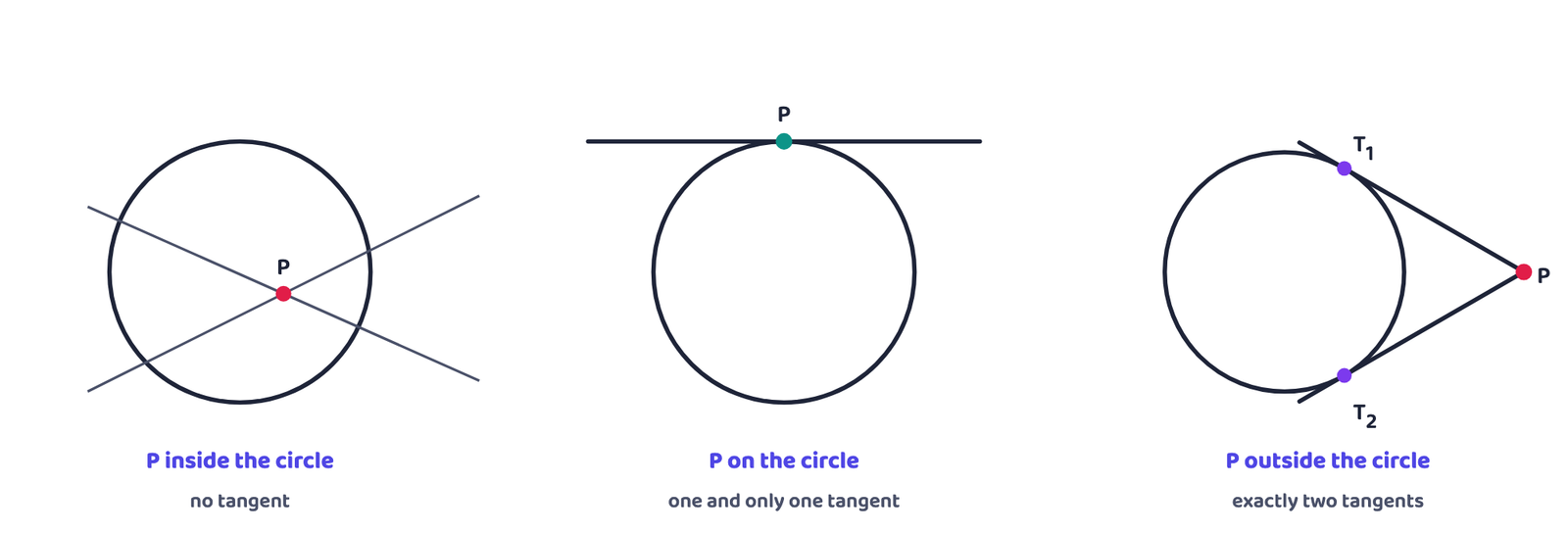
From outside, they touch at T1 and T2.
| Where P lies | Tangents through P | Book’s statement |
|---|---|---|
| Inside the circle | 0 | Case 1: There is no tangent to a circle passing through a point lying inside the circle. |
| On the circle | 1 | Case 2: There is one and only one tangent to a circle passing through a point lying on the circle. |
| Outside the circle | 2 | Case 3: There are exactly two tangents to a circle through a point lying outside the circle. |
Let P be a point outside the circle (an external point), and let a tangent from P touch
the circle at T. The distance PT, from P to the point of contact, is called the length of the
tangent from P to the circle. In Figure 3, and are the lengths of the two
tangents from P.
The lengths of tangents drawn from an external point to a circle are equal.

Given
A circle with centre O, a point P outside it, and two tangents PQ and PR from P.
To prove
1. Proof by Pythagoras: (as ),
which gives .
2. The same congruence also gives . So OP is the angle bisector
of (it cuts the angle into two equal halves): the centre lies on the bisector of
the angle between the two tangents.
Writing “SAS” or “SSS” here. Right angle + common hypotenuse OP + equal radius means RHS.
4 Solved Examples (from the book)
Q. Prove that in two concentric circles, the chord of the larger circle, which
touches the smaller circle, is bisected at the point of contact.
(Concentric circles have the same centre. Bisected means cut into two equal halves.)
Solution: Let (larger) and (smaller) be concentric circles with centre O.
Let the chord AB of touch at P. Join OP.
AB is a tangent to at P and OP is a radius of , so (Theorem 10.1).
AB is also a chord of . From Class 9, the perpendicular from the centre of a circle to a
chord bisects the chord. Hence .
Q. Two tangents TP and TQ are drawn to a circle with centre O from an external point T.
Prove that .
Solution: Let . By Theorem 10.2, , so is
isosceles (two equal sides). The angles opposite the equal sides are equal, and the three
angles add up to , so
By Theorem 10.1, . So
This gives .
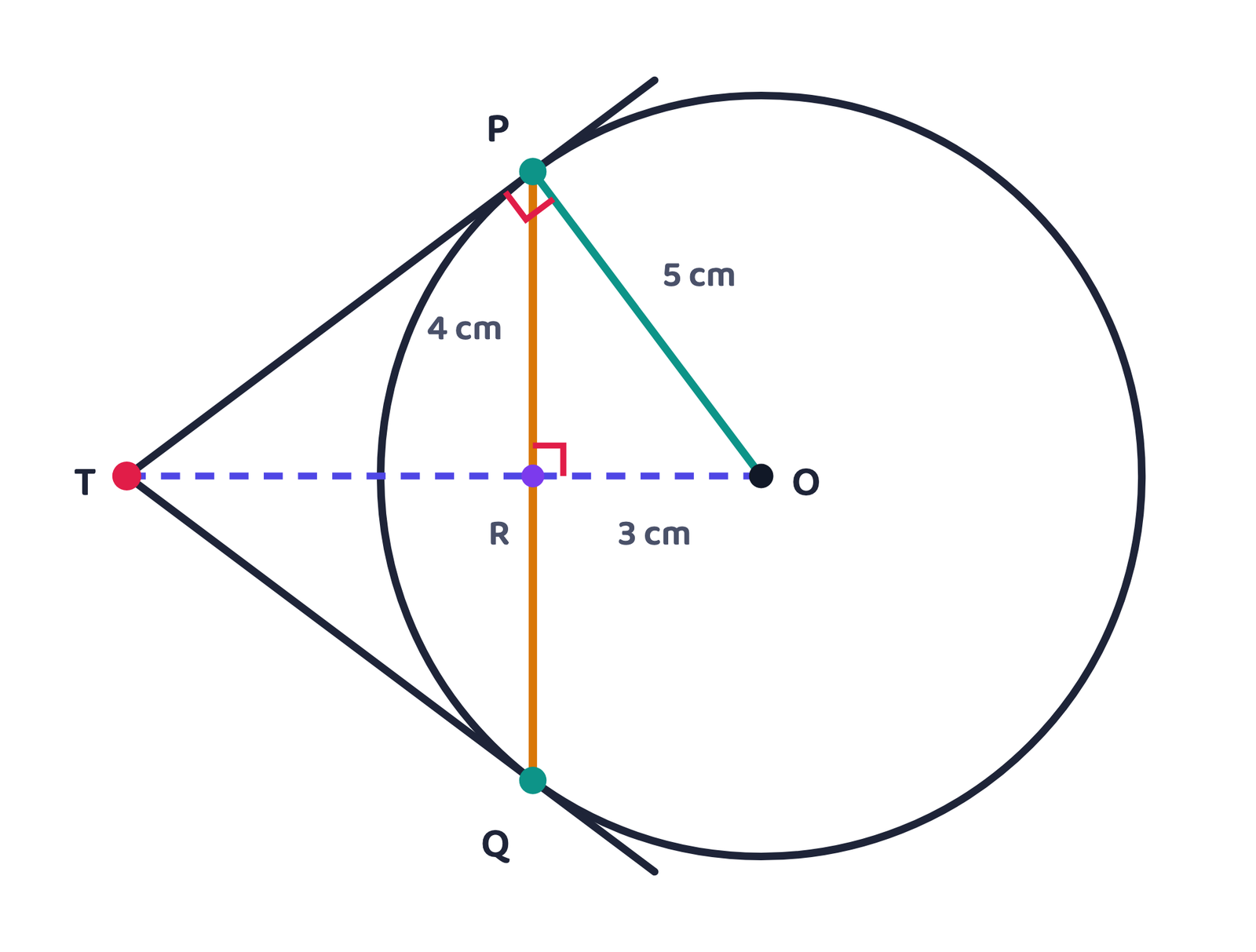
Q. PQ is a chord of length 8 cm of a circle of radius 5 cm. The tangents at P and Q
intersect at a point T. Find the length TP.
Given
cm, chord cm, TP and TQ are tangents
To find
Solution: Join OT; let it cut PQ at R. By Theorem 10.2, , so
is isosceles. TO bisects , because the centre lies on the bisector of the angle between the two
tangents (remark after Theorem 10.2). In an isosceles triangle, the bisector
of the angle between the equal sides is perpendicular to the base and cuts it in half. So
and cm.
Now (Theorem 10.1) and
(angle sum of right ). So . The right triangles TRP and PRO now have two pairs of equal
angles, so they are similar (AA similarity from Chapter 6, written ), and their
corresponding sides are in the same ratio:
cm (about 6.67 cm).
Let and . From right : …(1).
From right : …(2).
Expanding (2): . Subtracting (1): , so .
Then , so
cm, the same answer.
5 Standard Results the Exercises Use
Exercise 10.2 applies the two theorems to new figures. A polygon circumscribes a circle
when every side of it touches the circle (the circle sits inside, touching each side).
| Result | Why it is true |
|---|---|
| Radius , distance of the external point from the centre, tangent length : | Right angle at the point of contact (Thm 10.1), then Pythagoras |
| Tangents PA and PB touch at A and B: | In quadrilateral OAPB the angles at A and B are each (Thm 10.1), and all four angles add to |
| Quadrilateral ABCD circumscribing a circle: | Equal tangents from each of the four vertices (Thm 10.2) |
| A parallelogram circumscribing a circle is a rhombus | Previous result with , gives , so all four sides are equal |

tangents x from A, 8 from B, 6 from C.
Mark the two equal tangent lengths at every vertex.
Give the two tangents from each vertex the same letter or number, as in Figure 6. Each side is
then the sum of two pieces, and the question becomes simple algebra. For example, let a
quadrilateral ABCD touch the circle at P on AB, Q on BC, R on CD and S on DA. The tangents from A
are AP and AS, so ; likewise , , . Then
.
- A line and a circle: no common point (non-intersecting), two (secant) or one (tangent)
- Theorem 10.1: tangent radius at the point of contact, because OP is the shortest distance from O to the tangent
- Point inside: 0 tangents; on the circle: 1; outside: exactly 2
- Theorem 10.2: the two tangents from an external point are equal (RHS congruence), and the centre lies on the bisector of the angle between them
- Radius, distance and tangent length form a right triangle: