
1 Sector and Segment of a Circle
This chapter finds the area of a part of a circle: a pizza-slice shape or a piece cut off
by one straight line. The words you need, for a circle with centre O and radius :
| radius (plural radii) | a line from the centre O to the circle, such as OA or OB |
| chord | a straight line joining two points of the circle, such as AB; a diameter is a chord through O |
| arc | the curved piece of the circle itself between two points A and B |
| subtends | chord AB (or arc AB) subtends at the centre: the angle made at O by OA and OB |
| (“theta”) | the letter used for this angle at O, measured in degrees |
| (“pi”) | the fixed number circumference diameter. The book’s rule: “Unless stated otherwise, use “; some questions say |
The whole circle has circumference (length round it) and area .
A sector of a circle is the portion of the circular region enclosed by two radii and
the corresponding arc. The angle between the two radii, , is called the angle of the sector.
A segment of a circle is the portion of the circular region enclosed between a chord
and the corresponding arc.

Two radii make two sectors: the smaller is the minor sector, the bigger the major
sector, with angle . A chord likewise makes a minor and a major segment (a
diameter makes two equal semicircles). A sector is a quadrant. If a question just
says “sector” or “segment”, take the minor one.
2 Area of a Sector
The whole circle is a sector of with area . By the Unitary Method (find
the value for one unit, then multiply), find the area for , then multiply by .

…(1)
3 Length of an Arc
Likewise the circumference belongs to the full , so:
…(2)
Do not mix up formula (1) for area and formula (2) for arc length. Area uses (answer in ); length
uses (answer in ).
3.1 Perimeter of a sector
(The NCERT text does not give this formula; the CBSE 2026-27 syllabus lists problems on the
perimeter of these figures.) The perimeter of a shape is the total length of its boundary. A sector’s boundary is two
radii and one arc:
4 Area of a Segment
Chord AB splits sector OAPB into triangle OAB and segment APB, so the segment is the sector
minus the triangle.
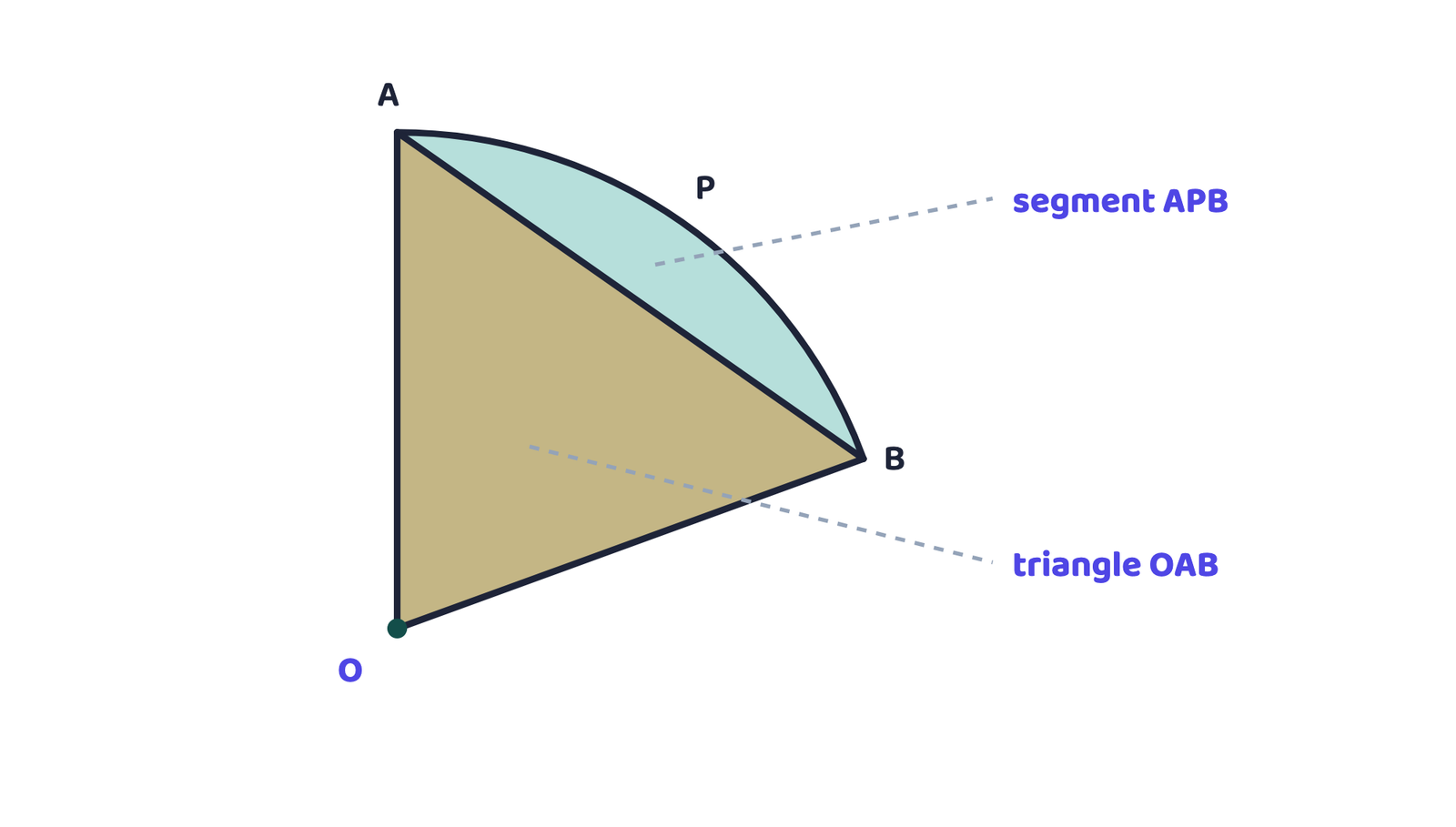
…(3)
The tricky part is triangle OAB. Two of its sides are radii, so . The CBSE 2026-27 syllabus
restricts segment problems to central angles of , and , and each has a quick triangle area:
| Angle | What is | Area of |
|---|---|---|
| equilateral: makes the other two angles equal, so each is , and | ||
| right-angled at O, legs and | ||
| draw OM from O at right angles to AB; then and (worked out in Example 2) |
The NCERT text does not give the next formula either; it follows from the meaning of perimeter.
5 Major Sector and Major Segment
Minor and major parts together make the whole circle:
6 Solved Examples from the Book
Given
Radius cm, angle of sector ,
To find
Area of the sector, and of the corresponding major sector
Sector: by (1), area
Major sector: , which
rounds to
Check the other way: the major sector’s angle is , so its area
again.
At , draw OM from O perpendicular to AB (at a right angle, written ).
The book calls this segment AYB, with Y a point on the minor arc (Fig. 11.6).
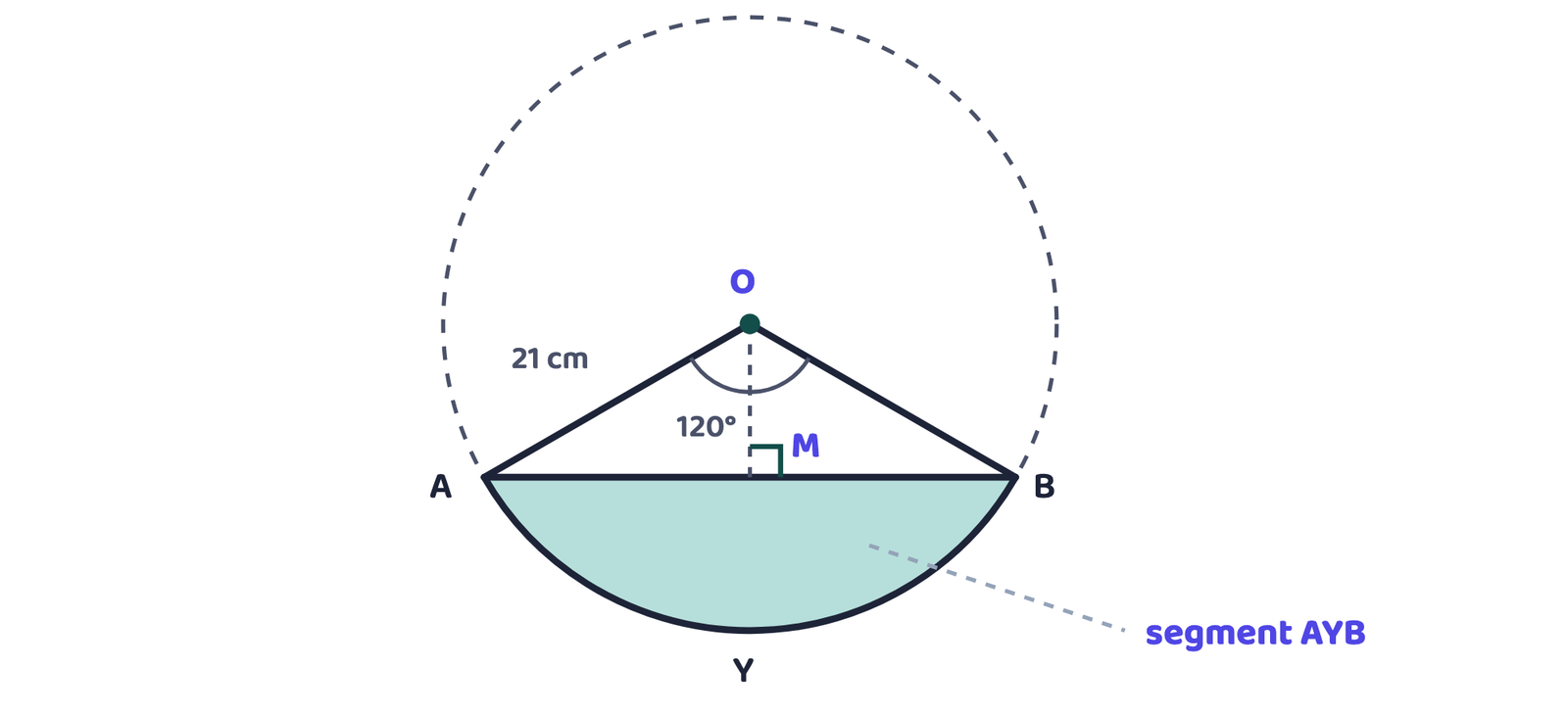
Given
cm, ,
To find
Area of the segment AYB
Step 1, sector: area of sector OAYB
Step 2, triangle: draw . Triangles AMO and BMO are right-angled at M, have
equal hypotenuses and share side OM, so by the RHS congruence rule they are
congruent (: exactly the same shape and size). So M is the
mid-point of AB and .
In right triangle OMA, , so cm; and
, so cm.
Then cm and
Step 3, segment: by (3), area . Take
common ( and ) to get
(about with )
7 Where These Formulas Show Up
Each object in Exercise 11.1 hides a sector or segment. Spot the shape and its angle first:
| Object | Shape | Angle and radius |
|---|---|---|
| Minute hand of a clock | sector | per minute; = hand length |
| Horse tied at a corner of a square field | quadrant (the corner is ) | ; = rope length |
| Silver-wire brooch with 5 diameters | 10 equal sectors | each; wire = circumference + 5 diameters |
| Umbrella with 8 equally spaced ribs (spokes) | 8 equal sectors | each |
| Two car wipers | 2 sectors | angle swept; = blade length |
| Lighthouse beam | sector | = distance the light reaches |
| Round table cover with six equal designs | 6 segments (cut off by a hexagon’s sides) | each; triangles OAB equilateral |
8 Shaded-Region Questions
Practice beyond the NCERT exercise: a question can join sectors or quadrants with a square or triangle and ask for the area or
perimeter of the shaded (coloured) part. Find each piece with formulas (1) to (3), then add or
subtract.

Given
Square ABCD of side 14 cm; a quadrant of radius 7 cm at each corner;
To find
Area and perimeter of the shaded region
Area: the four quadrants are each , so together they make one full circle of radius
7 cm: . Square .
Shaded area
Perimeter: the shaded region is bounded only by the four quarter-arcs, which together make
one full circumference:
The old section “Areas of Combinations of Plane Figures” is not in the current NCERT book, and the
CBSE 2026-27 syllabus lists only the areas of sectors and segments and problems on their areas and
perimeters. Example 3 is extra practice beyond the book.
- Sector: two radii + arc. Segment: chord + arc. If minor or major is not said, take the minor one.
- Area of sector ; arc length
- Perimeter of sector arc; perimeter of segment arc chord
- Segment sector ; major part minor part
- : or gives , gives
- Minute hand: per minute. Equal sectors: divide by the number of parts.
- The book’s rule: “Unless stated otherwise, use .”
- 1 markFind the area of a sector of angle of a circle of radius 9 cm ().
- 2 marksFind the perimeter of a quadrant of a circle of radius 21 cm.
- 3 marksA chord of a circle of radius 7 cm makes an angle of at the centre. Find the areas of the minor and major segments.