
- Recognise a combination of solids: an object made by joining two basic solids (cuboid, cube, cylinder, cone, sphere, hemisphere, which is half a sphere)
- Find the total surface area (TSA) of such an object by adding only the surfaces you can actually see
- Find the volume of such an object by adding (or subtracting) the volumes of its parts
- Spot the ring that appears when two joined solids have different radii (radii is the plural of radius), and include its area
volumeslant heighthemispherecapacity
1 Introduction
In Class IX you learnt the surface areas and volumes of the cuboid, cone, cylinder and sphere.
Many everyday objects are made by joining two or more of these basic solids:
- a truck container carrying oil or water: you may guess that it is made of a cylinder with two hemispheres as its ends
- a test tube in the science lab: a cylinder and a hemisphere
- big buildings and monuments: made of combinations of such solids
No single formula fits such objects, so we break them into basic solids we already know.

CSA (Curved Surface Area) is the area of only the curved part of a solid’s surface, leaving out its flat top and bottom. A cuboid or cube has no curved part, so for them we use the lateral surface area: the area of the 4 side walls only.
TSA (Total Surface Area) is the area of the whole outer surface of a solid: the curved part and the flat faces together.
| Solid | CSA (lateral area for cuboid, cube) | Total surface area (TSA) | Volume |
|---|---|---|---|
| Cuboid (length , breadth , height ) | (4 side walls) | ||
| Cube (edge ) | (4 side walls) | ||
| Cylinder (radius , height ) | |||
| Cone (radius , height , slant height ) | |||
| Sphere (radius ) | (the whole surface is curved) | ||
| Hemisphere (radius ) | |||
Both NCERT exercises of this chapter (12.1 and 12.2) begin with “Unless stated otherwise, take “. Use only
when the question says so. When a radius is a multiple of 0.7 (like 0.7, 1.4, 3.5, 7), the 7 in divides into it and the working stays simple.
2 Surface Area of a Combination of Solids
Take the truck container, seen as a cylinder with a hemisphere stuck at each end. When the pieces
are joined, the flat circular faces where they touch go inside the object. From outside you can
see only three surfaces: the curved surface of each hemisphere and the curved surface of the cylinder.
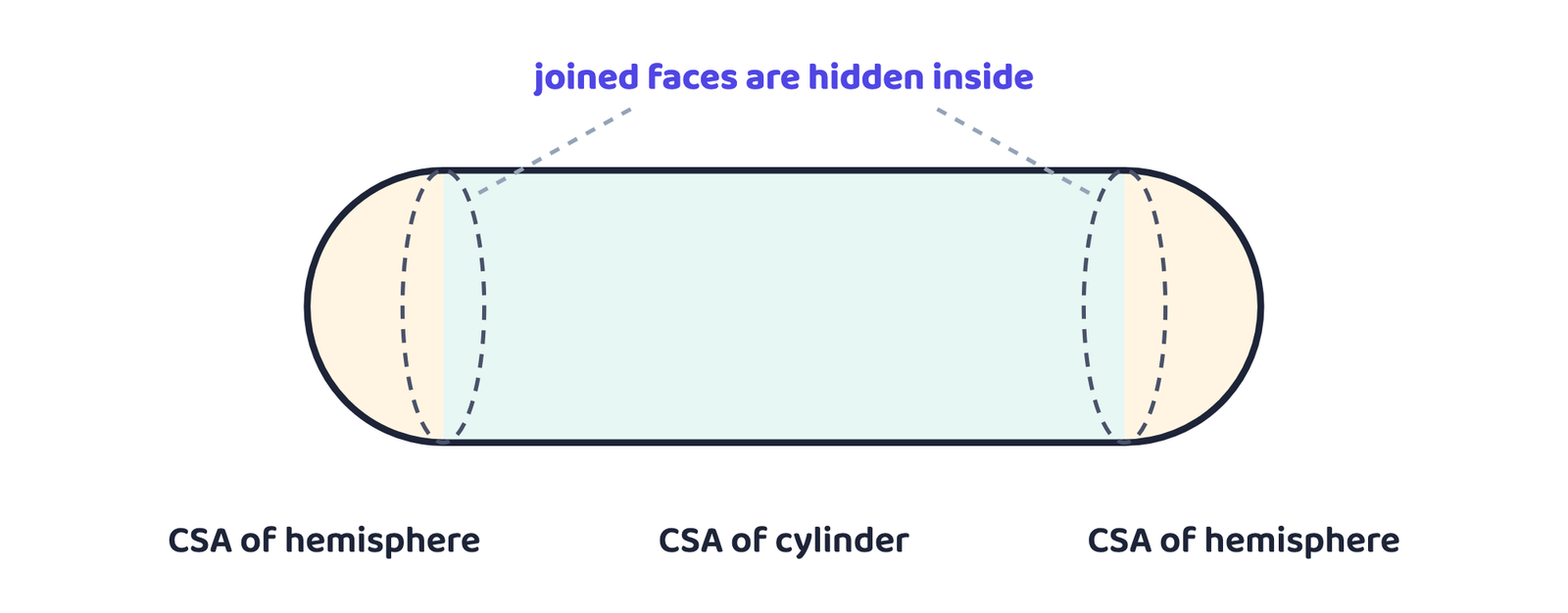
The total surface area of a combination of solids is the sum of the areas of only those surfaces
that remain on the outside. It is not the sum of the TSAs of the parts, because some surface
disappears inside when the parts are joined.
The same idea works for a toy made from a cone and a hemisphere. We keep the base radius of the cone
equal to the radius of the hemisphere so that the toy has a smooth surface. Their flat faces are pressed
together and vanish, so:
Adding the TSAs of the parts counts the hidden joining faces. Always ask: which faces went inside?
2.1 Example 1: cone and hemisphere (Rasheed’s playing top)
Rasheed’s playing top (lattu) is a cone surmounted by (topped with) a hemisphere. The whole top is 5 cm high and
its diameter is 3.5 cm. Find the area he has to colour ().
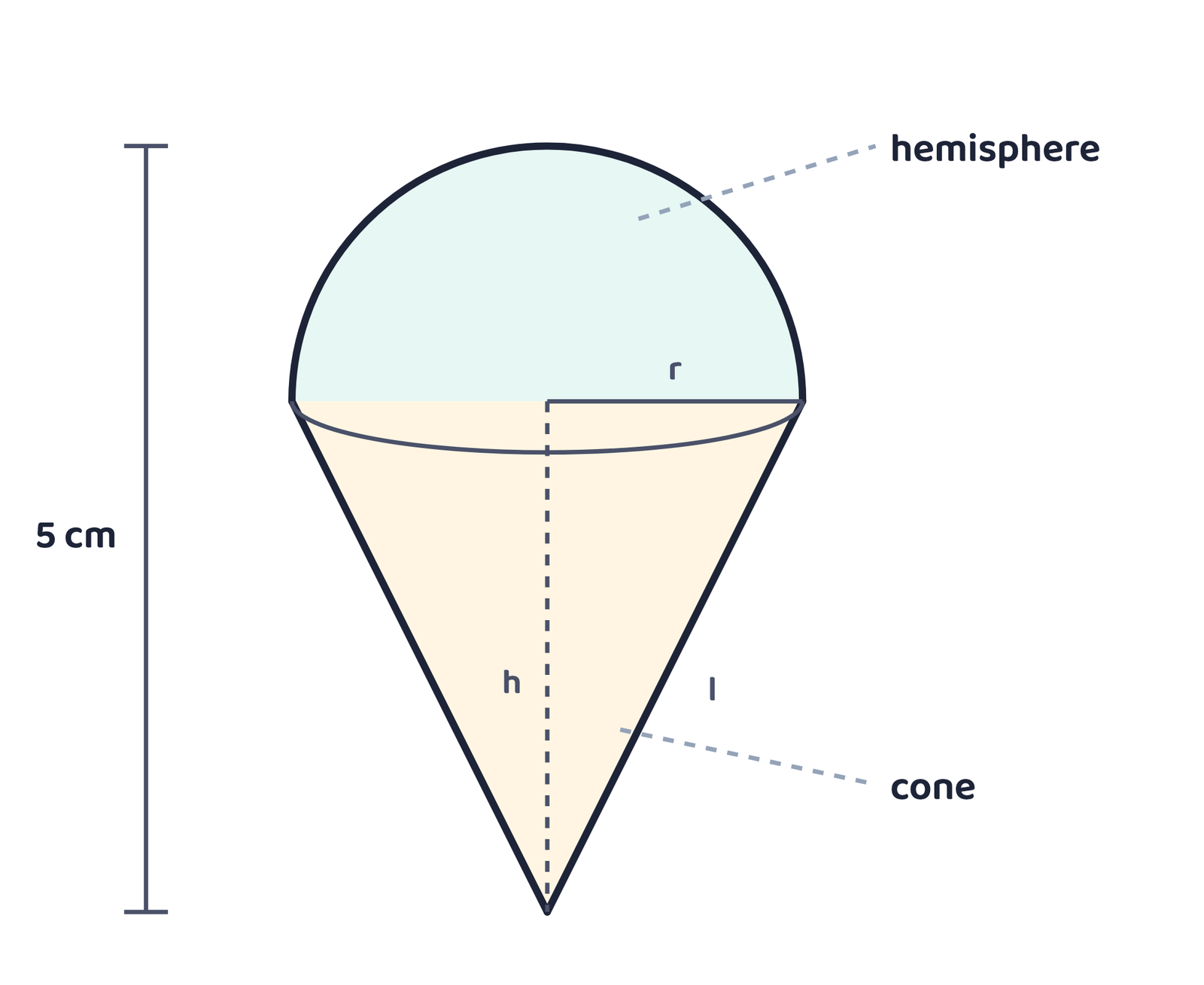
cm. Height of cone height of the whole top radius of hemisphere (a hemisphere is as tall as its radius) cm
Slant height cm
CSA of hemisphere and CSA of cone
TSA
39.6 cm²
2.2 Example 2: cube and hemisphere (the decorative block)
A decorative block is a cube of edge 5 cm with a hemisphere of diameter 4.2 cm fixed on top. Find
its total surface area ().

TSA of cube cm². The part of the cube’s top covered by the
hemisphere (a circle of area ) is no longer on the outside, but the hemisphere adds its curved surface . Here cm.
Surface area of block TSA of cube base area of hemisphere CSA of hemisphere
163.86 cm²
2.3 Example 3: wide cone on a narrower cylinder (the toy rocket and the ring)
A wooden toy rocket is a cone mounted on a cylinder: total height 26 cm, cone height 6 cm, cone base
diameter 5 cm, cylinder base diameter 3 cm. The cone is painted orange and the cylinder yellow. Find
each painted area ().

Cone: cm, cm, cm.
Cylinder: cm, cm (the dash in , just marks the cylinder’s values).
Orange CSA of cone base area of cone base area of cylinder
63.585 cm²
Yellow CSA of cylinder area of one base of cylinder
195.465 cm²
When the two radii are different, part of the wider base stays outside as a flat ring. Its area is
, and it must be added. Students who assume equal radii leave this area out and get the wrong total.
2.4 Example 4: cylinder with a hemispherical depression (Mayank’s bird-bath)
Mayank’s bird-bath is a cylinder, 1.45 m high with radius 30 cm, with a hemispherical depression
(a bowl-shaped hollow) at one end. Find its total surface area ().
The hollow has the same radius as the cylinder, so the cylinder’s top face is gone and the curved inside of
the hemisphere is seen in its place. The book’s solution counts only the cylinder’s curved surface and the hemisphere’s curved surface, so the flat base of the cylinder is not included.
Take m cm (same unit as ).
TSA CSA of cylinder CSA of hemisphere
cm² 3.3 m² (as )
2.5 What stays on the outside: common shapes at a glance
| Object | Surfaces that count | TSA |
|---|---|---|
| Two cubes (edge ) joined end to end | TSA of both cubes minus the two hidden faces | |
| Hollow hemisphere with hollow cylinder on it (inside of a container) | inner CSA of cylinder + inner CSA of hemisphere | |
| Cone on hemisphere (toy, top) | CSA of cone + CSA of hemisphere | |
| Cylinder with two hemispherical ends (capsule, container) | CSA of cylinder + 2 hemisphere CSAs | |
| Cylinder with a conical (cone-shaped) top, open base (tent) | CSA of cylinder + CSA of cone | (canvas area; the open base is not counted, Ex 12.1 Q7) |
| Hemisphere of radius on a cube of edge , or a hemispherical depression cut into it (Ex 12.1 Q5) | cube TSA circle hemisphere CSA | |
| Conical cavity (a cone-shaped hollow) cut from a cylinder of the same , | CSA of cylinder + bottom base + inside of cone | |
| Hemisphere scooped out of each end of a cylinder | CSA of cylinder + 2 hollow hemisphere CSAs |
These eight shapes cover every question type in Exercise 12.1.
A cavity or depression removes a flat face but adds a new curved face inside. So cutting material
out can make the surface area bigger. Draw a rough figure first and tick each face that is still
on the outside, so that no hidden face is added by mistake.
3 Volume of a Combination of Solids
The volume of a solid formed by joining two basic solids is the sum of the volumes of its
constituents (the parts it is made of), because no material is lost in joining them. If a part is cut out or hollowed out, its volume is subtracted.
3.1 Example 5: cuboid and half cylinder (Shanta’s shed)
Shanta runs an industry in a shed shaped like a cuboid surmounted by a half cylinder. The base is
7 m × 15 m and the cuboid part is 8 m high. Find the volume of air the shed can hold. If machinery takes
300 m³ and 20 workers take about 0.08 m³ each, how much air is left ()?

Cuboid: m m m. Half cylinder: diameter m ( m), height (length) m.
Volume volume of cuboid volume of cylinder
1128.75 m³
Space taken by machinery and workers m³
Air in the shed 827.15 m³
3.2 Example 6: a cylinder minus a hemisphere (the juice glass)
A juice seller’s glass is a cylinder of inner diameter 5 cm and height 10 cm, but its bottom has a
raised hemispherical portion that reduces how much juice it holds. Capacity means the volume of liquid a container can hold. Find its apparent capacity (what it seems to hold) and
its actual capacity (what it really holds) ().

cm, cm.
Apparent capacity cm³
Volume of hemisphere cm³ (approx.)
Actual capacity 163.54 cm³
3.3 Example 7: hemisphere with a cone, inside a circumscribing cylinder
A solid toy is a hemisphere surmounted by a right circular cone (a cone whose tip is straight above the centre of its base). The cone is 2 cm high and the base
diameter is 4 cm. Find the volume of the toy. A right circular cylinder (an upright cylinder) circumscribes the toy (fits
exactly around it). Find the difference between the volumes of the cylinder and the toy ().
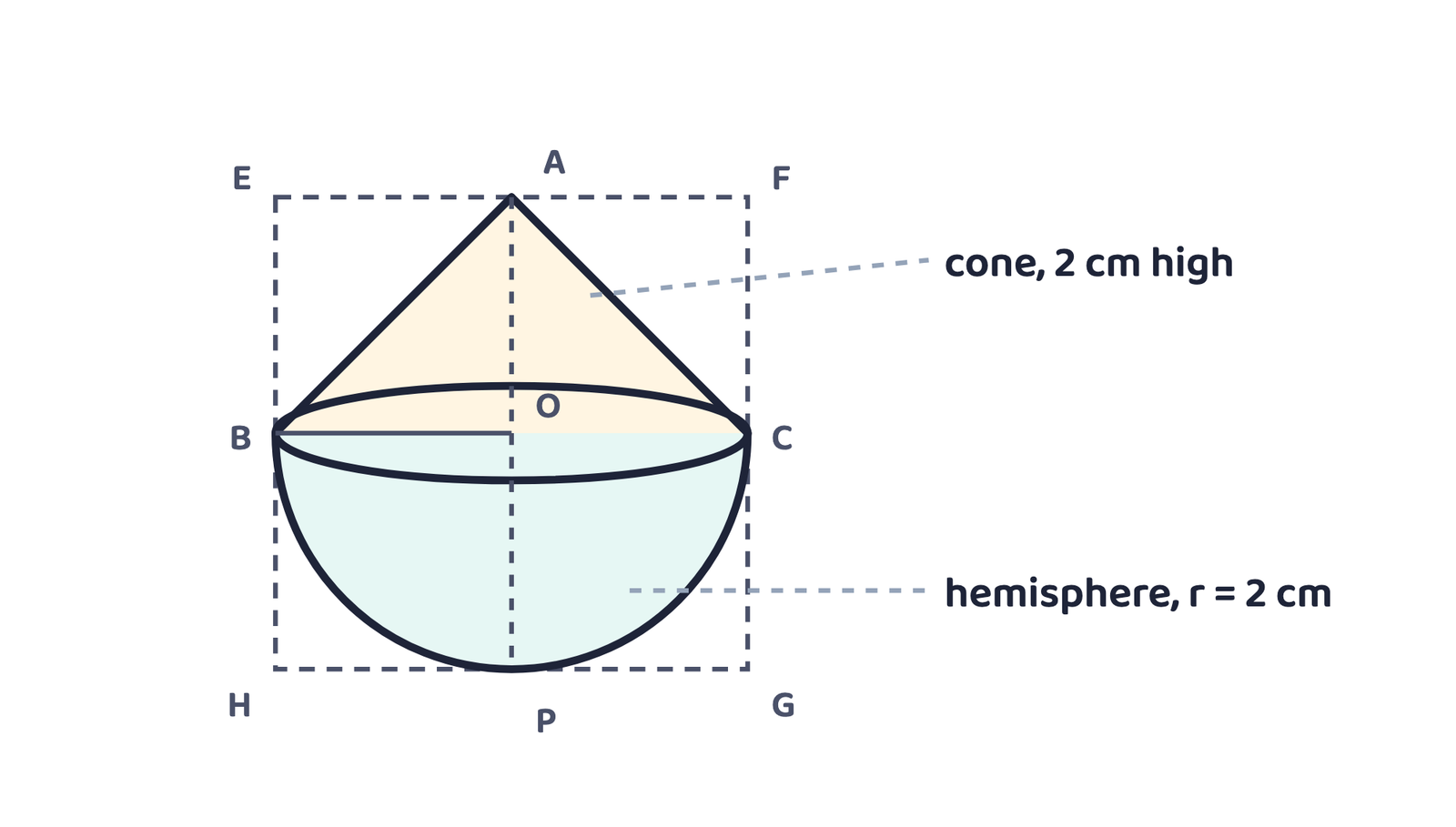
In Figure 8, O is the centre of the common base BC, A is the tip of the cone, P is the lowest point of the hemisphere, and EFGH is the cylinder.
Radius cm (for both hemisphere and cone), cone height cm.
Volume of toy 25.12 cm³
Cylinder: radius cm, height cm, volume cm³
Difference 25.12 cm³
3.4 Question types in Exercise 12.2
| Type | What to do | Example in NCERT Exercise 12.2 |
|---|---|---|
| Add the parts | sum the volumes of all pieces | cone on hemisphere; Rachel’s model; gulab jamun |
| Subtract a hollow | outer solid minus the removed part | pen stand; water left in a cylinder |
| Count objects | number total volume volume of one object | lead shots (small lead balls) in a conical vessel |
| Find mass | mass volume mass of 1 cm³ | solid iron pole |
| Check a claim | calculate the true volume, then compare | spherical glass vessel |
When solid objects are dropped into a vessel that is full of water, the water that flows out has the same
volume as the objects. So in the lead-shot question: volume of water that overflows number of shots
volume of one shot. For a percentage (such as the syrup inside a sweet), find the full volume first, then take that
percentage of it.
4 How to Solve Any Combined-Solid Question
✓ Do this
- Halve the diameter before using
- Find when only the cone’s height is given
- For mass, multiply volume by the mass of 1 cm³
✗ Never do this
- Use the cone’s height where its slant height is needed
- Mix metres and centimetres in one formula
- Forget the unit (cm² for area, cm³ for volume)
- TSA of a combined solid = only the outside surfaces; never the sum of the parts’ TSAs
- Volume of a combined solid = sum of the parts’ volumes; subtract any cavity or raised part
- Different radii at a joint: add the ring
- A cavity removes a flat face but adds a curved face, so surface area can increase
- Hemisphere: CSA , TSA , volume
Next, practise with this chapter’s important questions, MCQs and full NCERT solutions.