
- Define ecology and explain why it is not limited only to the forces of nature
- Explain the two-way process by which social environments emerge: nature shapes society and society shapes nature
- Show how social organisation, property, the division of labour, values and knowledge shape our relationship with the environment
- Explain why environmental management is hard in risk societies, with the Bhopal disaster as the case
- Describe the five major environmental problems: resource depletion, pollution, global warming, GM organisms and disasters
- Explain why environmental problems are also social problems, what social ecology means, and what sustainable development asks of us
| Board (2026-27) | Marks for this chapter | Paper |
|---|---|---|
| CBSE (039) | Not examined in 2026-27 (still in the NCERT book) | Theory 80 + project 20 |
| UP Board | 10 marks | One 100-mark theory paper, no project |
| Rajasthan Board (RBSE) | 10 marks | One 100-mark theory paper |
| MP Board | 8 marks | Theory 80 + project 20 |
CBSE students: this chapter is printed in your book but is not in the 2026-27 exam, so read it for understanding only. UP, Rajasthan and MP Board students: the whole chapter is examinable (10, 10 and 8 marks), and these notes cover every section of it.
1 Introduction: Where Does Your Chair Come From?
Look around a classroom: uniforms, chairs, desks, books, school bags, lunch boxes, ceiling fans. If you trace where each thing comes from, you find that the source of each material object lies in nature. Every day we use objects whose production draws upon natural resources from around the world.
Each producer and distributor in turn uses goods and services derived from nature. “Try and map these resource flows and you will soon see how complex such relationships are!”
What this chapter does: it studies social relationships with the environment as they have changed over time and as they vary from place to place. There are many urgent environmental problems. To address them we need a sociological framework for understanding why they occur and how they might be prevented or resolved.
2 Ecology: The Basis of Every Society
“All societies have an ecological basis.”
Ecology denotes the web of physical and biological systems and processes of which humans are one element.
- Mountains and rivers, plains and oceans, and the flora and fauna (plants and animals) they support are all part of ecology.
- The ecology of a place is also affected by the interaction between its geography and its hydrology (its water and its flows).
- Example, the desert: its plant and animal life is adapted to scarce rainfall, rocky or sandy soils and extreme temperatures.
- Similar ecological factors limit and shape how human beings can live in any particular place.
Hydrology is the science of water and its flows; or the broad structure of water resources in a country or region.
2.1 Ecology has been modified by human action
Over time, ecology has been modified by human action. So ecology is not limited only to the forces of nature.
| What looks “natural” | How human action may produce it |
|---|---|
| Aridity (dryness) or flood-proneness | Often produced by human intervention |
| A river becoming more flood-prone | Deforestation in the upper catchment of the river (the hilly area that drains into it) |
| Climate change | Brought about by global warming, a widespread impact of human activity on nature |
Over time, it is often difficult to separate and distinguish between the natural and human factors in ecological change.
Deforestation is the loss of forest area due to cutting down of trees and/or taking over of the land for other purposes, usually cultivation.
- The Ridge forest in Delhi is not the natural vegetation of the region. It was planted by the British around 1915. Its main tree, Prosopis juliflora (vilayati kikar or vilayati babul), was brought into India from South America and has become naturalised all over north India.
- The chaurs, the wide grassy meadows of Corbett National Park in Uttarakhand with excellent views of wildlife, were once agricultural fields. Villages were relocated to create what now looks like a pristine (untouched) wilderness.
The activity asks you to find other examples where what seems “natural” is actually modified by cultural interventions.
2.2 Ecology that is more obviously human-made
An agricultural farm
Soil and water conservation works, cultivated plants, domesticated animals, synthetic fertilisers and pesticides: clearly a human transformation of nature.
The built environment of a city
Concrete, cement, brick, stone, glass and tar. It uses natural resources but is “very much a human artefact” (a thing made by humans).
Other features, such as the flow of a river or the species composition of a forest, are biophysical (natural) properties that may also have been transformed by human action.
3 Social Environments: A Two-way Process
Social environments emerge from the interaction between biophysical ecology and human interventions. This is a two-way process: just as nature shapes society, society shapes nature.
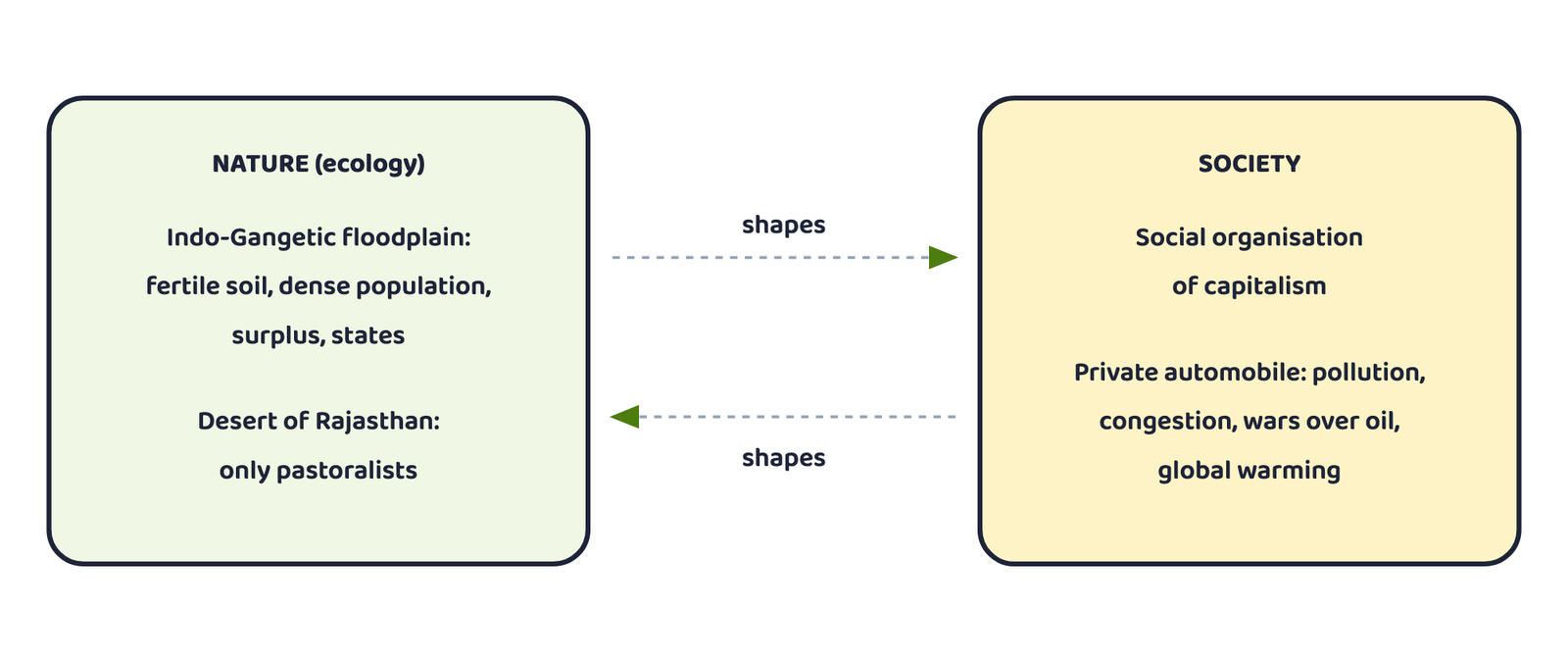
Nature shapes society
- The fertile soil of the Indo-Gangetic floodplain enables intensive agriculture.
- High productivity allows dense population settlements and enough surplus for non-agricultural activities.
- This gives rise to complex hierarchical societies and states.
- The desert of Rajasthan can only support pastoralists who move from place to place to find fodder for their livestock.
Society shapes nature
- The social organisation of capitalism has shaped nature across the world.
- The private automobile is a capitalist commodity that has transformed lives and landscapes.
- Its effects: air pollution and congestion in cities, regional conflicts and wars over oil, and global warming.
- Human interventions increasingly have the power to alter environments, often permanently.
The effects were felt all over the world:
- Large areas of southern North America and the Caribbean were turned into plantations to meet the demand for cotton in the mills of Lancashire.
- Young West Africans were forcibly transported to America to work as slave labour on the plantations.
- The depopulation of West Africa made its agricultural economy decline; fields reverted to fallow wastelands.
- In Britain, smoke from the coal-burning mills fouled the air.
- Displaced farmers and labourers came to the cities for work and lived in wretched conditions.
So the ecological footprints of the cotton industry could be found all over urban and rural environments.
4 How Social Organisation Shapes Environment and Society
The interaction between environment and society is shaped by social organisation. Social organisation influences how different social groups relate to their environment.
4.1 Property relations
Property relations determine how and by whom natural resources can be used.
- Government-owned forests: the government has the power to decide whether to lease them to timber companies or to allow villagers to collect forest produce.
- Private ownership of land and water sources: decides whether others can have access to them, and on what terms and conditions.
4.2 The division of labour
- Ownership and control over resources is related to the division of labour in the production process.
- Landless labourers and women have a different relationship with natural resources than men.
- In rural India, women are likely to experience resource scarcity more acutely, because gathering fuel and fetching water are generally women’s tasks, but they do not control these resources.
4.3 Values, norms and knowledge systems
Different relationships between environment and society also reflect different social values and norms, as well as knowledge systems.
| Values | Effect on the environment | Book’s example |
|---|---|---|
| Capitalist values | Support the commodification of nature: turning it into objects that can be bought and sold for profit | A river’s many cultural meanings (ecological, utilitarian, spiritual, aesthetic) are stripped down to profit and loss from selling water, for an entrepreneur |
| Socialist values of equality and justice | Seizure of land from large landlords | Redistribution among landless peasants in a number of countries |
| Religious values | Work in two directions | Some groups protect and conserve sacred groves and species; others believe they have divine sanction to change the environment to suit their needs |
Commodification of nature means turning nature into objects that can be bought and sold for profit, a process supported by the values underlying capitalism.
4.4 Different perspectives: the nature-nurture debate
- The “nature-nurture” debate asks whether individual characteristics are innate (inborn) or influenced by environmental factors.
- Example: are people poor because they are innately less talented or hard-working, or because they are born into a situation of disadvantage and lack of opportunity?
- Theories and data about environment and society are influenced by the social conditions under which they emerge. The notions that women are intrinsically less able than men, and Blacks naturally less able than Whites, were challenged as ideas of equality spread during the 18th century’s social and political revolutions.
4.5 Colonialism and knowledge
Colonialism generated a great deal of knowledge about environment and society, often compiling it systematically to make resources available to the imperial powers. Many disciplines were created and institutionalised to manage natural resources for colonial purposes:
5 Why Environmental Management Is So Difficult
Environmental management is a very difficult task. The book gives these reasons:
Limited knowledge
Not enough is known about biophysical processes to predict and control them.
Complex relations
Human relations with the environment have become increasingly complex.
Faster extraction
With industrialisation, resource extraction has expanded and accelerated, affecting ecosystems in unprecedented ways.
Fragile systems
Complex industrial technologies need sophisticated management systems, which are often fragile and vulnerable to error.
Risk society: “We live in risk societies using technologies and products that we do not fully grasp.”
The dangers inherent in industrial environments are shown by: nuclear disasters like Chernobyl, industrial accidents like Bhopal, and Mad Cow disease in Europe.
5.1 Case: Bhopal Industrial Disaster, Who was to Blame?
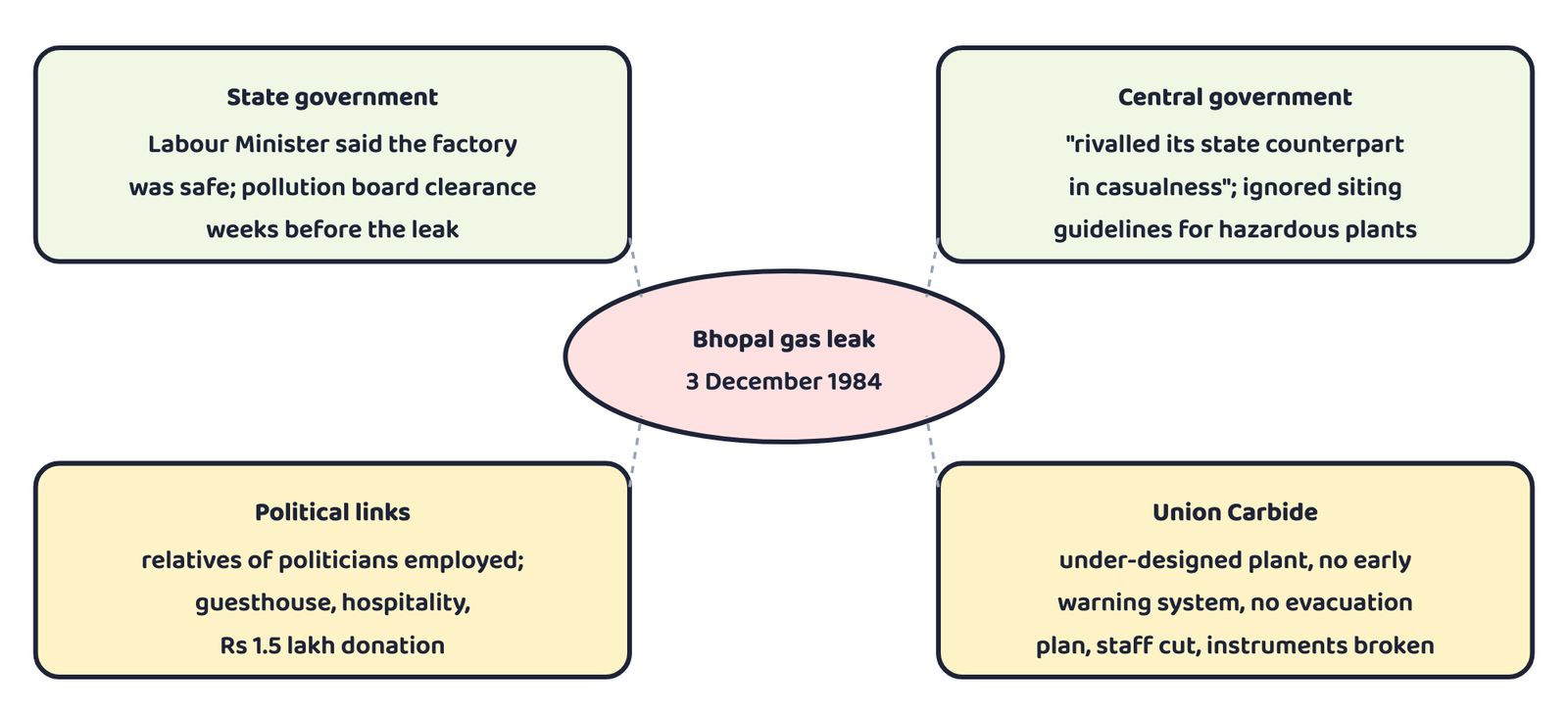
The Centre for Science and Environment analysed the reasons in its State of India’s Environment: The Second Citizens’ Report. Its account shows that blame was shared:
| Stage | What happened (as the box reports it) |
|---|---|
| 1977: welcome | Union Carbide’s coming to Bhopal was welcomed by all: jobs and money for Bhopal, saving in foreign exchange, and rising demand for pesticides after the Green Revolution. |
| Early troubles | The MIC plant was troublesome from the start; several leakages, including one that killed a plant operator. |
| Late 1970s: warning ignored | The head of the Bhopal Municipal Corporation issued notice to Union Carbide to move out of Bhopal. The officer was transferred, and the company donated Rs 25,000 to the Corporation for a park. |
| May 1982 | Three experts from Union Carbide Corporation, USA surveyed safety and pointed out alarming lapses. |
| 1982: press and union | The local weekly Rapat reported these fears in a series of “prophetic articles”. The factory’s employees’ union wrote to Central ministers and the chief minister. |
| Official casualness | The state Labour Minister reassured legislators that the factory was safe. A few weeks before the leak, the state pollution control board gave it an environmental clearance certificate. The Central government ignored the plant’s safety record and the Department of Environment‘s guidelines on siting hazardous plants. |
| Why warnings were ignored | The company employed relatives of powerful politicians and bureaucrats; its legal adviser was an important political leader; its public relations officer was the nephew of a former minister; its posh guesthouse was always open to politicians; the chief minister’s wife reportedly received lavish hospitality in the USA; it donated Rs 1.5 lakh to a welfare organisation in the chief minister’s home town. |
| Union Carbide’s own part | The plant was under-designed and lacked safety features; no computerised early warning system (standard in its US factories); no emergency evacuation procedures worked out with the local community; poor maintenance; low morale as sales dropped and the plant ran at a third of its capacity; staff reduced; many instruments out of order. |
Which social institutions and organisations play a role in industrial accidents like Bhopal? From the box: the company, the state and Central governments (ministers, the pollution control board, the Department of Environment), the municipal corporation, politicians and bureaucrats, the press (Rapat) and the employees’ union. (Our own suggestion, not from the book: steps to prevent such disasters follow from the same list, such as heeding warnings, enforcing siting and safety rules, and planning evacuation with the local community.)
6 Major Environmental Problems and Risks
The relative urgency of hazards varies from country to country, but these are globally recognised as the main ones:
6.1 A. Resource depletion
Using up non-renewable natural resources is one of the most serious environmental problems. Fossil fuels, and especially petroleum, “hog the headlines”, but the depletion and destruction of water and land is probably even more rapid.
| Resource | What is happening |
|---|---|
| Groundwater | Rapid decline in levels all over India, especially Punjab, Haryana and Uttar Pradesh. Aquifers that collected water over hundreds and thousands of years are being emptied in a few decades for intensive agriculture, industry and urban centres. |
| Rivers and water bodies | Rivers have been dammed and diverted, causing irreversible damage to the ecology of water basins. Many urban water bodies have been filled up and built upon, destroying the natural drainage. |
| Topsoil | Also created over thousands of years. Destroyed by poor environmental management: erosion, water-logging and salinisation (soil becoming salty). The production of bricks for houses is another cause. |
| Biodiversity habitats | Forests, grasslands and wetlands are being lost, largely due to the expansion of areas under agriculture. Various parts of the globe, including some parts of India, appear to have seen some re-forestation, but the overall trend is loss of biodiversity. Many species, several unique to India, are endangered. The tiger population fell sharply despite strict laws and large sanctuaries. |
Aquifers are natural underground formations in the geology of a region where water gets stored.
Monoculture is when the plant life in a locality or region is reduced to a single variety.
6.2 B. Pollution
Outdoor air pollution
- A major problem in urban and rural areas: respiratory and other problems, serious illness and death.
- Sources: emissions from industries and vehicles, and burning wood and coal for domestic use.
Indoor air pollution
- Cooking fires are a serious, often unrealised, source of risk.
- In rural homes, green or poorly burning wood, badly designed fireplaces (chulhas) and poor ventilation put village women at serious risk, because they do the cooking.
Emissions are waste gases given off by a human-initiated process, usually in the context of industries or vehicles.
WHO report (2012 data): around 7 million people died, one in eight of total global deaths, as a result of air pollution exposure. This more than doubles previous estimates and confirms that air pollution is now the world’s largest single environmental health risk. The data now covers rural as well as urban areas.
Deaths in 2012 linked to air pollution, as the book reports from WHO. Reducing air pollution, the book adds, could save millions of lives.
| Type | Sources given in the book |
|---|---|
| Water pollution (surface water and groundwater) | Domestic sewage, factory effluents, and runoff from farms using large amounts of synthetic fertilisers and pesticides. Pollution of rivers and water bodies is a particularly important problem. |
| Noise pollution (cities; subject of court orders in many cities) | Amplified loudspeakers at religious and cultural events, political campaigns, vehicle horns and traffic, and construction work. |
Effluents are waste materials in fluid form produced from industrial processes.
6.3 C. Global warming
China and India are increasingly significant contributors to world carbon and greenhouse gas emissions.
Green house: a covered structure for protecting plants from extremes of climate, usually from excessive cold; a green house (also called a hot house) maintains a warmer temperature inside compared to the outside temperature.
6.4 D. Genetically modified organisms (GMOs)
- New techniques of gene-splicing let scientists import genes from one species into another, introducing new characteristics.
- Example: genes from Bacillus thuringiensis were introduced into cotton, making it resistant to the bollworm, a major pest.
- GM can also shorten growing time and increase the size and shelf-life of crops.
- Concerns: little is known about the long-term effects on those who eat these foods or on ecological systems. Agricultural companies can create sterile seeds, so farmers cannot re-use them; the seeds stay the companies’ profit-yielding property and farmers are forced to depend on them.
6.5 E. Natural and man-made environmental disasters
The book calls this “a self-explanatory category” and gives the most recent examples:
Man-made
- The Bhopal disaster of 1984: about 4,000 killed when toxic gas leaked from the Union Carbide factory.
Natural
- The tsunami of 2004: killed thousands of people.
7 Why Environmental Problems Are Also Social Problems
How environmental problems affect different groups is a function of social inequality.
The chapter’s key claim
- Social status and power decide how far people can insulate themselves from environmental crises or overcome them.
- Their “solutions” may actually worsen environmental disparities.
Water is scarce in Kutch. Richer farmers have invested in deep bore tubewells to tap groundwater and grow cash crops. When the rains fail, the earthen wells of the poorer villagers run dry and they do not even have water to drink. The moist green fields of the rich farmers “seem to mock them”.
7.1 The “public interest” is contested
- Some concerns seem universal, in the public interest: reducing air pollution, protecting biodiversity.
- A sociological analysis shows that how public priorities are set and pursued may not be universally beneficial.
- Securing the public interest may actually serve politically and economically powerful groups, or hurt the poor and politically weak.
- The debates over large dams and protected areas show that the environment as a public interest is “a hotly contested arena”.
8 Social Ecology
Social ecology is the school of thought which points out that social relations, in particular the organisation of property and production, shape environmental perceptions and practices.
Different social groups stand in different relationships to the environment and approach it differently:
The Forest Department
- Geared to maximising revenues
- Supplies large volumes of bamboo to the paper industry
The artisan
- Harvests bamboo to make baskets
- Views and uses the same forest very differently from the Forest Department
“…nearly all our present ecological problems arise from deep-seated social problems.”
Murray Bookchin, political philosopher and founder of the Institute for Social Ecology
Bookchin adds that present ecological problems cannot be understood, much less resolved, without dealing with problems within society: economic, ethnic, cultural and gender conflicts lie at the core of the most serious ecological dislocations, apart from those produced by natural catastrophes.
9 Sustainable Development
The relation between ecology and economy is complex, but unless there is a balance between the two, the future of humanity will remain bleak.
- For the last 300 years, economic development has emphasised controlling nature and exploiting it ruthlessly for the benefit of a section of the population. This has led to the extinction of thousands of species of flora and fauna.
- The emphasis on non-renewable energy and the introduction of many new species for the industrial world’s demand has “played havoc with ecology”.
- If depletion and loss of biodiversity continue at this pace, future generations will pay the price.
“Sustainable development is development that meets the needs of the present without compromising the ability of future generations to meet their own needs.” (Brundtland Report, October 1987)
Key concept 1: needs
- In particular the essential needs of the world’s poor, to which overriding priority should be given.
Key concept 2: limitations
- Limitations imposed by the state of technology and social organisation on the environment’s ability to meet present and future needs.
The book’s footnote: the report Our Common Future was presented by Brundtland at a press conference of the World Commission on Environment and Development in London, England, on 27 April 1987.
9.1 Consumption and inequality
- “Today the basis of capitalist development is consumption.” Old things must be destroyed so that new things are introduced and people keep consuming new industrial products.
- Sunita Narain (“Why shouldn’t I be intolerant?”, Down to Earth, 25 January 2016): there is growing inequality; no amount of growth is enough “because aspiration is the new God”; the poor are marginalised as having “not made the grade”; it is a survival of the fittest that “would have made Darwin insane”.
- We have to make the world worth living not only for ourselves but for generations to come; we can be ignorant neither of present needs nor of future needs.
- The existing system of social stratification makes it easy for some sections to control most resources and opportunities.
- We need a society where people are at par, resources are equitably distributed, and development is inclusive and not exclusive. “This is what will make us sustainable.”
9.2 The Global Goals
They were arrived at through a deliberative process, and largely derive from the sentiment of former UN Secretary-General Ban Ki Moon: “there can be no Plan B, because there is no Planet B”.
If an entire nation of 300 million took to similar economic exploitation, it would strip the world bare like locusts.
Mahatma Gandhi, warning against India taking to industrialism in the manner of the West, whose economic imperialism of “a single tiny island kingdom (England)” kept the world in chains
10 Environment-Society Conflicts: Two Cases
10.1 Farmers’ suicides: a fusion of environmental and economic factors
Reports over the last six years indicate that thousands of farmers in Andhra Pradesh, Karnataka and Maharashtra killed themselves, often by drinking pesticide. The investigation of journalist P. Sainath shows the distress is due to a fusion of environmental and economic factors. Agrarian conditions became more volatile as farmers were exposed to world market fluctuations and as government support for small farmers declined due to liberalisation policies.
Faced with financial and social ruin, many farmers have nowhere to turn; suicide seems to them the only way out.
The book asks: is water scarcity natural or human-made? What social factors shape how water is allocated among users, and how do patterns of water-use affect different groups? How is water depleted through agricultural activity? Activity 2 asks you to find how much water your household uses in a day, compare households of different income groups, the time and money they spend on getting water, whose job it is to collect water, and how much water the government provides to different classes of people.
10.2 Conflict over urban space
Besides land, air and water have also become highly contested resources in the urban environment. (Source: Amita Baviskar, “Between Violence and Desire: Space, Power and Identity in the Making of Metropolitan Delhi”, International Social Science Journal 175: 89-98, 2003.)
Why do the urban poor often live in slums? Which social groups control landed property and housing in the city? What social factors affect access to water and sanitation? Activity 3: imagine you are a fifteen-year-old girl or boy living in a slum and write a short essay describing a day in your life.
11 Revision
- Every object’s source lies in nature; all societies have an ecological basis. Ecology = web of physical and biological systems, humans one element; shaped by geography and hydrology.
- Ecology is modified by human action (deforestation makes rivers flood-prone; climate change); natural and human factors are hard to separate. Delhi Ridge (around 1915, Prosopis juliflora) and Corbett’s chaurs.
- Social environments: two-way process. Indo-Gangetic floodplain and Rajasthan desert (nature shapes society); capitalism and the private automobile (society shapes nature). Industrial Revolution box: Lancashire, Caribbean, West Africa.
- Social organisation: property relations, division of labour (rural women likely to feel scarcity more acutely, but do not control resources), values (capitalist commodification, socialist land redistribution, religious sacred groves) and knowledge (nature-nurture; colonial disciplines).
- Management is hard: limited knowledge, complexity, faster extraction, fragile systems; risk societies (Chernobyl, Bhopal, Mad Cow disease).
- Bhopal, 3 December 1984: about 4,000 dead, 200,000 disabled, MIC, Union Carbide; blame on governments, political links and the company.
- Five problems: resource depletion (groundwater in Punjab, Haryana, UP; topsoil; biodiversity; tigers), pollution (air, indoor, WHO 7 million in 2012; water; noise), global warming, GMOs (Bt cotton, sterile seeds), disasters (Bhopal 1984, tsunami 2004).
- Environmental problems are social problems: effects follow social inequality (Kutch tubewells); “public interest” is contested (dams, protected areas).
- Social ecology: property and production shape perceptions (Forest Department vs artisan); Murray Bookchin.
- Sustainable development: Brundtland 1987 (needs, limitations); Sunita Narain on consumption; 193 states, 17 goals, 169 targets; Ban Ki Moon; Gandhi’s locusts. Cases: P. Sainath on farmers’ suicides; Amita Baviskar on urban space.
- Can I define ecology in the book’s words and give two reasons it is not only natural?
- Can I explain the two-way process with one example in each direction?
- Can I name three ways social organisation shapes the environment-society relationship?
- Can I list who was to blame for Bhopal, with three facts for each?
- Can I describe the five major environmental problems with one example each?
- Can I explain social ecology with the Forest Department and artisan example, and give the Brundtland definition?