
- What memory is and the three stages every piece of information passes through
- The two big models of memory: the Stage Model and the Levels of Processing view
- The different types of long-term memory, and how memory is measured
- Why we forget: trace decay, interference and retrieval failure
- How to improve memory with mnemonics and study strategies such as PQRST
CBSE Class 11 Psychology (2026-27) has a 70-mark theory paper and a 30-mark practical (a project or small study, experiments and a viva). This chapter, Human Memory, carries 8 marks of the theory paper. Nothing in this chapter is removed from the 2026-27 syllabus, so every section below is examinable.
1Introduction: Why Study Memory?
Forgetting a known person’s name, going blank in an exam, or happily reciting a poem learnt in Class 3: all of these are memory at work. Memory keeps our sense of who we are, holds our relationships together, and helps us solve problems and take decisions. It sits at the centre of almost every mental (cognitive) process such as perception, thinking and problem solving. Psychologists therefore study four things: how information gets into memory, how it is kept, why it is lost, and how memory can be improved.
Hermann Ebbinghaus, a German psychologist of the late nineteenth century (1885), is credited with the first systematic exploration of memory. Using himself as the subject, he showed that we do not forget learned material evenly or completely: forgetting is fast at first, and then it levels off.
2Nature of Memory
Memory refers to retaining and recalling information over a period of time, depending on the nature of the cognitive task you have to perform.
Some tasks need information for a few seconds (an unfamiliar phone number until you dial it); others need it for years (the addition and subtraction you learnt in early school). Memory is seen as a process of three separate but connected stages. Every piece of information we receive must go through all three.
Encoding is the process by which information is recorded and registered for the first time so that it becomes usable by our memory system.
Storage is the process through which information is retained and held over a period of time.
Retrieval is bringing the stored information back to one’s awareness so that it can be used for cognitive tasks.
Memory can fail at any of the three stages: you may not have encoded the information properly, or storage was weak, so you cannot retrieve it when needed.
3Information Processing Approach: The Stage Model
Earlier, memory was imagined as a huge storehouse where everything we learnt was kept, ready to be taken out. After computers arrived, psychologists began to see human memory as a system that processes information like a computer. A computer has a temporary memory (RAM) and a permanent memory (hard disk); it works on their contents as per programme commands and shows output on the screen. Humans too register, store and work on information depending on the task, for example pulling out division and subtraction rules to solve a maths sum.
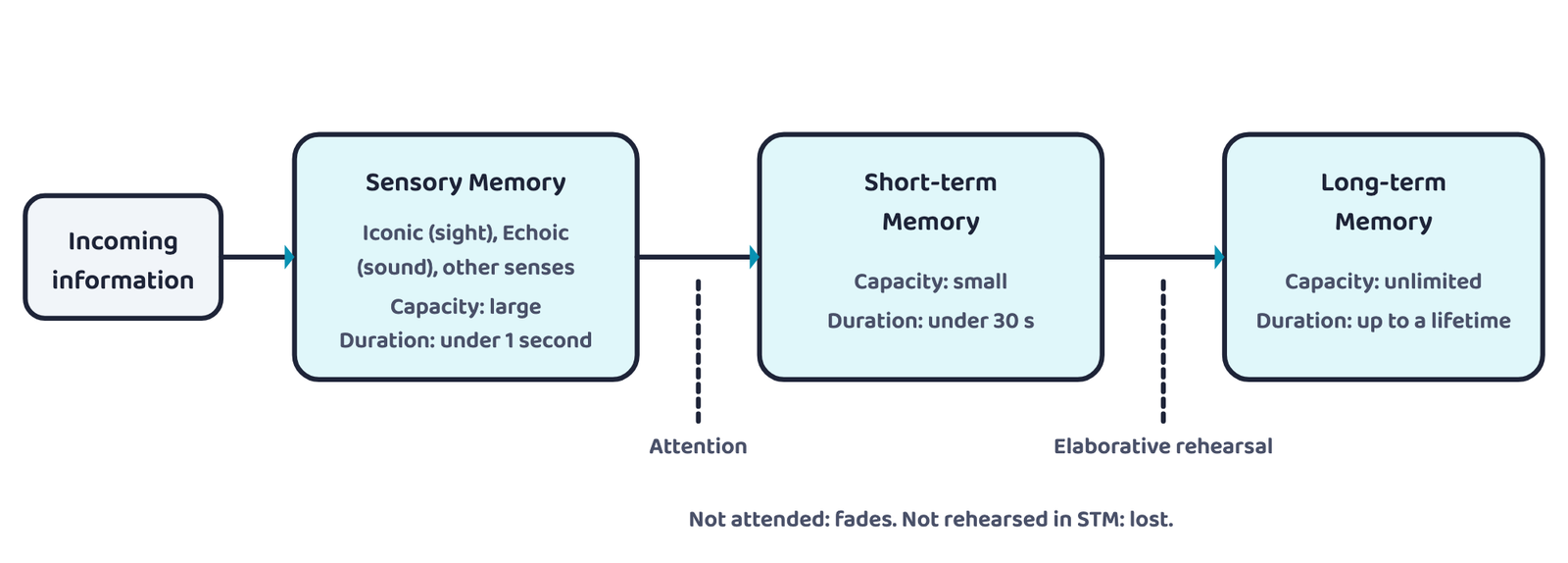
This computer comparison led to the first model of memory, proposed by Atkinson and Shiffrin in 1968, called the Stage Model.
4Memory Systems: Sensory, Short-term and Long-term
4.1 Sensory memory
All incoming information first enters sensory memory. It has a large capacity but a very short duration, less than a second. It registers information from every sense with reasonable accuracy, as an exact replica of the stimulus, which is why it is also called sensory memories or sensory registers.
- Iconic memory (visual): the trail of light you still “see” after a bulb is switched off (a visual after-image).
- Echoic memory (auditory): the echo of a sound you still “hear” after the sound has stopped (reverberation).
4.2 Short-term memory (STM)
We do not attend to everything that reaches our senses. What we pay attention to passes on to short-term memory. This store can keep only a small amount, and only briefly: usually 30 seconds or less. According to Atkinson and Shiffrin, information in STM is encoded mainly acoustically (in terms of sound). Unless it is rehearsed continuously, it may be lost in under 30 seconds. STM is fragile, but less fragile than sensory memory, where information decays automatically in under a second.
4.3 Long-term memory (LTM)
Material that survives STM’s limits of capacity and duration finally enters long-term memory, which has a vast capacity. It is a permanent storehouse holding everything from yesterday’s breakfast to your sixth birthday. Information in LTM is encoded semantically (by meaning). According to the chapter, nothing that reaches LTM is ever lost. When we say we have “forgotten” something, the real problem is retrieval failure: the information is still stored, but we cannot get it out.
| Feature | Sensory memory | Short-term memory | Long-term memory |
|---|---|---|---|
| Entry | All incoming information | Only information that is attended to | Information that survives STM (through elaborative rehearsal) |
| Capacity | Large | Small (7±2 items) | Vast, unlimited |
| Duration | Less than a second | 30 seconds or less | Permanent, up to a lifetime |
| Main encoding | Exact replica of the stimulus | Acoustic (sound) | Semantic (meaning) |
| Loss | Decays automatically | Lost unless rehearsed | Not lost; “forgetting” is retrieval failure |
4.4 Control processes: how information moves between stores
The model so far shows only the structure. Atkinson and Shiffrin explained the movement of information with control processes, which monitor the flow of information through the memory stores.
Control processes are the processes that monitor and manage the flow of information through the various memory stores.
Selective attention
The first control process. It decides what travels from the sensory registers to STM. Impressions that get no attention fade away quickly. (You read about attention in the chapter on sensory, attentional and perceptual processes.)
Maintenance rehearsal
Works in STM. It keeps information there for as long as needed by simple repetition, silent or aloud. When the repetition stops, the information is lost.
Chunking
Works in STM to expand its capacity, which is otherwise 7±2 items. Small units are grouped into larger meaningful chunks.
Elaborative rehearsal
Moves information from STM into LTM by connecting the new information to what is already in LTM.
The string 194719492004 has 12 digits, more than STM can hold. Break it into three chunks: 1947 (India became independent), 1949 (the Indian Constitution was adopted) and 2004 (the tsunami hit the coasts of India and South East Asia). Now you remember three items, not twelve.
Chunking is combining several smaller units of information into larger, meaningful chunks, which expands the capacity of short-term memory.
Maintenance rehearsal
- Simple repetition, silent or vocal
- Keeps information in STM only as long as repetition goes on
- Information is lost when repetition stops
- Example: repeating a phone number until you dial it
Elaborative rehearsal
- Links the new information to information already in LTM
- Moves information from STM into LTM
- Analyses the information through the associations it arouses; organises it in a logical framework, links it to similar memories, or forms a mental image
- The more associations you create, the more permanent the memory
- Example: ‘humanity’ is easier to remember if you already know ‘compassion’, ‘truth’ and ‘benevolence’
Maintenance rehearsal retains information in STM through simple repetition; elaborative rehearsal connects the information to be retained with information already in long-term memory.
Later psychologists argued that STM is not one single unit but has several parts. Baddeley (1986) first proposed this multi-component view. STM is not a passive store but a work bench where materials are constantly handled, changed and transformed while we do mental tasks. This work bench is called working memory.
- Phonological loop: keeps only a few sounds at a time; if they are not rehearsed, they fade within 2 seconds.
- Visuospatial sketchpad: stores visual and spatial information; its capacity is also limited.
- Central Executive: organises information from the phonological loop, the sketchpad and LTM; like a real executive it allocates attention, and monitors, plans and controls behaviour.
Working memory is the multi-component short-term memory proposed by Baddeley: a work bench that holds memory materials which are constantly handled, manipulated and transformed while we perform cognitive tasks.
4.5 Evidence against the Stage Model
Tests of the Stage Model gave mixed results. Some experiments clearly show STM and LTM are separate stores; other evidence questions this:
- The model said STM encodes acoustically and LTM semantically, but later experiments showed STM can also encode semantically and LTM acoustically.
- Shallice and Warrington (1970) reported the case of KF, a man injured in an accident that harmed the left side of his cerebral hemisphere. Afterwards his STM was badly damaged, yet his LTM worked normally. If everything must pass through STM to reach LTM, how could his LTM be normal?
- Other studies showed memory processes are similar whether information is kept for seconds or for years, so memory can be understood without separate stores.
This evidence led to a second model: the levels of processing view.
5Levels of Processing
Proposed by Craik and Lockhart in 1972. Its central idea: the way new information is perceived, analysed and understood at the start decides how long it will stay in memory. The view has been revised since, but the basic idea is unchanged: incoming information can be analysed at more than one level.
The first two levels give fragile memory that decays quickly. Encoding by meaning (semantic encoding) is the deepest level and gives the longest retention.
Do not depend on rote learning. While studying a lesson, work out its meaning in detail and think how it connects to other facts, concepts and your own life. That is the surest route to long-term retention.
Card questions such as “Is the word in capital letters?” (structural), “Does it rhyme with crew?” (phonetic) and “Does it fit the sentence?” (semantic) show that words processed for meaning are recalled best.
6Types of Long-term Memory
Just as STM has parts (working memory), LTM too is not unitary: it holds many kinds of information, so it is divided into types.
6.1 Declarative and procedural memory
Declarative memory
- Facts, names and dates
- Examples: a rickshaw has three wheels; India became independent on 15 August 1947; a frog is an amphibian; you and your friend share the same name
- Can be easily described in words
- You can explain how cricket is played
Procedural memory
- Procedures for doing tasks and skills
- Examples: riding a bicycle, making tea, playing basketball
- Hard to describe in words
- You find it hard to explain how you ride a bicycle
6.2 Episodic and semantic memory (Tulving)
Tulving divided declarative memory further into episodic and semantic memory.
Episodic memory
- Biographical details of our own life; personal experiences
- Contents are generally emotional
- Dated: tied to when it happened
- Example: how you felt when you stood first in class
- We do not remember every event; painful, unpleasant events are kept in less detail than pleasant ones
Semantic memory
- General awareness and knowledge: concepts, ideas, rules of logic
- Affect-neutral (no emotion attached)
- Not dated: you cannot say when you learnt it
- Examples: meaning of ‘non-violence’; 2+6=8; New Delhi’s STD code is 011; ‘elaphant’ is misspelt; Bangalore is the capital of Karnataka
- Not susceptible to forgetting
Episodic memory contains the biographical details of our lives, our personal life experiences.
Semantic memory is the memory of general awareness and knowledge; all concepts, ideas and rules of logic are stored in it.
- Flashbulb memories: very detailed memories of highly arousing or surprising events, like a photo frozen in memory and tied to particular places, dates and times. Perhaps more effort goes into forming them, and highlighting details may cause deeper processing and give more retrieval cues.
- Autobiographical memory: personal memories, not spread evenly across life. Almost no memories are reported from the first 4 to 5 years of childhood: this is childhood amnesia. Memories rise sharply just after early adulthood (the twenties), perhaps because of emotion, novelty and importance. In old age the most recent years are well remembered; decline in some kinds of memory starts around 30 years of age.
- Implicit memory: memory a person is not aware of, retrieved automatically, yet it still influences behaviour. Typists know where each letter is but many cannot label blank keys in a drawing of a keyboard. Brain-injured patients who could not recall a word list could complete words when given their first two letters. It is seen in people with normal memory too.
| Method | Measures | How it works |
|---|---|---|
| Free recall | Facts / episodes | Memorise a word list, later recall the words in any order. More recalled = better memory. |
| Recognition | Facts / episodes | Memorised items are shown mixed with distracter items (not seen before); pick out the old ones. More old items recognised = better memory. |
| Sentence verification task | Semantic memory | Say whether sentences are true or false. The faster the response, the better the needed information is retained. |
| Priming | Information we cannot report in words, including implicit memory | See words (garden, playground, house), then complete fragments (gar, pla, ho) mixed with fragments of unseen words. Seen words are completed faster, though people say they only guessed. |
7Nature and Causes of Forgetting
Forgetting refers to the loss of stored information over a period of time.
Ebbinghaus made the first systematic attempt to understand forgetting. He memorised lists of nonsense syllables: CVC trigrams (consonant-vowel-consonant) such as NOK or SEP. He then measured how many trials he needed to relearn the same list after different time gaps.

Most of the loss happens early: forgetting is fastest during the first nine hours, and fastest of all in the first hour. Later the loss slows down, and very little more goes even over many days. His experiments were early and simple, but today it is accepted almost unanimously that there is always a sharp drop in memory first, and then a very gradual decline.
7.1 Forgetting due to trace decay
Trace decay theory (also called disuse theory) is the earliest theory of forgetting. Memory causes physical changes in the central nervous system called memory traces. If these traces are not used for a long time, they fade away and become unavailable.
If disuse caused forgetting, people who sleep after memorising (no chance to use the traces) should forget more than those who stay awake. Results showed the opposite: the waking condition showed greater forgetting than the sleeping condition. So the theory was found inadequate and was replaced by interference theory.
7.2 Forgetting due to interference
Interference theory is perhaps the most influential theory of forgetting. Learning forms associations between items, and these stay intact in memory without conflict. Interference arises at the time of retrieval, when different sets of associations compete to be recalled. Example: a friend learns list A and then list B of nonsense syllables; while recalling list A, some list B items slip in.
Proactive interference (forward moving)
- Earlier learning interferes with recall of later learning
- Example: knowing English makes learning French difficult
Retroactive interference (backward moving)
- Later learning interferes with recall of earlier learning
- Example: while memorising French words, you cannot recall their English equivalents
| Design (Table 6.1) | Group | Phase 1 | Phase 2 | Testing |
|---|---|---|---|---|
| Retroactive | Experimental | Learns A | Learns B | Recalls A |
| Control | Learns A | Rests | Recalls A | |
| Proactive | Experimental | Learns A | Learns B | Recalls B |
| Control | Rests | Learns B | Recalls B |
Tip to remember the design: in retroactive designs the group recalls A (the old list is disturbed); in proactive designs the group recalls B (the new list is disturbed). Activity 6.4 (two animal word lists, then an hour of rest) lets you try this yourself.
7.3 Forgetting due to retrieval failure
Forgetting may also happen because, at the time of recall, the retrieval cues are absent or inappropriate. This view was advanced by Tulving and his associates.
Retrieval cues are aids which help us in recovering information stored in memory.
You learn words like hut, wasp, cottage, gold, bronze, ant, which belong to six categories (places of living, insects, metals and so on). Recalling freely, you get only a few. If you are given the category names as well, recall becomes almost total. The physical place where you learnt something also acts as a strong retrieval cue.
| Theory | Cause of forgetting | Key point |
|---|---|---|
| Trace decay (disuse) | Unused memory traces fade | Earliest theory; failed the sleep vs waking test |
| Interference | Stored associations compete at retrieval | Most influential; proactive and retroactive |
| Retrieval failure | Cues absent or inappropriate at recall | Tulving and associates; information is still stored |
- A traumatic experience hurts a person emotionally. Sigmund Freud said such experiences are repressed into the unconscious and are not available for retrieval: painful, threatening and embarrassing memories are kept out of consciousness.
- In some people trauma causes psychological amnesia: they cannot cope, shut their eyes, ears and mind to the harsh reality and take a mental flight from it, which can end in highly generalised amnesia.
- One result of such flight is the fugue state: the person takes on a new identity, name and address; there are two personalities and one knows nothing about the other.
- Stress and high anxiety can also cause forgetting, for example a well-prepared student who becomes extremely nervous on seeing the question paper and forgets everything.
8Enhancing Memory
Mnemonics (pronounced ni-mo-nicks) are strategies for improving memory. Some use images; others use self-made organisation of the learnt material.
8.1 Mnemonics using images
You create vivid, interacting images of the material you want to remember.
Keyword method
For learning foreign-language words. Find an English word that sounds like the foreign word; it becomes the keyword. Then imagine the keyword and the meaning interacting. Spanish for duck is ‘pato’: keyword ‘pot’; imagine a duck in a pot full of water. Far better than rote learning.
Method of loci
Items to be remembered are placed as visual images at familiar places in a fixed order. Best for remembering things in serial order. Shopping list: bread and eggs in the kitchen, tomatoes on a table, soap in the bathroom. In the market, take a mental walk from kitchen to bathroom and pick them up one by one.
8.2 Mnemonics using organisation
Organisation means putting some order on the material. The framework you create makes retrieval fairly easy.
Chunking
Combine smaller units into larger chunks using an organising principle. Besides expanding STM capacity, chunking also improves memory.
First letter technique
Take the first letter of each word to be remembered and make a new word or sentence from them. Rainbow colours: VIBGYOR = Violet, Indigo, Blue, Green, Yellow, Orange, Red.
8.3 A more complete approach to memory improvement
Mnemonics are too simplistic: they underestimate how complex memory tasks are. Many psychologists suggest a fuller approach that applies what we know about memory processes. One must:
8.4 The PQRST method (Thomas and Robinson)
No single method solves every memory problem or gives overnight improvement. Memory also depends on your health, interest and motivation and familiarity with the subject. Choose strategies that suit the memory task in front of you.
9Key Terms
| Term | Meaning in one line |
|---|---|
| Chunking | Grouping small units into larger meaningful chunks to expand STM capacity |
| Control process | A process that manages the flow of information between memory stores |
| Echoic memory | Sensory register for sounds (auditory) |
| Encoding | First registration of information so the memory system can use it |
| Episodic memory | Memory of one’s own life experiences; emotional and dated |
| Elaborative rehearsals | Linking new information to existing LTM knowledge; moves it into LTM |
| Fugue state | A disorder after trauma in which a person takes a new identity, name and address |
| Information processing approach | Seeing memory as a system that processes information like a computer |
| Maintenance rehearsals | Repeating information to keep it in STM |
| Memory making | The building of a memory through encoding, storage and retrieval |
| Mnemonics | Strategies (images or organisation) for improving memory |
| Semantic memory | Memory of general knowledge, concepts and rules; not dated, affect-neutral |
| Serial reproduction | Recalling material in the same order in which it was learnt |
| Working memory | Baddeley’s work-bench model of STM with three components |
10NCERT Review Questions: Short Answers
Encoding records and registers information for the first time in a usable form; storage holds it over time; retrieval brings it back to awareness for use in tasks such as problem solving.
All input enters sensory memory (large, under a second). Attended input moves to STM (small, under 30 seconds, kept by maintenance rehearsal and expanded by chunking). Elaborative rehearsal moves it to LTM (vast, permanent, semantic).
Maintenance rehearsal only repeats information to hold it in STM and it is lost when repetition stops; elaborative rehearsal links it to existing knowledge through associations and so moves it into LTM.
Declarative memory holds facts, names and dates and can be put into words; procedural memory holds skills and procedures (riding a bicycle) and is hard to describe.
Three explanations: unused memory traces decay (trace decay), stored associations compete at recall (interference), and retrieval cues are absent or unsuitable (retrieval failure). Stress and repression can also block recall.
In interference, competing associations block recall; in retrieval failure, the information is intact but the right cue is missing, so supplying cues (like category names) restores recall.
Mnemonics are memory-improving strategies using images or organisation. A plan: use PQRST for each chapter, learn by meaning (deep processing), study unrelated subjects one after another with short breaks, and build retrieval cues such as keywords and first-letter words.
- Ebbinghaus (1885): first systematic study of memory; nonsense syllables; forgetting fast first, then slow
- Three stages: encoding, storage, retrieval; failure possible at any stage
- Stage Model (Atkinson and Shiffrin, 1968): sensory (large, under 1 s) to STM (small, under 30 s, acoustic, 7±2) to LTM (vast, permanent, semantic)
- Control processes: selective attention, maintenance rehearsal, chunking, elaborative rehearsal
- Working memory (Baddeley, 1986): phonological loop, visuospatial sketchpad, central executive
- Against the stage model: patient KF (Shallice and Warrington, 1970)
- Levels of processing (Craik and Lockhart, 1972): structural, phonetic, semantic (deepest)
- LTM: declarative vs procedural; declarative = episodic + semantic (Tulving); Box 6.2: flashbulb, autobiographical, implicit
- Measurement: free recall, recognition, sentence verification, priming
- Forgetting: trace decay (earliest), interference (most influential; proactive, retroactive), retrieval failure (Tulving)
- Box 6.4: Freud’s repression, psychological amnesia, fugue state
- Mnemonics: keyword, loci, chunking, first letter (VIBGYOR); deep processing, minimise interference, retrieval cues; PQRST (Thomas and Robinson)
- Can I draw the Stage Model with the capacity and duration of each store?
- Can I name the three parts of working memory and say what each does?
- Can I explain the three levels of processing using the word “cat”?
- Can I tell proactive from retroactive interference with an example and the Table 6.1 design?
- Can I expand PQRST and explain the keyword method and the method of loci?