Nature and Scope
- How three different geographers have defined human geography, and what each definition emphasises
- Why the split between “physical” and “human” geography is not really valid
- The difference between environmental determinism, possibilism and neodeterminism, with the traffic-light idea that ties them together
- How human geography’s own approach has changed over six historical stages
- The three schools of thought that reshaped human geography in the 1970s
- How human geography branches into fields and sub-fields that connect with other social sciences
1 Meaning, Nature and Definitions of Human Geography
In Class 11 you already read “Geography as a Discipline” in Fundamentals of Physical
Geography. That chapter told you geography is integrative (it pulls together many
subjects), empirical (it works from observation and evidence) and practical
(it solves real problems). Because of this, geography’s reach is huge: almost any event or
process that varies over space and time can be studied geographically.
The earth has two major components: nature (the physical environment) and
life forms, including human beings. Physical geography studies the physical
environment. Human geography studies how the physical and human worlds relate to each
other, how human activity is spread across space, and why different parts of the world
differ socially and economically.
Human geography is “the relationship between the physical/natural and the human
worlds, the spatial distributions of human phenomena and how they come about, and the
social and economic differences between different parts of the world.”
We talk of the “face” of the earth, the “eye” of a storm, the “mouth” of a river, the
“snout” of a glacier, and the “neck” of an isthmus. German geographers even called a
country a “living organism”, and road/rail/waterway networks have been described as
“arteries of circulation”. These borrowed words are a hint that nature and human life
are too closely tied together to study as two separate things.
Three geographers, writing in different periods, each defined human geography a little
differently. A board question that says “define human geography, naming the geographer”
expects one of these three, word for word.
“Human geography is the synthetic study of relationship between human societies and
earth’s surface.” Keyword: synthesis. Ratzel’s definition is about bringing
human society and the earth’s surface together into one study.
“Human geography is the study of the changing relationship between the unresting man
and the unstable earth.” Keyword: dynamism. Semple’s definition stresses that
both people and the earth keep changing, so the relationship between them keeps
changing too.
Human geography is a “conception resulting from a more synthetic knowledge of the
physical laws governing our earth and of the relations between the living beings which
inhabit it.” Vidal de la Blache offered a fresh way of looking at how earth and human
beings are inter-related.
2 Dualism in Geography
For a long time geography was pulled between two extremes on several questions at once.
Should it make general laws (nomothetic) or just describe what it observes
(idiographic)? Should its study be organised by region, or by system (one theme
studied everywhere)? Should events be explained by theory, or by their own historical
background? These debates are called the dualism of geography.
The chapter’s own conclusion is the answer worth remembering: the split between
physical and human geography “is not a very valid one”, because nature and human
beings are inseparable and should be studied holistically, as one whole.
3 Physical Environment and Human Environment
Human geography studies the inter-relationship between the physical environment
and the socio-cultural environment that human beings have created, through their
constant mutual interaction with each other. In simple words: nature shapes what people
build and do, and people’s activities, in turn, reshape nature.
| Physical environment (given by nature) | Human / cultural environment (built by people) |
|---|---|
| Landforms | Houses and villages |
| Soils | Cities and road-rail networks |
| Climate | Industries and farms |
| Water | Ports |
| Natural vegetation | Items of daily use |
| Flora and fauna | Other elements of material culture |
Human beings interact with the physical environment with the help of technology.
What matters is not just what people produce, but the tools and techniques they use to
produce it. Technology develops once people understand nature’s own laws better: for
example, understanding friction and heat helped humans discover fire, and understanding
DNA and genetics helped conquer many diseases. So technology and knowledge of nature grow
together, and better technology loosens nature’s grip on human life.
4 Naturalisation of Humans
In the earliest stages of human life, technology was very simple and society was not
yet developed. So people were greatly influenced by nature, adapting to its demands rather
than controlling it. Such societies depend on nature directly for the resources that keep
them alive, so the physical environment becomes their “Mother Nature”.
Environmental determinism is the strong influence of nature over a primitive
human society with a very low level of technology. In this stage, humans listen to
nature, fear its fury, and worship it. The chapter illustrates this with Benda, a tribal
youth of the Abujh Maad forests of central India, whose whole life (his food, his
medicine, even the spirits he thanks) comes directly from the forest around him.
5 Humanisation of Nature
As time passes, people understand their environment and nature’s forces better. With
social and cultural development, they build better technology and move from a state of
necessity to a state of freedom. Human activity now creates a
cultural landscape. Its imprints appear everywhere: health resorts on highlands,
huge urban sprawls, fields and orchards in the plains, ports on coasts, shipping routes on
the oceans, and satellites in space.
Earlier scholars called this idea possibilism: nature offers possibilities, and
human beings choose which to use. Slowly, nature itself gets “humanised” and starts
carrying the imprint of human effort. The chapter illustrates this with Kari, who lives
in the cold, dark city of Trondheim but still enjoys a heated glass-domed workplace,
imported tropical fruit and same-day flights to London, all made possible by technology.
6 Neodeterminism: the Middle Path
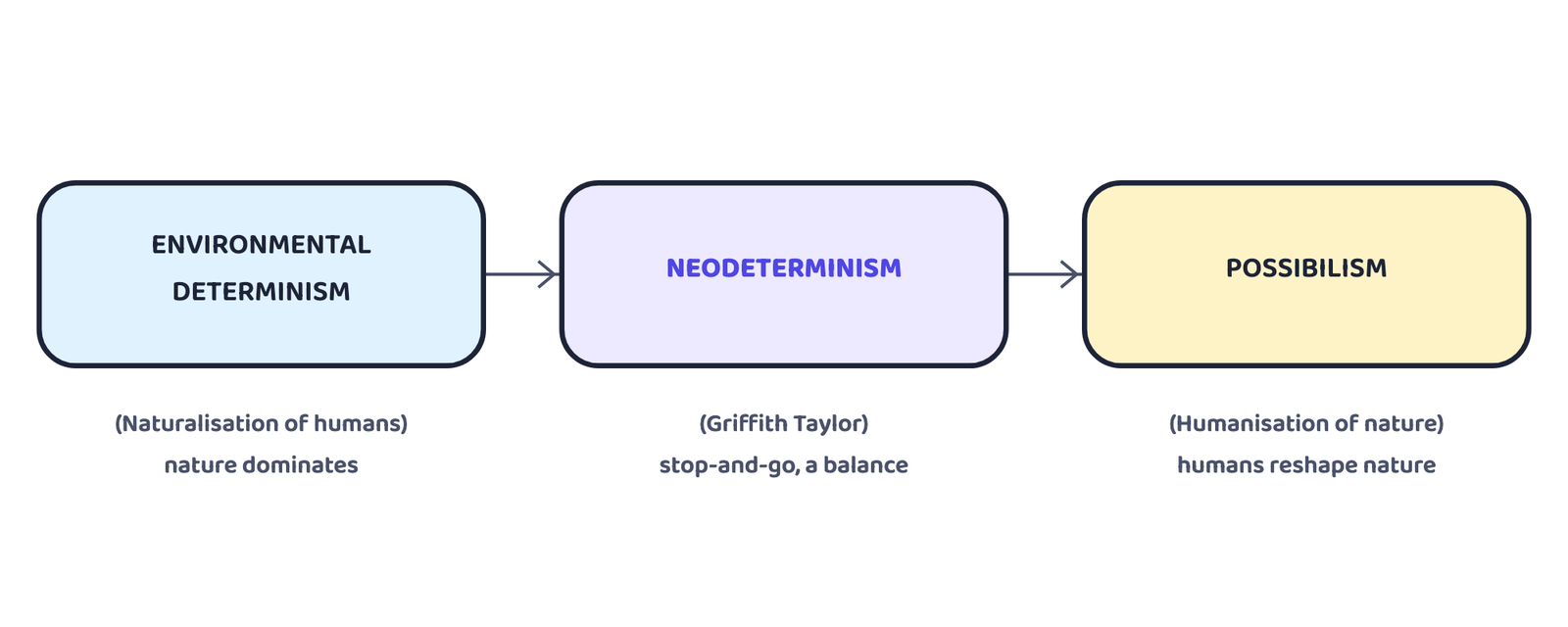
Geographer Griffith Taylor suggested a middle path (Madhyam Marg) between
environmental determinism and possibilism, called neodeterminism or
“stop-and-go determinism”.
Neodeterminism says human beings can “conquer nature by obeying it”: there is
neither absolute necessity (as in environmental determinism) nor absolute freedom (as in
possibilism). People can develop within limits that do not damage the environment.
Do not write that neodeterminism means “humans can do whatever they want with
technology.” The chapter is clear that an unlimited “free run” (ignoring nature’s
limits) has already caused the greenhouse effect, ozone-layer depletion, global
warming, receding glaciers and degrading land. Neodeterminism is about balance, not
about unlimited freedom.
7 Stages and Schools of Human Geography
Human geography’s own approach has changed with time, as summed up in the table below.
This table is asked directly in exams, so learn the period-approach pairs.
| Period | Approach | Broad feature |
|---|---|---|
| Early Colonial period | Exploration and description | Trade and empire pushed geographers to explore and describe new areas in detail |
| Later Colonial period | Regional analysis | Every aspect of a region was described, on the idea that understanding the parts builds an understanding of the whole earth |
| 1930s through the inter-war period | Areal differentiation | Focus shifted to what makes each region unique, and why it differs from others |
| Late 1950s to the late 1960s | Spatial organisation | Computers and statistics were used to find mappable patterns. This phase is nicknamed the quantitative revolution |
| 1970s | Emergence of humanistic, radical and behavioural schools | Discontent with the “dehumanised” quantitative approach led to three new schools of thought |
| 1990s | Post-modernism in geography | Universal, one-size-fits-all theories were questioned; each local context was seen as important in its own right |
The 1970s reaction against the quantitative revolution produced three new schools of
thought in human geography.
Welfare / humanistic school
Focused on people’s social well-being: housing, health and education. A university
paper called “Geography of Social Well-being” grew out of this school.
Radical school
Used Marxian theory to explain the real causes of poverty, deprivation and social
inequality, linking them to the development of capitalism.
Behavioural school
Focused on people’s lived experience, and how space is perceived differently by
groups based on ethnicity, race and religion.
8 Fields and Sub-fields of Human Geography
Human geography tries to explain the relationship between every element of human life
and the space it occurs in. This makes it highly inter-disciplinary: it develops a
close working relationship with other social sciences. As knowledge grows, new sub-fields
keep emerging.
| Field of human geography | Sub-fields | Linked social-science discipline |
|---|---|---|
| Social Geography | — | Sociology |
| Behavioural Geography | Psychology | |
| Geography of Social Well-being | Welfare Economics | |
| Geography of Leisure | Sociology | |
| Cultural Geography | Anthropology | |
| Gender Geography | Sociology, Anthropology, Women’s Studies | |
| Historical Geography | History | |
| Medical Geography | Epidemiology | |
| Urban Geography | — | Urban Studies and Planning |
| Political Geography | — | Political Science |
| Electoral Geography | Psephology | |
| Military Geography | Military Science | |
| Population Geography | — | Demography |
| Settlement Geography | — | Urban / Rural Planning |
| Economic Geography | — | Economics |
| Geography of Resources | Resource Economics | |
| Geography of Agriculture | Agricultural Sciences | |
| Geography of Industries | Industrial Economics | |
| Geography of Marketing | Business Studies, Economics, Commerce | |
| Geography of Tourism | Tourism and Travel Management | |
| Geography of International Trade | International Trade |
- Human geography studies how the physical and human worlds relate. Physical and human geography are not really separate subjects
- Three definitions to remember: Ratzel (synthesis), Semple (dynamism), Vidal de la Blache (new conception of earth-human relations)
- Naturalisation of humans = environmental determinism = nature dominates a primitive, low-technology society
- Humanisation of nature = possibilism = humans use nature’s possibilities and reshape it with technology
- Neodeterminism (Griffith Taylor) = the traffic-light middle path between the two above
- Table 1.1: six stages, Early Colonial → Later Colonial → Areal differentiation (1930s) → Spatial organisation/quantitative revolution (late 1950s-60s) → three new schools (1970s) → Post-modernism (1990s)
- Three 1970s schools: welfare/humanistic (social well-being), radical (Marxian, poverty and inequality), behavioural (lived experience, perception of space)
- Human geography is highly inter-disciplinary. Table 1.2 links its fields to sociology, economics, political science, demography and more
- Can I write all three definitions of human geography with the correct geographer’s name?
- Can I explain the difference between environmental determinism, possibilism and neodeterminism without mixing them up?
- Can I list the six stages of Table 1.1 in the right order?
- Can I name at least two sub-fields each of Social, Political and Economic Geography?
- 1 markWhich one of the following statements does NOT describe geography?
(a) An integrative discipline(b) Study of the inter-relationship between humans and environment(c) Subjected to dualism(d) Not relevant in the present time due to the development of technology - 1 markWhich one of the following is NOT a source of geographical information?
(a) Traveller’s accounts(b) Old maps(c) Samples of rock materials from the moon(d) Ancient epics - 1 markWhich one of the following is the most important factor in the interaction between people and environment?
(a) Human intelligence(b) People’s perception(c) Technology(d) Human brotherhood - 1 markWhich one of the following is NOT an approach in human geography, as listed in Table 1.1?
(a) Areal differentiation(b) Spatial organisation(c) Quantitative revolution(d) Exploration and description - 1 markWho defined human geography as “the synthetic study of relationship between human societies and earth’s surface”?
(a) Friedrich Ratzel(b) Ellen C. Semple(c) Griffith Taylor(d) Paul Vidal de la Blache - 1 markGriffith Taylor’s “stop-and-go determinism” is another name for:
(a) Environmental determinism(b) Neodeterminism(c) Possibilism(d) Areal differentiation - 1 markThe “quantitative revolution” phase in Table 1.1 falls in which period?
(a) Late 1950s to the late 1960s(b) 1930s through the inter-war period(c) Early Colonial period(d) 1990s - 1 markWhich 1970s school of thought used Marxian theory to explain poverty, deprivation and social inequality?
(a) Welfare / humanistic school(b) Radical school(c) Behavioural school(d) Post-modern school
Assertion and Reason Questions
Reason (R): In this early stage, both technology and social development were at a very low level, so nature dominated human life.
Reason (R): It holds that human beings must always submit completely to nature, with no possibility of development.
Reason (R): Nature and human beings are inseparable elements and should be studied holistically, as one whole.
- 1 markDefine human geography in one line.
- 1 markWhich geographer described human geography as “the study of the changing relationship between the unresting man and the unstable earth”?
- 1 markWhat do the terms “nomothetic” and “idiographic” mean in geography’s dualism debate?
- 1 markName the two ideas between which Griffith Taylor’s neodeterminism finds a middle path.
- 1 markDuring which period did the “quantitative revolution” take place?
- 1 markName any two sub-fields of Social Geography.
- 1 markWhat term is used for the visible imprints of human activity on the physical landscape?
- 2 marksDefine human geography in about 30 words.
- 2 marksName some sub-fields of human geography.
- 3 marksHow is human geography related to other social sciences?
- 3 marksList the elements of the physical environment and the elements of the human/cultural environment, as given in the chapter.
- 3 marksDistinguish between environmental determinism and possibilism.
- 3 marksExplain the traffic-light idea Griffith Taylor used to describe neodeterminism.
- 3 marksWhat consequences of the unlimited “free run” of developed economies does the chapter mention?
- 3 marksName the three schools of thought that emerged in human geography in the 1970s.
- 3 marksWhy is human geography called a highly inter-disciplinary subject?
- 5 marksExplain naturalisation of humans, in not more than 150 words.
- 5 marksWrite a note on the scope of human geography, in not more than 150 words.
- 5 marksDescribe the broad stages in the evolution of human geography, from the Early Colonial period to the 1990s, along with their approaches.
- 5 marksExplain, with the main idea of each, the welfare/humanistic, radical and behavioural schools of thought that emerged in the 1970s.
- 5 marks“The dichotomy between physical and human geography is not a valid one.” Discuss this statement with reference to naturalisation and humanisation of nature.