Trade
import substitutionGreen RevolutionKandlaJNPT
Mumbai PortUDANgems and jewellerydelicensing
1Growth and Pattern of India’s Foreign Trade
International trade is trade between two countries. It is mutually beneficial because no country produces everything it needs; every country has to buy some things from others and sell some things it makes well. India’s share in world trade is small, only about 1% of the total volume, but it still plays a significant role in the world economy.
International trade is the exchange of goods and services between two or more countries, driven by the fact that no country is fully self-sufficient in everything it needs.
India’s foreign trade has changed hugely since Independence, in volume, composition and direction. In 1950-51, India’s external trade was worth just ₹1,214 crore. By 2021-22 it had risen to about ₹77,19,796 crore, and reasons for this sharp rise include the growing momentum of the manufacturing sector, the government’s liberal trade policies, and the diversification of India’s export markets.
The trade balance is the difference between the value of a country’s exports and its imports. If imports are worth more than exports, the trade balance is negative, called a trade deficit.
Table 8.1 shows that although both imports and exports have grown steadily, the value of imports has stayed higher than exports throughout, so India runs a continuing trade deficit.
| Year | Exports (₹ crore) | Imports (₹ crore) | Trade Balance (₹ crore) |
|---|---|---|---|
| 2004-05 | 3,75,340 | 5,01,065 | −1,25,725 |
| 2009-10 | 8,45,534 | 13,63,736 | −5,18,202 |
| 2013-14 | 19,05,011 | 27,15,434 | −8,10,423 |
| 2016-17 | 18,52,340 | 25,77,422 | −7,25,082 |
| 2021-22 | 31,47,021 | 45,72,775 | −14,25,753 |
Source: Economic Survey 2016-17 and 2022-23 (NCERT Table 8.1)
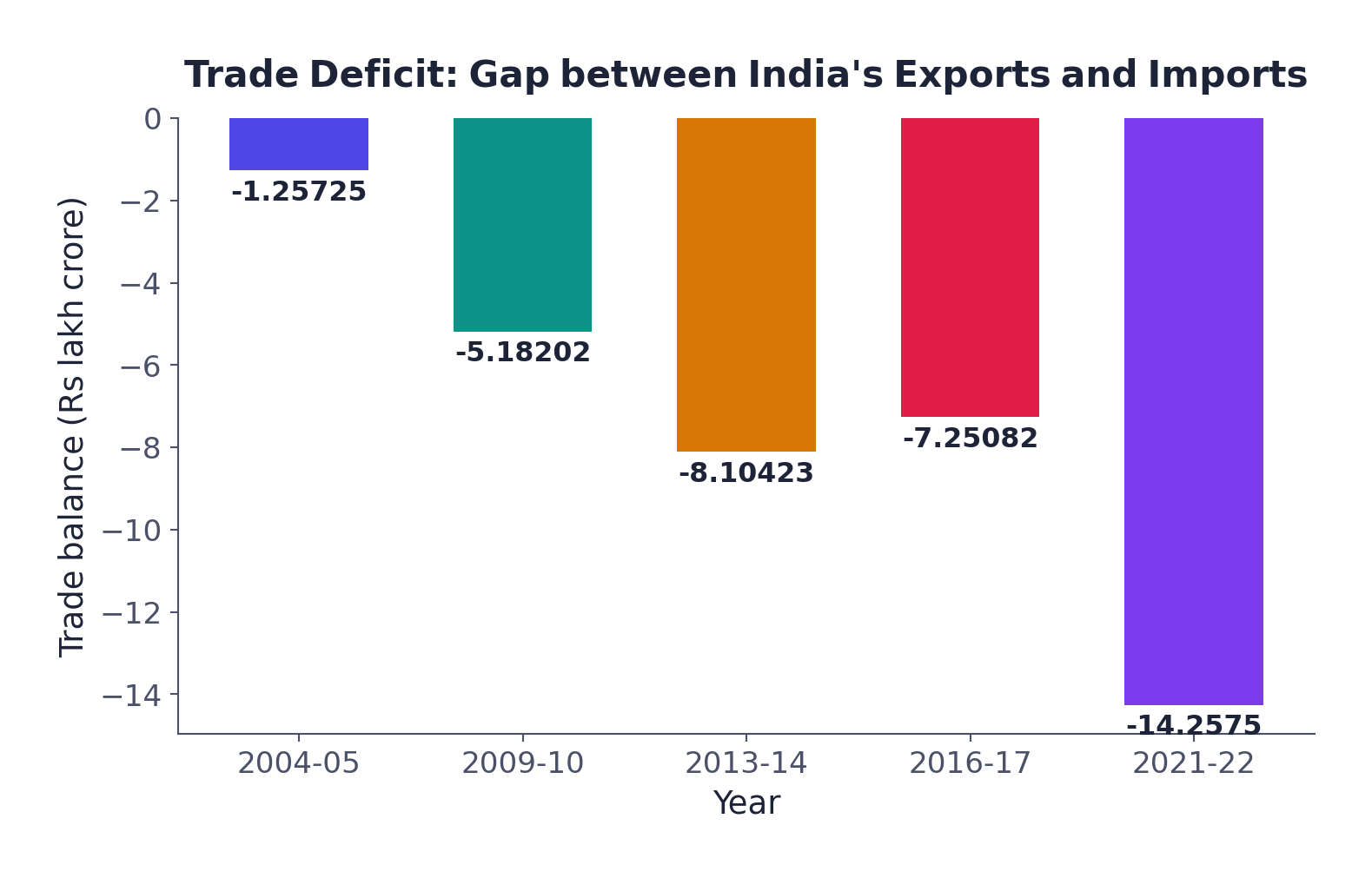
“India’s trade balance has always been negative” is a fact often asked directly. Quote at least two years’ figures from Table 8.1 to back it up.
2Composition of India’s Exports
The mix of what India exports has kept changing. In exports, the share of agriculture and allied products and of manufactured goods has gone down, while the share of crude petroleum and products and of other commodities has gone up. The share of ore and minerals has stayed roughly constant.
| Commodity group | 2015-16 | 2016-17 | 2020-21 | 2021-22 |
|---|---|---|---|---|
| Agriculture and allied products | 12.6% | 12.3% | 14.3% | 11.9% |
| Ore and Minerals | 1.6% | 1.9% | 3.2% | 2.0% |
| Manufactured goods | 72.9% | 73.6% | 71.2% | 67.8% |
| Crude and petroleum products | 11.9% | 11.7% | 9.2% | 16.4% |
| Other commodities | 1.1% | 0.5% | 2.1% | 1.9% |
Percentage share in exports. Source: Economic Survey 2016-17 and 2022-23 (NCERT Table 8.2)
Among traditional agricultural items, cashew exports have declined because of tough international competition, especially from China and other East Asian countries. But some newer agricultural exports have increased: floricultural products, fresh fruits, marine products and sugar. The manufacturing sector alone made up 67.8% of India’s total export value in 2021-22, with engineering goods showing significant growth. Gems and jewellery also contribute a large share of India’s foreign trade.
| Commodity group | Export value 2021-22 (₹ crore) |
|---|---|
| Agriculture and allied products | 3,75,742 |
| Ores and Minerals | 63,754 |
| Manufactured goods | 21,32,296 |
| Mineral fuels and Lubricants | 5,15,310 |
Source: Economic Survey 2022-23 (NCERT Table 8.3)
✓ Exports going up
- Crude petroleum and products
- Other commodities
- Floriculture, fresh fruit, marine products, sugar
- Engineering goods, gems and jewellery
✗ Exports going down
- Agriculture and allied products (overall share)
- Manufactured goods (overall share)
- Traditional items like cashew
3Composition of India’s Imports
India faced a serious food shortage in the 1950s and 1960s. Back then, the major imports were foodgrain, capital goods, machinery and equipment. Because imports were greater than exports, India’s balance of payment stayed negative even after all the efforts at import substitution.
Import substitution means producing goods at home that a country would otherwise have to import, to reduce dependence on foreign supplies and save foreign exchange.
Other major items in India’s import basket include pearls, precious and semi-precious stones, gold and silver, and non-ferrous metals.
| Commodity group | 2015-16 | 2016-17 | 2020-21 | 2021-22 |
|---|---|---|---|---|
| Food and allied products | 5.1% | 5.6% | 4.5% | 4.4% |
| Fuel (Coal, POL) | 25.4% | 26.7% | 25.1% | 31.6% |
| Fertilisers | 2.1% | 1.3% | 1.9% | 2.3% |
| Paper board manufacturing and news print | 0.8% | 0.9% | 0.8% | 0.7% |
| Capital goods | 13.0% | 13.6% | 12.7% | 10.1% |
| Others | 38.1% | 37.0% | 41.6% | 38.5% |
Percentage share in imports. Source: Economic Survey 2022-23 (NCERT Table 8.4)
| Commodity | Import value 2021-22 (₹ crore) |
|---|---|
| Fertilisers and fertiliser manufacturing | 1,05,796 |
| Edible oils | 1,41,532 |
| Pulp and waste paper | 11,934 |
| Non-ferrous metals | 4,99,766 |
| Iron and steel | 94,053 |
| Petroleum, oil and lubricants | 12,07,803 |
| Pearls, precious and semi-precious stones | 2,31,279 |
| Medicinal and Pharma products | 67,545 |
| Chemical products | 3,08,882 |
Source: Economic Survey 2022-23 (NCERT Table 8.5)
Students often think India stopped importing petroleum after finding its own oil fields. In fact petroleum, oil and lubricants form India’s single biggest import item by value; the change after the 1970s was that foodgrain import was replaced by fertiliser and petroleum, not removed altogether.
4Direction of India’s Trade
India has trade relations with most countries and major trading blocks of the world. Table 8.6 shows India’s region-wise import trade for two years.
| Region | Imports 2016-17 (₹ crore) | Imports 2021-22 (₹ crore) |
|---|---|---|
| Europe | 4,03,972 | 6,40,577 |
| Africa | 1,93,327 | 3,68,156 |
| North America | 1,95,332 | 3,78,041 |
| Latin America | 1,15,762 | 1,61,995 |
| Asia and ASEAN | 15,44,520 | 29,18,577 |
Source: Economic Survey 2016-17 and 2022-23 (NCERT Table 8.6)
India aims to double its share in international trade within the next five years. It has already begun suitable measures for this: import liberalisation, reduction in import duties, delicensing, and a change from process patents to product patents.
Most of India’s foreign trade moves through sea and air routes. A small portion also moves through land routes to neighbouring countries such as Nepal, Bhutan, Bangladesh and Pakistan.
5Sea Ports as Gateways of International Trade
India is surrounded by sea on three sides and has a long coastline. Water gives a smooth, cheap surface for transport, provided there is no turbulence, so India has a long tradition of sea-faring; many Indian place names end in “pattan“, meaning port. An interesting exam fact: India’s west coast has more ports than its east coast.
Ports have been used in India since ancient times, but they became truly important as gateways of international trade only after European traders arrived and the British colonised the country. This led to a real variation in the size and quality of ports: some grew a wide area of influence, others stayed limited.
A hinterland is the inland area a port serves, that is, the area from which goods are collected for export through that port, and to which imported goods are distributed. A hinterland’s boundary is difficult to fix exactly, because it is not fixed over space and can overlap with a neighbouring port’s hinterland.
Major ports (12)
- Policy decided by the Central Government
- Central government plays regulatory functions
- Handle a larger share of total port traffic
Minor / intermediate ports (200)
- Policy and functions regulated by state governments
- Handle a smaller share of traffic each
The British used Indian ports mainly as “suction points” to draw out resources from their hinterlands. As railways extended into the interior, they linked local markets to regional markets, regional markets to national markets, and national markets to international markets, a trend that continued right up to 1947.
Independence was expected to reverse this “suction” pattern, but Partition instead cost India two of its most important ports outright: Karachi port went to Pakistan, and Chittagong port went to the then East Pakistan, now Bangladesh. This is a favourite exam fact; don’t confuse the two ports or the two countries.
To make up for this loss, several new ports were developed: Kandla in the west, and Diamond Harbour near Kolkata on the river Hugli in the east. Despite this major setback, Indian ports kept growing after Independence and now handle large volumes of both domestic and overseas trade with modern infrastructure. Port development and modernisation were earlier the responsibility of government agencies alone; today, private entrepreneurs are also invited in, given the rising volume of traffic and the need to match international standards.
6India’s Major Ports
India has 12 major ports along its coastline. Each is known for a special history, cargo or hinterland.
6.1 West coast ports
| Port | Location and type | Known for | Hinterland |
|---|---|---|---|
| Deendayal Port (Kandla) | Head of the Gulf of Kuchchh | Built to reduce pressure on Mumbai; special facility for petroleum, petroleum products and fertiliser; offshore terminal at Vadinar | Western and north-western India |
| Mumbai | Natural harbour, India’s biggest port | Close to routes from the Middle East, Mediterranean countries, North Africa, North America and Europe; 20 km long, 6-10 km wide, 54 berths, country’s largest oil terminal | M.P., Maharashtra, Gujarat, U.P. and parts of Rajasthan |
| Jawaharlal Nehru Port (Nhava Sheva) | Satellite port of Mumbai | Developed to relieve pressure on Mumbai; India’s largest container port | Same as Mumbai |
| Mormugao | Entrance of the Zuari estuary, Goa; natural harbour | Gained importance after 1961 remodelling, for iron-ore exports to Japan; Konkan Railway extended its hinterland greatly | Karnataka, Goa, Southern Maharashtra |
| New Mangalore | Karnataka | Exports iron-ore and iron-concentrates; also handles fertilisers, petroleum products, edible oils, coffee, tea, wood pulp, yarn, granite stone, molasses | Karnataka |
| Cochin | Head of Vembanad Kayal; natural harbour, “Queen of the Arabian Sea” | Close to the Suez-Colombo shipping route | Kerala, southern Karnataka, south-western Tamil Nadu |
6.2 East coast ports
| Port | Location and type | Known for | Hinterland |
|---|---|---|---|
| Kolkata (Shyama Prasad Mookerjee) | On the Hugli river, 128 km inland from the Bay of Bengal | Developed by the British; lost significance as exports diverted to Vishakhapatnam, Paradwip and its own satellite port Haldia; problem of silt in the Hugli | U.P., Bihar, Jharkhand, West Bengal, Sikkim, north-eastern states; also serves Nepal and Bhutan |
| Haldia | 105 km downstream from Kolkata | Built to reduce congestion at Kolkata; handles bulk cargo: iron ore, coal, petroleum and products, fertilisers, jute and jute products, cotton and cotton yarn | Same as Kolkata |
| Paradwip | Mahanadi delta, about 100 km from Cuttack | Deepest harbour, suited for very large vessels; developed mainly for large-scale iron-ore export | Odisha, Chhattisgarh, Jharkhand |
| Visakhapatnam | Andhra Pradesh; land-locked harbour, connected to the sea by a channel cut through solid rock and sand | Outer harbour for iron-ore, petroleum, general cargo | Andhra Pradesh, Telangana |
| Chennai | One of the oldest ports on the east coast; artificial harbour, built 1859 | Not suitable for very large ships because of shallow waters near the coast | Tamil Nadu, Puducherry |
| Kamarajar (Ennore) | 25 km north of Chennai | Newly developed, to relieve pressure at Chennai port | Tamil Nadu |
| V.O. Chidambaranar (Tuticorin) | Tamil Nadu | Also developed to relieve Chennai port; handles coal, salt, food grains, edible oils, sugar, chemicals, petroleum products | Tamil Nadu |
“Distinguish between port and harbour” is a direct 2-3 mark question. A harbour is a sheltered stretch of water that gives ships safe anchorage, natural (like Mumbai, Mormugao, Cochin) or artificial (like Chennai). A port is a harbour that has been developed with berths, cranes and warehouses so cargo and passengers can actually be loaded and unloaded there. Every port needs a harbour, but not every harbour is developed into a port.
7Airports and International Trade
Air transport plays an important role in international trade. Its advantage is that it takes the least time to carry and handle high-value or perishable goods over long distances. But it is very costly and unsuitable for heavy and bulky commodities, which is exactly why air trade’s share stays much smaller than sea trade’s.
Advantage of air trade
- Least time for carriage and handling
- Best for high-value goods (jewellery, electronics)
- Best for perishable goods (flowers, fruit) over long distances
Disadvantage of air trade
- Very costly compared to sea transport
- Unsuitable for heavy, bulky commodities
- So its overall share in trade stays small next to sea routes
There were 25 major airports functioning in the country (Annual Report 2016-17): Ahmedabad, Bengaluru, Chennai, Delhi, Goa, Guwahati, Hyderabad, Kolkata, Mumbai, Thiruvananthapuram, Srinagar, Jaipur, Calicut, Nagpur, Coimbatore, Cochin, Lucknow, Pune, Chandigarh, Mangaluru, Vishakhapatnam, Indore, Patna, Bhubaneswar and Kannur.
UDAN is the scheme, running since 2017, that has operationalised a total of 73 unserved or underserved airports, including 9 heliports and 2 water aerodromes, across the country (Source: PIB, Ministry of Civil Aviation, Government of India, 2023).
Air transport features of India, such as the Airports Authority of India and the different airlines, are covered in detail in the chapter on transport. Look back at that chapter if you need the fuller picture of India’s airways.
- India’s share of world trade is only ~1%, but trade value grew from ₹1,214 crore (1950-51) to ₹77,19,796 crore (2021-22). Imports have always been bigger than exports, so India runs a continuing trade deficit (Table 8.1).
- Exports: manufacturing (67.8% in 2021-22) and agriculture shares are falling; crude petroleum and other commodities shares are rising; cashew is declining, floriculture/fruit/marine products/sugar are rising; gems and jewellery and engineering goods are large earners.
- Imports: food shortage in the 1950s-60s made foodgrain the top import; the Green Revolution ended that after the 1970s; the 1973 energy crisis made petroleum and fertiliser the new dominant imports; capital goods imports keep declining.
- Direction of trade: Asia and ASEAN supplies India’s largest share of imports, well ahead of Europe, North America, Africa and Latin America. India’s goal is to double its trade share in five years, through import liberalisation, lower import duties, delicensing and product patents.
- Trade mostly moves by sea and air; only a small share moves by land, to Nepal, Bhutan, Bangladesh and Pakistan.
- India has 12 major ports (Centre-regulated) and 200 minor/intermediate ports (state-regulated); the west coast has more ports than the east coast.
- Partition cost India Karachi port (to Pakistan) and Chittagong port (to Bangladesh); Kandla and Diamond Harbour were developed to compensate. Port capacity grew from 20 million tonnes (1951) to 837+ million tonnes (2016).
- Know each of the 12 major ports by name, coast, one defining feature and its hinterland: Kandla, Mumbai, JNPT, Mormugao, New Mangalore, Cochin on the west; Kolkata, Haldia, Paradwip, Visakhapatnam, Chennai, Ennore, Tuticorin on the east.
- Air trade is fastest but costliest, so it stays small in volume; it suits high-value or perishable goods. UDAN (since 2017) has opened 73 unserved/underserved airports, including 9 heliports and 2 water aerodromes.
- 1 markDefine international trade.
- 1 markWhat is India’s approximate share in world trade by volume?
- 1 markWhat was the value of India’s external trade in 1950-51?
- 1 markName the two ports India lost to Partition.
- 1 markHow many major ports does India have?
- 1 markWhich is India’s largest container port?
- 1 markWhich port is known as the “Queen of the Arabian Sea”?
- 1 markSince which year has UDAN operationalised unserved airports?
- 1 markWhich coast of India has more ports, east or west?
- 1 markWhat is a trade deficit?
- 3 marksMention the characteristics of India’s foreign trade.
- 2 marksDistinguish between port and harbour.
- 2 marksExplain the meaning of hinterland.
- 3 marksName important items which India imports from different countries.
- 2 marksName the ports of India located on the east coast.
- 3 marksWhy did India’s import basket shift away from foodgrain after the 1970s?
- 2 marksWhat is import substitution?
- 3 marksExplain why India lost the ports of Karachi and Chittagong, and what was done to compensate.
- 2 marksWhy does India’s west coast have more ports than its east coast? (Hint: think of what became gateways for European traders.)
- 3 marksWhat is the difference between a major port and a minor port in India?
- 2 marksGive one reason why air transport carries a much smaller share of India’s trade than sea transport.
- 3 marksWhat measures has India adopted to increase its share in international trade?
- 5 marksDescribe the composition of export and import trade of India.
- 5 marksWrite a note on the changing nature of the international trade of India.
- 5 marksDescribe the growth and role of sea ports as gateways of India’s international trade, including the effect of Partition.
- 5 marksGive an account of any five major ports of India, with their location and hinterland.
- 1 markTrade between two countries is termed as
(a) Internal trade(b) External trade(c) International trade(d) Local trade - 1 markWhich one of the following is a land-locked harbour?
(a) Vishakhapatnam(b) Mumbai(c) Kamarajar (Ennore)(d) Haldia - 1 markMost of India’s foreign trade is carried through
(a) Land and sea(b) Land and air(c) Sea and air(d) Sea - 1 markWhich port was developed as a satellite port to relieve pressure on Mumbai?
(a) Kandla(b) Jawaharlal Nehru Port(c) Mormugao(d) Cochin - 1 markMormugao Port gained significance after its 1961 remodelling mainly to export:
(a) Cotton(b) Iron-ore, to Japan(c) Tea(d) Petroleum - 1 markIndia’s port cargo-handling capacity in 2016 was about:
(a) 20 million tonnes(b) 200 million tonnes(c) 837 million tonnes(d) 1,700 million tonnes - 1 markThe largest share of India’s import trade by region (2021-22) comes from:
(a) Europe(b) Africa(c) North America(d) Asia and ASEAN - 1 markUnder the UDAN scheme, how many heliports have been operationalised?
(a) 2(b) 9(c) 25(d) 73
Reason (R): The value of India’s imports has stayed higher than the value of its exports every year in this period.
Reason (R): A small portion of India’s foreign trade is still carried by land route to neighbouring countries like Nepal, Bhutan, Bangladesh and Pakistan.
Reason (R): Air transport is very costly and unsuitable for carrying heavy and bulky commodities.
Reason (R): Chennai is an artificial harbour built in 1859 on a coast with shallow waters near the shore.