
- How to tell metals and non-metals apart by their physical properties (lustre, hardness, malleability, ductility), and why a handful of exceptions mean this test alone is never fully reliable
- How metals react with oxygen, water, acids and other metals’ salt solutions, and how these reactions build the reactivity series
- How an ionic bond forms, and why ionic compounds have the properties they do
- Every step from ore to pure metal: enrichment, roasting and calcination, reduction, and refining
- The conditions under which corrosion happens, how it is prevented, and how alloying changes a metal’s properties
reactivity seriesdisplacement reactionionic compoundsminerals and ores
roasting and calcinationthermit reactionelectrolytic refining
corrosiongalvanisationalloys
1 Telling Metals and Non-metals Apart by Physical Properties
Look around your own home: a spoon, a nail, a wire, a steel vessel: all of these are shiny and strong. Coal, sulphur and iodine look nothing like them. This difference is where the split of elements into two big groups, metals and non-metals, begins.
1.1 Physical properties of metals
Samples of iron, copper, aluminium, magnesium and others are cleaned, cut, hammered, drawn into wire, heated and connected in a circuit. Every test brings out the same kind of behaviour in metals.
- Metallic lustre: a metal’s surface is shiny in its pure state
- Hardness: metals are generally hard, though hardness varies a good deal from one metal to another
- Malleability: can be hammered into thin sheets: gold and silver are the most malleable metals
- Ductility: can be drawn into thin wire: gold is the most ductile, about 2 km of wire can be drawn from just 1 gram of it
- Thermal conductivity: silver and copper are the best conductors of heat; lead and mercury conduct comparatively poorly
- Electrical conductivity: connecting a metal into a circuit lights the bulb
- Sonority: gives out a ringing sound when struck on a hard surface, which is why a school bell is made of metal
It is malleability and ductility together that let metals be shaped into exactly what we need: vessels, wires, sheets and jewellery all rely on these two properties.
1.2 Physical properties of non-metals
Non-metals are far fewer in number than metals: carbon, sulphur, iodine, oxygen and hydrogen are the main examples. Most non-metals are solids or gases; only bromine is found in the liquid state.
Physically, non-metals are almost the opposite of metals: they are not malleable and not ductile (most are brittle solids or gases), and they are poor conductors of heat and electricity: the one well-known exception is graphite, a non-metal that does conduct electricity.
1.3 The limits of physical properties: classification cannot rest on these alone
If metals and non-metals were classified purely by the properties above, four cases would go wrong:
The mercury exception
Every metal is solid at room temperature except mercury, which is liquid. Gallium and caesium melt at such low temperatures that they start melting if simply held in the palm of the hand.
The iodine exception
Iodine is a non-metal, yet it looks lustrous.
Allotropes of carbon
Diamond and graphite are both allotropes of carbon, a non-metal. Diamond is the hardest known natural substance, while graphite conducts electricity.
The alkali metals
Lithium, sodium and potassium are so soft they can be cut with a knife. Both their density and melting point are low.
For “Why can metals and non-metals not be classified on the basis of physical properties alone?”, always give at least two of the four exceptions above as your examples.
Magnesium is burnt and its ash is dissolved in water; the resulting solution turns red litmus paper blue (it is basic). Sulphur is burnt separately and the fumes given off are collected and dissolved in water; the resulting solution turns blue litmus paper red (it is acidic).
Most oxides of non-metals are acidic and most oxides of metals are basic. Elements can be divided into metals and non-metals far more reliably on the basis of their chemical properties.
2 Chemical Properties of Metals
2.1 Reaction with oxygen: amphoteric oxides
Different metals are burnt in a flame and observed: which one catches fire easily, what colour the flame turns, and what the surface looks like after burning.
Almost all metals combine with oxygen to form the corresponding metal oxide:
An amphoteric oxide is a metal oxide that reacts with both acids and bases, giving a salt and water in each case. The book names two examples: aluminium oxide (Al₂O₃) and zinc oxide (ZnO) (it says “some metal oxides, such as” these two, so they are examples, not a complete list).
(with a base, forming sodium aluminate)
Some metal oxides also dissolve in water to form alkalis (bases that dissolve in water):
Not every metal combines with oxygen at the same rate:
- Potassium and sodium react so fast that they catch fire the moment they are left in the open, so they are stored under kerosene oil
- Magnesium, aluminium, zinc and lead form a thin oxide layer on the surface, which protects the metal from further oxidation
- Iron does not burn directly when heated, but iron filings sprinkled into a flame burn vigorously
- Copper does not burn, but a black layer of copper(II) oxide forms on the heated metal
- Silver and gold do not react with oxygen even at very high temperatures
The most reactive metals hold onto oxygen so strongly that ordinary heating cannot pull them apart from their compounds at all. Getting those metals out, and purifying some others, needs a different method altogether: electrolysis, defined here so it is ready before Section 4 uses it for extraction and refining.
Electrolysis is the process of passing an electric current through a molten (melted) or dissolved compound to break it apart into its elements. The two rods or plates that carry the current into the liquid are called electrodes, and the liquid itself is the electrolyte. The cathode is the negatively charged electrode; the anode is the positively charged electrode.
Anodising: the process of building up a thick protective oxide layer on aluminium. A clean aluminium article is made the anode and electrolysed in dilute sulphuric acid. The resulting thick oxide layer can be dyed to make it attractive.
2.2 Reaction with water
Metal samples are tested first with cold water, then hot water, and finally by passing steam directly over the heated metal.
| Metal | With cold water | With hot water | With steam |
|---|---|---|---|
| Potassium, sodium | Violent, exothermic (releases heat), H₂ catches fire immediately | × | × |
| Calcium | Slower reaction, starts floating | × | × |
| Magnesium | No reaction | Forms Mg(OH)₂ + H₂, floats | × |
| Aluminium, iron, zinc | No reaction | No reaction | Forms metal oxide + H₂ |
| Lead, copper, silver, gold | Do not react with water at all | ||
× = not tested at that stage, because the metal had already reacted at a milder stage (e.g. potassium already reacts violently with cold water, so there is no need to test it with hot water or steam)
+ heat energy
Calcium and magnesium float on water, not because they are light but because bubbles of the hydrogen gas produced stick to the metal’s surface.
2.3 Reaction with dilute acids
All metals except sodium and potassium are dropped into dilute hydrochloric acid, and the rate of bubbling and the change in temperature are noted.
The order of reactivity found experimentally: Mg > Al > Zn > Fe. Copper shows no bubbling and no change in temperature at all: copper does not react with dilute HCl.
Nitric acid (HNO₃) reacting with a metal does not usually release hydrogen gas, because HNO₃ is a strong oxidising agent: it oxidises other substances by supplying them oxygen, and in doing so is itself reduced, meaning it loses oxygen. Here it oxidises the hydrogen formed into water, and is itself reduced to an oxide of nitrogen: you will meet oxidation and reduction properly defined in the extraction section below. Only magnesium and manganese, both reactive metals, give H₂ gas with very dilute HNO₃.
Aqua regia: a freshly prepared 3:1 mixture of concentrated hydrochloric acid and concentrated nitric acid. It can dissolve gold and platinum, even though neither acid can do so on its own.
2.4 Reaction with salt solutions of other metals: displacement
A copper wire is placed in an iron sulphate solution, and an iron nail in a copper sulphate solution. After 20 minutes, only the test tube with the iron nail shows a change: a brownish coating of copper deposits on the nail and the blue of the solution fades. The test tube with the copper wire shows no change at all.
A more reactive metal displaces a less reactive metal from a solution or molten state of its compound: metal (A) + salt solution of (B) → salt solution of (A) + metal (B), where metal A is more reactive than metal B.
The result of Activity 3.12 shows that iron is more reactive than copper: iron displaced copper from its solution, but copper could not displace iron from its solution.
2.5 The reactivity series
The reactivity (activity) series is a list of metals arranged in order of decreasing reactivity. It has been built up from displacement experiments like the one above, repeated with many pairs of metals.
| Metal | Symbol | Reactivity |
|---|---|---|
| Potassium | K | Most reactive |
| Sodium | Na | |
| Calcium | Ca | |
| Magnesium | Mg | |
| Aluminium | Al | |
| Zinc | Zn | Reactivity decreases |
| Iron | Fe | |
| Lead | Pb | |
| (Hydrogen, for comparison) | [H] | × |
| Copper | Cu | |
| Mercury | Hg | |
| Silver | Ag | |
| Gold | Au | Least reactive |
× = not applicable: hydrogen is not a metal and is placed here only for comparison, to show which metals can displace it from a dilute acid and which cannot. Only potassium, zinc and gold carry a reactivity label here; the metals in between are simply read top to bottom, most to least reactive.
Being able to write out the entire reactivity series (K to Au) from memory is essential: this same order decides how each metal is extracted, in the next section. Remember where [H] sits too: metals above it can displace hydrogen from a dilute acid, metals below it cannot.
2.6 Chemical properties of non-metals
Non-metals react in almost the opposite way to metals. A non-metal atom gains electrons instead of losing them, to become a negatively charged ion.
Non-metals combine with oxygen to form acidic or neutral oxides (never basic). Sulphur dioxide (SO₂), formed when sulphur burns, is an acidic oxide. Non-metals do not displace hydrogen from dilute acids; instead, a non-metal can react directly with hydrogen gas to form a compound called a hydride (for example, hydrogen chloride, HCl).
3 How Metals and Non-metals React: Ionic Compounds
You studied in Class 9 that noble gases have a completely filled valence shell, which is why they hardly react at all. The reactivity of every other element can be understood as its tendency to complete that same valence shell: the electronic configurations below (Table 3.3) make this comparison directly.
| Type of element | Element | K | L | M | N |
|---|---|---|---|---|---|
| Noble gases | Neon (Ne) | 2 | 8 | × | × |
| Argon (Ar) | 2 | 8 | 8 | × | |
| Metals | Sodium (Na) | 2 | 8 | 1 | × |
| Magnesium (Mg) | 2 | 8 | 2 | × | |
| Aluminium (Al) | 2 | 8 | 3 | × | |
| Non-metals | Chlorine (Cl) | 2 | 8 | 7 | × |
| Oxygen (O) | 2 | 6 | × | × |
× = this shell does not exist in the atom (the atom has fewer occupied shells than the table has columns)
A sodium atom’s outermost (M) shell holds just one electron. The moment it loses that electron, its L shell, already a stable and fully filled octet (eight electrons, the arrangement every atom “wants”), becomes the outermost shell. A chlorine atom’s outermost shell, on the other hand, holds 7 electrons, one short of a full octet. So the electron sodium gives up is exactly the one chlorine needs:
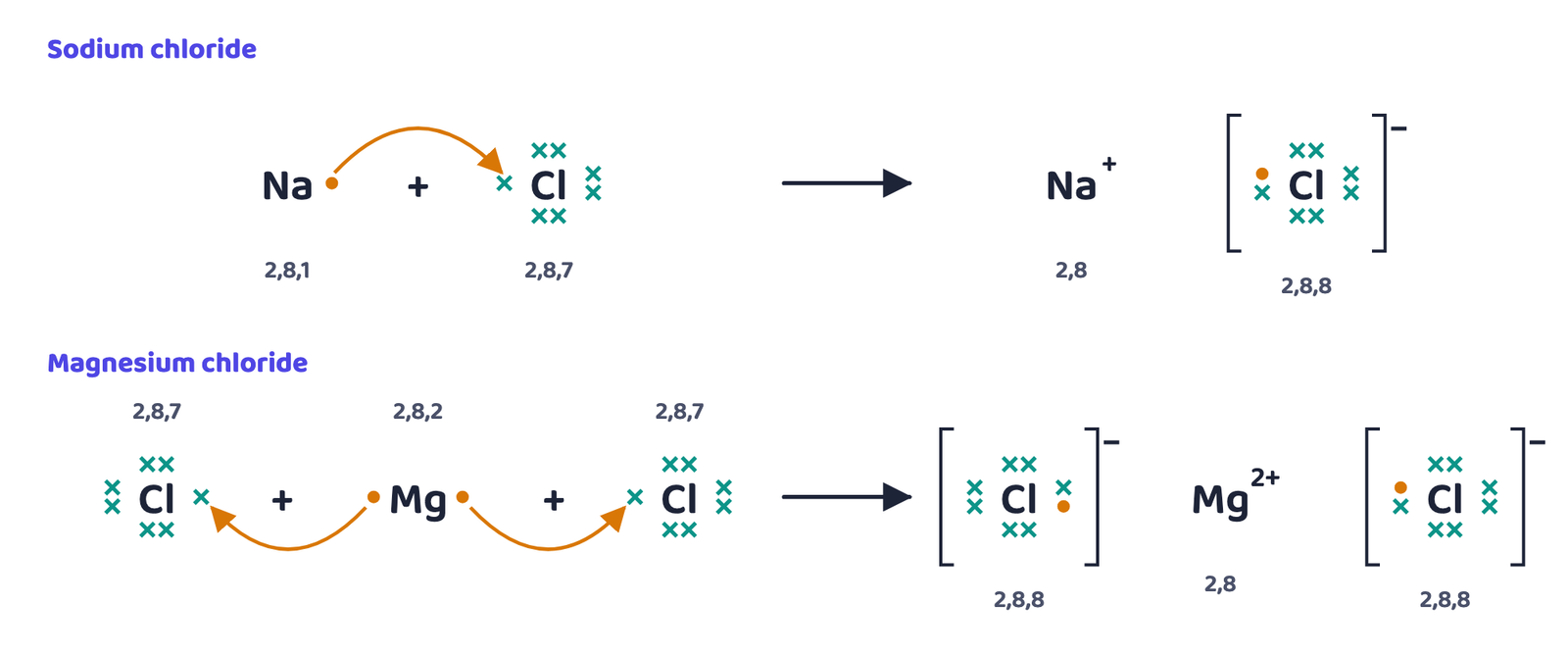
Sodium chloride is not found as molecules: it is an aggregate (a large cluster) of oppositely charged ions.
Magnesium chloride forms the same way, except magnesium has to give up two electrons (so it needs two chlorine atoms):
Sodium oxide and magnesium oxide form in exactly the same way. Oxygen (2,6) needs two more electrons, so it takes one from each of two sodium atoms, or both from one magnesium atom (this is the NCERT in-text question on electron-dot structures):

Compounds formed by the transfer of electrons from a metal to a non-metal are called ionic compounds or electrovalent compounds.
3.1 Properties of ionic compounds
Salts such as sodium chloride and potassium iodide are heated in a flame, and attempts are made to dissolve them in water, petrol and kerosene. Their solutions are then tested for electrical conductivity using a simple circuit with a battery and a bulb.
| Ionic compound | Melting point (K) | Boiling point (K) |
|---|---|---|
| NaCl | 1074 | 1686 |
| LiCl | 887 | 1600 |
| CaCl₂ | 1045 | 1900 |
| CaO | 2850 | 3120 |
| MgCl₂ | 981 | 1685 |
Melting points of ionic compounds (Table 3.4 data): CaO has the highest melting point. This is because both Ca²⁺ and O²⁻ carry a double charge, so the pull between them is the strongest of all the compounds in the table.
These experiments bring out four properties of ionic compounds:
Physical nature
Solid, somewhat hard (because of strong electrostatic attraction), but generally brittle: they break into pieces the moment pressure is applied
Melting and boiling points
Very high, because a great deal of energy is needed to break the strong inter-ionic force of attraction
Solubility
Soluble in water, insoluble in solvents such as kerosene and petrol
Electrical conductivity
No conduction in the solid state (the ions cannot move), but they conduct in the aqueous solution and molten state (the ions are then free to move)
4 Occurrence and Extraction of Metals
The earth’s crust is the main source of metals. Sea water, too, holds some soluble salts such as sodium chloride and magnesium chloride. Metallurgy is the name for the whole process covered in this section: extracting a metal from its ore and then refining it for use.
Mineral: an element or compound found naturally in the earth’s crust. Ore: a mineral from which a metal can be extracted profitably, because it contains enough of that metal.
4.1 Three classes of metals by reactivity
Low reactivity (around Cu, Ag, Au)
Found in the free state: gold, silver, platinum and copper. Copper and silver are also found as sulphide/oxide ores.
Medium reactivity (Zn, Fe, Pb)
Found in the earth’s crust mostly as oxides, sulphides or carbonates.
High reactivity (K, Na, Ca, Mg, Al)
So reactive that they are never found as free elements, always found combined in compounds.
4.2 Enrichment of ores
Mined ores come mixed with impurities such as soil and sand, called gangue. Before the metal is extracted, the gangue is removed by exploiting differences between the physical or chemical properties of the ore and the gangue.
4.3 Extraction of low-reactivity metals: heating alone
These metals are so unreactive that simply heating their ore in air, in two steps, is enough to obtain the metal. Cinnabar (HgS), the ore of mercury, is first heated in air to convert it into mercuric oxide (HgO); that oxide is then reduced to metallic mercury on further heating:
(mercuric oxide decomposes to give mercury)
Copper, found in nature as Cu₂S, follows the same two-step pattern: heating in air first gives copper(I) oxide, which then reacts further with the remaining sulphide to give the metal directly:
4.4 Extraction of medium-reactivity metals
These metals are usually found as sulphides or carbonates, which are first converted to oxides:
Roasting
- Heating a sulphide ore strongly in excess air
Calcination
- Heating a carbonate ore in limited air
Reduction is the removal of oxygen from a compound. A reducing agent is the substance that brings this about, by itself combining with the oxygen that is removed: carbon does exactly this when it turns a metal oxide back into the metal.
The metal oxide formed is then reduced with a reducing agent such as carbon:
Highly reactive metals (sodium, calcium, aluminium) are also used as reducing agents, because they can displace a less reactive metal from its compound. Here aluminium displaces manganese, another reactive metal, from manganese dioxide:
The thermit reaction: a highly exothermic displacement reaction between iron(III) oxide and aluminium, in which iron is obtained in the molten state. Used for joining railway tracks and machine parts.
4.5 Extraction of high-reactivity metals: electrolytic reduction
The metals at the very top of the reactivity series have a stronger affinity (chemical attraction) for oxygen than carbon does, so carbon cannot reduce them. They are obtained instead by electrolysis of their molten compounds:
Sodium, magnesium and calcium are obtained this way from their molten chlorides; aluminium, from the electrolytic reduction of aluminium oxide.
4.6 Refining of metals: electrolytic refining
The metal obtained after reduction is not completely pure. The most common purification method is:

The impure metal is made the anode, a thin strip of the pure metal is made the cathode, and a solution of the metal’s salt is used as the electrolyte. Soluble impurities pass into the solution. Many metals, including copper, zinc, tin, nickel, silver and gold, are refined this way.
5 Corrosion and Alloys
5.1 The conditions under which corrosion happens
Corrosion is the gradual eating away of a metal’s surface, caused by it reacting with substances around it such as air and moisture. Recall from Chapter 1: silver turns black in air (a layer of silver sulphide forms), copper develops a green coating (basic copper carbonate), and iron develops a brownish, flaky coating known as rust. All three are examples of corrosion.
Clean iron nails are placed in three test tubes, A, B and C. A holds plain water; B holds boiled distilled water (dissolved air removed) with a layer of oil on top; C holds dry air and anhydrous calcium chloride (which absorbs moisture). After a few days, only the nail in A has rusted.
Rusting needs both air (oxygen) and water to be present. Test tube A had both, which is why only that nail rusted.
5.2 Preventing corrosion
Painting
Keeps the surface from direct contact with air and water
Applying oil or grease
A common method for tools and machine parts
Galvanisation
Coating iron/steel with a thin layer of zinc
Chromium plating
Gives a shiny, rust-resistant surface
Anodising
Building up a thick protective oxide layer
Alloying
E.g. stainless steel, which does not rust at all
A galvanised object stays protected even if the zinc coating gets scratched, because zinc is more reactive than iron and corrodes first, in iron’s place.
5.3 Alloys
Alloy: a homogeneous (uniform throughout, with no separate layers) mixture of two or more metals, or of a metal and a non-metal. The pure metal is melted, other elements are mixed in fixed proportions, and the mixture is then cooled to room temperature.
Pure iron is very soft and stretches easily when heated. Adding about 0.05% carbon makes it hard and strong. Adding nickel and chromium gives stainless steel, which is hard and does not rust.
An alloy made with mercury is called an amalgam. An alloy’s electrical conductivity and melting point are generally lower than those of the pure metal.
| Alloy | Composition | Notable property |
|---|---|---|
| Brass | Copper + zinc | Poor conductor of electricity (unlike pure copper) |
| Bronze | Copper + tin | Poor conductor of electricity |
| Solder | Lead + tin | Very low melting point, used to weld electrical wires |
| Stainless steel | Iron + nickel + chromium | Hard, does not rust |
Pure gold (24 carat) is too soft to make jewellery from, so silver or copper is mixed in to harden it. Jewellery in India is typically 22 carat gold: 22 parts pure gold to 2 parts silver or copper.

A metal in its pure state is rarely of much use on its own: mix in even a small amount of another element and its properties change completely, and that single fact is the foundation of modern engineering.
This chapter in one line
- Can I name the seven physical properties of metals, and the four exceptions to classifying metals by physical properties alone, with examples?
- Can I write out the full reactivity series (K to Au) from memory?
- Can I explain how NaCl and MgCl₂ form, in terms of electron transfer?
- Can I explain the difference between roasting and calcination?
- Can I list both conditions needed for rusting, and the ways to prevent it?
- Physical properties: lustre, hardness, malleability, ductility, thermal/electrical conductivity, sonority, but mercury, iodine, allotropes of carbon and the alkali metals are four big exceptions
- Non-metals: opposite of metals physically (not malleable/ductile, poor conductors except graphite); form acidic or neutral oxides, never basic; do not displace hydrogen from acids, form hydrides instead
- Metal + oxygen → metal oxide (basic); amphoteric oxides (react with both acids and bases), e.g. Al₂O₃ and ZnO
- Metal + water: K, Na violent; Ca slower; Mg only with hot water; Al, Fe, Zn only with steam; Pb, Cu, Ag, Au never
- Metal + dilute acid → salt + H₂; order Mg > Al > Zn > Fe; copper does not react
- Reactivity series: K, Na, Ca, Mg, Al, Zn, Fe, Pb, [H], Cu, Hg, Ag, Au
- Ionic compounds: formed by electron transfer, do not conduct in the solid state but conduct well as solutions/melts, high melting and boiling points
- Extraction depends on reactivity: low reactivity = heating alone; medium = roasting/calcination then reduction with carbon; high = electrolytic reduction
- Rusting needs both air and water; prevention: paint, oil, grease, galvanisation, chromium plating, anodising, alloying
- Alloying changes a metal’s properties: remember brass, bronze, solder and stainless steel