
- How to plot any point in a plane using an ordered pair of numbers (x, y)
- How to tell which of the four quadrants a point lies in, just from the signs of its coordinates
- How to find the exact distance between any two points, using a theorem you already know
- How to find the midpoint of a segment, and use it to check if three points lie on one straight line
1The Coordinate Plane
A single number line can only locate a point along one direction: left-right. But a room, a city, or a computer screen is flat: to pin down an exact spot you need two pieces of information, not one. Those two numbers are what this chapter is about.
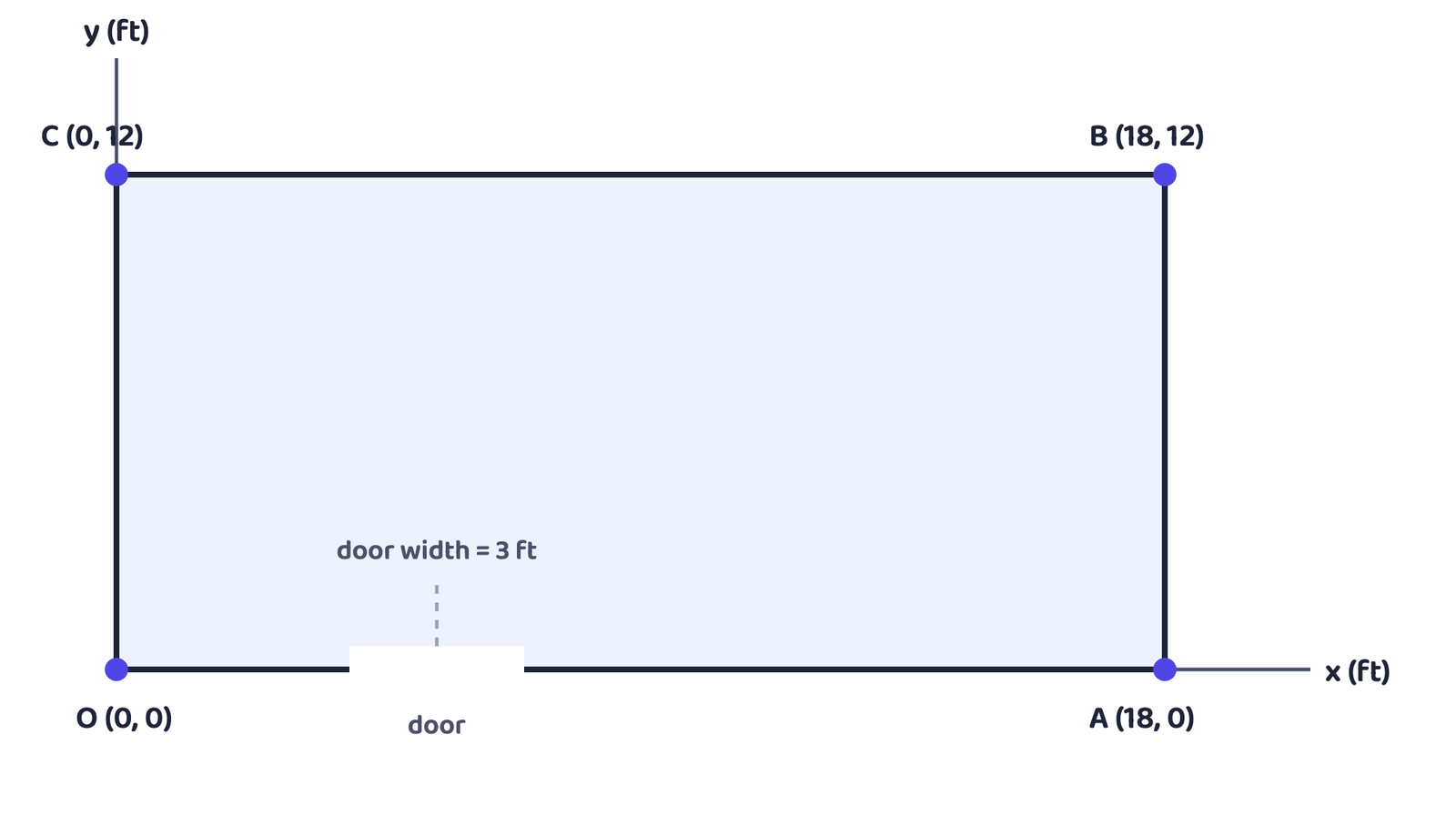
The coordinate axes are two number lines drawn perpendicular to each other: one horizontal, called the x-axis, and one vertical, called the y-axis. Their point of intersection is called the origin, written O, with coordinates (0, 0).
The plane containing the two axes is called the Cartesian plane, the coordinate plane, or the xy-plane. Distances to the right of O or above O are positive; distances to the left of O or below O are negative.
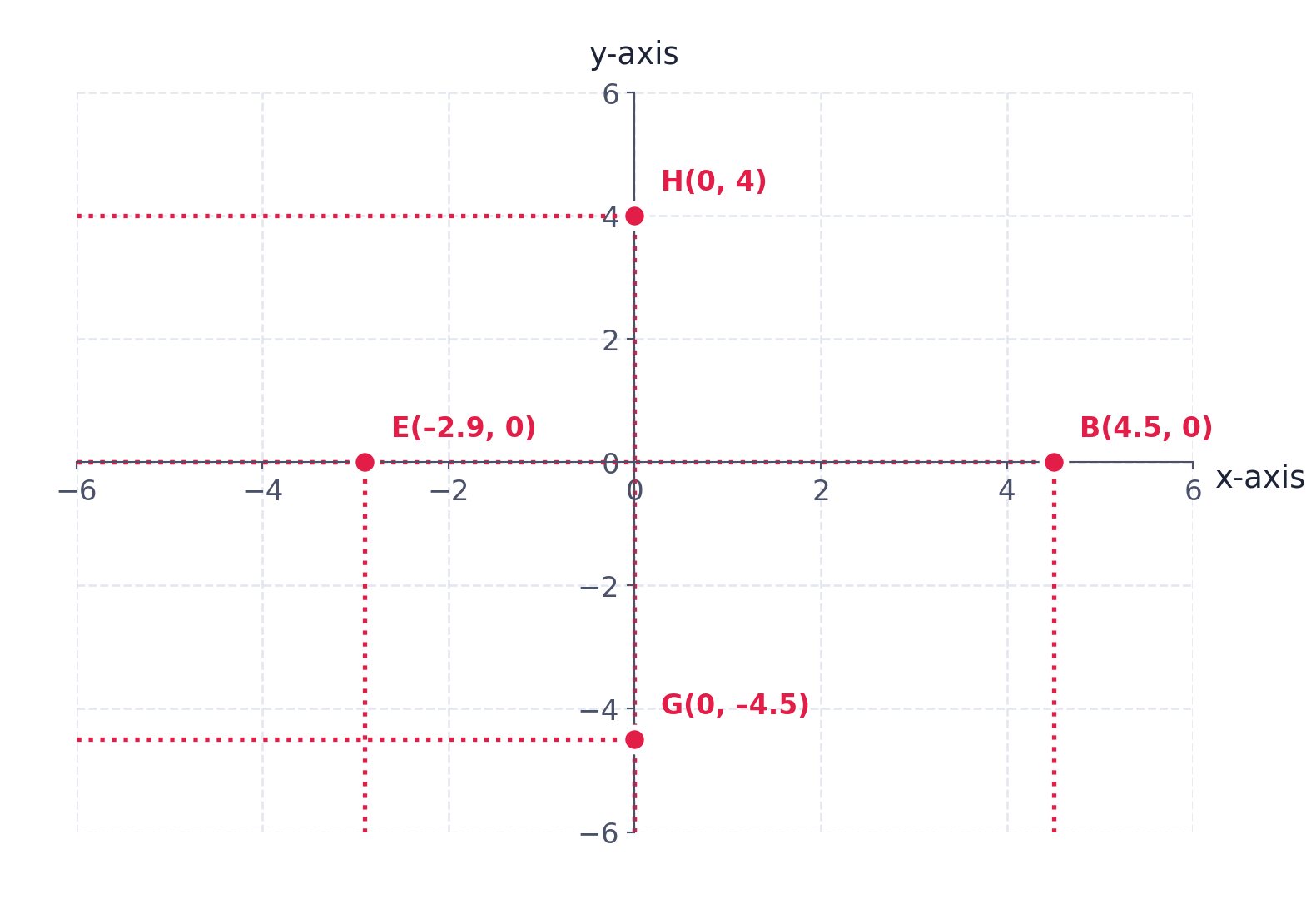
The coordinates of a point P are written as an ordered pair (x, y), where x is the distance of P from the y-axis (measured along the x-axis) and y is the distance of P from the x-axis (measured along the y-axis). x is called the x-coordinate (or abscissa) and y the y-coordinate (or ordinate).
(x, y) and (y, x) are not the same point unless x = y. Always write the x-coordinate first, students lose marks by swapping the order when reading a point off a graph.
Coordinate thinking is far older than Descartes. Cities in the Sindhu-Sarasvatī Civilisation were laid out on a precise North-South/East-West grid over 4,000 years ago. Āryabhaṭa (c. 499 CE) used coordinates to map the sky, and Brahmagupta (c. 628 CE) gave zero and negative numbers their algebraic meaning, without which the origin and the left/below-axis directions we use today would not exist. Fermat and Descartes only formalised the system in the 1600s, in Europe.
2Quadrants
The two axes divide the Cartesian plane into four regions, called quadrants, numbered I to IV starting from the top-right and going anticlockwise.
| Quadrant | x-coordinate | y-coordinate | Form | Example |
|---|---|---|---|---|
| I | positive | positive | (+, +) | P(3, 5) |
| II | negative | positive | (–, +) | Q(–5, 3) |
| III | negative | negative | (–, –) | R(–4, –4) |
| IV | positive | negative | (+, –) | S(3, –5) |
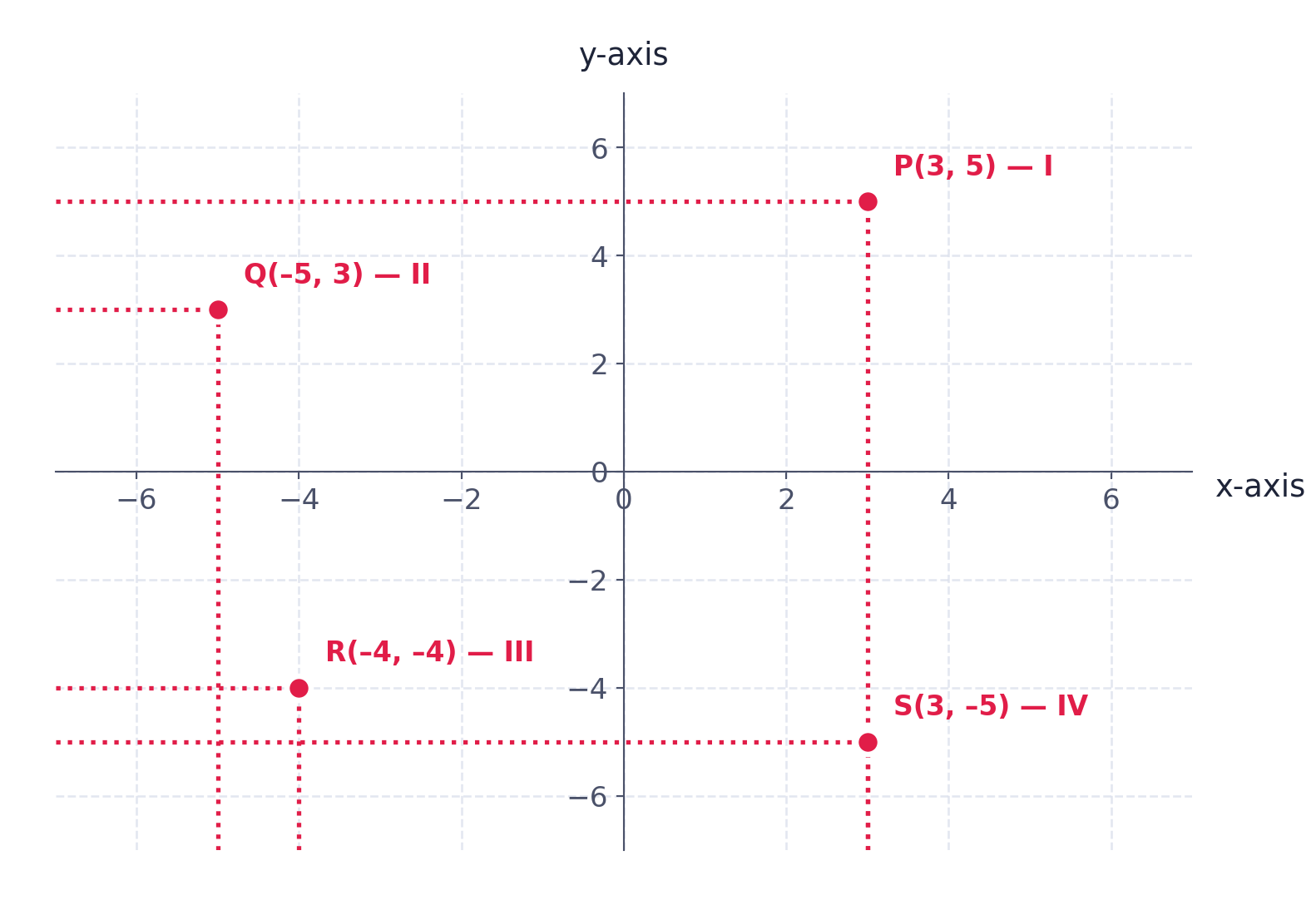
A point on the x-axis is always of the form (x, 0), and a point on the y-axis is always of the form (0, y). Neither one lies “in” any quadrant. This is a favourite 1-mark question.
Q. State the quadrant (or axis) for: A(–2, 7), B(0, –6), C(8, –1), D(–3, –3).
A. A → Quadrant II (–, +) · B → on the y-axis (x = 0) · C → Quadrant IV (+, –) · D → Quadrant III (–, –)
3Distance Between Two Points
If two points lie on the same axis, or on a line parallel to an axis, finding the distance between them is simple subtraction.
But what if the segment joining two points is slanting, not parallel to either axis? Look at points A(3, 4) and D(7, 1). Drop a helper point C(3, 1): now AC is vertical, CD is horizontal, and AD is the hypotenuse of a right triangle.
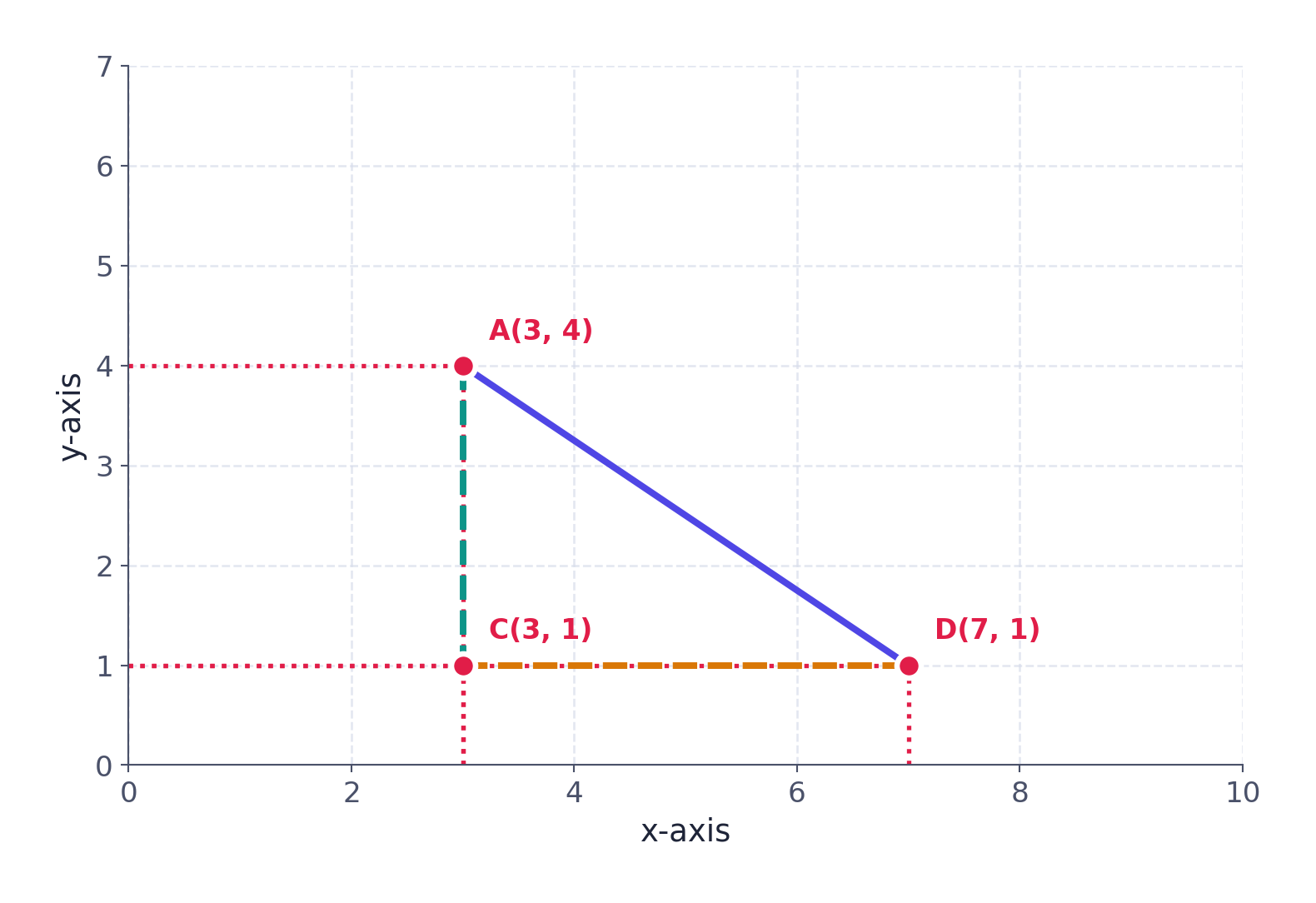
Repeating this for any two points and gives the general distance formula, and it makes no difference whether the coordinates are positive or negative, since we are only measuring lengths.
…(1)
Given
Points M(–3, 6) and N(5, 0)
Find
Distance MN
units
Reflecting a figure in an axis flips the signs of one coordinate but never changes any of its side lengths. The distance formula gives the same answer before and after, because it only ever uses squares of differences.
4Midpoint, Collinearity and Circles
The distance formula is the one tool this whole chapter is built on: the next three ideas are all applications of it.
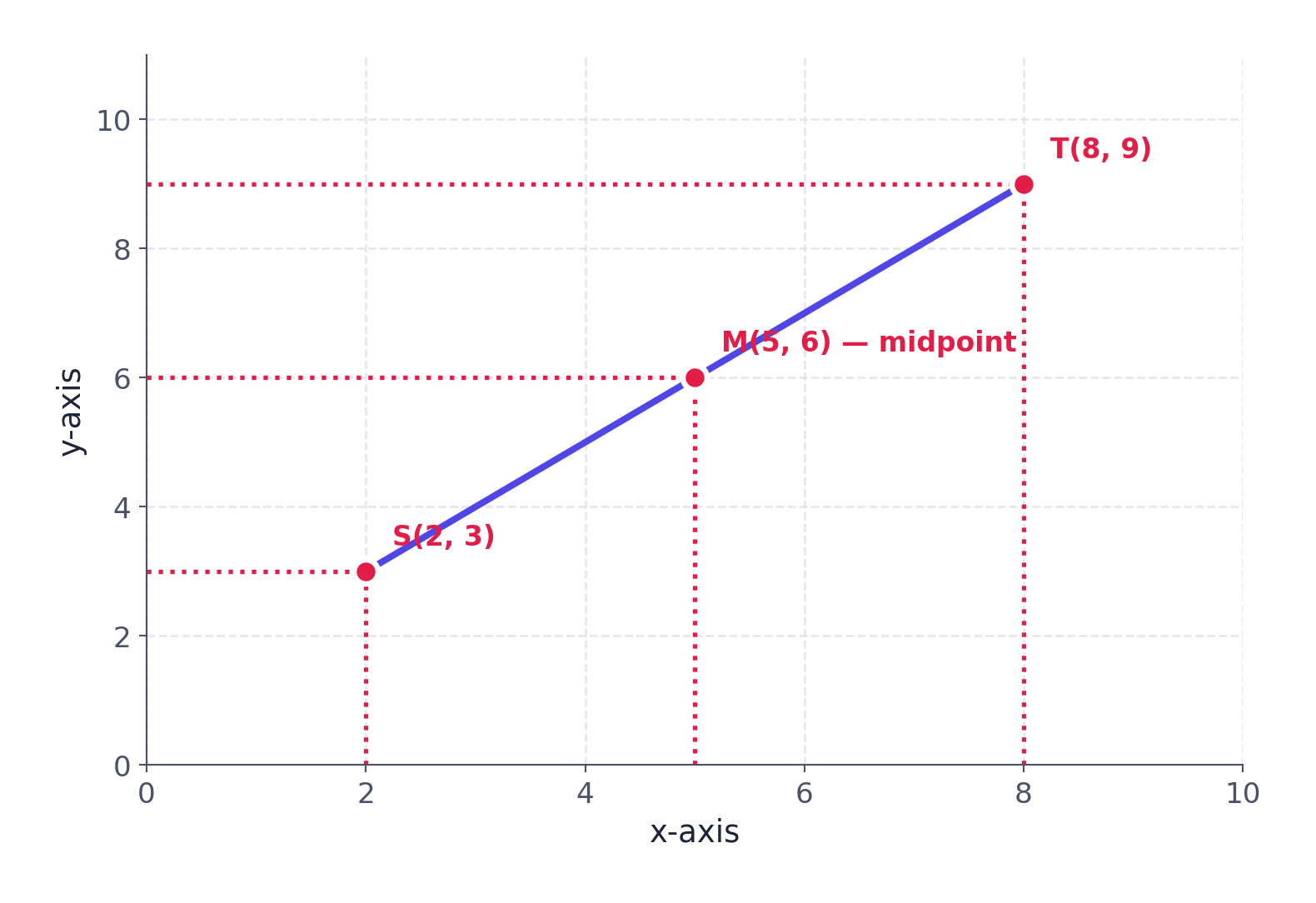
Given
M(–7, 1) is the midpoint of A(3, –4) and B(x, y)
Find
Coordinates of B
and . So B
Given
A(4, 7) and B(16, –2)
Find
Trisection points P (near A) and Q (near B)
Three points A, B, C (with B between A and C) are collinear, meaning they lie on one straight line, exactly when . Find all three distances with the distance formula and check the sum. No plotting needed.
Q. Are M(–3, –4), A(0, 0) and G(6, 8) collinear?
, ,
Since , the points are collinear.
A circle is the set of all points at a fixed distance (the radius) from a fixed centre, so the distance formula also tells us whether a point lies on, inside, or outside a circle.
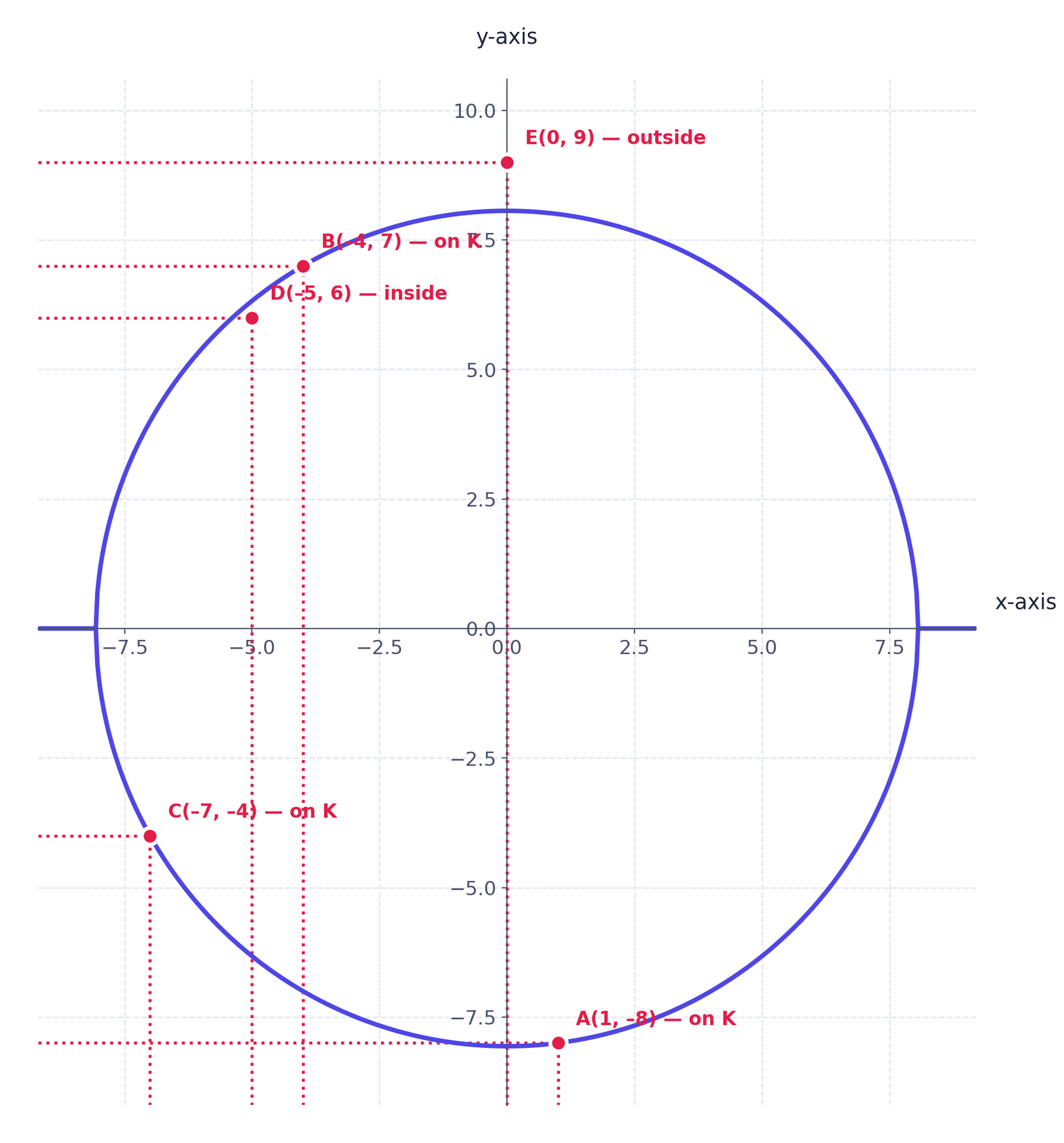
Q. Show A(1, –8), B(–4, 7), C(–7, –4) lie on a circle centred at O(0, 0), and find its radius.
, ,
All three distances from O are equal, so A, B, C lie on one circle of radius units.
Inside → distance < radius. On → distance = radius. Outside → distance > radius.
Just compare the point’s distance from the centre with the radius, and the three cases follow directly.
Every idea in this chapter, quadrants, distance, midpoint, collinearity, circles, comes from just one thing: two perpendicular number lines and the Baudhāyana–Pythagoras theorem.
the single idea to carry out of this chapter
- Can I plot a point and name its quadrant instantly from its signs?
- Can I write the distance formula from memory and apply it without a diagram?
- Can I find a midpoint, and use it to check three points are collinear?
- Can I tell whether a point lies inside, on, or outside a given circle?
- Coordinates (x, y): x from the y-axis, y from the x-axis. (x, 0) is on the x-axis; (0, y) is on the y-axis
- Quadrants I–IV: (+,+), (–,+), (–,–), (+,–)
- Distance ; on a line parallel to an axis it is just difference
- Midpoint
- A, B, C are collinear iff (B between A and C)
- A point is on a circle of radius r centred at O iff its distance from O equals r
- 1 markWhat are the coordinates of the origin?
- 1 markIn which quadrant does the point (–6, –2) lie?
- 1 markWrite the coordinates of a point that lies on the y-axis, 5 units below the origin.
- 2 marksFind the distance between P(–5, 7) and Q(–1, 4).
- 2 marksFind the midpoint of the segment joining (–8, 7) and (6, –3).
- 3 marksPoint W has x-coordinate –5. H lies on the line through W parallel to the y-axis. Which quadrants can H lie in? Explain.
- 3 marksCheck whether R(–5, –1), B(–2, –5) and C(4, –12) are collinear.
- 3 marksPlot A(2, 1), B(–1, 2), C(–2, –1), D(1, –2). Show ABCD is a square and find its area.
- 4 marksGiven D(–5, 6) and E(0, 9), and circle K of radius √65 centred at the origin, state whether each point lies inside, on, or outside K. Show your working.
- 5 marksThe midpoints of the sides of triangle ABC are D(5, 1), E(6, 5) and F(0, 3). Find the coordinates of A, B and C.
- 3 marksFind the trisection points of the segment joining A(2, –2) and B(–7, 4).
- 3 marksFor quadrilateral RAMP with R(3, 0), A(0, –2), M(–5, –2), P(–5, 2): name two sides that are perpendicular to each other, one side parallel to an axis, and a pair of points that are mirror images of each other in an axis.
- 4 marksA computer screen is 800 px wide and 600 px high (origin at the bottom-left corner). A circular icon of radius 80 px has centre A(100, 150); another of radius 100 px has centre B(250, 230). Does any part of either circle lie outside the screen? Do the two circles intersect?
- 1 markThe point (0, –7) lies on:
(a) the x-axis(b) the y-axis(c) Quadrant III(d) Quadrant IV - 1 markIf x ≠ y, then (x, y) and (y, x):
(a) are always the same point(b) are never the same point(c) lie in the same quadrant always(d) both lie on an axis - 1 markThe distance of the point (–8, 6) from the origin is:
(a) 2(b) 10(c) 14(d) 100
Reason (R): Every point on the x-axis has y-coordinate 0.
- 1 markWhat real-world idea does this intersection-naming system represent?
- 1 markUsing 1 cm = 200 m, what distance on paper represents the real distance between two streets?
- 2 marksTwo friends live at intersections (2, 5) and (2, 9). What is the actual distance between their homes?