1 The Concept of Force
A force can start something moving, change its speed, change its direction, or change its shape. A ball at rest starts rolling when you kick it, a cricket bat changes the direction of a moving ball, and your fingers squeeze a lemon out of shape.
Every time a force is described, its direction comes with it: friction acts opposite to motion, like poles of a magnet repel, unlike charges attract, gravity pulls objects towards the Earth, buoyant force pushes upward on something floating. That is because force needs a direction stated alongside its size, exactly like the displacement, velocity and acceleration you met in Chapter 4.
Force is a push or a pull with both a magnitude and a direction. Its SI unit is the newton (N).
Written out, the unit is newton with a small “n” (it is named after a person), but its symbol is a capital N. This exact detail is a favourite one-mark trap.
A spring balance measures the magnitude of a force directly, not only weight: pull on its free end, and it reads the force with which you are pulling.
The smallest force a human can directly feel is around a millinewton ( N), like a light touch. In specialised experiments, scientists have measured forces as tiny as a yoctonewton ( N).
2 Balanced and Unbalanced Forces
Real objects almost always have more than one force acting on them at once. A box being pushed also feels friction; a ball floating on water feels gravity pulling it down and buoyant force pushing it up.
Two forces equal in magnitude but opposite in direction are balanced forces: their combined effect on motion is zero. If the forces on an object are unequal, they are unbalanced, and a non-zero net force acts on it.
Balanced forces
- Equal tug of war teams: the rope does not move
- Net force = 0
- No change in motion
Unbalanced forces
- One team pulls harder: the rope moves their way
- Net force = difference of the two, direction of the larger one
- Motion changes
Q. Forces of 10 N and 6 N act on a block. Find the net force when they act (a) in the same direction, (b) in opposite directions.
(a) Net force 16 N, in that direction.
(b) Net force 4 N, in the direction of the 10 N force.
An object’s motion depends only on the net force, no matter how many individual forces are actually acting on it. Add forces in the same direction; subtract forces in opposite directions.
3 The Force of Friction
Friction is the force between two surfaces in contact that opposes the relative motion between them. A box only starts moving once your push exceeds the friction resisting it.
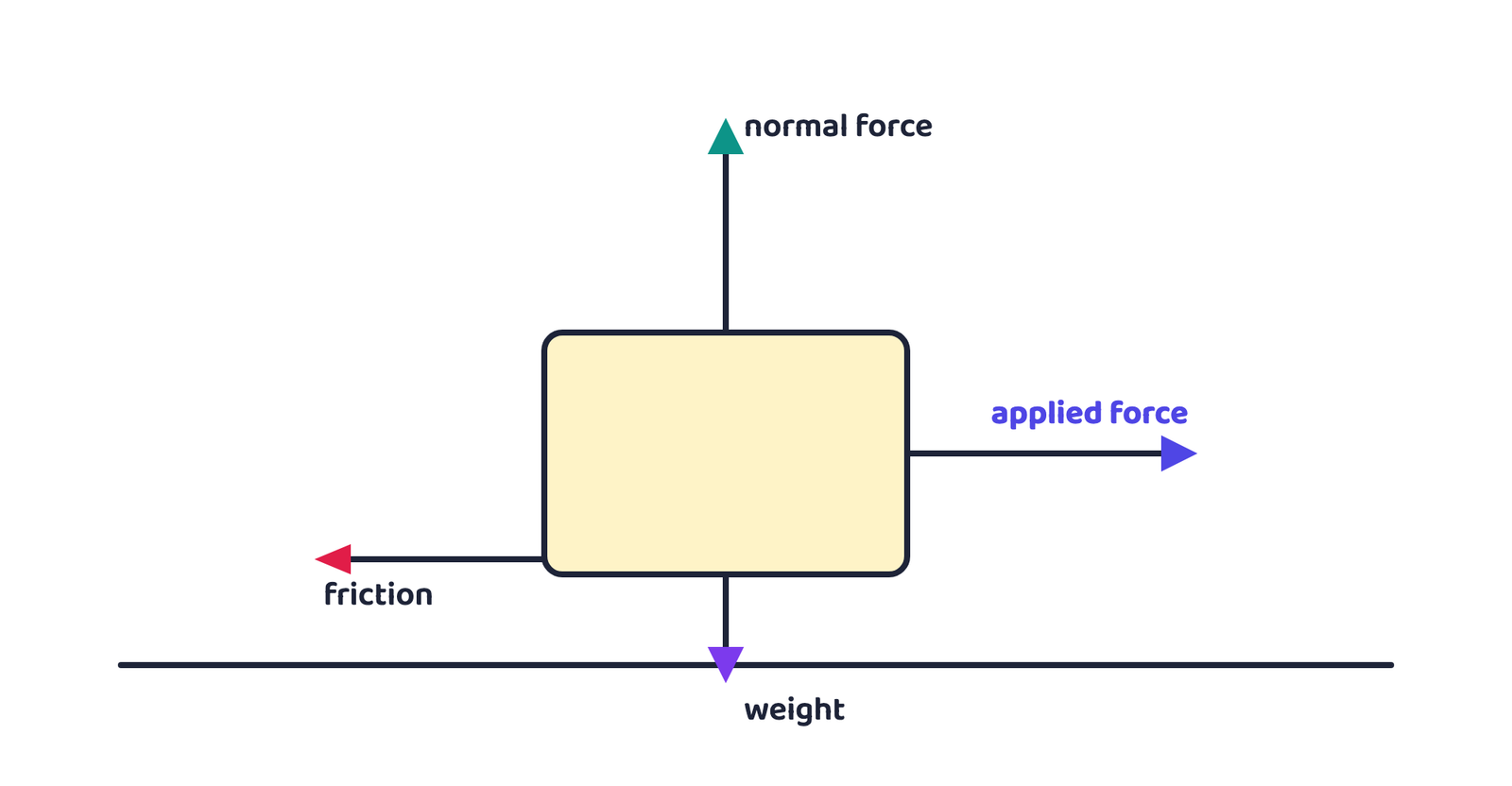
The normal force is the surface pushing back, perpendicular to itself. It always balances the object’s weight, whether the box is moving or not. Those two never cause motion by themselves.
Once a moving box stops being pushed, friction alone acts on it and slows it down until it stops. That is why a bicycle rolls to a stop once you quit pedalling: you have to keep applying a force only to counter friction, not to “keep something moving” in some deeper sense.
Two classic activities confirm this. Sliding coins across different surfaces (wood, laminate, polished tile) shows the smoothest surface lets the coins travel farthest, because it has the least friction. Pulling a block with a spring balance and reading the force just as it starts to move gives a direct measurement of the friction: a smaller reading means less friction.
Galileo Galilei argued in the 17th century, through thought experiments, that a body moving on a frictionless horizontal surface would keep moving forever if nothing stopped it. Before that, people wrongly believed a force was always needed just to keep something moving. Isaac Newton built on this with the word inertia and published his three laws of motion in 1687.
4 Newton’s First Law of Motion
Newton’s first law: an object at rest remains at rest, and an object in motion continues moving with constant velocity, unless a net force acts on it.
If the net force on an object is zero, its acceleration is zero. “Constant velocity” means neither the magnitude nor the direction of the velocity changes. An object at rest is simply the special case where that constant velocity is zero.
Q. A person pushes a moving box forward with a force exactly equal to the friction acting on it. Will the box keep moving or stop?
The two forces are equal and opposite, so they balance: net force . By Newton’s first law, the box continues moving at constant velocity.
✓ Zero net force means
- Object stays at rest, if it was at rest
- Object keeps its exact velocity, if it was moving
- Position-time graph: straight line (flat if at rest, sloped if moving)
✗ Zero net force never means
- The object is accelerating
- The object’s speed is changing
- The object’s direction is changing
5 Newton’s Second Law of Motion
A force produces acceleration. But exactly how are force, mass and acceleration related? Two everyday observations point the way: pushing something gently gives it a small acceleration, pushing it hard gives it a large one; and for the same push, a lighter object speeds up faster than a heavier one.
Newton’s second law: when a net force acts on an object, it accelerates in the direction of that force. The acceleration is directly proportional to the net force and inversely proportional to the object’s mass.
One newton is the force that gives a 1 kg object an acceleration of : .
Weight is just this law applied to gravity: , where near the Earth’s surface (often rounded to for quick estimates). Because does not depend on mass, every object near the Earth’s surface falls with the same acceleration.
A 100 g mass in your palm pushes up on your hand with about 1 N.
That is a useful, physical feel for exactly how strong one newton is.
Q. A weightlifter holds a 30 kg barbell steady. What force must she apply?
294 N, applied upward to balance the barbell’s weight.
Given
25 kg block, friction 50 N, pushed with (i) 50 N, (ii) 55 N, for 2 s
To find
Displacement in each case
(i) Applied force = friction, so net force . The block stays at rest.
(ii) Net force . Acceleration .
Using : 0.4 m
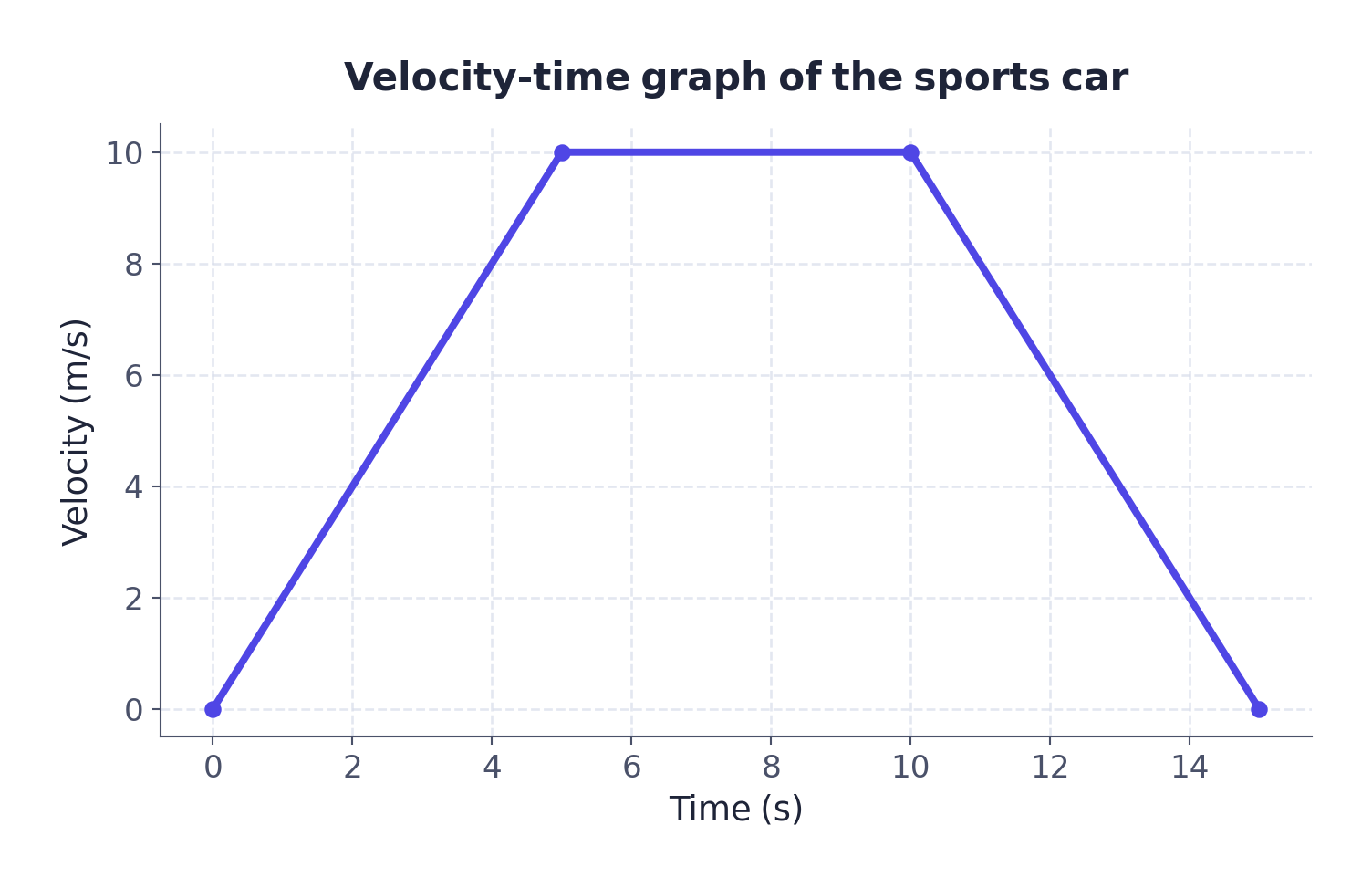
Q. Using the graph above, find the force on the 1500 kg car during 0–5 s, 5–10 s and 10–15 s.
0–5 s: , so 3000 N forward
5–10 s: velocity constant, , so 0 N
10–15 s: , so 3000 N backward
Increasing the time over which a velocity change happens reduces the acceleration, and so reduces the force needed. This is exactly why a cricket fielder pulls their hands back while catching a fast ball, why airbags cushion a crash, and why a landing mat softens a high jump. The same idea in reverse explains why a coconut cracks: it stops in a very short time, so the ground exerts a very large force on it.
Newton’s second law is more completely written in terms of momentum (mass × velocity): the net force equals the rate of change of momentum. Written this way, the law still works even when an object’s mass itself is changing, such as a rocket burning fuel.
6 Newton’s Third Law of Motion
Kick a ball and you feel the ball push back on your foot. Every force involves two objects, and both are affected.
Newton’s third law: whenever one object exerts a force on a second object, the second object exerts an equal and opposite force on the first, at the same instant.
Action-reaction pairs act on two different objects, so they never cancel each other out. Two forces that balance each other, by contrast, act on the same object. Confusing these two ideas is the single most common mistake with this law.
| Everyday action | The third-law pair |
|---|---|
| Walking or running | Foot pushes ground backward; ground (via friction) pushes foot forward |
| Rowing a canoe | Paddle pushes water backward; water pushes paddle and canoe forward |
| Climbing a coconut tree | Legs push the trunk down; friction pushes the climber up |
| A balloon released while inflated | Balloon pushes air out; air pushes the balloon in the opposite direction |
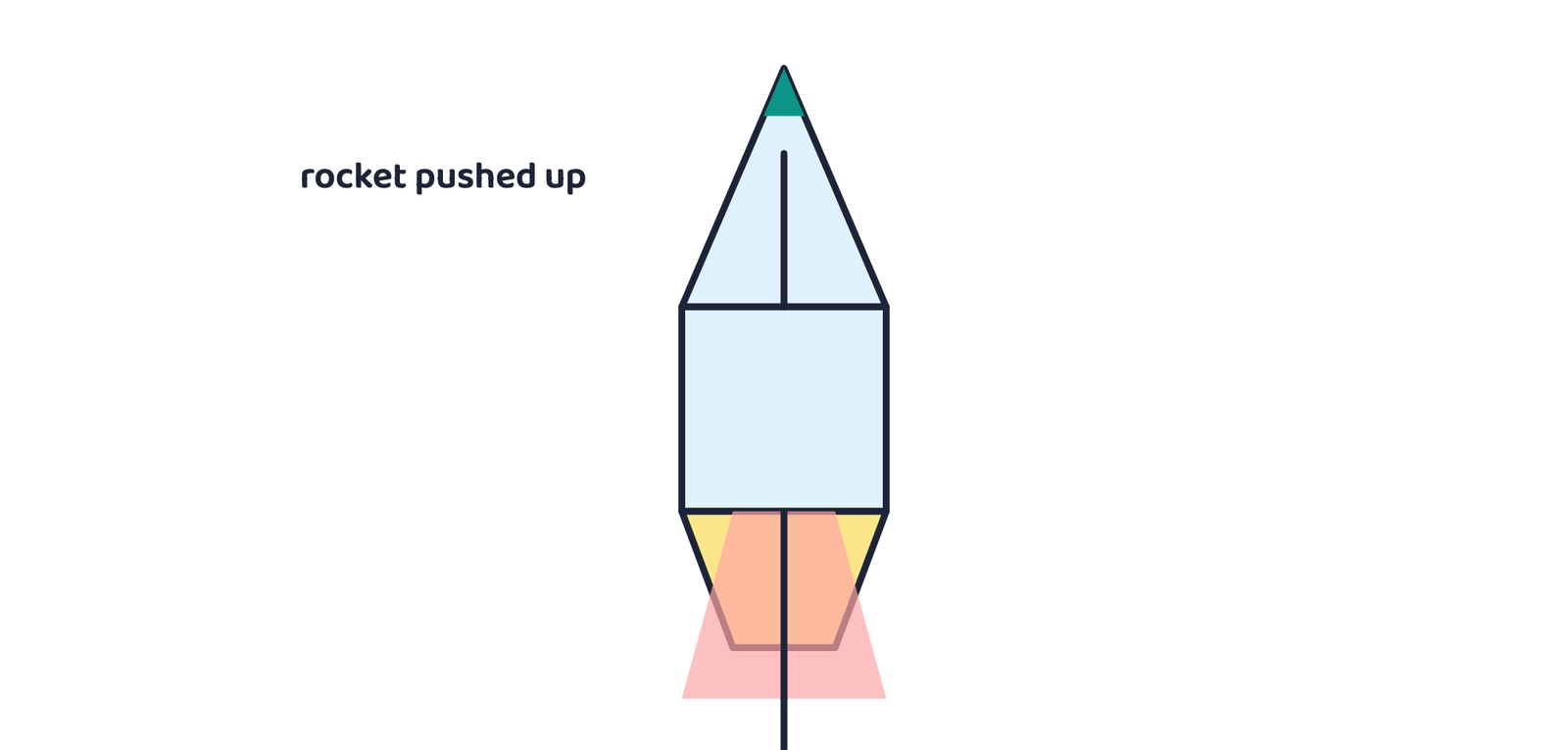
| Rocket launch | Engine expels gas down; gas pushes the rocket up |
Friction is usually described as opposing motion, but while walking it is friction, acting forward on your foot, that actually pushes you along. Grooves on shoe soles and treads on tyres exist to increase this useful friction, which is exactly why wet, polished floors and icy or snowy roads are so hard to walk or drive on.
Chandrayaan-3’s Vikram lander used this same third-law thrust, fired in the direction of motion, to slow itself down for a soft landing near the Moon’s south pole.
Q. The Earth and a falling fruit pull on each other with equal gravitational forces. Why does only the fruit seem to move?
From : the force is the same for both, but the Earth’s mass is enormously larger than the fruit’s, so the Earth’s acceleration is too small to notice, while the fruit’s is not.
Q. A 0.1 kg bullet fired from a 5 kg gun feels a force of 2 N. Find the acceleration of each.
By the third law, the gun also feels 2 N (recoil).
Bullet: 20 m/s² Gun: 0.4 m/s²
Equal forces, very different accelerations, because the masses are different. Equal action-reaction forces never guarantee equal accelerations.
7 Forces on a System of Objects
Two boxes of mass and sit on a frictionless surface, joined by a string, with a force pulling box 1. The string pulls box 2 forward with a tension , and by the third law, box 2 pulls back on box 1 with the same tension.
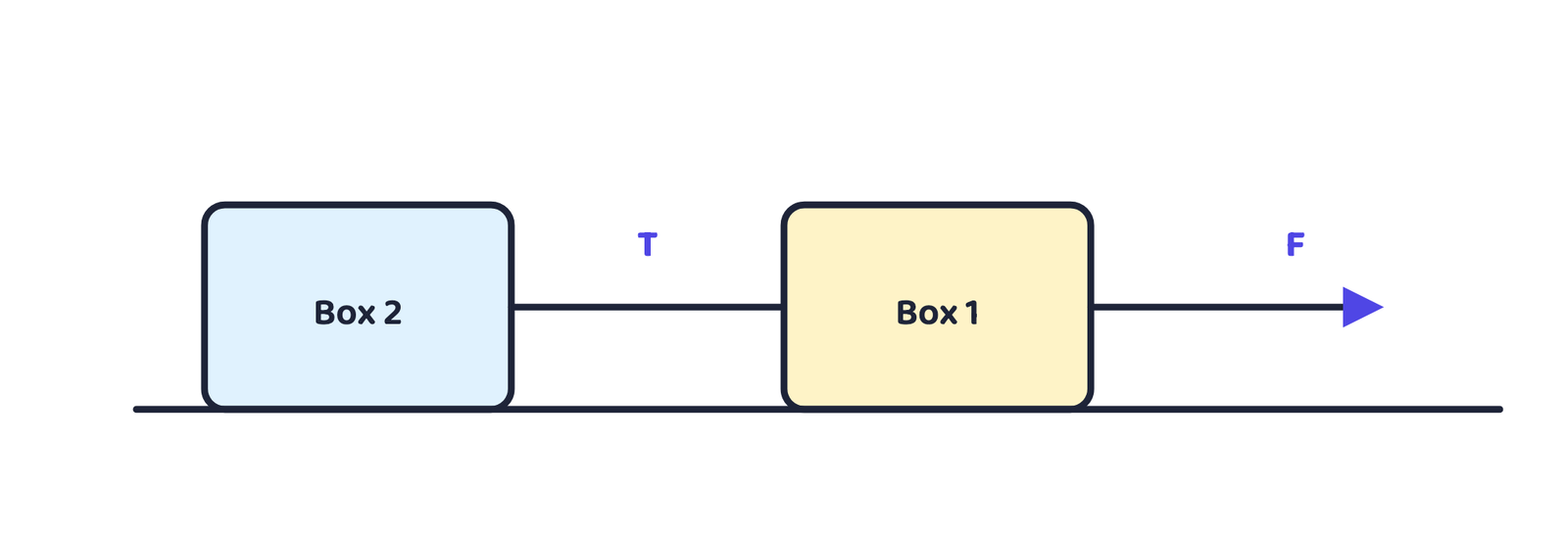
Rather than analysing each box separately, treat both boxes as one system. Internal forces (the tension, since it appears as an equal-and-opposite pair inside the system) cancel out, leaving only the external force :
This “treat it as one object” trick works for a person’s own body too: arms and legs move in complicated ways while walking, but the body’s overall motion can still be studied as a single object. Science often gets simpler once you stop tracking every part and look at the whole system instead.
- A force can start, stop, speed up, slow down, redirect, or reshape an object; its SI unit is the newton (N).
- Balanced forces produce no change in motion; only an unbalanced net force does.
- Friction opposes relative motion between surfaces and depends on the nature of the surfaces.
- Newton’s first law: no net force means no change in velocity (inertia).
- Newton’s second law: ; a bigger force gives more acceleration, a bigger mass gives less.
- Weight is , with near Earth, independent of mass.
- Newton’s third law: every force has an equal, opposite reaction acting on a different object, so the pair never cancels.
- Friction can push you forward (walking, rowing) just as easily as it can oppose you.
- Equal action-reaction forces can still produce very different accelerations if the masses differ.
- Connected objects can be treated as one system, using only the external forces on it.
- 1 markState Newton’s first law of motion.
- 1 markWhat is the SI unit of force, and what is its symbol?
- 1 markDefine balanced forces.
- 1 markWhat is tension in a connecting string?
- 1 markWrite the formula relating force, mass and acceleration.
- 1 markWhat is the value of near the Earth’s surface?
- 1 markDo action-reaction forces act on the same object or different objects?
- 1 markDefine momentum.
- 2 marksA table is pushed with a horizontal force F and moves at constant velocity. What is the frictional force exerted by the floor?
- 3 marksWhy does a fielder pull their hands back while catching a fast cricket ball? Explain using Newton’s second law.
- 2 marksA toy car of mass 100 g moves with a constant velocity of 0.5 m/s. What is the net force acting on it?
- 3 marksExplain, using Newton’s third law, why it is difficult to walk on a wet, polished floor.
- 3 marksA sailor jumps forward from a small stationary boat onto the shore. Will the boat move, and if so, in which direction? Explain.
- 2 marksWhy is a cushioned mat placed for athletes in a high jump event?
- 3 marksThe Earth and a fruit exert equal gravitational forces on each other. Explain why the fruit falls but the Earth does not appear to move.
- 3 marksTwo blocks P and Q lie on a smooth surface. Forces of 4 N and 5 N act in opposite directions on P; Q moves at constant velocity with no other force on it. Does either block experience a net force? Explain.
- 2 marksWhy does a moving bicycle eventually stop when you stop pedalling?
- 3 marksA 0.1 kg bullet is fired from a 5 kg gun with a force of 2 N. Find the initial accelerations of the bullet and the gun.
- 5 marksA 25 kg block is pushed on a horizontal floor where the maximum friction is 50 N. Find its displacement in 2 s when pushed with (i) 50 N, (ii) 55 N.
- 5 marksA bullet of mass 50 g moving at 100 m/s enters a wooden block and stops after penetrating 50 cm. Estimate the stopping force, assuming constant acceleration.
- 5 marksState and explain Newton’s three laws of motion with one everyday example for each.
- 5 marksTwo boxes of mass 4 kg and 6 kg are connected by a string on a frictionless surface. A force of 20 N pulls the 6 kg box. Find the acceleration of the system and the tension in the string.
- 5 marksExplain how a rocket lifts off the ground, using Newton’s third law. Why must the upward force exceed the rocket’s weight?
- 1 markWhat is the acceleration of the car between 5 s and 10 s?
- 2 marksFind the force acting on the car between 0 s and 5 s.
- 2 marksFind the force acting on the car between 10 s and 15 s, and state its direction.
- 1 markIf the net force on a moving object is zero, the object:
(a) stops immediately(b) continues at constant velocity(c) accelerates(d) reverses direction - 1 markThe SI unit of force is:
(a) kilogram(b) newton(c) joule(d) pascal - 1 markNewton’s third law pairs of forces:
(a) act on the same object and cancel(b) act on different objects and do not cancel(c) are never equal in magnitude(d) only apply to contact forces - 1 markOne newton equals:
(a) 1 kg × 1 m/s(b) 1 kg × 1 m/s²(c) 1 g × 1 m/s²(d) 1 kg/m/s² - 1 markWhile walking, the force that pushes you forward is:
(a) gravity(b) the normal force(c) friction(d) air resistance - 1 markTwo boxes of mass 2 kg and 3 kg, connected by a string, are pulled by a 10 N force on a frictionless surface. The system’s acceleration is:
(a) 1 m/s²(b) 2 m/s²(c) 3.3 m/s²(d) 5 m/s² - 1 markThe acceleration due to gravity, g:
(a) depends on the object’s mass(b) does not depend on the object’s mass(c) is always 10 m/s² exactly(d) has no direction
Choose: (a) both A and R true, R explains A; (b) both true, R does not explain A; (c) A true, R false; (d) A false, R true.
Reason (R): The gas expelled downward pushes the rocket upward with an equal and opposite force, which exceeds the rocket’s weight.
Reason (R): The Earth experiences no gravitational force from the fruit.
Reason (R): The force on each, by Newton’s third law, is equal in magnitude.