1 Law of Conservation of Mass
Dissolve salt in water, and the total mass of the solution exactly equals the mass of the salt plus the mass of the water: a physical change never changes total mass. Does a chemical change behave the same way?
Mix vinegar and baking soda in an open flask, and the reading on a balance seems to drop, because the carbon dioxide gas produced simply escapes into the air. Repeat it in a closed balloon-sealed flask, so no gas can leave, and the reading before and after match exactly.
The Law of Conservation of Mass, proposed by Antoine Lavoisier in 1789: mass is neither created nor destroyed in a chemical reaction, so the total mass of the reactants equals the total mass of the products.
If a mass check on an open system looks “wrong”, check first whether a gas escaped. That single question resolves most conservation-of-mass puzzles in the exam.
Given
4.0 g calcium carbonate + 2.92 g hydrochloric acid → 1.76 g CO₂ + 0.72 g water + 4.44 g calcium chloride
To find
Whether the Law of Conservation of Mass holds
Mass of reactants g
Mass of products g
Reactants = Products, so the law is obeyed.
Q. 12 g of carbon reacts fully with oxygen to give 44 g of carbon dioxide. How much forms from 2.4 g of carbon?
8.8 g of
2 Law of Constant Proportions
The Law of Constant Proportions (Proust’s Law): in any compound, the elements are always combined in the same fixed ratio by mass, no matter what its source is.
Purified water from a river, a borewell or the ocean always contains hydrogen and oxygen in a mass ratio of exactly 1:8. Decompose 9 g of water from anywhere, and you always get 1 g of hydrogen and 8 g of oxygen.
Q. Sodium chloride contains sodium and chlorine in a mass ratio of 23:35.5. How much chlorine is needed to react fully with 46 g of sodium?
71 g of chlorine
Cinnabar (called hingula in India), a red pigment used since ancient times, is roughly 86.22% mercury and 13.78% sulfur by mass. Many ancient civilisations independently discovered that heating cinnabar releases these two elements in exactly this ratio, and that grinding mercury and sulfur together in the same ratio re-forms cinnabar.
3 Dalton’s Atomic Theory
Both laws above are explained by one simple idea: chemical reactions only rearrange atoms; they never create, destroy or transform them.
Dalton’s postulates (1808): matter is made of indivisible atoms; atoms of one element are identical in mass and properties, atoms of different elements differ; atoms combine in simple whole-number ratios to form compounds; the relative number and kind of atoms in a compound stays constant.
Constant proportions follows directly from “atoms combine in whole-number ratios”: since one water molecule is always 2 hydrogen atoms plus 1 oxygen atom, the mass ratio is fixed by the atoms’ own masses, never by how the water was made.
4 How Atoms Combine
A molecule is an electrically neutral group of two or more atoms that can exist on its own and shows every property of that substance.
An atom with a full octet, like helium, is already stable and stays as a single atom. An atom short of a full octet becomes stable by sharing electrons (a covalent bond) or transferring them (an ionic bond). Either way, the combined arrangement ends up at lower energy, and lower energy means more stable.
4.1 Covalent bonds: sharing electrons
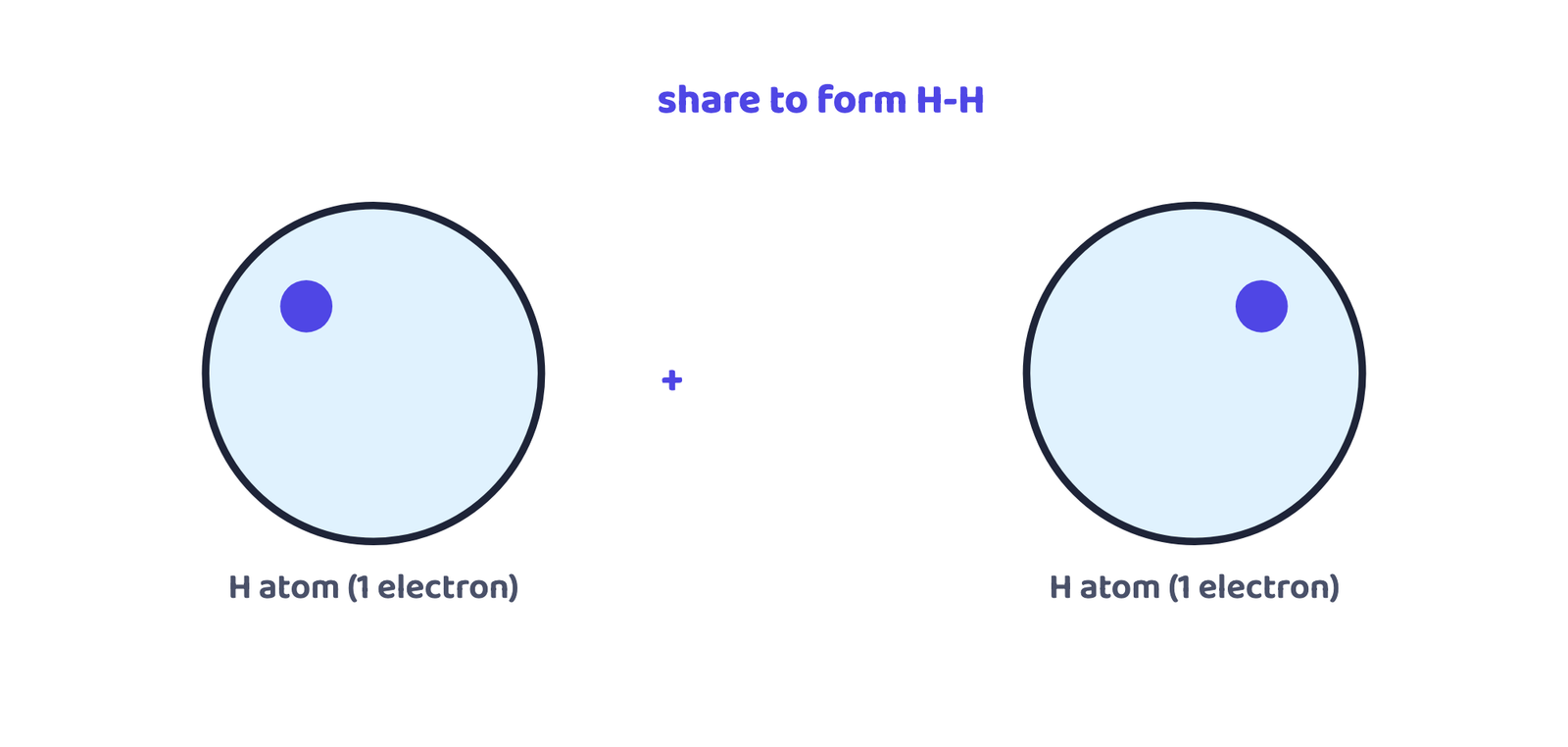
| Molecule | Valence electrons needed | Electrons shared | Bond type | Written as |
|---|---|---|---|---|
| 1 each | 1 pair | Single | H-H | |
| 1 each | 1 pair | Single | Cl-Cl | |
| 2 each | 2 pairs | Double | O=O | |
| H needs 1, Cl needs 1 | 1 pair | Single | H-Cl | |
| O needs 2, each H needs 1 | 2 pairs (with 2 H atoms) | 2 single bonds | H-O-H |
Chlorine has 7 valence electrons, needs just 1 more; oxygen has 6, needs 2. Oxygen’s two needs are met by sharing with two separate hydrogen atoms, each contributing one electron, which is exactly why water is and not .
Naming covalent compounds
The first element keeps its normal name; the second ends in -ide. A prefix states how many atoms of each element are present: mono- (1), di- (2), tri- (3), tetra- (4), penta- (5), hexa- (6). “Mono-” is dropped for the first element, but kept for the second.
| Formula | Name |
|---|---|
| CO | Carbon monoxide |
| Carbon dioxide | |
| Carbon disulfide | |
| Phosphorus trichloride | |
| Sulfur hexafluoride | |
| Dinitrogen tetroxide |
Hydrogen never takes a prefix as the first element, however many atoms are present: is hydrogen sulfide, never “dihydrogen sulfide”. A few compounds keep only their common names: is water, and is ammonia, not their systematic names.
4.2 Ionic bonds: transferring electrons
An atom with fewer than 4 valence electrons usually loses them instead of sharing.
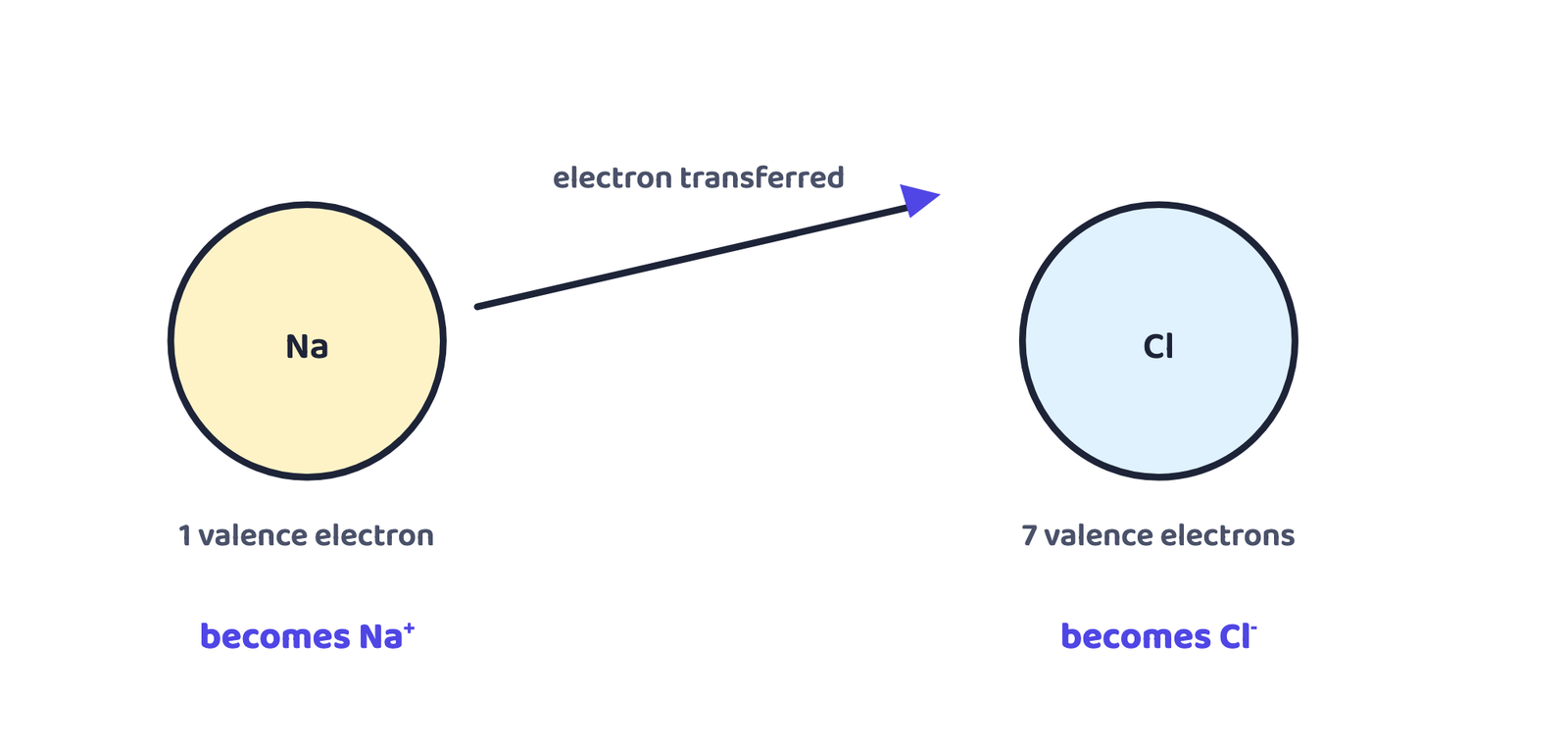
A positively charged ion is a cation; a negatively charged ion is an anion. An ionic bond is the electrostatic attraction that holds oppositely charged ions together.
Sodium (2, 8, 1) loses one electron to become (11 protons, only 10 electrons left). Chlorine (2, 8, 7) gains one electron to become . The two ions then attract each other to form .
Ionic compounds do not exist as single molecules. They pack into a repeating 3D crystal lattice, where every is surrounded by six ions and every is surrounded by six ions.
Naming ionic compounds
Write the cation’s name first, then the anion’s, ending in -ide for simple anions. Metals usually form cations, non-metals usually form anions.
| Common cations | Common anions |
|---|---|
| , , (valency 1) | , , , (valency 1) |
| , , (valency 2) | , (valency 2) |
| , (valency 3) | , , (valency 1, polyatomic) |
| (valency 1, polyatomic) | , (valency 2, polyatomic) |
5 Writing Chemical Formulae
The “criss-cross” method: write the symbols, write each one’s valency, then swap the two valencies over to become the other’s subscript. Simplify by any common factor, and never write a subscript of 1.
| Compound | Ions | Formula | Note |
|---|---|---|---|
| Aluminium oxide | , | 3 and 2 criss-cross directly | |
| Magnesium oxide | , | MgO | Equal valencies simplify to MgO |
| Magnesium hydroxide | , | Brackets needed: 2 or more of a polyatomic ion | |
| Aluminium sulfate | , | Brackets around the polyatomic ion |
Aluminium hydroxide is , never ““. Brackets are required whenever a polyatomic ion appears more than once; skip them only when exactly one is present.
6 Ionic vs Covalent: Telling Them Apart
| Property | Ionic compounds | Covalent compounds |
|---|---|---|
| Example | Sodium chloride, copper sulfate | Camphor, naphthalene, sugar |
| Solubility in water | Usually soluble | Usually insoluble (sugar is an exception) |
| Solubility in kerosene/petrol | Usually insoluble | Usually soluble |
| Conducts electricity as a solid | No (ions fixed in place) | No |
| Conducts electricity dissolved/molten | Yes (ions become free to move) | Usually no (sugar dissolves but does not ionise) |
| Melting and boiling points | High (strong ionic attraction) | Low |
Conductivity is really a question about free-moving charges. Ions in a solid ionic crystal are locked in place; dissolve or melt the compound, and the ions can move, so it conducts. A covalent substance like sugar dissolves without ever forming ions, so its solution never conducts.
7 Molecular Mass and Formula Unit Mass
Molecular mass (for covalent compounds) is the sum of the atomic masses of every atom in one molecule. Ionic compounds do not form molecules, so instead they have a formula unit mass: the sum of atomic masses in the simplest whole-number ratio of ions.
Q. Find the molecular mass of (H = 1 u, O = 16 u) and (C = 12 u, O = 16 u).
18 u
44 u
Q. Find the formula unit mass of (Na = 23 u, O = 16 u).
62 u
Splitting or combining atomic nuclei releases enormous energy, called nuclear energy. In India, Raja Ramanna, often called the father of the Indian nuclear programme, helped develop it for peaceful uses like electricity generation, medicine and research.
- Law of Conservation of Mass (Lavoisier): reactant mass equals product mass in every chemical reaction.
- Law of Constant Proportions (Proust): a compound’s elements always combine in the same fixed mass ratio.
- Dalton’s postulates explain both laws: atoms are indivisible and only rearrange, never created or destroyed.
- A covalent bond shares electrons (H-H, Cl-Cl, O=O, H-Cl, H-O-H).
- An ionic bond transfers electrons, forming a cation and an anion that attract each other.
- Write covalent formulae, and ionic formulae, by criss-crossing valencies as subscripts.
- Ionic compounds dissolve in water and conduct electricity in solution or molten; covalent compounds usually do neither.
- Molecular mass sums atomic masses in a molecule; formula unit mass does the same for an ionic compound’s simplest ratio.
- 1 markState the Law of Conservation of Mass.
- 1 markWho proposed the Law of Constant Proportions?
- 1 markWhat is a cation? Give one example.
- 1 markName the bond formed by sharing electrons.
- 1 markWrite the chemical name of .
- 1 markWhat is the valency of the sulfate ion?
- 1 markDefine molecular mass.
- 1 markWhy do ionic compounds not conduct electricity in the solid state?
- 3 marksDescribe the formation of a water molecule with the help of a labelled diagram.
- 3 marksExplain, with a diagram, how sodium chloride is formed by the transfer of electrons.
- 2 marksDistinguish between ionic and covalent compounds on the basis of solubility.
- 3 marks20 g of hydrogen reacts completely with 160 g of oxygen. How much water is formed, according to the Law of Conservation of Mass?
- 2 marksWrite the chemical formula for aluminium sulfate, showing the criss-cross method.
- 3 marksA compound contains 40% sulfur and 60% oxygen by mass. If a sample has 20 g of sulfur, how much oxygen must it contain?
- 2 marksFind the molecular mass of nitric acid, (H=1u, N=14u, O=16u).
- 3 marksExplain why sugar solution does not conduct electricity even though sugar dissolves in water.
- 2 marksName the following: (i) (ii) .
- 3 marksShow the formation of a chlorine molecule () using electron sharing.
- 5 marksState Dalton’s atomic theory and explain how it accounts for both the Law of Conservation of Mass and the Law of Constant Proportions.
- 5 marksAn element A has 1 electron in its third shell; an element B has 6 electrons in its second shell. Explain what kind of ions they form, what bond forms between them, and predict the formula of the resulting compound.
- 5 marksCompare ionic and covalent compounds under solubility, electrical conductivity and melting point, with one example of each.
- 5 marksFind the formula unit mass of calcium nitrate, (Ca=40u, N=14u, O=16u), showing every step.
- 5 marks5.3 g of sodium carbonate reacts with 6.0 g of acetic acid to give 2.2 g of carbon dioxide, 0.9 g of water and 8.2 g of sodium acetate. Verify the Law of Conservation of Mass.
- 1 markIn which setup does the final reading match the initial reading?
- 2 marksExplain why the readings differ in the other setup.
- 2 marksWhat does this experiment demonstrate about mass during a chemical reaction?
- 1 markThe Law of Conservation of Mass was proposed by:
(a) Dalton(b) Proust(c) Lavoisier(d) Rutherford - 1 markIn water, hydrogen and oxygen combine in the mass ratio:
(a) 1:1(b) 1:8(c) 8:1(d) 2:1 - 1 markThe bond in is:
(a) covalent(b) ionic(c) metallic(d) hydrogen - 1 markThe molecular mass of (C=12u, O=16u) is:
(a) 28 u(b) 32 u(c) 44 u(d) 16 u - 1 markIonic compounds conduct electricity when:
(a) solid(b) dissolved in water or molten(c) never(d) frozen - 1 mark is named:
(a) nitrogen oxide(b) dinitrogen pentoxide(c) nitrogen pentoxide(d) dinitrogen oxide - 1 markA negatively charged ion is called a:
(a) cation(b) anion(c) proton(d) neutron
Choose: (a) both A and R true, R explains A; (b) both true, R does not explain A; (c) A true, R false; (d) A false, R true.
Reason (R): According to Dalton’s atomic theory, atoms combine in a simple whole-number ratio by mass.
Reason (R): In the molten state, ions are free to move; in the solid state they are fixed in the lattice.
Reason (R): Camphor is an ionic compound.