
Exam-useful questions from this chapter, grouped by marks, each with a full model answer. Try writing the answer yourself first, then check it against this one.
1 1-Mark Questions
Q. Define magnetic field.
Answer: The region surrounding a magnet, in which the force of the magnet can be detected, is called a magnetic field.
Q. How is the direction of a magnetic field line at a point defined?
Answer: It is the direction that a north pole placed at that point would tend to move.
Q. State the right-hand thumb rule in one line.
Answer: If a current-carrying straight conductor is held in the right hand with the thumb pointing along the current, the curled fingers give the direction of the magnetic field around it.
Q. Name the two ends of a current-carrying solenoid in terms of the poles they behave like.
Answer: One end behaves like a north pole and the other end behaves like a south pole, just like a bar magnet.
Q. What is an electromagnet?
Answer: A piece of magnetic material such as soft iron, placed inside a current-carrying solenoid, gets magnetised by the strong field inside it; the magnet so formed is called an electromagnet.
Q. Name the scientist who discovered the magnetic effect of electric current, and state the year.
Answer: Hans Christian Oersted discovered it in 1820.
Q. What colour of insulation does the earth wire carry in a domestic circuit?
Answer: The earth wire has green insulation.
Q. Define a short circuit.
Answer: A short circuit occurs when the live and neutral wires come into direct contact, usually due to damaged insulation or a faulty appliance, causing the current in the circuit to increase abruptly.
2 2-Mark Questions
Q. Why do magnetic field lines never intersect each other?
Answer: If two field lines crossed at a point, a compass needle placed there would have to point in two different directions at the same time, which is not possible. So no two field lines ever cross.
Q. How does the magnetic field due to a straight current-carrying conductor change with (a) an increase in current, and (b) an increase in distance from the conductor?
Answer: (a) The field increases as the current through the conductor increases. (b) The field decreases as the distance from the conductor increases.
Q. State Fleming’s left-hand rule.
Answer: Stretch the thumb, forefinger and middle finger of the left hand so that all three are mutually perpendicular. If the forefinger points in the direction of the magnetic field and the middle finger in the direction of the current, the thumb points in the direction of the force (motion) on the conductor.
Q. How is the field-line pattern at the centre of a current-carrying circular loop different from that around a straight conductor?
Answer: Around a straight conductor, field lines are concentric circles at every point. In a circular loop, the arcs from every part of the wire overlap at the centre and appear as nearly straight lines there, instead of circles.
Q. Why is the field pattern of a current-carrying solenoid similar to that of a bar magnet?
Answer: One end of the solenoid behaves as a north pole and the other as a south pole, and the field lines outside it curve from one end to the other just as they do outside a bar magnet, so the two patterns look alike.
Q. Name two devices that work on the principle of the force on a current-carrying conductor in a magnetic field.
Answer: The electric motor and the loudspeaker both work on this principle (measuring instruments and microphones also use it).
Q. Why are electrical appliances in a house connected in parallel rather than in series?
Answer: In parallel, every appliance gets the same potential difference (220 V) and can be switched on or off independently; if they were in series, one appliance failing or being switched off would break the circuit for every other appliance too.
Q. What is the function of a fuse in a domestic electric circuit?
Answer: A fuse is a safety device that melts, due to its own Joule heating, and breaks the circuit when the current becomes unduly high, protecting the wiring and appliances from damage due to overloading or a short circuit.
3 4-Mark Questions
Q. Describe how you would use a compass to trace the magnetic field lines of a bar magnet.
Answer: Place the bar magnet on a sheet of paper and mark its boundary. Place a small compass near the north pole; its south pole points towards the magnet’s north pole. Mark the positions of the two ends of the needle, then move the compass so its south pole occupies the position just vacated by its north pole, and mark the new position. Repeat this step by step until the south pole of the magnet is reached, then join all the marked points with a smooth curve. This curve is one magnetic field line; repeating the process from different starting points around the magnet gives the full field-line pattern, with lines emerging from the north pole and merging into the south pole outside the magnet.
Q. Describe an activity that shows a current-carrying conductor produces a magnetic field, and state the conclusion.
Answer: Place a straight thick copper wire between two points in an electric circuit, keeping it perpendicular to the plane of a sheet of paper, and place a small compass horizontally near the wire. Note the position of the compass needle. Close the key so current flows through the wire, and observe the needle again: it is found to deflect from its earlier position. Reversing the current reverses the direction of deflection. This shows that a current-carrying conductor produces its own magnetic field, and that the field’s direction depends on the direction of the current, confirming that electricity and magnetism are linked.
Q. Using the right-hand thumb rule, explain how the direction of the magnetic field around a straight current-carrying conductor is found.
Answer: Imagine holding the straight current-carrying conductor in the right hand such that the thumb points in the direction of the current. The fingers then curl naturally around the conductor, and the direction in which they curl gives the direction of the magnetic field lines, which form concentric circles around the wire. This rule is also called Maxwell’s corkscrew rule, since it matches the direction a corkscrew would turn if driven along the direction of the current.
Q. Explain why the magnetic field at the centre of a current-carrying circular coil with n turns is n times the field due to a single turn.
Answer: In a circular coil, the current in every turn flows in the same direction around the loop. By the right-hand rule, each turn therefore produces a magnetic field at the centre in the same direction as every other turn. Since all n turns’ fields point the same way, they simply add up, making the total field at the centre n times as large as the field a single turn alone would produce.
Q. Describe an activity that demonstrates the force on a current-carrying conductor placed in a magnetic field, and name the rule used to find its direction.
Answer: Suspend a light aluminium rod horizontally between the poles of a strong horseshoe magnet, with the magnetic field directed vertically upward (north pole below, south pole above the rod), and connect the rod in series with a battery, a key and a rheostat. When current is passed through the rod, it is displaced sideways. Reversing the direction of the current reverses the direction of displacement, and reversing the magnetic field (by interchanging the magnet’s poles) also reverses the displacement. The direction of this force is found using Fleming’s left-hand rule.
Q. Explain the function and colour code of the live, neutral and earth wires in a household electric circuit.
Answer: The live wire (red insulation) carries the supply at a higher potential, and the neutral wire (black insulation) completes the circuit; the potential difference between them in India is 220 V. The earth wire (green insulation) is connected to a metal plate buried deep in the ground and is a safety wire only: it is connected to the metal body of appliances such as an iron or a refrigerator, so that if current ever leaks onto the metal body, it flows safely to the earth through this low-resistance path instead of through a person touching the appliance.
Q. Explain the difference between overloading and short-circuiting in a domestic circuit, and how a fuse protects against both.
Answer: A short circuit happens when the live and neutral wires touch each other directly, usually because insulation has worn away or an appliance has developed a fault; the current then rises abruptly. Overloading can happen from an accidental rise in supply voltage or from connecting too many appliances to a single socket or circuit, again pushing the current higher than the wiring is meant to carry. In both cases, the fuse wire heats up due to its own resistance and, once the current crosses its rated value, melts and breaks the circuit before the excess current can damage the wiring or the appliances.
4 6-Mark Questions
Q. With the help of labelled diagrams, describe the magnetic field patterns due to (a) a straight current-carrying conductor, (b) a circular current-carrying loop, and (c) a current-carrying solenoid, stating the rule used in each case to find the field’s direction.
Answer: (a) A straight current-carrying conductor has field lines that are concentric circles centred on the wire; the field grows weaker farther from the wire. Its direction is found from the right-hand thumb rule: thumb along the current, curled fingers give the field direction.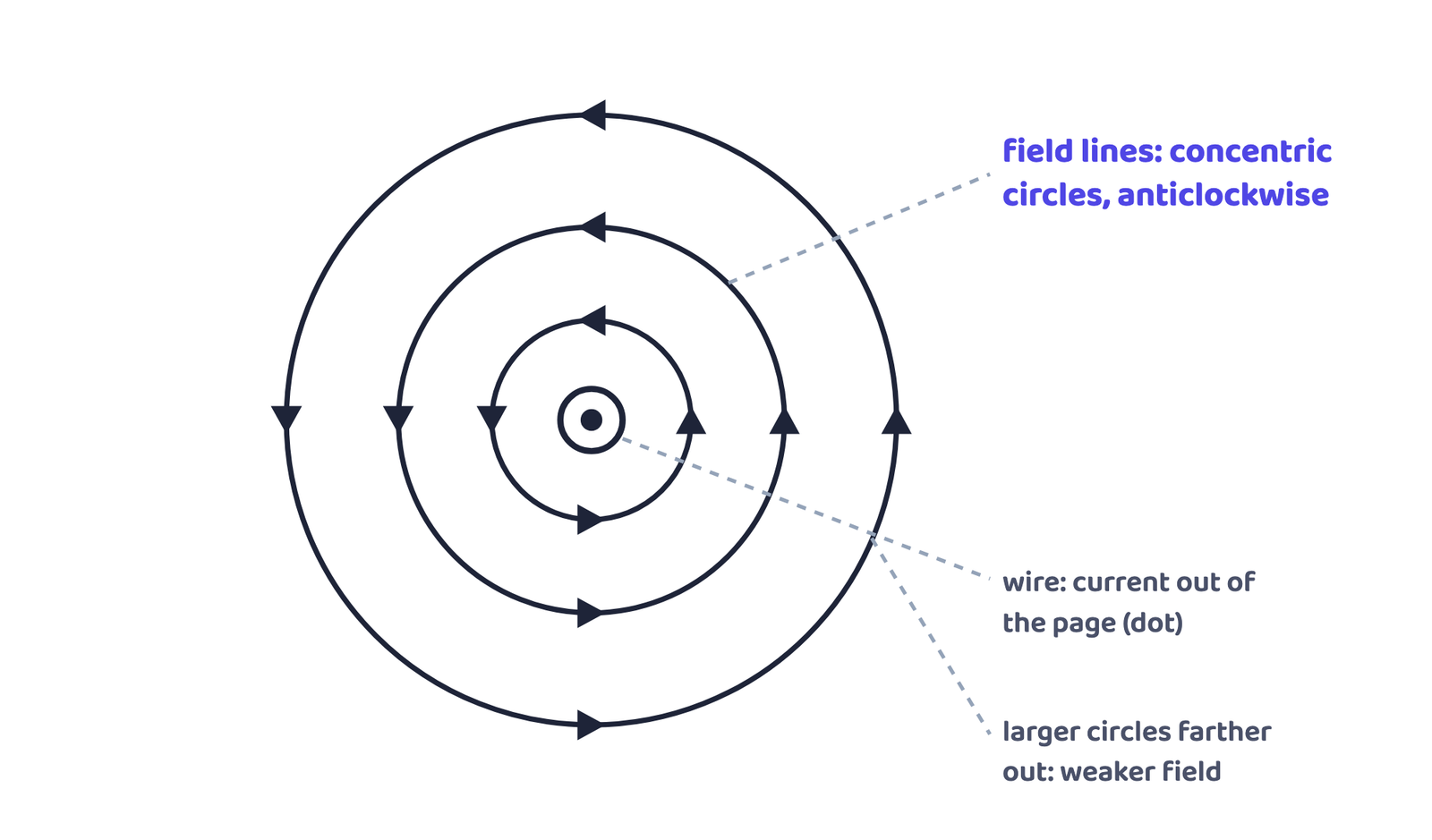 Diagram (a): field lines of a straight current-carrying conductor (current out of the page, shown by the dot)
 Right-hand thumb rule: thumb along the current, curled fingers along the field lines
(b) In a circular loop, every part of the wire contributes field lines that are circles growing larger away from the wire; near the centre, these overlapping arcs look almost straight, and for n turns the field is n times that of a single turn, since every turn’s field adds in the same direction (again found using the right-hand rule). Diagram (b): field lines of a current-carrying circular loop, seen edge-on
(c) A solenoid’s field lines are parallel and uniform inside it, and curve around outside from one end to the other exactly like a bar magnet; one end behaves as a north pole and the other as a south pole. Its direction, too, follows from applying the right-hand rule to the current in the turns. Diagram (c): field lines of a current-carrying solenoid (uniform inside, like a bar magnet outside)
Q. State Fleming’s left-hand rule. Describe an activity that verifies it, and explain how the force on the conductor changes when (a) the current is reversed, and (b) the magnetic field is reversed.
Answer: Fleming’s left-hand rule: stretch the thumb, forefinger and middle finger of the left hand mutually perpendicular. The forefinger gives the direction of the magnetic field, the middle finger the direction of the current, and the thumb then gives the direction of the force on the conductor.
Activity: an aluminium rod is suspended between the poles of a horseshoe magnet with the field pointing vertically upward, and connected in series with a battery, key and rheostat. Passing current through the rod displaces it sideways, in the direction Fleming’s left-hand rule predicts.
(a) Reversing the current reverses the direction of the force, so the rod is displaced the opposite way.
(b) Reversing the magnetic field, by interchanging the magnet’s poles, also reverses the direction of the force. In both cases, the force is largest when the current and the field are exactly perpendicular to each other.
Q. Draw and explain a schematic diagram of a domestic electric circuit, describing the role of the live wire, neutral wire, earth wire and fuse.
Answer:  Schematic diagram of a domestic electric circuitIn a domestic circuit, the live wire (red) and neutral wire (black) run from the meter board, through a main fuse and the main switch, into the house’s line wires, carrying a potential difference of 220 V (AC, 50 Hz). Appliances are connected in parallel between the live and neutral wires, each with its own switch, so every appliance gets the full 220 V and can be operated independently. The earth wire (green) connects the metal body of appliances such as an iron, toaster or refrigerator to a metal plate buried deep in the earth; if current leaks onto the metal body, it flows away safely through this low-resistance earth path instead of through a person touching the appliance. The main fuse protects the whole installation: if the current rises abruptly, due to a short circuit (live and neutral touching directly) or overloading (too many appliances, or a voltage surge), the fuse wire heats up and melts, breaking the circuit before the wiring or appliances are damaged.
Q. Explain what is meant by the magnetic effect of electric current, with reference to Oersted’s discovery, and describe how a solenoid can be used to make an electromagnet.
Answer: The magnetic effect of electric current is the fact that a current-carrying conductor produces its own magnetic field around it, exactly as a magnet does. This was discovered accidentally in 1820 by Hans Christian Oersted, when he found that a compass needle got deflected when an electric current passed through a metallic wire placed nearby; through this observation he showed that electricity and magnetism are related phenomena.
A solenoid, a coil of many closely wound circular turns of insulated copper wire, produces a strong, uniform magnetic field inside itself when current flows through it, with a field pattern outside resembling a bar magnet. If a piece of soft iron is placed inside this current-carrying solenoid, the strong field magnetises it, turning it into a magnet for as long as the current flows. This soft-iron-and-solenoid combination is called an electromagnet.
5 Case Studies
(A) 1 mark What most likely caused the spark and the fuse to melt?
Answer: The frayed insulation let the live and neutral wires touch directly, causing a short circuit and an abrupt rise in current.
(B) 1 mark Why did the bedroom circuit remain unaffected?
Answer: It is a separate, independent parallel circuit with its own fuse, so a fault on the kitchen circuit does not affect it.
(C) 2 marks Explain what the fuse actually did in this situation.
Answer: As the current rose abruptly due to the short circuit, the fuse wire heated up due to its own resistance (Joule heating) and melted, breaking the kitchen circuit before the wiring or the iron could be further damaged.
(D) 2 marks What safety precaution should Meera take before using the iron again?
Answer: She should get the frayed insulation repaired or the wire replaced, and check that the iron’s metal body is properly earthed before using it again.