
- How printing began in China, Japan and Korea, and how it travelled to Europe with Marco Polo
- How Gutenberg’s printing press worked, and why it changed the world so fast
- Why print frightened rulers and churches just as much as it excited readers
- How print reached India, and how it reshaped religion, women’s lives and the freedom movement
- How the colonial government tried to control and censor the press, right up to the Quit India movement
1The First Printed Books
Before there were printing presses, there was woodblock printing, and it was invented not in Europe but in China, Japan and Korea. In this method, a craftsman carved a whole page of writing onto a block of wood, inked it, and pressed paper onto it by hand, one sheet at a time.
China printed books this way from as early as AD 594. Paper was invented in China too, and books were made by rubbing paper against an inked woodblock. Since only one side of this thin paper could be printed, the traditional Chinese book was folded like an accordion and stitched at the side. Skilled craftsmen could reproduce the beauty of hand-lettering, called calligraphy, with remarkable accuracy.
Calligraphy is the art of beautiful and stylised handwriting.
For a long time, the Chinese emperor’s government was the biggest producer of printed material, because it needed huge numbers of textbooks for the civil service examinations that recruited its officials. From the 16th century, more candidates appeared for these exams, so even more books had to be printed.
By the 17th century, city life in China was booming, and print was no longer only for scholars and officials. Merchants used print to record trade information, and reading became something people did for pleasure: novels, poetry, autobiographies and romantic plays became popular. Rich women began to read, and many women began publishing their poetry and plays; wives of scholar-officials published their works and courtesans wrote about their lives.
Western printing techniques and mechanical presses were imported into China in the late 19th century, as Western powers established their outposts there. Shanghai became the centre of this new, machine-based print culture.
1.1 Print in Japan and Korea
Buddhist missionaries carried hand-printing technology from China into Japan around AD 768-770. The oldest Chinese book, printed in AD 868, is the Buddhist Diamond Sutra, made of six sheets of text and woodcut pictures. In Japan, pictures were also printed on textiles, playing cards and paper money.
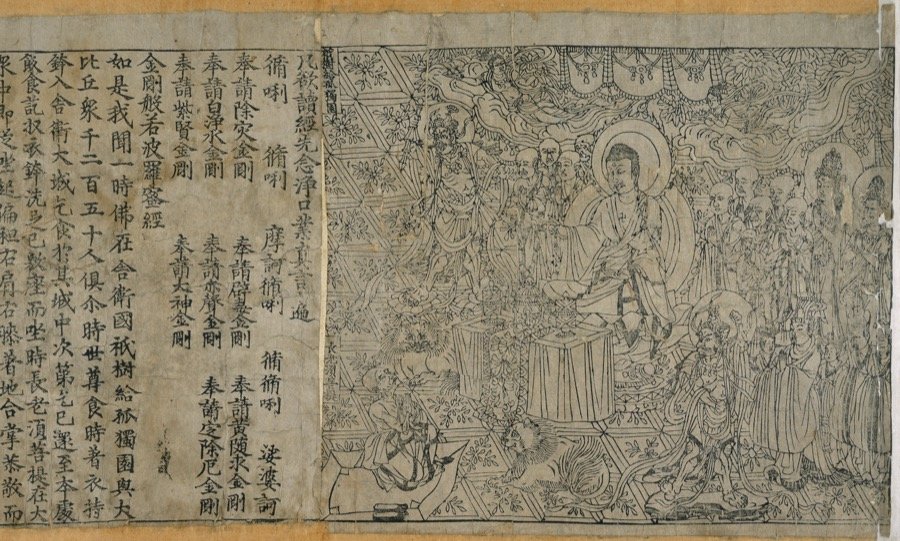
Korea has two famous early printed works. The Tripitaka Koreana, a huge collection of Buddhist scriptures, was engraved on about 80,000 wooden printing blocks in the mid-13th century, and UNESCO inscribed it on its Memory of the World Register in 2007. Even more important for the history of printing: the Jikji of Korea, printed in the late 14th century, is among the world’s oldest existing books printed with moveable metal type, not carved wood. It contains the essential features of Zen Buddhism and mentions about 150 monks of India, China and Korea. Its first volume is unavailable; the second is kept in the National Library of France, and UNESCO inscribed it on the Memory of the World Register in 2001.
In late-18th-century Edo (the city we now call Tokyo), publishers commissioned artists to draw scenes of everyday city life, called ukiyo (“pictures of the floating world”). One of the most famous ukiyo artists, Kitagawa Utamaro (born in Edo in 1753), influenced European painters like Manet, Monet and Van Gogh when his prints reached the West. To make each print, a woodblock carver had to destroy the artist’s original drawing while carving the block, so only the printed copies survive today.
2Print Comes to Europe
For centuries, the Silk Route carried silk and spices from China into Europe. Chinese paper reached Europe by the same route in the 11th century. In 1295, the explorer Marco Polo returned to Italy after years in China and brought back the knowledge of woodblock printing. Soon Italians were printing books with woodblocks too, and the technology spread to other parts of Europe.
Rich aristocrats still preferred handwritten books on expensive vellum, and looked down on printed books as cheap. But merchants and students, who could not afford vellum manuscripts, happily bought the cheaper printed copies.
Vellum is a parchment made from the skin of animals, used for expensive handwritten manuscripts.
As demand grew, booksellers exported books to many countries and book fairs were held; scribes were now employed by booksellers too, and more than 50 scribes often worked for one bookseller. Still, hand-copying manuscripts could not satisfy the ever-increasing demand for books: copying was expensive, laborious and time-consuming, and manuscripts were fragile, awkward to handle and hard to carry around. By the early 15th century, woodblocks were widely used in Europe to print textiles, playing cards and religious pictures with brief texts, but something faster was needed.
2.1 Gutenberg and the Printing Press
The breakthrough came at Strasbourg in Germany, where Johann Gutenberg developed the first-known printing press in the 1430s. Gutenberg grew up around wine and olive presses, and later learned to be a goldsmith who cast metal trinkets in moulds. He combined these two skills: the olive press became the model for the printing machine, and his mould-casting skill let him cast small metal letters for every character of the alphabet, which could be arranged and rearranged to spell out any page of text. This is called moveable type, and it stayed the basic way of printing for the next 300 years.
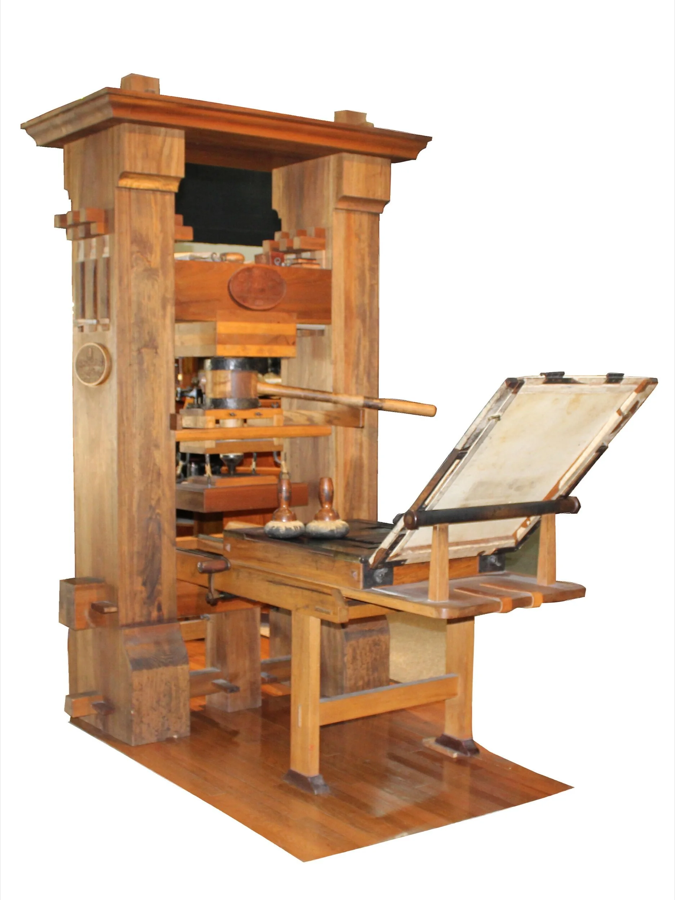
The very first printed books still looked like handwritten manuscripts. Printers left blank spaces on the page for an artist to paint decorated borders and illustrations by hand afterwards, and the text was printed in plain black with gaps for colour to be added later. In books printed for the rich, each buyer could choose the design and the painting school that would do the illustrations. The book (Fig. 7) notes that no two copies of Gutenberg’s Bible were the same, and elites preferred this: nobody else owned a copy exactly like theirs.
Between 1450 and 1550, printing presses were set up in most countries of Europe, as German printers travelled abroad to help start new presses. As presses multiplied, book production exploded: the second half of the 15th century saw 20 million copies of printed books flood the European market, and by the 16th century that number had climbed to about 200 million copies. This huge shift, from books made slowly by hand to books made quickly by machine, is what historians call the print revolution.
3The Print Revolution and Its Impact
Print was not just a new way of making books. It changed how people related to information, to knowledge, and to the institutions and rulers who had always controlled both.
3.1 A New Reading Public
Printing brought down the cost, time and labour of making a book, so books flooded the market and reached more and more readers. Before print, ordinary people lived in a world of spoken, or oral, culture: they heard sacred texts, ballads and folk tales read aloud in a group, rather than reading books alone and silently.
But the change to a “reading public” was not simple, because literacy rates in most European countries stayed very low until the 20th century. So printers found a clever middle path: they published illustrated ballads and folk tales that could be sung or read aloud at village gatherings and in taverns, so that even people who could not read could still enjoy a printed book. In this way, the old oral culture and the new print culture blended into each other rather than one replacing the other.
3.2 Religious Debates and the Fear of Print
Print let anyone, not just kings and priests, put their ideas in front of a huge audience. This excited reformers, but it terrified people in power, who worried that if printing went unchecked, “dangerous” or rebellious ideas would spread out of control.
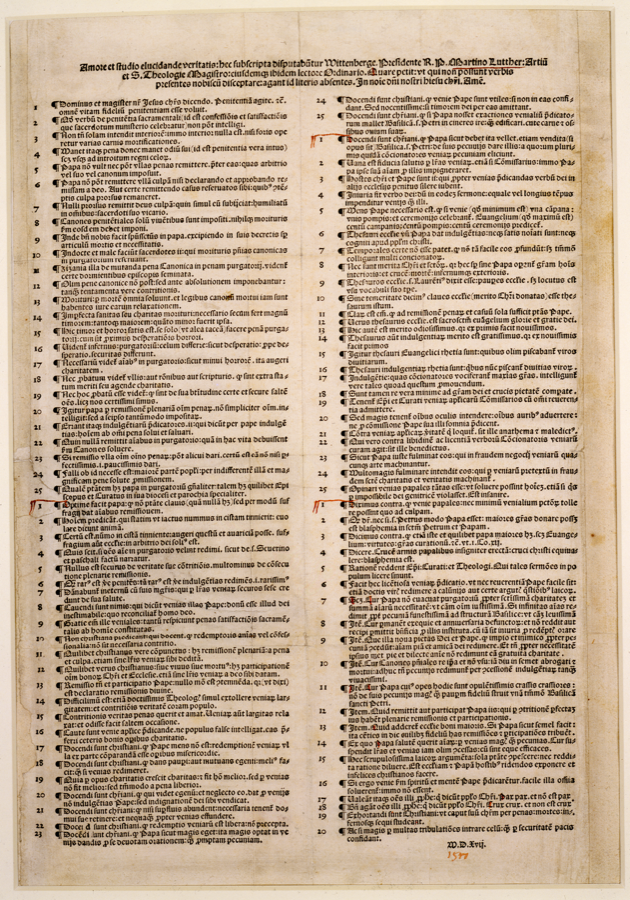
The clearest example is Martin Luther, a religious reformer who in 1517 wrote the Ninety Five Theses criticising the practices of the Roman Catholic Church. A printed copy was posted on a church door in the German town of Wittenberg, openly challenging the Church to debate him. Luther’s writings were immediately reproduced in vast numbers and read widely, and this led to a division within the Church and to the beginning of the Protestant Reformation. Several scholars think that print brought about a new intellectual atmosphere and helped spread the new ideas that led to the Reformation. Luther’s own translation of the New Testament sold 5,000 copies within a few weeks, and a second edition appeared within three months. Deeply grateful to print, Luther said: “Printing is the ultimate gift of God and the greatest one.”
The Protestant Reformation was a 16th-century movement to reform the Catholic Church dominated by Rome. Martin Luther was one of the main Protestant reformers.
3.3 Print and Dissent
Print let even ordinary, poorly educated people form their own opinions about religion. In 16th-century Italy, a miller named Menocchio read books available in his village and formed his own, very different idea of God and Creation. This enraged the Roman Catholic Church so much that it put him on trial twice and finally had him executed. Troubled by such readings and questionings of faith, the Church imposed severe controls over publishers and booksellers and began keeping an Index of Prohibited Books from 1558, listing books that Catholics were forbidden to read.
“To what corner of the world do they not fly, these swarms of new books? … even in good things satiety is most harmful.”
Erasmus, Catholic reformer, worrying about too many printed books, in his Adages (1508)
4The Reading Mania
Through the 17th and 18th centuries, literacy rates went up in most parts of Europe as churches of different denominations set up village schools. By the end of the 18th century, some parts of Europe had literacy rates as high as 60 to 80 per cent, and people wanted more and more to read.
Cheap new formats appeared to feed this hunger. In England, travelling pedlars called chapmen sold pocket-sized chapbooks for a single penny, so even the poor could afford one. In France, there was the “Bibliothèque Bleue”: low-priced small books printed on poor-quality paper and bound in cheap blue covers. People also bought almanacs, yearly booklets giving the timing of tides, eclipses and the movement of the sun and moon, and much else of importance in everyday life.
A chapbook is a pocket-size book sold cheaply by travelling pedlars called chapmen; an almanac is a yearly publication giving astronomical and tide information important in everyday life.
The periodical press, newspapers and journals that came out regularly, developed from the early 18th century, mixing news of wars and trade with entertainment. Scientific ideas spread too: when Isaac Newton published his discoveries, print carried them to a much wider circle of readers, and the writings of thinkers like Voltaire, Rousseau and Thomas Paine, were widely printed and read, so their ideas about science, reason and rationality found their way into popular literature.
The book’s Box 2 quotes the London publisher James Lackington’s diary (1791): book sales had increased enormously in twenty years, and even poor country people now spent winter evenings hearing their sons and daughters read tales and romances to them.
4.1 “Tremble, therefore, tyrants of the world!”
By the mid-18th century many people believed that books could change the world, liberate society from despotism and tyranny, and bring in a time when reason and intellect would rule. The French novelist Louise-Sebastien Mercier wrote: “The printing press is the most powerful engine of progress and public opinion is the force that will sweep despotism away,” and famously declared, “Tremble, therefore, tyrants of the world! Tremble before the virtual writer!” In Source B, Mercier describes himself reading like a man dying of thirst gulping down fresh water, reading on through the night even as his lamp ran low.
4.2 Print Culture and the French Revolution
Many historians connect print culture to the French Revolution, through three kinds of argument, though the chapter itself is careful to say the connection is not simple.
Spreading Enlightenment ideas
Print popularised the ideas of Enlightenment thinkers such as Voltaire and Rousseau, who argued for the rule of reason rather than custom and attacked the sacred authority of the Church and the despotic power of the state.
Creating debate and dialogue
A public that had learned to reason for itself began openly discussing and re-evaluating every value, norm and institution around it.
Mocking royalty in print
By the 1780s, cartoons and pamphlets mocked the king and queen’s morality, circulating underground and building hostility toward the monarchy. The book’s Fig. 11 is a late-18th-century cartoon of the nobility enjoying life while peasants, artisans and workers suffer.
But as the book itself points out, people did not read only one kind of book, they read royalist and Church propaganda too, and they accepted some ideas while rejecting others. Print did not directly control what people thought; it simply opened up the possibility of thinking differently.
5The Nineteenth Century
The 19th century brought a huge jump in literacy across Europe, and three new groups of readers became important: children, women and workers.
5.1 Children, Women and Workers
Once primary education became compulsory in the late 19th century, school textbooks became a big business, and a press devoted only to children’s books was set up in France in 1857. In Germany, the Grimm Brothers spent years collecting traditional folk tales from peasants, publishing them as an edited collection in 1812, anything considered unsuitable for children or vulgar to the elites was left out, so print both recorded old tales and changed them.
Women became important both as readers and as writers. Penny magazines were especially meant for women, as were manuals teaching proper behaviour and housekeeping. (The book’s Fig. 12 shows the Penny Magazine, published in England between 1832 and 1835 by the Society for the Diffusion of Useful Knowledge and aimed primarily at the working class.) As the novel became popular, some of the best-known novelists of the century were women: Jane Austen, the Bronte sisters, and George Eliot. Their books helped create a new picture of a woman: someone with her own will, personality and power to think.
Lending libraries, which had existed since the 17th century, became important tools for educating white-collar workers and artisans in 19th-century England. As the working day gradually grew shorter from the mid-19th century, self-taught working-class people found time to write their own political tracts and autobiographies. (Box 3: Thomas Wood, a Yorkshire mechanic, rented old newspapers and read them by firelight because he could not afford candles.)
5.2 Further Innovations
Printing technology kept improving through the 19th century. In the mid-19th century, Richard M. Hoe of New York built a power-driven cylindrical press that could print an astonishing 8,000 sheets an hour, perfect for printing newspapers fast.
Later in the century, the offset press could print up to six colours at once, and by the turn of the 20th century electric power sped up printing even further. In the 1920s, cheap books in England were sold as the “Shilling Series”, and the dust cover, or book jacket, was invented in the 20th century too. When the Great Depression of the 1930s hit book sales, publishers responded by bringing out cheap paperback editions to keep people buying.
6India and the World of Print
6.1 Manuscripts Before the Age of Print
India had a long, rich tradition of hand-copied manuscripts in Sanskrit, Arabic, Persian and many regional languages, written on palm leaves or handmade paper. These manuscripts kept being produced right through the 19th century, well after print arrived, but they were costly, fragile and hard to handle. Even in pre-colonial Bengal, which had a wide network of village schools, students were mostly taught to write from a teacher’s dictation rather than to actually read a text, so many people became “literate” without ever reading a book themselves.
6.2 Print Comes to India
Printing first reached India with Portuguese missionaries who set up a press in Goa in the mid-16th century. Jesuit priests learnt Konkani and printed several tracts; by 1674 about 50 books had been printed in Konkani and Kanara. (Source C: as late as 1768, William Bolts put up a notice in Calcutta promising to encourage printers, because the city had no printing press; he left for England soon after and nothing came of it.)
| Place / language | Who printed it | Year |
|---|---|---|
| Konkani and Kanara books (about 50 in all) | Printed in Goa (Jesuit priests learnt Konkani) | by 1674 |
| First Tamil book, at Cochin | Catholic priests | 1579 |
| 32 Tamil texts, many of them translations of older works | Dutch Protestant missionaries | by 1710 |
| First Malayalam book | Catholic priests | 1713 |
| Bengal Gazette (English weekly) | James Augustus Hickey | from 1780 |
The English East India Company had imported printing presses since the late 17th century, but a real English-language press in India developed only much later. James Augustus Hickey‘s Bengal Gazette, from 1780, proudly called itself “a commercial paper open to all, but influenced by none.” Hickey printed plenty of gossip about senior Company officials, which so enraged Governor-General Warren Hastings that he had Hickey persecuted and encouraged official, pro-government newspapers instead. Indians soon began publishing their own papers too: the very first was a weekly, also called the Bengal Gazette, brought out by Gangadhar Bhattacharya, a close associate of Rammohun Roy.
7Religious Reform and Public Debates
From the early 19th century, print carried fierce public debates about religion, especially in Bengal, over issues like widow immolation (sati), idol worship and the role of Brahmin priests. Both reformers and orthodox groups used the press to reach and persuade a much wider audience than ever before.
| Newspaper | Language / who published it | Since |
|---|---|---|
| Sambad Kaumudi | Rammohun Roy, reformist | 1821 |
| Samachar Chandrika | Hindu orthodoxy, to counter Roy | — |
| Jam-i-Jahan Nama and Shamsul Akhbar | Persian | from 1822 |
| Bombay Samachar | Gujarati | 1822 |
In north India, Muslim legal scholars called the ulama feared that colonial rulers would encourage conversion and change the Muslim personal laws, so they used cheap lithograph presses to print Persian and Urdu translations of scripture and religious tracts. The Deoband Seminary, founded in 1867, published thousands of fatwas, religious rulings, guiding ordinary Muslims on everyday conduct.
The ulama are legal scholars of Islam and Islamic law (the sharia). A fatwa is a legal ruling on a point of Islamic law, usually given by a qualified scholar called a mufti.
Among Hindus too, print encouraged reading of religious texts in everyday, vernacular languages: the first printed edition of the Ramcharitmanas of Tulsidas (originally a 16th-century text) came out from Calcutta in 1810. From the 1880s, the Naval Kishore Press in Lucknow and the Shri Venkateshwar Press in Bombay printed huge numbers of vernacular religious texts, cheap and portable enough to be read anywhere, or read aloud to illiterate listeners. Newspapers also began carrying news from one part of India to another, creating pan-Indian identities. (Source D: in 1849 Krishnaji Trimbuck Ranade of Poona announced a Marathi newspaper open to free discussion on subjects of general use, and in 1870 the Native Opinion compared the native newspapers to the Opposition in the British House of Commons.)
8New Forms of Publication
As more people learned to read, they wanted to see their own everyday lives and feelings reflected in what they read, and the novel, a form that began in Europe, ideally catered to this need, and soon acquired distinctively Indian forms and styles. Essays, short stories and lyric poetry about social and political life became popular too.
By the end of the 19th century, cheap printing also created a whole new visual culture. The painter Raja Ravi Varma produced mythological paintings for mass printing and sale, and cheap prints and calendars, sold in the bazaar, decorated the walls of even poor homes, shaping popular ideas about religion, tradition and modernity. By the 1870s, journals and newspapers were carrying political caricatures and cartoons, some mocking Indians who copied Western fashions, others attacking colonial rule directly.
8.1 Women and Print
Women’s lives and feelings began to be written about in vivid and intense ways, and women’s reading increased enormously in middle-class homes. Many journals carried writings by women, explained why women should be educated, and gave a syllabus and reading matter for home-based schooling. Not every family welcomed this: some conservative Hindus feared an educated daughter would be widowed, and some Muslim families feared Urdu romances would “corrupt” their women. Even so, women found ways to read and write.
Hindi printing, unlike Urdu, Tamil, Bengali or Marathi, began seriously only from the 1870s, and a large part of it was aimed at educating women. In the early 20th century, journals written for and sometimes edited by women became extremely popular, discussing women’s education, widowhood, widow remarriage and the national movement. In Punjab, Ram Chaddha’s fast-selling book Istri Dharm Vichar taught women to be “obedient wives”, while in Calcutta, an entire neighbourhood called the Battala was devoted to printing cheap popular books, some religious, some considered scandalous, which pedlars carried to women’s homes for their leisure reading.
8.2 Print and the Poor People
Very cheap books, sold at crossroads in 19th-century Madras, let even poor market-goers own a book, and public libraries, set up from the early 20th century, spread access further.
From the late 19th century, print also carried the voice of caste protest. Jyotiba Phule wrote about caste injustice in his Gulamgiri (1871), and in the 20th century, B.R. Ambedkar in Maharashtra and E.V. Ramaswamy Naicker, better known as Periyar, in Madras wrote powerfully on caste, and were read all over India. Workers used print too: a Kanpur millworker named Kashibaba wrote and published Chhote Aur Bade Ka Sawal in 1938 on the links between caste and class exploitation, and another Kanpur millworker, writing as Sudarshan Chakr between 1935 and 1955, had his poems published as Sacchi Kavitayan. By the 1930s, Bangalore’s cotton millworkers set up libraries to educate themselves, following Bombay’s example; these were sponsored by social reformers who tried to restrict excessive drinking among them, to bring literacy and, sometimes, to spread the message of nationalism.
9Print and Censorship
Before 1798, the East India Company was not too concerned with censorship; its early measures were directed against Englishmen in India who criticised Company misrule. By the 1820s, the Calcutta Supreme Court had begun regulating press freedom, and in 1835, faced with urgent petitions by editors of English and vernacular newspapers, Governor-General Bentinck agreed to revise press laws, and Thomas Macaulay, a liberal colonial official, formulated new rules that restored the earlier freedoms.
Everything changed after the Revolt of 1857. Enraged Englishmen demanded a clampdown on the “native” press, and as vernacular newspapers became assertively nationalist, the colonial government began debating stringent controls. The Vernacular Press Act of 1878, modelled on Irish press laws, gave the government sweeping powers to censor vernacular reports and editorials: a newspaper judged “seditious” was warned first, and if the warning was ignored, its press could be seized and its printing machines confiscated.
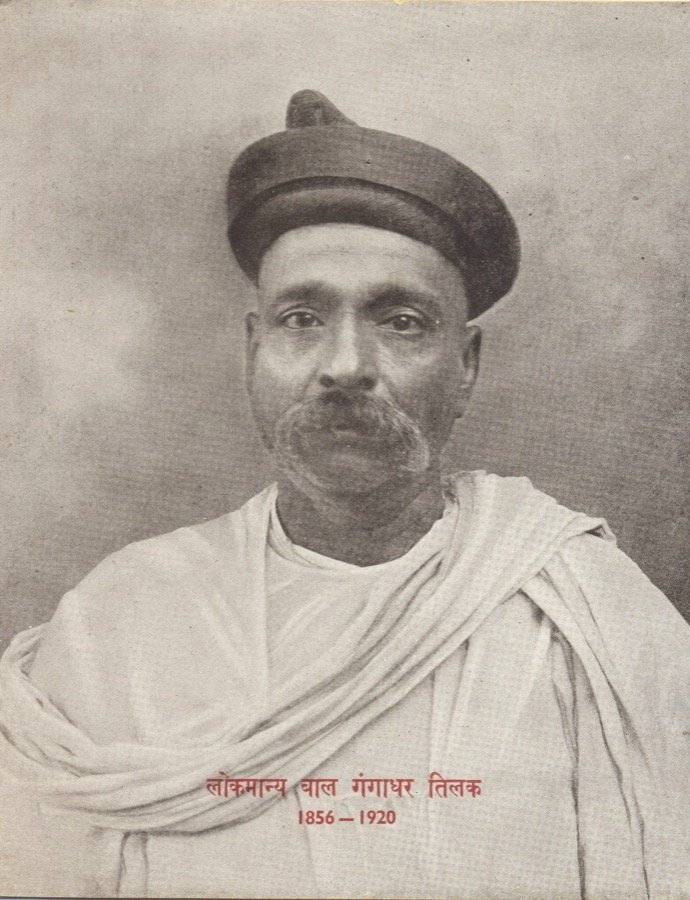
Despite this, nationalist newspapers kept growing, reporting colonial misrule and encouraging protest, which led to a renewed cycle of persecution and protests. When Punjab revolutionaries were deported in 1907, Balgangadhar Tilak wrote sympathetically about them in his paper Kesari, and was imprisoned in 1908, sparking protests all over India.
“Liberty of speech … liberty of the press … freedom of association. The Government of India is now seeking to crush the three powerful vehicles of expressing and cultivating public opinion.”
Mahatma Gandhi, 1922
Box 4 of the book adds that the government sometimes found it hard to get editors for loyalist papers: Sanders, editor of the Statesman (founded 1877), rudely asked how much he would be paid for losing his freedom, and the Friend of India refused a government subsidy, fearing it would have to obey government orders.
Revise the chapter’s own “Write in brief” and “Discuss” questions. Keep one dated sentence for each event in Section 9, for example: 1878, the Vernacular Press Act let the government censor reports and editorials in the vernacular press.
- Woodblock printing was developed in China, Japan and Korea; China was printing books this way from AD 594; Japan got it around AD 768-770; the Diamond Sutra (AD 868) is the oldest Chinese book; Korea’s Jikji (late 14th c.) is among the world’s oldest books printed with moveable metal type
- Marco Polo brought woodblock printing to Italy in 1295; Gutenberg developed the first-known printing press at Strasbourg in the 1430s and perfected it by 1448, printing the Bible
- Luther’s Ninety Five Theses (1517) were reproduced in vast numbers and led to a division within the Church; several scholars think print helped spread the ideas behind the Reformation; the Church later kept an Index of Prohibited Books from 1558
- Literacy in parts of Europe reached 60-80% by the late 18th century; chapbooks, almanacs and periodicals fed the “reading mania”
- Historians link print to the French Revolution through Enlightenment ideas, public debate, and mockery of royalty, but caution that print did not directly control minds
- Print reached India through Portuguese Goa (mid-16th century); Hickey’s Bengal Gazette (1780) began the English press; Rammohun Roy published the Sambad Kaumudi from 1821
- Print gave a voice to women (Rashsundari Debi’s Amar Jiban, 1876) and to caste reformers (Phule, Ambedkar, Periyar)
- The colonial government’s control tightened over time: Vernacular Press Act (1878), Tilak’s imprisonment (1908), Defence of India Rules (WWI), the Rowlatt-era Sedition Committee (1919), and the Defence of India Act (WWII), which suppressed about 90 newspapers in August 1942
- Can I name the oldest Chinese book, and the Korean book that is among the oldest printed with moveable metal type?
- Can I explain, in two lines, why the Roman Catholic Church began keeping an Index of Prohibited Books from 1558?
- Can I list three ways print culture is connected to the French Revolution, and the book’s own caution about that link?
- Can I name the first Tamil and Malayalam books printed in India, and when?
- Can I explain what the Vernacular Press Act of 1878 actually allowed the government to do?