
- How Belgium and Sri Lanka, both democracies, handled demands for power-sharing very differently, and what each choice cost or saved them
- What majoritarianism is, and why it can undermine a country’s unity even inside a democracy
- The two separate reasons, prudential and moral, that make power-sharing good for a democracy
- The four forms power-sharing can take in a modern democracy, with a real example of each
1Two Stories: Belgium and Sri Lanka
A speech bubble at the start of the chapter says: “I have a simple equation in mind. Sharing power = dividing power = weakening the country.” The chapter
then tests this common assumption with two stories, from Belgium and Sri Lanka. In the book’s words, the stories
“yield some general conclusions about the need for power-sharing in democracy”. They are two illustrations, one
for each side of the argument.
Belgium is a small European country, smaller in area than Haryana, bordering France, the Netherlands, Germany
and Luxembourg. Its population is a little over one crore, about half of Haryana’s. What makes Belgium
tricky to govern is its ethnic mix: the country is split by both region and language.
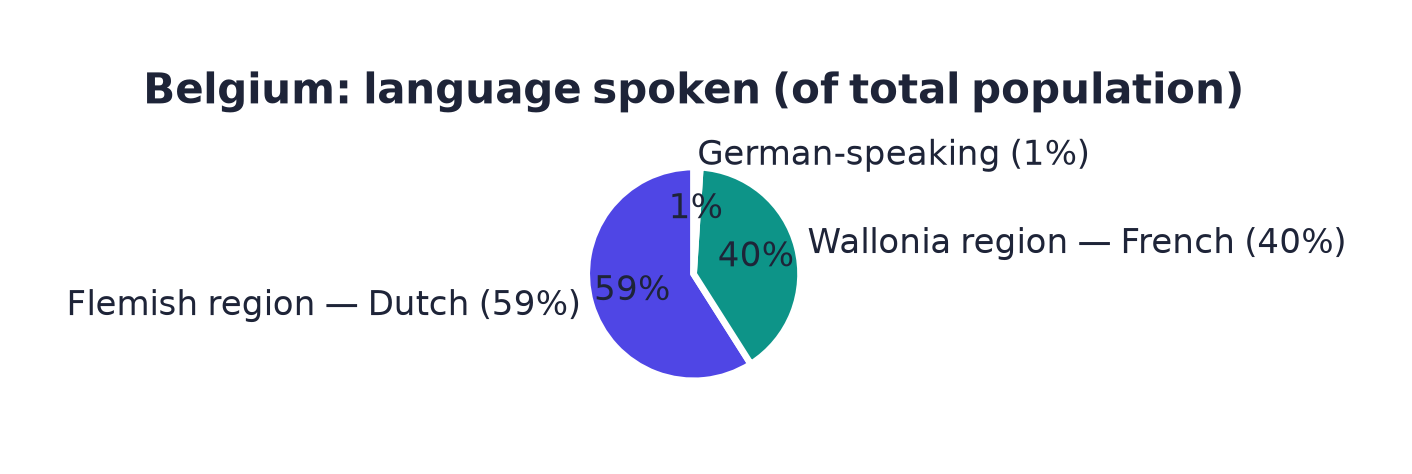
| Whole country | Capital city, Brussels | |
|---|---|---|
| French-speaking | 40% | 80% |
| Dutch-speaking | 59% | 20% |
Ethnic is a social division based on shared culture. People belonging to the same ethnic group
believe in their common descent because of similarities of physical type or of culture, or both. They need
not always share the same religion or nationality.
Notice how the table above flips: Dutch-speakers are the national majority (59%) but a small minority in
Brussels itself (20%). This is why, in the book’s words, “Brussels presented a special problem: the Dutch-speaking
people constituted a majority in the country, but a minority in the capital.” The minority French-speakers were relatively
rich and powerful, which the Dutch-speaking majority resented once they too gained access to
education and economic development. This resentment turned into open tension through the 1950s and
60s, felt most sharply in Brussels.
Do not assume “majority” automatically means “more powerful” in every sense. In Belgium, the Dutch-speakers
were the numerical majority but were, for a long period, economically and educationally behind the
French-speaking minority. Power-sharing questions in this chapter are not always a simple bigger-group-versus-
smaller-group story.
1.2 Sri Lanka: a country that did not
Sri Lanka is an island nation just a few kilometres off Tamil Nadu’s southern coast, with a population of
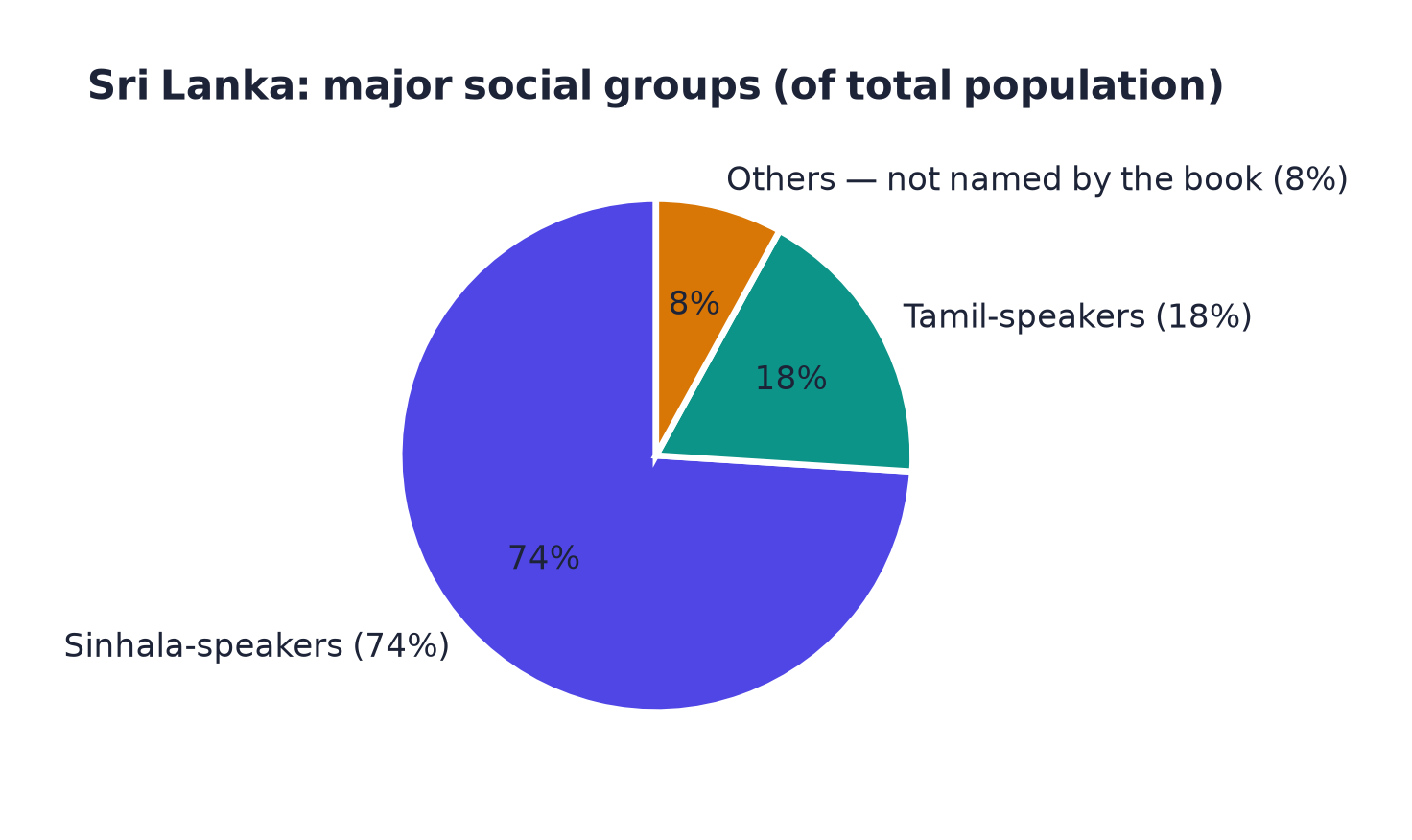
about two crore, roughly the same as Haryana. Its major social groups are the Sinhala-speakers (74%) and the
Tamil-speakers (18%). Among the Tamils, the natives of the country are called “Sri Lankan Tamils” (13%),
while the rest, whose forefathers were brought from India as plantation workers under colonial rule, are
called “Indian Tamils”. As the book’s map shows, Sri Lankan Tamils are concentrated in the north and east
of the country. Religion cuts across these language groups separately: most Sinhala-speakers are
Buddhist, most Tamils are Hindu or Muslim, and about 7% of the population, drawn from both language
communities, are Christian.
Sri Lanka became independent in 1948. Sinhala community leaders then sought to secure dominance over
government by virtue of their majority, and the elected government adopted one majoritarian
measure after another to establish Sinhala supremacy:
Sinhala-only Act
An Act recognised Sinhala as the only official language, thus disregarding Tamil.
Preferential policies
Government favoured Sinhala applicants for university positions and government jobs.
New constitution
Stipulated that the state shall protect and foster Buddhism.
Majoritarianism is a belief that the majority community should be able to rule a country in whichever
way it wants, by disregarding the wishes and needs of the minority.
These measures, coming one after another, deepened Sri Lankan Tamils’ sense of alienation. They felt the
constitution and government policy denied them equal political rights, discriminated against them in jobs
and other opportunities, and ignored their interests altogether. Tamils launched parties and struggles
demanding Tamil as an official language, regional autonomy, and equal opportunity in education and jobs, but
their demand for autonomy in Tamil-majority provinces was repeatedly refused. By the 1980s, several political
organisations were demanding an independent Tamil Eelam (state) in the north and east of the island.
The resulting distrust between the two communities turned into widespread conflict, and eventually into a
civil war: thousands of people from both communities were killed, many families fled as refugees, and many
more lost their livelihoods. The war caused a terrible setback to the country’s social, cultural and economic
life. It ended in 2009.
Civil war is a violent conflict between opposing groups within a country that becomes so intense
that it appears like a war.
1.3 Accommodation in Belgium
Belgian leaders took the opposite path from Sri Lanka’s: they recognised the existence of regional
differences and cultural diversity, and between 1970 and 1993 amended their constitution four times to
work out an arrangement letting everyone live together in the same country. This “Belgian model” is unusual
and, as the book says, very complicated even for people living in Belgium, but these arrangements “have worked
well so far”.
These arrangements helped Belgium avoid civic strife between its two major communities and a possible
division of the country along linguistic lines. When many countries of Europe came together to form the European
Union, Brussels was chosen as its headquarters.
Belgium
- Recognised regional and cultural diversity
- Constitution reshaped through negotiation, four times over 23 years
- Result: civic strife and a possible linguistic division avoided
Sri Lanka
- Majority tried to impose its will through one law after another
- Tamil demands for autonomy repeatedly denied
- Result: decades-long civil war, thousands killed
Both are democracies. Yet, they dealt with the question of power sharing differently. In Belgium, the leaders
have realised that the unity of the country is possible only by respecting the feelings and interests of different
communities and regions. … Sri Lanka shows us a contrasting example. It shows us that if a majority community wants
to force its dominance over others and refuses to share power, it can undermine the unity of the country.
The book’s own conclusion from the two stories.
2Why Is Power-Sharing Desirable?
The chapter gives two separate sets of reasons in favour of power-sharing: one practical, one about what
democracy actually means.
Prudential reason
- Reduces the chance of conflict between social groups
- Social conflict often turns into violence and political instability
- Imposing majority will looks attractive short-term, but undermines national unity in the long run
- “Tyranny of the majority” often affects the majority adversely as well, not only the minority
Moral reason
- Power-sharing is the very spirit of democracy itself
- Democratic rule means sharing power with everyone affected by it
- People have a right to be consulted on how they are governed
- A legitimate government is one where citizens, through participation, acquire a stake in the system
Prudential means based on prudence, or on a careful calculation of gains and losses. Prudential
decisions are usually contrasted with decisions based purely on moral considerations.
The book’s Exercise 2 asks: “State one prudential reason and one moral reason for power sharing with an example
from the Indian context.” Keep the two separate in your answer: prudential reasons stress that power sharing will bring
out better outcomes; moral reasons emphasise the very act of power sharing as valuable.
Annette studies in a Dutch medium school in the northern region of Belgium; many French-speaking students in her
school want the medium of instruction to be French. Selvi studies in a school in the northern region of Sri Lanka; all
the students in her school are Tamil-speaking and want the medium of instruction to be Tamil. The book asks: “If the
parents of Annette and Selvi were to approach respective governments to realise the desire of the child who is more
likely to succeed? And why?” Use Belgium’s community government and Sri Lanka’s majoritarian measures to answer it.
3Khalil’s Dilemma: Power-Sharing in Lebanon
The book tells this through a short story. Khalil, from Beirut, was born to an Orthodox Christian father
and a Sunni Muslim mother, not unusual in cosmopolitan Beirut, where many communities lived side by side yet
still fought a bitter civil war (one of Khalil’s uncles was killed in it). When that civil war ended, Lebanon’s
leaders agreed on fixed rules for sharing the top offices of the state:
| Office | Reserved for |
|---|---|
| President | Maronite sect of Catholic Christians |
| Prime Minister | Sunni Muslim community |
| Deputy Prime Minister | Orthodox Christian sect |
| Speaker (of Parliament) | Shi’a Muslims |
Under this pact, Christians agreed not to seek French protection, and Muslims agreed not to seek
unification with neighbouring Syria. When the deal was struck, Christians and Muslims were nearly equal in
number; Muslims are now the clear majority, yet both sides still respect the old agreement.
Khalil does not like this system. He is a popular man with political ambition, but under the present system
the top position is out of his reach. He does not practise either his father’s or his mother’s religion and does not
wish to be known by either. His elders, who have seen the bloodshed of the civil war, tell him the
present system is the best guarantee for peace. The book leaves the question open: would you rewrite
Lebanon’s rules, or keep them?
4Forms of Power-Sharing
For a long time it was believed all of a government’s power had to sit with one person or group in one
place, otherwise, it was thought, decisions could not be made or enforced quickly. Democracy changed this
belief: since people are the ultimate source of all political power, a good democratic government owes
respect to every group and view in society, so political power itself should be spread among as many
citizens as possible. In modern democracies, power-sharing arrangements can take many forms; the book describes four of “the most
common arrangements”.
Horizontal distribution
Power shared among the legislature, executive and judiciary, organs at the same level. Each checks the others, so none can use unlimited power: a system of “checks and balances”. Ministers answer to Parliament; judges, though appointed by the executive, can check both the executive and laws made by the legislature.
Vertical distribution
Power shared between governments at different levels: one general (federal) government for the whole country, India’s Central/Union Government, and provincial or regional governments, India’s State Governments, with the constitution clearly fixing each level’s powers. The same idea extends further down to the municipality and the panchayat. This system is not followed in all countries: many countries have no provincial or state governments. Belgium built this; Sri Lanka refused to.
Power shared among religious, linguistic or other social groups: Belgium’s “community government” is the chapter’s own example. In some countries, constitutional and legal arrangements make sure that socially weaker sections and women are represented in the legislatures and administration. India’s system of reserved constituencies in assemblies and Parliament (studied last year) is this type of arrangement: it gives space in government and administration to diverse social groups (such as the Scheduled Castes and Scheduled Tribes) who otherwise would feel alienated from the government.
Through parties and pressure groups
Power shared through competition among political parties, which ensures that power does not remain in one hand: in the long run it is shared among different parties that represent different ideologies and social groups. Two or more allied parties elected together form a coalition government. Interest groups (traders, industrialists, farmers, industrial workers) also gain a share by joining government committees or by pressuring the decision-makers.
| Real example | Which form of power-sharing? |
|---|---|
| Bombay High Court orders the Maharashtra Government to improve children’s homes in Mumbai | Horizontal (judiciary checking the executive) |
| Nigeria’s state finance ministers demand the federal government declare its income sources | Vertical (states versus the federal centre) |
| Ontario’s government (Canada) settles a land claim with the aboriginal community | Among social groups |
| Russia’s Union of Right Forces and Liberal Yabloko Movement agree to unite their organisations into a strong right-wing coalition | Through political parties |
Q. Germany’s 2005 election produced a “grand coalition” between the historically rival Christian
Democratic Union and Social Democratic Party. Which form of power-sharing is this, and why did it happen?
Step 1: Identify the actors: two political parties, not two organs of government or two levels of
government.
Step 2: Match to a form: this is power-sharing through political parties (Form 4).
Answer: Neither party won a clear majority of seats on its own in 2005, so, despite taking divergent
positions on policy, they had to jointly form a coalition government to run the
country at all.
“Who” tells you “which form”
Organs of government (legislature/executive/judiciary) means Horizontal. Levels of government
(Centre/State/panchayat) means Vertical. Communities (language/religion) means Social groups. Parties/pressure
groups means Political competition. Ask “who is sharing power with whom” first, and the form usually names
itself.
- Belgium shared power (four constitutional amendments, 1970-1993) and kept its unity; Sri Lanka imposed Sinhala majoritarianism (1956 Act onward) and fell into civil war (ended 2009)
- Power-sharing is desirable for two separate reasons: prudential (reduces conflict, keeps stability) and moral (it is the spirit of democracy itself)
- Lebanon fixes its top four offices by religious sect: President (Maronite), PM (Sunni), Deputy PM (Orthodox Christian), Speaker (Shi’a)
- Four forms of power-sharing: horizontal (organs of government), vertical (levels of government), among social groups, and through parties/pressure groups
- Can I explain, in my own words, why Belgium stayed united while Sri Lanka fell into civil war?
- Can I state one prudential reason and one moral reason for power-sharing, without mixing the two up?
- Can I name all four forms of power-sharing and give one real example of each, without looking at the book?
- Can I explain what “checks and balances” means in one sentence?
Activity: “Read any newspaper for one week and make clippings of news related to ongoing conflicts or wars.”
In groups of five, classify the conflicts by location (your state, India, outside India), find the cause of each, and
ask which of them are power sharing disputes that power sharing arrangements could resolve.
Cartoon (“Reigning the Reins”, 2005 Russia): “What, according to this cartoon, is the relationship between
democracy and concentration of power?”