
- What federalism means, and how it is different from a unitary system of government
- Why India is called a federal country, and how the Union, State and Concurrent Lists divide law-making power
- How linguistic states and India’s language policy tested and strengthened Indian federalism
- How Centre-State relations changed after 1990, and why federal power sharing works better today
- How decentralisation created a third tier of government, panchayati raj, and what it has and hasn’t achieved
1What is Federalism?
In the previous chapter you saw Belgium reduce the power of its Central Government and give
constitutional powers to its regions, while Sri Lanka stayed a unitary system with all power at the
centre. That contrast is exactly what this chapter is about: the form of power-sharing called
federalism, where power is divided vertically, between a central government and the
governments of a country’s states or provinces.
Federalism is a system of government in which the power is divided between a central
authority and various constituent units of the country. Usually, a federation has two levels of
government: one for the entire country, usually responsible for a few subjects of common national
interest, and others at the level of provinces or states, which look after the day-to-day
administration of their state. Both levels enjoy their power independently of the other.
Unitary government
- Only one level of government, or the sub-units are subordinate to it
- The central government can order the provincial or local government to do something
Federal government
- Two or more levels of government, each with its own powers
- The central government cannot order the state government to do something
- Both levels are separately answerable to the people
Only 25 of the world’s 193 countries have a federal political system, but their citizens make
up about 40% of the world’s population, and most large countries in the world are
federations.
| Countries labelled on the chapter’s world map of federal political systems | |
|---|---|
| North & South America | Canada · United States of America · Mexico · Venezuela · Brazil · Argentina · St. Kitts and Nevis |
| Europe | Germany · Switzerland · Austria · Belgium · Spain · Bosnia and Herzegovina · Russia |
| Asia & Middle East | Pakistan · India · United Arab Emirates · Malaysia |
| Africa | Ethiopia · Nigeria · Comoros · South Africa |
| Oceania | Australia · Micronesia |
The textbook shows these countries on a world map. The chapter’s exercises (Exercise 2) ask you to identify and shade
three federal countries (other than India) on a blank outline political map of the world, so
practise locating them on the map as well as naming them.
1.1 Seven Key Features of Federalism
Two or more tiers
There are two or more levels (tiers) of government.
Same citizens, different jurisdiction
Different tiers govern the same citizens, but each has its own jurisdiction over specific matters of legislation, taxation and administration.
Constitutionally guaranteed
The jurisdictions of each tier are specified in the constitution, so the existence and authority of every tier is guaranteed.
No unilateral change
The fundamental provisions of the constitution cannot be changed by one level of government alone: such changes need the consent of both levels.
Courts as umpire
Courts can interpret the constitution and the powers of each level; the highest court acts as an umpire if a dispute arises between levels.
Separate revenue sources
Sources of revenue for each level are clearly specified, to ensure its financial autonomy.
Dual objectives
The federal system safeguards and promotes the country’s unity, while also accommodating regional diversity, needing both mutual trust and agreement between levels to live together.
Jurisdiction is the area over which someone has legal authority. This area may be defined
in terms of geographical boundaries, or in terms of certain kinds of subjects.
1.2 Two Routes to Forming a Federation
The exact balance of power between the central and state governments is not the same in every
federation. It depends mainly on the historical context in which the federation was formed. There
are two routes:
“Coming together” federations
- Independent states come together on their own to form a bigger unit
- Pooling sovereignty and retaining identity increases their security
- Examples: USA, Switzerland, Australia
- Constituent states usually have equal power and are strong vis-à-vis the federal government
“Holding together” federations
- A large country decides to divide its power between constituent states and the national government
- Examples: India, Spain, Belgium
- The Central Government tends to be more powerful vis-à-vis the states
- Different constituent units often have unequal powers; some units are granted special powers
India is a “holding together” federation, not a “coming together” one. The book: “India, Spain and Belgium are examples of
this kind of ‘holding together’ federations.” The chapter’s fill-in-the-blank exercise uses this
pair of terms.
2What Makes India a Federal Country?
India became independent after a painful and bloody partition, and several princely states soon
merged into the country. The Constitution declared India “a Union of States”; it did not use the
word federation, but the Indian Union is built on the principles of federalism, and all seven
features from Section 1 apply to it.
2.1 The Three Lists
The Constitution provides a clear three-fold distribution of legislative powers between the Union
and the States:
| List | Who can legislate | Example subjects (book’s own) |
|---|---|---|
| Union List | Union Government alone, since a uniform policy is needed across the country | Defence, foreign affairs, banking, communications, currency |
| State List | State Governments alone | Police, trade, commerce, agriculture, irrigation |
| Concurrent List | Both: if their laws conflict, the Union Government’s law prevails | Education, forest, trade unions, marriage, adoption, succession |
A subject that is not printed in any list is not left ungoverned:
the Union Government has the power to legislate on such “residuary” subjects (the book’s own
example: computer software, which came up only after the Constitution was made).
2.2 States With Unequal Power
Most “holding together” federations, including India, do not give equal power to every
constituent unit.
Special-status States
Assam, Nagaland, Arunachal Pradesh and Mizoram enjoy special powers under Article 371, due to their peculiar social and historical circumstances, especially protecting indigenous peoples’ land rights and culture, and preferential government employment. Indians who are not permanent residents of such a State cannot buy land or a house there; similar special provisions exist for some other States as well.
Union Territories
Areas too small to be an independent State, but which could not be merged into an existing one, e.g. Chandigarh, Lakshadweep, and Delhi (the capital). They do not have State powers; the Central Government has special powers in running them.
2.3 Protecting the Power-Sharing Arrangement
The judiciary, the High Courts and the Supreme Court, plays an important role in overseeing
constitutional provisions and deciding any dispute about the division of powers. Both the Union and
State Governments have the power to raise resources by levying taxes, to carry out the
responsibilities assigned to them.
Exercise 3 asks: “Point out one feature in the practice of federalism in India that is similar
to and one feature that is different from that of Belgium.” Similar: both countries have shaped
their units around language (India’s linguistic States; Belgium’s Dutch-speaking Flemish and
French-speaking Wallonia regions). Different: Belgium also has a ‘community government’ elected by
people of one language community wherever they live, and equal numbers of Dutch- and
French-speaking ministers in its central government (Chapter 18); India has no such arrangement.
Belgium’s regional governments already had powers that the Centre could withdraw, and only in 1993
were they given constitutional powers.
3How is Federalism Practised?
Constitutional provisions are necessary for federalism to succeed, but they are not sufficient by
themselves. The real success of federalism in India is credited to the nature of India’s democratic
politics, which made the spirit of federalism, respect for diversity, and the desire to live together
into shared national ideals. If you compare the political map of India in 1947 with 2019, many old
States have vanished, many new ones have been created, and areas, boundaries and names have changed.
3.1 Linguistic States
Creating linguistic States was the first major test for India’s democratic politics. In 1947, the
boundaries of several old States were changed so that people who spoke the same language would live
in the same State. Some States, however, were created not on the basis of language but to recognise
differences of culture, ethnicity or geography: Nagaland, Uttarakhand and Jharkhand.
When the demand for linguistic States first came up, some national leaders feared it would break
up the country, and the Central Government resisted it for a time. The chapter says this fear was not borne out: experience showed linguistic States
actually made the country more united and made administration easier.
3.2 Language Policy
The Constitution did not make any single language India’s national language. Hindi was
made the official language, but it is the mother tongue of only about 40 per cent of Indians
(the chapter’s own approximate figure in this section; a later statistical box in the same chapter
gives a slightly more precise 44%, from the Census; both figures come from the book itself). Besides
Hindi, the Constitution recognises 21 other Scheduled Languages. A candidate for a Central
Government exam may take it in any of these languages, and States have their own official languages
too: much of the government work takes place in the official language of the concerned State.
Unlike Sri Lanka, the leaders of our country adopted a very cautious attitude in spreading the use of
Hindi.
Coalition government is a government formed by the coming together of at least two
political parties. Partners in a coalition usually form a political alliance and adopt a common
programme.
Promotion does not mean that the Central Government can impose Hindi on States where people speak
a different language.
The chapter, on the flexibility that helped India avoid Sri Lanka’s situation
3.3 India’s Linguistic Diversity
The Census of India, 2011, recorded more than 1,300 distinct languages as mother tongues.
Once languages like Bhojpuri, Magadhi, Bundelkhandi, Chhattisgarhi, Rajasthani and many others were
grouped together under ‘Hindi’, the Census still found 121 major languages. Of these, 22
languages are listed in the Eighth Schedule of the Constitution and called “Scheduled
Languages”; the rest are “non-Scheduled Languages”.
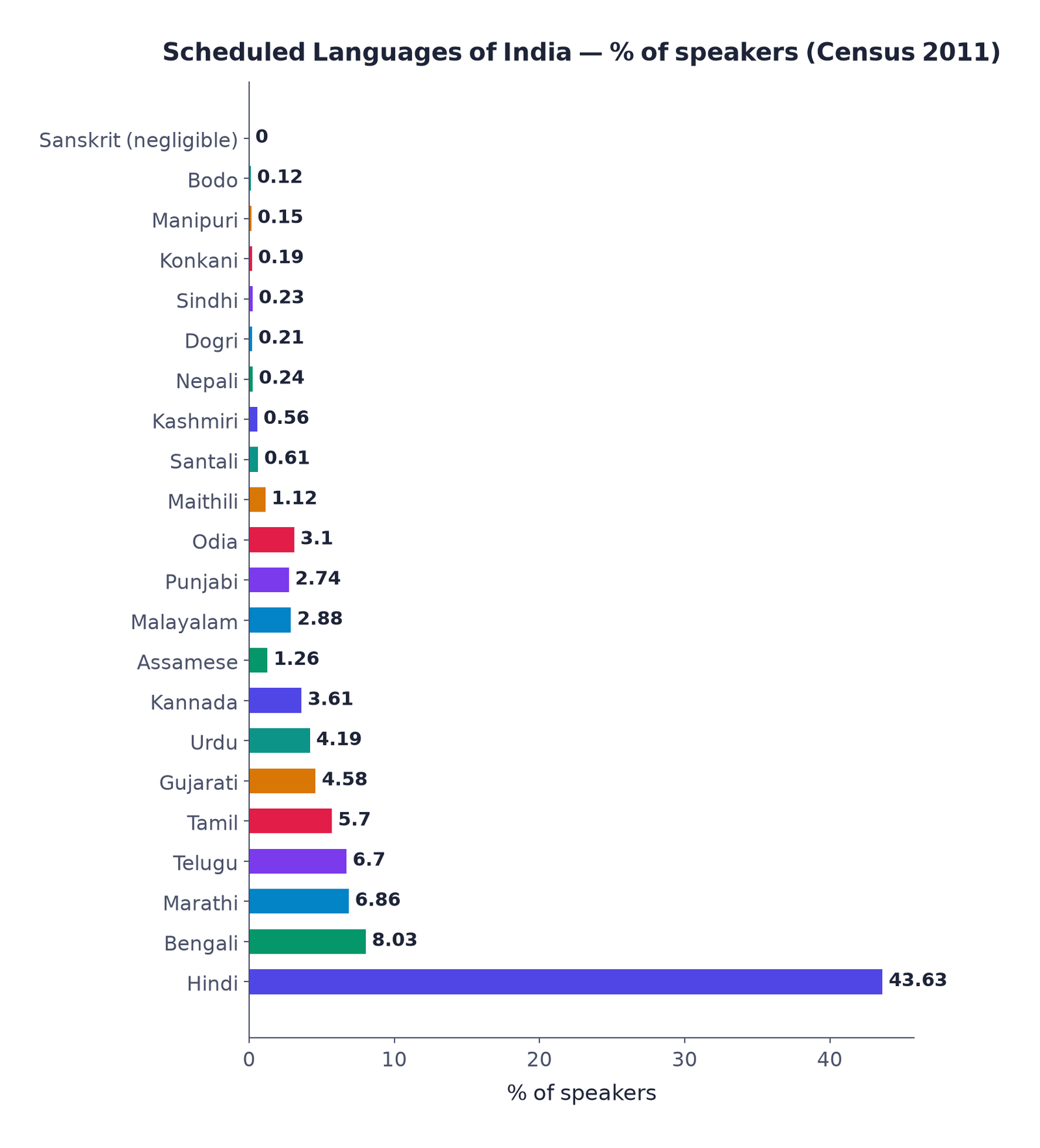
The chapter gives two figures for Hindi’s mother-tongue share: “about 40 per cent” in the
language-policy section, and “about 44 per cent” (43.63% in the Census table) in the linguistic-
diversity box. Quote the figure the question uses, and know which section it comes from. Counting
those who knew Hindi as their second or third language, the total was still less than 50 per cent
in 2011.
| Language | % speakers | Language | % speakers |
|---|---|---|---|
| Assamese | 1.26 | Manipuri | 0.15 |
| Bengali | 8.03 | Marathi | 6.86 |
| Bodo | 0.12 | Nepali | 0.24 |
| Dogri | 0.21 | Odia | 3.10 |
| Gujarati | 4.58 | Punjabi | 2.74 |
| Hindi | 43.63 | Sanskrit | N (negligible) |
| Kannada | 3.61 | Santali | 0.61 |
| Kashmiri | 0.56 | Sindhi | 0.23 |
| Konkani | 0.19 | Tamil | 5.70 |
| Maithili | 1.12 | Telugu | 6.70 |
| Malayalam | 2.88 | Urdu | 4.19 |
English is the mother tongue of only 0.02 per cent of Indians, though another 11 per
cent know it as a second or third language. The chapter also carries an excerpt from historian
Ramachandra Guha (Times of India, 1 November 2006) on linguistic reorganisation, and asks
students to write a short note for or against his argument (p.23).
3.4 Centre-State Relations
How well the constitutional power-sharing arrangement works in practice depends heavily on how
ruling parties and leaders actually follow it. For a long time, the same party ruled both the Centre
and most States, so States rarely asserted their rights as autonomous federal units; when a
different party ruled a State, the Centre often misused the Constitution to dismiss that State’s
government, undermining the spirit of federalism.
Federal power sharing is more effective today than it was in the early years after the
Constitution came into force.
The chapter’s own conclusion on Centre-State relations
4Decentralisation in India
A vast country like India cannot be run through just two tiers of government. Some States are as
large as entire European countries: Uttar Pradesh’s population is bigger than Russia’s, and
Maharashtra is about as big as Germany. Many States are themselves internally very diverse,
so power needs to be shared within States too. This is the rationale for a third tier below
the State governments, called local government.
Decentralisation is when power is taken away from Central and State governments and given
to local government. The idea behind it is that many problems are best settled at the local level,
since local people understand local problems better and have better ideas on spending money
efficiently. It also lets people directly participate in decision-making, building a habit of
democratic participation. Local government is the best way to realise one important principle of
democracy, namely local self-government.
4.1 Before 1992: Decentralisation on Paper Only
Panchayats (villages) and Municipalities (urban areas) were set up in all the States,
but they were directly controlled by State governments: elections to them were not
held regularly, and they had no powers or resources of their own. In effective terms, there was very
little real decentralisation.
4.2 The 1992 Amendment
✓ Made mandatory by the 1992 amendment
- Regular elections to local government bodies
- Reserved seats for SC, ST and OBC candidates in elected bodies and executive-head posts
- At least one-third of all positions reserved for women
- An independent State Election Commission in every State, to conduct panchayat and municipal elections
- State governments required to share some powers and revenue with local bodies
✗ Before 1992
- Local bodies directly under the control of State governments
- No regular elections to local bodies
- No powers or resources of their own
- The Constitution now requires States to share some powers and revenue, but most State governments have not transferred significant powers or adequate resources (section 4.5)
4.3 Panchayati Raj: Rural Local Government
The gram panchayat is the decision-making body for the entire village and works under the overall
supervision of the gram sabha, of which every voter in the village is a member. The gram
sabha has to meet at least twice or thrice a year to approve the annual budget of the gram panchayat
and to review the performance of the gram panchayat.
4.4 Urban Local Government
Municipality
- Set up in towns
- Controlled by an elected body of people’s representatives
- Political head: the municipal chairperson
Municipal Corporation
- Set up in big cities
- Also controlled by an elected body
- Political head: the mayor
In Porto Alegre, Brazil, the nearly 13 lakh people of the city get to participate in making
its budget, through ward-level meetings, like a gram sabha, open to anyone living in that area,
and city-wide meetings open to any citizen; about 20,000 people actually take part each year. It has ensured money isn’t spent only in rich neighbourhoods, and
builders can’t evict slum-dwellers without resettling them. A similar experiment has taken place in
parts of Kerala, India.
4.5 What Local Government Has Achieved, and Not Yet
Achieved
- The largest experiment in democracy conducted anywhere in the world
- Constitutional status has helped deepen democracy in India
- Increased women’s representation and voice
Still a difficulty
- Elections are held regularly, but gram sabhas are not held regularly
- Most State governments have not transferred significant powers or resources to local bodies
- India is still far from the ideal of true self-government
The book itself asks: if the Prime Minister runs the country and the Chief Minister runs the
State, why doesn’t the Zilla Parishad chairperson run the district instead of the D.M./Collector?
There’s no book-given answer, so answer in your own words based on what you’ve learnt about
elected vs administrative heads.
5Recap
- Federalism divides power between a central authority and constituent units; India is a “holding together” federation (like Spain, Belgium), not a “coming together” one (like the USA, Switzerland, Australia)
- India’s Constitution splits legislative power into the Union List, State List and Concurrent List; anything left over is a residuary power of the Union Government
- Assam, Nagaland, Arunachal Pradesh and Mizoram have special status under Article 371; Chandigarh, Lakshadweep and Delhi are Union Territories
- Linguistic states (1947 onward) and language policy (Hindi as official language, 21 other Scheduled Languages) were the two biggest tests of Indian federalism, and both strengthened it rather than dividing the country
- Federal power sharing became more effective after 1990, with the rise of regional parties, coalition governments at the Centre, and a Supreme Court check on arbitrary dismissal of State governments
- The 1992 amendment made local government (panchayati raj and urban bodies) a real third tier: mandatory elections, SC/ST/OBC and women’s reservation, and an independent State Election Commission
- Can I state all seven features of federalism, not just the first two or three?
- Can I explain the difference between a “coming together” and a “holding together” federation, with examples?
- Can I list which subjects go in the Union, State and Concurrent Lists, and say which government’s law wins in a conflict?
- Can I name India’s Article 371 special-status States and its Union Territories?
- Can I describe the panchayati raj structure from gram panchayat up to zilla parishad?
- Can I give at least two changes the 1992 amendment made to local government?