
- Why gender, a division that is rarely recognised in the study of politics, shapes who gets heard in a democracy, and where India still lags behind
- How ordinary religious belief differs from communalism, and what makes India’s Constitution a secular one
- What makes caste unlike every other social division, how it has changed and how it hasn’t, and the two-way relationship between caste and politics
Gender, religion and caste all do the same job in this chapter: each is a real social difference that
some people think should be kept out of politics entirely. This chapter argues, with evidence, that social
differences based on gender, religion and caste all get expressed in politics one way or another, and asks,
for each one, whether that expression is healthy for democracy or harmful to it. The book’s starting point: the
existence of social diversity does not threaten democracy, and political expression of social differences is
possible and sometimes quite desirable in a democratic system.
1Gender and Politics
1.1 The public/private division
Boys and girls are brought up believing that a woman’s main responsibility is housework and raising
children. This shows up as a sexual division of labour in most families: women do the cooking, cleaning,
washing and childcare inside the home; men work outside it. This is not because men cannot do housework:
when these jobs are paid for, men are ready to take them up (most tailors or cooks in hotels are men). Women, too, work
outside the home all the time: fetching water and working the fields in villages, working as domestic help or
in offices in towns. Most women, in fact, do paid work in addition to unpaid housework, but that unpaid
work is neither valued nor recognised.
Sexual division of labour is a system in which all the work inside the home is either done by the
women of the family, or organised by them through domestic helpers.
This division is often understood as “natural” or biological. The book is explicit that it is not based on
biology: it rests on social expectations and stereotypes about what men and women “should” do.
The result of this division of labour: although women are half of humanity, their role in public life,
especially politics, is minimal in most societies. Earlier, only men could vote or contest for public office.
Gradually, women in different countries organised and agitated for voting rights and equal treatment;
some of these movements went further, demanding equality in personal and family life too: these are called
feminist movements.
A feminist is a woman or a man who believes in equal rights and opportunities for women and men.
This political mobilisation improved women’s role in public life: women today work as scientists, doctors,
engineers, lawyers, managers and college/university teachers, jobs earlier considered unsuitable for them. In
some countries (the book names Sweden, Norway and Finland), women’s participation in public life is very high.
1.2 Where India still lags
India remains a male-dominated, patriarchal society, and women still face several disadvantages compared
with men.
Patriarchy literally means rule by the father; the term is used for a system that values men more than
women and gives men power over women.
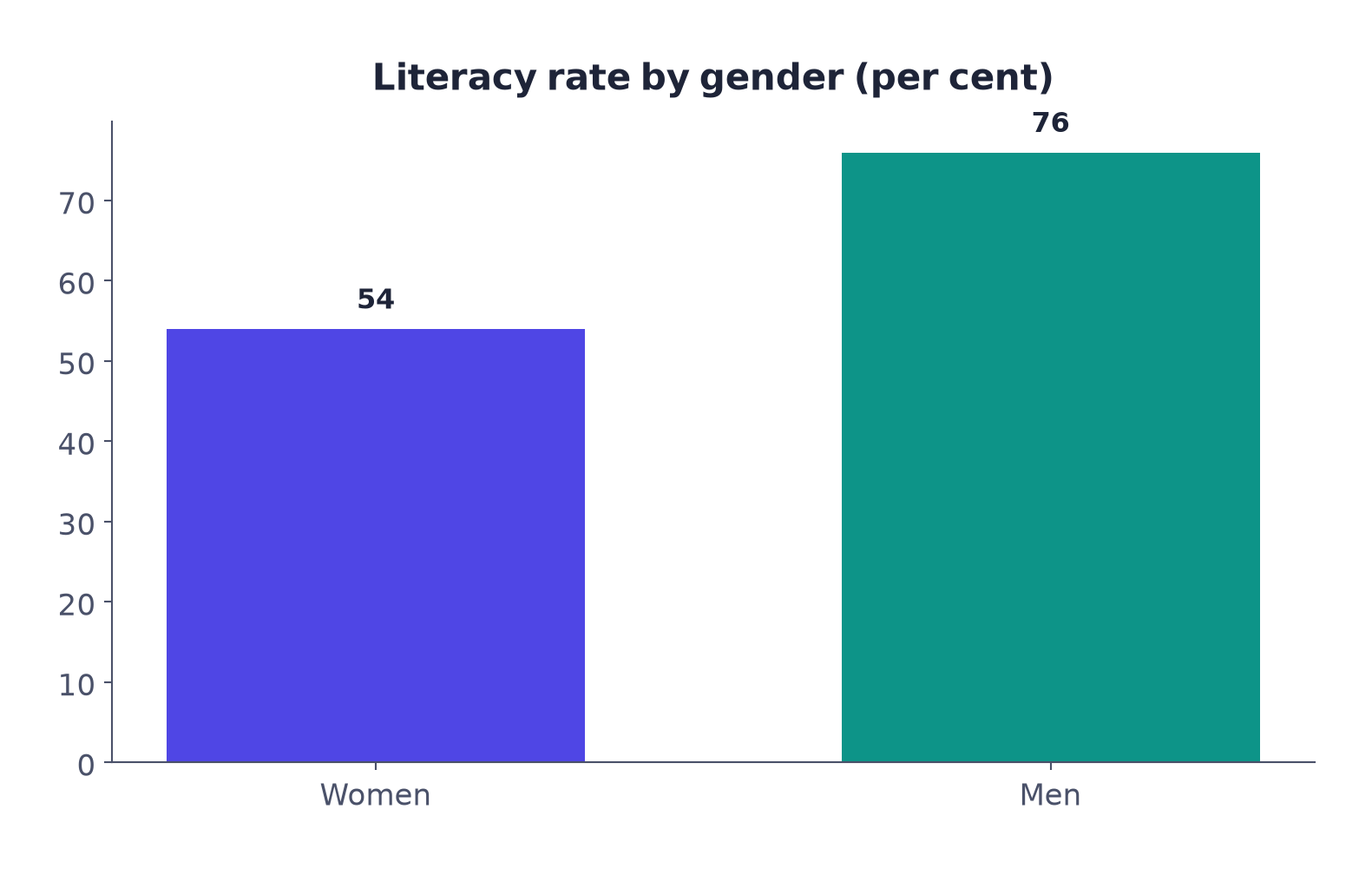
The literacy rate among women is only 54%, against 76% among men, and a smaller proportion of girl students
go for higher studies. In school results, girls perform as well as boys, if not better in some places, but they
drop out because parents prefer to spend their resources on their boys’ education rather than equally on sons
and daughters. Consequently, the proportion of women
in highly paid, valued jobs remains very small. An average Indian woman works one hour more than an average man
every day, yet much of her work goes unpaid and, therefore, unvalued.
| Daily time use (hours : minutes) | Men | Women |
|---|---|---|
| Income generating work | 6:00 | 2:40 |
| Household and related work | 0:30 | 5:00 |
| Talking, gossip | 1:25 | 1:20 |
| No work / leisure | 3:40 | 3:50 |
| Sleep, self-care, reading etc. | 12:25 | 11:10 |
Source: Government of India, Time Use Survey, 1998-99 (conducted in six states). An average
woman works a little over 7½ hours a day; an average man, 6½ hours. Men’s work is more visible because it
mostly generates income; women’s income-generating work exists too, but the bulk of their labour is unpaid
household work.
Other disadvantages the book lists: the Equal Remuneration Act, 1976 says equal wages must be paid for
equal work, but in almost every field (sport, cinema, factories, farms) women are paid less than men even for
identical work. In many parts of India, parents’ preference for sons, and sex-selective abortion of girls that
follows from it, has pushed the country’s child sex ratio (number of girls per 1,000 boys) down to
919 (Census 2011); the ratio has fallen below 850 or even 800 in some states. Urban areas are particularly unsafe for
women, who also face harassment, exploitation and domestic violence within their own homes.
1.3 Women’s political representation
Because women’s well-being gets inadequate attention, feminists and women’s movements have concluded that
unless women control power, their problems will not get adequate attention. One way to ensure this is to
have more women as elected representatives.
Lok Sabha, 2019
The share of women members in Lok Sabha touched this figure for the very first time in 2019.
State Assemblies
Women’s representation in State Legislative Assemblies is even lower: less than 5% of members.
Panchayati Raj
One-third of seats in panchayats and municipalities are reserved for women; over 10 lakh women now hold elected local office.

Cabinets remain largely all-male even when a woman becomes Chief Minister or Prime Minister. A bill to
reserve at least one-third of Lok Sabha and State Assembly seats for women was pending in Parliament for
decades. In 2023 the Nari Shakti Vandan Adhiniyam (Women’s Reservation Act, 2023) was passed, which will
give 33% reservation of seats for women in the Lok Sabha, State Legislative Assemblies and also the Delhi Assembly.
“Gender division is an example that some form of social division needs to be expressed in politics. This
also shows that disadvantaged groups do benefit when social divisions become a political issue.”
From the book, Section 1 (Gender and politics).
2Religion, Communalism and Politics
2.1 Religion in politics is not automatically dangerous
Religious diversity, unlike gender, is not found everywhere in the world, but it is fairly widespread.
India is one of many countries whose population follows several different religions. The book gives instances
that involve a relationship between religion and politics, and says they “do not seem very wrong or dangerous”:
Gandhiji used to say religion can never be separated from politics: by “religion” he did not mean any
one religion like Hinduism or Islam, but the moral values that inform all religions; he believed politics must
be guided by ethics drawn from religion.
Human rights groups have demanded government action to prevent communal riots and protect religious
minorities; the women’s movement has demanded that discriminatory family laws (on marriage, divorce, adoption,
inheritance) of all religions be changed to be more equitable.
The book adds that ideas, ideals and values drawn from different religions can and perhaps should play a role
in politics; people should be able to express in politics their needs, interests and demands as members of a
religious community; and those who hold political power should sometimes be able to regulate the practice of
religion so as to prevent discrimination and oppression. These political acts are not wrong as long as they
treat every religion equally.
2.2 What communalism actually is
The problem begins when religion is seen as the basis of the nation. It becomes more acute when religion is
expressed in politics in exclusive and partisan terms, when one religion and its followers are pitted against
another. Communalism rests on the belief
that one religion’s followers form a single community whose interests are all the same, and that people of
different religions cannot share a social community at all.
Communal politics is based on the idea that religion is the principal basis of social community.
Communalism involves thinking that the followers of a particular religion must belong to one community,
with the same fundamental interests. A communal mind often leads to a quest for political dominance of one’s own
religious community: majoritarian dominance for the majority community, and, for a minority community, it can
take the form of a desire to form a separate political unit.
Communalism can take various forms in politics (in the order the book lists them):
Everyday communal belief
The most common expression: religious prejudice, stereotyping of religious communities, belief in one’s own religion’s superiority, so routine that it often goes unnoticed even by those who hold it.
Quest for dominance
A communal mind seeks political dominance for its own religious community: majoritarian dominance if it is the majority, a separate political unit if it is the minority.
Political mobilisation
Using sacred symbols, religious leaders, emotional appeal and fear to bring one religion’s followers together in the political arena, especially in elections.
Communal violence
Sometimes communalism takes its most ugly form of communal violence, riots and massacre. India and Pakistan suffered some of the worst communal riots at the time of the Partition; the post-Independence period has also seen large scale communal violence.
The book uses Northern Ireland twice. First, it shows that even when most of the people belong to the same
religion, there can be serious differences about the way people practise that religion. Second, it shows the
dangers of an approach to nationalism in which religion is seen as the basis of the nation.
2.3 The secular state
Communalism was and continues to be one of the major challenges to democracy in India, and the Constitution’s makers were
aware of it, which is why they chose the model of a secular state.
A secular state has no official religion of its own, and does not favour any one religion over
others, but it can still act to guarantee equality and prevent discrimination within religious communities.
| Country | Religion whose special status the book notes |
|---|---|
| Sri Lanka | Buddhism |
| Pakistan | Islam |
| England | Christianity |
| India | None: no special status to any religion |
No official religion
Unlike Sri Lanka, Pakistan or England, the Indian Constitution gives no special status to any religion.
Freedom to any/no religion
All individuals and communities are free to profess, practise and propagate any religion, or none at all.
No discrimination
The Constitution prohibits discrimination on grounds of religion.
State can still intervene
To ensure equality within religious communities the state may regulate religious practice: for example, it bans untouchability.
A secular Constitution is necessary but not sufficient to combat communalism. Everyday communal prejudice must be countered in daily life, and religion-based political mobilisation
must be countered in the arena of politics itself.
3Caste Inequalities and Politics
3.1 What makes caste different
Every society has some social inequality and some division of labour; occupations usually pass from one
generation to the next. What makes the caste system an extreme, special-to-India form of this is that its
hereditary occupational division was sanctioned by ritual: members of one caste group formed a social
community that practised the same occupation, married within the group and did not eat with other castes.
The caste system is an extreme, ritually-sanctioned form of hereditary occupational division, based on
excluding and discriminating against “outcaste” groups, who were historically subjected to untouchability.
Caste hierarchy is a ladder-like formation in which caste groups are placed from the
“highest” to the “lowest”.
Reformers and political leaders worked against these inequalities:
Jotiba Phule
Social reformer named by the book among those who fought caste-based exclusion.
Mahatma Gandhi
Advocated and worked for a society free of caste inequality.
B.R. Ambedkar
Named alongside Gandhi and Phule for the same cause.
Periyar Ramaswami Naicker
The fourth reformer the chapter names in this list.
3.2 What has changed, and what hasn’t
Changed
- Economic development, urbanisation, spread of literacy/education, freedom to choose occupation, and weaker landlordism have loosened old caste-hierarchy notions
- Very rich and very poor people can now be found in every caste, “low” or “high”; twenty or thirty years ago it was very rare to find rich people among the “lowest” castes
- The Constitution of India prohibited any caste-based discrimination and laid the foundations of policies to reverse the injustices of the caste system
Not changed
- Most people still marry within their own caste or tribe
- Untouchability has not ended completely despite the constitutional ban
- Groups that had access to education under the old system did very well in modern education too, so there is a disproportionately large presence of “upper caste” among the urban middle classes
Urbanisation is the shift of population from rural areas to urban areas.
Occupational mobility is the shift from one occupation to another, usually when a new generation takes
up work different from its ancestors’.
3.3 Caste inequality today
Caste is an important source of economic inequality because it regulates access to resources of various
kinds. In the past, the so-called “untouchable” castes were denied the right to own land, while only the so-called
“twice born” castes had the right to education. This explicit and formalised inequality is now outlawed, but the
effects of centuries of accumulated advantages and disadvantages continue to be felt, and new kinds of
inequalities have also developed. Caste continues to be closely linked to economic status. The average economic status of caste groups still
follows the old hierarchy: “upper” castes best off, Dalits and Adivasis worst off, backward classes in between.
Every caste has some poor members, but the proportion living in extreme poverty is highest among the lowest
castes; every caste also has some rich members, but the “upper” castes are heavily over-represented among the
rich.
| Caste / community group | Rural (%) | Urban (%) |
|---|---|---|
| Scheduled Tribes | 45.8 | 35.6 |
| Scheduled Castes | 35.9 | 38.3 |
| Other Backward Classes | 27.0 | 29.5 |
| Muslim Upper Castes | 26.8 | 34.2 |
| Hindu Upper Castes | 11.7 | 9.9 |
| Christian Upper Castes | 9.6 | 5.4 |
| Sikh Upper Castes | 0.0 | 4.9 |
| Other Upper Castes | 16.0 | 2.7 |
| All groups | 27.0 | 23.4 |
Percentage of population living below the poverty line, 1999-2000 (“Upper Caste” here means
not from SC, ST or OBC; the poverty line was ₹327 or less per person per month in rural areas and ₹454 or less
in urban areas). Source: NSSO, 55th Round, 1999-2000.
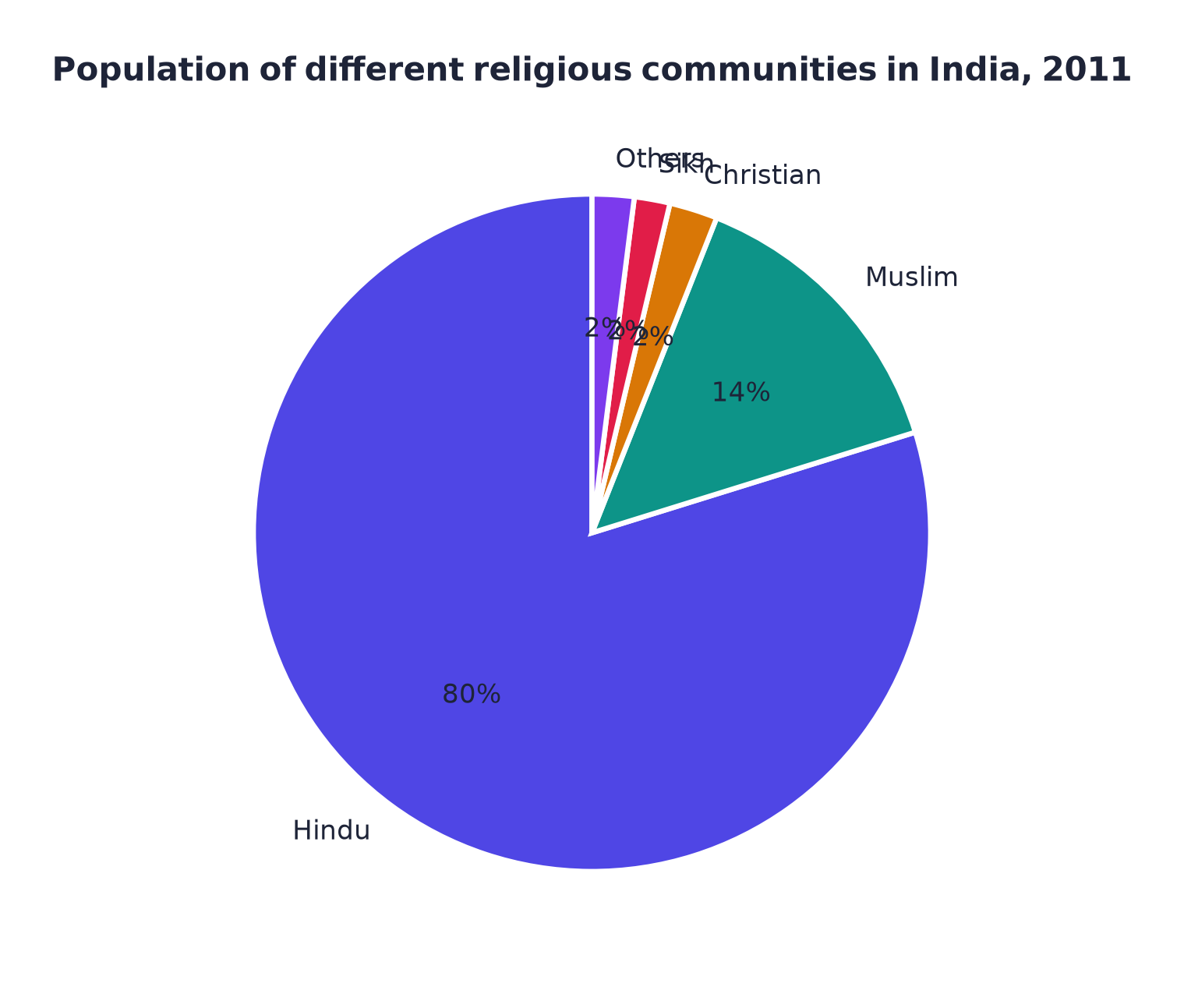
The Census records every citizen’s self-declared religion every ten years, exactly as stated (even “no
religion” or “atheist” is recorded verbatim), so these proportions are reliable. Since Independence, each
community’s share of the population has stayed broadly stable even as absolute numbers grew: Hindu, Jain and
Christian shares have declined marginally since 1961, while Muslim, Sikh and Buddhist shares have risen
slightly. Expert estimates done for the Prime Minister’s High Level Committee (popularly known as the
Sachar Committee) show that the proportion of the Muslims is expected to go up a little, by about 3 to 4 per
cent, in the next 50 years. So the book calls it a “common but mistaken impression” that the proportion of the
Muslims is going to overtake other religious communities.
Scheduled Castes
Share of India’s population, Census 2011: Dalits, previously “outcaste” under the Hindu social order.
Scheduled Tribes
Share of India’s population, Census 2011: Adivasis, communities largely secluded in hills and forests.
Other Backward Classes
National Sample Survey 2004-05 estimate; the Census does not yet count OBCs.
Together, SC, ST and OBC account for about two-thirds of the country’s population, and about three-fourths of
its Hindu population.
3.4 Caste in politics
Casteism, as in the case of communalism, is rooted in the belief that caste is the sole basis of social
community: people of the same caste are thought to form a natural social community with the same interests,
which they do not share with anyone from another caste. The book says this belief is not borne out by our
experience: caste is one aspect of our experience, but not the only relevant or the most important aspect.
Caste shapes politics in several ways: parties keep an electorate’s caste composition in mind when choosing
candidates and forming governments; parties and candidates appeal to caste sentiment for support; some parties
are seen as representing particular castes; and universal adult franchise (one person, one vote) gave castes
that were long treated as inferior a new political consciousness.
- No parliamentary constituency in the country has a clear majority of one single caste: every candidate needs support across castes to win
- No party wins the votes of all the voters of a caste or community; calling a caste one party’s “vote bank” usually means that a large proportion of the voters from that caste vote for that party
- Many parties may put up candidates from the same caste (if that caste is believed to dominate the electorate in a constituency); some voters have more than one candidate from their caste while many voters have none
- Ruling parties and sitting MPs/MLAs frequently lose elections in India: impossible if castes and communities were “frozen” in their political preferences
Other factors matter too: voters’ attachment to a political party is often stronger than their
attachment to caste; rich and poor, or men and women, within the same caste often vote very differently; and
people’s assessment of the government’s performance and the popularity rating of leaders matter and are often decisive.
3.5 Politics in Caste: The Reverse Direction
So far this is what caste does to politics; but the relationship also runs the other way: politics shapes
the caste system too, by drawing it into the political arena.
Castes grow larger
Each caste group tries to become bigger by incorporating neighbouring castes/sub-castes it had earlier excluded.
Castes form coalitions
Various caste groups are required to enter into a coalition with other castes or communities, and thus enter into a dialogue and negotiation.
New caste groups come up
New kinds of caste groups, like “backward” and “forward” caste groups, have come up in the political arena.
In some situations, expression of caste differences in politics gives many disadvantaged communities the
space to demand their share of power; in this sense, caste politics has helped people from Dalits and OBC castes
to gain better access to decision making. Several political and non-political organisations have been demanding
and agitating for an end to discrimination against particular castes, for more dignity and more access to land,
resources and opportunities. At the same time, exclusive attention to caste can produce negative results: as in
the case of religion, politics based on caste identity alone is not very healthy in a democracy. It can divert
attention from other pressing issues like poverty, development and corruption, and in some cases caste division
leads to tensions, conflict and even violence.
In the book’s words: “it is not politics that gets caste-ridden, it is the caste that gets politicised.”
From the book, section “Politics in caste”.
- Gender: sexual division of labour is social, not biological; women lag on literacy (54% vs 76%), wages, safety and child sex ratio (919, Census 2011); women’s share in Lok Sabha touched 14.36% for the first time in 2019; the Nari Shakti Vandan Adhiniyam (2023) will give 33% reservation of seats
- Religion: communal politics treats religion as the principal basis of social community; its forms run from everyday beliefs (most common) to communal violence (its most ugly form); religion in politics is not wrong as long as every religion is treated equally; India is a secular state with no official religion, but that alone is not enough to defeat communalism
- Caste: a hereditary, ritually-sanctioned occupational division special to India; old caste hierarchy is breaking down, but most people still marry within their own caste or tribe and untouchability has not ended completely; caste shapes candidate selection and voting, but no parliamentary constituency has a clear majority of one single caste; politics also reshapes caste itself by making castes merge, ally and re-form
- Can I explain, in my own words, why the sexual division of labour is social rather than biological?
- Can I state two constitutional features that make India a secular state?
- Can I give two reasons why caste alone cannot decide an Indian election?
- Can I explain how politics changes caste, not just how caste changes politics?