
- What biodiversity means, and the three levels at which it is studied
- How old biodiversity is, how many species exist, and how fast it is disappearing
- The ecological, economic and scientific importance of biodiversity
- The main causes behind the loss of biodiversity today
- How IUCN classifies threatened species, and how India and the world are trying to conserve biodiversity
- What mega diversity centres and biodiversity hotspots are, with real examples
In CBSE 2026-27 this chapter is assessed through internal assessment (project and presentation), not in the board theory paper. Only its map-work items come in the theory paper: the seven ecological hotspots Eastern Himalaya, Western Ghats, Indonesia, Eastern Madagascar, Upper Guinean forests, Atlantic forest (Brazil) and Tropical Andes.
1What Is Biodiversity?
You have already studied weathering and how it varies across climatic zones (Chapter 11). That same weathering mantle, shaped by solar energy and water, is what allows different kinds of vegetation, and therefore different kinds of life, to develop in different regions. Areas that receive plenty of solar energy and water end up with the widest range of life. This range of life is what this chapter calls biodiversity.
Biodiversity (Bio = life + diversity = variety) is the number and variety of organisms found within a specified geographic region. It covers the varieties of plants, animals and micro-organisms, the genes they contain, and the ecosystems they form.
Biodiversity is not spread evenly across the earth. It is consistently richer in the tropics; as you move towards the polar regions, the variety of species falls, even though the population of each surviving species tends to be larger. Biodiversity can be studied at three levels, each nested inside the next.
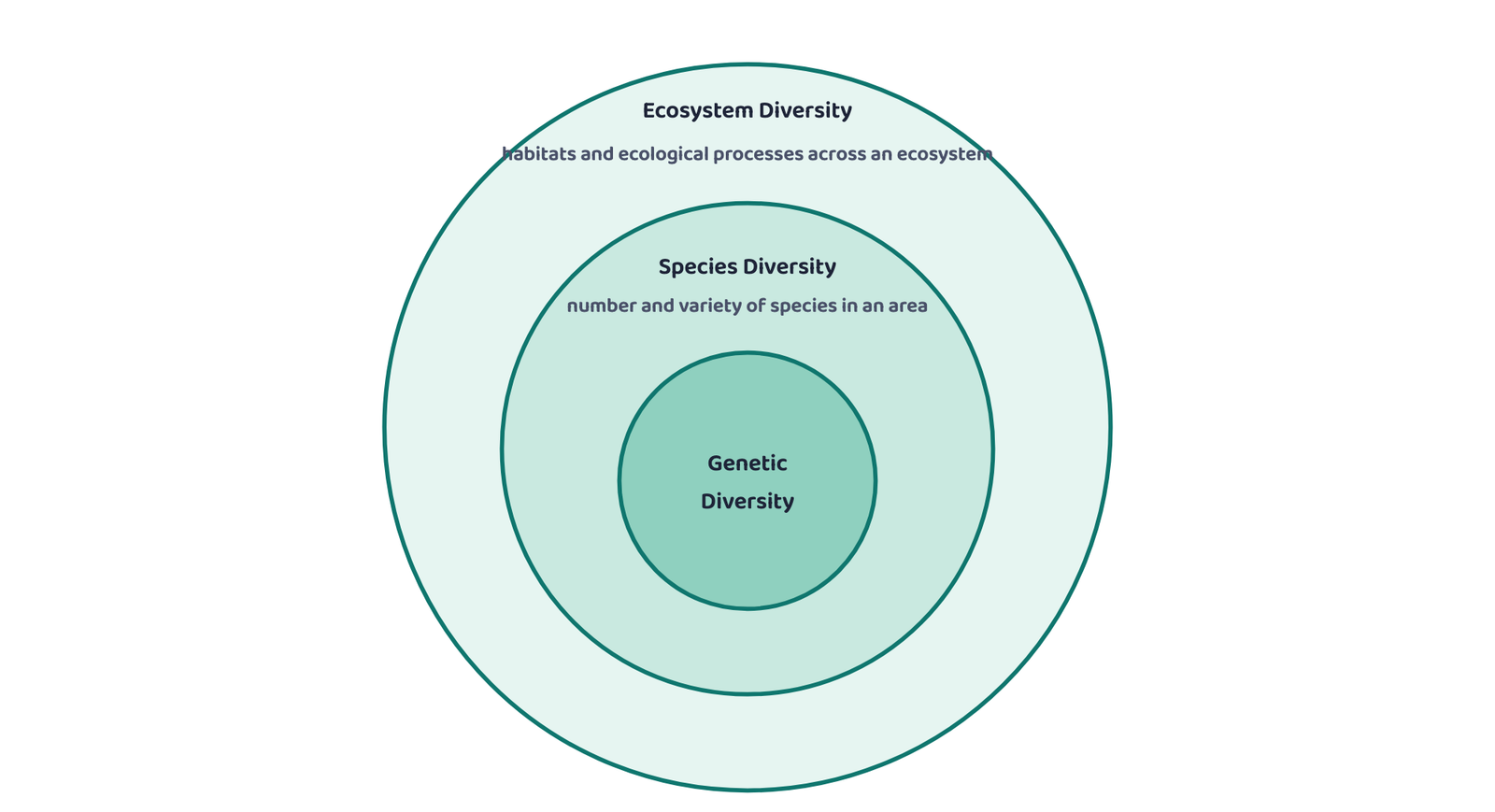
| Level | What it means |
|---|---|
| Genetic diversity | Variation of genes within a species. Humans all belong to the same species, Homo sapiens, yet differ considerably in height, colour and appearance because of genetic diversity. This diversity is essential for the healthy breeding of a population. |
| Species diversity | The variety of species in a defined area, measured through richness, abundance and types. Areas especially rich in species diversity are called hotspots of diversity. |
| Ecosystem diversity | The broad differences between ecosystem types, and the diversity of habitats and ecological processes within each type. The boundaries of ecosystems are not rigidly fixed, which makes them difficult to demarcate. Example: the grasslands and sholas of Indira Gandhi National Park, Annamalai, Western Ghats. |
Write the three levels in this order every time: genetic → species → ecosystem, each named and matched with a one-line explanation. Getting all three right matters more than length.
2Biodiversity in Numbers
Biodiversity as we see it today is the result of an extraordinarily long history of evolution, and it is still being counted and classified.
Before the advent of humans, the earth supported more biodiversity than in any other period. Since the emergence of humans, however, biodiversity has begun a rapid decline, with one species after another bearing the brunt of extinction due to overuse.
Estimates of the total number of species globally range from 2 million to 100 million, with 10 million treated as the most reliable figure. New species are still being discovered, and most of them remain unclassified: an estimated 40% of freshwater fish species from South America have not yet been classified. Tropical forests are very rich in biodiversity. Biodiversity is a system in constant evolution, from the point of view of species as well as of an individual organism.
3Importance of Biodiversity
Biodiversity has shaped human culture, and in turn, human communities have shaped the diversity of nature at the genetic, species and ecological levels. Biodiversity plays three distinct roles.
Ecological Role
Every species performs some function in its ecosystem: capturing and storing energy, producing and decomposing organic material, cycling water and nutrients, fixing atmospheric gases, and helping regulate climate. The more diverse an ecosystem, the better its species survive adversity, the more productive it is, and the more stable it remains.
Economic Role
Biodiversity is a resource for daily human life. Crop diversity (agro-biodiversity) is one important part of it. Biodiversity is a reservoir drawn upon for food, pharmaceutical and cosmetic products; important economic commodities from it include food crops, livestock, forests, fish and medicinal resources.
Scientific Role
Each species gives us clues about how life evolved and how it will keep evolving. Biodiversity helps us understand how life functions, and the role each species plays in sustaining ecosystems, of which humans are also a part.
Students often write only “biodiversity gives us food and medicine” for this whole topic. That covers only the economic role. An answer on “importance of biodiversity” must cover all three roles: ecological, economic and scientific.
It is also an ethical responsibility: every species, alongside us, has an intrinsic right to exist, so it is morally wrong to voluntarily cause the extinction of any species. The level of biodiversity is a good indicator of how healthy our relationship is with other living species, and the concept of biodiversity is an integral part of many human cultures.
4Loss of Biodiversity
Growth in human population over the last few decades has sharply increased the consumption of natural resources, accelerating the loss of species and habitats worldwide. Tropical regions occupy only about one-fourth of the world’s total area, yet hold about three-fourths of the world’s human population, and this pressure has made over-exploitation and deforestation rampant. Since tropical rain forests alone hold about 50% of all species on earth, destroying these habitats has proved disastrous for the entire biosphere.
| Cause | How it damages biodiversity |
|---|---|
| Overexploitation and deforestation | Driven by the resource needs of a large tropical population; destroys the habitats richest in species |
| Natural calamities | Earthquakes, floods, volcanic eruptions, forest fires and droughts damage flora and fauna and change the biodiversity of the affected region |
| Pesticides and pollutants | Hydrocarbons and toxic heavy metals destroy weak and sensitive species |
| Exotic species | Species introduced from outside a habitat have, in many cases, caused extensive damage to the natural biotic community already living there |
| Poaching | Tigers, elephants, rhinoceros, crocodiles, minks and birds hunted mercilessly for horns, tusks and hides, pushing them into the endangered category |
An exotic species is a species that is not a natural inhabitant of the local habitat, but has been introduced into that system from elsewhere.
5Conservation of Biodiversity
All forms of life are so closely interlinked that a disturbance in one gives rise to imbalance in others. If plant and animal species become endangered, they cause degradation in the environment, which can eventually threaten human existence too.
The International Union for Conservation of Nature and Natural Resources (IUCN) classifies threatened species of plants and animals into three categories, for the purpose of their conservation.
An endangered species is a species that is in danger of extinction. IUCN publishes information about such species worldwide as the Red List of threatened species.
A vulnerable species is a species likely to move into the endangered category in the near future if the factors threatening it continue, because its population has already reduced greatly.
A rare species is a species whose population is very small worldwide: confined to limited areas, or thinly scattered over a much wider area.
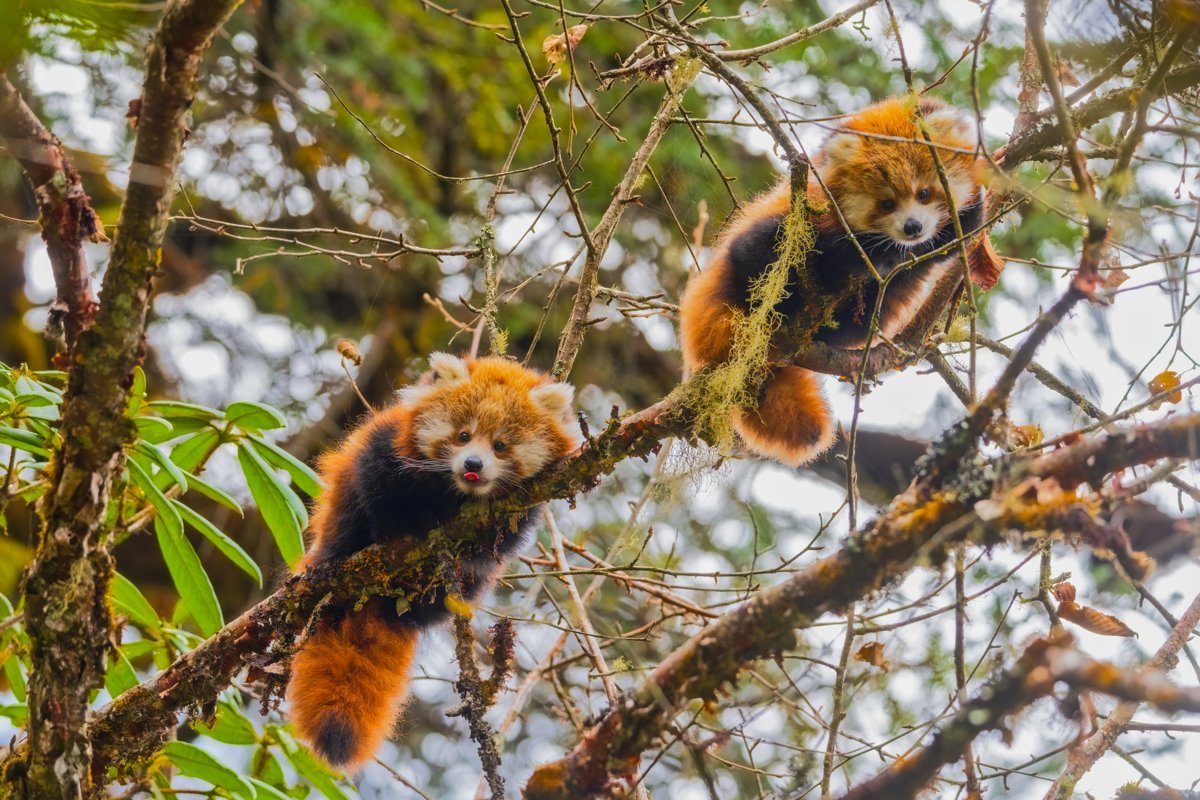
The book names two real examples: the Red Panda is classified as an endangered species, and Humboldtia decurrens Bedd, a tree found only in the southern Western Ghats of India, is a highly rare endemic species.
There is an urgent need to educate people towards environment-friendly practices, so that development stays harmonious with other life forms and sustainable. Conservation with sustainable use is only possible with the involvement of local communities and individuals, which needs institutional structures at the local level. The continuing process of conservation matters just as much as protecting any one species or habitat.
The world conservation strategy has suggested six steps for biodiversity conservation:
| Step | What it requires |
|---|---|
| (i) | Efforts should be made to preserve species that are endangered |
| (ii) | Prevention of extinction requires proper planning and management |
| (iii) | Varieties of food crops, forage plants, timber trees, livestock, animals and their wild relatives should be preserved |
| (iv) | Each country should identify habitats of wild relatives and ensure their protection |
| (v) | Habitats where species feed, breed, rest and nurse their young should be safeguarded and protected |
| (vi) | International trade in wild plants and animals should be regulated |
When asked for the conservation steps, write all six points as short numbered lines rather than one long paragraph, so that each step stands out clearly.
6Mega Diversity Centres and Biodiversity Hotspots
Some countries situated in the tropical region hold a disproportionately large share of the world’s species diversity. These are called mega diversity centres. There are 12 such countries.
A mega diversity centre is a country, typically in the tropics, that possesses a very large share of the world’s species diversity.
| # | Mega diversity centre country |
|---|---|
| 1 | Mexico |
| 2 | Colombia |
| 3 | Ecuador |
| 4 | Peru |
| 5 | Brazil |
| 6 | Democratic Republic of Congo |
| 7 | Madagascar |
| 8 | China |
| 9 | India |
| 10 | Malaysia |
| 11 | Indonesia |
| 12 | Australia |
To concentrate resources on the areas that are most at risk, the IUCN has identified certain such areas as biodiversity hotspots. Hotspots are defined according to their vegetation, since plants determine the primary productivity of an ecosystem. Most, though not all, hotspots also support local livelihoods through food, firewood, cropland and timber income.
A biodiversity hotspot is an area identified by the IUCN as holding an especially large share of species diversity that is also under especially high risk, so that conservation resources can be concentrated there.
| Hotspot example | What makes it a hotspot |
|---|---|
| Madagascar | About 85% of its plants and animals are found nowhere else in the world |
| Hawaiian Islands | Many unique plants and animals, threatened by introduced species and land development, despite being in a wealthy country |
Figure 14.4 of the book shows some ecological hotspots of the world. Learn them with the continent and country they lie in; the seven marked “Yes” are the CBSE 2026-27 map-work items for this chapter.
| Hotspot (Figure 14.4) | Continent / country | CBSE map item |
|---|---|---|
| Central American Lowland Forests | North America (Central America) | No |
| Central American Highland Forests | North America (Central America) | No |
| Western Ecuador and Colombian Choco | South America (Ecuador, Colombia) | No |
| Tropical Andes | South America (Andes mountains) | Yes |
| Atlantic Forest, Brazil | South America (Brazil) | Yes |
| Upper Guinean Forests | Africa (West Africa) | Yes |
| Eastern Arc Mountains, Tanzania | Africa (Tanzania) | No |
| Eastern Madagascar | Africa (Madagascar) | Yes |
| Western Ghats, India | Asia (India) | Yes |
| Eastern Himalaya | Asia (India) | Yes |
| Sinharaja Forest, Sri Lanka | Asia (Sri Lanka) | No |
| Peninsular Malaysia | Asia (Malaysia) | No |
| Philippines | Asia (Philippines) | No |
| Northern Borneo | Asia (Borneo) | No |
| Indonesia | Asia (Indonesia) | Yes |
| Queensland | Australia (north-east) | No |
| Melanesia (New Caledonia) | Oceania (Pacific islands) | No |
CBSE map work for this chapter asks you to locate and label these seven hotspots on an outline political map of the world.
| Hotspot | Continent / country | Where to mark it |
|---|---|---|
| Eastern Himalaya | Asia (India) | The eastern part of the Himalaya, in north-east India (Sikkim to Arunachal Pradesh) |
| Western Ghats | Asia (India) | The narrow hill strip along the western side of peninsular India, parallel to the Arabian Sea coast |
| Indonesia | Asia | The islands of Indonesia (Sumatra, Java and nearby islands), south-east of Malaysia, along the equator |
| Eastern Madagascar | Africa | The eastern side of the island of Madagascar, off the south-east coast of Africa |
| Upper Guinean forests | Africa | The forest belt along the coast of West Africa, just north of the Gulf of Guinea |
| Atlantic forest | South America (Brazil) | The strip along the Atlantic (south-east) coast of Brazil |
| Tropical Andes | South America | The tropical stretch of the Andes mountains in western South America (Venezuela to Bolivia) |
Lightly shade the area of each hotspot, write its name (or a number) beside it, and add a small key listing the numbers and names.
Q. A student is asked to name the total number of mega diversity centre countries and give any three examples.
Step 1: Recall the definition: countries in the tropics with a very large share of world species diversity.
Step 2: State the count: there are 12 such countries.
Answer: 12 countries; any three of Mexico, Colombia, Ecuador, Peru, Brazil, D.R. Congo, Madagascar, China, India, Malaysia, Indonesia, Australia.
The textbook’s own project asks you to list the national parks, sanctuaries and biosphere reserves of your own state. Build this as a simple table with three columns: National Parks, Sanctuaries, Biosphere Reserves, and fill each with the names for your state. The book also asks you to show their location on the map of India, so mark each one on an outline map of India.
- Biodiversity = Bio (life) + diversity (variety); studied at 3 levels: genetic → species → ecosystem
- Today’s biodiversity is 2.5-3.5 billion years old; best estimate of total species is 10 million; ~99% of all species that ever lived are extinct
- 3 roles of biodiversity: ecological, economic, scientific
- Tropical regions: 1/4 of world’s area but 3/4 of world’s population; tropical rainforests hold ~50% of all species
- Loss causes: overexploitation and deforestation, natural calamities, pesticides/pollutants, exotic species, poaching
- IUCN’s 3 threat categories: Endangered (Red List) → Vulnerable → Rare
- India: Wild Life (Protection) Act, 1972; World: Convention on Biological Diversity, Rio de Janeiro, 1992 (India + 155 nations)
- World Conservation Strategy: 6 steps, from preserving endangered species to regulating international trade in wild plants/animals
- 12 mega diversity centre countries, all in the tropics; biodiversity hotspots defined by vegetation (e.g. Madagascar: 85% endemic species)
- Since the emergence of humans, biodiversity has been declining rapidly, one species after another going extinct due to overuse
- CBSE 2026-27: chapter assessed through project/presentation (internal assessment); map work = 7 hotspots: Eastern Himalaya, Western Ghats, Indonesia, Eastern Madagascar, Upper Guinean forests, Atlantic forest (Brazil) and Tropical Andes
- 1 markConservation of biodiversity is important for:
(a) Animals(b) Animals and plants(c) Plants(d) All organisms - 1 markThreatened species are those which:
(a) Threaten others(b) Are lion and tiger(c) Are abundant in number(d) Are suffering from the danger of extinction - 1 markNational parks and sanctuaries are established for the purpose of:
(a) Recreation(b) Hunting(c) Pets(d) Conservation - 1 markBiodiversity is richer in:
(a) Tropical regions(b) Polar regions(c) Temperate regions(d) Oceans - 1 markIn which one of the following countries was the Earth Summit held?
(a) The UK(b) Mexico(c) Brazil(d) China - 1 markHow many countries are recognised as mega diversity centres?
(a) 10(b) 12(c) 15(d) 20 - 1 markIndia’s Wild Life (Protection) Act was passed in:
(a) 1952(b) 1962(c) 1972(d) 1992
Reason (R): Tropical rainforests contain about 50% of all the species found on earth.
Reason (R): Biodiversity is consistently richer in the tropics than in the polar regions.
Reason (R): An exotic species is a species introduced into a system from outside its natural habitat.
- 1 markGive the full form of IUCN.
- 1 markWhat does the word “biodiversity” literally mean?
- 1 markName the three levels at which biodiversity is studied.
- 1 markWhat is a biodiversity hotspot?
- 1 markIn which year, and where, was the Convention on Biological Diversity signed?
- 1 markWhat is meant by an “exotic species”?
- 2 marksDistinguish between an endangered species and a vulnerable species.
- 3 marksWhat is the ecological role of biodiversity? Give any two functions species perform in an ecosystem.
- 2 marksWhat is a rare species?
- 3 marksList the three categories into which the IUCN classifies threatened species, with one line on each.
- 2 marksName any four mega diversity centre countries.
- 3 marksWhat is the economic role of biodiversity? Name any three economic commodities it supplies to humankind.
- 5 marksWhat are the roles played by biodiversity in the shaping of nature?
- 5 marksWhat are the major factors responsible for the loss of biodiversity? What steps are needed to prevent them?
- 5 marksDescribe the three levels of biodiversity, with an example of each.
- 5 marksExplain the steps suggested by the World Conservation Strategy for biodiversity conservation.