1Mesopotamia Begins: Land, Names and Discovery
1.1 From Wandering to Settling
Cities did not appear out of nowhere. For millions of years before them, people lived by hunting animals and gathering wild plants, moving from place to place. This chapter is about what happened once that changed.
About 10,000 years ago, people slowly shifted from wandering in search of food to growing it themselves, settled agriculture. In West Asia they grew wheat, barley, peas and pulses; in East and Southeast Asia, millet and rice. Around the same time, people learned to keep animals instead of only hunting them, sheep, goat, cattle, pig and donkey were domesticated. A little later, about 5,000 years ago, cattle and donkeys were harnessed to ploughs and carts.
Some scholars call this whole change a “revolution”, because within a few thousand years it transformed how people lived almost beyond recognition. The pace picked up sharply once the very first cities began to grow.
1.2 The Land and Its Changing Names
City life first began in Mesopotamia, the land between the Euphrates and the Tigris rivers, now part of the Republic of Iraq. Mesopotamian civilisation is remembered for its prosperity, its city life, its huge and rich literature, and its mathematics and astronomy.
Mesopotamia comes from the Greek words mesos, meaning “middle”, and potamos, meaning “river”. It is the land lying between two rivers, the Euphrates and the Tigris.
After 2000 BCE, Mesopotamia’s writing and literature spread to the eastern Mediterranean, northern Syria and Turkey, so that kingdoms across that whole region wrote to each other, and even to the Pharaoh of Egypt, in the Mesopotamian language and script. But the land’s own name, and its main language, kept changing over the centuries.
| Period | The land was called | The main language was |
|---|---|---|
| Earliest recorded history | Sumer and Akkad (the urbanised south) | Sumerian, the first known language of the land |
| From c. 2400 BCE | Sumer and Akkad | Akkadian gradually replaces Sumerian, and lasts till Alexander’s time (336-323 BCE) |
| After 2000 BCE | Babylonia, once Babylon became an important city | Akkadian continues; Aramaic trickles in from 1400 BCE |
| From c. 1100 BCE | Assyria, once the Assyrians built their kingdom in the north | Aramaic becomes widely spoken after 1000 BCE, and is still spoken in parts of Iraq today |
S-A-B-A: Sumer/Akkad → Akkadian → Babylonia → Assyria
Read the region names in this order and you have the whole political history of ancient Mesopotamia in four words.
1.3 Digging Up the Past: Archaeology and the Bible
Archaeology in Mesopotamia began in the 1840s. At sites like Uruk and Mari, excavations went on for decades, longer than any dig in India. Because of this, historians can study hundreds of Mesopotamian buildings, statues, ornaments, graves, tools and seals, and thousands upon thousands of written tablets.
Europeans first grew interested in Mesopotamia because of the Bible. The Book of Genesis, in the Old Testament, mentions a land called “Shimar” (Sumer) as a land of brick-built cities. Early travellers and scholars saw Mesopotamia as a kind of ancestral homeland, and when archaeological work began, the first goal was actually to prove that the Bible’s stories were literally true.
According to the Bible, a great Flood was meant to destroy all life on earth, but Noah built an ark and saved a pair of every animal. Mesopotamian tradition has a strikingly similar flood story, with the hero called Ziusudra or Utnapishtim instead of Noah. In 1873, a British newspaper even funded a British Museum expedition just to search for a tablet narrating this Flood story.
By the 1960s, historians understood that the Old Testament’s stories were not literally true, but were ways of remembering real changes in history. Archaeological methods became far more careful, and attention shifted to a new question: not “is the Bible true”, but “how did ordinary Mesopotamians actually live”. Most of what the rest of this chapter describes comes from that later, more scientific kind of study.
2The Land and the Idea of the City
2.1 The Geography of Mesopotamia
Iraq is a land of very different environments side by side, and this variety shaped where cities could grow and where they could not.
| Zone | What it was like | What it offered |
|---|---|---|
| North-east | Green, rolling plains rising to tree-covered mountains, with streams and enough rain to farm | Rain-fed agriculture, going back to 7000-6000 BCE |
| North | A stretch of upland called the steppe | Better for herding sheep and goats than for farming, especially after the winter rains |
| East | Tributaries of the river Tigris | Routes of communication into the mountains of Iran |
| South | Desert | Where the first cities and writing appeared, made farmable only because the Euphrates and Tigris carry fine silt down from the northern mountains and deposit it when they flood |
Even without rainfall, irrigated southern Mesopotamia was, in the book’s own words, “the most productive” farming system of any ancient civilisation, more productive than even the Roman Empire’s agriculture. The reason was silt, not rain. This exact comparison is a favourite one-mark question.
2.2 Why Did Cities Grow? The Idea of Urbanism
It is tempting to think cities grew simply because Mesopotamia’s countryside was rich in food. But the chapter is clear that this is not the whole answer, and NCERT’s own first exercise question asks exactly this.
A city is not just a place with a large population. Urbanism is what happens when an economy develops activities besides food production, trade, manufacturing and services, so that people find it worthwhile to cluster together. This need for constant exchange between specialists is called the division of labour.
Think of a stone-seal carver. He needs bronze tools he cannot make himself, and coloured stones he does not know how to find; his own skill is fine carving, not trading or metalworking. The bronze toolmaker, in turn, does not go and dig for copper and tin himself. Everyone depends on everyone else, and someone has to organise the trade, storage and delivery that this depends on, which is why urban economies so often need written records.
NCERT asks you to sort highly productive agriculture, water transport, the lack of metal and stone, the division of labour, the use of seals, and kings’ military power, into necessary conditions, causes, and outcomes of early urbanisation. One well-reasoned way to sort them:
Necessary conditions (present, but not enough by themselves): productive agriculture, and cheap water transport.
Causes (what actually pushed cities to form): the lack of metal and stone, which forced organised long-distance trade, and the resulting division of labour.
Outcomes (results, once city life had begun): the use of seals to mark ownership and authenticity, and kings’ power to make labour compulsory.
3Trade and the First Tablets
3.1 Moving Goods Into the Cities: Trade
However rich Mesopotamia’s food supply was, its mineral resources were poor. Southern Mesopotamia had almost no good stone for tools, seals or jewels; its date-palm and poplar wood was too weak for carts or boats; and it had no metal at all for tools or ornaments.
So Mesopotamians traded their abundant textiles and farm produce for wood, copper, tin, silver, gold, shell and stones, brought from Turkey, Iran, and across the Gulf. This kind of regular, organised exchange was only possible where there was social organisation to equip expeditions and manage the trade.
Do not write that cheap transport by land made cities possible. The chapter says the exact opposite: pack animals and bullock carts eat too much feed to be economical over long distances. It was river transport, boats and barges pushed by the current or wind, that was the cheapest way to move grain and charcoal, and Mesopotamia’s canals doubled as these trade routes.
3.2 The Development of Writing
All societies talk to each other with spoken sounds, but writing is different: it turns those same sounds into visible signs on a surface. The very first Mesopotamian tablets, written around 3200 BCE, were simple picture-like signs and numbers.
About 5,000 of these earliest tablets have been found. They are not stories or letters at all, they are lists: of oxen, fish and bread loaves, being brought into or given out from the temples of Uruk, a city in the south. Writing, in other words, began as a way to keep records, because in a city, transactions happened constantly, involving many people and many different goods.
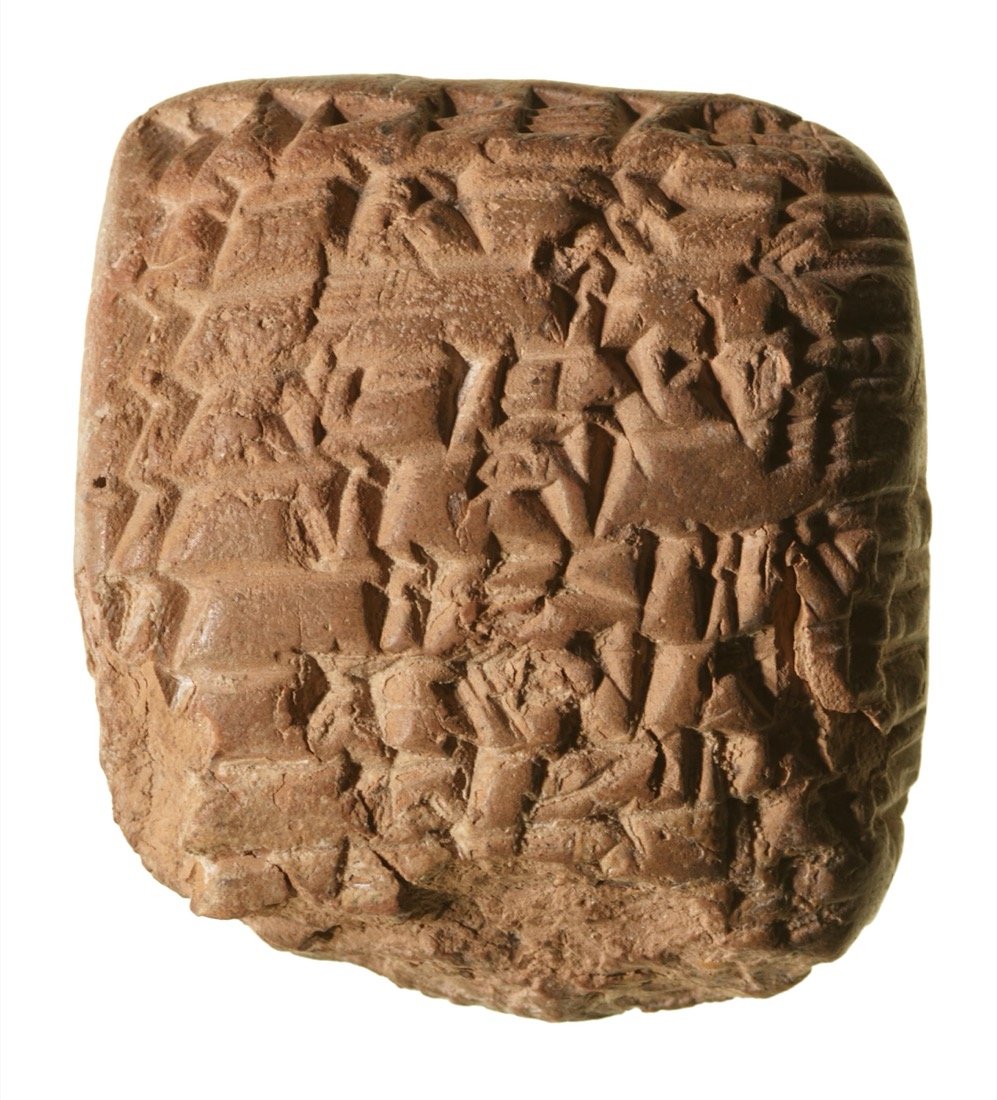
Mesopotamians wrote on tablets of wet clay, patted flat enough to hold in one hand and smoothed on both sides. A scribe pressed wedge-shaped signs into the moist surface with the sharp, obliquely cut end of a reed. Once the clay dried in the sun, it hardened almost like pottery, and no new sign could ever be pressed onto it again. That is why every single transaction, however small, needed its own fresh tablet, and why tablets survive at Mesopotamian sites by the hundreds.
Cuneiform comes from the Latin cuneus, meaning “wedge”, and forma, meaning “shape”. It is the wedge-shaped writing pressed into clay tablets with a cut reed, first used in Mesopotamia.
By about 2600 BCE, the script had become fully cuneiform, written in Sumerian. From here writing quickly outgrew simple record-keeping: it was now used to compile dictionaries, to give legal force to land transfers, to narrate the great deeds of kings, and to announce changes a king had made to the customary laws of the land. Cuneiform writing in the Akkadian language stayed in use until the first century CE, more than 2,000 years after it began.
4How Writing Worked
4.1 Cuneiform: The System, and Who Could Read It
A cuneiform sign did not stand for a single letter the way “m” or “a” does in English. Instead, each sign stood for a whole syllable, such as -put-, -la- or -in-. Because of this, a Mesopotamian scribe had to learn hundreds of different signs, and had to write fast enough to finish a tablet before the wet clay dried out. Writing was a skilled craft, and, more importantly, an enormous intellectual achievement: turning the sounds of a spoken language into a system of visible marks.
Given how hard this was to learn, it is no surprise that very few Mesopotamians could actually read and write. A king who could read made absolutely sure to record this fact in one of his own boastful inscriptions. Even so, most writing still reflected the way people actually spoke, a letter from an official had to be read aloud to the king, so it opened just like spoken speech: “To my lord A, speak: … Thus says your servant B: I have carried out the work assigned to me…”
4.2 The Uses of Writing: The Story of Enmerkar
A long Sumerian poem tells how writing connected trade and city life through Enmerkar, an early ruler of Uruk, the city so central to Mesopotamian tradition that it was simply called “The City”.
Enmerkar wanted lapis lazuli and precious metals to beautify a city temple, and sent his messenger across seven mountain ranges to the distant land of Aratta, again and again, carrying threats and promises. Eventually the messenger “grew weary of mouth” and could not keep the long spoken messages straight. So, the poem says, “Enmerkar formed a clay tablet in his hand, and he wrote the words down. In those days, there had been no writing down of words on clay.”
from the Sumerian epic of Enmerkar and the Lord of Aratta
This is not meant to be taken as the literal invention of writing. What it tells historians is how Mesopotamians themselves understood their own history: it was kingship that organised both trade and writing, and writing itself was seen as proof of Mesopotamian urban culture’s superiority over its neighbours.
5Temples, Kings and Uruk
5.1 Temples and Kings: Urbanisation in Southern Mesopotamia
From 5000 BCE, villages in southern Mesopotamia slowly grew into towns of different kinds, those that grew up around temples, those that became trading centres, and imperial cities. This chapter looks closely at only the first two kinds.
The very earliest known temple was a small shrine, made of unbaked bricks. Over time, temples were rebuilt bigger and bigger, in fired brick, with rooms arranged around open courtyards. What always set a temple apart from an ordinary house was its outer wall, going in and out at regular intervals, because a temple was the house of a god.
The temple was seen as the residence of a particular god, such as the Moon God of Ur or Inanna, the Goddess of Love and War, and as the theoretical owner of the local fields, fisheries and herds. Over time it also processed produce like oil, grain and wool, and kept the community’s written records, making it the main institution of the whole city.
But agriculture in Mesopotamia was never fully safe from hazards. The Euphrates’ channels could flood too much in one year, or shift course entirely, and villages upstream could take so much water that villages downstream went dry, or block a channel with unswept silt. All this led to repeated conflict over land and water.
Leaders also encouraged villagers to settle close by, both so an army could be gathered quickly, and because people were simply safer living near one another.
5.2 Uruk: A City of Kings, Temples and New Technology
Uruk, one of the very earliest temple towns, shows this process at its clearest. Its art shows armed heroes and their victims, and by around 3000 BCE it had grown to an enormous 250 hectares, twice the size Mohenjo-daro would reach centuries later, while dozens of small nearby villages were abandoned. This was a major shift of population into the city.
Uruk built a defensive wall very early, and was occupied continuously from about 4200 BCE to about 400 CE. War captives and local people were put to compulsory work for the temple or the ruler directly, not as an agricultural tax, and were paid in rations, hundreds of ration lists survive, recording exactly how much grain, cloth or oil each worker received. One temple alone is estimated to have taken 1,500 men, working ten hours a day, five whole years to build.
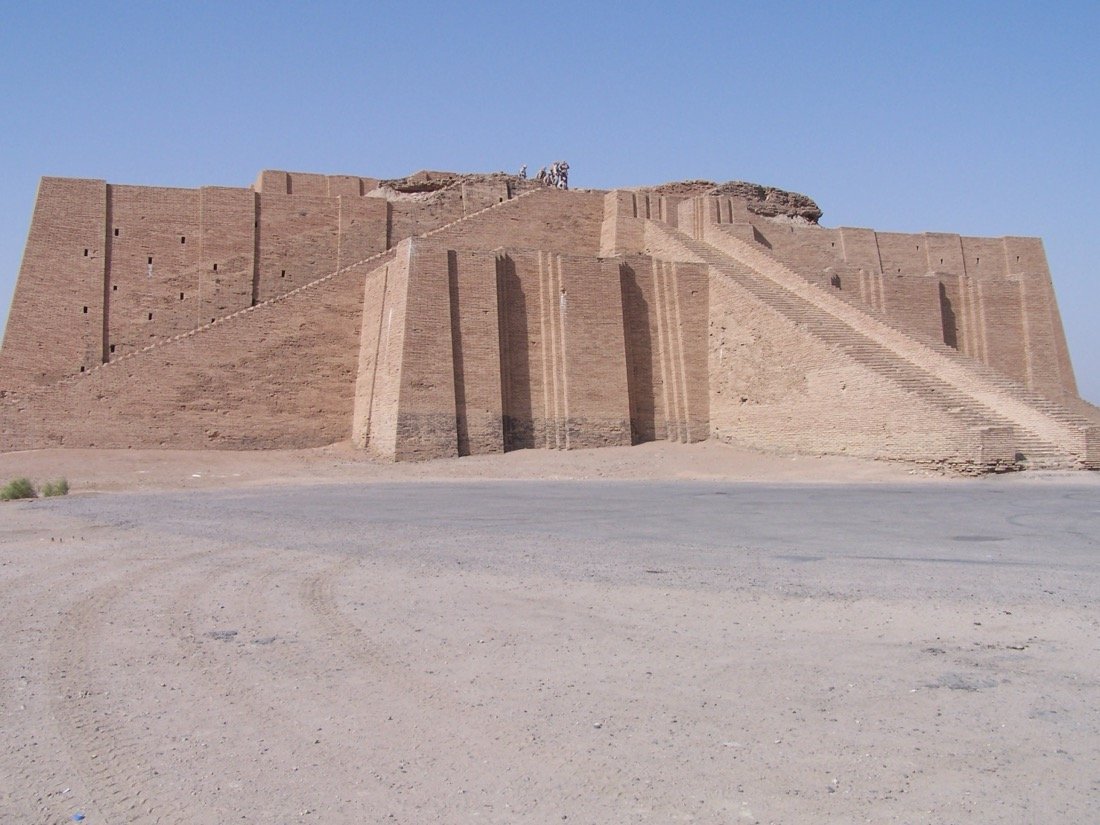
A ziggurat is a stepped, tower-like temple platform built in ancient Mesopotamian cities. Babylon, at its height, had a ziggurat as part of its ritual centre, reached by a processional way.
Around 3000 BCE, Uruk also saw real technical progress: bronze tools for various crafts, brick columns built because there was no suitable local wood to support the roofs of large halls, and clay cones baked and pushed into temple walls to create colourful mosaics. Most important of all was the potter’s wheel, a genuine technological landmark that let a workshop mass-produce dozens of near-identical pots at a time.
Bronze is an alloy of copper and tin. Both metals had to be brought from far away, so using bronze meant organising long-distance trade, and bronze tools made fine carpentry, bead-drilling and seal-carving possible.
6Seals and Everyday Life in Ur
6.1 The Seal: An Urban Artefact
In India, early stone seals were stamped flat onto a surface. Mesopotamia, until the end of the first millennium BCE, used a different design entirely.
A cylinder seal was a small stone cylinder, pierced through the centre and fitted onto a stick, then rolled over wet clay so that a continuous picture appeared. They were carved by highly skilled craftsmen and sometimes carried writing, the owner’s name, his god, or his official position.
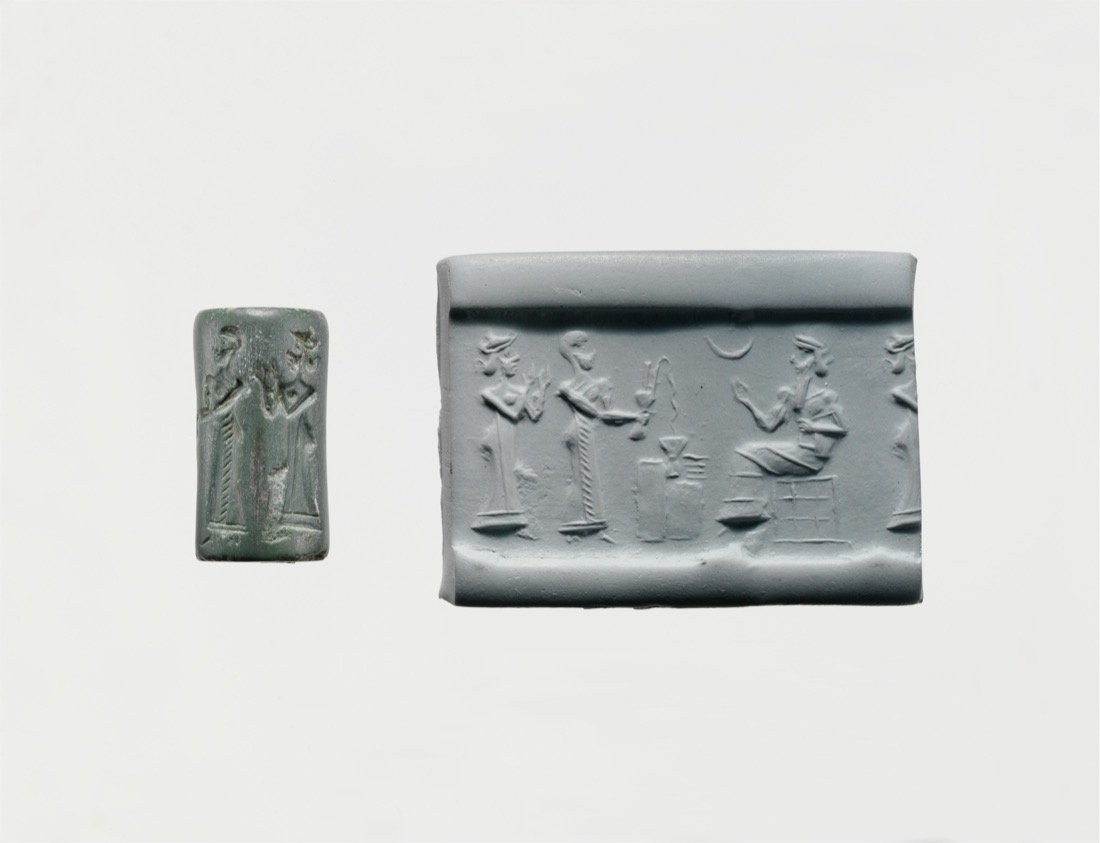
A seal could be rolled across the string knot tying a cloth package, or across the mouth of a sealed pot, keeping the contents safe from tampering. Rolled onto a clay letter, it became a mark of authenticity, proof of who had really sent it. In short, the seal was the mark of a city dweller’s role in public life.
6.2 Life in the City: Family and the Houses of Ur
A ruling elite clearly existed: nothing shows this more clearly than the enormous wealth, jewellery, gold vessels, musical instruments inlaid with shell and lapis lazuli, and gold ceremonial daggers, buried with certain kings and queens at Ur.
But what about ordinary families? Legal texts about disputes and inheritance show that the nuclear family was the norm, though a married son and his family often lived with his parents. The father was head of the household. Marriage followed a set pattern: a declaration of willingness to marry, the bride’s parents giving consent, a gift from the groom’s family to the bride’s family, an exchange of gifts at the wedding itself, and offerings made together in a temple. When she was later fetched by her mother-in-law, the bride received her share of inheritance from her own father; sons, in turn, inherited their father’s house, herds and fields.
A nuclear family is a family made up of a man, his wife, and their children, as opposed to a larger joint or extended household.
Ur, one of the earliest cities ever excavated, was systematically dug up in the 1930s. Its narrow, winding streets show there was no real town planning, they were too narrow even for wheeled carts, so grain and firewood arrived by donkey instead. Unlike contemporary Mohenjo-daro, Ur had no street drains at all; instead, drains and clay pipes sat inside private courtyards, with roofs sloping inward to channel rainwater into covered sumps below.
A sump is a covered basin dug into the ground, into which water and sewage flow.
Even so, people swept their household rubbish straight into the streets, so street levels gradually rose, and house thresholds had to be raised again and again to keep mud out after rain. Rooms had no windows; all their light came from doorways opening onto the inner courtyard, which also gave families privacy. Omen tablets found at Ur even recorded house-related superstitions: a raised threshold brought wealth, a front door that avoided facing another house was lucky, but a main door that opened outward instead of inward meant, the tablets warn, that “the wife would be a torment to her husband.” Ur’s town cemetery held graves of both royalty and commoners, and a few individuals were buried right under the floors of ordinary houses.
7Mari: Trade in a Pastoral Zone
7.1 Mari: A Trading Town in a Pastoral Zone
After 2000 BCE, the royal capital of Mari flourished, but not on the fertile southern plain, it lay much further upstream on the Euphrates, where farming and animal-rearing existed side by side, though most of Mari’s own territory was pasture for sheep and goats.
Farmers and herders needed each other: herders exchanged young animals, cheese, leather and meat for grain and metal tools, and a penned flock’s manure fertilised a farmer’s fields. But there was real friction too, a shepherd’s flock could ruin a sown field crossing it for water, mobile herdsmen could raid and seize a village’s stored grain, and settled communities could deny herders access to canal water along certain paths.
What herders gave farmers
- Young animals, cheese, leather and meat
- Manure from penned flocks to fertilise fields
What caused friction
- Flocks crossing and ruining sown fields
- Raids on stored village grain
- Villages denying herders water access
Through Mesopotamian history, nomadic groups from the western desert kept filtering into the rich farming heartland, first as herders, harvest labourers or hired soldiers, and some eventually grew prosperous enough to found their own ruling dynasties, the Akkadians, Amorites, Assyrians and Aramaeans among them. Mari’s own kings were Amorites, dressed differently from the region’s original inhabitants; they honoured Mesopotamia’s traditional gods, yet also built a temple at Mari for Dagan, god of the steppe. This openness to different peoples and cultures was, the chapter suggests, part of what gave Mesopotamian civilisation its vitality.
7.2 The Palace of King Zimrilim at Mari
Mari’s great palace, home to King Zimrilim (1810-1760 BCE), was the royal family’s residence, the hub of the kingdom’s administration, and a centre of production, especially of precious-metal ornaments. It was famous enough that a minor king from north Syria travelled there purely to see it, carrying a letter of introduction from a friend of Zimrilim’s.
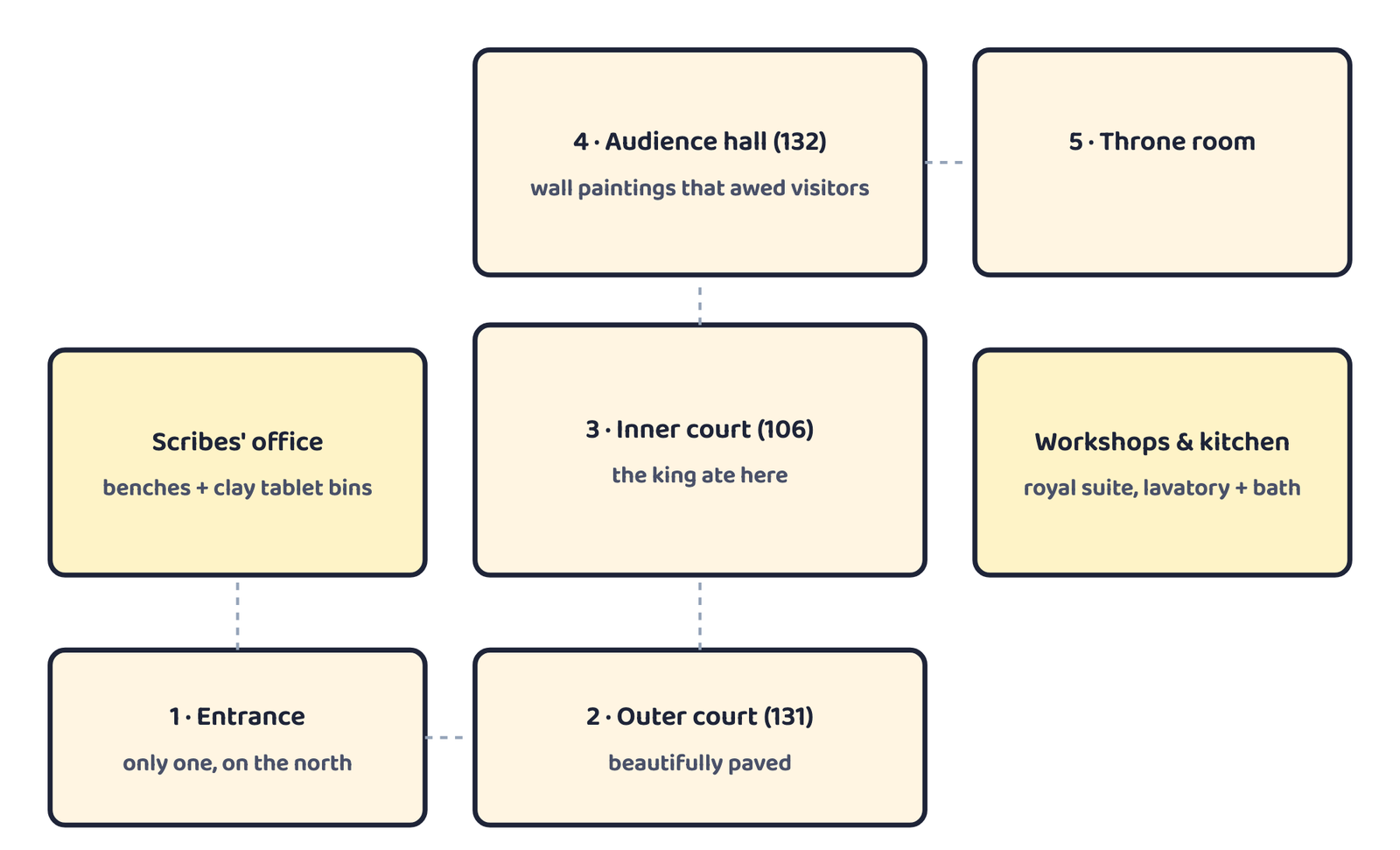
The kings of Mari still had to stay watchful: herders of various tribes were allowed to move through the kingdom, but were kept under watch. Officers’ letters mention frequent night-time fire signals, one herding camp warning another, as a sign that a raid might be coming.
Mari’s real strength was trade, not its army. Sitting on the Euphrates between the southern cities and the mineral-rich uplands of Turkey, Syria and Lebanon, it was perfectly placed for boats carrying wood, copper, tin, oil and wine. Officers inspected each cargo, a single river boat could carry 300 wine jars, and levied a toll of about one-tenth of its value before letting it continue downstream. Copper came from the island the tablets call “Alashiya” (Cyprus), and tin was traded too, both vital because bronze was the main industrial metal of the age. Though Mari was never militarily strong, it grew exceptionally prosperous purely through this trade.
8Digging Up, and Remembering, the Past
8.1 Digging Smaller: The Excavation at Abu Salabikh
Today’s Mesopotamian archaeologists work very differently from the huge, decades-long digs of a century ago; few now have the funding for large teams, so smaller and more careful excavation is the norm.
Abu Salabikh, a small town of about 10 hectares and under 10,000 people around 2500 BCE, shows the method well. Archaeologists first scraped the top few millimetres off a mound while the soil beneath was still slightly moist, letting them make out the different colours and textures of buried brick walls. They then sieved tons of earth to recover tiny plant and animal remains, finding large quantities of charred fish bones that had been swept out into the streets.
Kitchens identified
Plant seeds and fibre survived where dung cakes had once been burned as fuel
Living rooms identified
By having far fewer such traces than the kitchens
Free-roaming pigs identified
Young pig teeth were found scattered across the streets themselves
Roofed vs open rooms identified
By microscopic study of floor surfaces, showing which rooms had poplar-log, palm-leaf or straw roofing
One house burial at Abu Salabikh contained pig bones alongside the body, most likely food meant to nourish the dead person in the afterlife.
8.2 Cities in Mesopotamian Culture: The Gilgamesh Epic
Mesopotamians took real pride in living alongside people of many different communities and cultures in their cities, and when a city was destroyed in war, they mourned it in poetry.
The most moving example comes at the end of the Epic of Gilgamesh, written across twelve tablets. Gilgamesh, said to have ruled Uruk sometime after Enmerkar, was a great hero who subdued people far and wide, until the death of his closest friend shocked him into searching for the secret of immortality. He crossed the very waters that were believed to surround the whole world, but failed to find it, and returned home to Uruk.
There, Gilgamesh found his consolation walking back and forth along the city wall, admiring its foundations of fired brick, the very wall he himself had built. He does not console himself, as a tribal hero would, with the thought that his sons will outlive him. He takes pride instead in the city that his people had built together.
the single idea to carry out of this chapter: a Mesopotamian’s true legacy was the city, not the family line
8.3 The Legacy of Writing: Mathematics and Time
Stories can travel by word of mouth, but science cannot, it needs written texts that later scholars can read and build upon. Perhaps Mesopotamia’s single greatest gift to the world is exactly this: a written scholarly tradition of mathematics and time-reckoning.
Tablets from around 1800 BCE already contain multiplication and division tables, square- and square-root tables, and even compound-interest tables. One tablet gives the square root of 2 as:
Students were even set word problems, such as: a field of a given area is covered one finger deep in water, find the volume of the water. And the time system nearly every person alive still uses today, twelve months to a year, four weeks to a month, twenty-four hours to a day, sixty minutes to an hour, comes directly from Mesopotamian astronomy. It passed down to Alexander’s successors, then to the Roman world, then to the world of Islam, and finally to medieval Europe. Mesopotamian astronomers also carefully recorded every solar and lunar eclipse by year, month and day, along with the observed positions of stars and constellations.
None of this would have been possible without writing, or without the urban institution of the school, where students read and copied earlier tablets, and where some were trained not just as record-keepers, but as intellectuals who could build further on the work of those before them.
8.4 An Early Library: Assurbanipal at Nineveh
In the iron age, the Assyrians of the north built an empire that at its height (720-610 BCE) stretched as far as Egypt, run on a “predatory” economy that extracted labour and tribute, food, animals, metal, craft goods, from a huge subject population.
Even so, the Assyrian kings still looked to the southern region, Babylonia, as the true centre of high culture. The last of the great Assyrian kings, Assurbanipal (668-627 BCE), built a library at his capital, Nineveh, sending his own scribes south to hunt down old tablets on history, epic poetry, omens, astrology, hymns and songs.
This was possible because Babylonian scribal schools trained students to copy tablets by the dozen, and because Sumerian, though it had stopped being spoken by about 1800 BCE, was still deliberately taught through vocabulary lists, sign lists, and bilingual Sumerian-Akkadian tablets. So even around 650 BCE, tablets written as far back as 2000 BCE could still be read, and Assurbanipal’s scribes knew exactly where to look for them. Copies of major texts like the Epic of Gilgamesh named the copier and the date, and tablets were even catalogued, a clay label on a basket might read “n number of tablets about exorcism, written by X”.
8.5 An Early Archaeologist: Nabonidus of Babylon
In 625 BCE, Nabopolassar freed Babylonia from Assyrian rule, and his successors expanded the kingdom and built up Babylon itself. Even after the Achaemenids of Iran conquered Babylon in 539 BCE, and right up to Alexander’s conquest in 331 BCE, Babylon remained the world’s premier city, more than 850 hectares in size, with a triple wall, great palaces and temples, a ziggurat, and a processional way leading to its ritual centre.
A stele is a stone slab carved with inscriptions or images. Nabonidus used the carvings on an ancient stele to work out how a priestess should be dressed.
Nabonidus, the last ruler of independent Babylon, is one of history’s earliest known “archaeologists” in spirit. He wrote that the god of Ur appeared to him in a dream, ordering him to restore the long-forgotten office of High Priestess of Ur. Searching for a model, he found a stele of a very early king, one we today date to about 1150 BCE, carved with an image of the priestess, and used her recorded clothing and jewellery to dress his own daughter for her consecration.
On another occasion, Nabonidus’s men brought him a broken statue inscribed with the name of Sargon, king of Akkad, whom we now know ruled around 2370 BCE. Out of “reverence for the gods and respect for kingship”, as he put it, Nabonidus summoned skilled craftsmen and had the statue’s head repaired, treating a ruler who had lived more than 1,800 years before his own time as a figure worth actively preserving.
9Timeline: Writing and City Life at a Glance
- Mesopotamia means “between rivers”, the Euphrates and the Tigris, in what is now Iraq
- Cities need more than food surplus, they need trade, specialisation and social organisation, urbanism
- Writing began around 3200 BCE as temple record-keeping at Uruk, then grew into law, literature and dictionaries
- Cuneiform signs stood for syllables, not letters, so only a trained few could ever read and write
- Southern Mesopotamia’s mineral poverty forced long-distance trade for wood, metal and stone
- Temples were a city’s first major institution; conflict over land and water helped turn war leaders into kings
- Uruk, Ur and Mari each show a different side of city life: temple power, ordinary houses, and pastoral trade
- The cylinder seal, rolled rather than stamped, marked ownership, safety and authenticity
- Mesopotamian mathematics and the 12-month, 24-hour, 60-minute time system reached us through Greece, Rome, Islam and medieval Europe
- Assurbanipal’s library at Nineveh and Nabonidus’s respect for Sargon’s statue show Mesopotamians were already collecting and studying their own ancient past
- Can I explain, in my own words, why “natural fertility” alone does not explain early urbanisation?
- Can I sort productive agriculture, water transport, lack of metal, division of labour, seals and compulsory labour into necessary conditions, causes and outcomes, and justify my choices?
- Can I describe how a scribe actually made and wrote a clay tablet?
- Can I explain why the temple, not the market, was southern Mesopotamia’s first major urban institution?
- Can I name at least three things Mesopotamia is known for besides its cities, and explain one of them (writing, mathematics, or time-reckoning)?
- Can I describe one thing that made Ur’s houses different from Mohenjo-daro’s?
- Can I explain why herders were both useful to, and a danger for, a trading town like Mari?