1Two Empires, and How We Know About Rome
1.1 Two Thousand Years of Empire-Building
This chapter is the second theme in the book’s section on Empires. In the two thousand years after empires first rose in Mesopotamia, one attempt at empire-building followed another across the region. By the sixth century BCE, Iranians controlled major parts of the old Assyrian empire, and trade networks grew both overland and along the Mediterranean coasts. Greek city-states like Athens and Sparta flourished, and in the late fourth century BCE, Alexander of Macedon conquered North Africa, West Asia and Iran, reaching all the way to the river Beas in India, before his own soldiers refused to march any further.
Alexander’s political empire broke apart quickly after his death, but “Hellenistic” culture, Greek language and ideas mixed with local traditions, especially Iranian, stayed important for almost three centuries after. It was out of the political confusion that followed Alexander’s empire that a new power rose: from the second century BCE, the small but well-organised military forces of the Italian city-state of Rome took control of North Africa and the eastern Mediterranean.
Rome was still a republic when this expansion began. Julius Caesar, a high-born military commander, extended the “Roman Empire” as far as present-day Britain and Germany in the middle of the first century BCE. The empire became substantially Christian only later, after the emperor Constantine’s own conversion in the fourth century CE, and it was split into eastern and western halves that same century to make government easier.
1.2 Sources: How Historians Know About Rome
Roman historians are unusually lucky: they have a rich collection of sources, which fall into three broad groups.
| Type of source | What it includes |
|---|---|
| Texts | Histories written by contemporaries, usually called “Annals” because they narrate year by year, plus letters, speeches, sermons and laws |
| Documents | Mainly inscriptions (cut into stone, so many survive, in both Greek and Latin) and papyri |
| Material remains | Buildings, monuments, pottery, coins, mosaics, even whole landscapes, mostly recovered by archaeologists through excavation, field survey and aerial photography |
Papyrus was a reed-like plant grown along the banks of the Nile in Egypt, processed into a writing material used everywhere in daily life. Thousands of contracts, accounts, letters and official documents survive “on papyrus”, and scholars who study them are called papyrologists.
Each kind of source can only tell historians so much on its own, combining them is worthwhile, but how well that is done depends entirely on the historian’s own skill.
1.3 Rome and Iran: Two Superpowers Divide the World
Between the birth of Christ and the early seventh century (down to the 630s), two powerful empires, Rome and Iran, ruled most of Europe, North Africa and the Middle East. The two were rivals, fighting each other through much of their history, and their territories lay side by side, separated only by a narrow strip of land along the river Euphrates.
The Mediterranean Sea, stretching from Spain in the west to Syria in the east, separates Europe from Africa, and it was the true heart of Rome’s empire, which dominated the sea and every region around it.
| Boundary of the Roman Empire | Formed by |
|---|---|
| North | The rivers Rhine and Danube |
| South | The vast expanse of the Sahara desert |
Iran, Rome’s rival, controlled the whole area south of the Caspian Sea down to eastern Arabia, and sometimes much of Afghanistan too. Between them, these two superpowers had divided up most of what the Chinese called Ta Ch’in, “greater Ch’in”, meaning roughly the whole of the west as China then knew it.
2The Emperor, the Senate and the Army
2.1 Augustus and the Principate
The Roman Empire is usually divided into two broad phases, “early” and “late”, split by the third century CE as a kind of historical watershed. A key difference between Rome and Iran was cultural: Iran’s Parthian and later Sasanian rulers governed a population that was largely Iranian, while Rome was, in the book’s own words, “a mosaic of territories and cultures” held together chiefly by a shared system of government. Latin and Greek were the main administrative languages, the upper classes of the east wrote in Greek and those of the west in Latin, and the boundary between the two ran roughly across the middle of the Mediterranean, between Latin-speaking Tripolitania and Greek-speaking Cyrenaica in North Africa. Whatever language they spoke, everyone in the empire was a subject of one ruler: the emperor.
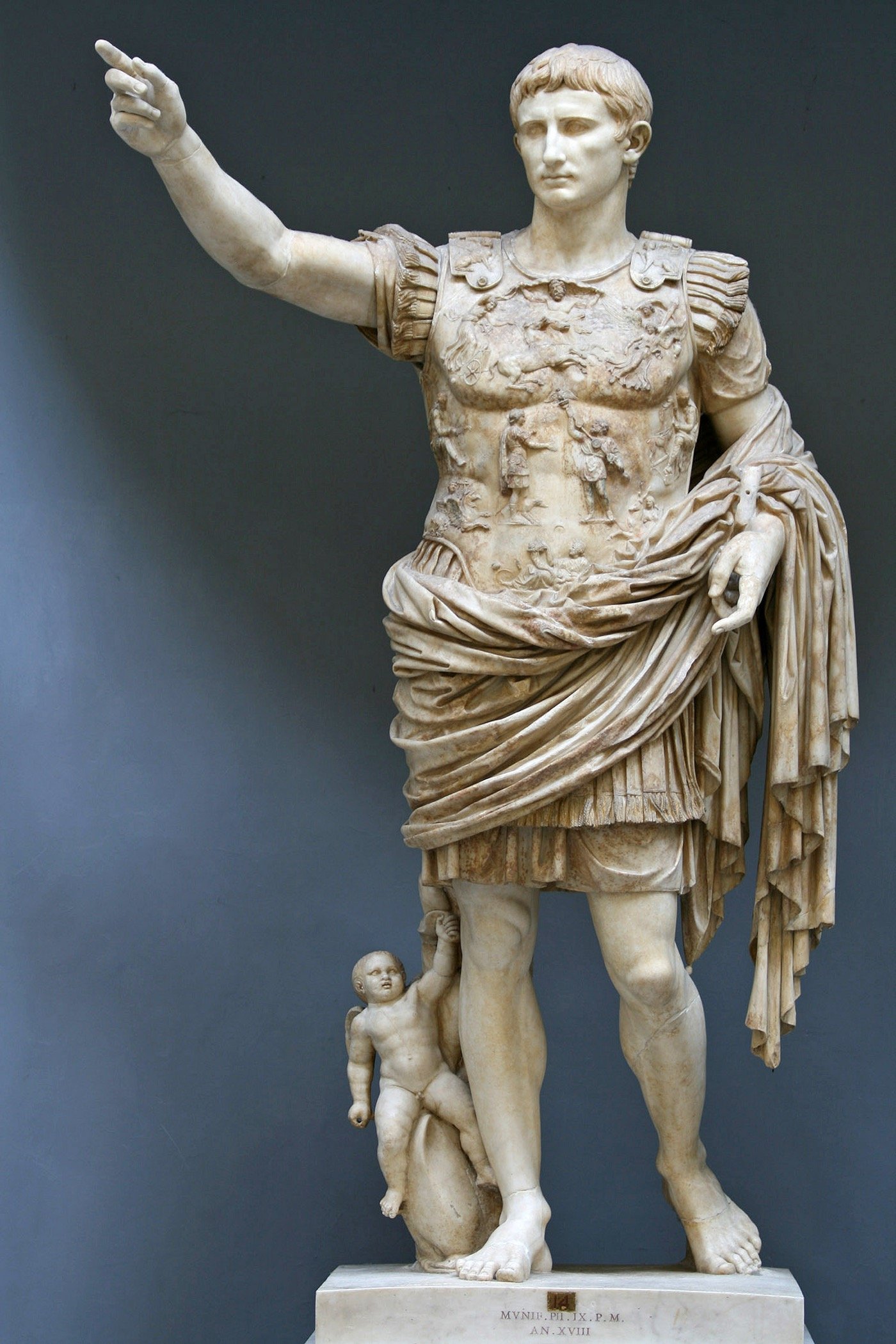
In 27 BCE, Augustus established the regime called the Principate. Although he was the sole ruler and the only real source of authority, the fiction was kept alive that he was merely the “leading citizen” (Princeps in Latin), not an absolute ruler, out of respect for the Senate.
The Republic (509 BCE-27 BCE) was the regime in which real power lay with the Senate, a body dominated by a small group of wealthy families, the “nobility”. Senate membership was for life, and wealth and office-holding counted for more than birth. The Republic was overthrown by Octavian, Julius Caesar’s adopted heir, who later renamed himself Augustus.
Most surviving Roman histories were written by people from a senatorial background, so in these sources emperors are judged above all by how they treated the Senate; the “worst” emperors, in this telling, were those who were hostile, suspicious or violent towards senators. Many senators longed for the old days of the Republic, though most must have known this was impossible.
2.2 The Army: Rome’s Third Power Centre
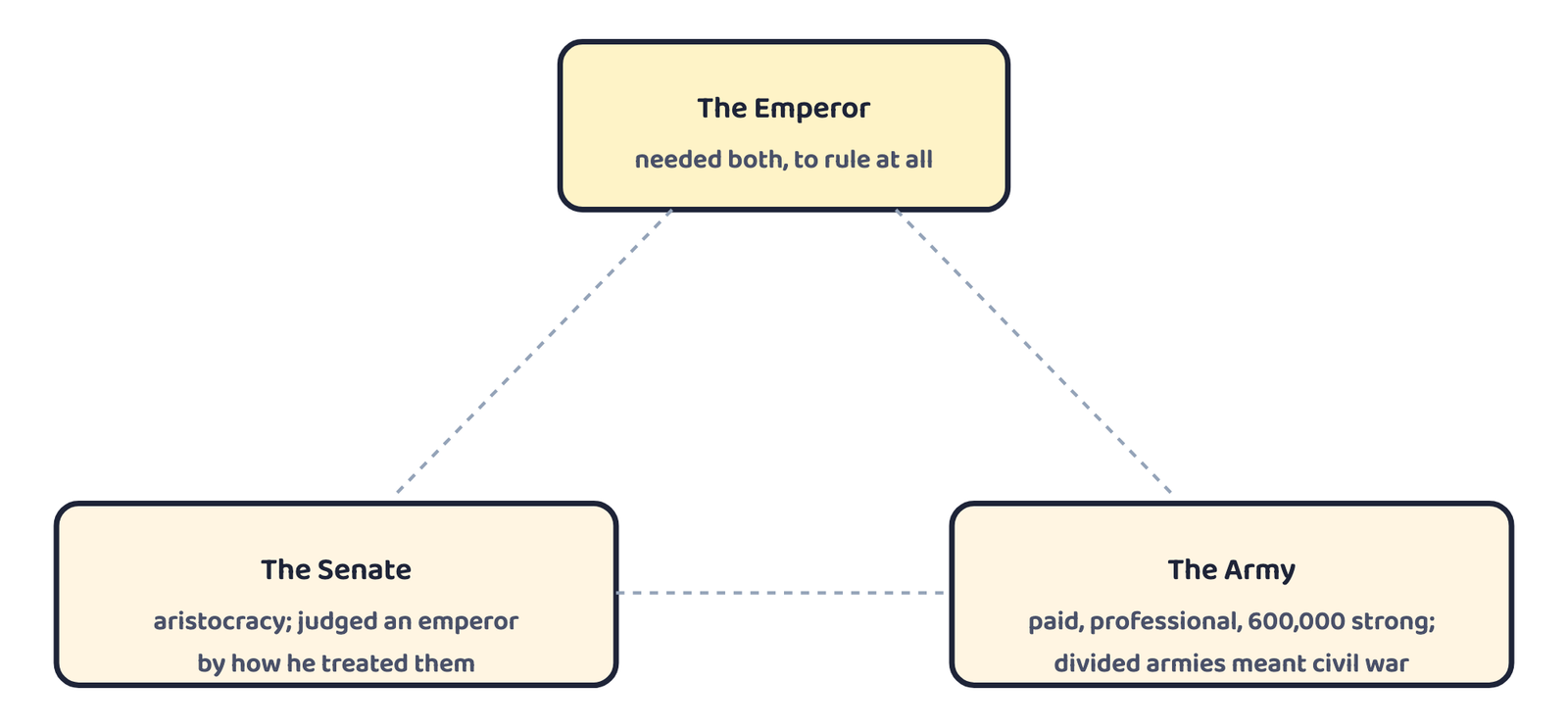
Next to the emperor and the Senate stood the third key institution of imperial rule: the army. Unlike Iran’s conscripted army, forcibly recruited, Rome had a paid professional army, in which soldiers signed up for a minimum of 25 years, a genuinely distinctive Roman feature.
The army was the largest single organised body in the whole empire, and it certainly had the power to determine an emperor’s fate; soldiers constantly agitated for better pay and conditions, sometimes through outright mutiny. The Senate, for its part, hated and feared the army as a source of unpredictable violence, especially once the strained third century forced heavier taxation to pay for it.
Do not write that the first two centuries of the empire were full of civil war. The book says the opposite: except for the single “year of four emperors” (69 CE), the first two centuries were on the whole free of civil war and relatively stable, and even external warfare was uncommon, since the empire Tiberius inherited from Augustus was already felt to be large enough. Trajan’s occupation across the Euphrates (113-17 CE) was the only major expansion attempt, and it was abandoned as fruitless by his own successors.
Succession followed family descent, natural or adoptive, wherever possible, and even the army was strongly wedded to this principle. Tiberius (14-37 CE), the second Roman emperor, was not Augustus’s natural son at all, but his adopted heir, chosen to guarantee a smooth transition of power.
“Then, after a winter (115/16) in Antioch marked by a great earthquake, in 116 Trajan marched down the Euphrates to Ctesiphon, the Parthian capital, and then to the head of the Persian Gulf. There [the historian] Cassius Dio describes him looking longingly at a merchant-ship setting off for India, and wishing that he were as young as Alexander.”
Fergus Millar, The Roman Near East, quoting the historian Cassius Dio
3Ruling Three Continents
3.1 From Client Kingdoms to Roman Provinces
More typical than conquest by war was the gradual extension of direct Roman rule by simply absorbing a whole series of “dependent” or client kingdoms into Roman provincial territory. The Near East was full of such kingdoms, whose rulers used their own forces in support of Rome in exchange for being allowed to exist. By the early second century CE, every one of these kingdoms lying west of the Euphrates, closer to Roman territory, had disappeared, swallowed into the empire.
Some of these absorbed kingdoms were exceedingly wealthy. Herod’s kingdom alone is said to have yielded 5.4 million denarii a year, equal to over 125,000 kg of gold, a striking one-mark statistic examiners like to test.
The denarius was a Roman silver coin containing about 4½ grams of pure silver, and was the backbone of Roman currency for the empire’s first three centuries.
Except for Italy, which was not considered a province in these centuries, every territory of the empire was organised into provinces and made subject to taxation. At its peak, in the second century, the Roman Empire stretched from Scotland to the borders of Armenia, and from the Sahara to the Euphrates and sometimes beyond, home to a population of around 60 million people in the mid-second century.
A Roman city was an urban centre with its own magistrates, a city council, and a “territory” that contained villages under its jurisdiction. One city could never lie within another city’s territory, though villages almost always did, and a village could be upgraded to city status, or demoted, usually as a mark of imperial favour or its opposite.
3.2 Why Cities? The Answer to Governing a Vast Empire
Given there was no government in the modern sense to run things, how did an emperor govern such an enormous and diverse territory at all? The book’s own answer is: urbanisation. The great urban centres that lined the Mediterranean’s shores, Carthage, Alexandria and Antioch the biggest among them, were the true bedrock of the whole imperial system. It was through cities that “government” was able to tax the provincial countryside that generated most of the empire’s wealth, because local upper classes actively collaborated with the Roman state to administer their own territories and collect taxes from them.
One of the most striking features of Roman political history is the dramatic shift of power, across the second and third centuries, from Italy to the provinces. Throughout this period, it was provincial upper classes who increasingly supplied the administrators and army commanders, forming a new elite that grew far more powerful than the old senatorial class, because they had the backing of the emperors themselves. Emperor Gallienus (253-68 CE) went further still, consolidating this shift by excluding senators from military command altogether, to keep control of the army out of senatorial hands.
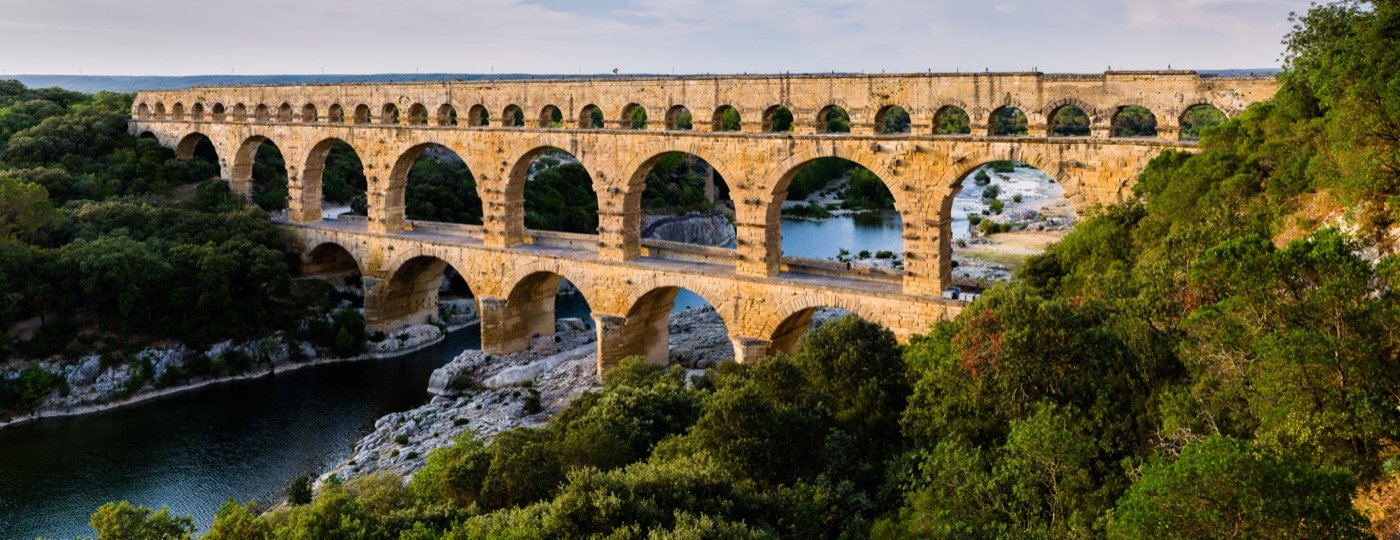
Living in a city had a very practical advantage too: it was likely to be better provided for during food shortages and famines than the surrounding countryside.
“The famine prevalent for many successive years in many provinces has clearly displayed for men of any understanding the effect of malnutrition in generating illness. The city-dwellers, as it was their custom to collect and store enough grain for the whole of the next year immediately after the harvest, carried off all the wheat, barley, beans and lentils, and left to the peasants various kinds of pulse… After consuming what was left in the course of the winter, the country people had to resort to unhealthy foods in the spring; they ate twigs and shoots of trees and bushes and bulbs and roots of inedible plants…”
the physician Galen, On Good and Bad Diet
3.3 Public Life in a Roman City
Public baths were a striking feature of Roman urban life, so much so that when one Iranian ruler tried to introduce them into Iran, he faced the fury of the clergy there: water was a sacred element, and public bathing seemed to them a kind of desecration. Urban populations also enjoyed a great deal of entertainment: one surviving calendar tells us that spectacula (“shows”) filled no fewer than 176 days of the year.
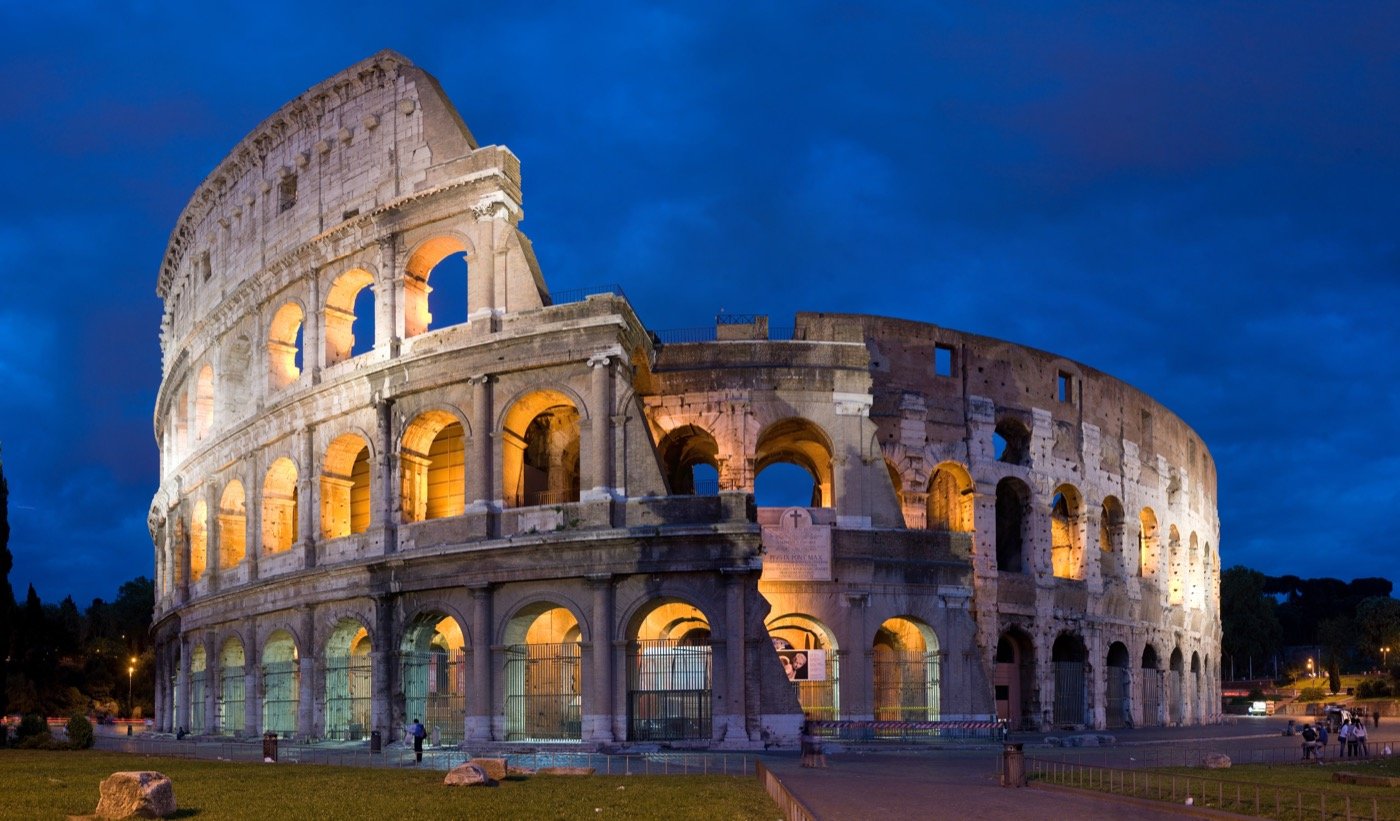
Put together, this is exactly what the chapter title means by an empire “across three continents”:
| Continent | Roman territory there |
|---|---|
| Europe | Italy, Spain, Gaul, Britain, and lands up to the Rhine and Danube frontiers |
| Africa | Egypt, North Africa (including Carthage), up to the edge of the Sahara desert |
| Asia | Syria, Palestine (the “Near East”), and territory reaching toward the Euphrates and Armenia |
4The Third-Century Crisis
If the first and second centuries were, broadly, a period of peace, prosperity and economic expansion, the third century brought the first major signs of internal strain. From the 230s, the empire found itself fighting on several fronts at once.
Historians rely on Shapur I’s own inscription, in his own words, to know how badly Rome suffered in this period, a rare case of getting the “enemy’s” side of a Roman defeat directly, cut into stone.
5Family, Women and Literacy
5.1 The Roman Nuclear Family
One of the most modern features of Roman society was the widespread nuclear family: adult sons did not usually live with their parents, and it was exceptional for adult brothers to share one household, though slaves were still counted as part of the family, as the Romans understood it.
By the late Republic (first century BCE), a Roman nuclear family marriage kept the wife’s property under her own natal family’s authority, not her husband’s. Her dowry went to her husband only for the marriage’s duration; she remained her father’s primary heir and became an independent property owner on his death, so in law the married couple was two financial entities, not one, and the wife had complete legal independence.
Roman women could own and manage property fully in their own right, and divorce needed no more than a notice of intent from either husband or wife, genuinely striking legal independence for the period. But this must be balanced against real inequality: men typically married in their late twenties or thirties, women in their late teens or early twenties, and marriages were generally arranged. Augustine, the bishop of Hippo, records that his own mother was regularly beaten by his father, and that most other wives in his hometown showed similar bruises. Fathers, too, had extensive legal control over children, including, in shocking cases, the power of life and death over unwanted infants.
5.2 Literacy: Patchy, Not Universal
Casual literacy varied hugely across the empire. At Pompeii, buried by the eruption of Mount Vesuvius in 79 CE, the walls of the main streets often carried advertisements, and graffiti covered the city, strong evidence of widespread casual reading and writing among ordinary people. One of the funniest surviving examples reads: “Wall, I admire you for not collapsing in ruins when you have to support so much boring writing on you.”
Egypt tells a different story. Hundreds of surviving papyri show that most formal documents, contracts especially, were written by professional scribes, and often note that one party or another “is unable to read and write.” Even here, though, literacy was noticeably more widespread among particular groups: soldiers, army officers and estate managers.
5.3 A Mosaic of Languages and Cultures
The empire’s cultural diversity showed at every level: in the sheer variety of religious cults and local deities, in the many languages spoken, in styles of dress and food, and in different forms of social organisation and settlement. Aramaic dominated the Near East west of the Euphrates, Coptic was spoken in Egypt, Punic and Berber in North Africa, and Celtic in Spain and the northwest.
| Language | Where it was spoken | When it was first written |
|---|---|---|
| Coptic | Egypt | Already had a Bible translation by the mid-third century CE |
| Armenian | Armenia | Only began to be written as late as the fifth century CE |
| Celtic | Spain and the northwest | Stopped being written after the first century CE, as Latin spread |
Many of these local languages remained purely oral for a long time, until a script was invented for them, and where Latin spread its influence, it sometimes displaced a local language’s written form entirely, as happened with Celtic.
6Trade and the Economy Across Three Continents
6.1 A Mediterranean Economy of Wheat, Wine and Oil
The empire had a substantial economic infrastructure: harbours, mines, quarries, brickyards and olive-oil factories among them. Wheat, wine and olive oil were traded and consumed in huge quantities, coming mainly from Spain, the Gallic provinces, North Africa and Egypt, and, to a lesser extent, Italy.
Amphorae were the containers used to transport liquids like wine and olive oil across the Mediterranean. Rome’s Monte Testaccio alone is said to hold the broken remains of over 50 million of them, and archaeologists can match a fragment’s clay to its original clay pit to say exactly where, and often when, it was made.
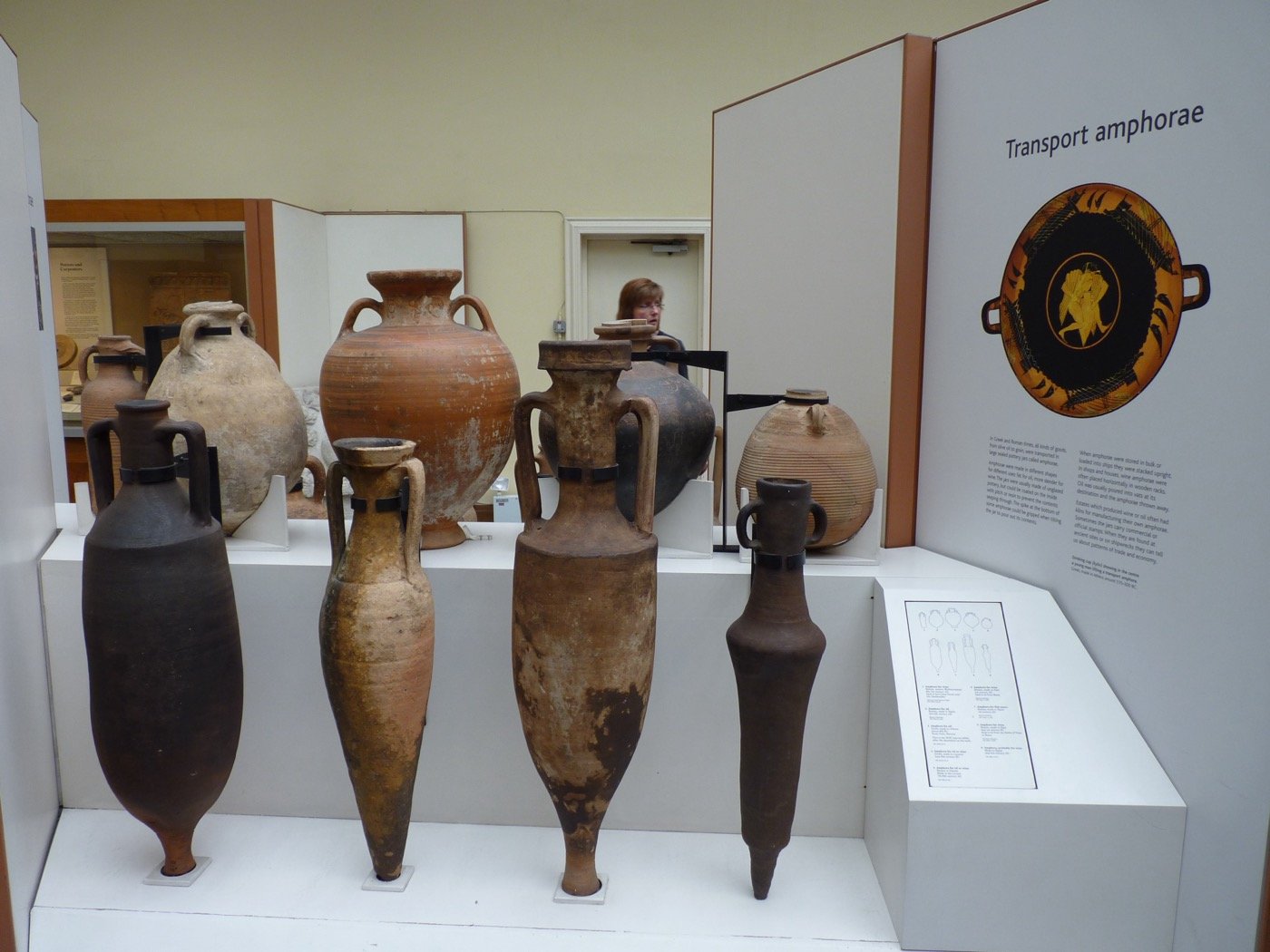
Spanish olive oil, at its commercial peak between 140 and 160 CE, was mainly carried in a container called “Dressel 20”, named after the archaeologist who first defined its shape. Wide scatter of Dressel 20 finds across the Mediterranean shows how far Spanish oil travelled, and that Spanish producers had captured markets from their Italian rivals, almost certainly by offering better oil at lower prices.
6.2 Fertile Regions and Pastoral Zones
Writers like Strabo and Pliny name several regions with a reputation for exceptional fertility. Campania in Italy produced the best wines; Sicily and Byzacium (Tunisia) exported huge quantities of wheat to Rome; Galilee, in the historian Josephus’s own words, had “every inch of the soil… cultivated by the inhabitants”; and Baetica, in southern Spain, produced olive oil from estates called fundi along the river Guadalquivir.
But large parts of Roman territory were far less developed. In Numidia (modern Algeria), transhumance was widespread, and as Roman estates expanded there, the pastures of these communities shrank and their movement was tightly regulated. Northern Spain, too, was much less developed, home mostly to a Celtic-speaking peasantry living in hilltop villages called castella.
Transhumance is a herdsman’s regular annual movement between higher mountain pastures and lower ground, in search of grazing for sheep and other flocks. In Numidia, these semi-nomadic communities carried oven-shaped huts called mapalia with them as they moved.
The chapter warns against imagining that “ancient” automatically meant backward. Diversified uses of water power, advances in water-powered milling, and hydraulic mining in the Spanish gold and silver mines reached an industrial scale not matched again until the nineteenth century, some 1,700 years later. Well-organised commercial and banking networks and the widespread use of money were part of this same sophistication.
7Controlling Workers
7.1 Slavery: Widespread, but Not the Whole Story
Slavery was an institution deeply rooted across the ancient Mediterranean and Near East, and even Christianity, once it became the state religion in the fourth century, did not seriously challenge it. But it does not follow that slaves performed the bulk of labour across the whole empire. That may have been true of much of Italy under the Republic (three million slaves in a total Italian population of 7.5 million, under Augustus), but it was no longer true of the empire as a whole.
“Soon afterwards the City Prefect, Lucius Pedanius Secundus, was murdered by one of his slaves. After the murder, ancient custom required that every slave residing under the same roof must be executed. But a crowd gathered, eager to save so many innocent lives; and rioting began. The senate-house was besieged… [The senators] favouring execution prevailed. However, great crowds ready with stones and torches prevented the order from being carried out. Nero rebuked the population by edict, and lined with troops the whole route along which those condemned were taken for execution.”
Tacitus (55-117 CE), historian of the early empire, On the Treatment of Slaves
Slaves were an investment, and at least one Roman agricultural writer advised landowners against using them where too many might be needed at once, for a harvest, say, or where their health was at real risk, such as from malaria. This was hard economic calculation, not sympathy. As warfare became rarer with the first century’s peace, the supply of slaves fell, so slave-owners turned either to slave breeding or to cheaper, more easily dispensable wage labour. Free labour was, in fact, extensively used on public works at Rome precisely because widespread slave labour would have been too expensive, slaves, unlike hired workers, had to be fed and housed all year round.
7.2 Managing and Disciplining Labour
Slaves and freedmen (slaves who had been set free by their masters) were, by contrast, extensively used as business managers, since this role did not need large numbers of them; masters often gave slaves or freedmen capital to run a business on their behalf, or even a business of their own.
Columella, a first-century writer from southern Spain, recommended that landowners keep a reserve of tools, twice what they needed, so production never stopped, “for the loss in slave labour-time exceeds the cost of such items”. He also recommended organising workers into squads of ten, easier to supervise closely. Pliny the Elder, by contrast, condemned slave gangs chained together by the feet as the very worst method of organising production.
Sealed and searched
Alexandria’s frankincense factories sealed workmen’s aprons, made them wear masks or close-mesh nets, and stripped them before they could leave the premises
Branding
A law of 398 CE ordered workers branded, so runaways could be identified if they tried to hide
Debt bondage
Employers cast worker agreements as debt contracts, so poorer families “surrendered themselves to work in servitude, although they are free”
High wages, freely offered
Not all labour was coerced: Emperor Anastasius built the city of Dara in under three weeks by attracting free workers with high pay
Rural indebtedness ran deep too. A letter of Augustine records parents selling their own children into 25 years of servitude, and in the great Jewish revolt of 66 CE, the rebels’ very first act was to destroy the moneylenders’ bonds, to win popular support. Yet by the sixth century, papyri show wage labour had become widespread in parts of the Mediterranean, especially in the East, a reminder that coerced labour, though real, was never the whole picture.
8Social Hierarchies
The historian Tacitus described the leading social groups of the early empire in this order: senators (“patres”, literally “fathers”); leading members of the equestrian class; the respectable people attached to the great houses; the “unkempt lower class” (plebs sordida), whom he says were addicted to the circus and theatre; and, at the bottom, the slaves.
The equites (“knights” or “horsemen”) were traditionally the second most powerful and wealthy group in Rome, families whose property once qualified them to serve in the cavalry. Like senators, most were landowners, but many equites were also shipowners, traders and bankers, unlike senators, who mostly stayed out of business.
The humiliores (literally “lower”) were the vast mass of the lower classes: a rural labour force on the great estates, industrial and mining workers, migrant harvest and building labourers, self-employed artisans (said to be better fed than wage labourers), casual city labourers, and, still, many thousands of slaves, especially in the western empire.
By the early third century, the Senate numbered roughly 1,000 members, about half from Italian families still. By the late empire, which starts with Constantine’s reign in the early fourth century, senators and equites had merged into one unified, expanded aristocracy, of whom at least half were now of African or eastern origin. This “late Roman” aristocracy was enormously wealthy, yet in many ways less powerful than the purely military elites, who came almost entirely from non-aristocratic backgrounds.
“Each of the great houses of Rome contained within itself everything which a medium-sized city could hold, a hippodrome, fora, temples, fountains and different kinds of baths… Many of the Roman households received an income of four thousand pounds of gold per year from their properties, not including grain, wine and other produce which, if sold, would have amounted to one-third of the income in gold. The income of the households at Rome of the second class was one thousand or fifteen hundred pounds of gold.”
Olympiodorus of Thebes, historian and ambassador, early fifth century
Rome’s late bureaucracy drew most of its salary in gold and invested heavily in land, making it comparatively affluent, but corruption was real too, especially in the judicial system and military supplies, and the extortion of higher bureaucrats and provincial governors was, in the book’s own word, “proverbial”. Even so, a strong tradition of Roman law had developed by the fourth century, one that could act as a genuine brake even on the most fearsome emperors, letting powerful bishops like Ambrose confront emperors directly over harsh treatment of ordinary people.
9Late Antiquity
9.1 Diocletian and Constantine Remake the State
Late antiquity is the term historians use for the final, transformative period in the evolution and break-up of the Roman Empire, roughly the fourth to seventh centuries CE. Changes to the very structure of the state began with Emperor Diocletian (284-305 CE): he cut back overexpansion by abandoning territories of little strategic or economic value, fortified the frontiers, reorganised provincial boundaries, and separated civilian from military functions, giving military commanders (duces) far greater autonomy and power.
Constantine consolidated these changes and added innovations of his own. His most important was monetary: the solidus, a coin of 4½ grams of pure gold, minted on a huge scale, that would in fact outlast the Roman Empire itself.
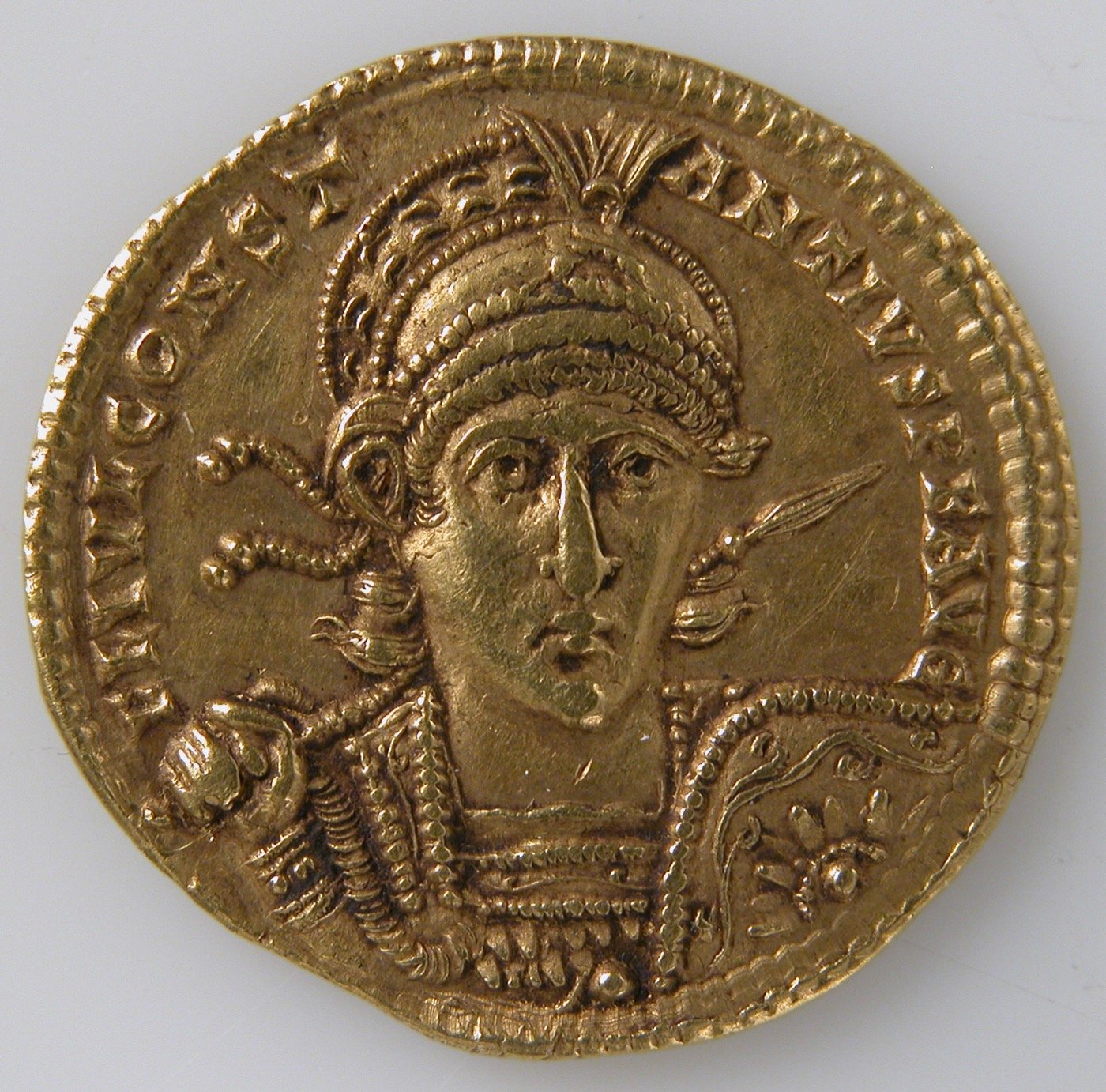
The solidus was a gold coin of 4½ grams of pure gold, introduced by Constantine after the Spanish silver mines were exhausted and the old silver-based currency of the first three centuries could no longer be maintained. Solidi circulated by the millions across late antiquity.
Constantine’s other major innovation was political: a second capital, Constantinople (modern Istanbul, previously called Byzantium), surrounded by sea on three sides. Because the new capital needed its own senate, the fourth century became a period of rapid expansion for the governing classes. Monetary stability and a growing population together stimulated real economic growth, archaeology shows heavy rural investment in oil presses, glass factories, screw presses and multiple water-mills, and a revival of long-distance trade with the East.
Egypt’s late papyri paint a picture of real prosperity: a relatively affluent, money-using society where rural estates generated vast incomes in gold. Egypt alone contributed over 2.5 million solidi a year in tax, roughly 35,000 lbs of gold, in the reign of Justinian in the sixth century. Large parts of the Near Eastern countryside, remarkably, were more developed and densely settled in the fifth and sixth centuries than they would be even in the twentieth century.
9.2 Christianisation, and a World of Many Faiths
The traditional religious culture of the classical world, both Greek and Roman, was polytheist: Roman and Italian gods such as Jupiter, Juno, Minerva and Mars stood alongside numerous Greek and eastern deities, worshipped in thousands of temples, shrines and sanctuaries across the empire. Polytheists, notably, had no shared name for themselves. Judaism was the empire’s other great religious tradition, and it too was far from a single, uniform thing, there was real diversity within the Jewish communities of late antiquity.
Christianisation is the process by which Christianity spread among different groups of the population and became the dominant religion of the empire. It was gradual and complex: polytheism did not disappear overnight, especially in the western provinces, and religious-community boundaries were far more fluid in the fourth century than they later became, once powerful bishops worked to enforce a more rigid set of beliefs.
9.3 The Empire’s End: A Fallen West, a Surviving East
Prosperity in the East was especially marked, its population kept expanding right up to the sixth century, despite the impact of the plague that struck the Mediterranean in the 540s. In the West, though, the empire fragmented politically as Germanic groups, the Goths, Vandals and Lombards among them, took over the major provinces and founded kingdoms historians describe as “post-Roman”.
| Post-Roman kingdom | Where | How long it lasted |
|---|---|---|
| Visigoths | Spain | Destroyed by the Arabs, 711-720 CE |
| Franks | Gaul | c. 511-687 CE |
| Lombards | Italy | 568-774 CE |
In the East, where the empire stayed united, the reign of Justinian (527-65 CE) marks the high-water mark of prosperity and imperial ambition, seen at Ravenna in the famous mosaic portrait made in his own lifetime.
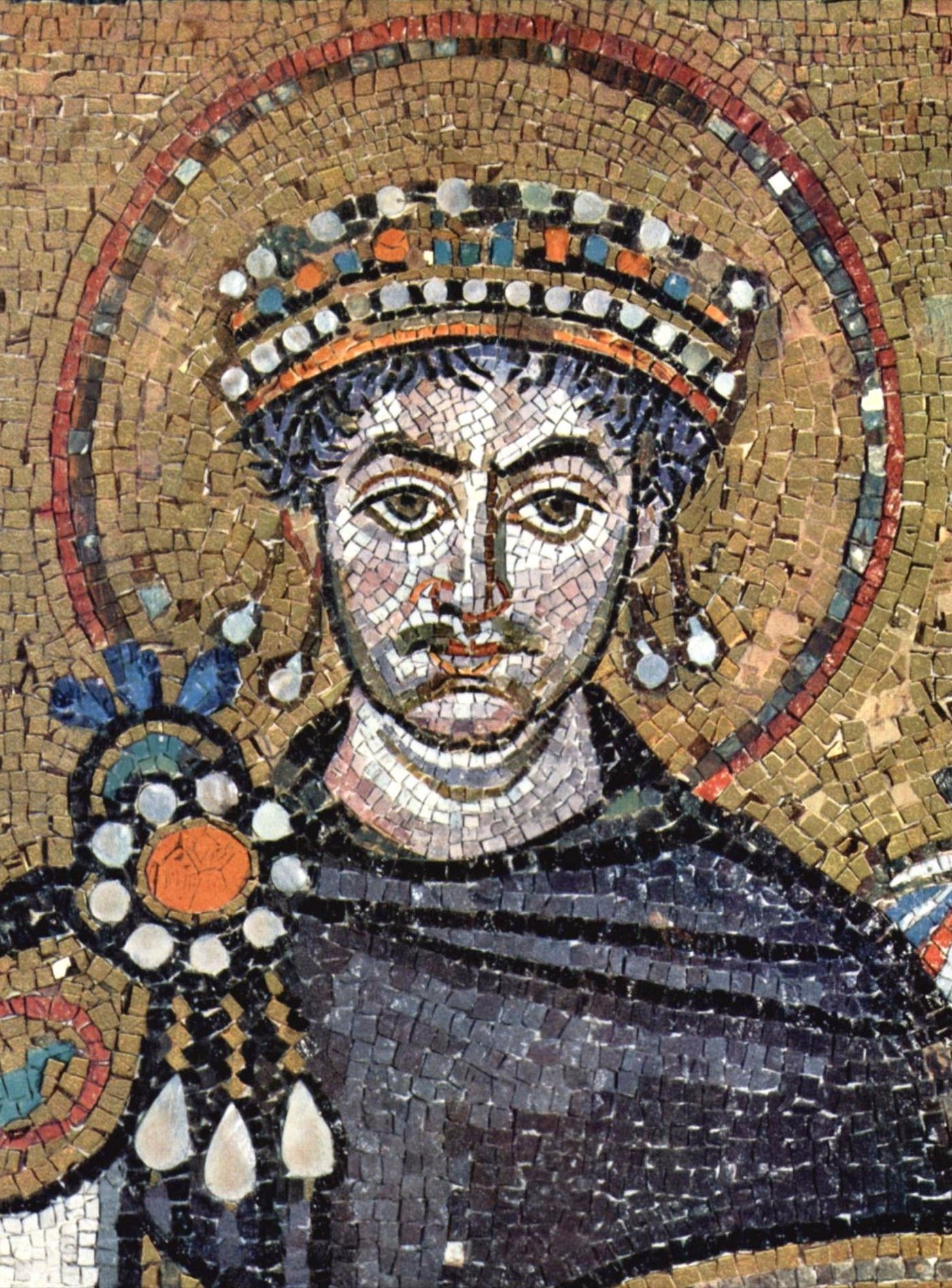
Justinian recaptured Africa from the Vandals in 533 CE, but recovering Italy from the Ostrogoths left that country devastated and paved the way for the later Lombard invasion. By the early seventh century, war between Rome and Iran flared up again: the Sasanians, who had ruled Iran since the third century, launched a full-scale invasion of the major eastern provinces, including Egypt. When Byzantium, as the eastern Roman Empire was now increasingly called, recovered these provinces in the 620s, it was only a few years from the final major blow, which came, this time, from the south-east.
The expansion of Islam from Arabia has been called “the greatest political revolution ever to occur in the history of the ancient world”. By 642 CE, barely ten years after the Prophet Muhammad’s death, large parts of both the eastern Roman and Sasanian empires had fallen to the Arabs. These conquests eventually, a century later, reached as far as Spain, Sind and Central Asia, but they began with the new Islamic state first uniting the Arab tribes within Arabia itself, a story this book picks up properly in the very next chapter, Theme 4.
10Timeline: An Empire Across Three Continents at a Glance
- Rome and Iran divided most of Europe, North Africa and the Middle East between them, separated by the river Euphrates
- Augustus founded the Principate in 27 BCE; the emperor, the Senate and the paid professional army were the empire’s three main “players”
- Client kingdoms were steadily absorbed into taxed provinces; cities, not a modern government, were how such a vast empire was actually run
- The third century brought real crisis: the aggressive new Sasanian dynasty in Iran, Germanic invasions on the Rhine and Danube, and 25 emperors in 47 years
- Roman women had striking legal independence in owning property and seeking divorce, but real inequality remained in marriage age and household power
- Literacy was patchy: widespread graffiti at Pompeii, but professional scribes doing most formal writing in Egypt
- Wheat, wine and olive oil moved across the Mediterranean in amphorae; Spain, then North Africa, then the East took turns dominating the oil trade
- Slave labour mattered less over time as free and debt-bonded wage labour grew; supervision, branding and debt contracts all controlled workers, coerced or not
- Society ran from senators and equites down to the humiliores, and by the late empire senators and equites had merged into one wealthy aristocracy
- Diocletian and Constantine remade the state: new provinces, the gold solidus, and a second capital at Constantinople; Christianity became the state religion
- The West fragmented into Germanic “post-Roman” kingdoms by the fifth century, while the East, as Byzantium, survived and flourished until the rise of Islam
- Can I name the empire’s three main “players” in politics, and explain how each one checked the others?
- Can I explain how a client kingdom like Herod’s became a Roman province?
- Can I explain why the book calls urbanisation the “answer” to governing such a vast territory?
- Can I list at least three causes of the third-century crisis?
- Can I compare a Roman wife’s legal position with a Roman father’s legal power over his children?
- Can I explain what amphorae are, and how archaeologists use them as evidence?
- Can I describe two different ways the Romans tried to control workers, coerced or free?
- Can I explain the difference between the Principate’s silver-based currency and the later gold solidus, and why the change happened?
- Can I explain why the Western empire collapsed by the fifth century while the Eastern empire, as Byzantium, survived for centuries more?
- Can I explain what Diocletian and Constantine each changed about how the empire was run?
- Can I describe how a historian actually uses texts, documents and material remains together to reconstruct Roman history?
- Can I explain why “late antiquity” is treated as a distinct, transformative period rather than simply “decline”?