
- What kinesiology and biomechanics mean, their definitions, and how the two are related
- The 13 points of importance of kinesiology and the 13 points of importance of biomechanics in sports, each with an example
- The nine principles of biomechanics, each with its sports example
- The difference between kinetics and kinematics, point by point
- The eight fundamental body movements, drawn: flexion, extension, abduction, adduction, rotation, circumduction, supination and pronation
- The three planes and three axes of the body, which movement happens in which, and how to name the plane and axis of any sports action
In the CBSE Physical Education (048) curriculum this is Unit 8, worth 4 marks + 4 “b” marks in Class XI (the “b” marks are concept questions, such as a tactile diagram, data interpretation or a case study, for visually impaired candidates). The prescribed book is CBSE’s own Physical Education Class XI. The curriculum lists five topics and this page follows them in order: definition and importance of kinesiology and biomechanics, principles of biomechanics, kinetics and kinematics, types of body movements, and axis and planes.
1 Kinesiology: Meaning, Definitions and Importance
Every sports skill, a sprint start, a smash, a squat, has a “why” behind it. Biology (the body) and physics (forces and motion) together explain that why. Coaches and teachers use this knowledge to identify, design and apply a training programme for the best performance, so teachers, coaches, doctors and sports professionals who know kinesiology and biomechanics have the upper hand in their fields.
Kinesiology
- “The science of movement” or “the study of movement”
- The whole scholarly study of human movement
- Studies movement through anatomy and mechanics
- The bigger field
Biomechanics
- “Analysis/study of forces”
- Applies the principles of physics and studies their effect on the human body
- Precise description of human activity and analysis of the causes of movement
- One of the many subdisciplines of kinesiology, and its central part
The physical educator or coach teaching movement techniques, and the athletic trainer or physical therapist treating an injury, all use biomechanics to analyse movement qualitatively (by observing it).
1.2 Meaning of kinesiology
Kinesiology is the study of human movement and muscular function. It is derived from the Greek words kinesis (movement) and logos (to study).
- It seeks to understand the impact of muscle function on health, and the mechanism of human movement.
- It pinpoints the specific muscle involved in a particular movement.
- It draws on several sciences: biomechanics, anatomy, physiology and neuroscience.
- It views the human body as a machine that functions in a very purposeful way.
- Kinesiology is also called human kinetics. It addresses physiological, mechanical and psychological mechanisms.
- Applied to health it includes strength and coordination, sports psychology, rehabilitation methods (physical and occupational therapy), and sports and exercise.
Aristotle (384-322 BC) is called the “father of kinesiology”. He wrote that a moving animal changes position by pressing against what is beneath it, so athletes jump further with weights in their hands, and runners run faster if they swing their arms. He was the first to analyse walking, in which rotatory motion is transformed into translatory motion. His treatises Parts of Animals, Movements of Animals and Progression of Animals first described muscle actions and analysed them geometrically. His ideas on leverage, gravity and laws of motion were forerunners of Newton and Borelli. Hart called his work the starting point of a chain of thought in the subject’s evolution.
1.3 Definitions of kinesiology
| Source | Definition |
|---|---|
| General | “Kinesiology refers to the whole scholarly area of human movement study, while biomechanics is the study of motion and its causes in living things.” |
| Rasch & Burke, 1978 | “Kinesiology is a term formed by the combination of two Greek words, Kinesin, meaning to move, and logos, meaning to discourse.” |
| Burke R.K, 1977 | “Kinesiology can be defined as studying the movement behaviour of all living organisms.” |
1.4 Importance of kinesiology in sports
The book gives 13 points; most carry an example. For a 3- or 5-mark answer, write the heading in bold and then one line of explanation plus the example.
| # | Importance | What it means | Example / note |
|---|---|---|---|
| 1 | Analysing human motion | Clear insight into how motor skills and techniques can be improved | Analysing fundamental movements in relation to the sports skills performed |
| 2 | Learning and improvement of motor skills | Knowing the nature and effect of each activity helps select the right exercise and perfect the skill | Teaching correct walking and running patterns |
| 3 | Applying anatomic background to prevent injuries | Understanding how common musculoskeletal injuries happen; preventive flexibility and strengthening exercises; safe landing, falling and catching; re-educating weak muscles during rehabilitation | Applying kinesiological principles to landing, falling and catching |
| 4 | Ensuring economy of movement | Analyses energy use and the timing of muscular contraction | Minimising body movement to save energy and improve timing in long-duration activities |
| 5 | Ensuring effectiveness of movement | Recognises awkward and skilful movements and corrects irregular ones for efficiency | Correcting body position during the snatch (weightlifting) |
| 6 | Aiding clinical purposes | Postural analysis, corrective exercise and rehabilitation | Analysing students’ posture in school and correcting it with corrective exercise |
| 7 | Designing and teaching exercise and conditioning | Improves general physical condition through planned routine exercise | Teaching the correct position for sit-ups in training and fitness tests |
| 8 | Discovering the underlying principles of movement | Which muscles, bones and joints act, which principles of mechanics apply, the effect of gravity, and how bones act as anatomic levers moved by muscles | Basic science for physical education, physical therapy and athletic training |
| 9 | Designing and teaching fundamental movements | Physical educators and therapists both study posture and the body mechanics of daily life skills | Analysing the anatomical and mechanical basis of everyday movement |
| 10 | Acquiring self-realisation about own performance | Helps match the performer to the activity and the activity to the performer | A basketball player checking what to correct to jump higher |
| 11 | Effective teaching of motor skills (fundamental and specialised) | Perfecting the performance = mastery of the technique; perfecting the performer = making the individual perfect in the act | Intelligent selection of methods, skills and activities |
| 12 | Evaluation of exercise and its effect on the human structure | Helps assess how far an exercise achieved the purpose it was prescribed for | Assessing an exercise against the purpose it was prescribed for |
| 13 | Benefit to physiotherapists and physical medicine professionals | A three-fold purpose: “safety”, “effectiveness” and “efficiency”; safety is the first concern so no harm is done | Optimum safety, effectiveness and efficiency for trainees or clients |
Kinesiology = A-L-I-E-E-C-D-D-D-S-T-E-P
Analyse, Learn skills, Injury prevention, Economy, Effectiveness, Clinical, Design exercise, Discover principles, Design fundamental movements, Self-realisation, Teaching motor skills, Evaluation, Physiotherapists.
2 Biomechanics: Meaning, Definitions and Importance
2.1 Meaning of biomechanics
The word biomechanics dates from 1899 and biomechanical from 1856. Both come from Ancient Greek bios (life) and mechanike (mechanics): the study of the mechanical principles of living organisms, particularly their movement and structure.
Biomechanics is the study of the mechanics related to the functional and anatomical analysis of biological systems, mainly of humans. It is needed to study the body’s mechanical characteristics and principles and to understand its movements.
“Mechanics” itself has two sub-fields, and dynamics splits again. This is the family tree of the words in this chapter:
Sports biomechanics is a quantitative study and analysis of professional athletes, sportspersons and sports activities in general. In simple terms it describes the physics of sports: the science of explaining how and why the human body moves in the way that it does.
In sports biomechanics the laws of mechanics are applied to sporting events through mathematical modelling, computer simulation and measurement, to understand athletic performance better.
A biomechanical calculation finds how large the load on the musculoskeletal system is. It needs the person’s height and weight, how many degrees they bend forward, the weight being lifted and the reaching distance. A person of 80 kg and 186 cm, bending 45 degrees forward and lifting 10 kg at a reach of 30 cm, puts a strain of about 255 kg on the disc in the lumbar region. That is why health workers who transfer patients risk back injury.
2.2 Definitions of biomechanics
| Source | Definition |
|---|---|
| Hatze, 1974 | Studying the movement of living things using the science of mechanics. |
| General | “The area of study wherein knowledge and methods of mechanics are applied to the structure and function of the living human system.” |
| James G. Hay | “Biomechanics is the science concerned with the internal and external forces acting on a human body and the effects produced by these forces.” |
2.3 Importance of biomechanics in sports
Again 13 points, each with the book’s example where it gives one.
| # | Importance | What it means / example |
|---|---|---|
| 1 | Basis for analysing the efficient structure of competitive performance | Biomechanics is the science of movement technique, used most where technique dominates (analysing Usain Bolt’s 9.63 s at the 2012 London Olympics). Tools listed below. |
| 2 | Practical organisation of the sport’s technical profession | Technology and data track performance and health; visual tools show athletes how to improve in training, treatment and competition |
| 3 | Effective development of motor abilities | Motor abilities (force, speed, endurance, coordination, flexibility) are developed through systematic training |
| 4 | Diagnostic teaching | Discovering each athlete’s abilities, needs and objectives; monitoring understanding and performance before, during and after a lesson |
| 5 | Diagnostic coaching | Training diagnostics evaluate training through assessment, analysis and data; helps design the training schedule |
| 6 | Self-evaluation of athletes | Every detail of running, jumping, throwing, changing direction can be studied. Example: an athlete not bending the knees optimally while jumping or landing can train to correct it |
| 7 | Designing and accepting equipment | Designs new equipment and measures its efficiency. Examples: T-shirts, studs, spikes, swimming costumes, hockey sticks, different-sized footballs, low-weight helmets |
| 8 | Evaluating and changing rules and regulations | Mathematical modelling, simulation and measurement show where rules can be changed for safety and performance |
| 9 | Evaluating new techniques | Teachers and coaches use qualitative analysis to correct a skill; researchers use quantitative analysis to discover new techniques, which are then passed to coaches |
| 10 | Selecting techniques suited to the athlete | A short sprinter is better with a bullet start: efficient block clearance time, force impulse on the blocks, take-off velocity and acceleration |
| 11 | Selection of players | Understanding structure, function and forces helps select players for a sport: short players for gymnastics, tall players for volleyball |
| 12 | Designing exercises for the best outcome | Exercises designed on how the body adapts to biomechanical stress. Example: a half-squat instead of a full squat puts less stress on the knee joint and lower back |
| 13 | Prevention and rehabilitation of injuries | Analysing a runner’s style, arm swing, foot strike and trunk lean finds the cause of injury, prevents recurrence and guides rehabilitation exercises |
Tools used to analyse performance (point 1):
Do not mix up the two lists. Selection of players, designing equipment, changing rules and diagnostic coaching are in the importance of biomechanics. Economy of movement, clinical purposes, self-realisation and benefit to physiotherapists are in the importance of kinesiology.
2.4 Biomechanics in action: Usain Bolt
The chapter opens with Usain Bolt to show why scientists use biomechanics and kinesiology to explain performance. Read it as an example, not as facts to memorise.
| Fact | Usain Bolt | Tyson Gay |
|---|---|---|
| Who | Usain St. Leo Bolt, born August 21, 1986, Montego Bay, Jamaica; 100 m and 200 m gold in three straight Olympics | American sprinter, Bolt’s closest rival in Berlin |
| Height | 6’5″ | 5’11” |
| Steps in the Berlin 2009 100 m final | 41 steps, average 2.44 m | 45.45 steps, average 2.20 m |
| Average angle of “falling” forward | 18.5 degrees (9.58 s) | 18.4 degrees (9.71 s) |
| Step frequency (cadence) | 4.28 steps per second | 4.68 steps per second |
Bolt uses gravitational torque: his body rotates forward around the point of support, almost a free fall forward, and he converts this rotational (angular) velocity into horizontal velocity. Longer steps, fewer of them, and gravity used well: that is a biomechanical explanation.
The book’s opening picture shows three sprinters crouched on starting blocks with the feet at different distances apart. Sprinters choose the start that suits their build, such as the bullet start for a short sprinter (see point 10 in the table above). Choosing a technique to suit the athlete is itself a use of biomechanics.
3 Principles of Biomechanics
The book gives nine principles: the minimum number of core principles that can be applied to all human movements. They fall into two groups: those dealing with the creation of movement (process) and those dealing with the outcome of projectiles (product). They are based mainly on the work of bio-mechanists Norman (1975) and Hudson (1995). Some bio-mechanists feel general principles for all sports are hard to identify because every skill has its own goal and setting.
3.1 The nine principles with examples
Force-Motion
It takes unbalanced forces (and the torques they cause) to create or modify motion. Forces must act first, before motion changes. A free-body diagram is a simplified model of an object showing the significant forces acting on it. So train the muscle groups that mainly create the movement.
Example: a person standing still: the forces on them are equal, so there is no movement.
Force-Time
The change in movement depends on the timing of force application as much as its size. Applying force for longer gives more motion; a longer time is also used to slow objects down (catching) and to land safely.
Example: the sweep shot in hockey: force applied for more time gives much more power than a hit.
Inertia
The property of all objects to resist a change in their state of motion. Linear inertia is measured by mass (m); angular inertia by moment of inertia (I). Inertia resists motion, but can also be used to transfer energy between body segments.
Example: stopping a shot put needs much more force than stopping a netball, because the heavier shot put has more inertia.
Range of Motion
The overall linear or angular motion of the body segments in a movement. Less range of motion suits low-effort, high-accuracy movements; more range suits maximum speed or force. Moving through a range takes time, so it is linked to force-time.
Example: throwing a dart (reduced ROM) vs throwing a javelin (increased ROM).
Balance
A person’s ability to control body position relative to a base of support. Stability and mobility are inversely related. Balance depends on the centre of gravity, stability and equilibrium. Stability increases with a wider base of support, a lower centre of gravity and more body mass; the line of gravity should fall in the middle of the base.
Example: sumo wrestlers take a very wide, low stance and train for a very large mass.
Coordination Continuum
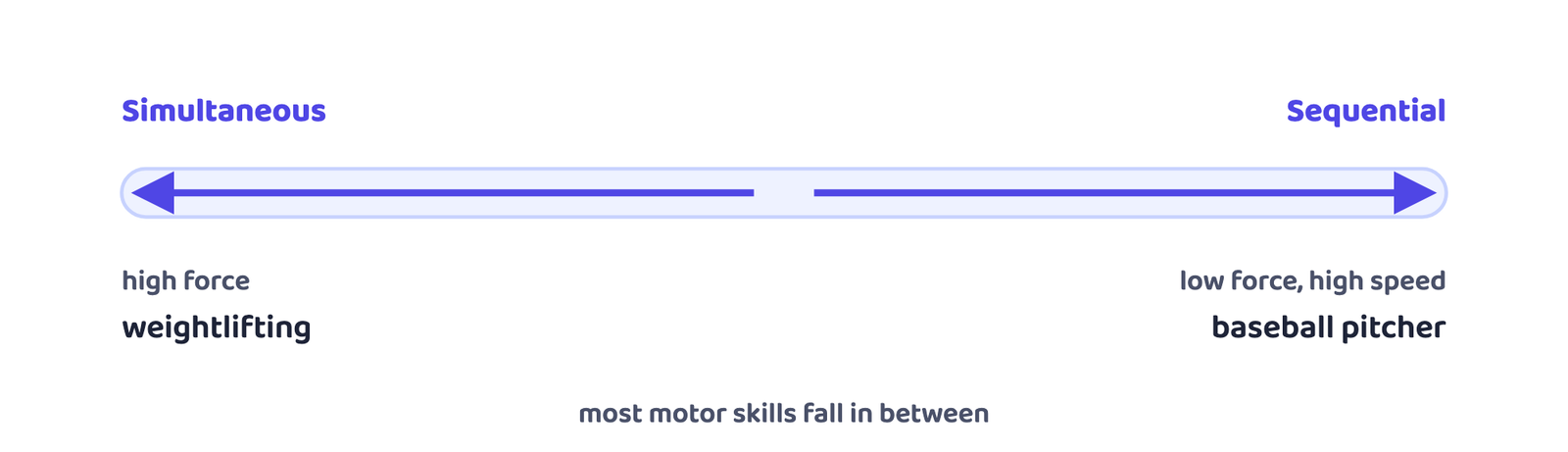
The best timing of muscle actions depends on the goal of the movement. High force goals use more simultaneous muscle actions and joint rotations; low-force, high-speed goals use more sequential actions. Most skills fall somewhere in between.
Example: weightlifting = simultaneous; baseball pitcher = sequential.
Segmental Interaction
Forces acting in a system of linked body segments can be transferred through the links and joints (transfer, summation, sequential). Muscles work in short, precisely timed bursts.
Example: golf and tennis shots: the movement begins with the largest, slowest and strongest segments and works through to the smaller, faster ones, creating maximum power.
Optimal Projection
For most movements that project an object, there is an optimal range of projection angles for a specific goal. The book gives 45 degrees as the optimal angle for maximum distance.
Example: hitting a golf ball on a level plane for maximum distance.
Spin
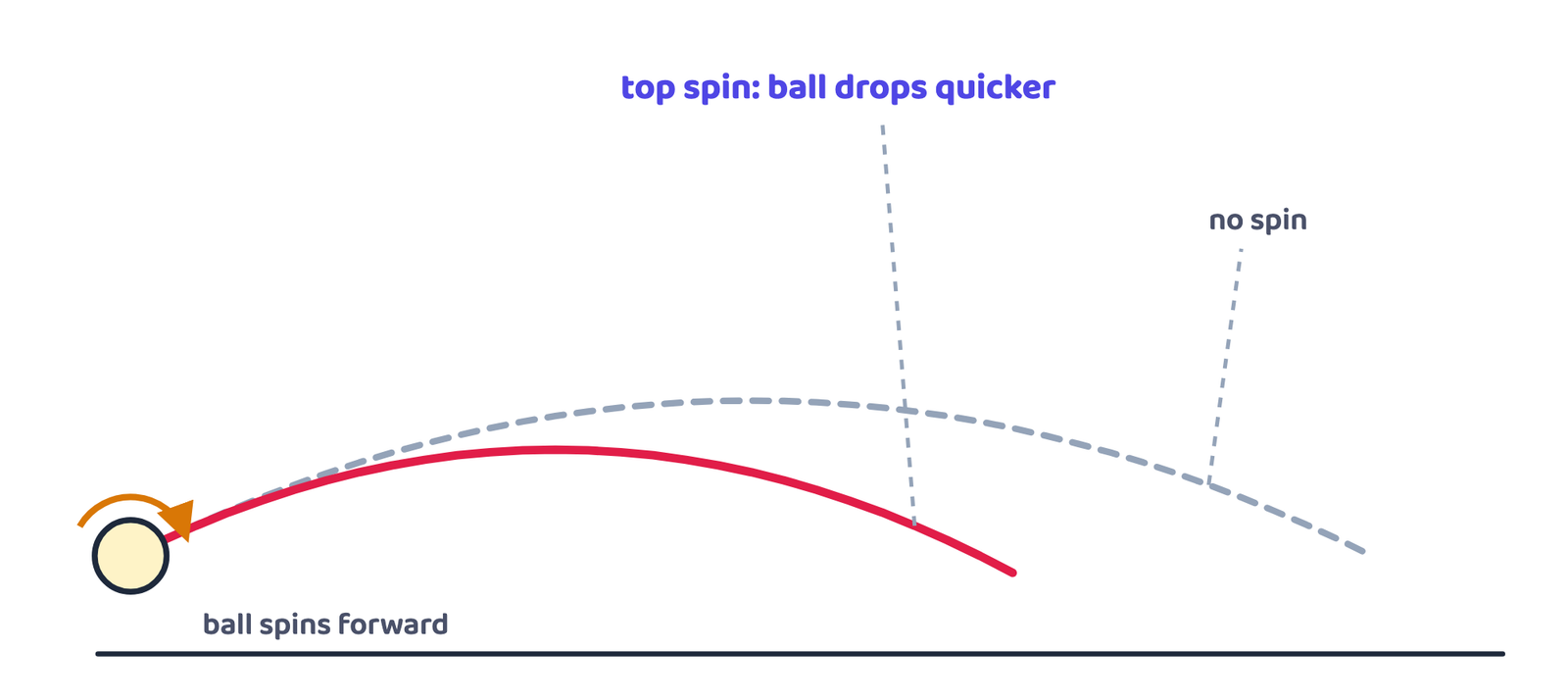
Applies mainly to projectiles, particularly sports balls. Spin stabilises flight and creates a fluid force called lift, used to curve the ball or counter gravity; it changes the trajectory and the bounce.
Example: a tennis player puts top spin on the ball to make it drop quicker.
3.2 Four principles drawn


F-F-I-R-B-C-S-O-S
“Fast Feet In Race Bring Champions Success On Stage”: Force-Motion, Force-Time, Inertia, Range of Motion, Balance, Coordination Continuum, Segmental Interaction, Optimal Projection, Spin.
To name the principle from its example, learn the pairs: sweep shot → force-time; dart vs javelin → range of motion; sumo → balance; weightlifting vs baseball pitch → coordination continuum; golf and tennis power → segmental interaction; shot put vs netball → inertia; top spin → spin; 45 degrees → optimal projection; standing still → force-motion.
4 Kinetics and Kinematics in Sports
The same physical laws that govern all objects also govern the human body. Mechanical laws are classed as static (objects in static equilibrium) or dynamic (objects in motion), and dynamics is subdivided into kinematics and kinetics. Sports biomechanics is traditionally divided into these two studies.
4.1 What each one studies
Kinetics is the study of the forces associated with motion: the action of forces in producing or changing motion. It explains the cause of motion (the “why”).
Kinematics is the geometry of motion: it describes motion in terms of time, displacement, velocity and acceleration, in a straight (linear) line or a rotary (angular) direction, without reference to the forces causing it. It describes the “how” of motion.
Kinetics
- Forces that cause motion: gravity, friction and so on
- A force may be a push or a pull. All levers in the human body are pull-type machines, but a skill can include a push, like the hand pushing the shot
- Human levers produce force to overcome resistance; this action is work
- Includes Newton’s three laws of motion
Kinematics
- Describes motion: velocity, acceleration
- Displacement and velocity of the body’s segments and joints
- Measurement of motion is one of its central aspects
- Golf swing: path of the clubhead, positions of body and club, velocities, timing of the body slowing down so the club speeds up
Fundamental kinematic quantities: time, position, displacement (distance), velocity (speed) and acceleration. The paths (trajectories) of points on the body and the club, and the orientation of the planes of motion, are also kinematic issues. A complex motion can be resolved into the linear motion of the centre of mass (COM) plus the angular motion of the body about its COM. A kinematic sequence plot is based on the angular velocity patterns of body segments and the club.
4.2 Differences between kinetics and kinematics
The book’s “Do you know?” table of differences, attribute by attribute:
| Attribute | Kinetics | Kinematics |
|---|---|---|
| Definition | Study of motion considering the mass and external forces as well | Not dependent on the mass of the object |
| Relation | Determines the relationship between the motion of bodies caused by inertial force and the mass of a body | Simply describes motion: velocity, displacement, time and acceleration |
| Study | Motion caused by forces, gravity, friction, torque | The “how” of motion |
| Nature | Tries to get at the cause | Descriptive, based on observation |
| Treated | In terms of energy transformations | Geometrically |
| Example | A person sitting inside a train; a child running around in the house; a running fan | A moving train; the parabolic path traced by a football; a stone hitting the ground |
| Uses | Gas laws, fluid dynamics, physical chemistry | Classical mechanics in engineering |
kineTics = Tug (force) · kineMatics = Measure
Kinetics deals with the tug, push or pull that causes motion (why). Kinematics only measures and describes the motion (how).
5 Movement and the Types of Body Movements
5.1 Movement and locomotion
Movement (motion) is the act of moving: a change of place or posture. Human movement is the movement produced by the human body due to the contraction of muscles and bending of joints. It is controlled by the nervous system and uses muscles, ligaments, joints and bones.
Movement
- A change in position of a body part or a combination of parts
- Eyelids, heart muscles, jaw, teeth
Locomotion
- Movement that changes the position of the whole organism
- Walking, running, swimming
Movement is one of the things that separate a living thing from a non-living thing. Sports and games use much more complicated movements, built from the fundamental movements below.
5.2 Flexion and extension
Flexion is bending a limb: decreasing the angle at the moving joint.
Extension is straightening a limb: increasing the angle at the joint. It is the opposite of flexion.

5.3 Abduction and adduction
Abduction is moving a limb away from the body’s centreline (midline).
Adduction is moving a limb towards the body’s centreline.
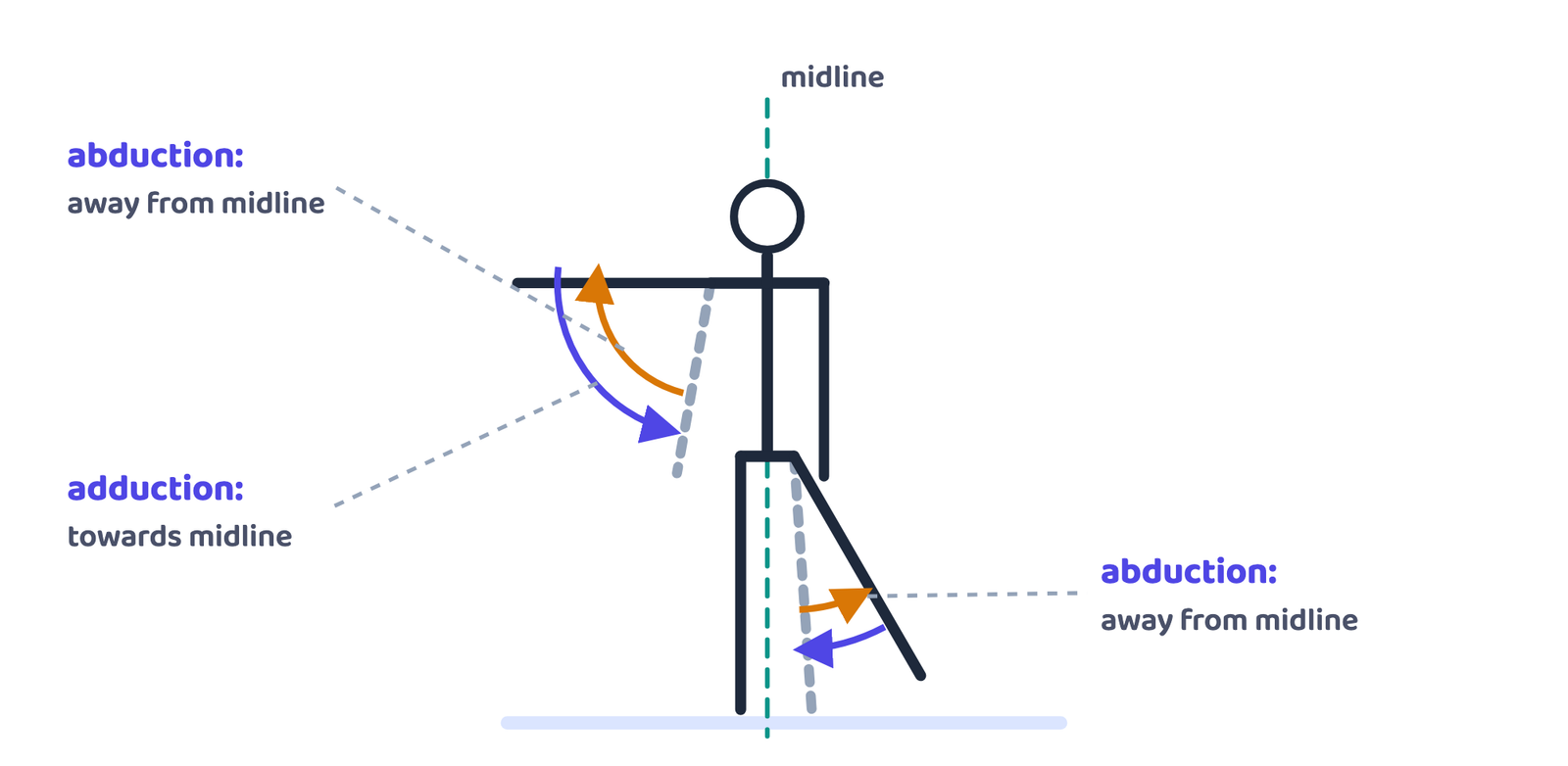
AB-duction = taken AWAY · AD-duction = ADDed back
The limb is “abducted” (taken away) from the midline and “added” back to the body.
5.4 Rotation and circumduction
Rotation is movement around the long axis (of a bone or of the body).
Circumduction combines flexion, extension, abduction and adduction. It usually occurs at ball and socket joints, like the shoulder joint and hip joint.

5.5 Supination and pronation
Supination means turning the palm up.
Pronation means turning the palm down.

Students swap these two. Think of carrying a bowl of soup: supination holds the palm up so the soup does not spill. Pronation is the other one: palm down.
| Movement | What happens | Opposite pair |
|---|---|---|
| Flexion | Bending; joint angle decreases | Extension |
| Extension | Straightening; joint angle increases | Flexion |
| Abduction | Limb away from the centreline | Adduction |
| Adduction | Limb towards the centreline | Abduction |
| Rotation | Around the long axis | (internal / external) |
| Circumduction | Flexion + extension + abduction + adduction; at ball and socket joints | None |
| Supination | Palm turned up | Pronation |
| Pronation | Palm turned down | Supination |
6 Axis and Planes
6.1 The idea
In kinematics, the limbs are assumed to rotate about the joints with no sliding movement. This is not strictly correct, but it is a usable approximation. The joint is the axis, a line around which the part rotates, and the plane is like a sheet of paper at right angles to that axis, in which the movement takes place.
A plane is an imaginary flat surface running through the body. A single plane divides the body into two parts.
An axis is a point or straight line around which an object moves or a body segment moves. It is an imaginary line at right angles to the plane, about which the body rotates or spins.
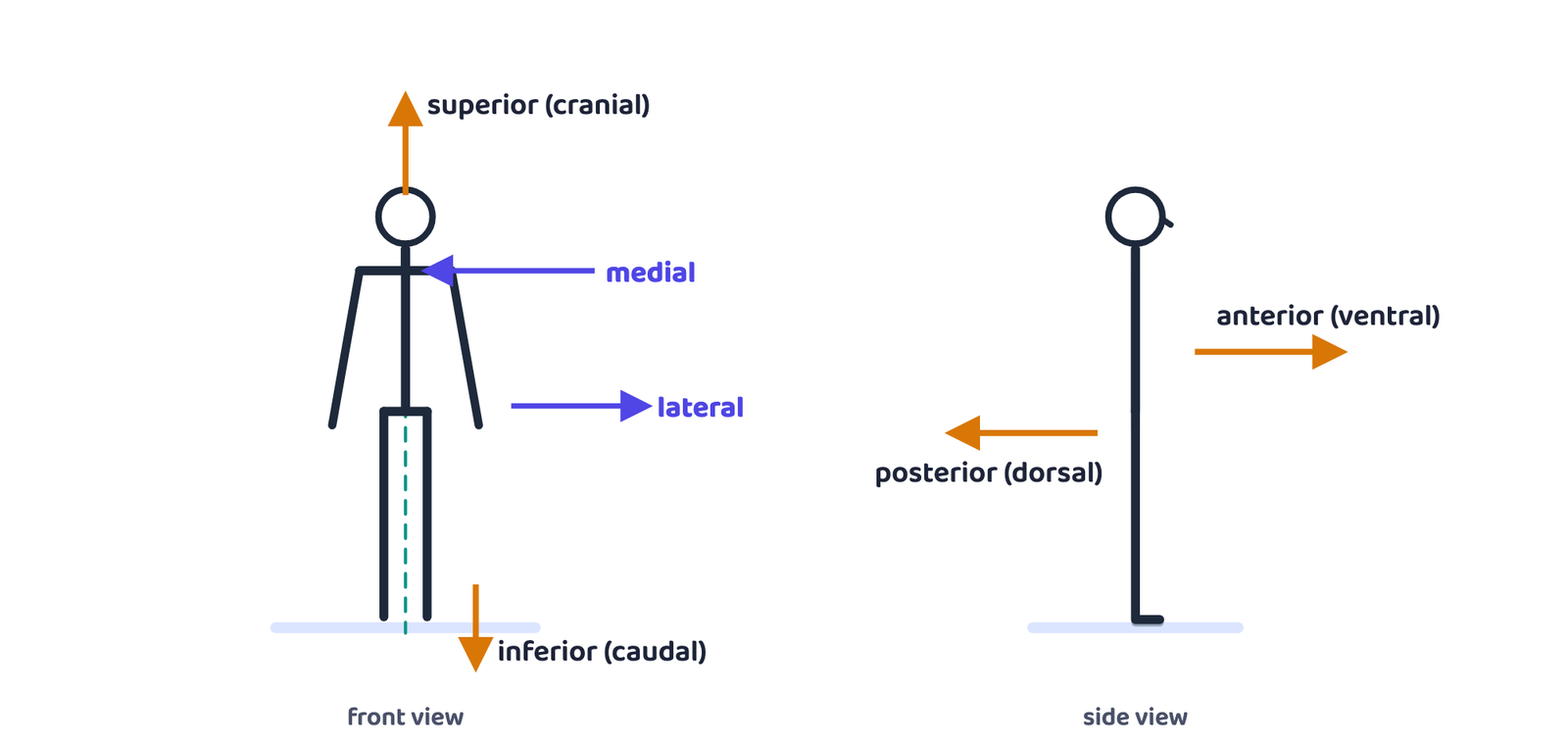
6.2 Terms of direction
| Term | Also called | Means |
|---|---|---|
| Anterior | Ventral | Towards the front of the body |
| Posterior | Dorsal | Towards the back of the body |
| Superior | Cranial | Towards the head, or upper part of the body |
| Inferior | Caudal | Towards the lower part of the body |
| Medial | (inner side) | Towards the midline of the body |
| Lateral | (outer side) | Away from the midline of the body |
6.3 The three planes
There are three planes of motion. Most sports movements are not straight up, down or sideways in one direction, but each can be described by its main plane.
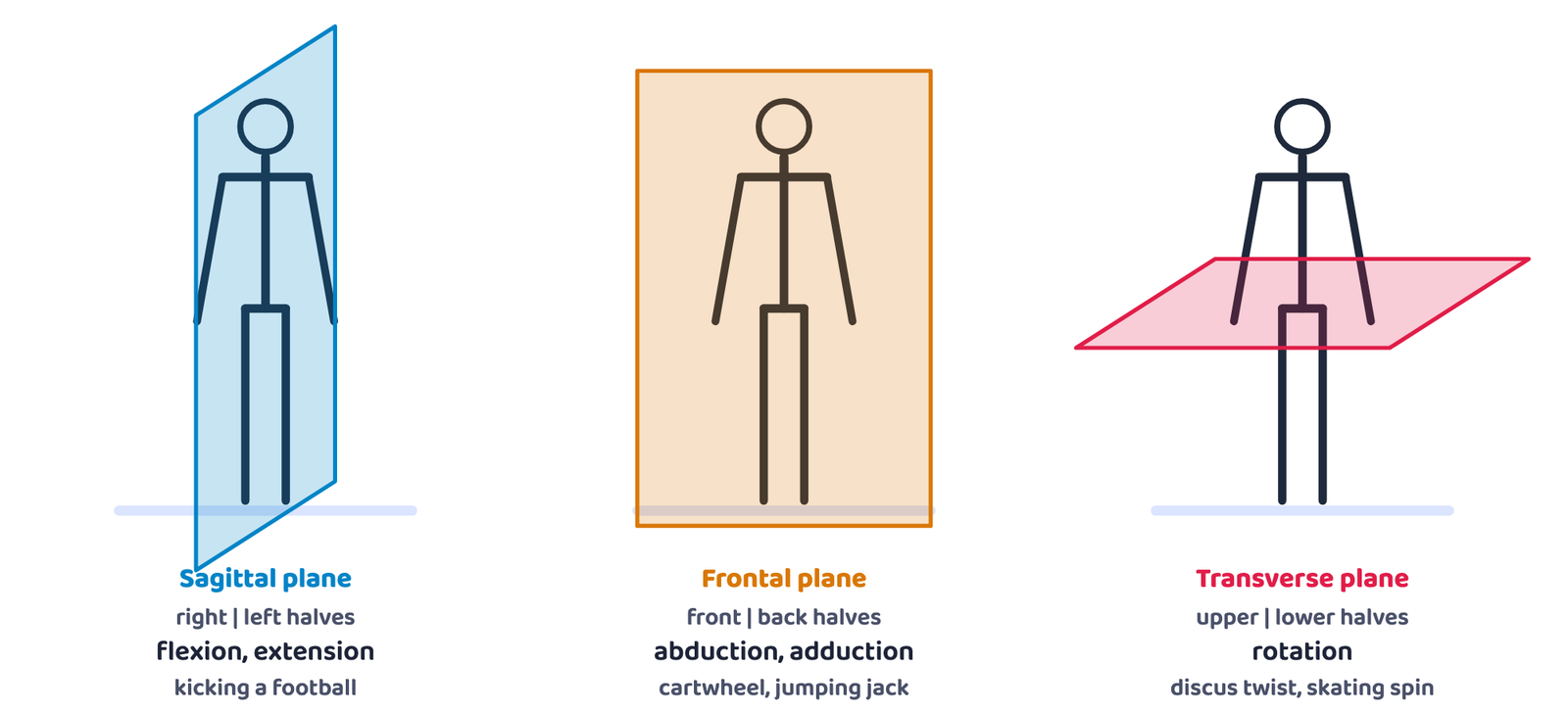
| Plane | Also called | Lies | Divides the body into | Movements | Sports examples |
|---|---|---|---|---|---|
| Sagittal | Median plane | Vertically | Right and left parts | Flexion, extension | Kicking a football, chest pass in netball, walking, jumping, squatting |
| Frontal | Lateral or coronal plane | Vertically | Anterior (ventral) and posterior (dorsal) parts | Abduction, adduction | Jumping jacks, raising and lowering arms and legs sideways, cartwheel |
| Transverse | Horizontal plane | Horizontally | Superior and inferior parts | Rotation | Hip rotation in a golf swing, twisting in a discus throw, pivoting in netball, spinning in skating |
The centre of gravity may be defined as the point at which the three planes of the body intersect each other.
CBSE Physical Education Class XI, Unit 8
6.4 The three axes
There are three axes of rotation, and each axis is perpendicular to a plane.

| Axis | Also called | Runs | Perpendicular to | Movements about it |
|---|---|---|---|---|
| Sagittal axis | Anteroposterior axis | Horizontally, from posterior to anterior (back to front) | Frontal plane | Abduction, adduction |
| Frontal axis | Transverse axis; horizontal and mediolateral axis | Side to side | Sagittal plane | Flexion, extension |
| Vertical axis | Longitudinal axis | Vertically, from inferior to superior | Transverse plane | Rotation |
The sagittal axis is NOT in the sagittal plane. Movement in the sagittal plane (flexion, extension) happens about the frontal axis; movement in the frontal plane (abduction, adduction) happens about the sagittal axis. The names cross over. The transverse plane pairs with the vertical axis.
6.5 Concept and its application in body movements
A movement is usually named by the plane it mainly occurs in: walking is a sagittal plane movement. But this is only the gross direction. At each joint, movement happens in all three planes. During walking the hip
- flexes and extends in the sagittal plane,
- adducts and abducts in the frontal plane, and
- rotates internally and externally in the transverse plane.
The hip quietly decelerates internal rotation and adduction and accelerates external rotation and abduction, absorbing force (eccentric) and producing force (concentric) in all three planes together.
Tri-planar motion is a simultaneous movement seen as one motion with three components, one in each plane. All functional movements are three-dimensional, but describing them in single-plane terms is most useful for general movement patterns.
| Plane | Motion | Axis | Example |
|---|---|---|---|
| Sagittal | Flexion / extension | Frontal | Walking, squatting, overhead press |
| Frontal | Abduction / adduction, side flexion, inversion / eversion | Sagittal | Star jump, lateral arm raises, side bending |
| Transverse | Internal / external rotation, horizontal flexion / extension, supination / pronation | Vertical | Throwing, baseball swing, golf swing |
Q. Name the plane and axis of (a) kicking a football, (b) a cartwheel, (c) a front roll, (d) a discus twist.
Method: find the movement, then read its plane and axis off the table.
(a) Kicking: the leg flexes and extends → sagittal plane, frontal axis.
(b) Cartwheel: the body turns sideways like a wheel → frontal plane, sagittal axis.
(c) Front roll: the body rolls forward head over heels, like flexion of the whole body → sagittal plane, frontal axis.
(d) Discus twist: the trunk rotates → transverse plane, vertical axis.
For “identify and label the planes and axes” on a figure, draw a standing person and show: one vertical sheet through the middle from front to back (sagittal plane), one vertical sheet from side to side (frontal plane), one horizontal sheet at the waist (transverse plane). Then the three lines: front-to-back (sagittal axis), side-to-side (frontal axis) and head-to-foot (vertical axis).
- Kinesiology: Greek kinesis (movement) + logos (study); study of human movement and muscular function; also called human kinetics. Aristotle (384-322 BC) is its father.
- Biomechanics: bios (life) + mechanics; the central part (a subdiscipline) of kinesiology. Hatze 1974; James G. Hay: internal and external forces and their effects.
- Sports biomechanics = physics of sports: how and why the body moves.
- Mechanics → statics (rest or constant velocity) and dynamics (acceleration) → kinematics and kinetics.
- Kinesiology importance (13): analysing motion, motor skills, injury prevention, economy, effectiveness, clinical, conditioning, principles (bones as levers), fundamental movements, self-realisation, teaching motor skills, evaluation, physiotherapists (safety, effectiveness, efficiency).
- Biomechanics importance (13): performance analysis (EMG, dynamometry, electrogoniometry…), technical profession, motor abilities, diagnostic teaching, diagnostic coaching, self-evaluation, equipment, rules, new techniques, suitable techniques (bullet start), player selection, exercise design (half-squat), injury prevention and rehabilitation.
- Nine principles: force-motion (standing still), force-time (sweep shot; impulse = force × time), inertia (shot put vs netball), range of motion (dart vs javelin), balance (sumo), coordination continuum (weightlifting vs baseball pitch), segmental interaction (golf, tennis), optimal projection (45 degrees), spin (top spin drops quicker).
- Kinetics = forces, cause, why, energy; kinematics = description, how, geometry, independent of mass.
- Flexion: angle decreases. Extension: angle increases. Abduction: away from midline. Adduction: towards. Rotation: around the long axis. Circumduction: all four, ball and socket joints. Supination: palm up. Pronation: palm down.
- Sagittal plane (right/left) + frontal axis = flexion/extension. Frontal plane (front/back) + sagittal axis = abduction/adduction. Transverse plane (upper/lower) + vertical axis = rotation.
- The centre of gravity is the point where the three planes intersect. All functional movement is tri-planar.
- Can I define kinesiology and biomechanics and give the Greek roots of each?
- Can I write any six points of importance of kinesiology, and six of biomechanics, with examples?
- Can I name all nine principles of biomechanics and give the example for each?
- Can I write five differences between kinetics and kinematics?
- Can I draw and define the eight fundamental movements?
- Can I draw a figure showing the three planes and three axes, and name the plane and axis of a kick, a cartwheel, a front roll and a discus twist?