
Human beings are unique in two respects: they possess reason and the ability to reflect on their actions, and they have the capacity to use language and communicate with each other. Unlike other species, they can express their innermost thoughts and desires, and share and discuss what they consider good and desirable. Political theory has its roots in these twin aspects of the human self.
Basic questions it analyses: How should society be organised? Why do we need government? What is the best form of government? Does law limit our freedom? What does the state owe its citizens? What do we owe each other as citizens?
What it does: it systematically thinks about the values that inform political life, such as freedom, equality and justice, and explains their meaning and significance. It clarifies the existing definitions of these concepts by focusing on some major political thinkers of the past and present. It examines the extent to which freedom or equality are actually present in the institutions of everyday life, such as schools, shops, buses, trains or government offices. At an advanced level, it looks at whether existing definitions are adequate and how existing institutions (government, bureaucracy) and policy practices must be modified to become more democratic.
Objective: to train citizens to think rationally about political questions and assess the political events of our time.
1 What is Politics?
People have very different ideas about what politics is. Political leaders and those who contest elections often say that politics is a kind of public service. Some others associate politics with manipulation and intrigue, undertaken to pursue ambitions and satisfy wants. A few think of politics as what politicians do, and when they see politicians defecting from parties, making false promises and tall claims and manipulating different sections, they link politics with “scams”. Disillusioned by such pursuits of selfishness, we despair of politics. It is not only ordinary people who despair of politics: even businessmen and entrepreneurs routinely blame politics for their woes even as they benefit from and fund various political parties, and cinema stars also complain of politics though they seem to be adept at the game once they join it. We are thus confronted with conflicting images of politics.
Mahatma Gandhi once observed that politics envelops us like the coils of a snake and there is no other way out but to wrestle with it. No society can exist without some form of political organisation and collective decision making.
Politics is not confined to the affairs of government. What governments do is relevant because it affects the lives of people in many different ways. Governments determine economic policy, foreign policy and educational policy. An inefficient or corrupt government can endanger people’s lives and security, for instance if the ruling government allows conflicts to become violent, markets close down and schools are shut, disrupting life. Since the actions of the government affect us so deeply, we form associations, organise campaigns, protest and organise demonstrations to try and shape the goals that governments pursue.
To sum up, politics arises from the fact that we have different visions of what is just and desirable for us and our society. It involves the multiple negotiations that go on in society through which collective decisions are made. At one level it involves what governments do and how they relate to the aspirations of the people, at another level it involves how people struggle and influence decision making.
2 What Do We Study in Political Theory?
If we look deeper at our societies, we find certain values and principles, like democracy, freedom and equality, that have consistently inspired people and guided policies. Different countries try to protect such values by enshrining them in their constitutions, as is the case with the American and Indian constitutions. These documents did not emerge overnight, they are built upon ideas and principles debated almost since the time of Kautilya and Aristotle to Jean-Jacques Rousseau, Karl Marx, Mahatma Gandhi and Dr. B.R. Ambedkar.
These ideas find their place in the Indian Constitution: the Preamble enshrines freedom and equality, the chapter on Rights abolishes untouchability in any form, and Gandhian principles find a place in the Directive Principles. Political theory deals with the ideas and principles that shape Constitutions, governments and social life in a systematic manner. It probes the significance of principles such as rule of law, separation of powers and judicial review. Besides examining the arguments of different thinkers, political theorists also reflect upon our current political experiences and point out trends and possibilities for the future.
Can you identify the political principle/value which is in application in each of the following statements/situations?
(a) I should be able to decide which subjects I want to study in school.
(b) The practice of untouchability has been abolished.
(c) All Indians are equal before law.
(d) Minorities can have their own schools and colleges.
(e) Foreigners who are visiting India cannot vote in Indian elections.
(f) There should be no censorship of media or films.
(g) Students should be consulted while planning the annual day functions.
(h) Everyone must join the Republic Day celebrations.
2.1 Is All This Still Relevant for Us Now? Three Reasons
India is free and independent, yet questions regarding freedom and equality have not ceased to crop up. This is because issues of freedom, equality and democracy arise in many areas of social life, and they are being implemented in different sectors at different paces.
1. Equality is uneven across spheres. Equality may exist in the political sphere in the form of equal rights, but not to the same extent in the economic or social spheres. People may enjoy equal political rights but still be discriminated against socially because of their caste or poverty. Some have a privileged place in society while others are deprived even of basic necessities, and many are unable even to go to school so that they can have decent jobs in the future. For them, freedom is still a distant dream.
2. New interpretations all the time. Freedom is guaranteed in our Constitution, but we encounter new interpretations all the time. This is a bit like playing a game: as we play chess or cricket, we learn how to interpret the rules, and in the process we discover new and broader meanings of the game itself. Similarly, our fundamental rights are continually being reinterpreted in response to new circumstances. The right to life has been interpreted by the Courts to include the right to livelihood, and the right to information has been granted through a new law. The fundamental rights have been amended and expanded over time through judicial interpretations and government policies designed to address new problems.
3. New dimensions of freedom, and new threats to it. Global communications technology makes it easier for activists to network with one another across the world for protecting tribal cultures or forests, but it also enables terrorists and criminals to network. As internet commerce grows, the information we give about ourselves online to buy goods or services must be protected. So even though netizens (citizens of the internet) do not like government control, they recognise that some form of regulation is necessary to safeguard individual security and privacy. This raises questions: should people be allowed to send unsolicited e-mails to strangers or advertise their products in chat rooms? Should governments be allowed to read private e-mails to track down terrorists? How much regulation is justified, and who should regulate, governments or some private regulators?
Political theory has a lot to teach us about possible answers to such questions, and is therefore very relevant.
3 Putting Political Theory to Practice
This textbook confines itself to one aspect of political theory: the origins, meaning and significance of familiar political ideas such as freedom, equality, citizenship, justice, development, nationalism and secularism. When we begin a debate, we usually ask “what does it mean?” and “how does it matter?” Unlike in mathematics, where there can be only one definition of a triangle or a square, in political theory we encounter many definitions of equality, freedom or justice, because these words concern our relationships with other human beings rather than with things.
3.1 The Complexity of Equality : A Concrete Example
People often jump the queue in shops or government offices, and we feel glad when they are sent back in line, because we all want equal opportunity. Yet if there are separate counters for the old and disabled, we understand that this special treatment is justified. But many poor people, such as day labourers who spend hours cutting stones or carrying bricks, cannot go to a shop or a doctor because they have no money to pay for goods or services. Many children cannot go to school because they have to work, and most girl students in poor households are pulled out of school to care for younger siblings while parents go to work. Even though the Indian Constitution guarantees the right to primary education for all, this right remains merely formal.
So the reason we have many definitions of equality is that its meaning depends on the context. We start with what it means for ourselves and then consider others (the poor, the disadvantaged, senior citizens), discovering many layers of meaning: we have been doing political theory without realising it. Equality must involve not just equal opportunity, but also some kind of fairness, so that people are not unduly exploited or disadvantaged by economic factors. Sometimes this means enabling people through proactive measures such as fair distribution of resources (jobs, decent wages, subsidised hospitals), which requires some agency to be made responsible for ensuring fairness.
Political theorists clarify the meaning of political concepts by looking at how they are understood and used in ordinary language, and debate and examine the diverse meanings and opinions in a systematic manner. When is equality of opportunity enough? When do people need special treatment? How far and how long should such special treatment be given? Should poor children be given midday meals to encourage them to stay in schools? These questions are eminently practical: they provide guidelines for framing public policies on education and employment. Freedom, equality, citizenship, rights, development, justice, nationalism and secularism are some of the concepts we will discuss in the chapters that follow.
In ancient Greece, in the city of Athens, Socrates was described as the “wisest man”. He was known for questioning and challenging popularly held beliefs about society, religion and politics, for which he was condemned to death by the rulers of Athens. His student Plato wrote extensively about his life and ideas, creating the character Socrates in his book “The Republic” to examine the question, “what is justice?” The book opens with a dialogue between Socrates and Cephalus, who first defines justice as “to speak the truth and to pay your debts”. Socrates challenges this with an exception: if a friend deposits weapons with you while sane and then asks for them back while not in his right mind, returning them would not be just. Cephalus and his friend Polemarchus then propose that justice is “to do good to our friends and harm to our enemies”, but Socrates uses reason to show that this too fails: just as horses are made worse in the qualities proper to horses when injured, and dogs in the qualities proper to dogs, so too a man who is injured is made worse in human virtue, which is justice itself, meaning injury could only ever make a person more unjust, never more just, just as a musician cannot make people unmusical through their art. Eventually Polemarchus is compelled to agree: the injuring of another can be in no case just.
4 Why Should We Study Political Theory?
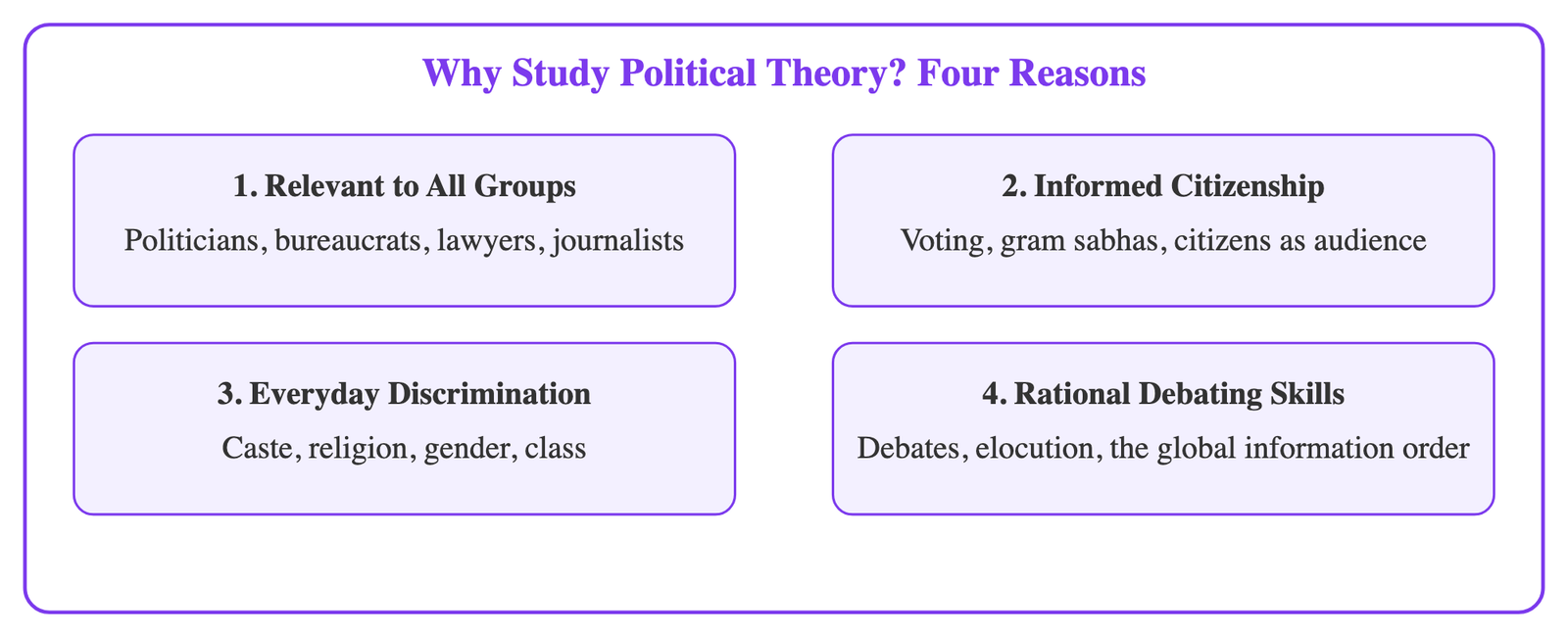
First, political theory is relevant for all the groups that engage with politics: politicians, bureaucrats, teachers, lawyers and judges, and activists and journalists. As students, we may choose one of these professions in the future, so it is indirectly relevant for us even now, just as we learn mathematics though not all of us will become mathematicians or engineers, because basic arithmetic is useful to life in general.
Second, we are all going to be citizens entitled to vote and decide other issues. In an information society, it is crucial that we learn to be reasonable and informed if we are to participate in gram sabhas or offer our views on websites and polls. As citizens, we are a bit like the audience at a music concert: we are not the main performers, but we set the agenda, appreciate the output, and put in new requests. An educated and vigilant citizenry makes those who play politics more public-spirited.
Third, freedom, equality and secularism are not abstract issues in our lives. We daily encounter discrimination of various sorts in families, schools and colleges, based on caste, religion, gender or class. Political theory encourages us to examine our own ideas and feelings about political things, and just by looking at them more carefully, we become more moderate in our views. Finally, as students we enjoy debates and elocution competitions, and only when we argue with others do we realise the need to defend our opinions and seek out reasons and arguments. Political theory exposes us to systematic thinking on justice or equality, skills of debating rationally and communicating effectively that are likely to be great assets in the global information order.
- Politics is more than what governments do, it is born from our differing visions of what is just and desirable, expressed through multiple negotiations that lead to collective decisions
- Political theory has its roots in two human capacities, reason and language; its objective is to train citizens to think rationally about political questions and assess the political events of our time
- Political theory rests on a tradition of debate from Kautilya-Aristotle to Rousseau-Marx-Gandhi-Ambedkar
- Political theory is still relevant after independence: equality is uneven across spheres, rights keep getting new interpretations (like learning the rules of chess or cricket), and the internet brings new dimensions of and threats to freedom
- Equality has many definitions because its meaning depends on context, unlike mathematics’ single definition of a triangle or square
- Socrates’ method: using reason to expose the limitations of a given point of view
- Four reasons to study political theory: relevance to all groups, informed citizenship, everyday discrimination, rational debating skills
- Can I recall the three common images of politics (public service, manipulation, “what politicians do”)?
- Can I write the objective of political theory and the six basic questions it analyses?
- Can I give the three reasons why political theory is still relevant after independence, with the chess/cricket analogy and the netizens example?
- Can I name all five thinkers and what each one specifically argued?
- Can I trace the links in the equality example (queue, day labourers, schools)?
- Do I remember the conclusion of the Socrates-Plato search for justice?
- Can I list all four reasons for studying political theory separately?