
1 The Ideal of Freedom
Human history is full of examples of people and communities who were dominated, enslaved or exploited by more powerful groups, but it also gives us inspiring examples of heroic struggles against such domination. What exactly is this freedom that people have been willing to sacrifice their lives for? At its core, the struggle for freedom expresses people’s desire to control their own lives and destinies, and to express themselves freely through their own choices and activities.
The autobiography of one of the greatest persons of the twentieth century, Nelson Mandela, is titled “Long Walk to Freedom”. In it he describes his personal struggle against the apartheid regime of South Africa. The white regime’s segregationist policies bundled black people into townships, denied them free movement about their own country, and even denied them a free choice of whom to marry. For Mandela and his colleagues, this was a struggle to remove such unjust constraints for the freedom of all South Africans, not just the black or coloured people but the white people too. For this freedom, Mandela spent twenty-seven years of his life in jail, often in solitary confinement.
“For me real freedom is freedom from fear and unless you can live free from fear you cannot live a dignified human life.”
Aung San Suu Kyi, “Freedom from Fear”
Aung San Suu Kyi remained under house arrest in Myanmar for years, separated from her own children. When her husband was dying of cancer in England, she could not go to visit him, fearing she would not be allowed to return to Myanmar. She saw her own freedom as inseparable from the freedom of her people; Gandhiji’s thoughts on non-violence were, in fact, a source of inspiration for her own struggle. The stories of Mandela and Suu Kyi together reveal the power of the ideal of freedom, an ideal that was also at the centre of India’s own national struggle and of the struggles of the peoples of Asia and Africa against British, French and Portuguese colonialism.
2 What is Freedom?
A simple answer to “what is freedom” is: the absence of external constraints on the individual. By this definition, a person is free if they can make independent decisions and act autonomously, without being subject to external control or coercion. But absence of constraints is only one dimension of freedom. Freedom is also about expanding a person’s ability to express themselves freely and develop their own potential, whether in sports, science, art, music or any other pursuit. Freedom is considered valuable because it allows us to make choices and to exercise our judgement: it permits the exercise of the individual’s powers of reason and judgement.
Freedom has two dimensions: (1) the absence of external constraints, control or coercion on the individual, and (2) the existence of conditions in which the individual can fully develop their creativity, sensibilities and capabilities. A free society is one that enables all its members to develop their potential with the minimum of social constraints.
A concept analogous to freedom in Indian political thought is “Swaraj”: it combines “Swa” (Self) and “Raj” (Rule), and can mean both the rule of the self and rule over the self. In India’s freedom struggle, Swaraj was both a constitutional-political demand and a social-collective value. Tilak’s famous statement was: “Swaraj is my birth right and I shall have it.” Gandhiji emphasised the “rule over the self” meaning; in his 1909 work Hind Swaraj he wrote: “It is Swaraj when we learn to rule ourselves.” For Gandhiji, Swaraj was not just freedom but liberation from institutions of dehumanisation, including self-respect, self-responsibility and the capacity for self-realisation.
To understand which social constraints are necessary, discussions on freedom need to look at the core relationship between the individual and the society (or group, community or state) within which she or he is placed. We need to see which features of society allow the individual the freedom to choose, decide or act and which do not, which are desirable and which should be removed. We also need to see whether the principles we use to separate necessary from unnecessary constraints apply to relationships between individuals, groups and nations too.
2.1 The Sources of Constraints
Where do restrictions on an individual’s freedom come from? The first source is domination and external control: constraints imposed by force, or by a government’s laws that embody the power of rulers over people, as with colonial rulers or the apartheid system in South Africa. Some form of government may be inevitable, but if it is a democratic one, citizens retain some control over their rulers; this is why democratic government is considered an important means of protecting freedom. The second source is social inequality, of the kind found in the caste system or in extreme economic inequality within a society.
“By freedom I mean all round freedom, i.e., freedom for the individual as well as for society; freedom for the rich as well as for the poor; freedom for men as well as for women; freedom for all individuals and for all classes. This freedom implies not only emancipation from political bondage but also equal distribution of wealth, abolition of caste barriers and social iniquities and destruction of communalism and religious intolerance.”
3 Why Do We Need Constraints?
We cannot live in a world with no constraints at all; society would descend into chaos without some. People’s ideas and ambitions differ, and they may compete for scarce resources; disagreements can turn into open conflict. Rage while driving, fights over parking spaces, quarrels over housing or land, and disagreement over whether a film should be screened can all lead to conflict and even violence. Every society therefore needs some mechanism to control violence and settle disputes. As long as people respect each other’s views and do not try to impose their own views on others, they can live freely with minimum constraints.
But building such a free society also requires some constraints of its own: at the very least, a willingness to respect differences of view, opinion and belief. When we are confronted with attempts to bully or coerce us into conforming to others’ wishes, we need the support of law to protect our freedom. The real question is: which constraints on freedom are necessary and justifiable, and which are not?
As a political ideology, liberalism is identified with tolerance as a value: liberals defend a person’s right to hold and express opinions even when they disagree with them. But what is more distinctive about liberalism is its focus on the individual: entities like family, society or community have value only if the individual values them (for example, the decision to marry someone should be the individual’s, not the family’s, caste’s or community’s). Liberals give priority to individual liberty over values like equality, and tend to be suspicious of political authority. Historically, liberalism favoured a free market and a minimal role for the state; present-day liberalism accepts a role for the welfare state and the need to reduce social and economic inequalities.
4 Harm Principle
To decide which constraints on freedom are necessary and justifiable, political theory draws on an idea John Stuart Mill set out in his essay On Liberty, known as the “harm principle”.
“…the sole end for which mankind are warranted, individually or collectively, in interfering with the liberty of action of any of their number, is self-protection. That the only purpose for which power can be rightfully exercised over any member of a civilised community, against his will, is to prevent harm to others.”
John Stuart Mill, “On Liberty”
Mill draws an important distinction here: between self-regarding actions and other-regarding actions.
4.1 Self-Regarding vs Other-Regarding Actions
Self-regarding actions
- Have consequences only for the individual actor
- “That’s my business, I’ll do what I like”
- The state or any external authority has no business to interfere
Other-regarding actions
- Also have consequences for others
- “If your actions cause me harm, some external authority must save me from it”
- The state can constrain a person from acting in a way that harms someone else
Since freedom is central to a dignified human life, it should be constrained only in special circumstances: the harm caused must be “serious”. For minor harm, Mill recommends only social disapproval, not the force of law. For example, if a person plays loud music in an apartment building, other residents may show their disapproval socially (say, by refusing to greet that person), but they need not involve the police. Legal restriction is justified only when other-regarding actions cause serious harm to definite individuals. Hate campaigns are one such serious harm, and can be restricted, but the restriction must not be so severe that it destroys freedom itself; for example, life imprisonment for conducting a hate campaign would be excessive, some restriction on movement or public meetings is enough, especially if the campaign continues despite warnings.
In India’s constitutional discussions, the term used for such justifiable limits is “reasonable restrictions”: restrictions may exist, but they must be capable of being defended by reason, not excessive, and proportionate to the action being restricted, since otherwise they would impinge on the general condition of freedom in society. We must not develop a habit of imposing restrictions, since such a habit is detrimental to freedom.
4.2 Let’s Think: The Issue of Dress Code
If choosing what to wear is an expression of freedom, how should we look at the following situations?
- In Mao’s China, everyone had to wear “Mao suits”, justified as an expression of equality.
- A fatwa was issued against Sania Mirza over a style of dress considered by one cleric to be against the dress code prescribed for women.
- Test-match cricket rules require every cricketer to wear white dress.
- Students are required to wear school uniforms.
Questions to debate: Is the restriction justified in all these cases, or only some? Who has the authority to impose it: religious leaders, the state, or a sporting body like the ICC? Is the imposition excessive? What are the consequences of accepting it?
5 Negative and Positive Liberty
Political theory calls freedom’s two dimensions, the absence of external constraints and the expansion of opportunities for self-expression, negative liberty and positive liberty respectively.
5.1 Negative vs Positive Liberty
Negative liberty
- Defines and defends an inviolable area for the individual
- Question: “Over what area am I the master?” This is the idea of “freedom from”
- The bigger this area, the greater the freedom
Positive liberty
- Concerned with creating conditions that enable individual development
- Question: “Who governs me?” The ideal answer is “I govern myself”; this is the idea of “freedom to”
- Traced to the tradition of Rousseau, Hegel, Marx, Gandhi, Aurobindo
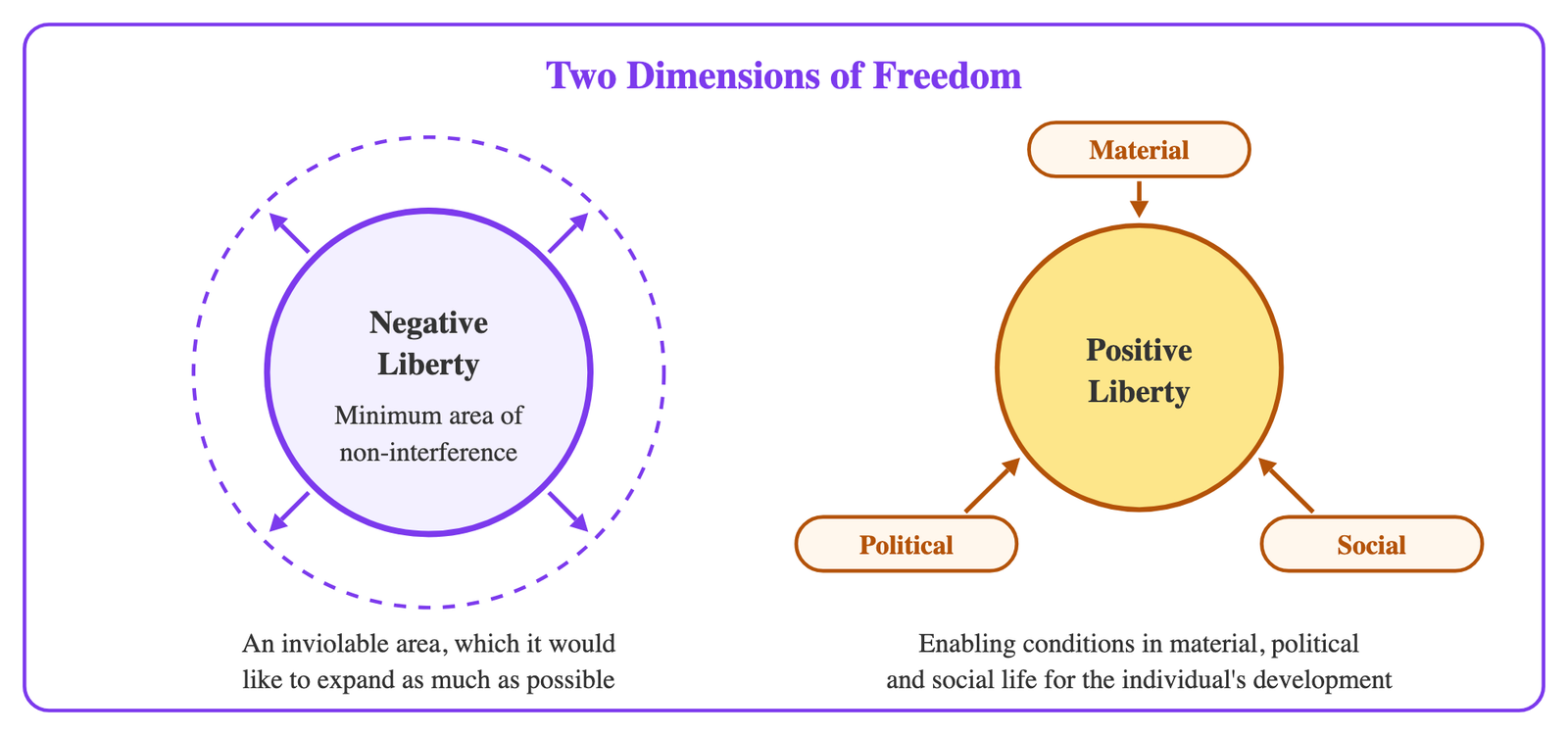
Positive liberty is concerned with improving the relationship between the individual and society so that there are fewer constraints on personal development. The individual is like a flower that blossoms when the soil is fertile, the sun is gentle, the water is adequate and the care is regular. This requires three kinds of enabling conditions: material (freedom from poverty and unemployment, adequate resources), political (the opportunity to participate in decision-making) and social (access to education and other opportunities). Positive liberty recognises that a person can be free only within society, not outside it, while negative liberty is concerned only with that minimum inviolable area and not with wider social conditions, though it would like to expand this minimum area as much as possible, keeping in mind the stability of society. The two usually go together and support each other, but tyrants can sometimes justify their rule by invoking arguments of positive liberty.
6 Freedom of Expression
Freedom of expression is considered part of the same minimum area of “non-interference” described under negative liberty. In his book On Liberty, J. S. Mill gave four strong reasons why freedom of expression should not be restricted, even for ideas that appear false or misleading today.
6.1 Mill’s Four Arguments
No idea is completely false
What appears false to us usually contains an element of truth. Banning a “false” idea also loses that element of truth.
Truth emerges from conflict of ideas
Truth does not emerge by itself. Ideas that seem wrong today may help the right kind of ideas to emerge.
This conflict has continuing value
It is valuable not just in the past but at all times; without being challenged, truth risks becoming an unthinking cliché.
We can never be fully certain
What we consider true today is not necessarily true. Many ideas once suppressed as false have later turned out to be true.
Demands to ban books, plays, films or research articles have come up at various times: filmmaker Deepa Mehta’s film on the plight of widows in Varanasi faced strong protest on the grounds that it would show India in a bad light, and it could not be made in Varanasi, though it was later made elsewhere. Similarly, Aubrey Menon’s Ramayana Retold and Salman Rushdie’s The Satanic Verses were banned after protest, as were the film The Last Temptation of Christ and the play Me Nathuram Boltey. Banning is an easy short-term solution but is harmful for the long-term prospects of freedom, because banning easily becomes a habit.
“I disapprove of what you say but I will defend to death your right to say it.”
Voltaire
In England, anyone employed by the Royal household is contractually constrained from writing about its inner affairs, even after leaving that employment. Is this an unjustifiable constraint on freedom of expression, or, because the person accepted this condition voluntarily, does it not count as a curtailment of freedom at all? This is a distinction worth remembering: when constraints are backed by organised social (religious or cultural) authority or by the might of the state, they restrict our freedom in ways that are difficult to fight against. But if we accept certain restrictions willingly, or for the sake of pursuing our goals or ambitions, our freedom is not similarly limited, as long as we are not coerced into accepting the conditions.
We began by saying that freedom is the absence of external constraints. We now realise that freedom really lies in our capacity to make choices, and when we make choices, we must also accept responsibility for our actions and their consequences. This is why most advocates of freedom hold that children must be placed in the care of parents: the capacity to make the right choices and shoulder responsibility for our actions has to be built through education and the cultivation of judgement, just as much as by limiting the authority of the state and society.
- Two dimensions of freedom: absence of external constraints, and expansion of opportunities for self-development
- Two sources of constraints: domination/external control, and social-economic inequality
- Harm Principle: no interference in self-regarding actions; interference in other-regarding actions only for serious harm
- Negative liberty = area of non-interference (“freedom from”), positive liberty = enabling conditions for development (“freedom to”)
- Mill’s four arguments for freedom of expression, and Voltaire’s famous statement
- Can I recall the Mandela and Aung San Suu Kyi examples separately, with their key details?
- Can I state both meanings of Swaraj along with the Tilak and Gandhi quotes?
- Is the difference between self-regarding and other-regarding actions clear to me?
- Can I explain negative and positive liberty with examples of each?
- Do I remember all four of Mill’s arguments for freedom of expression?